
Page 10 of 21
Hispanic Pioneers in Schools Teacher Corps and CSU-P Chicano Studies
Teacher Corps and CSU-P Chicano Studies (Video Clip) 2016 interview with George Autobee talking about how the teacher corps was involved with Chicano Studies classes at CSU Pueblo while working in the public schools in Pueblo.

May 11, 2019
Hispanic Pioneers in Schools
The Pueblo Chieftain article explaining the representation of Hispanic people in administration positions in School District 60 including Edmund Vallejo, the superintendent.

Edmund Vallejo named to the Board of Trustees of State Colleges, 1975
Dr. Edmund Vallejo, Asst. Superintendent of District 60, has been appointed to the Board of Trustees of State Colleges. He has a BA from Adams State, a master’s from UNC Greeley, and a Ph.D. from Kansas State University. He is active in several civic organizations, including Congress of Hispano Educators and Pueblo Diversified Industries.

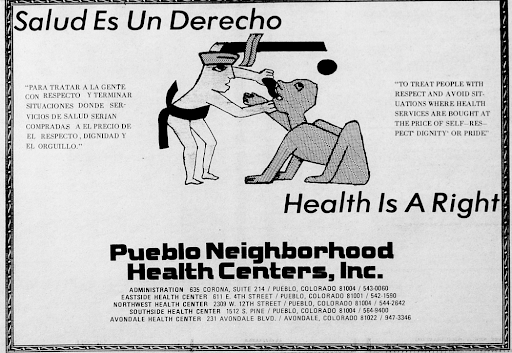
Advertisement for Equitable Health Services in Pueblo from La Cucaracha: “Salud Es Un Derecho”
Bilingual advertisement in 1976 raising awareness to the equity, respect, and dignity provided by Pueblo Neighborhood Health Centers
Carlos Solano as a soldier and poem to him, 1943
Photo and start of a long, sentimental poem in Spanish about Carlos, of Pueblo, who had just finished a week’s leave from the Navy and will now be going into Signal School

Spanish section of The CF&I Blast, 1933
Spanish-language page of the newspaper put out by Colorado Fuel & Iron for its employees. Ten years before there were few mentions of anyone with a Spanish name, much less a Spanish section.

1921 Flood After effects, Interview, 1980
1921 Flood After effects, Interview, 1980 (Audio Clip) Theodora Valles talks about the after effects of the 1921 flood which according to her caused people to be taken to different places in order to be sheltered. The red cross was involved. Many people seemed to have gotten sick from vaccines “shots”, they received. Additionally there was no electricity and homes were very damaged.
1921 Flood Description, Interview, 1980
1921 Flood Description, Interview, 1980 (Audio Clip) Theodora Valles talks about how she and others could hear people, horses and cows scream and be taken by the 1921 flood. It was caused by heavy rain which caused the river (or current) to create mass destruction. At the beginning, the flooding was very close to people’s homes and in fact had already reached many homes. It carried with it dead cows. Police were working to get people out of the flood and out of danger but many people tried to stay in their homes and protect their belongings. Many people were not successful.
Pueblo in 1919 and Italian Neighbors, Interview, 1980
Pueblo in 1919 and Italian Neighbors, Interview, 1980 (Audio Clip) In an interview, Theodora Valles and Tom Valles talk about their experience during the Great Depression and living in Pueblo. Here they talk about how Theodora, Toms mother, arrived to Pueblo and about her relationship with her Italian neighbors.
Girls Learning to Swim, 1948
A female swimming instructor with a whistle in her mouth instructs a group of girls in the Steel Company’s YMCA pool.

Page 10 of 21