



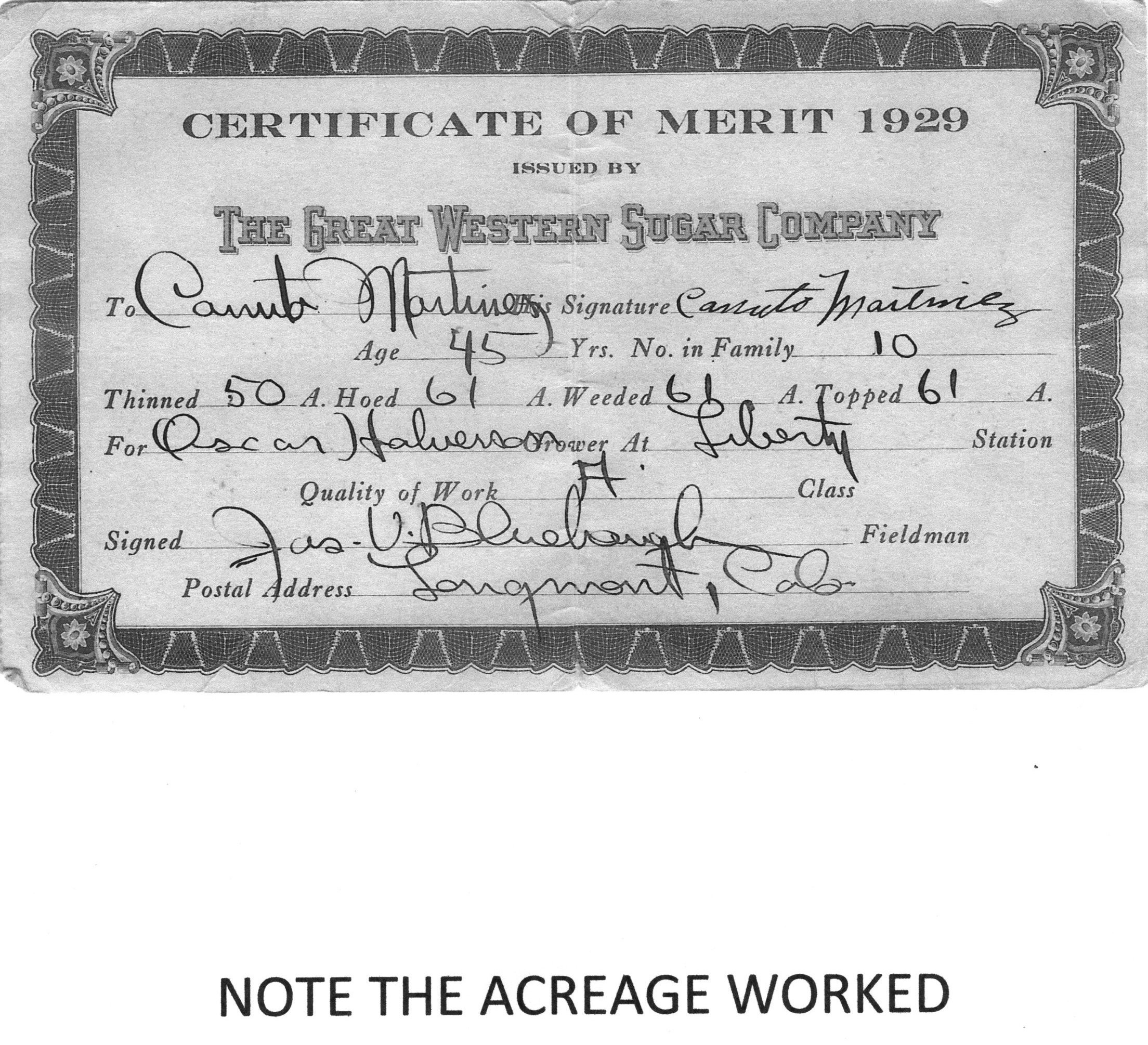
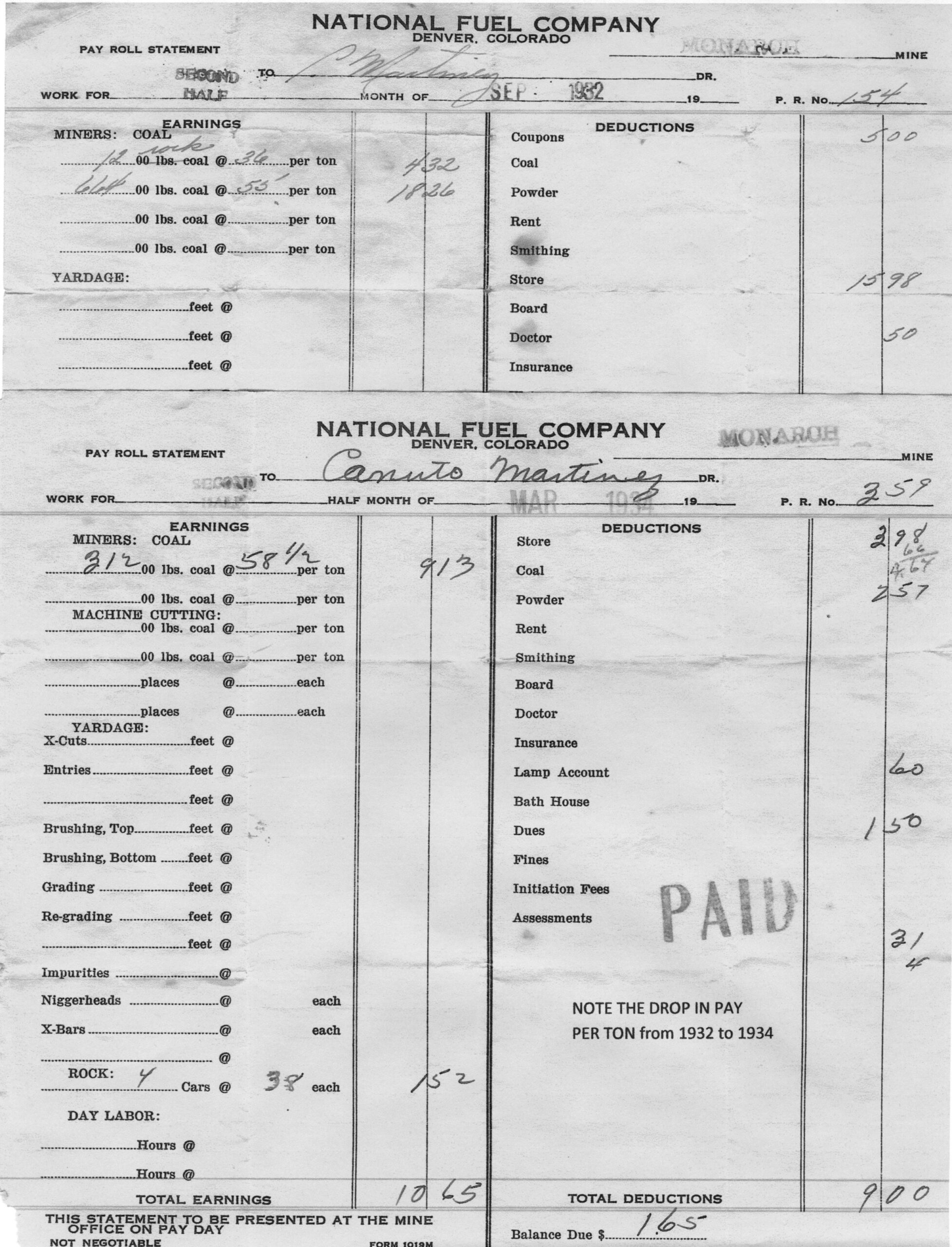
National Fuel Company, Denver, earnings and deductions, Monarch mine, 1932 and 1934
Esperanza Zarate2025-05-14T19:57:20+00:00


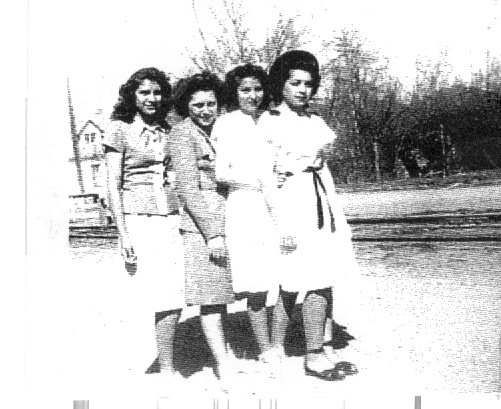
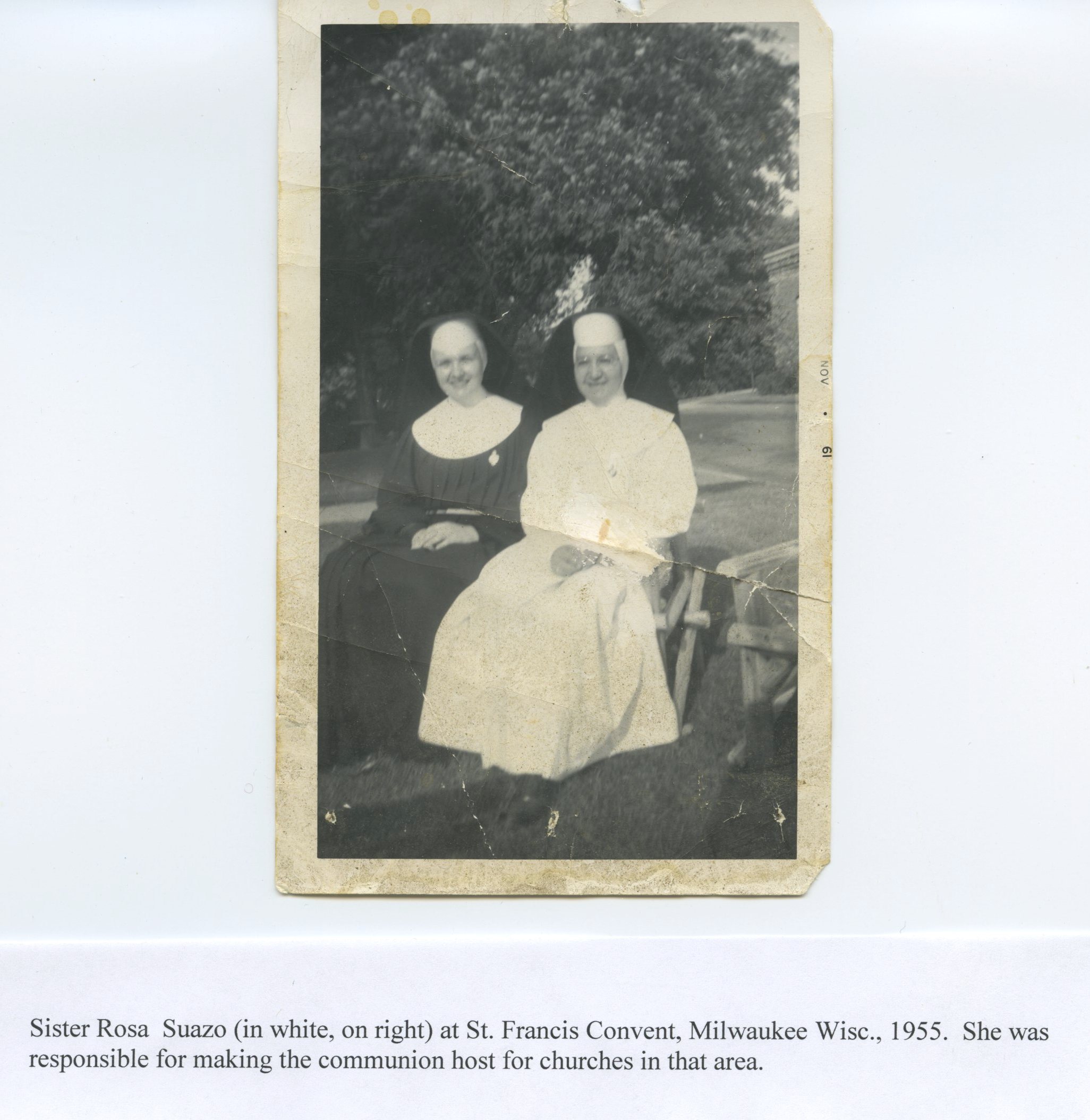 Sister Rosa Suazo (in white, on right) at St. Francis Convent, Milwaukee Wisc., 1955. She was responsible for making the communion host for churches in that area. Gallery
Sister Rosa Suazo (in white, on right) at St. Francis Convent, Milwaukee Wisc., 1955. She was responsible for making the communion host for churches in that area.















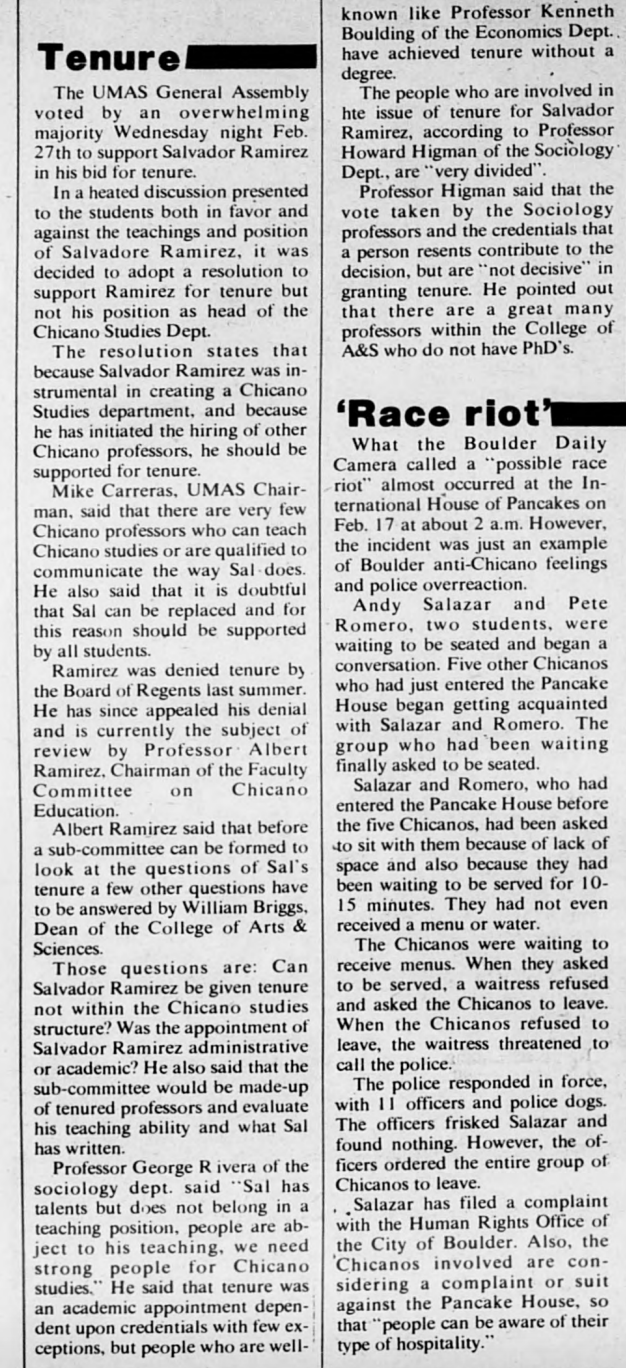


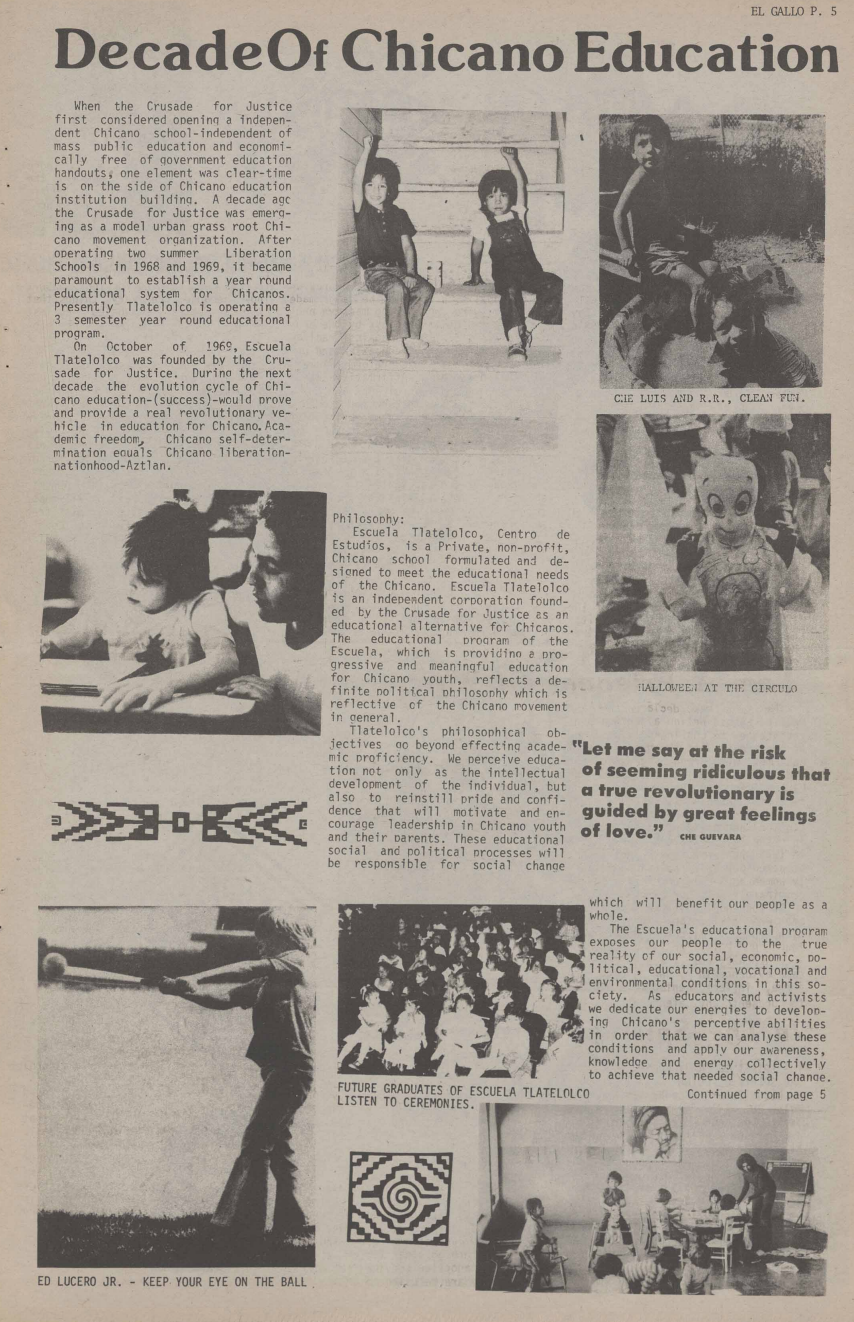
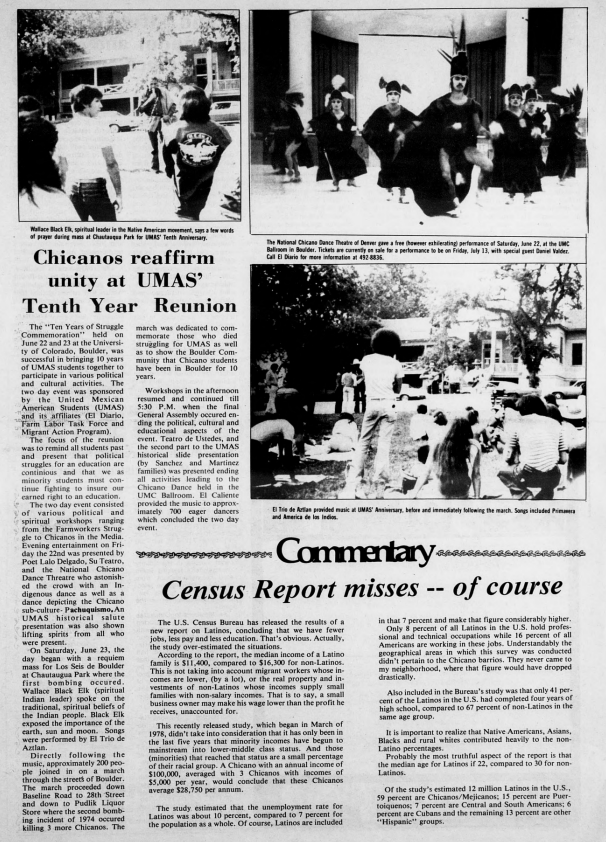


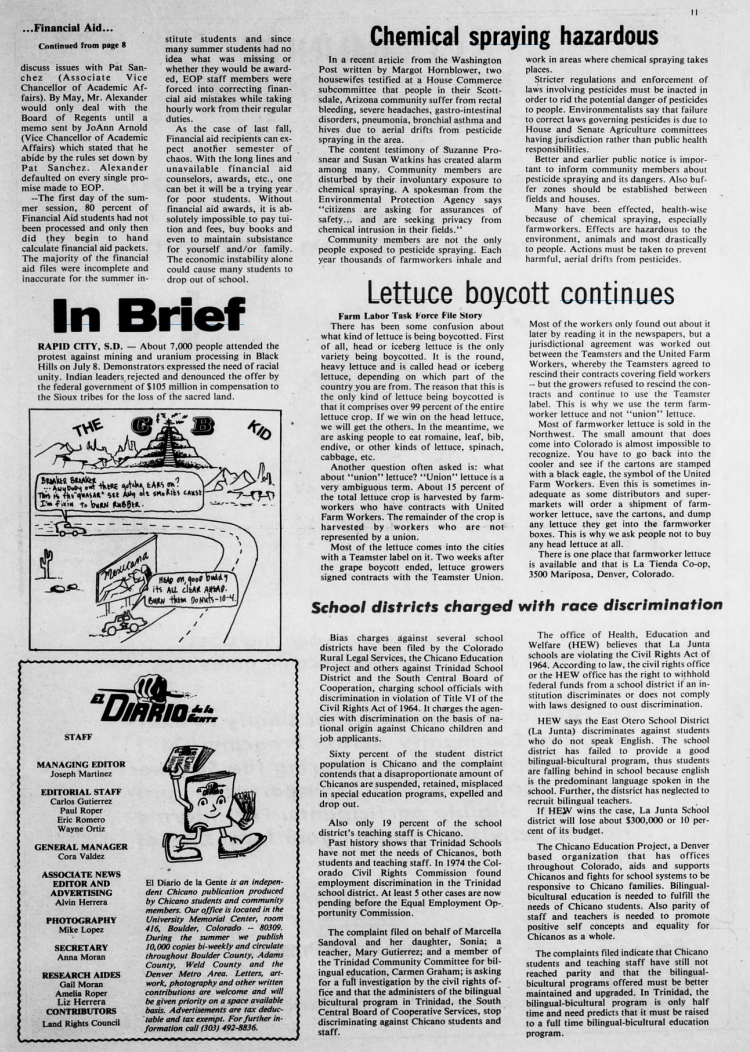



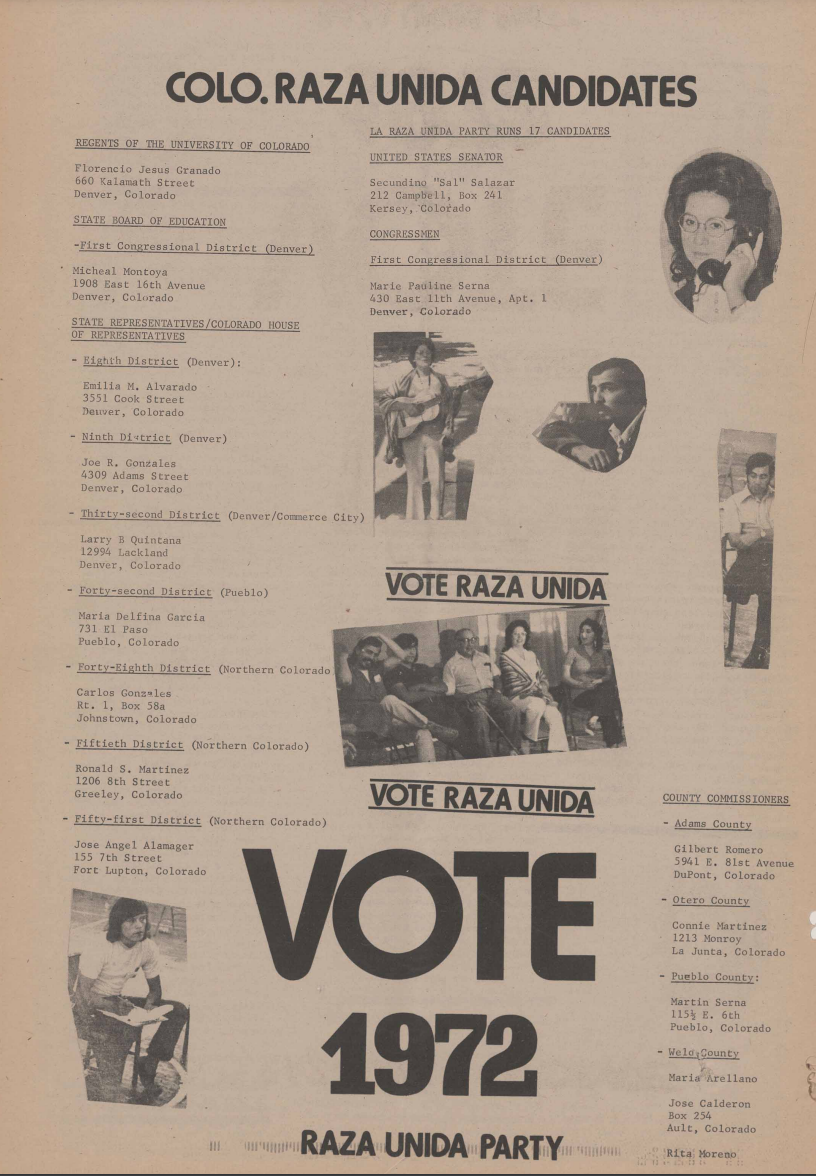
La Raza Unida Candidates
LHP_Intern2022-11-30T19:41:43+00:00El Gallo announces that La Raza Unida will run 17 candidates for Denver’s First Congressional District election.
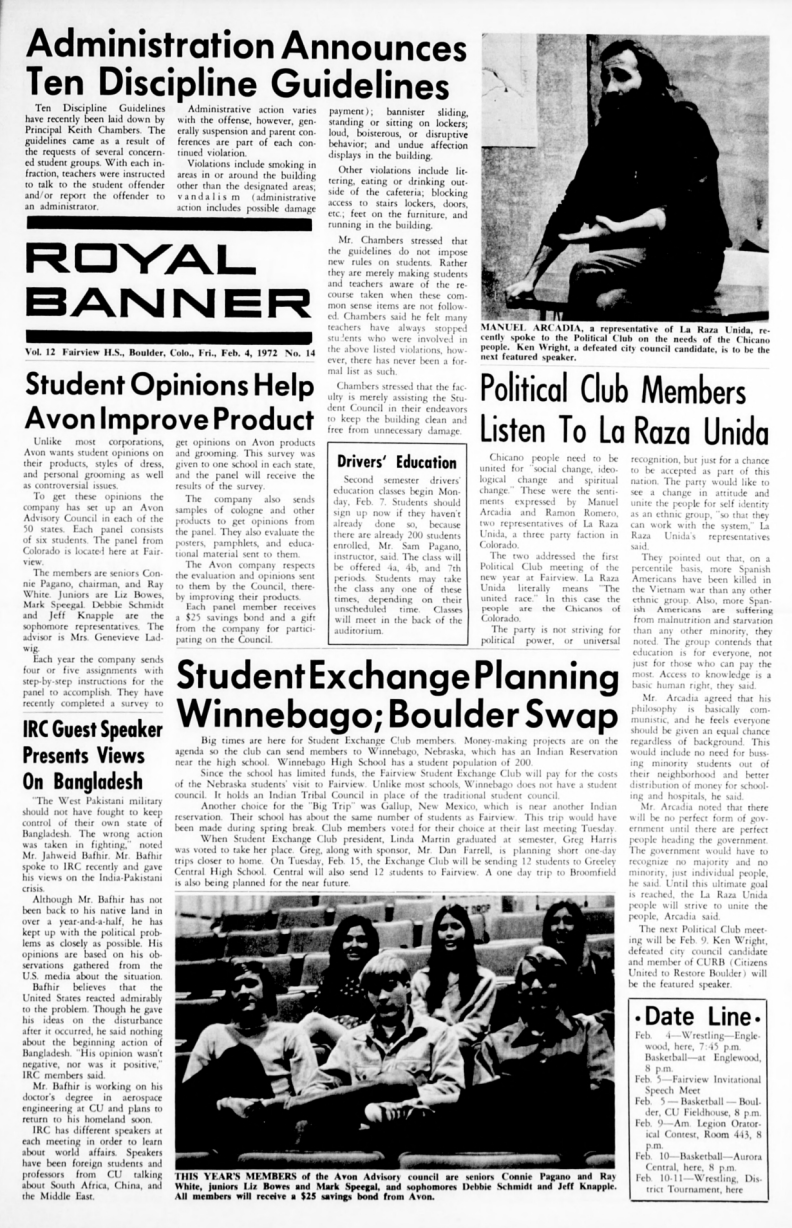
La Raza Unida Urges Chicano Community to Unify
LHP_Intern2022-11-30T19:14:46+00:00A few of La Raza Unida’s representatives urge the Chicano people to unify for a systematic change in the US. Some beliefs are expressed on why unifying should be prioritized.
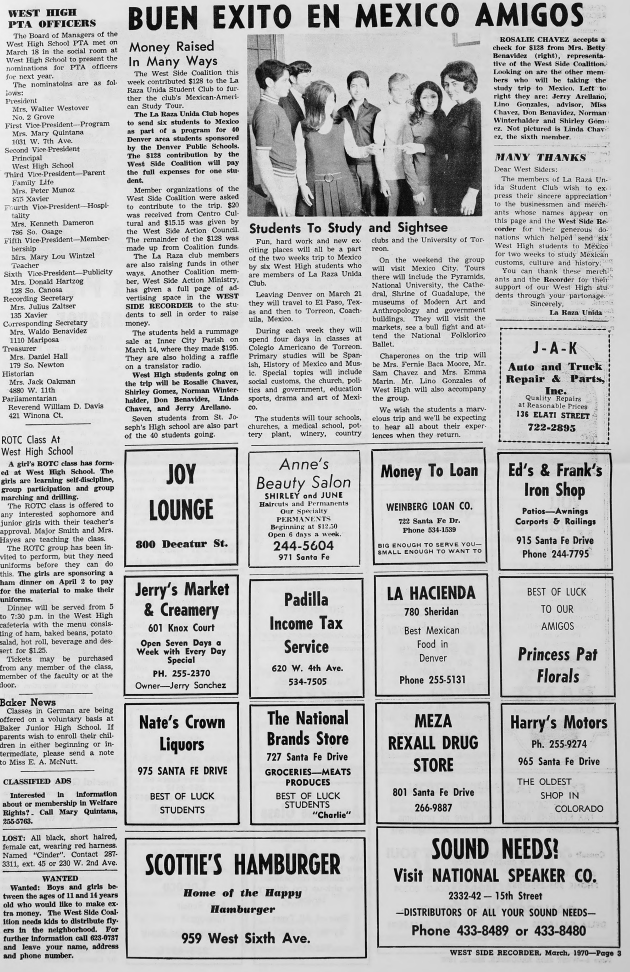
La Raza Unida Student Club Give Thanks
LHP_Intern2022-11-30T00:34:20+00:00La Raza Unida Student Club thanks for the generous donations and efforts to send six West High students to Mexico.
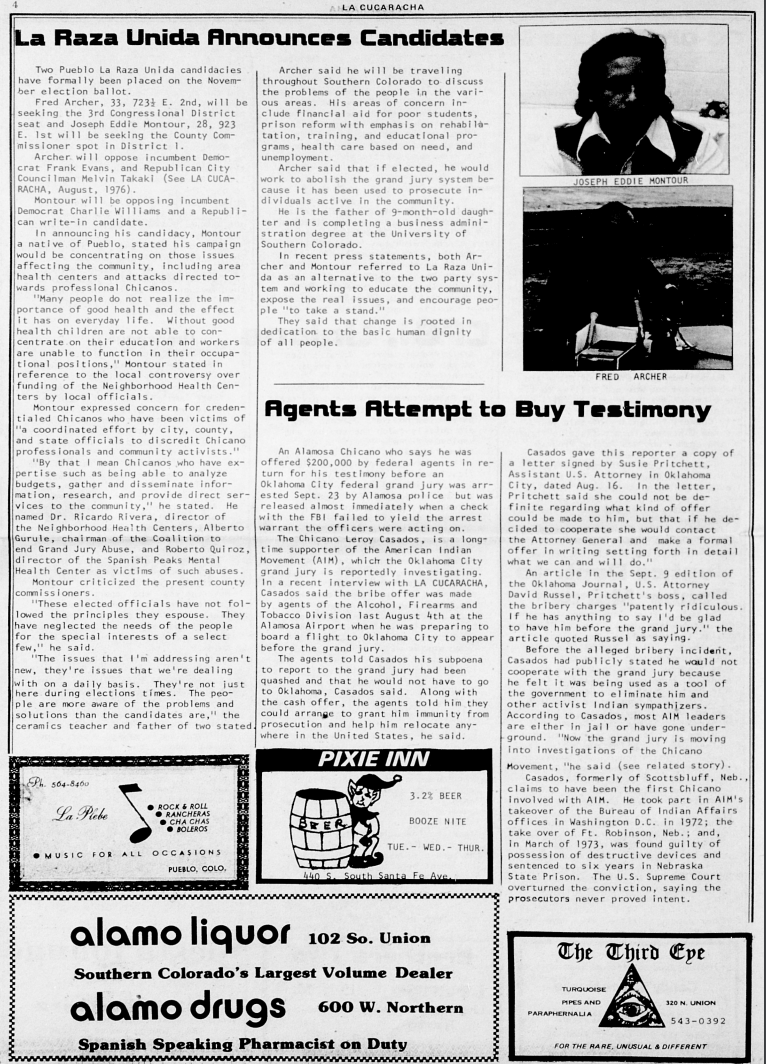
La Raza Unida Announces Candidates
LHP_Intern2022-11-30T00:17:40+00:00La Cucaracha announces La Raza Unida candidates. The article goes into detail about Fred Archer and Joseph Eddie Montour and their political agendas.
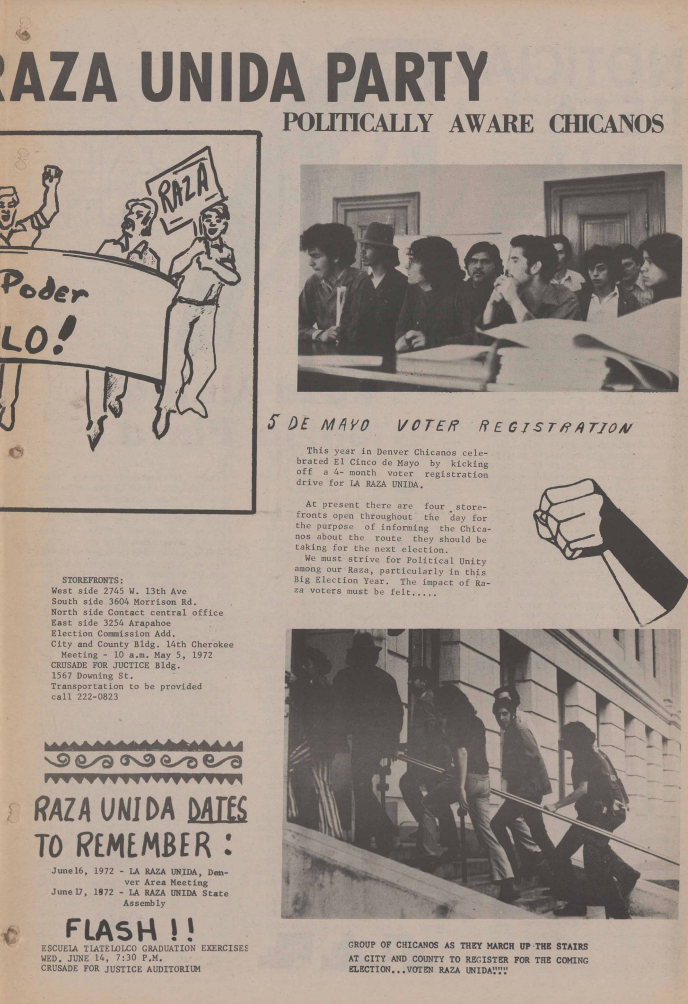
Voter Registration and Upcoming Elections For La Raza Unida
LHP_Intern2022-11-29T23:58:24+00:00El Gallo reminding Chicanos about upcoming La Raza Unida elections and dates.

The Story of Brown Berets
LHP_Intern2022-11-08T23:59:49+00:00El Gallo explains the story of the Brown Berets and the personal story of one of its founders, David Sanchez.

Acquittal of Carlos Montes
LHP_Intern2022-11-08T20:56:26+00:00La Cucaracha celebrates the Brown Berets’ Leader, Carlos Montes, acquittal after ten years of being accused of arson.

The Chicano Fight Against the KKK
LHP_Intern2022-11-08T20:41:08+00:00La Cucaracha announces the Brown Berets’ efforts in fighting the KKK and their patrol of the Mexican-American border.
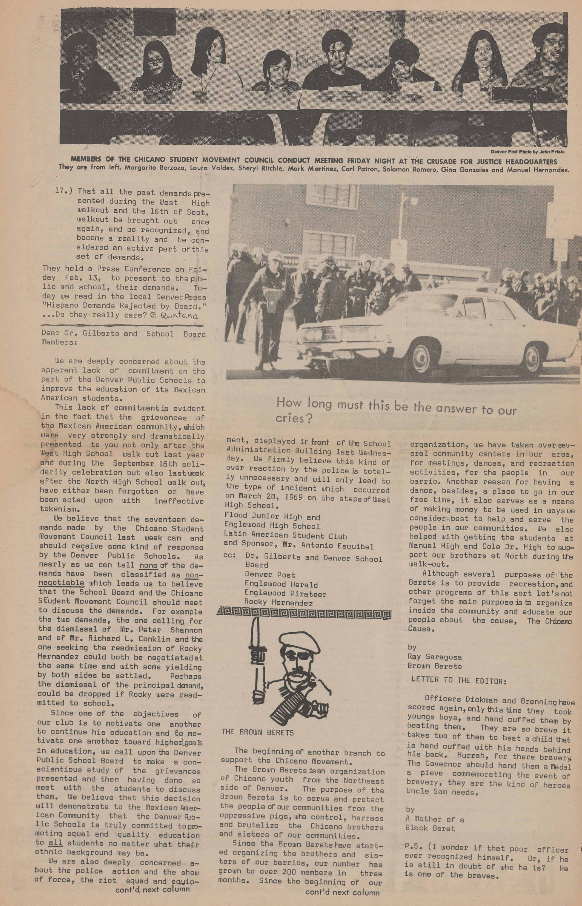
The Chicano Causa: The Brown Berets
LHP_Intern2022-11-07T21:51:03+00:00A newspaper entry explaining who the Brown Berets are and their mission. The entry includes a short history of the Brown Berets, their achievements, and their goals.
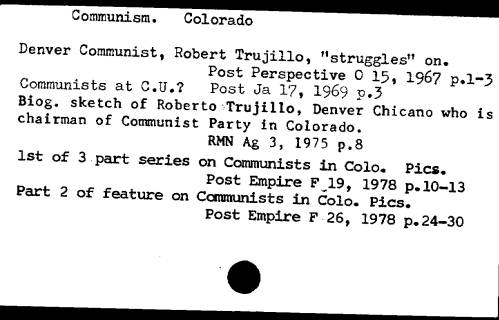
Denver Communist Party Contact
LHP_Intern2023-06-01T15:49:34+00:00A transcription specifying that Robert Trujillo is the chairman of Colorado’s Communist Party.
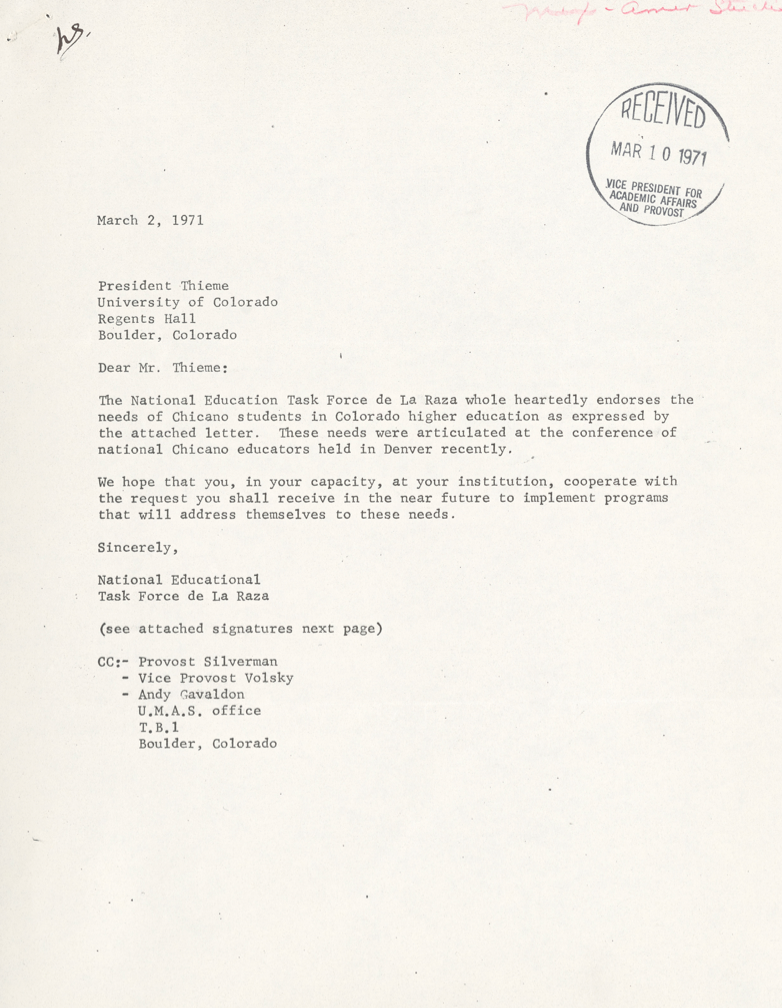
Task Force De La Raza
LHP_Intern2022-10-27T22:01:13+00:00A letter in which the Task Force de La Raza ask the University of Colorado Boulder’s president for the university’s cooperation in helping Chicano students in higher education.

Viva La Raza!
LHP_Intern2023-06-01T15:48:40+00:00An article where UMAS and MAP students announce an upcoming rally and march against police brutality. The march is in honor of a Chicano student who was unjustly arrested and maced by police officers.
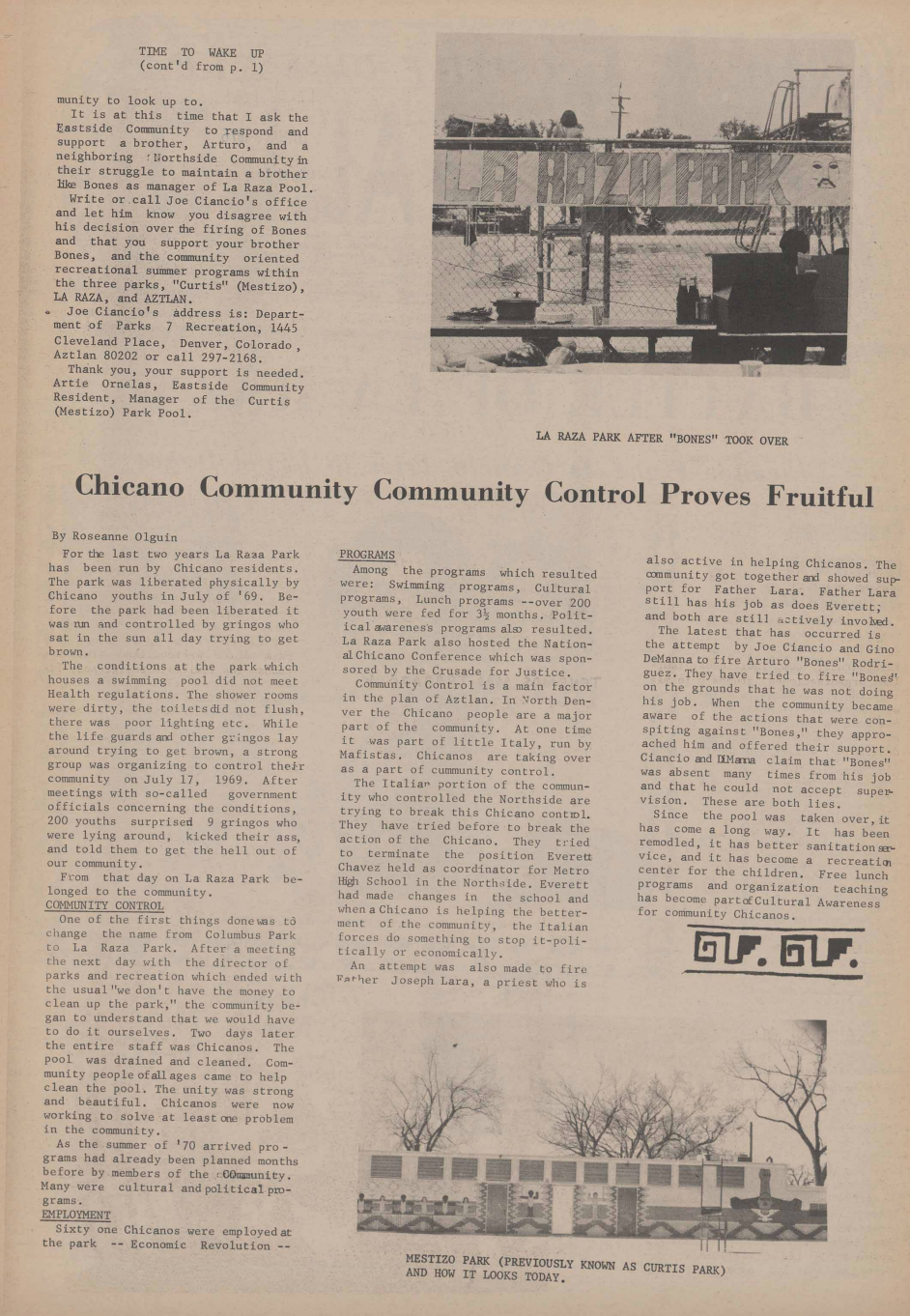
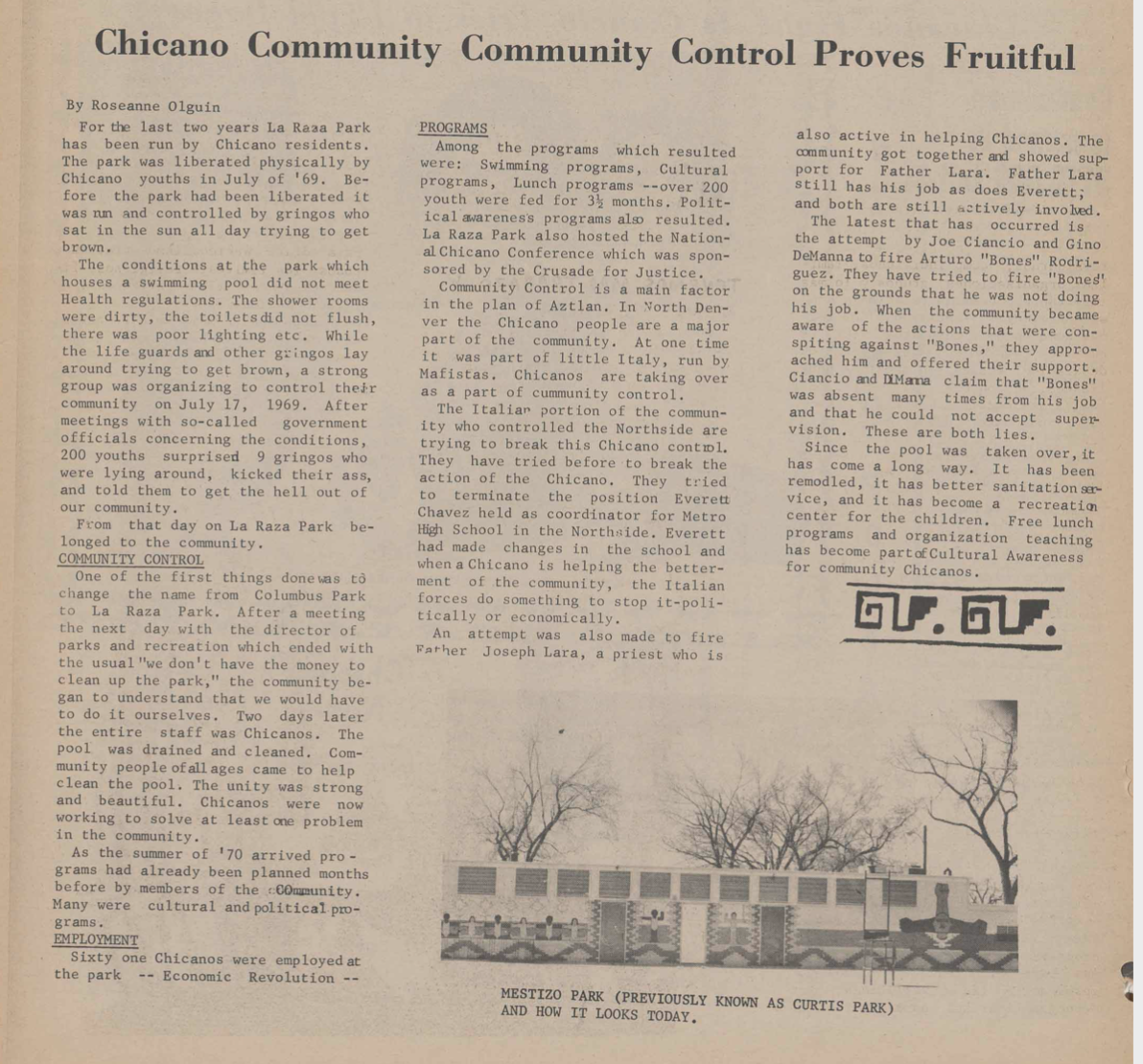
La Raza Park Pool
LHP_Intern2022-10-19T20:50:49+00:00A history of La Raza’s community pool, the Chicano community effort to preserve the pool, and the fight to keep Arturo “Bones” Rodriguez as the pool’s manager.

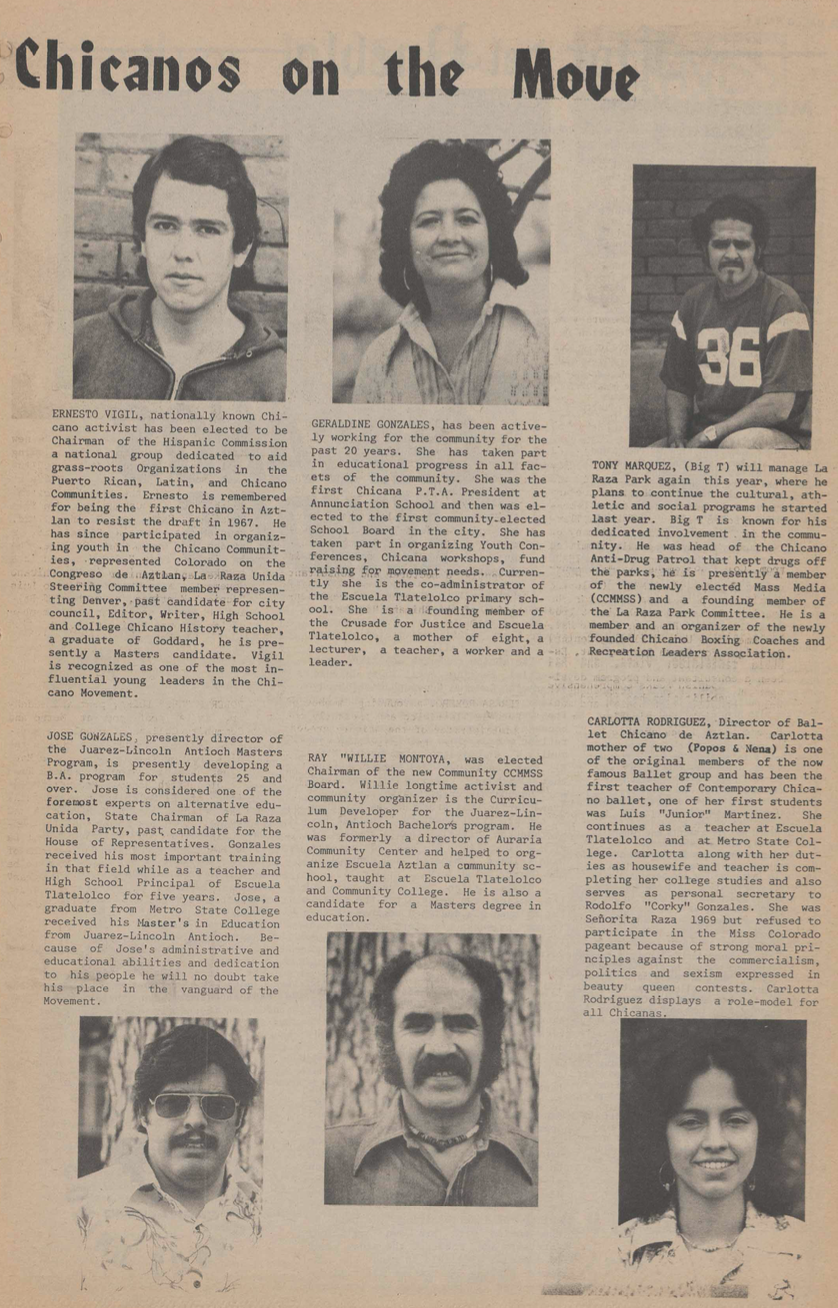
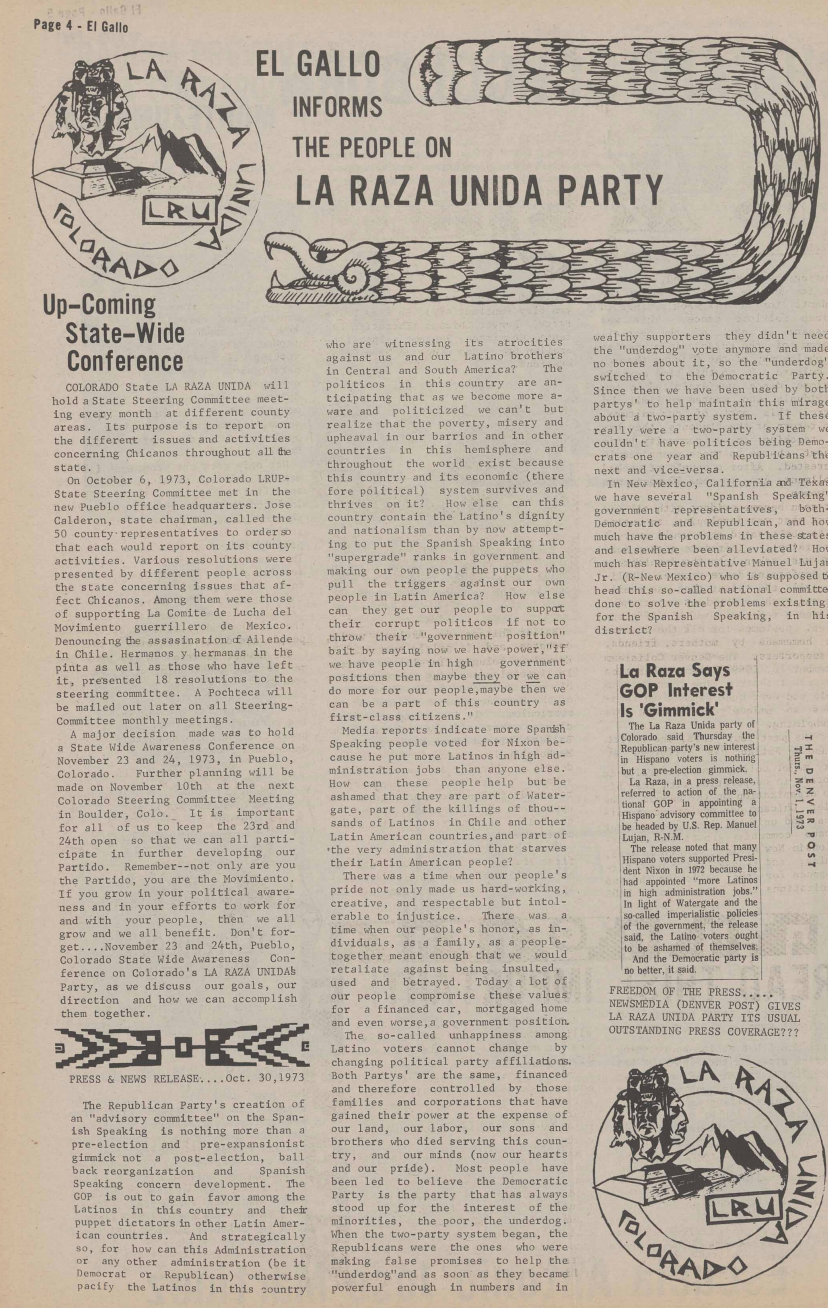
La Raza Unida Candidates
LHP_Intern2022-10-18T22:23:24+00:00An explanation of the Chicano political party: La Raza Unida. Listed in the article are reasons for the party’s existence, key figures within the party, future candidates, and political events hosted by the party, including La Raza Unida’s state conventions.

La Raza Unida and Fighting the Aztlan Myth
LHP_Intern2022-10-18T21:54:53+00:00A newspaper article explaining the need for La Raza Unida and why Aztlan must change from a myth to a reality.
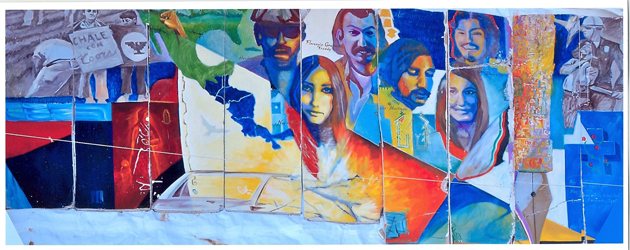
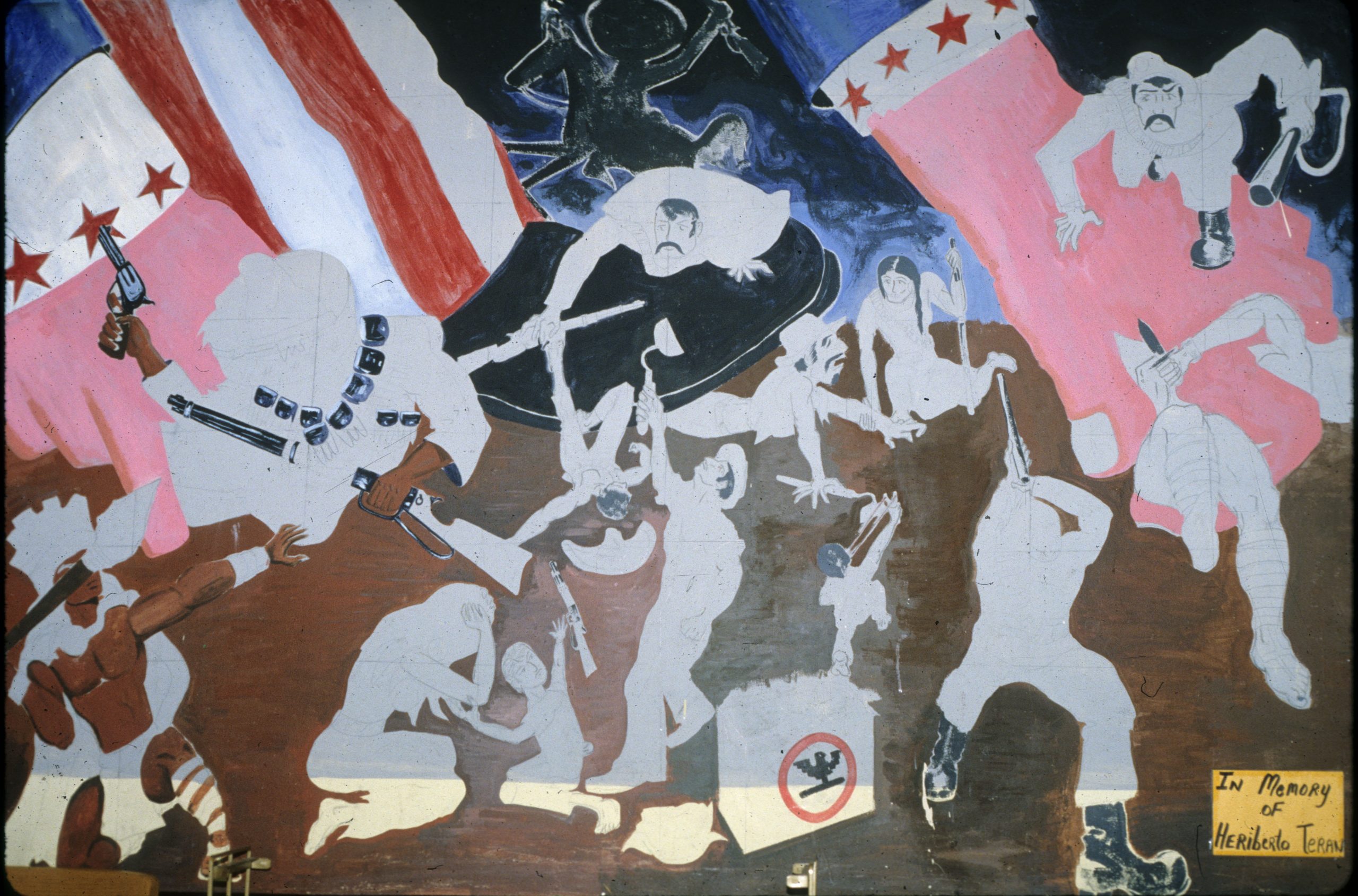
Los Seis de Boulder Mural
jason2023-02-02T15:30:48+00:00A mural created by artist Pedro Romero in 1989 commemorating Los Seis de Boulder. Originally painted on the walls of the University Memorial Center, now housed in a conference room at Pueblo Community College
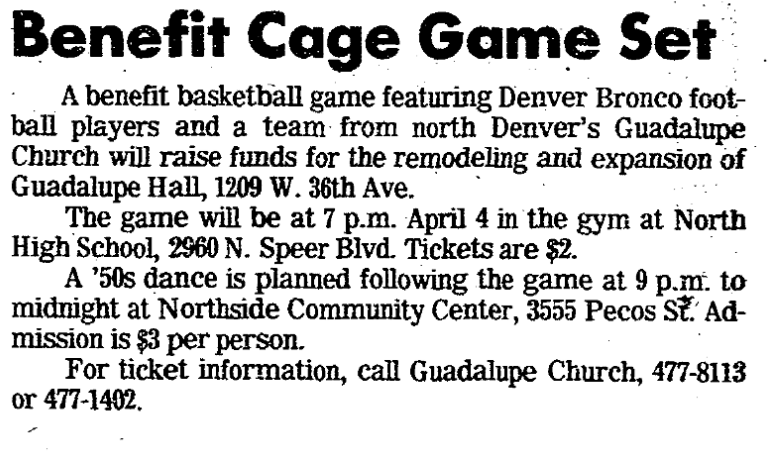
“Benefit Cage Game Set”, 1981
LHP_Intern2022-05-23T19:01:29+00:00“A benefit game played between Broncos football players and Guadalupe Church team to raise money for expansion of Guadalupe. A dance was held after at the Northside Community Center”, Denver, 3-25-1981
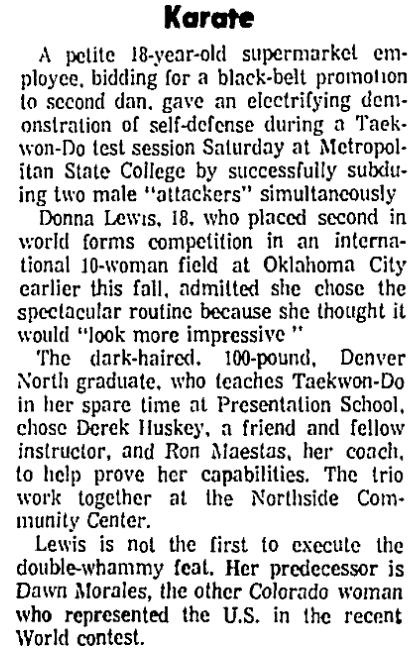
“Recreation Sports Roundup- Karate”, 1978
LHP_Intern2022-05-23T19:01:11+00:00“Donna Lewis works to get her black belt; her Derek Husky, and Ron Maestas trained at the Northside Community Center.”, Denver, 12-5-1978
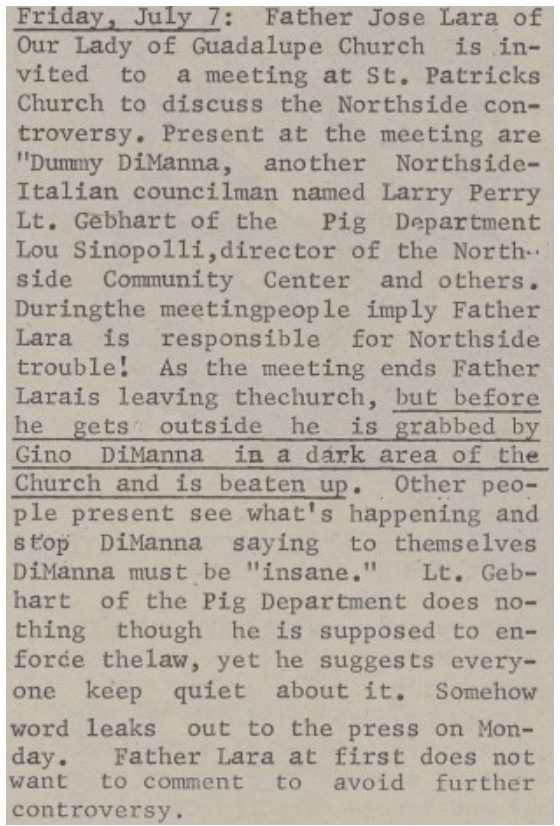
“Chicano Community Control”, 1972
LHP_Intern2022-05-23T19:00:36+00:00“A meeting was held July 7th 1972 pertaining to La Raza, and the director of the Northside Community Center was one of the main people in this meeting”, Denver, 8-1-1972
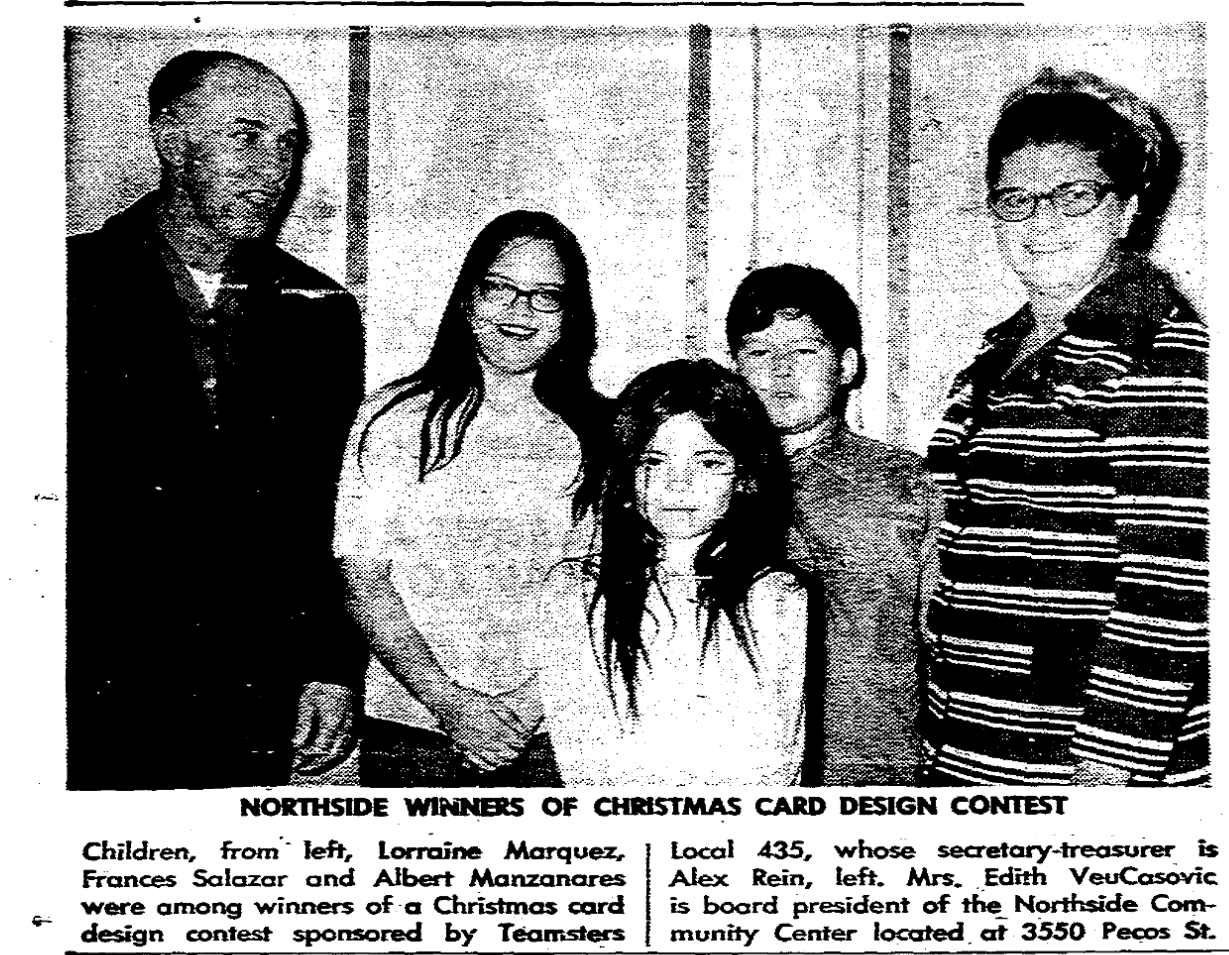
“Northside Winners of Christmas Card Design Contest”, 1971
LHP_Intern2022-05-23T19:00:15+00:00“Winners of a Christmas card design contest pose with the board president of the Northside Community Center”, Denver, 11-25-1971
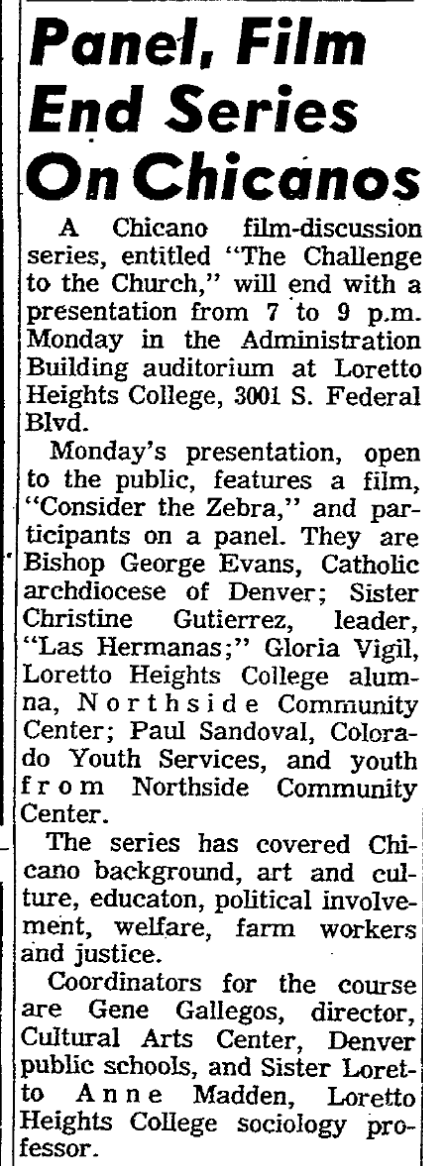
“Panel, Film End Series on Chicanos”, 1972
LHP_Intern2022-05-23T18:59:50+00:00An article on film series presentations, This film presentation Northside Community Center youth and Paul Sandoval present, Denver, 3-18-1972
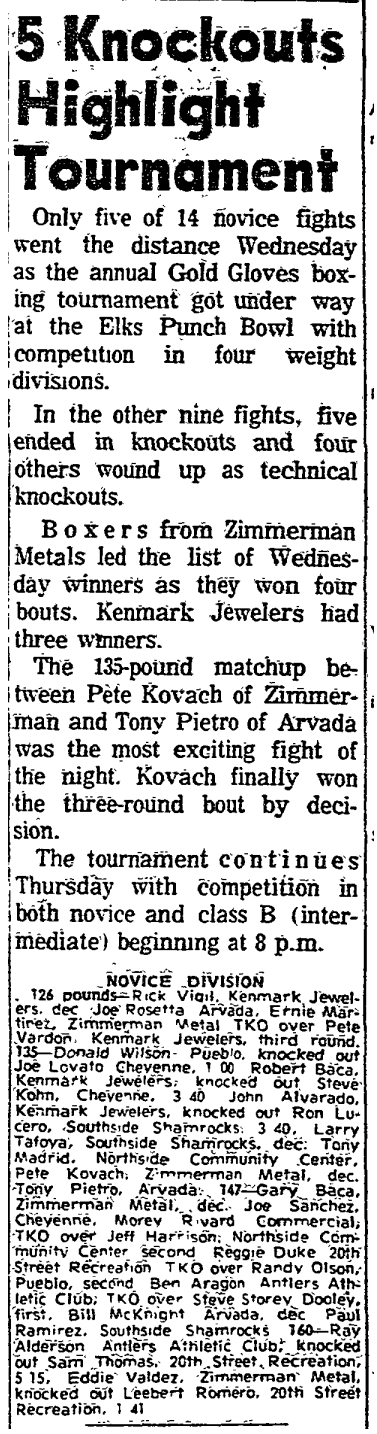
“5 Knockouts Highlight Tournament”, 1973
LHP_Intern2022-05-23T18:59:24+00:00An article highlighting boxing tournaments in the novice division, two fighters hail from the Northside Community Center, Denver, 2-22-1973
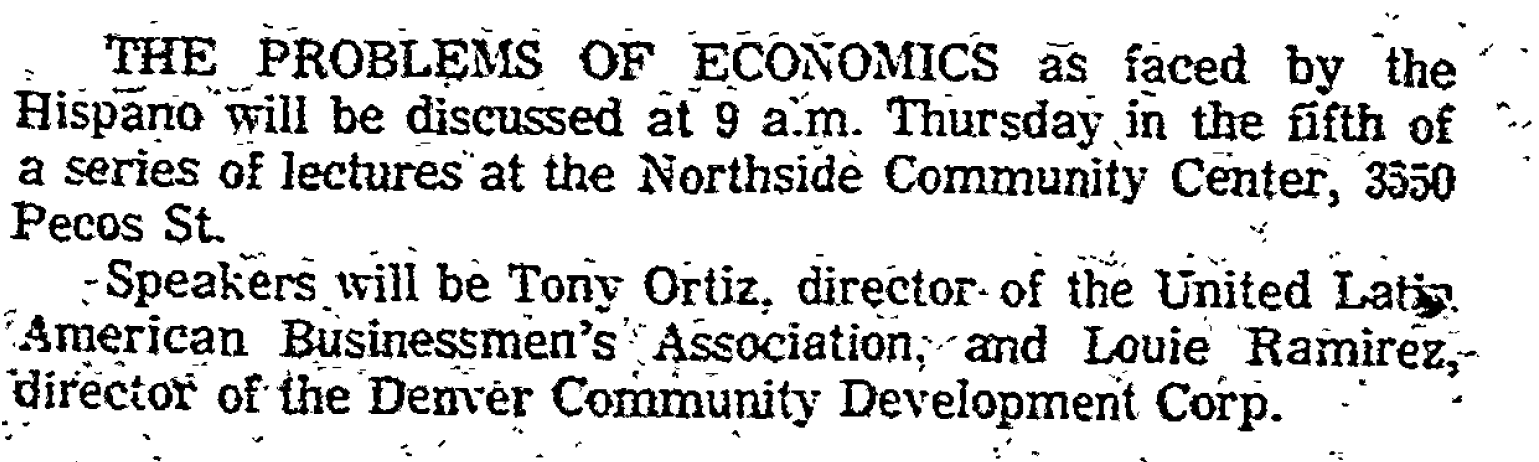
“The Problem of Economics”, 1971
LHP_Intern2022-05-23T18:59:02+00:00An article on classes that will be taught at the Northside Community Center, A specific one on economic problems for Hispanos led by Toni Ortiz and Louie Ramirez, By Barbara Tramutt, Denver, 3-10-1971
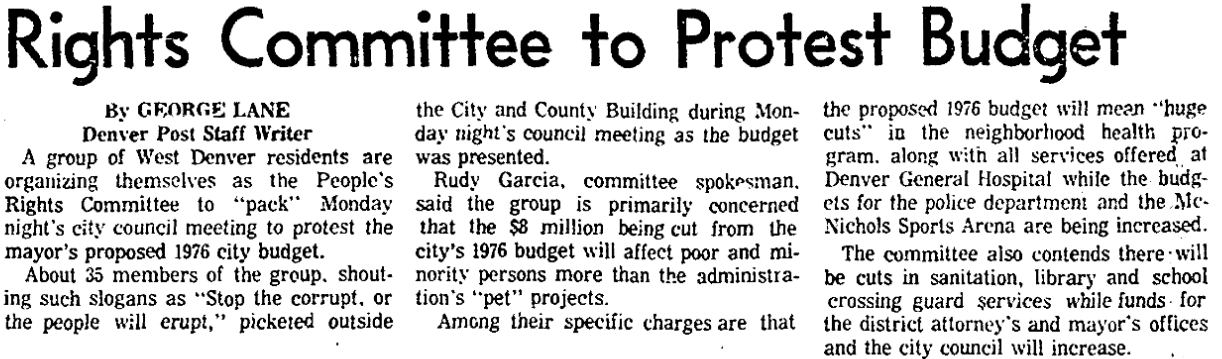
“Rights Comittee to Protest Budget”, 1975
LHP_Intern2022-05-23T18:58:30+00:00An article on a group of people protesting the city budget, Rudy Garcia being part of it and will hold a meeting at Northside Community Center, By George Lane, Denver, 10-21-1975
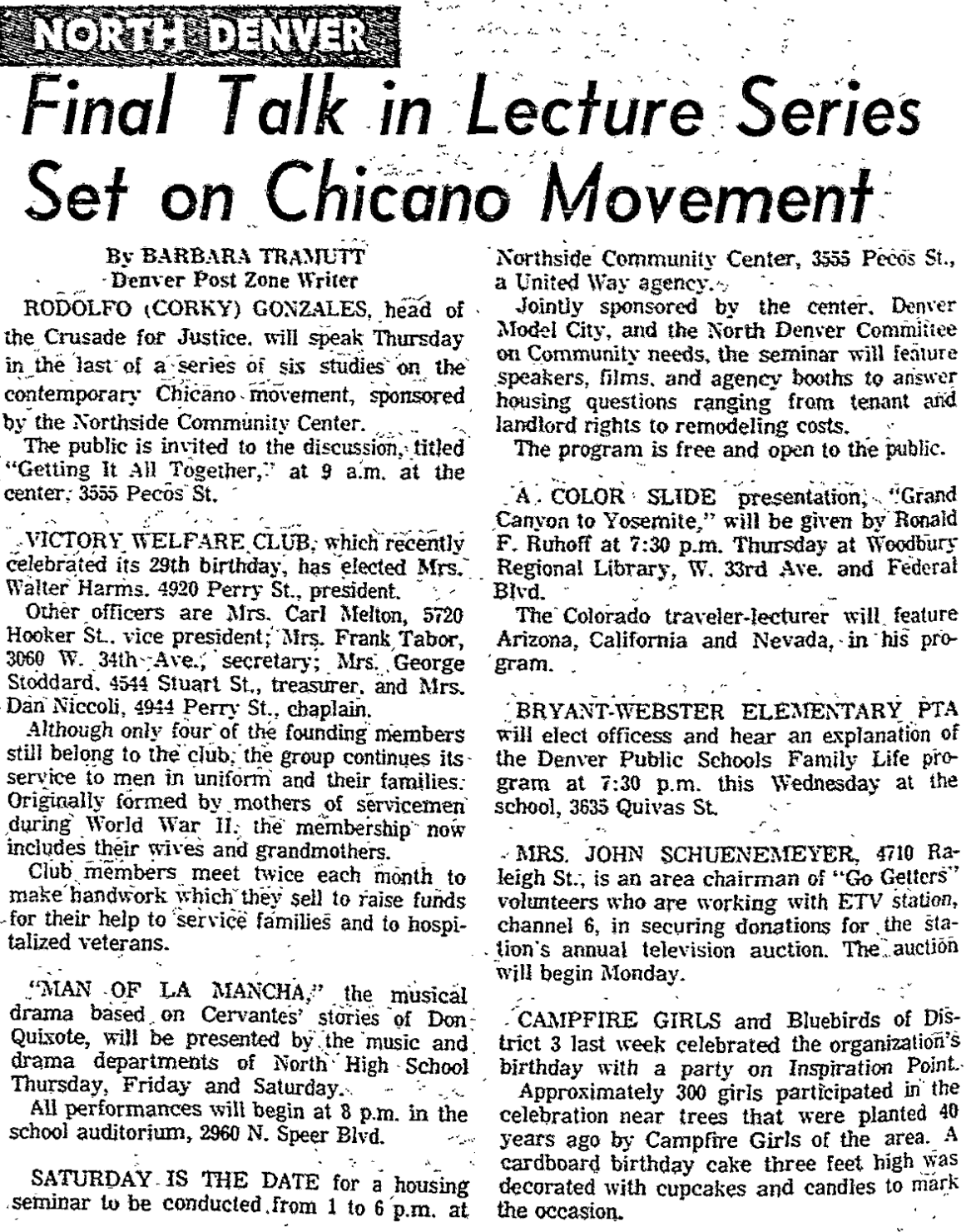
“Final Talk in Lecture Series Set on Chicano Movement”, 1971
LHP_Intern2022-05-23T18:58:12+00:00An article talking about the different class availabilities, the first being the last lecture taught by Rodolfo (Corky) Gonzalez about the contemporary Chicano movement at the Northside Community Center, By Barbara Tramutt, 3-24-1971
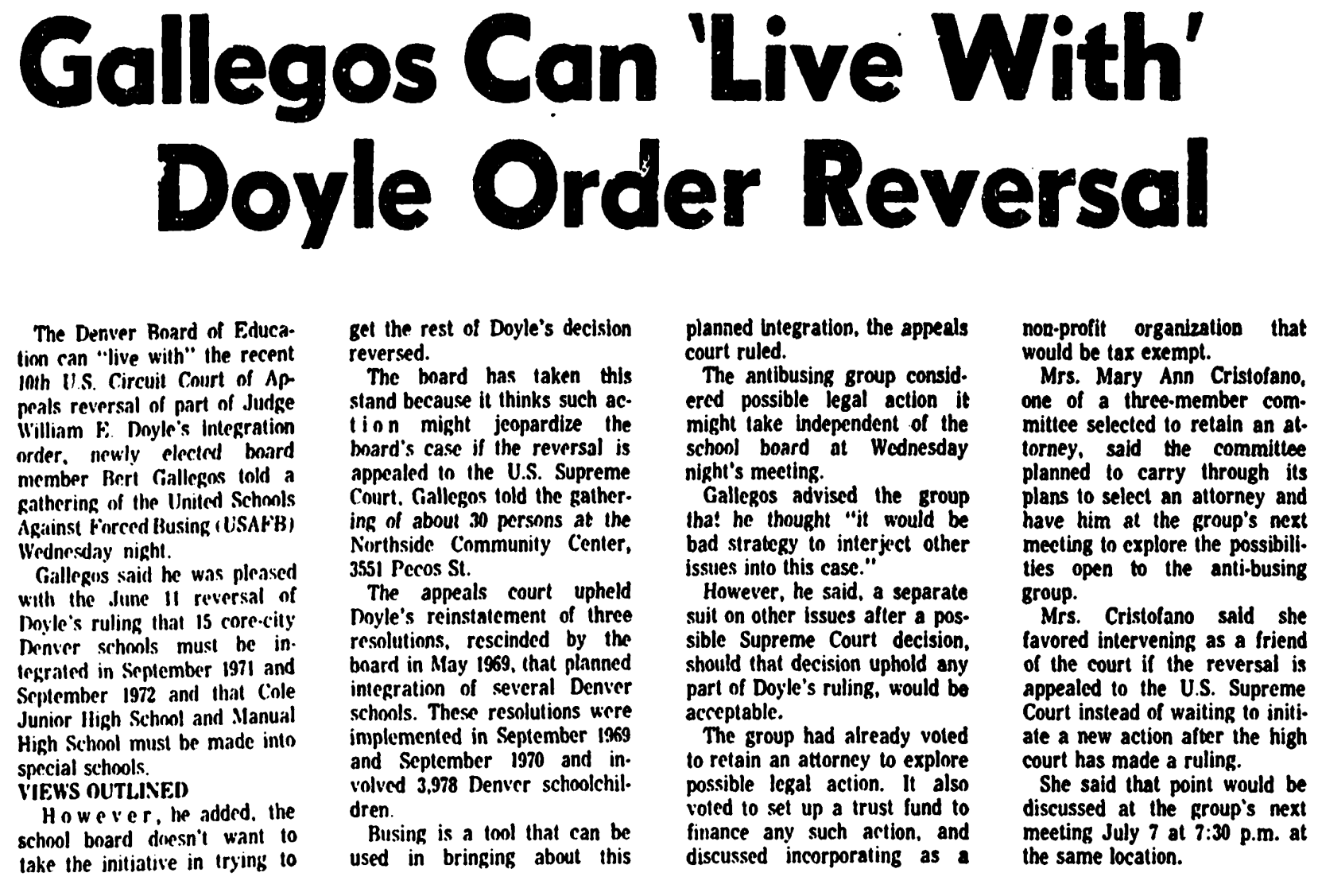
“Gallegos can ‘Live With’ Doyle Order Reversal”, 1971
LHP_Intern2022-05-23T18:57:55+00:00An article on a meeting about busing and integration held at the Northside Community Center, Denver, 6-24-1971
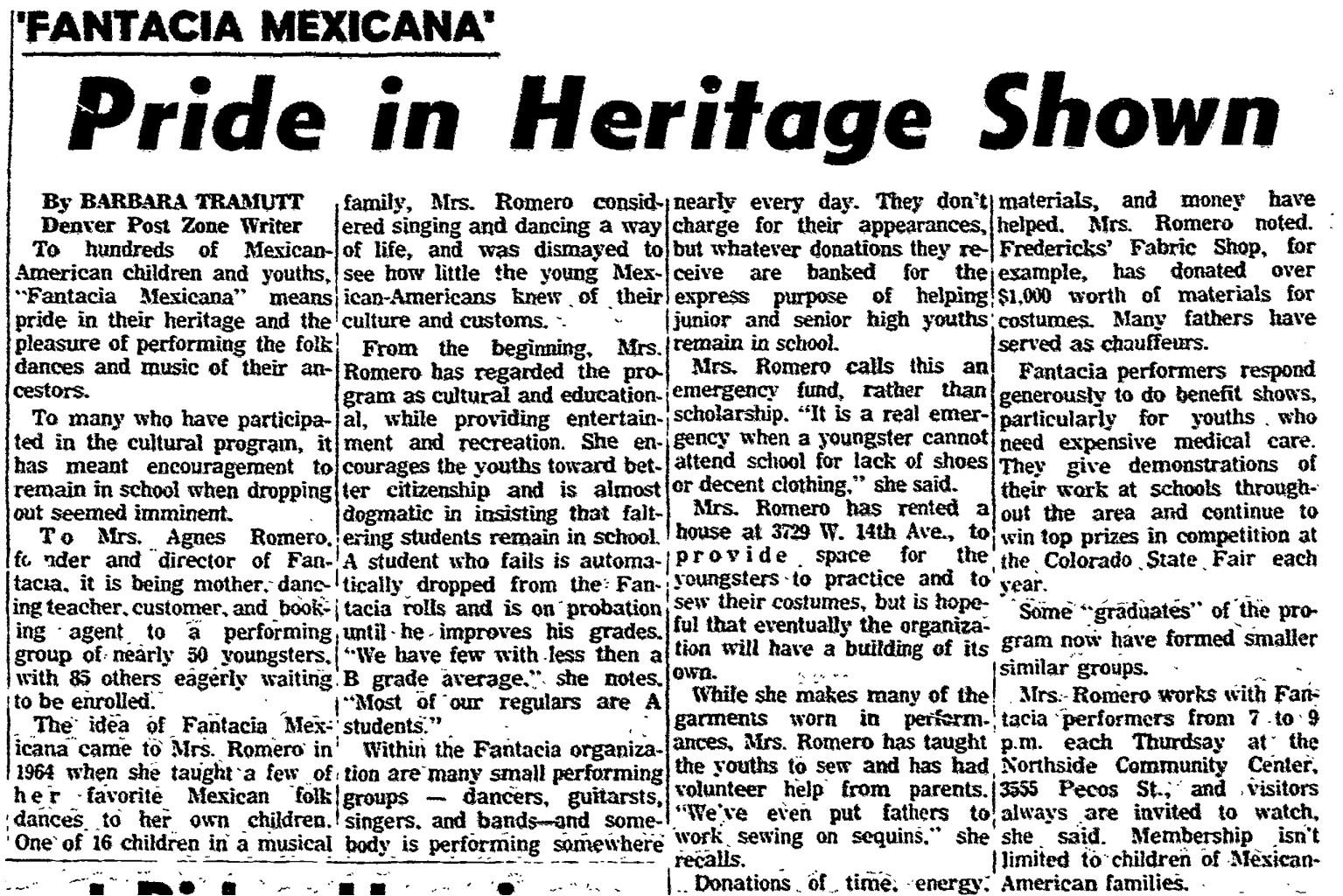
“Fantasia Mexicana, Pride in Heritage Shown”, 1971
LHP_Intern2022-05-23T18:57:41+00:00An article talking about Fantasia Mexicana and its origins as well as its current location at Northside Community Center, By Barbara Tramutt, Denver, 3-3-1971
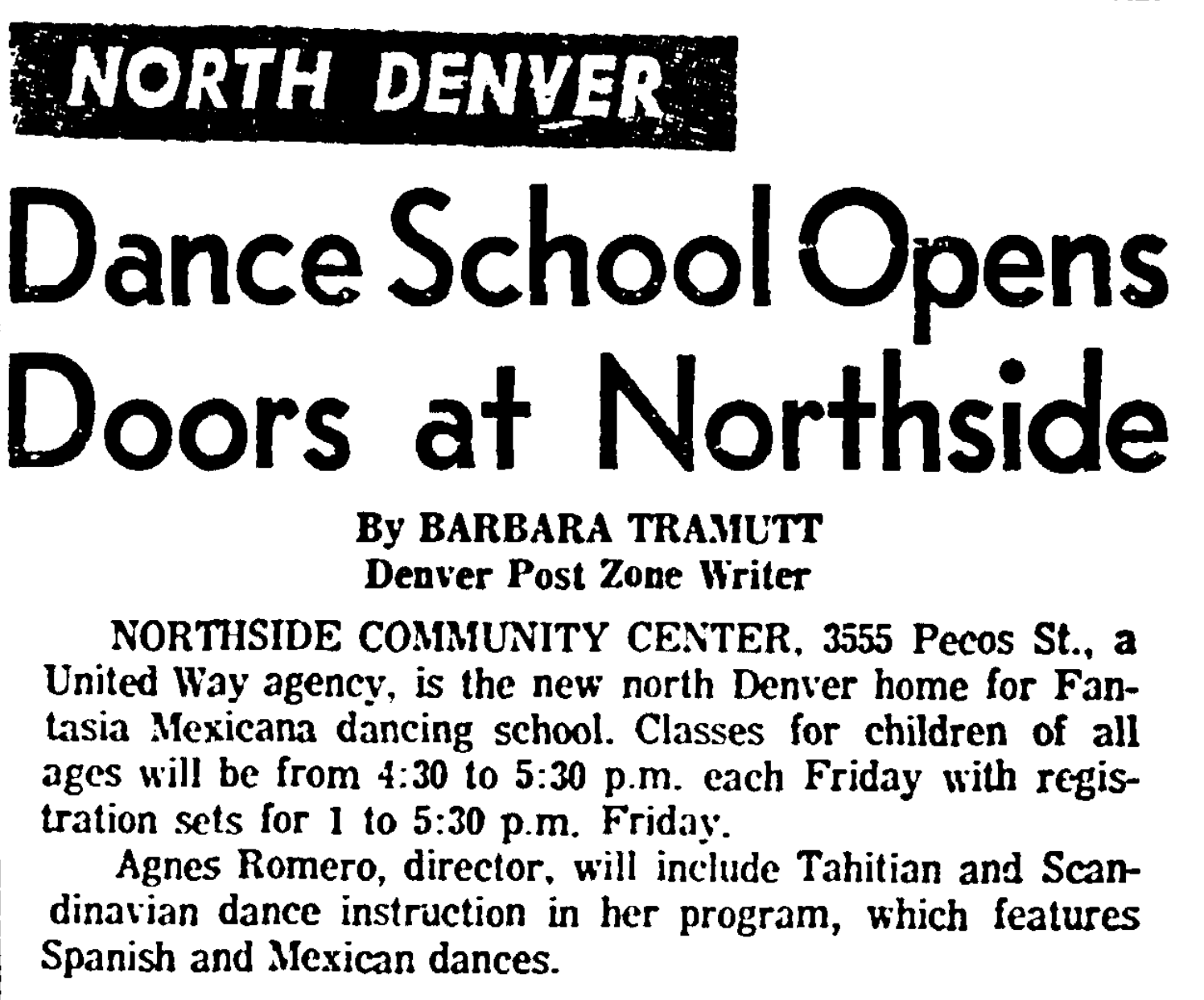
“Dance School Opens Doors at Northside”, 1970
LHP_Intern2022-05-23T18:57:24+00:00An article announcing that the new home for the Fantasia Mexicana Dance School will now be at the Northside Community Center, By Barbara Tramutt, Denver, 11-4-1970

Commendation to Ignacita and Eusebio Vigil from President Harry Truman
LHP_Intern2022-05-18T20:24:37+00:00Posthumously, Max was awarded a Purple Heart and a Presidential Unit Citation.
Phil Vigil acknowledges recognition to Ron Vigil, Valerie E. Ryan and the Department of the Army for their support in obtaining information for closure to our beloved Max Vigil from Sarcillo, Las Animas County, Colorado.
In 2021, Valerie E. Ryan, the granddaughter of Joe Vigil, brother of Max Vigil, has been invited to participate in a DNA search for any of Private Max Vigil’s remains. As of July, 2021 the DNA search is active.
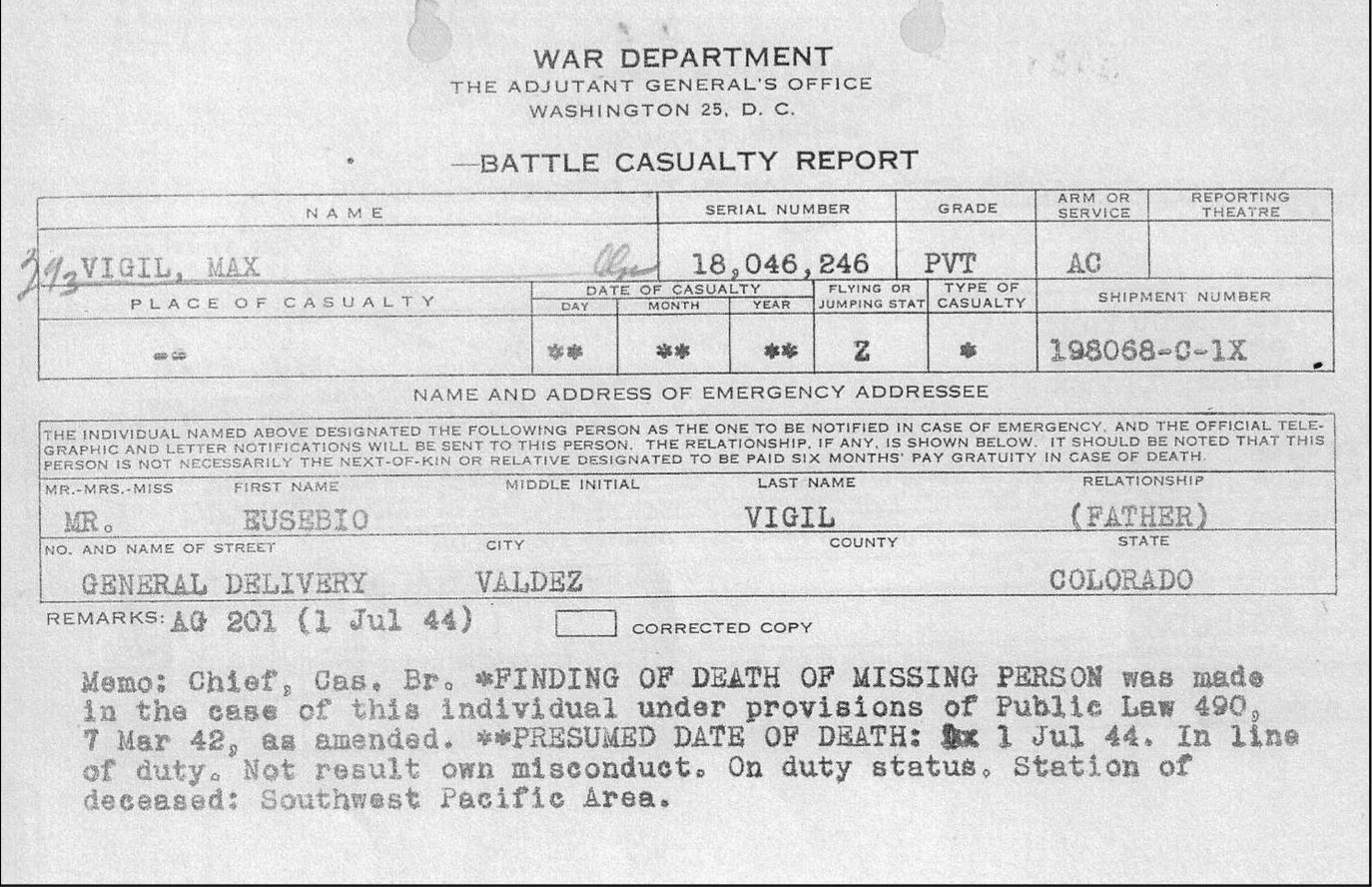 A letter from the World War II Memorial Division assigned to investigate the locations of military personnel “Missing in Action or Killed in Action” Gallery
A letter from the World War II Memorial Division assigned to investigate the locations of military personnel “Missing in Action or Killed in Action”
A letter from the World War II Memorial Division assigned to investigate the locations of military personnel “Missing in Action or Killed in Action”
LHP_Intern2022-05-18T20:19:20+00:00The letter stated the following: “According to information obtained from the Cabanatuan Prisoner of War Death Report, your son died as a result of disease….(Malaria and Dysentery) at the Cabanatuan Prisoner of War Camp, Province of Nueva Ecija, Luzon Island, Philippine Islands. The original interment of the remains of personnel who died while POWs were made by the Japanese in the Camp Cabanatuan Cemetery on a mass grave basis. All remains have (since) been disinterred….and removed to the American Graves Registration Service Mausoleum, Manila, P. I., where they were subjected to exhaustive investigations, including processing by anthropologist and medical, dental and laboratory technicians in our Central Identification Laboratory. I regret to inform you that it has been impossible to identify any of the recovered remains as those of your son… (and that) ….the Department of Army has been forced to determine that the remains of your son are not recoverable.”
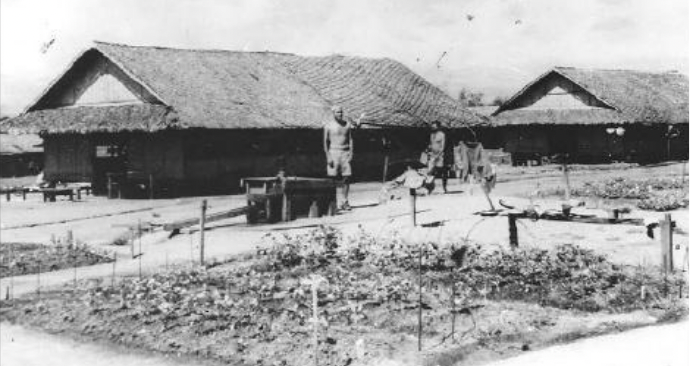
Max Vigil captured and sent to Prisoner of War Camp Cabanatuan
LHP_Intern2022-05-18T20:09:48+00:00After the fall of Bataan in the Philippines, Max and his squadron joined the American forces on Corregidor Island, which surrendered to the Japanese on May 7, 1942.At the age of eighteen, Max was captured along with his fellow service men, and imprisoned in a Prisoner of War Camp Cabanatuan. Initially it was reported that Max died in prison on June 22, 1942 as a result of disease….Malaria and Dysentery. He was buried in Common Grave 1003. His remains are still unresolved.
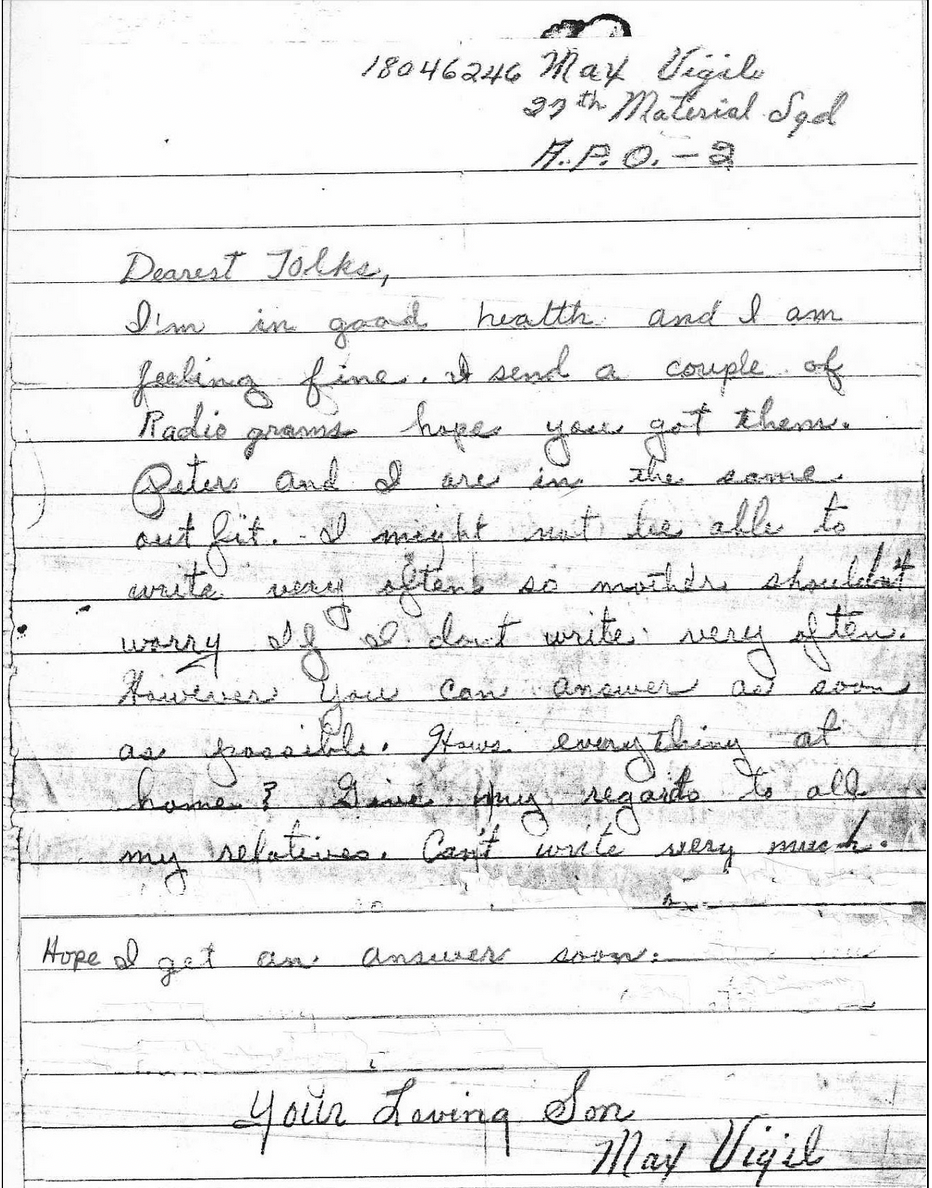
Letter from Private Máximo Vigil
LHP_Intern2022-05-18T19:59:54+00:00Max wrote letters to his folks back home in Sarcillo, Colorado. In the letter below, he writes that he is in good health and he asks his parents not to worry about him because he’s fine.
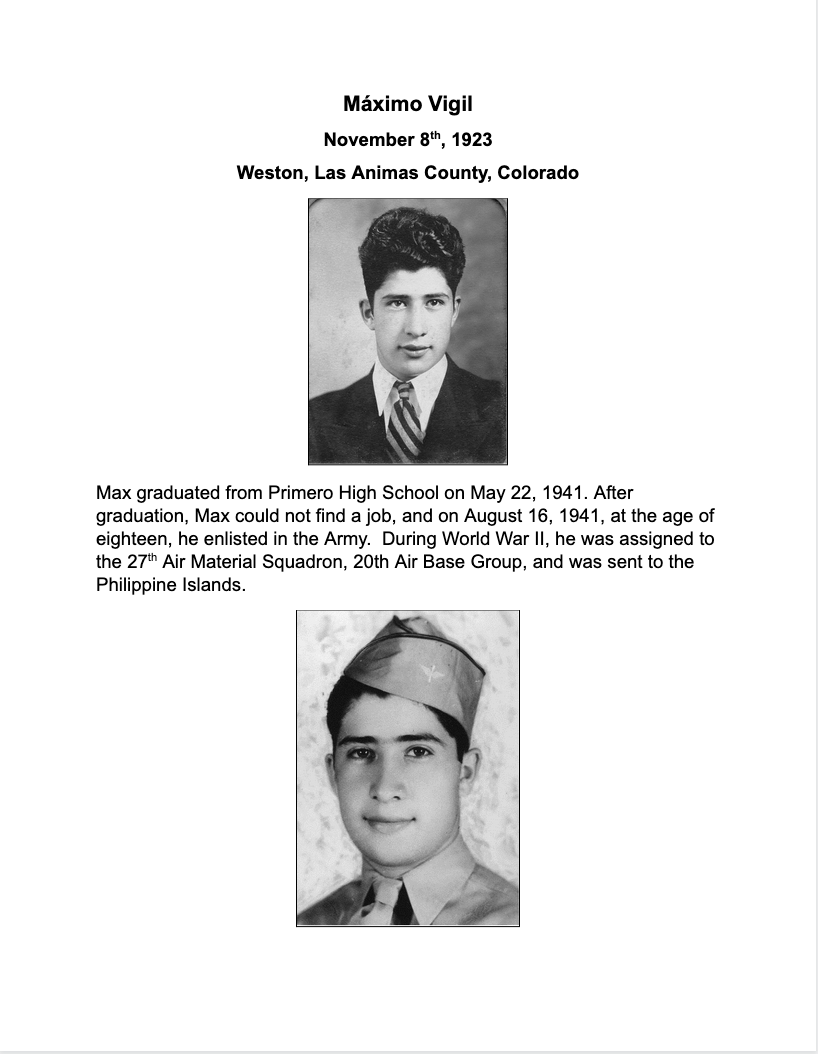
Early life of Max Vigil
LHP_Intern2022-05-18T19:52:51+00:00Max graduated from Primero High School on May 22, 1941. After graduation, Max could not find a job, and on August 16, 1941, at the age of eighteen, he enlisted in the Army. During World War II, he was assigned to the 27th Air Material Squadron, 20th Air Base Group, and was sent to the Philippine Islands.

Luis Ramirez cleared of all charges in Crusade massacre
LHP_Intern2022-05-02T20:53:37+00:00Article in El Diario de la Gente from September 14, 1974. Luis Ramirez was cleared on charges of assaulting a police officer at the “Saint Patrick’s Day Massacre” at the Crusade for Justice.

An interview with Daniel Arroyo, an Elder of the Black Berets por La Justicia
LHP_Intern2022-05-02T17:28:24+00:00Daniel Arroyo, an ELDER of the Black Berets por La Justicia (Since 1968) talks about his experiences in Denver and with Corky Gonzales. This is the 2nd video of an overall interview, that took place on May 28, 2020 in Phoenix Arizona and was interviewed by Gabriel Ramiro Cruz with the assistance of Kelly Gallagher Blacksmith.
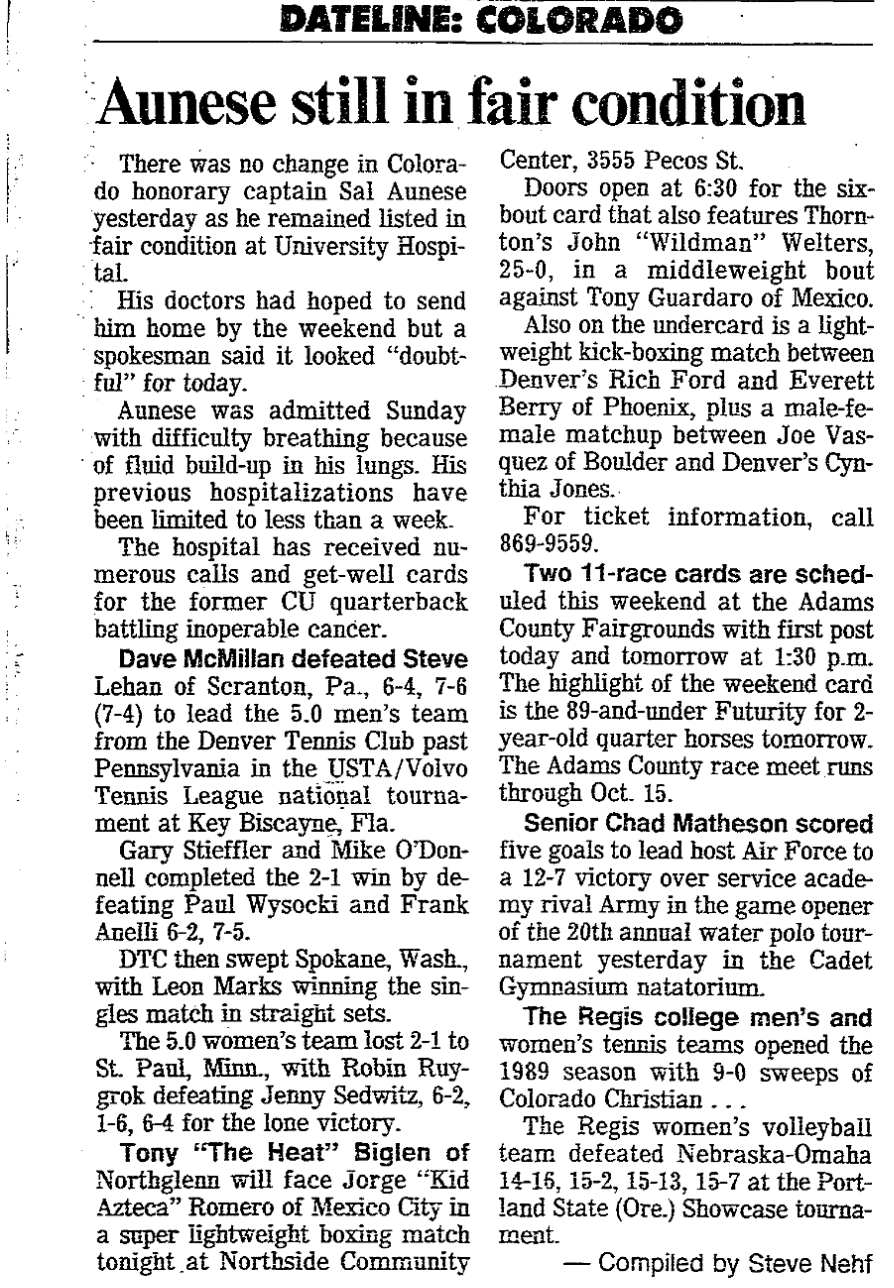
“Tony ‘The Heat’ Biglen will face Jorge ‘ Kid Azteca’ Romero”, 1989
LHP_Intern2022-04-01T21:44:19+00:00An article updating on conditions of boxers and upcoming boxer events, one being between The Heat and Kid Azteca at Northside Community Center, By Steve Nehf, Denver, 9-23-1989
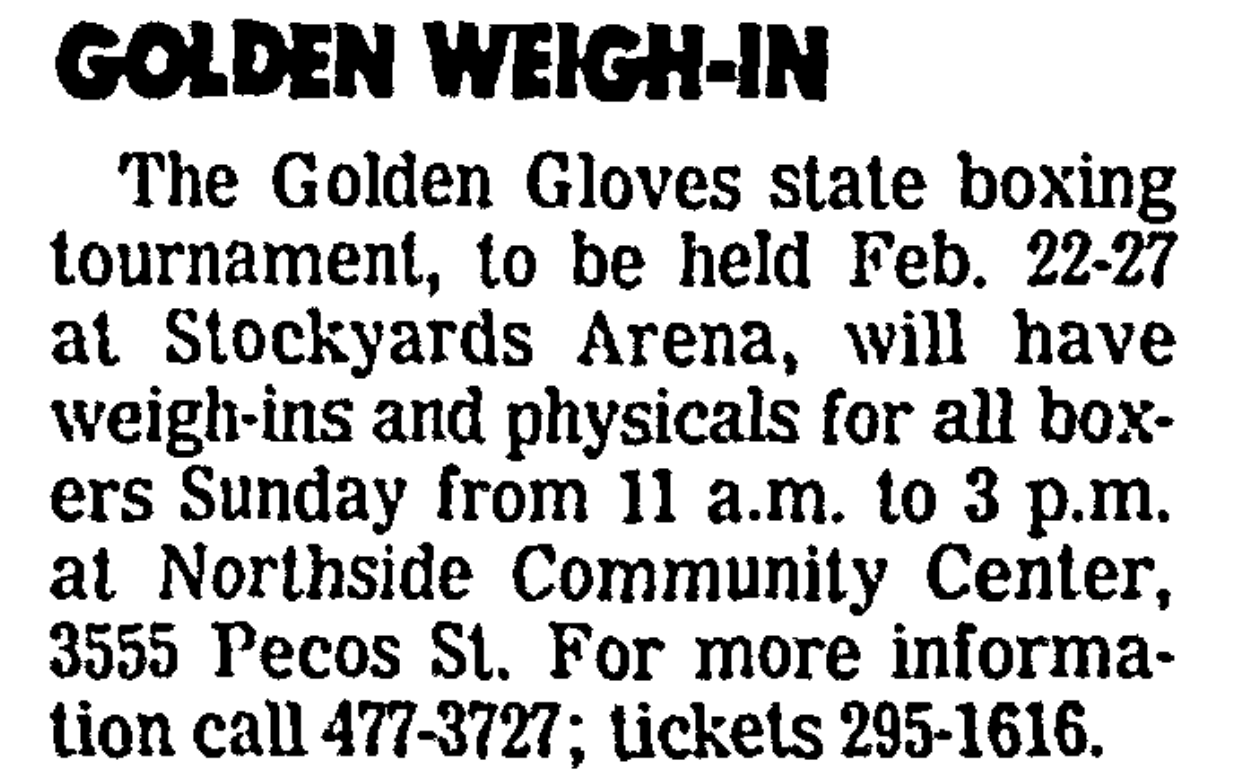
“Golden Weigh in”, 1988
LHP_Intern2022-04-01T21:30:50+00:00A segment informing people that the Golden State boxing tournament weigh-ins will be held at Northside Community Center, Denver, 2-18-1988
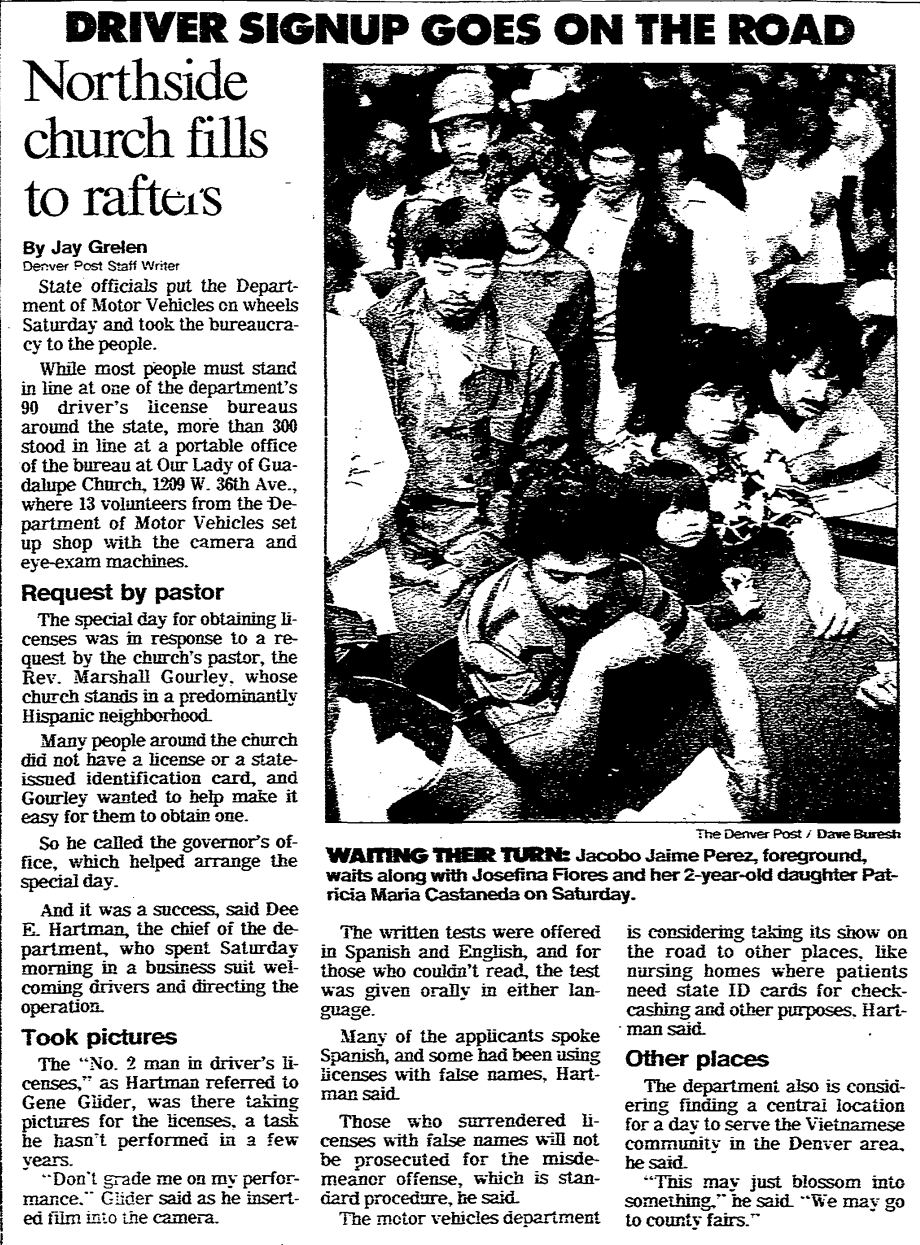
“Driver Signup Goes on the Road”, 1988
LHP_Intern2022-04-01T21:27:05+00:00An article on an event held in Our Lady of Guadalupe Catholic Church by the DMV to get people identification by request of Reverend Marshall Gourley, By Jay Grelen, Denver, 10-16-1988
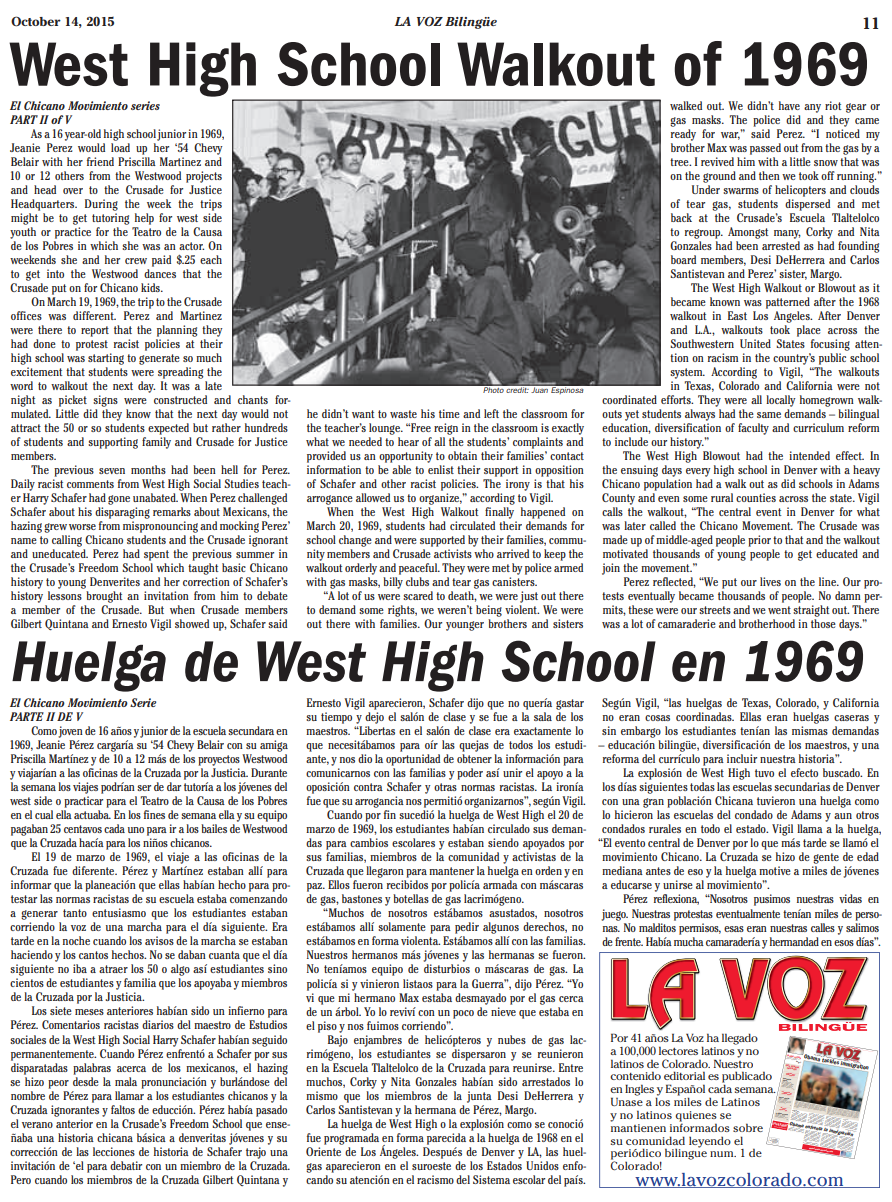
“West High School Walkout of 1969/Huelga de West High School en 1969”, 2015
LHP_Intern2022-03-31T21:36:59+00:00An article on the West High School Walkout of 1969 as part of a series called El Chicano Movimiento, Denver, 10-14-2015
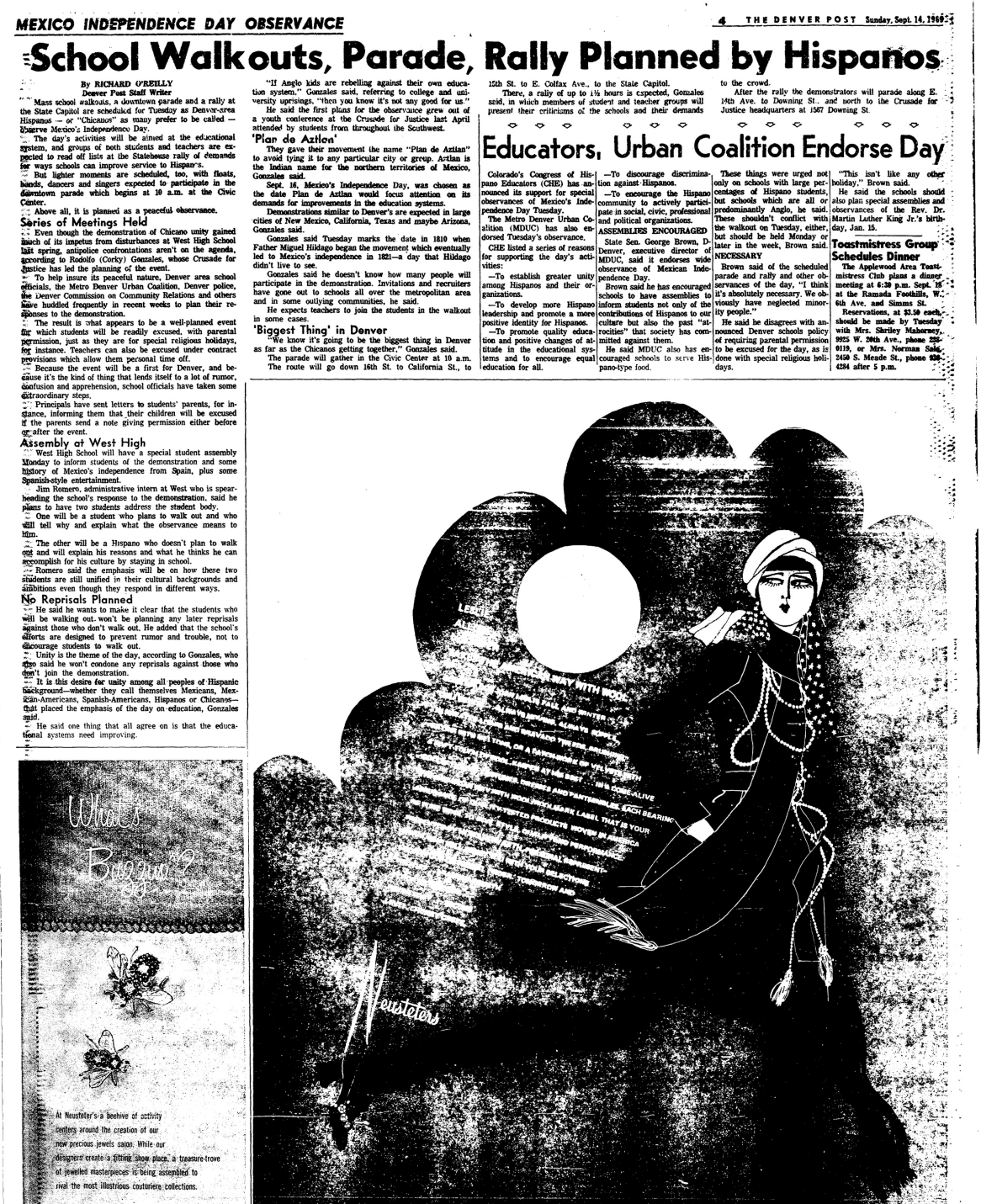
“School Walkouts, Parade, Rally Planned by Hispanos”, 1969
LHP_Intern2022-03-31T21:36:08+00:00Article on the plans for the walkouts at varying schools by students and organizations, By Richard O’Reilly, Denver, 9-14-1969
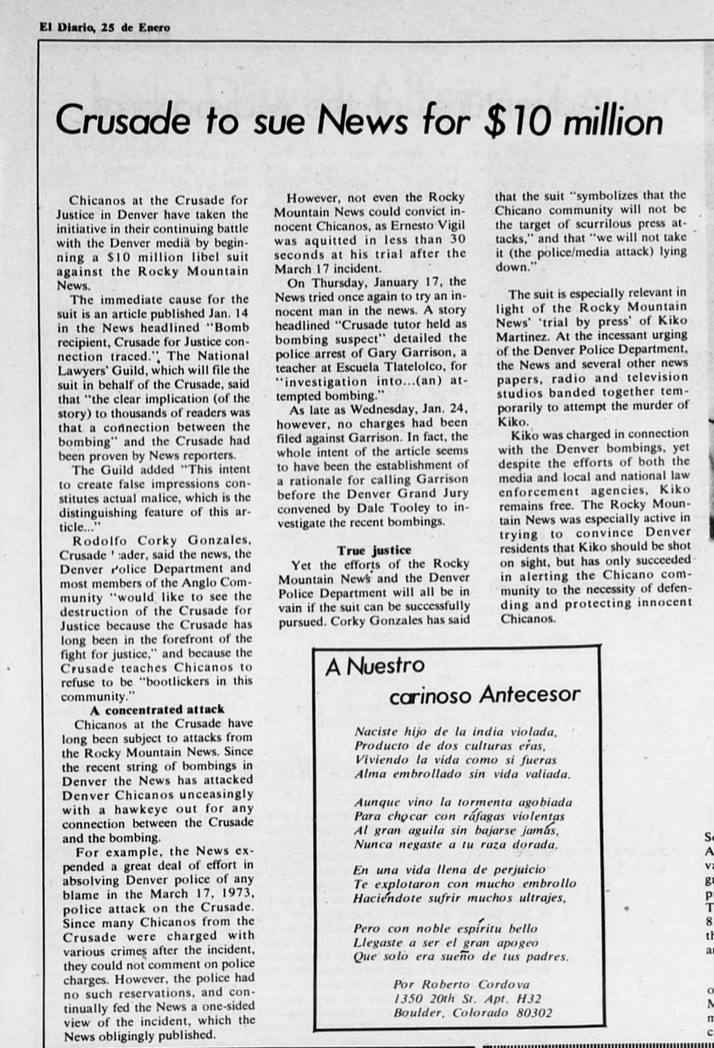
Crusade Sues Rocky Mountain News, 1974
LHP_Intern2022-03-30T17:59:34+00:00Segment of “El Diario de la Gente” Newspaper detailing the 10 million dollar lawsuit being filled againt the Rocky Mountain News publications company from the Crusade for Justice for creainga false narrative around the organization and the rbombing that occured at their building.
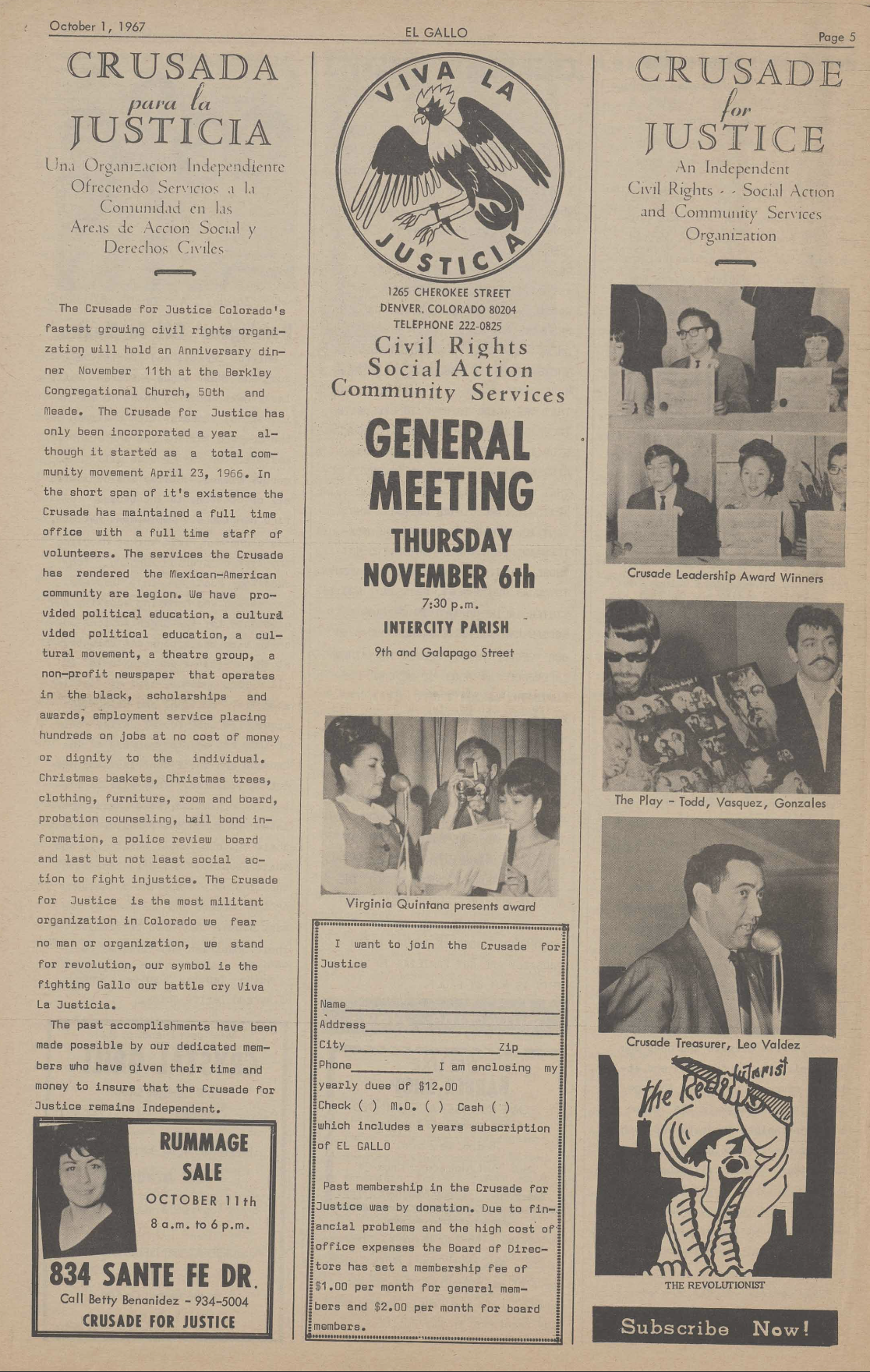
Crusada para la Justicia. 1967
LHP_Intern2022-03-30T17:57:33+00:00Segment of “El Gallo Newpsaper” detailing the goals and mission of the Crusade for Justice organization as well as their growth within the first year of the organizations existence.
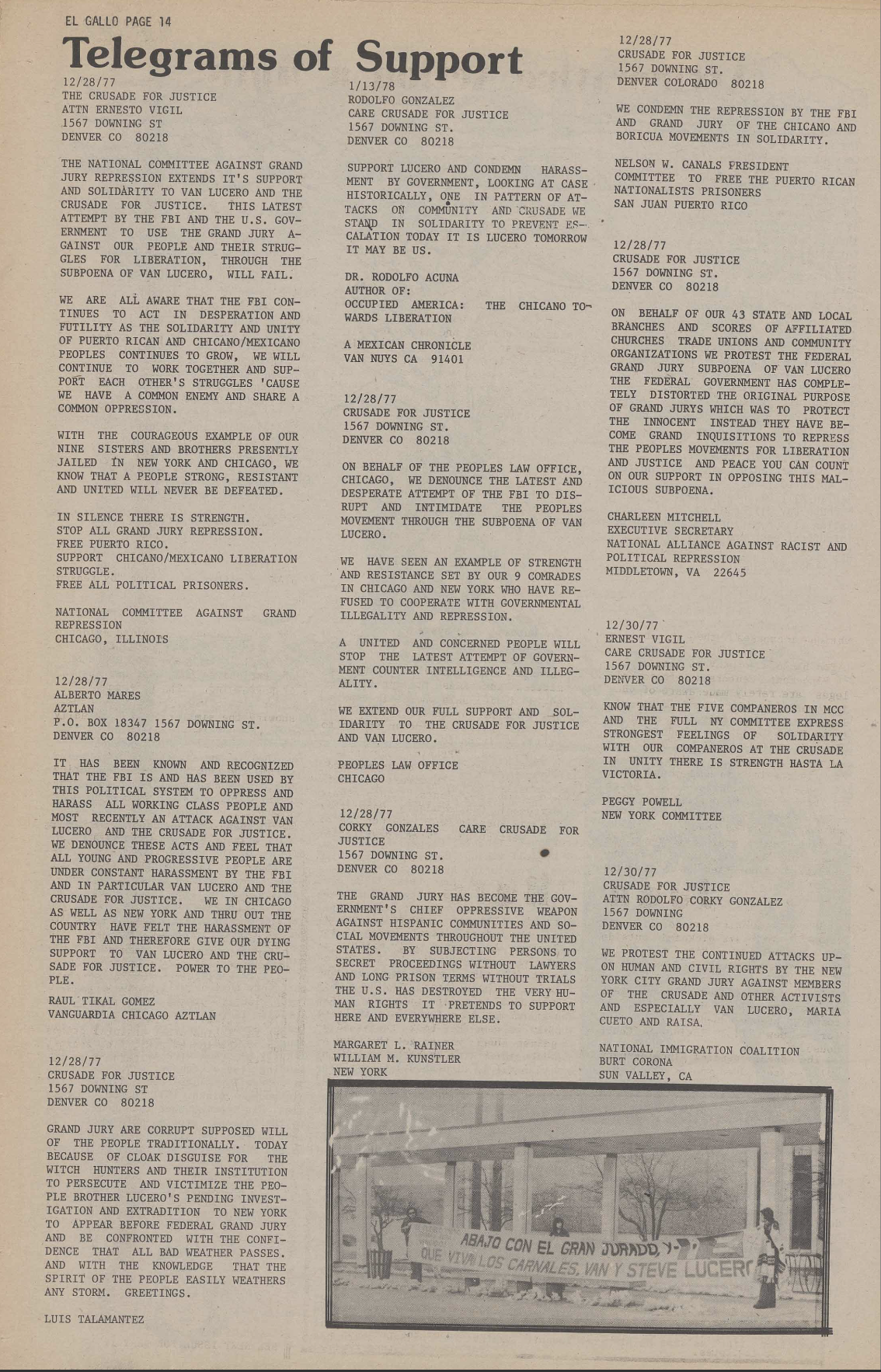
Telegrams of Support, 1978
LHP_Intern2022-03-30T17:55:10+00:00Segment of “El Gallo Newpsaper” with various messgaes sent to the Crusade for Justice calling for support or aid in issues occuring in the community in 1978.
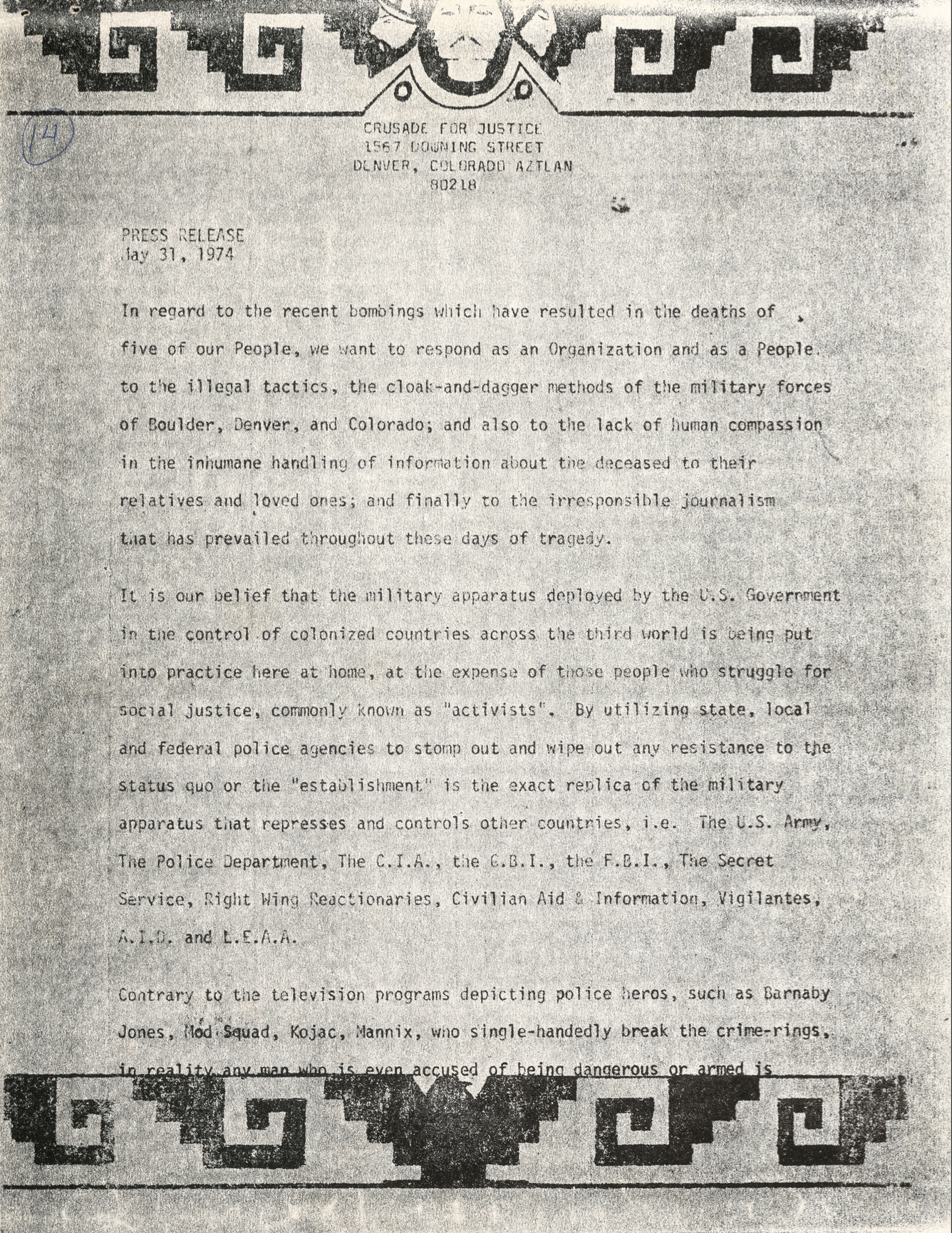
Crusade for Justice press release on Los Seis de Boulder, 1974
LHP_Intern2022-03-30T16:16:48+00:00A press release from community organization ‘The Crusade for Justice’ on the bombings that killed 6 Chicanx Univeristy of Colorado Boulder students. View full resource here.
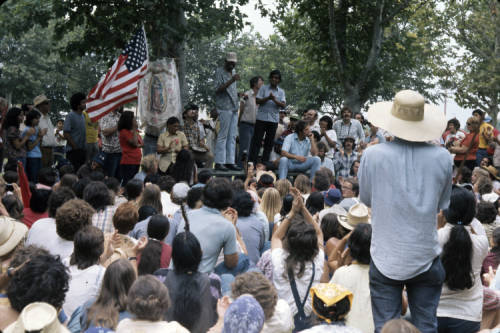
UFW Lettuce Worker Rally 1971
LHP_Intern2022-03-29T00:54:08+00:00UFW members gather for lecttuce workers striking against the Finerman Company in Center, CO.
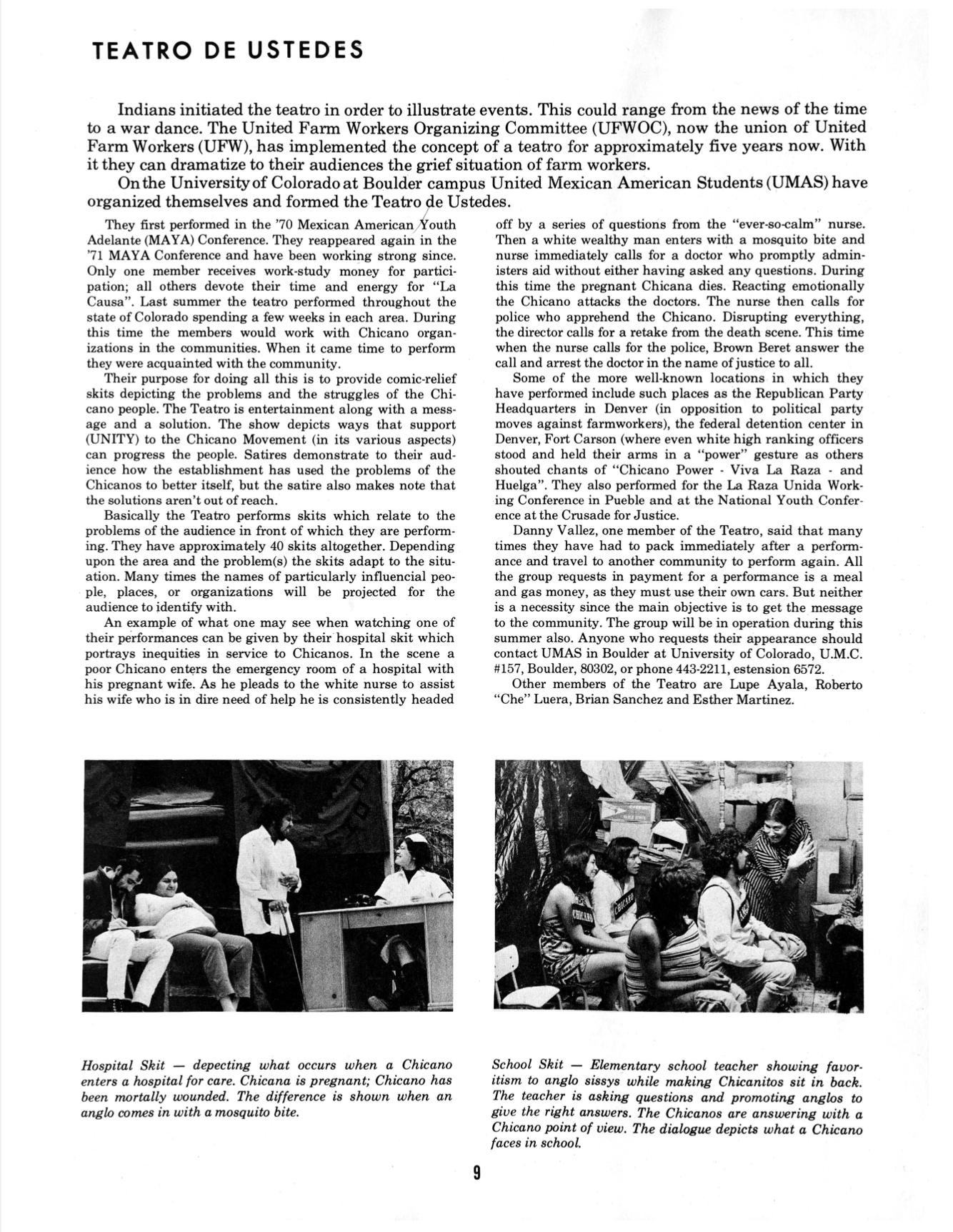
Teatro de Ustedes Creation at CU Boulder 1972
LHP_Intern2022-03-29T00:54:08+00:00Entry describing the creation of Teatro de Ustedes by CU Boulder UMAS students in Somoz Aztlan Vol. 1 Issue 1.
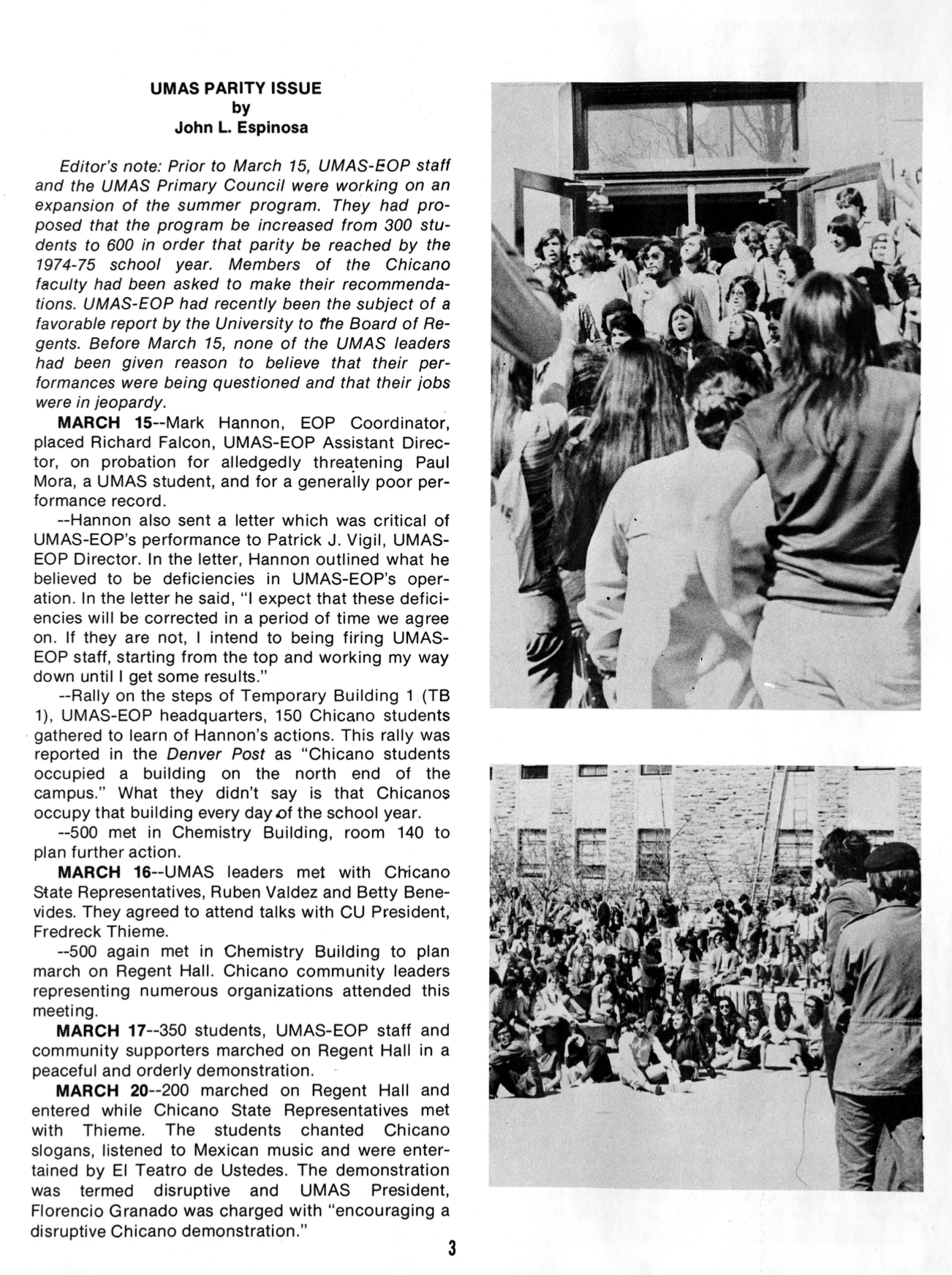
UMAS EOP Parity Struggle Timeline 1972
LHP_Intern2022-03-29T00:54:08+00:00Timeline of UMAS EOP and student efforts to achieve racial/ethnic parity at CU Boulder 1972.
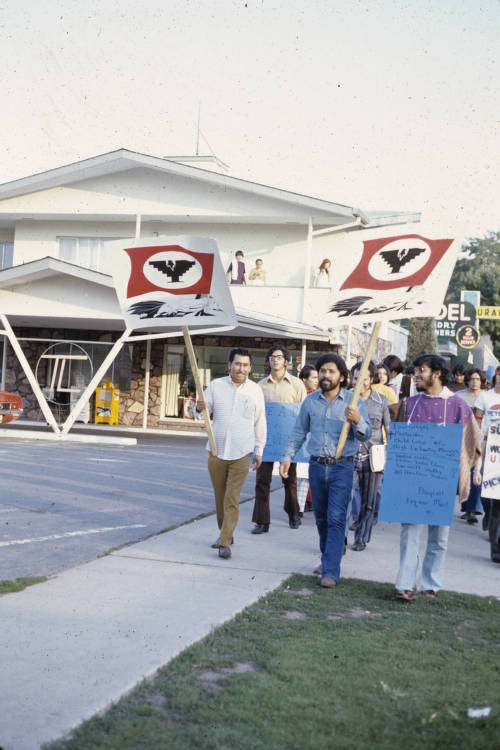
UFW Liquor Mart Boycott 1972
LHP_Intern2022-03-29T00:54:08+00:00UFW members and CU Boulder students picketing for the Liquor Mart boycott in Boulder, CO.
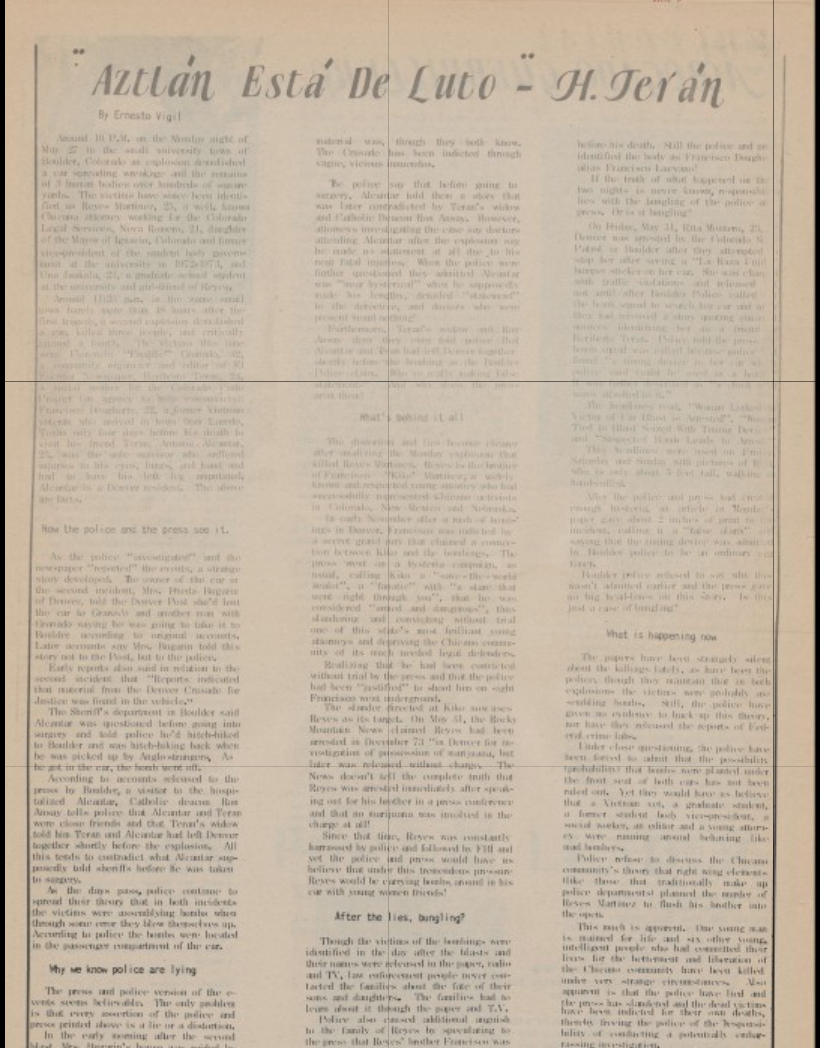
“Victims in Boulder explosion”, 1974
LHP_Intern2022-03-29T00:54:07+00:00“Victims in Boulder explosion and the effects on the Chicano community”, 07-01-1974
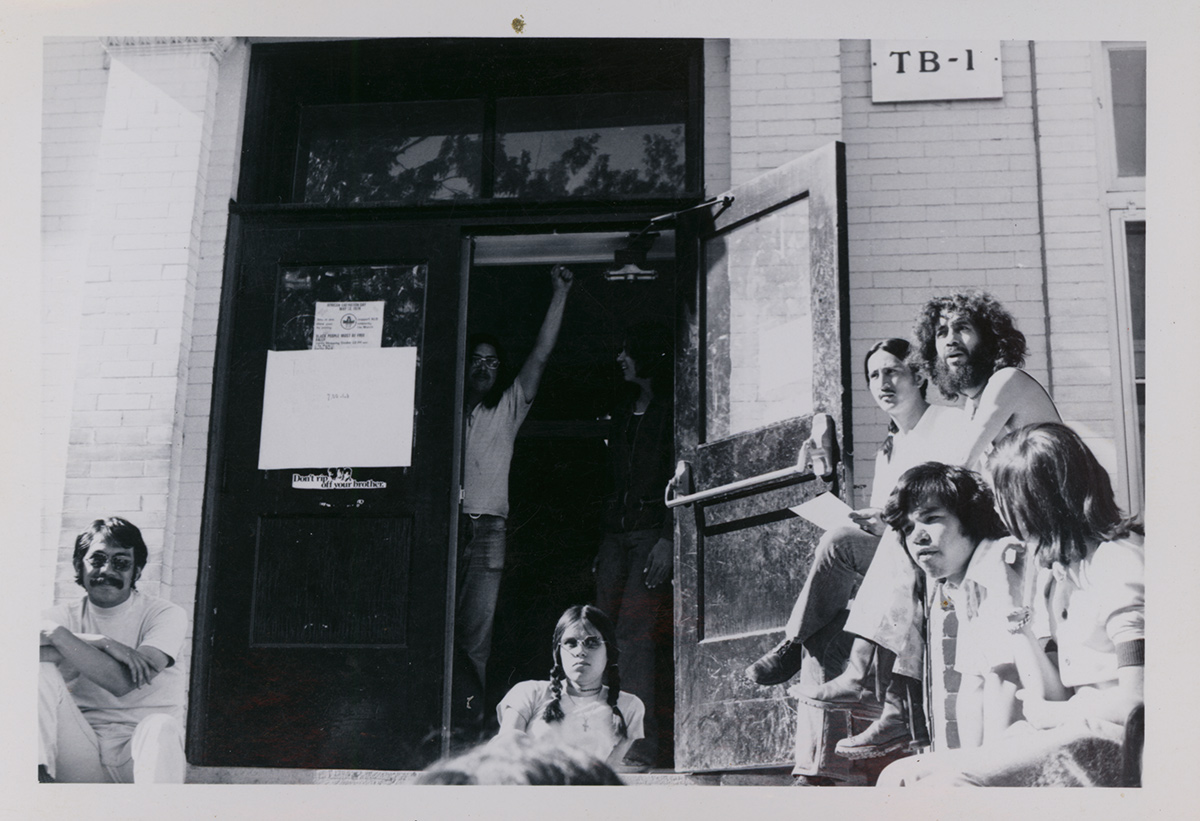
Students in Front of TB-1 1974
LHP_Intern2022-03-29T00:54:07+00:00Photo of students outside of Temporary building 1 (TB-1) during the 1974 building occupation at CU Boulder.
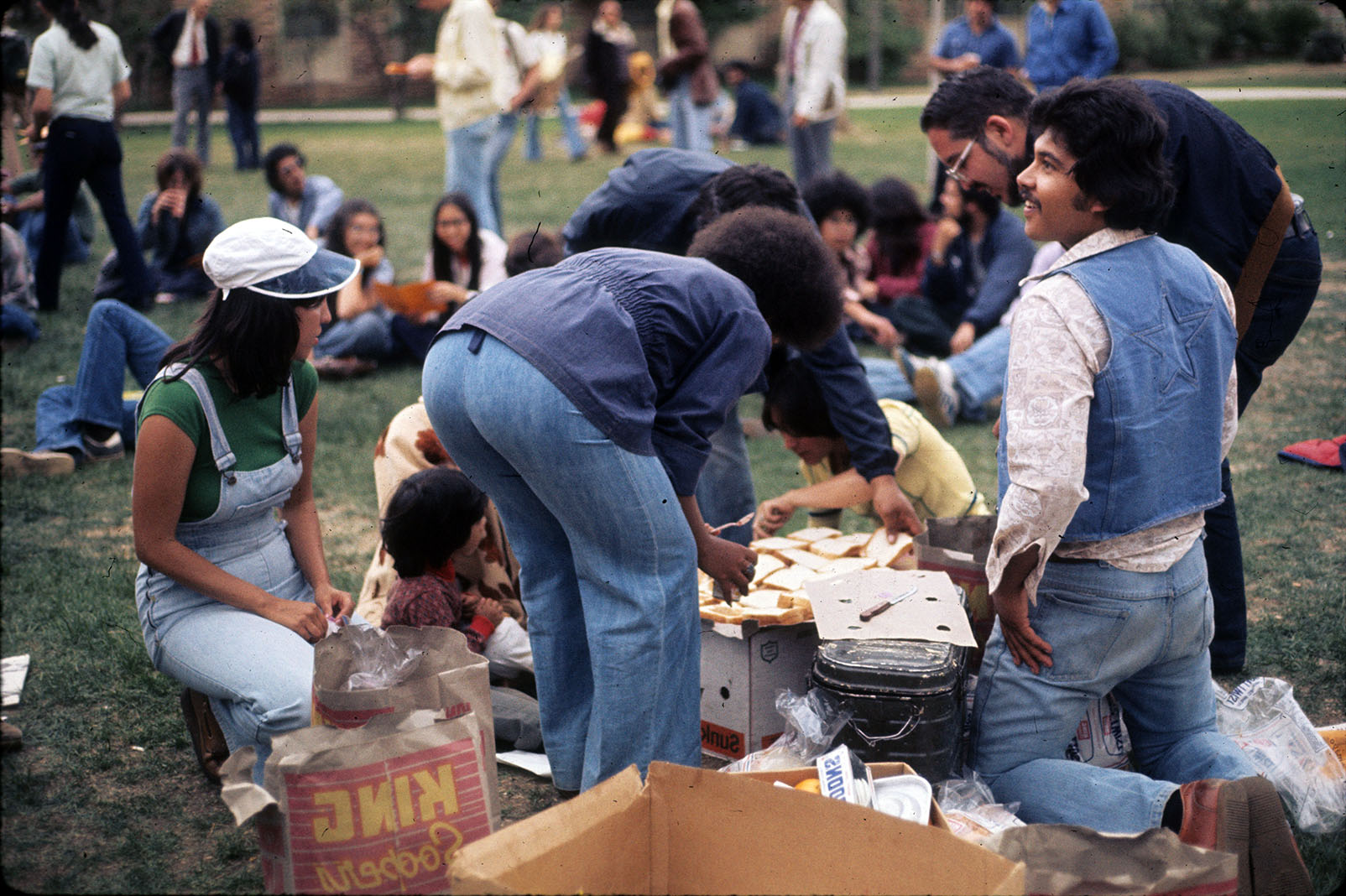
CU Boulder Helms EOP Sit-in
LHP_Intern2022-03-29T00:54:07+00:00CU Boulder students Frances Cestillo and Felipe Roybal, gathered at UMAS EOP sit-in at Helms Building.
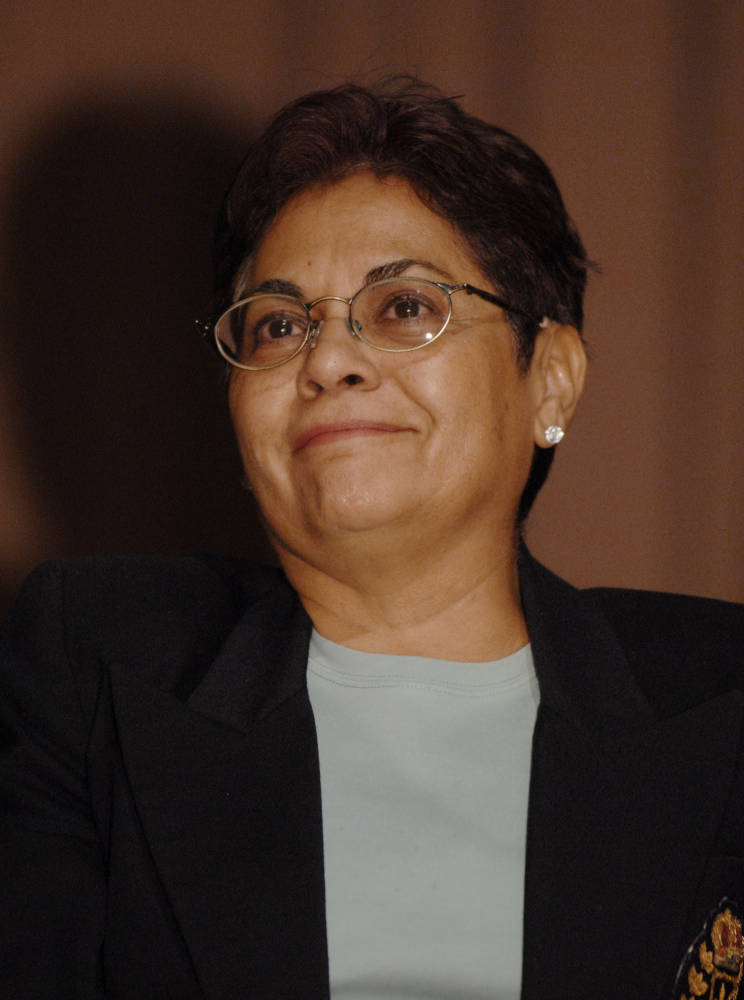
“Photo of Rita Montero at Steele Elementary”, 2007
LHP_Intern2022-03-29T00:53:50+00:00“Photo of Denver Public School Board member Rita Montero at Steele Elementary”, by Matt Nager, 10-16-2007
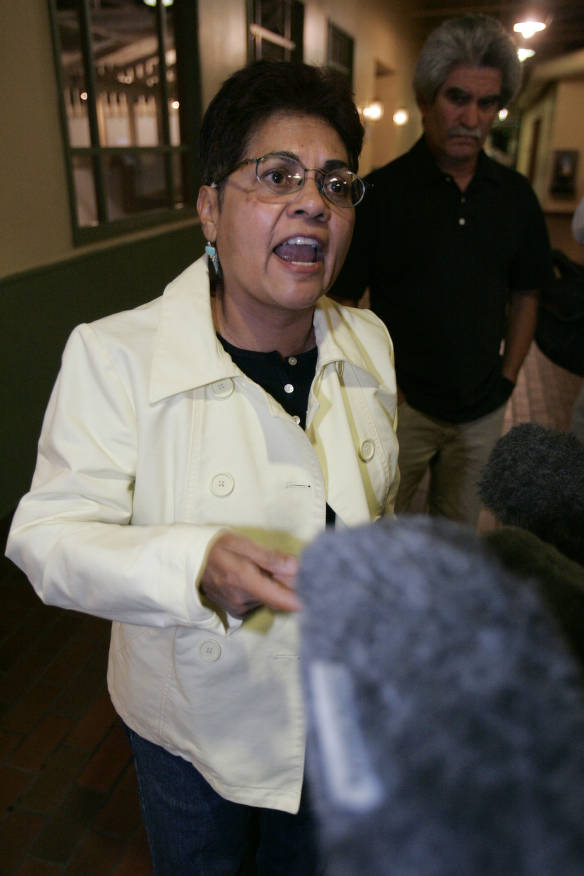
“Rita Montero reaction to DPS committee”, 2007
LHP_Intern2022-03-29T00:53:50+00:00“Rita Montero reaction to DPS committee announcement”,by Dennis Schroeder, 10-01-2007
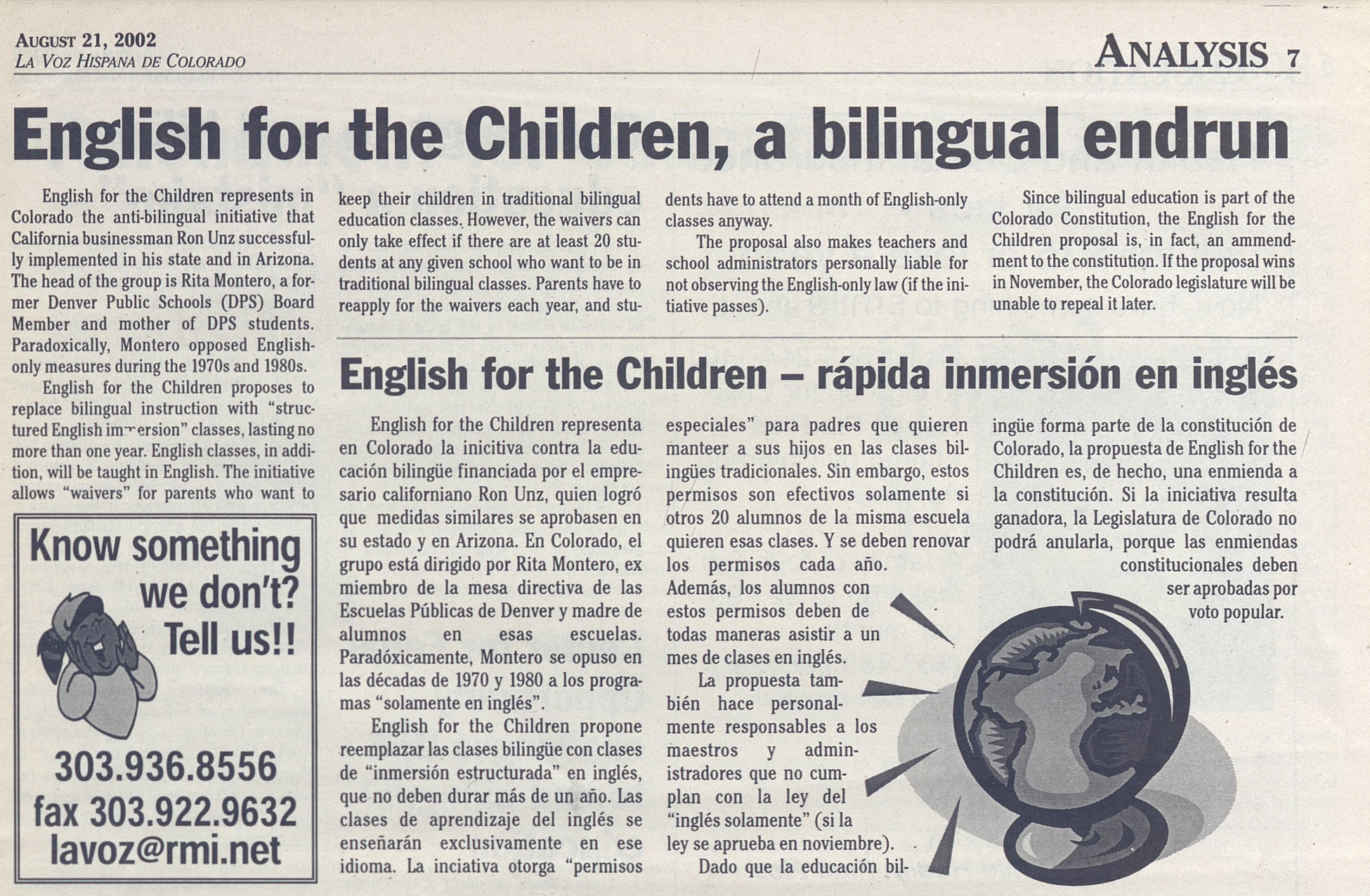
“Rita Montero on anti-bilingual initiative”, 2002
LHP_Intern2022-03-29T00:53:50+00:00“Rita Montero on anti-bilingual initiative speaks out for english only measures”, 08-21-2002
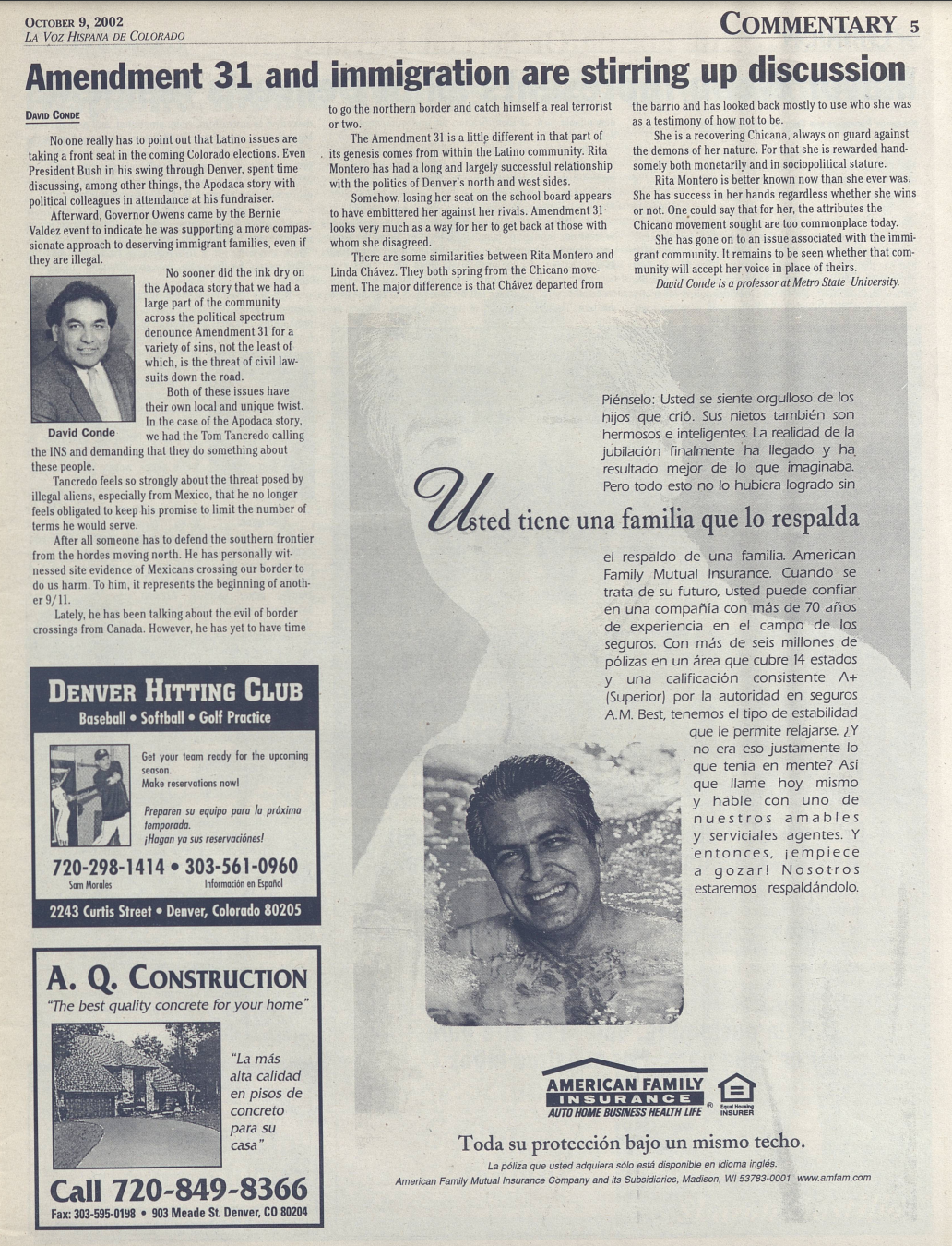
“Amendment 31 and DPS elections”, 2002
LHP_Intern2022-03-29T00:53:50+00:00“Amendment 31 and Denver Public School elections on community and chicano movement”, 10-09-2002
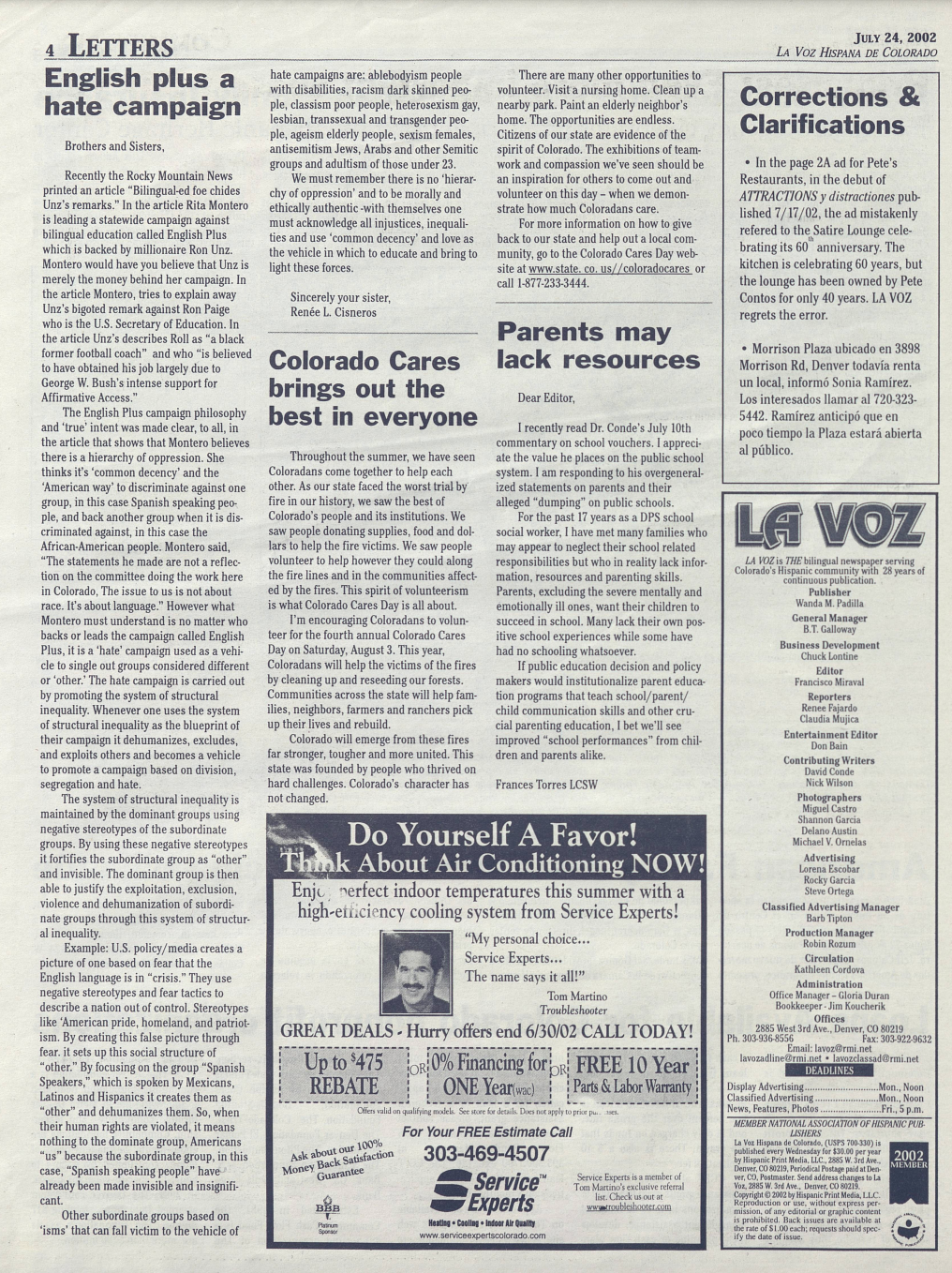
“Rita Montero and Ron Unz campaign”, 2002
LHP_Intern2022-03-29T00:53:50+00:00“Rita Montero and Ron Unz campaign for anti-bilingual education”,07-24-2002
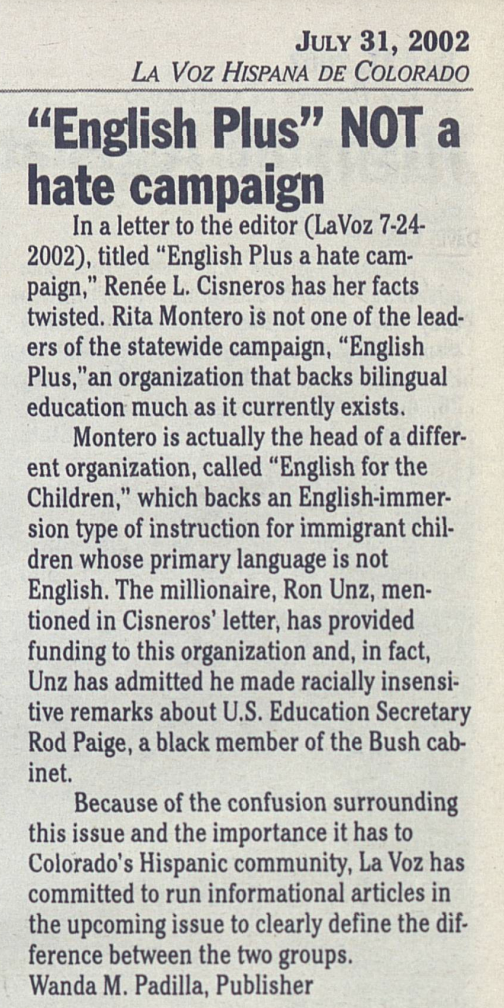
“Rita Montero on English for Children campaign”, 2002
LHP_Intern2022-03-29T00:53:50+00:00“Rita Montero on English for Children campaign”,07-24-2002
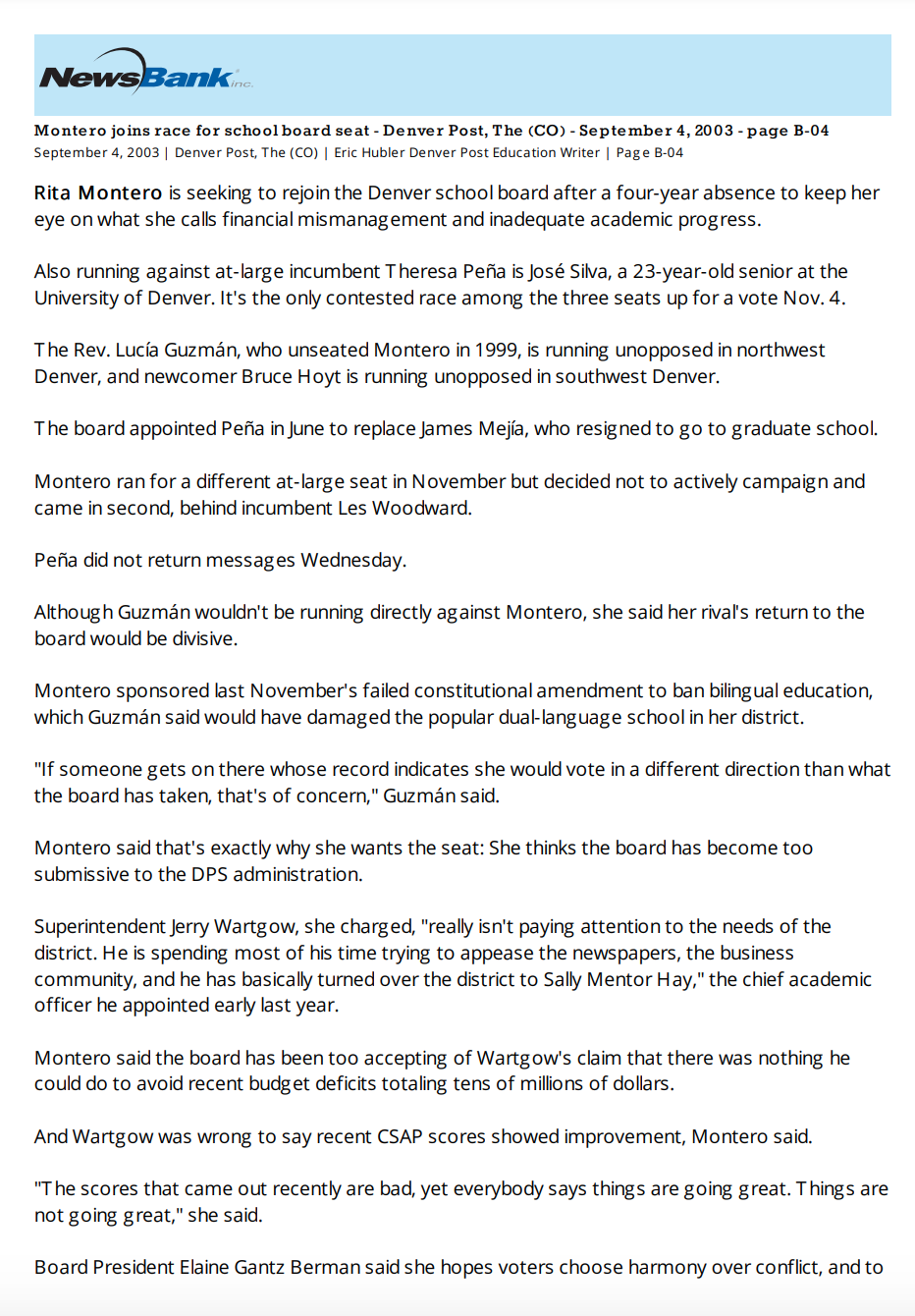
“Montero runs race to rejoin school board”, 2003
LHP_Intern2022-03-29T00:53:49+00:00“Montero runs race to rejoin Denver School Board after being unseated” , by Eric Hubler, 09-04-2003
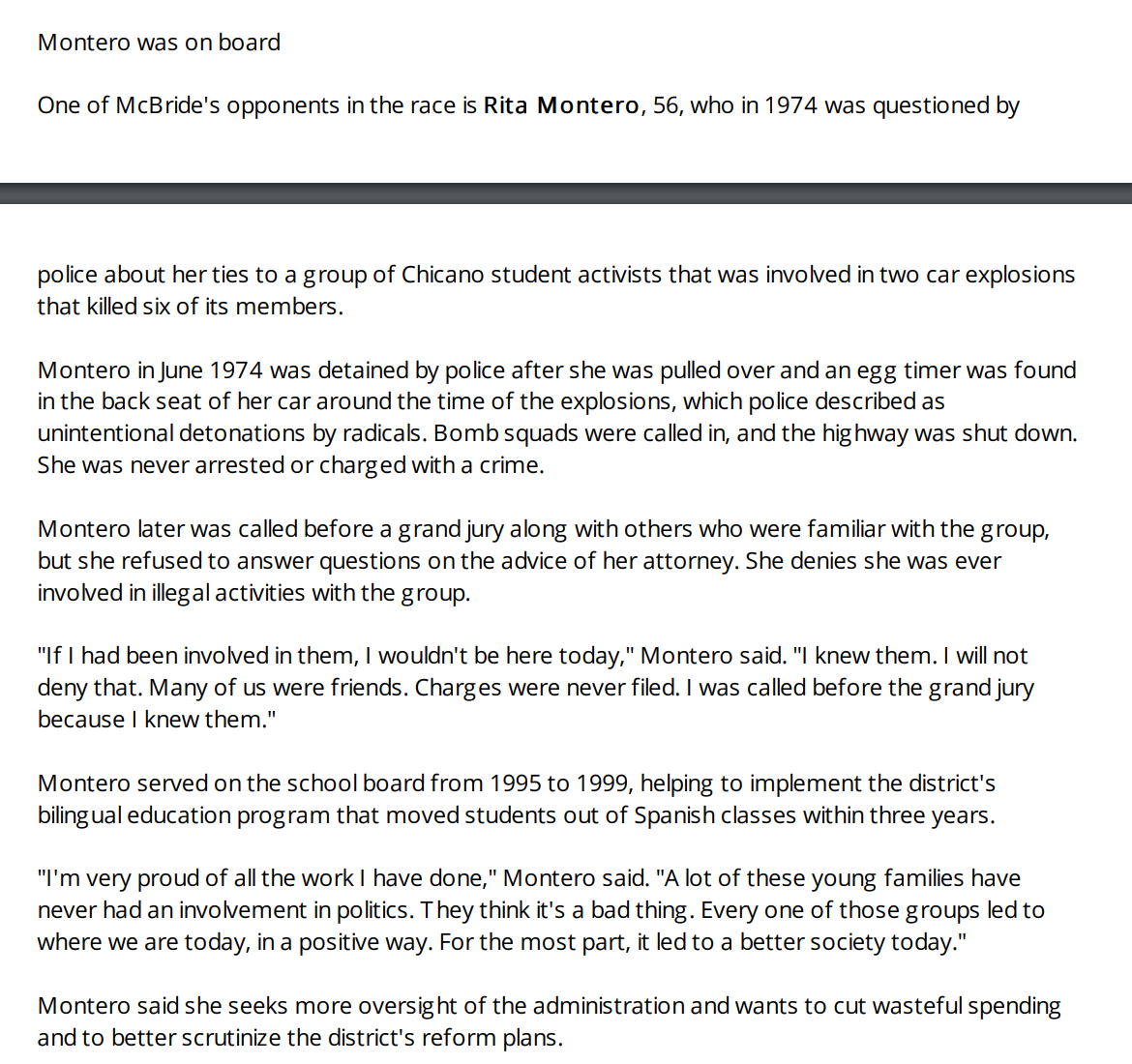
“DPS candidates revealing histories”, 2007
LHP_Intern2022-03-29T00:53:49+00:00“DPS candidates run for seats with history unveiling itself”, by Jeremy P. Meyer, 10-22-2007
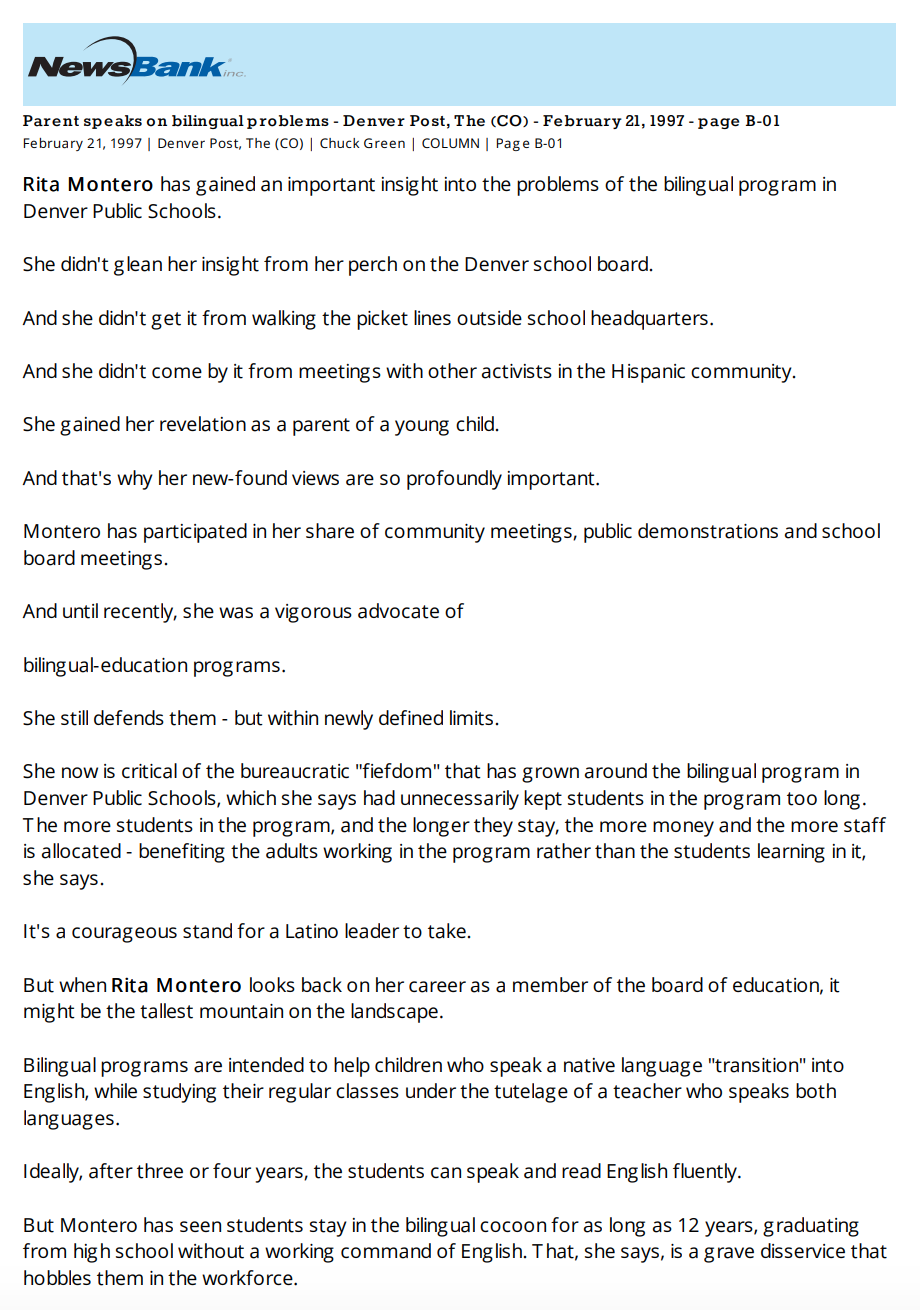
“Montero speaks out about bilingual problems”, 1997
LHP_Intern2022-03-29T00:53:49+00:00“Montero speaks out as a parent about bilingual problems of Spanish speaking students”, by Chuck Green, 02-21-1997
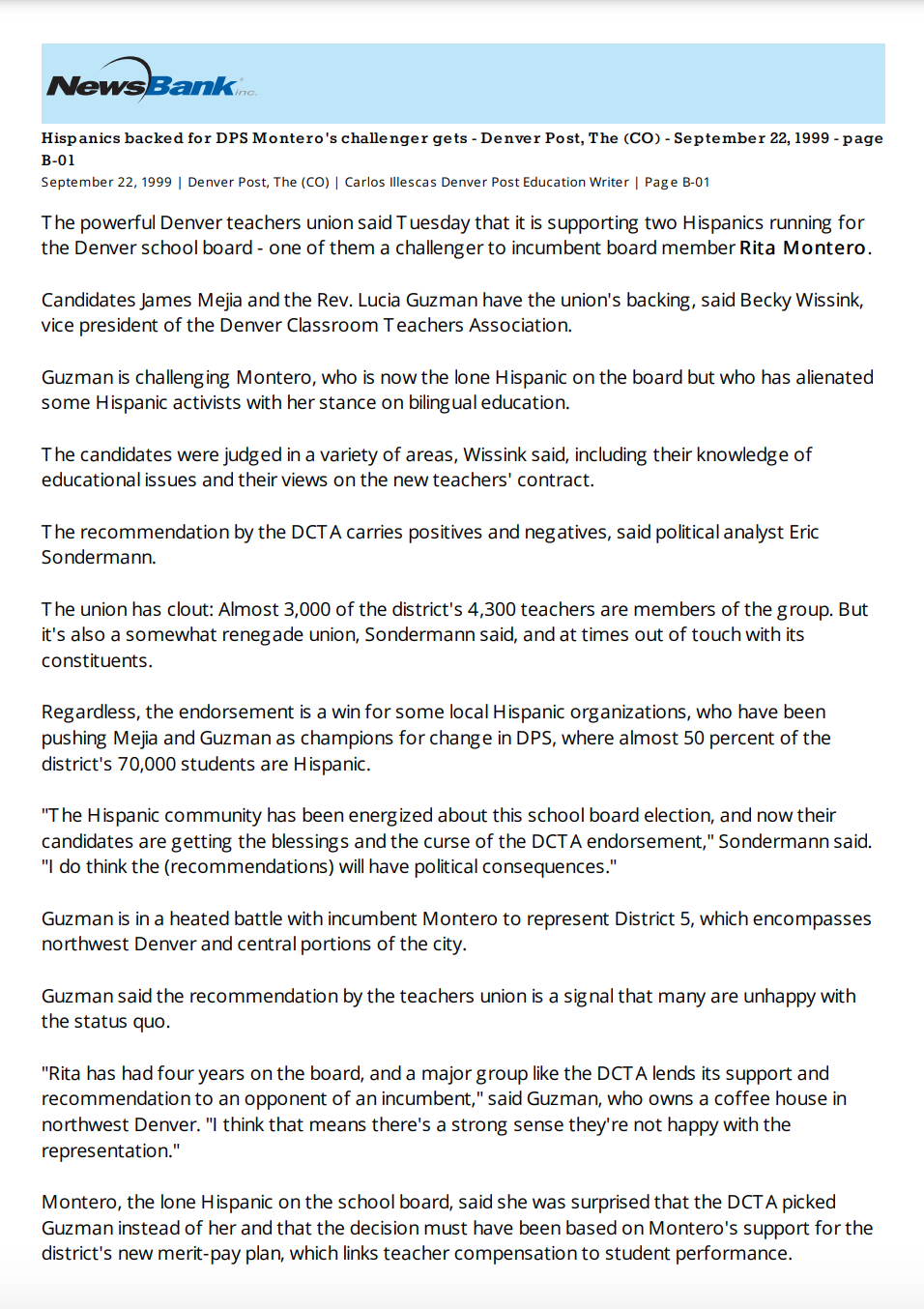
“Montero and Guzman battle to represent District, 5”, 1999
LHP_Intern2022-03-29T00:53:49+00:00“Montero and Guzman battle to represent District, 5″ for Denver school board”,by Carlos Illescas, 09-22-1999
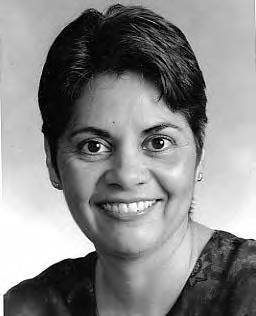
“Photo of Rita Montero”, 2007
LHP_Intern2022-03-29T00:53:49+00:00“Photo of Former Denver Public School Board Member Rita Montero” by Unknown, 10-15-2007
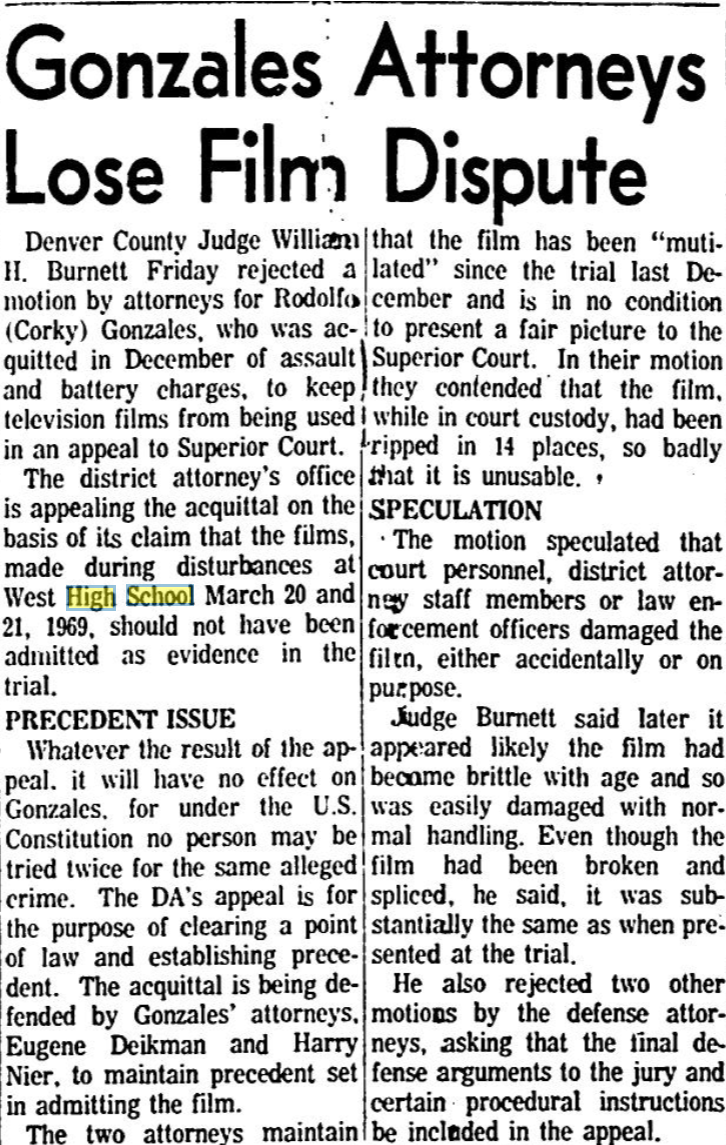
“Gonzales Attorney’s Lose Film Dispute”, 1970
LHP_Intern2022-03-29T00:53:48+00:00“Gonzales Attorney’s attempt to use film of West High Walkouts is unsuccessful”, Denver, 10-17-1970
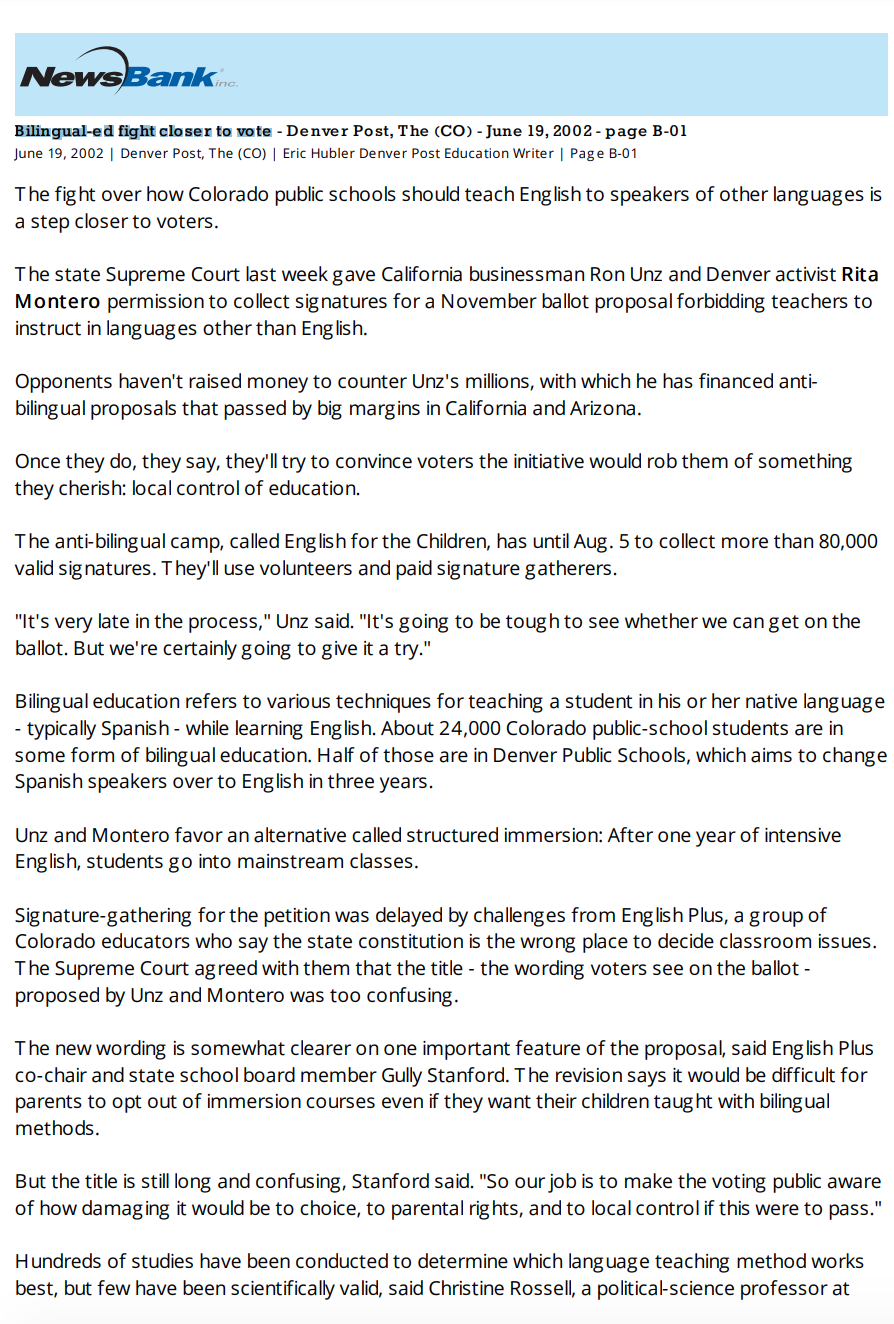
“Unz and Montero in favor of structured immersion”,2002
LHP_Intern2022-03-29T00:53:48+00:00“Unz and Montero favor new bilingual education through structured immersion”, by Eric Hubler, 06-19-2002
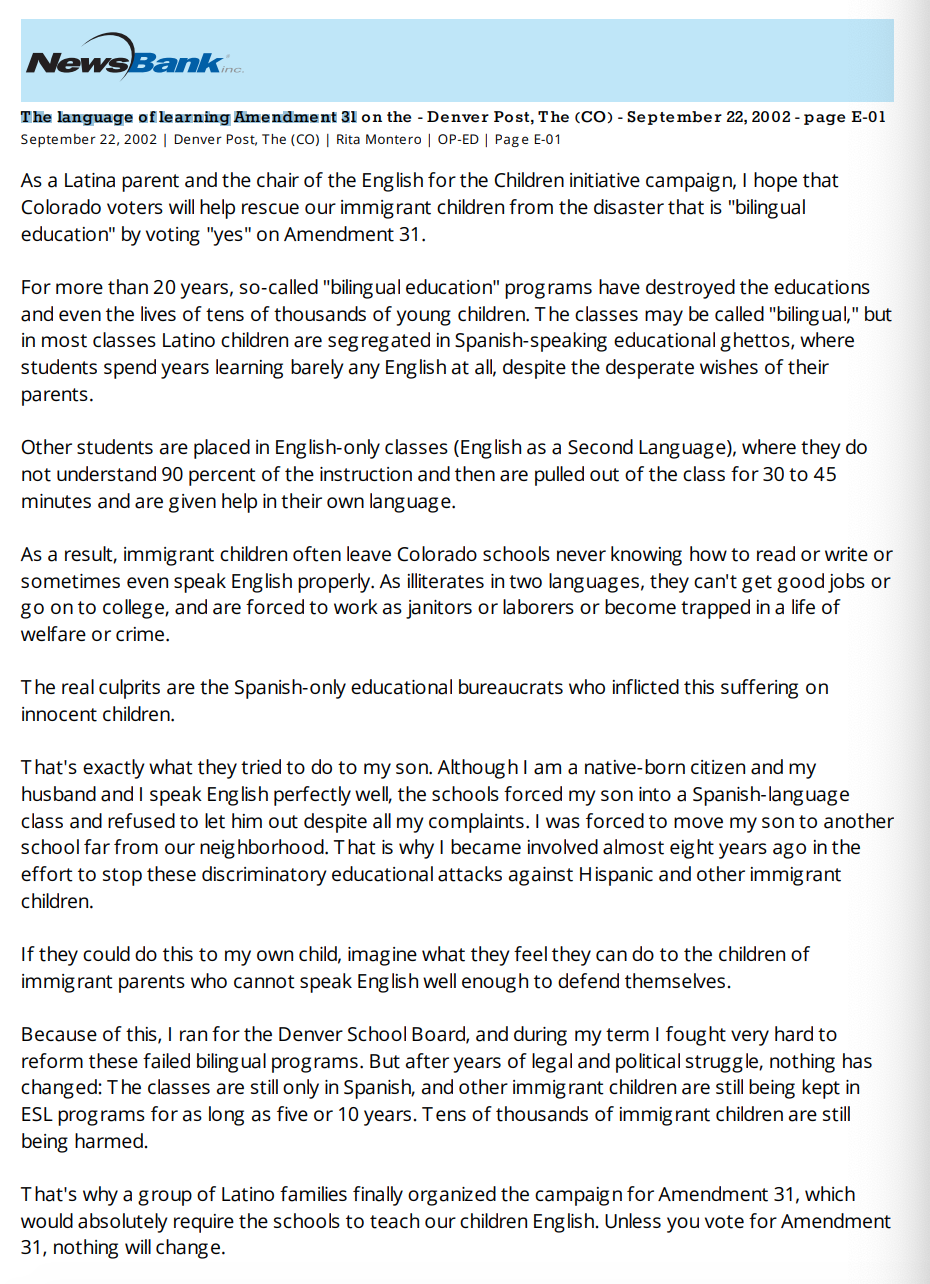
“Montero says vote yes on of Amendment 31”, 2002
LHP_Intern2022-03-29T00:53:48+00:00“Montero says vote yes on Amendment 31 and end bilingual education” by Rita Montero, 09-22-2002
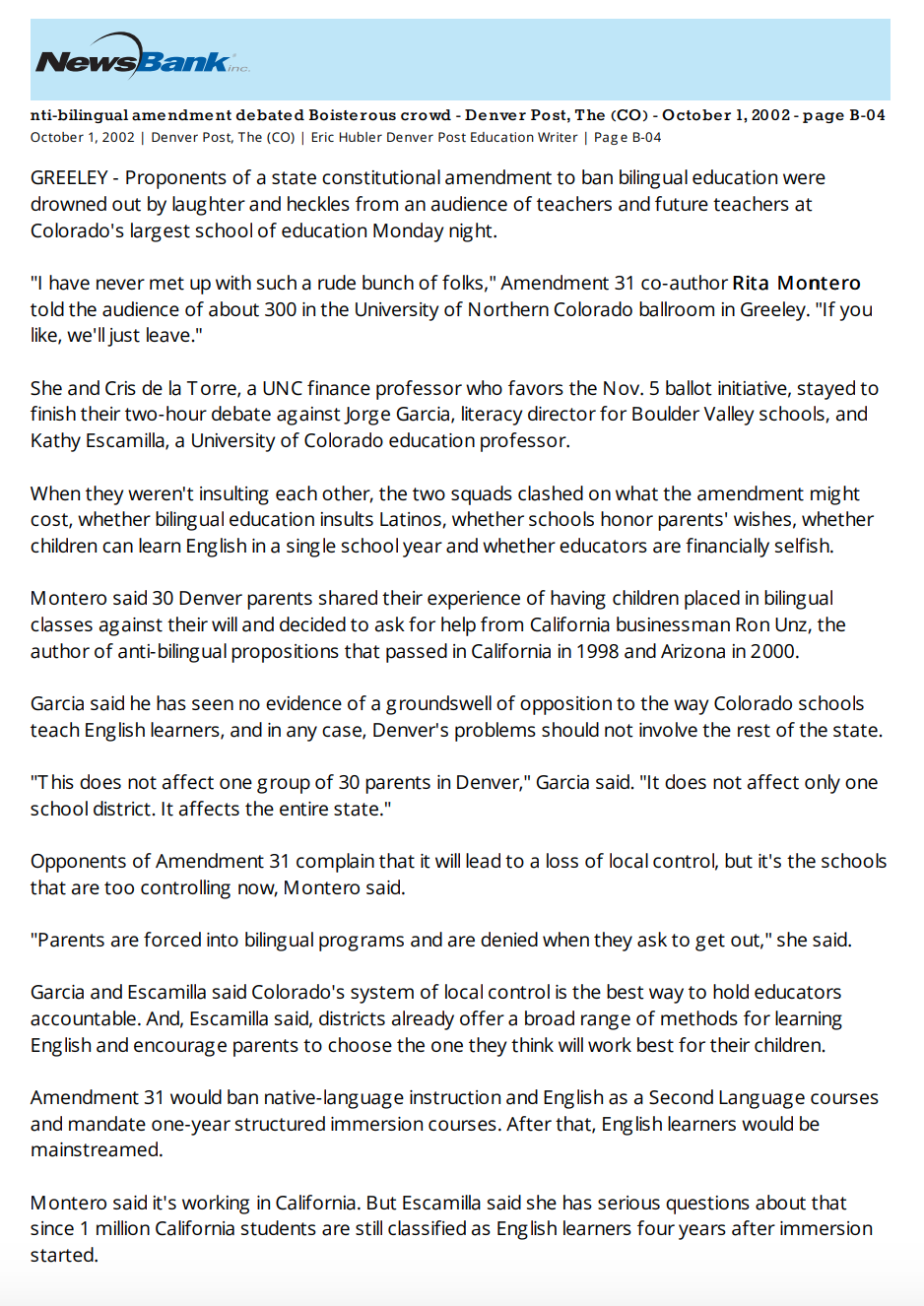
“Amendment 31 to stop bilingual education issues”, 2002
LHP_Intern2022-03-29T00:53:48+00:00“Amendment 31 debated to end bilingual classes for Spanish-Speaking students”, by Eric Hubler, 10-01-2022
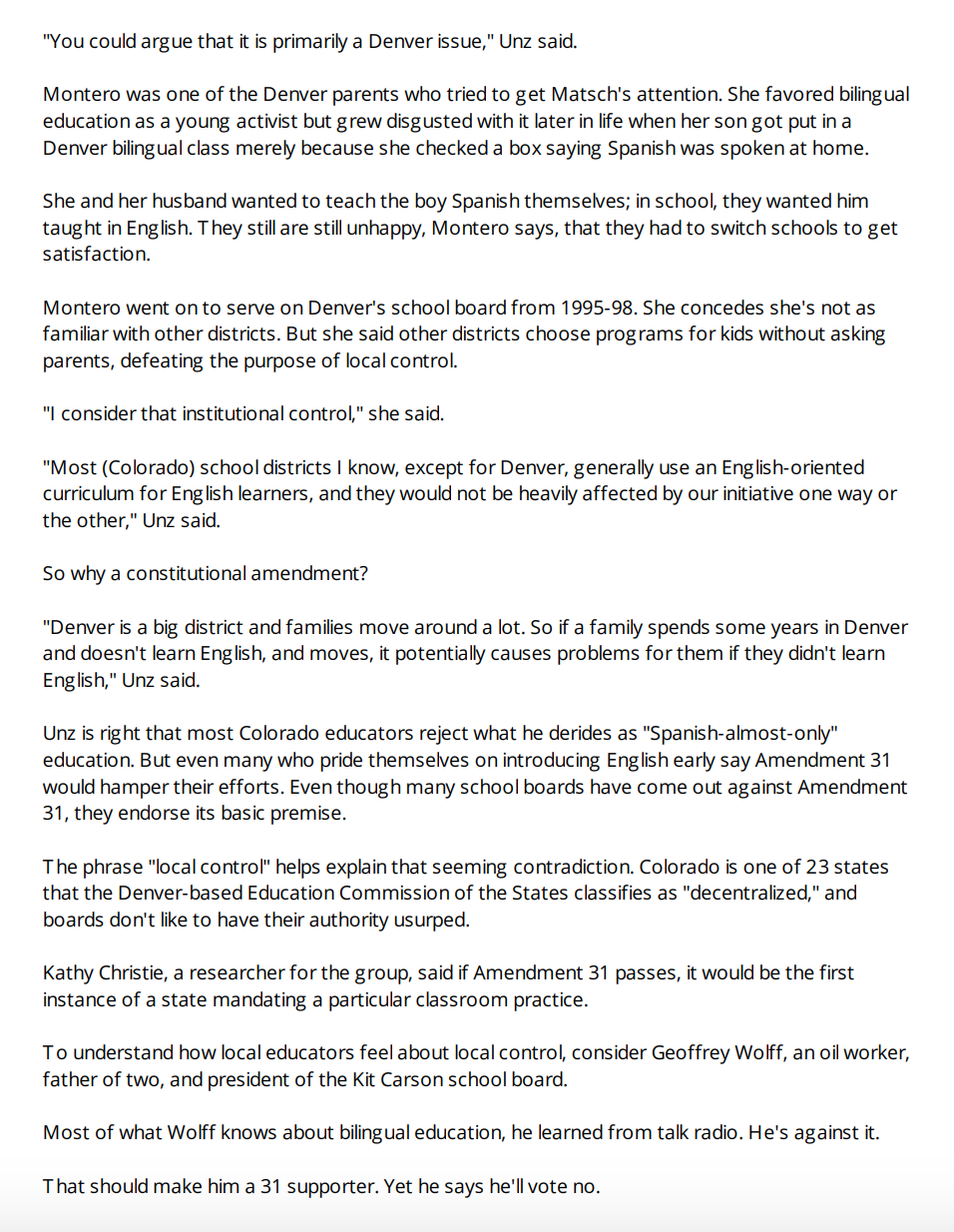
“Amendment 31 immersion called to question”, 2002
LHP_Intern2022-03-29T00:53:48+00:00“Amendment 31 immersion called to question with its fit with Denver Public Schools”, by Eric Hubler, 10-29-2002
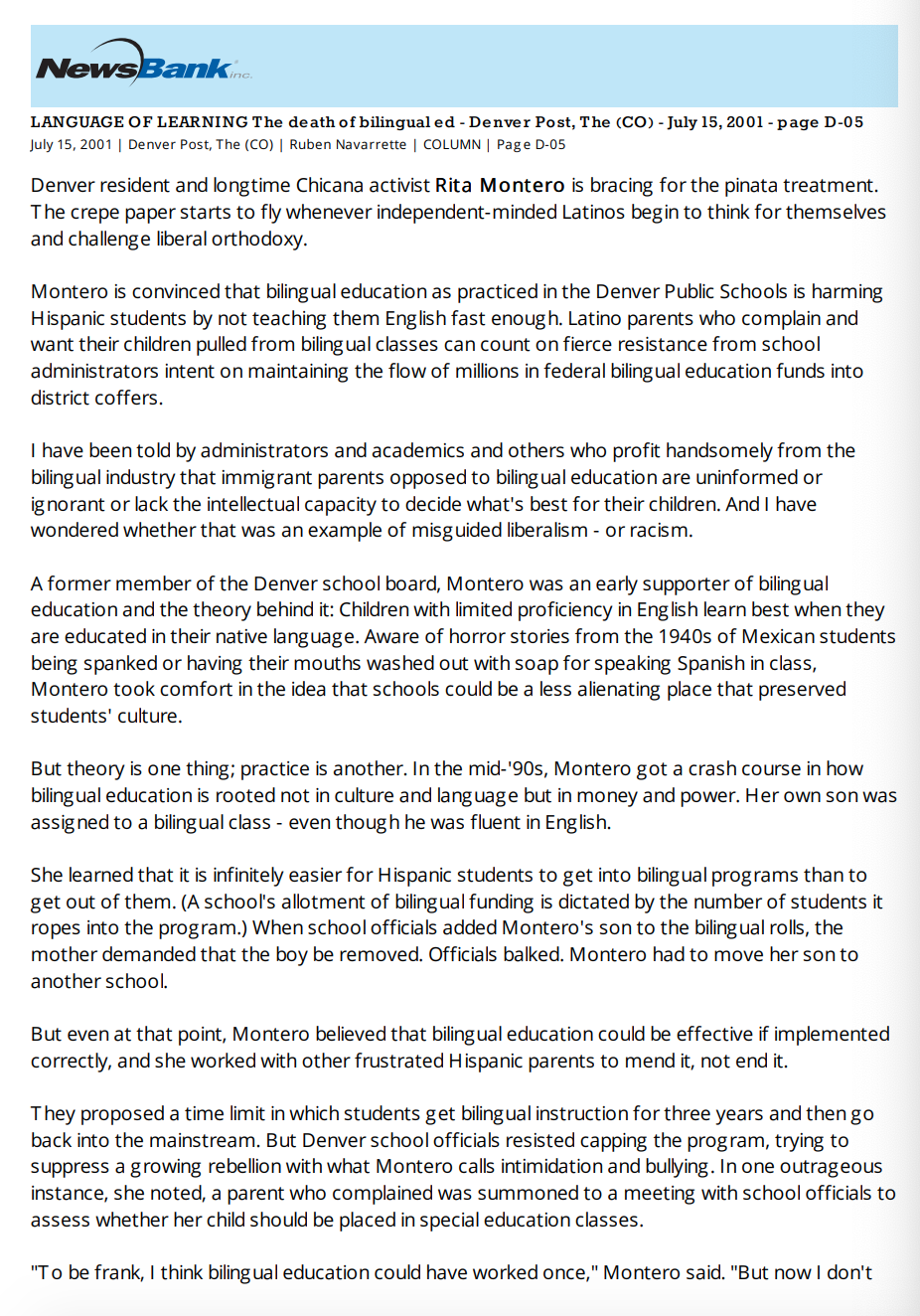
Montero and Parents Against Bilingual Education”,2001
LHP_Intern2022-03-29T00:53:47+00:00“Montero and Denver Public School parents against bilingual education” by Ruben Navarrette, 07-15-2001
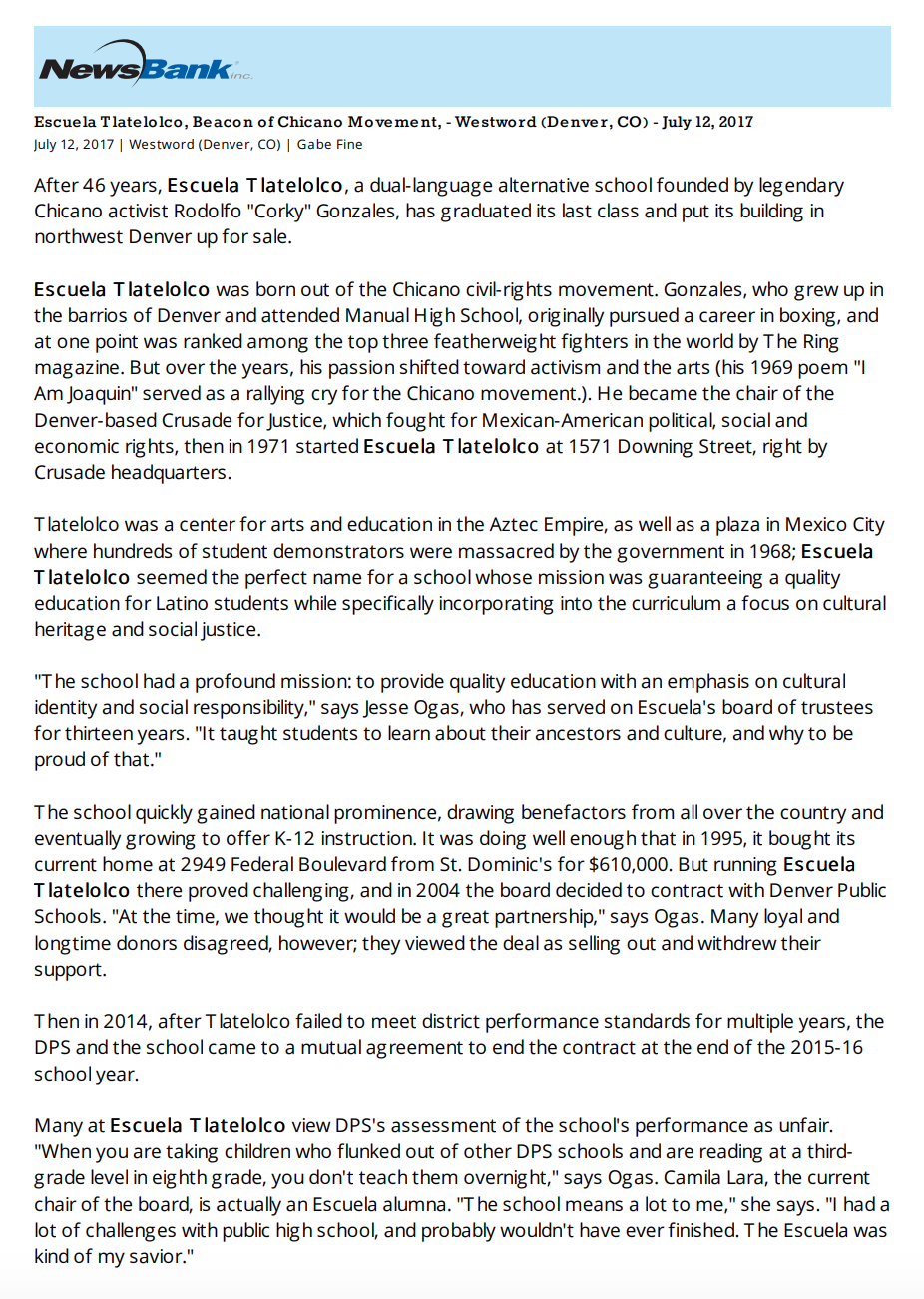
“Escuela Tlatelolco closes”, 2017
LHP_Intern2022-03-29T00:53:47+00:00“Escuela Tlatelolco a legendary school for the chicano movement closes after 46 years”,by Gabe Fine, 07-12-2017
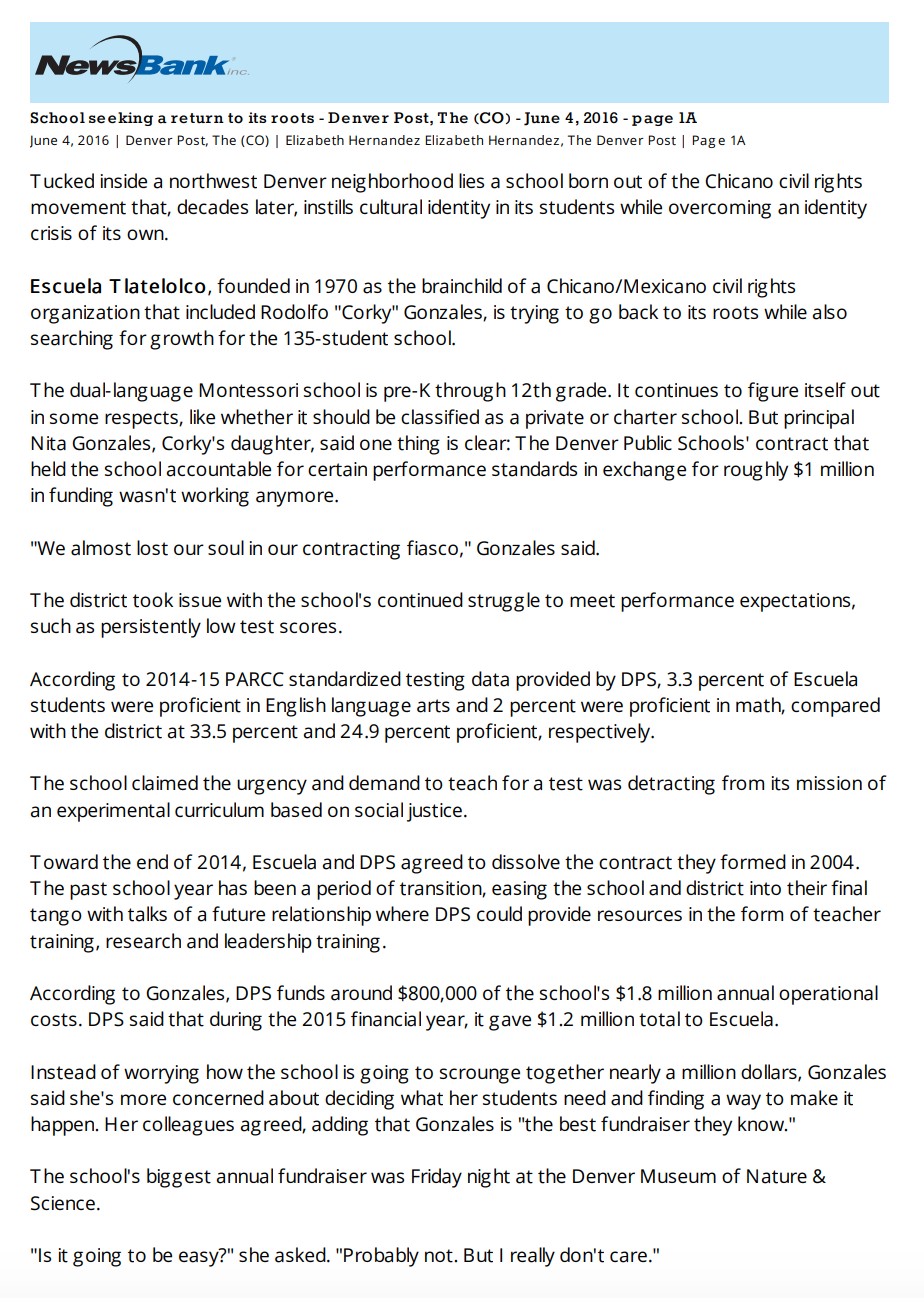
“Escuela Tlatelolco connection to chicano movement”, 2016
LHP_Intern2022-03-29T00:53:47+00:00“Escuela Tlatelolco connection to chicano civil rights movement and its performance struggles”, by Elizabeth Hernandez, 06-04-2016
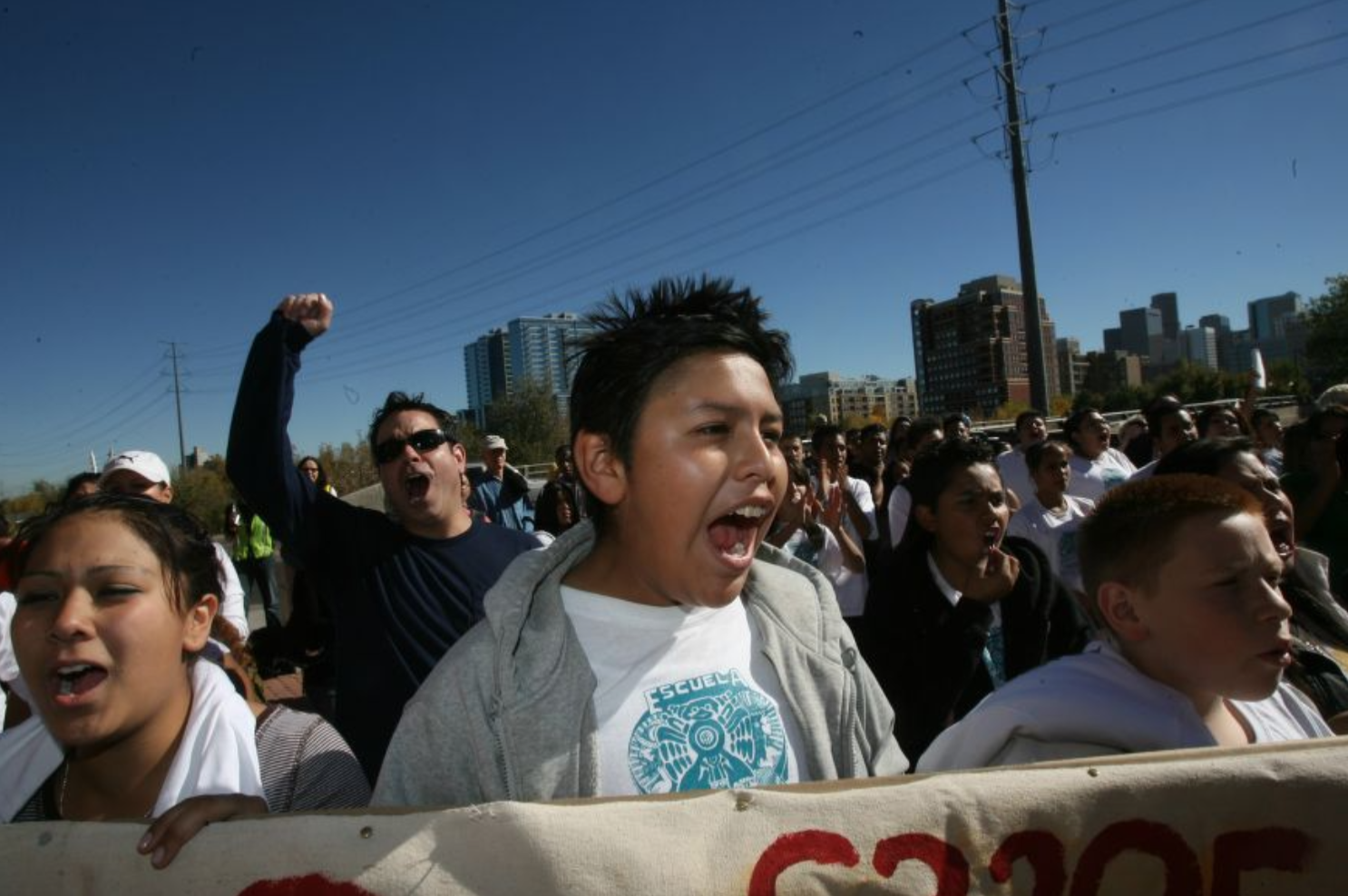
“Escuela Tlatelolco students march for the Dream Act”, 2007
LHP_Intern2022-03-29T00:53:47+00:00“Escuela Tlatelolco students march to Senator Salazar’s office for the pass of the Dream Act”, by Javier Manazano, 10-24-2007
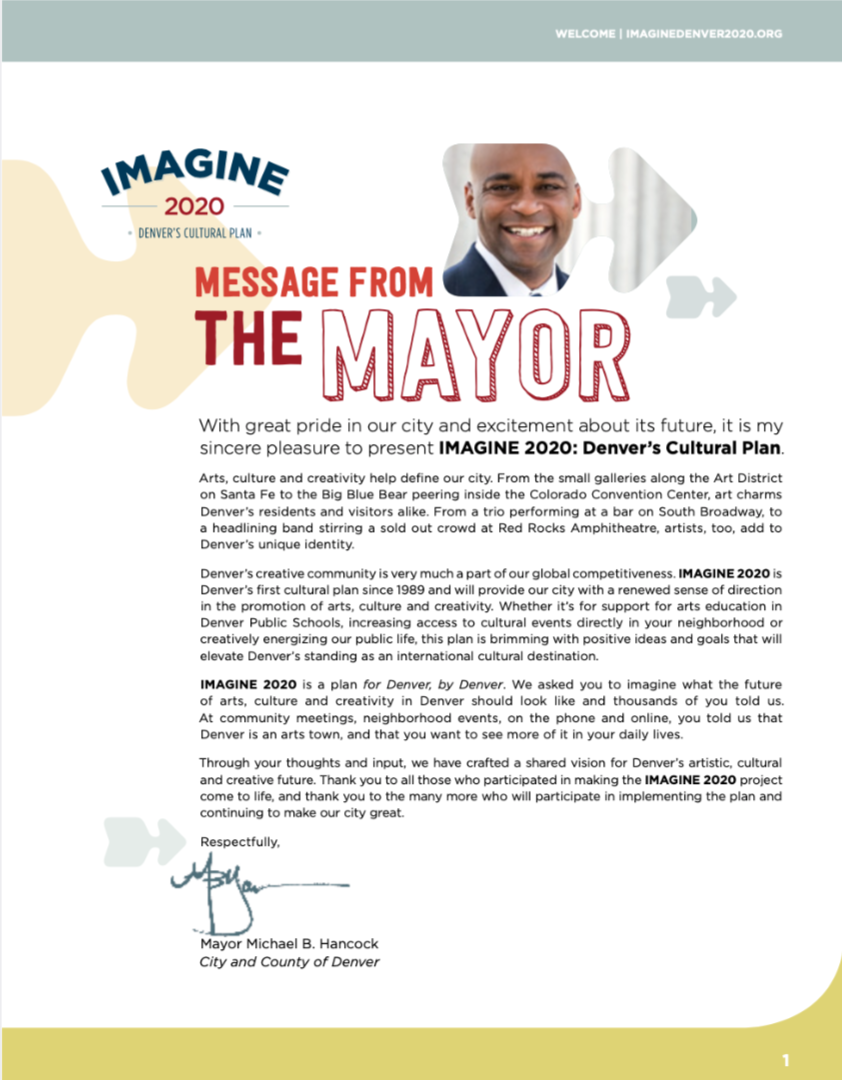
“Denvers Cultural Plan – Santa Fe Art District”,2017
LHP_Intern2022-03-29T00:53:25+00:00“Denvers Cultural Plan and vision for Arts and Venues- Santa Fe Art District”,2017
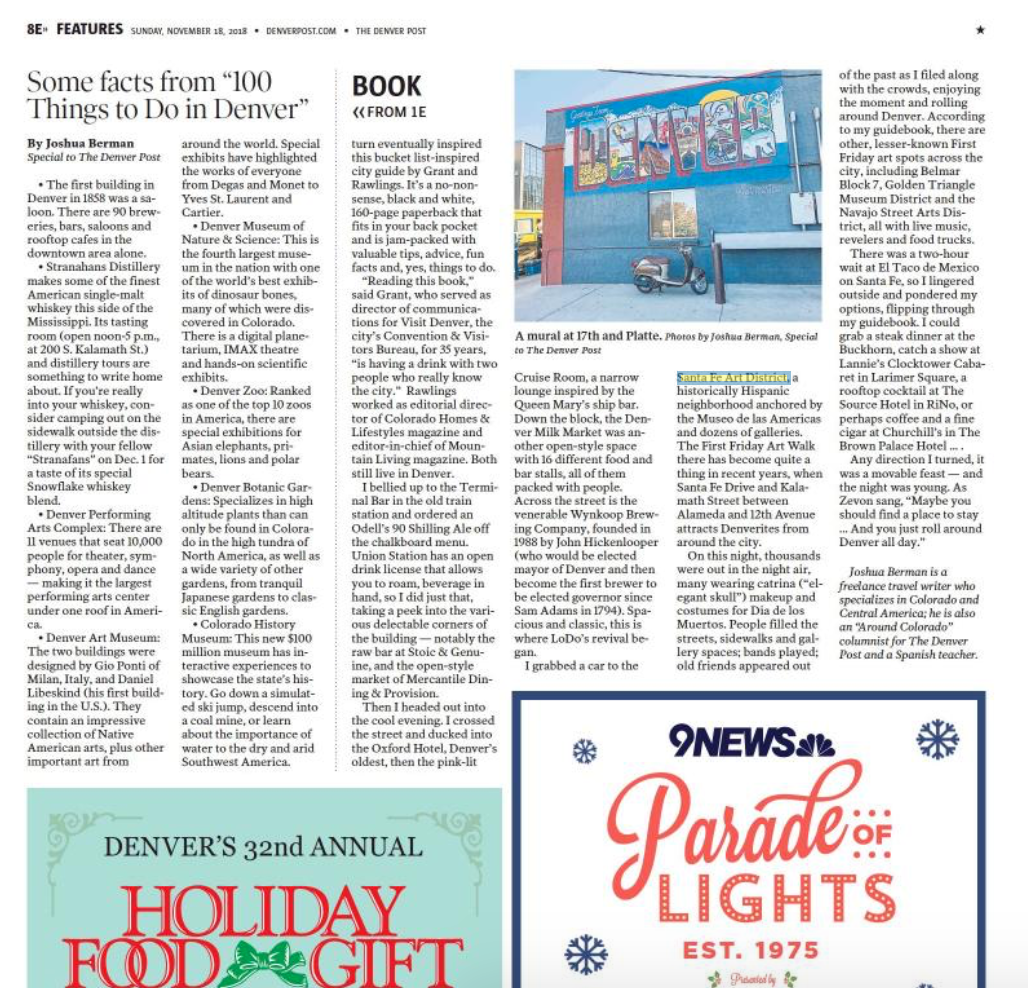
“Santa Fe Art District historical Hispanic history”, 2018
LHP_Intern2022-03-29T00:53:25+00:00“Santa Fe Art Districts historical Hispanic history and First Fridays”, by Joshua Berman, 11-18,2018
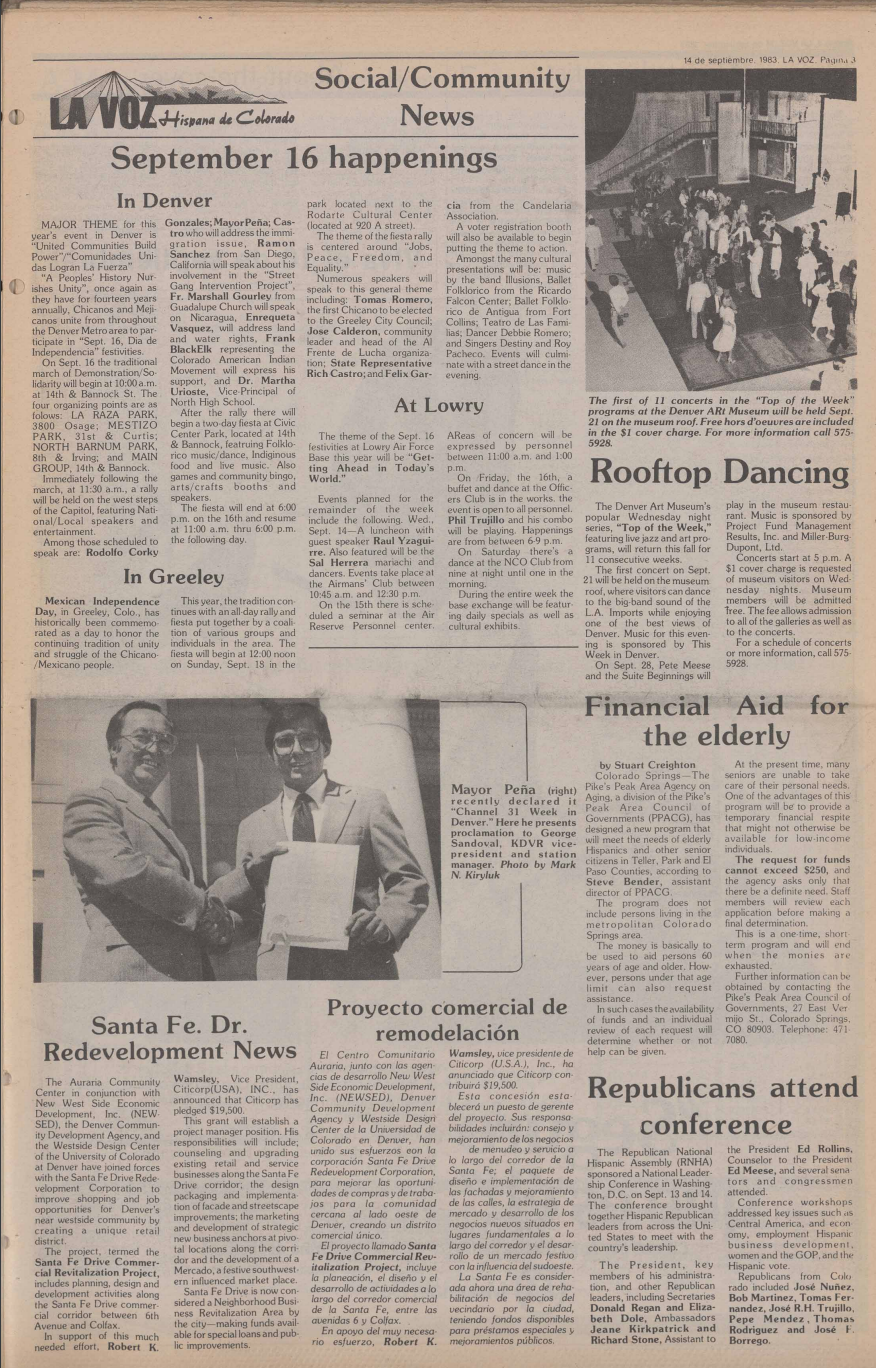
“Santa Fe Drive Revitalization Project”, 1983
LHP_Intern2022-03-29T00:53:24+00:00“Plans for Santa Fe Drive Commercial Revitalization Project”, 09-14-1983
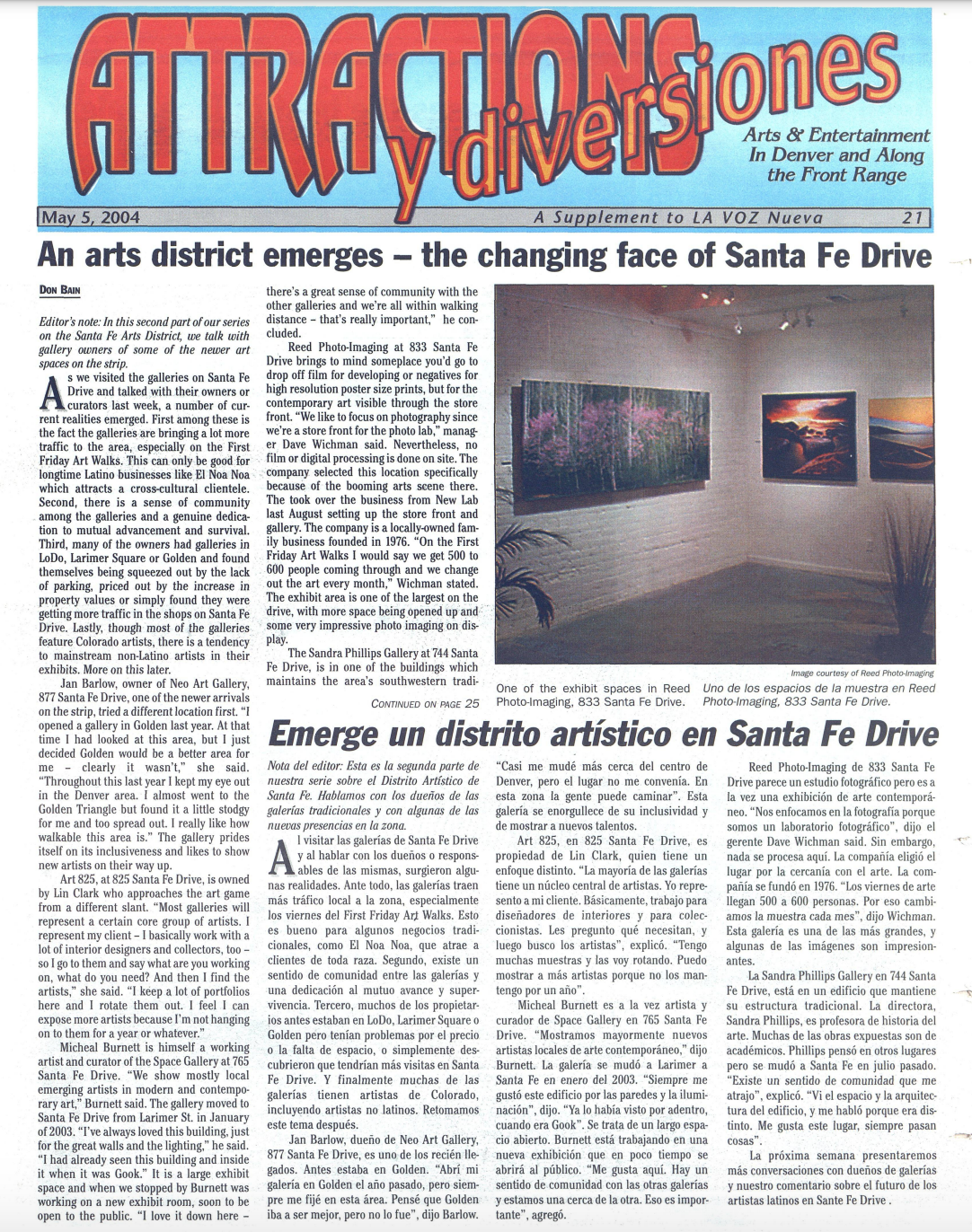
“Santa Fe Drive Art District Growth”, 2004
LHP_Intern2022-03-29T00:53:24+00:00“Santa Fe Drive Art district growth on Santa Fe Drive”, 05-05-2004
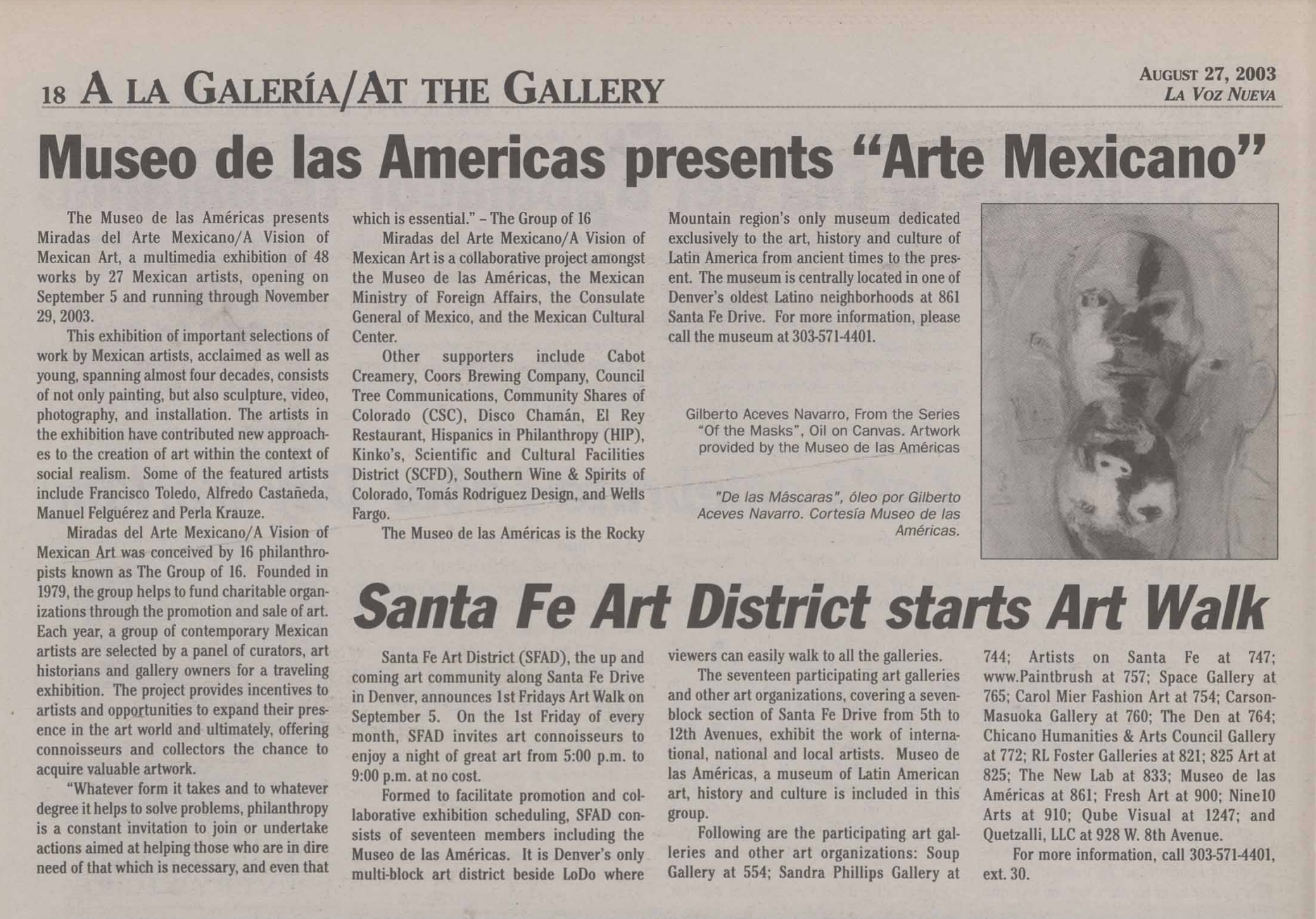
“Museo de las Americas celebrates Mexican artists”, 2003
LHP_Intern2022-03-29T00:53:24+00:00“Museo de las Americas on Santa Fe celebrates Mexican artists”,08-27- 2003
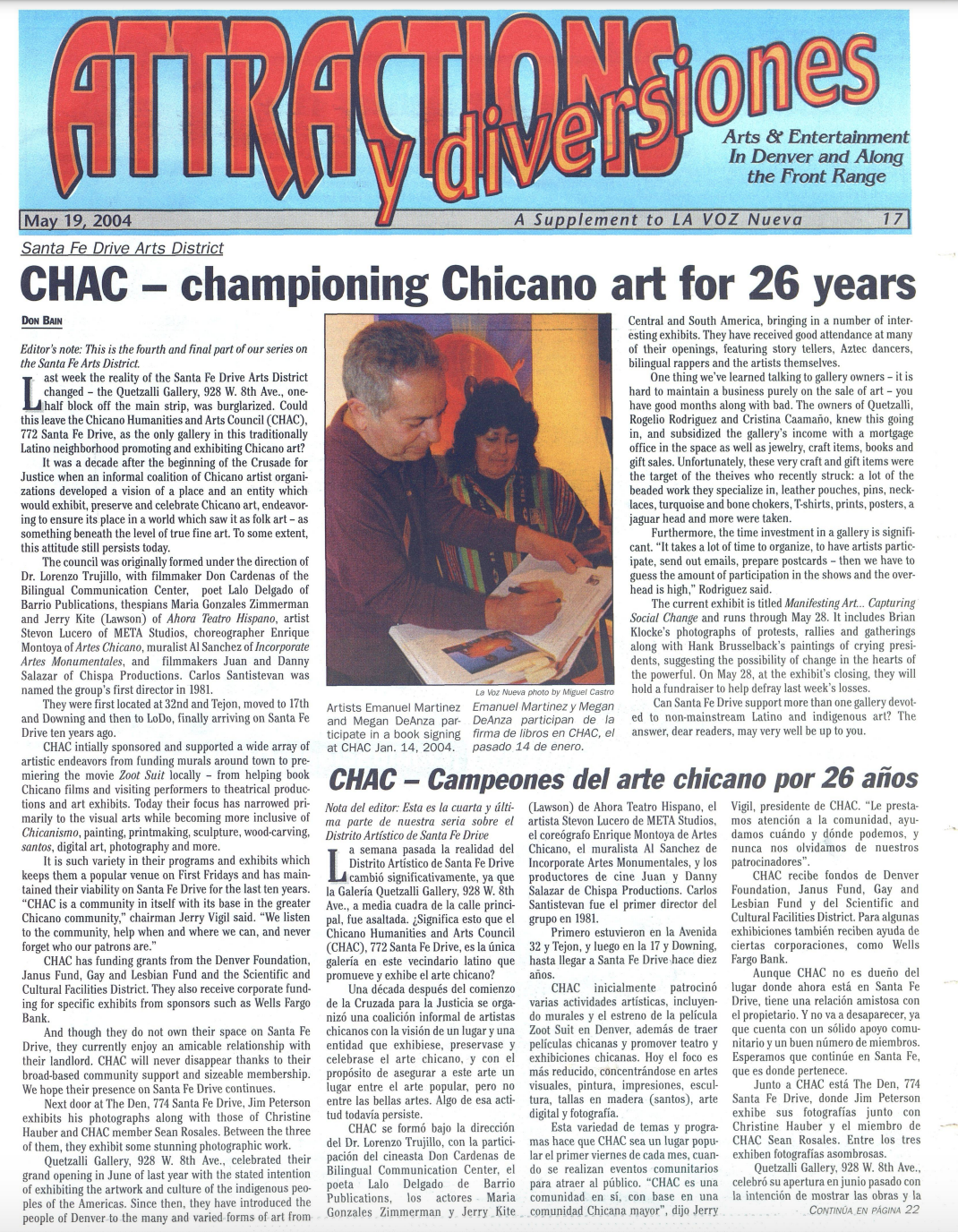
“Santa Fe Drive celebrates Chicano art”, 2004
LHP_Intern2022-03-29T00:53:24+00:00“Santa Fe Drive one of few galleries celebrates Chicano art”, 05-19-2004
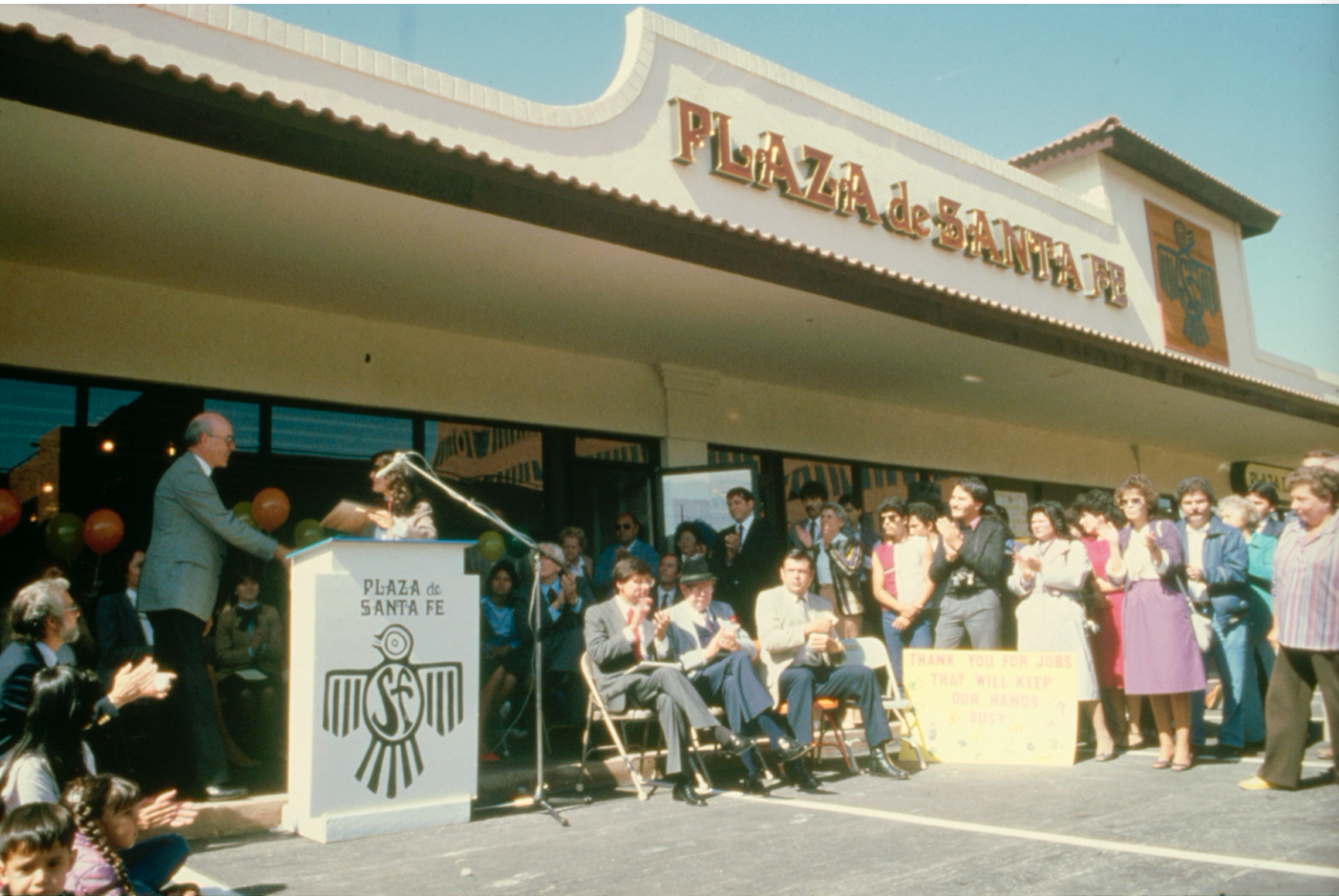
“Santa Fe Drive chicano history and movement”, 2018
LHP_Intern2022-03-29T00:53:24+00:00“Santa Fe Drive chicano history and movement and art development”, by Kevin Beaty, 08-06-2018
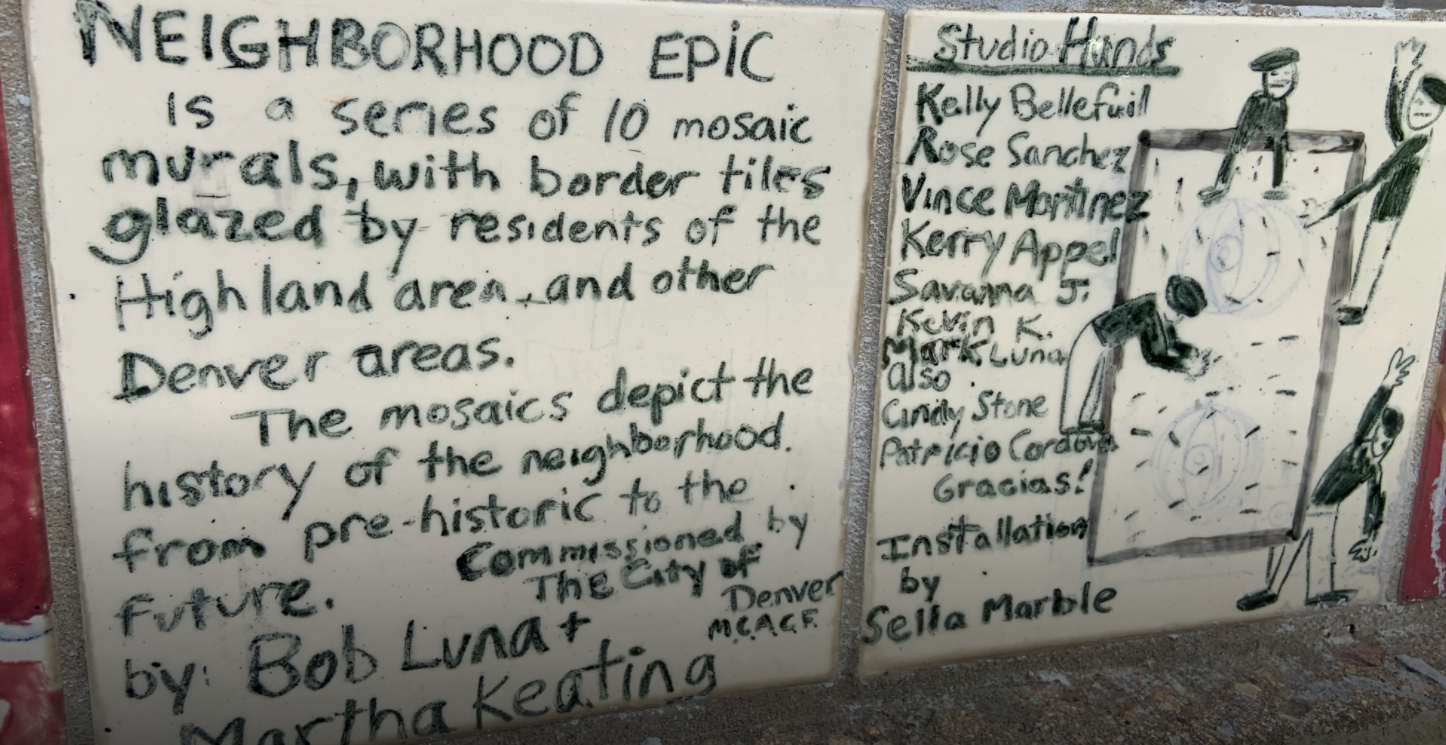
Neighborhood Epic, 1993
LHP_Intern2022-03-29T00:53:23+00:00A series of 10 mosaic murals, with border tiles glazed by Highland residents, By Bob Luna and Martha Keating, Denver, 1993
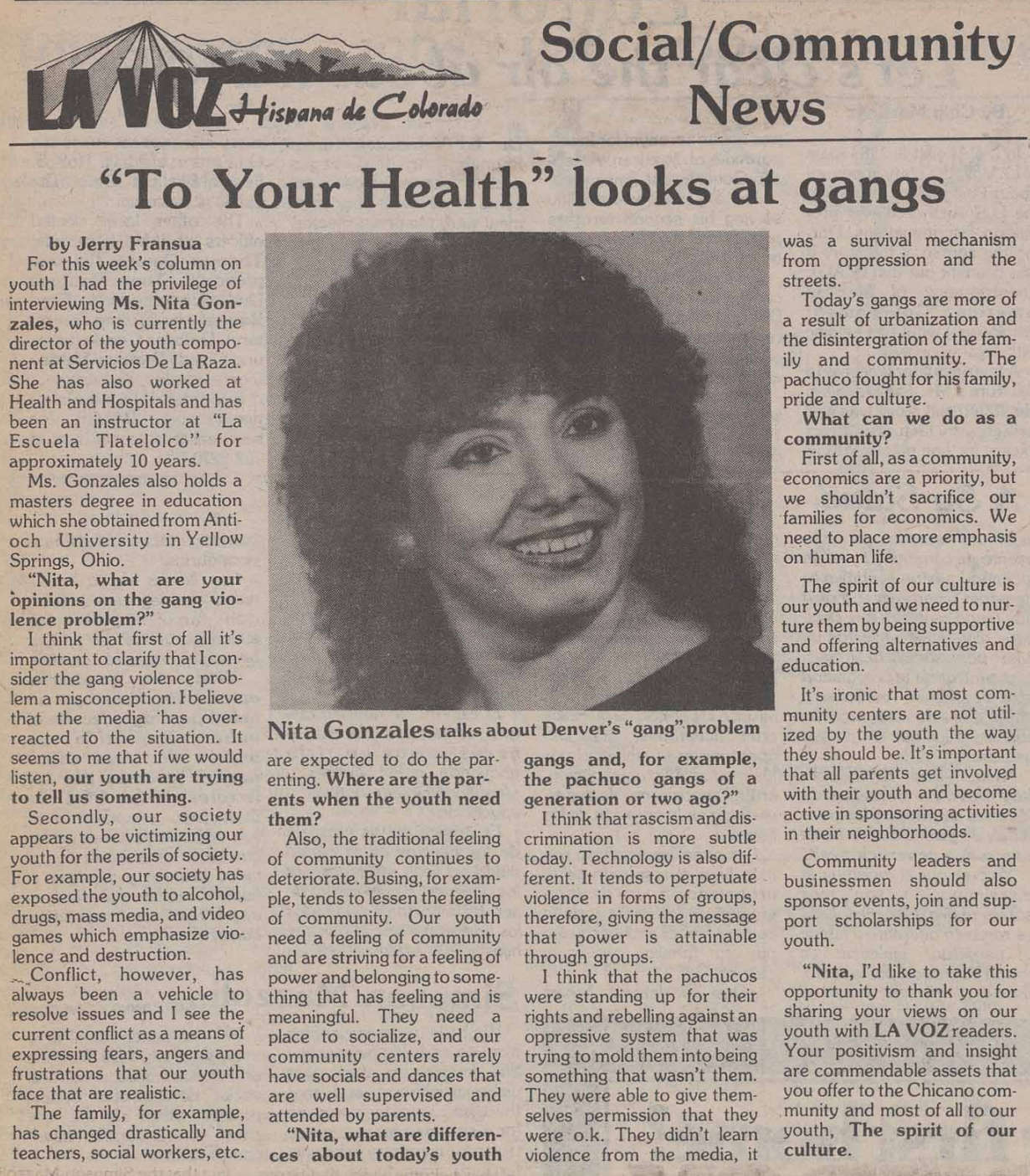
“To Your Health Looks at Gangs”, 1983
LHP_Intern2022-03-29T00:53:23+00:00Jerry Fransua interviews Nita Gonzales on the issue of gangs, in which Nita cites busing as a cause, by Jerry Fransua, Denver, 9-7-1983
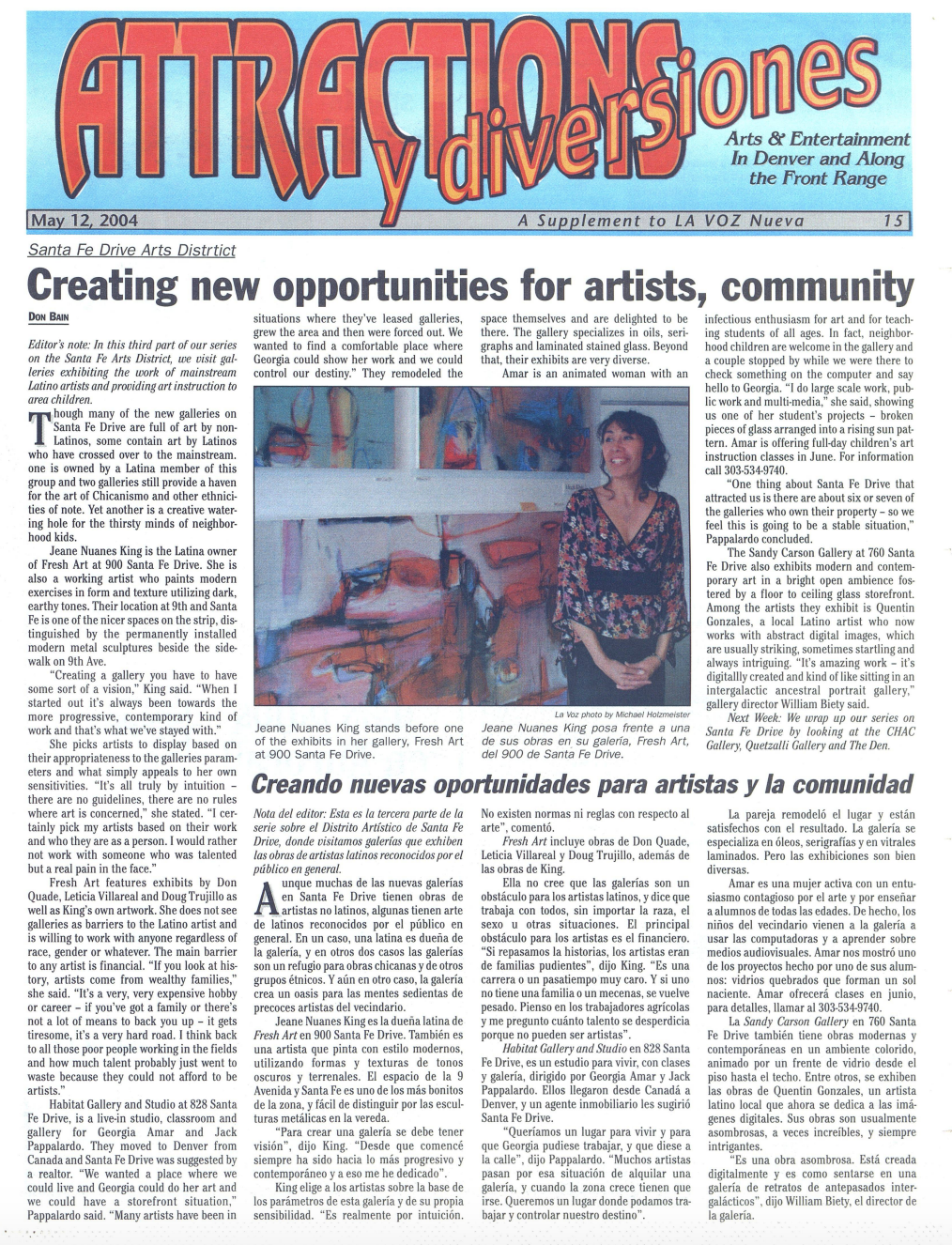
“Santa Fe Drive new opportunties for artists”, 2004
LHP_Intern2022-03-29T00:53:23+00:00“Santa Fe Drive provides new opportunties for artists to exhibit work”, 05-14-2004
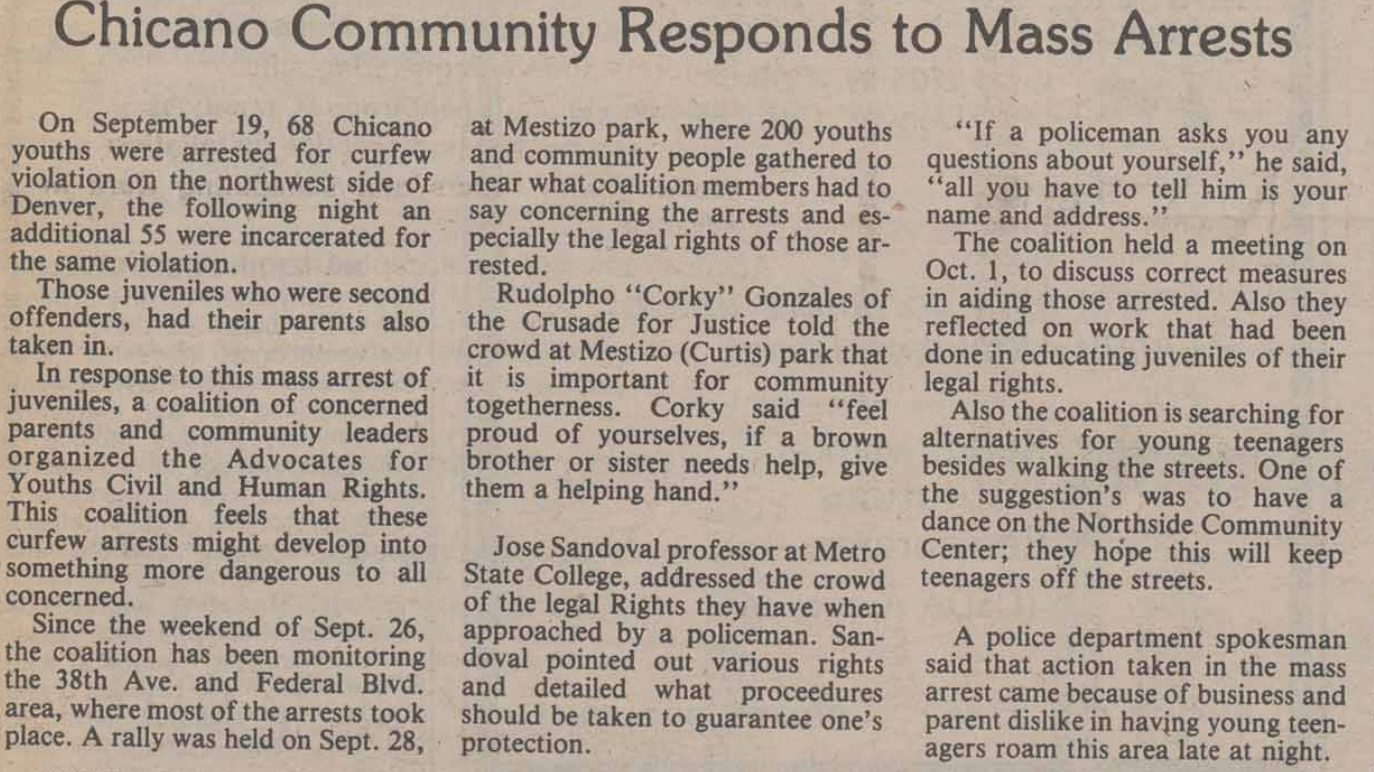
“Chicano Community Responds to Mass Arrests”, 1980
LHP_Intern2022-03-29T00:53:04+00:00An article on mass arrests of Chicano Youths in Northside and the communities’ reaction, Denver, 10-3-1980
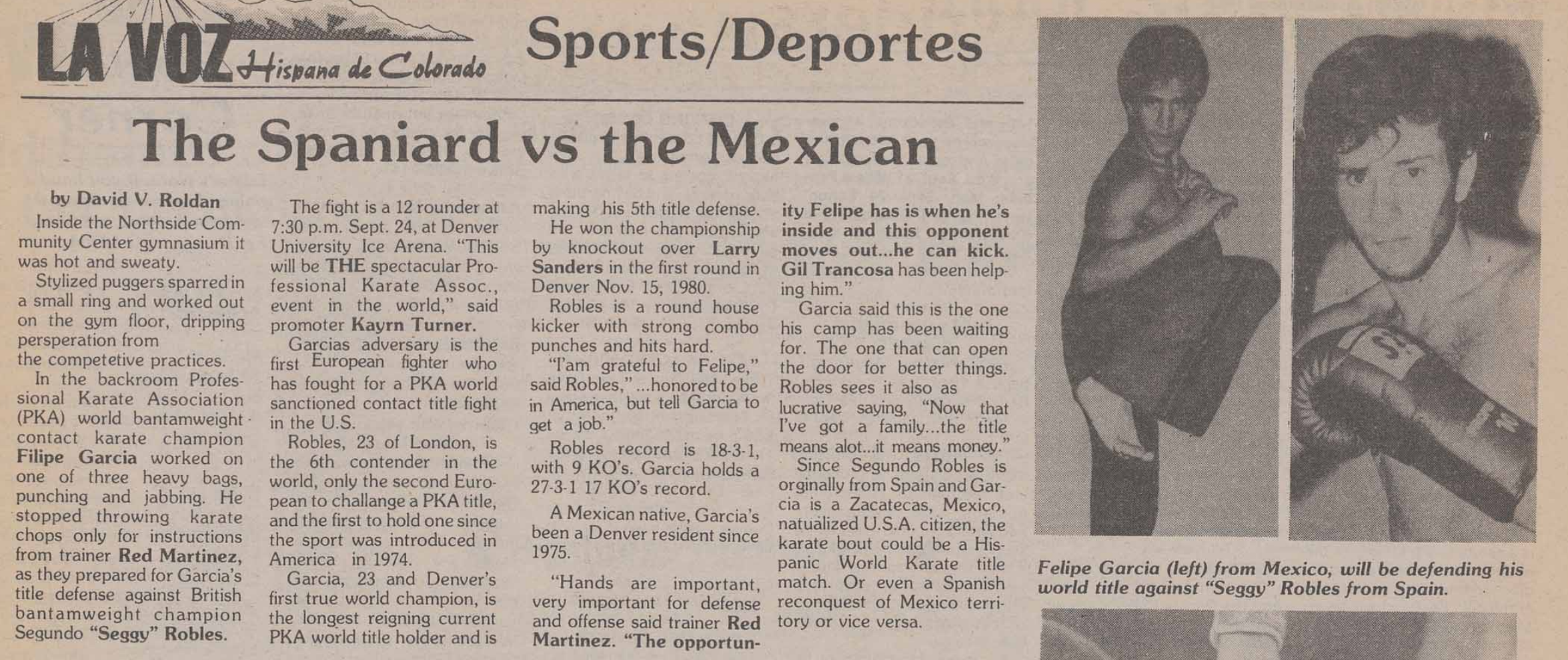
“The Spanish Vs. The Mexican”, 1983
LHP_Intern2022-03-29T00:53:04+00:00Article on the Professional Karate Association training at the Northside Community Center for a match, By, David B. Roland, Denver, 9-21-1983
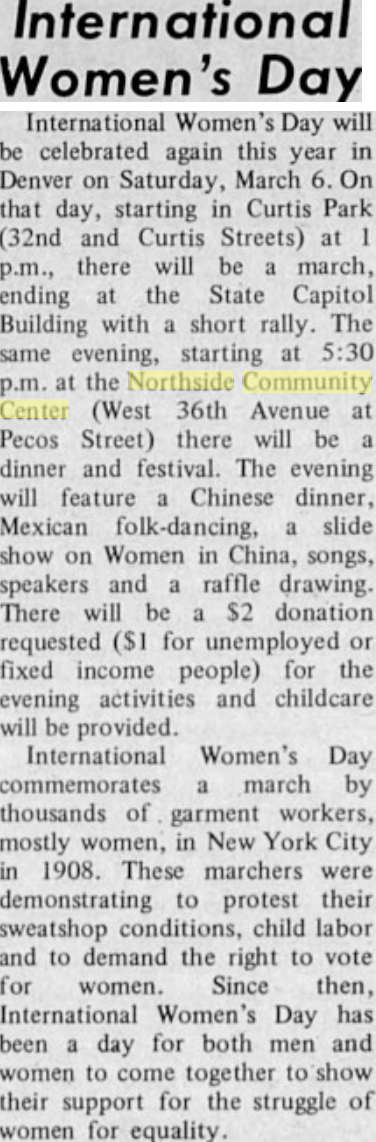
“International Women’s Day”, 1976
LHP_Intern2022-03-29T00:53:03+00:00Article on a celebration taking place at the Northside Community Center, Denver, 3-3-1976
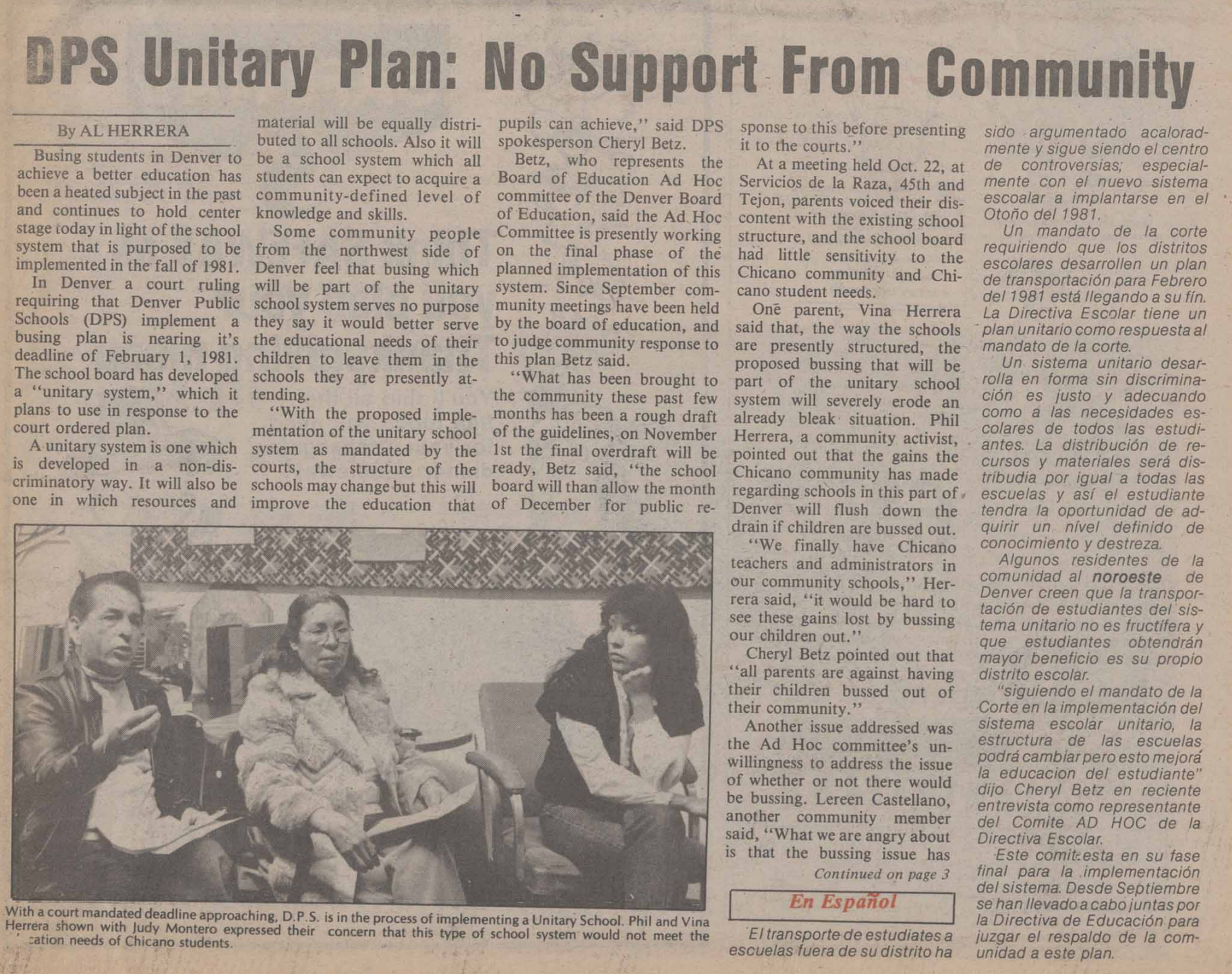
“Unitary Plan: No Support”, 1980
LHP_Intern2022-03-29T00:53:03+00:00“DPS Unitary Plan:No Support From Community”, By Al Herrerra, Denver, 11-1-1980
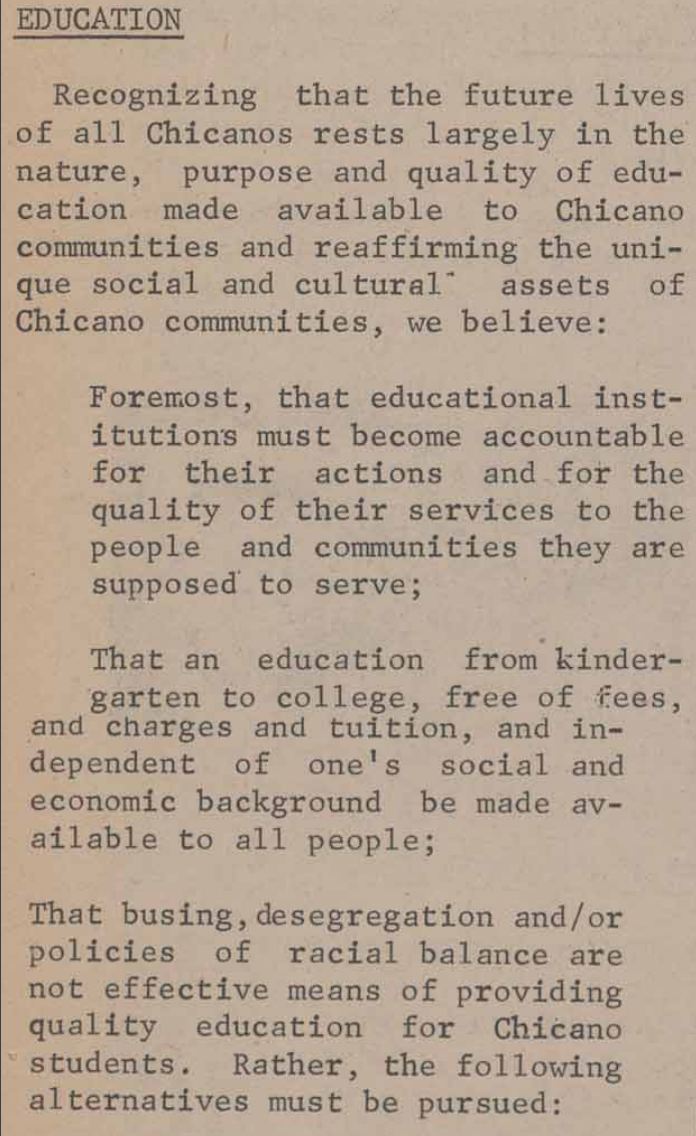
“La Raza Party Platform”, 1972
LHP_Intern2022-03-29T00:59:27+00:00“Raza Unida Part Platform/ Education”, By Raza Party, 10-1-1972
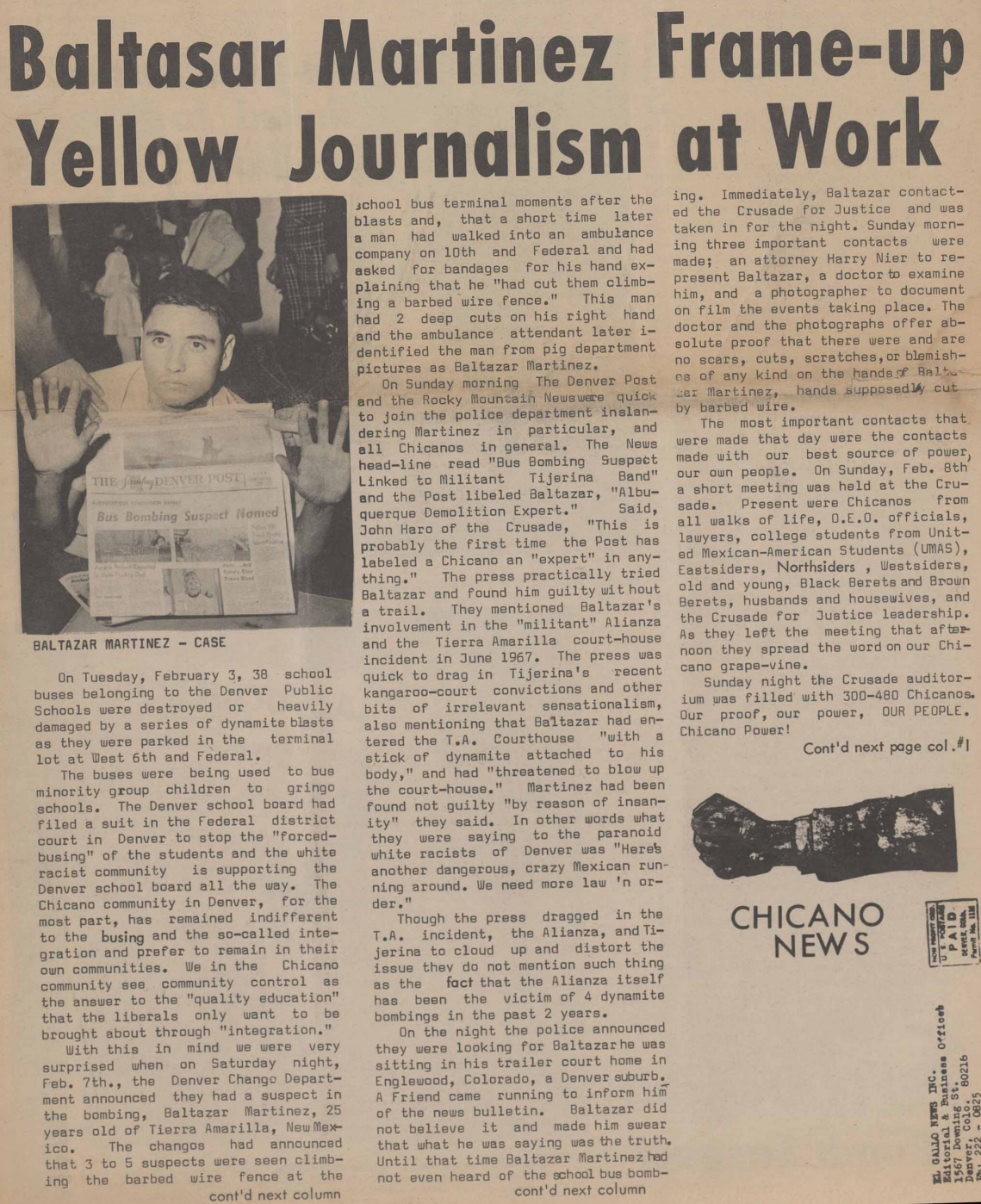
“Baltasar Frame-up”, 1970
LHP_Intern2022-03-29T00:53:03+00:00“Baltasar Martinez Frame-up Yellow Journalism at Work”, By El Gallo, 8-1-1970
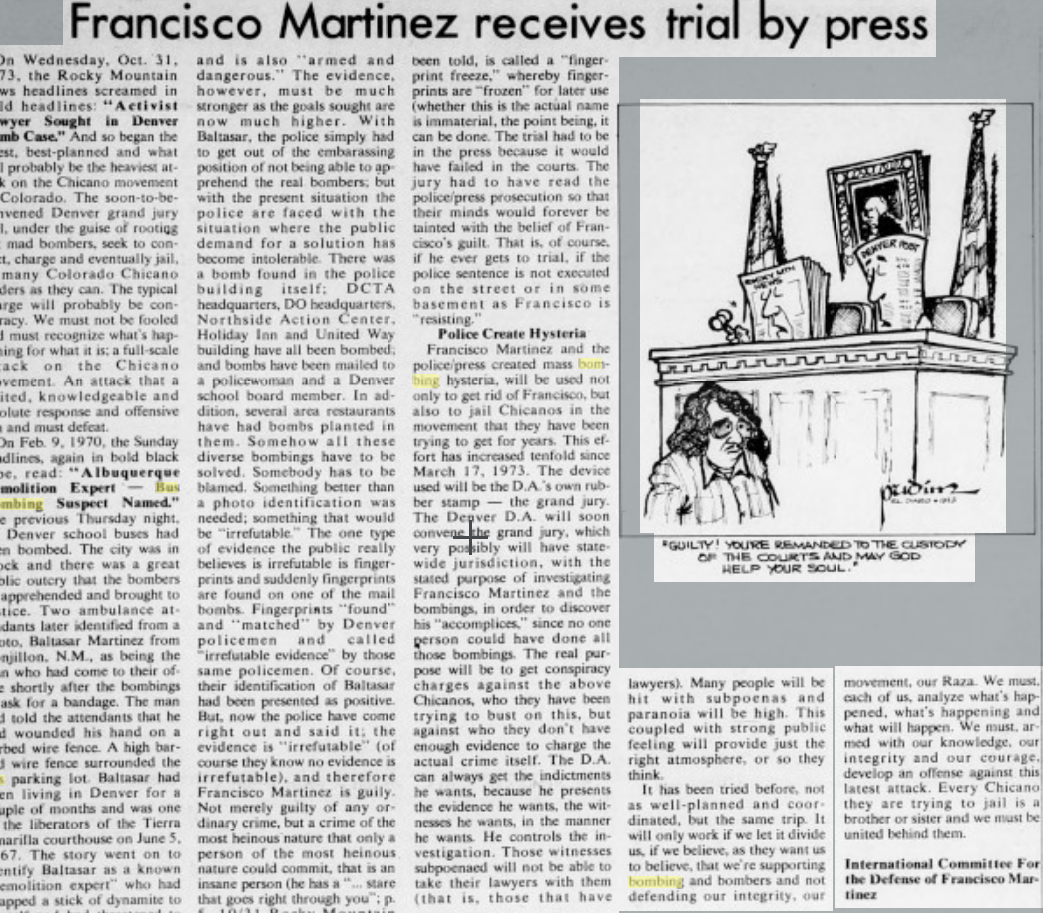
“Francisco Martinez Trial”, 1973
LHP_Intern2022-03-29T00:53:03+00:00“Franicisco Martinez Recieves Trial by Press”, Denver, 11-9-1973
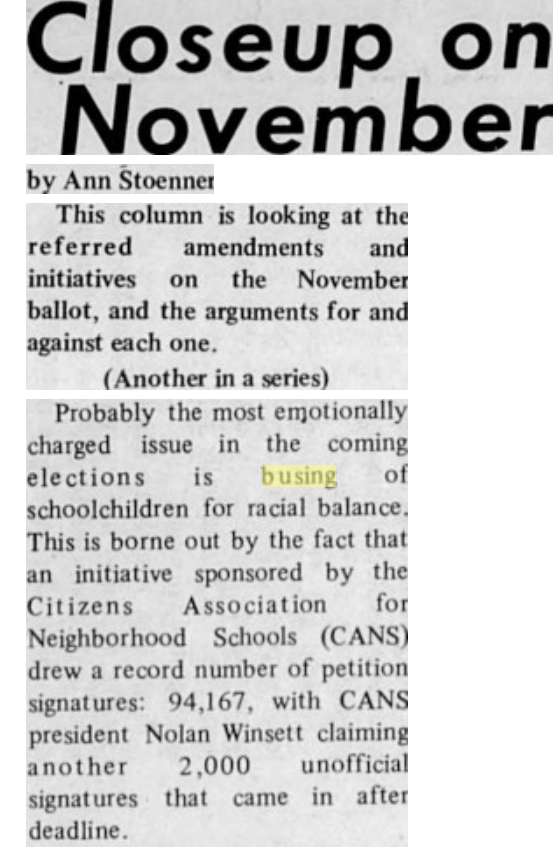
“Close Up on November”, 1974
LHP_Intern2022-03-29T00:53:02+00:00“Close up on November”, looking at amendments and the argument for and against them, by Anne Stoenner, Denver, 7-31-1974
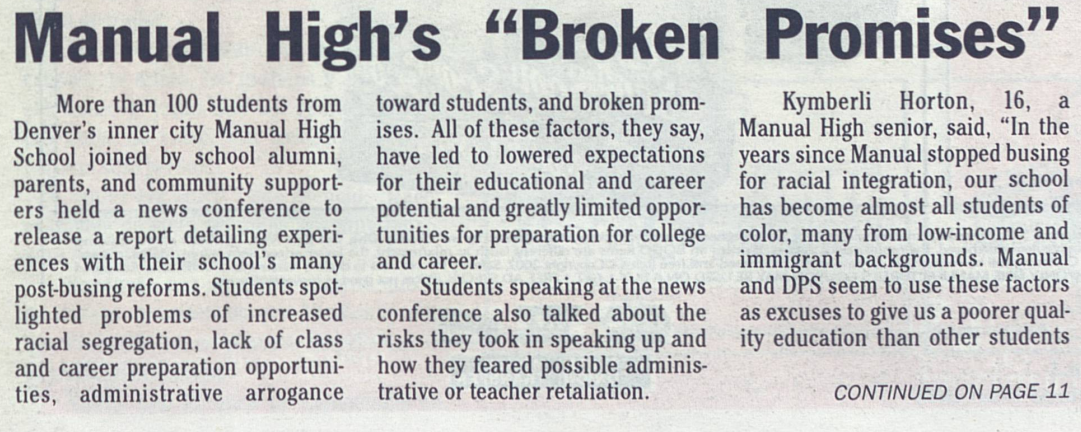
“Manual High”, 2002
LHP_Intern2022-03-29T00:53:02+00:00“Manual High’s “Broken Promises”, Denver, 8-14-2002
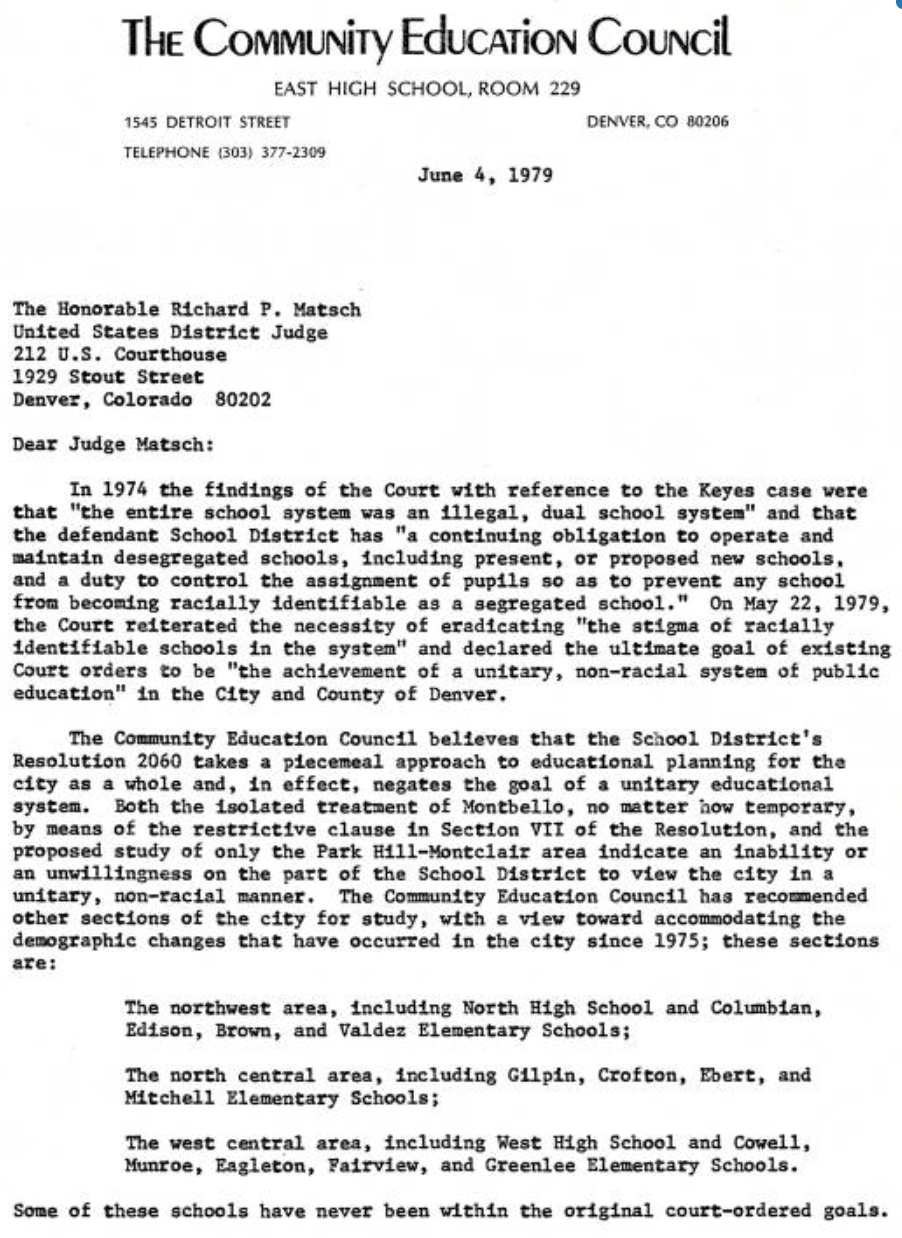
Letter from Francisco Ríos, 1979
LHP_Intern2022-03-29T00:53:02+00:00Letter from Francisco Ríos to Judge Richard P. Matsch regarding education planning and transportation in relation to Resolution 2060, by Francisco Rios, Denver, 6-4-1979
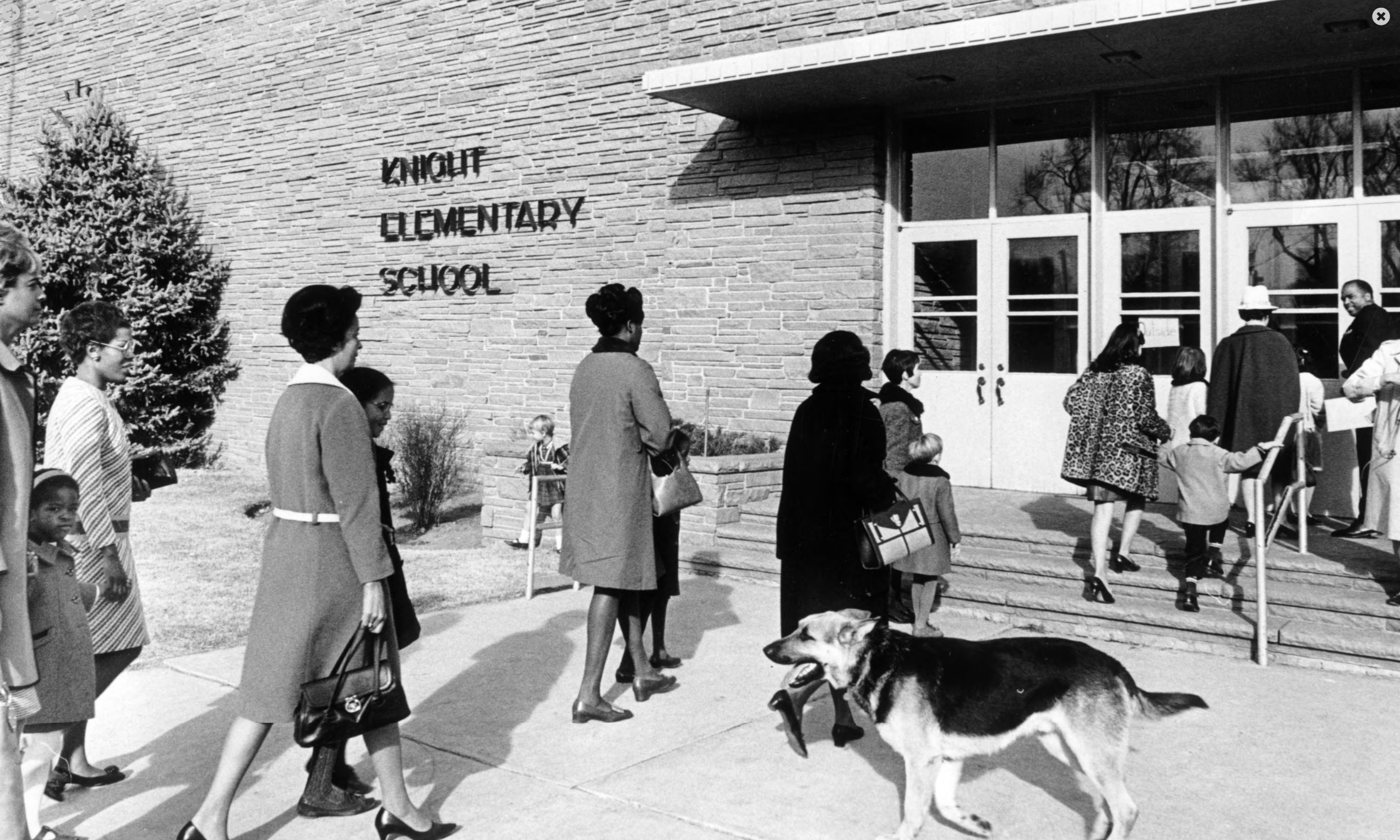
Photo of People Entering Knight Elementary School, 1969
LHP_Intern2022-03-29T00:53:02+00:00A photo of Integrated school board meeting on busing issue, Denver, 1-14-1969
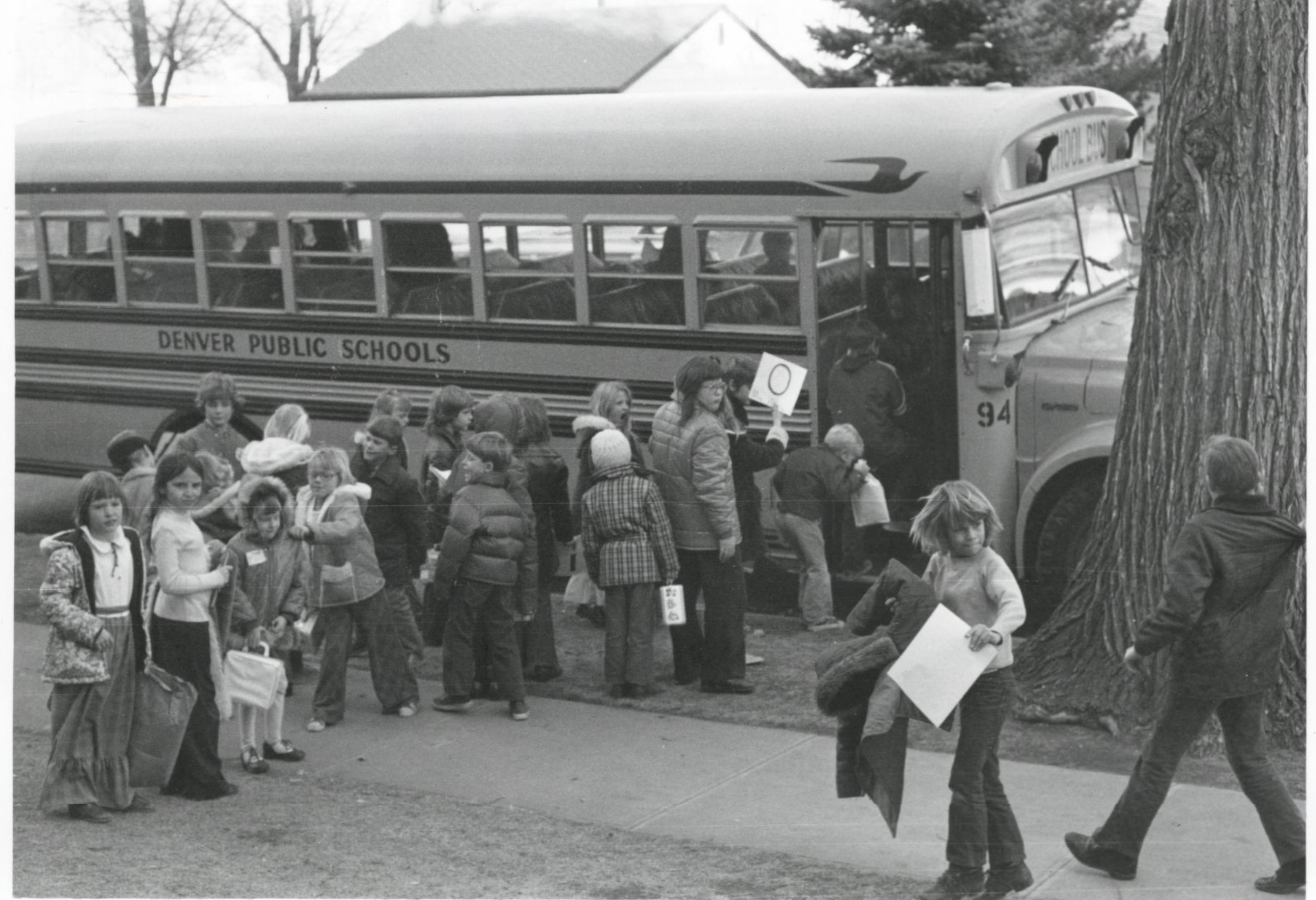
Eagleton School desegregation student busing, circa 1970
LHP_Intern2022-03-29T00:53:01+00:00Photograph of several students standing in line waiting to board the bus as part of the Denver Public Schools desegregation busing system, Denver, circa 1970
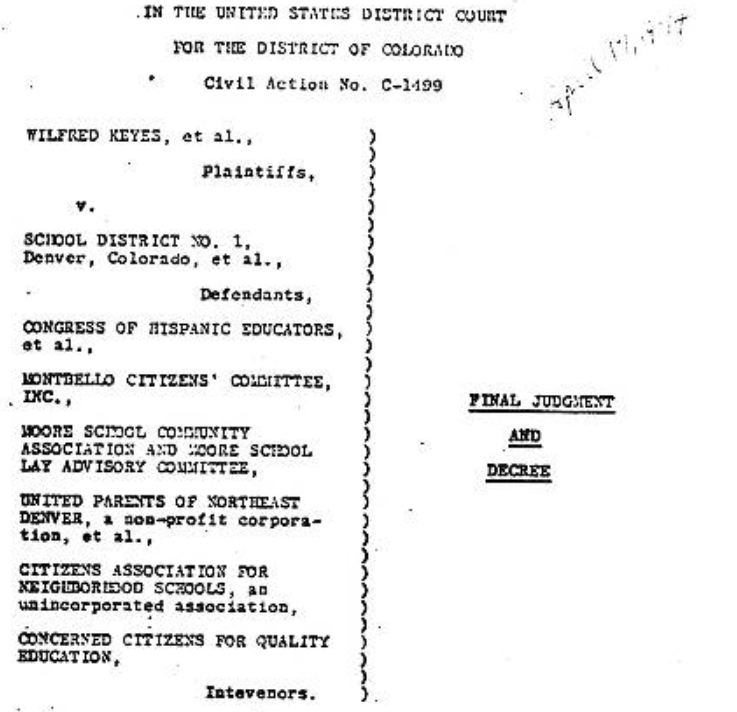
Keyes v. School Distrct #1, Denver, 1974
LHP_Intern2022-03-29T00:53:01+00:00Copy of legal document of the 1974 Civil Action No. C-1499 Keyes v. School District No. 1, Denver, 4-17-1974
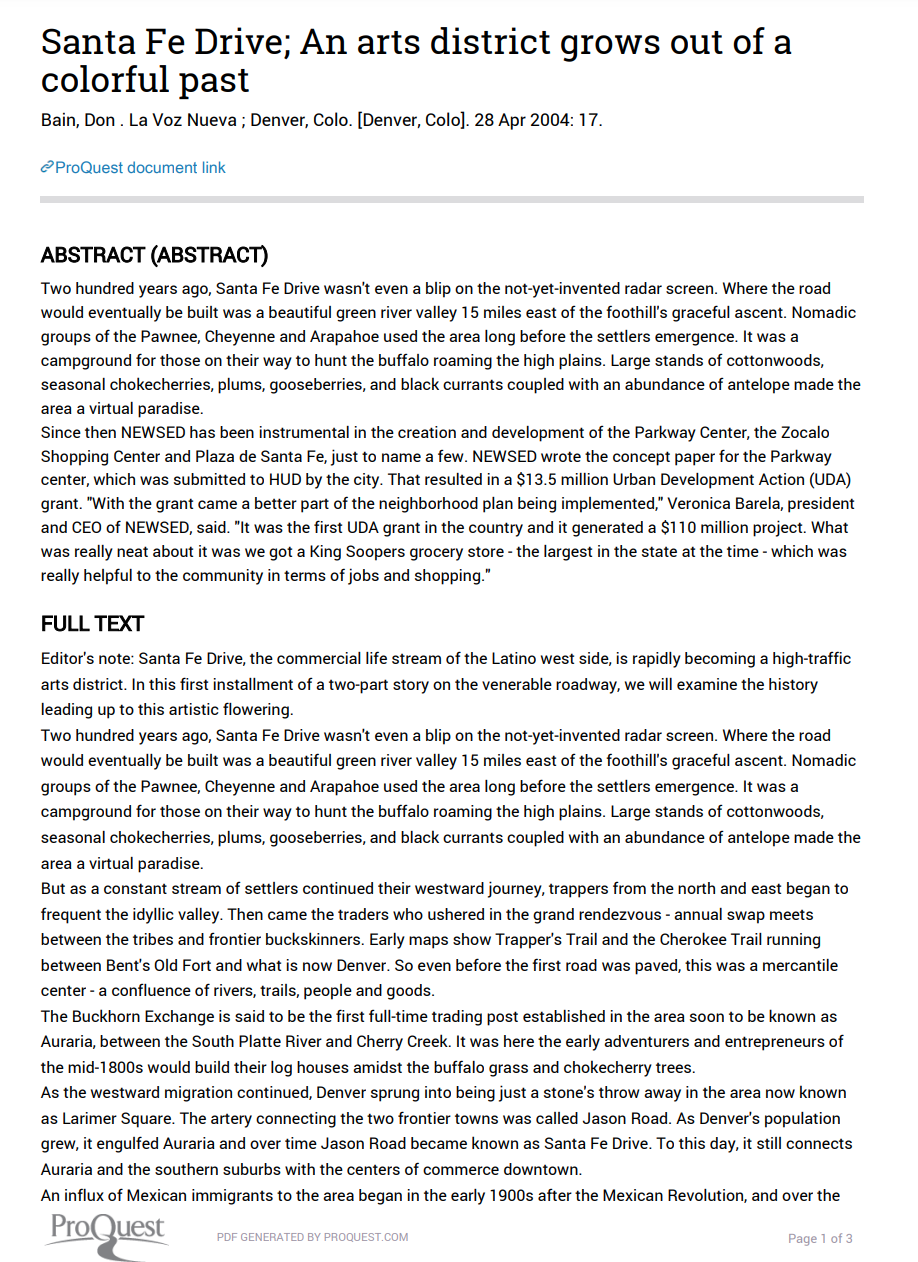
“Santa Fe Artist District history and past”,2004
LHP_Intern2022-03-29T00:53:01+00:00“Santa Fe Artist District Latino history and how it started”, by Don Bain 04-28-2004
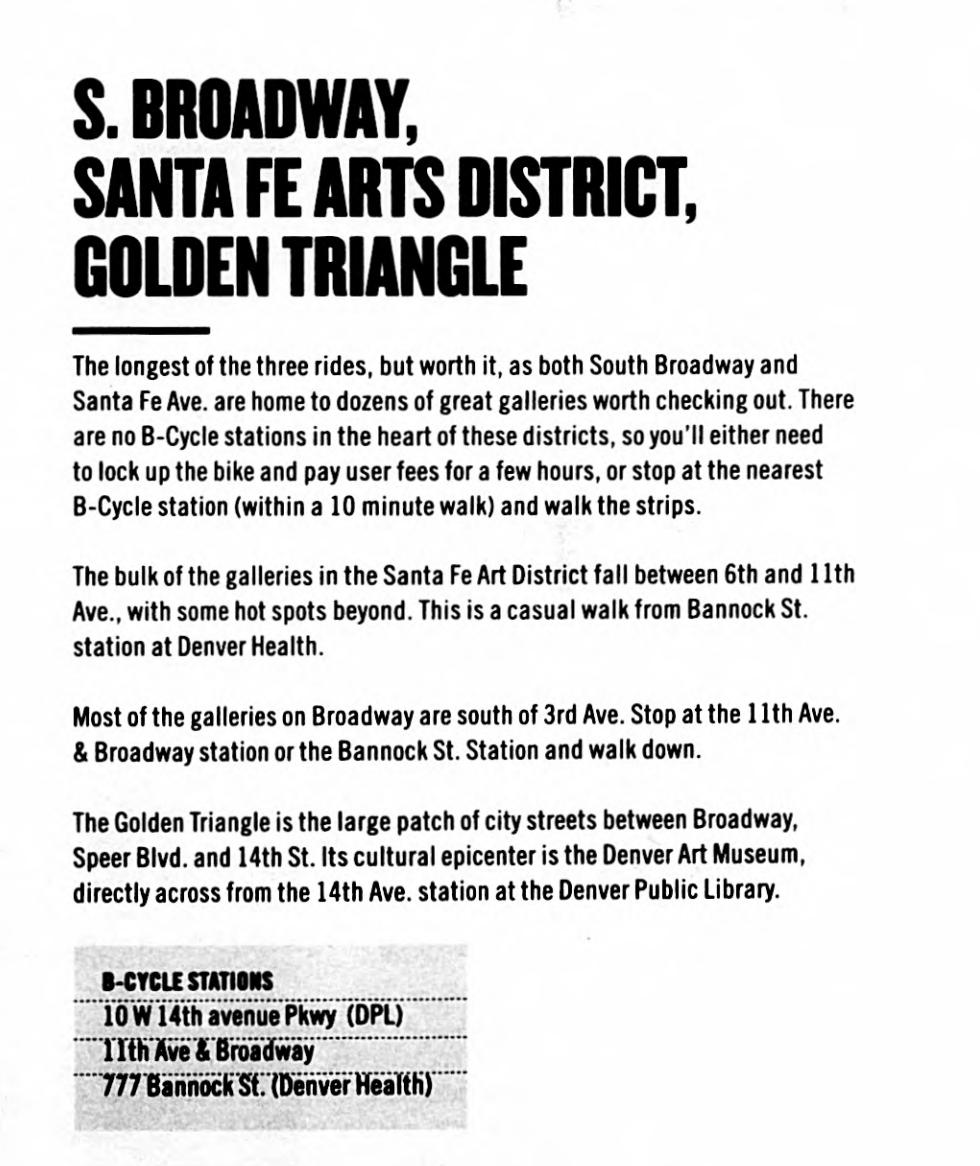
“Santa Fe Art District gallery walks”,2011
LHP_Intern2022-03-29T00:53:00+00:00“Santa Fe Art District provides many gallery walks and is close to many districts”,06-01-2011

“Santa Fe Art District and its past”, 2004
LHP_Intern2022-03-29T00:53:00+00:00“Santa Fe Art District and its past to many cultural communities” , 04-28-2004
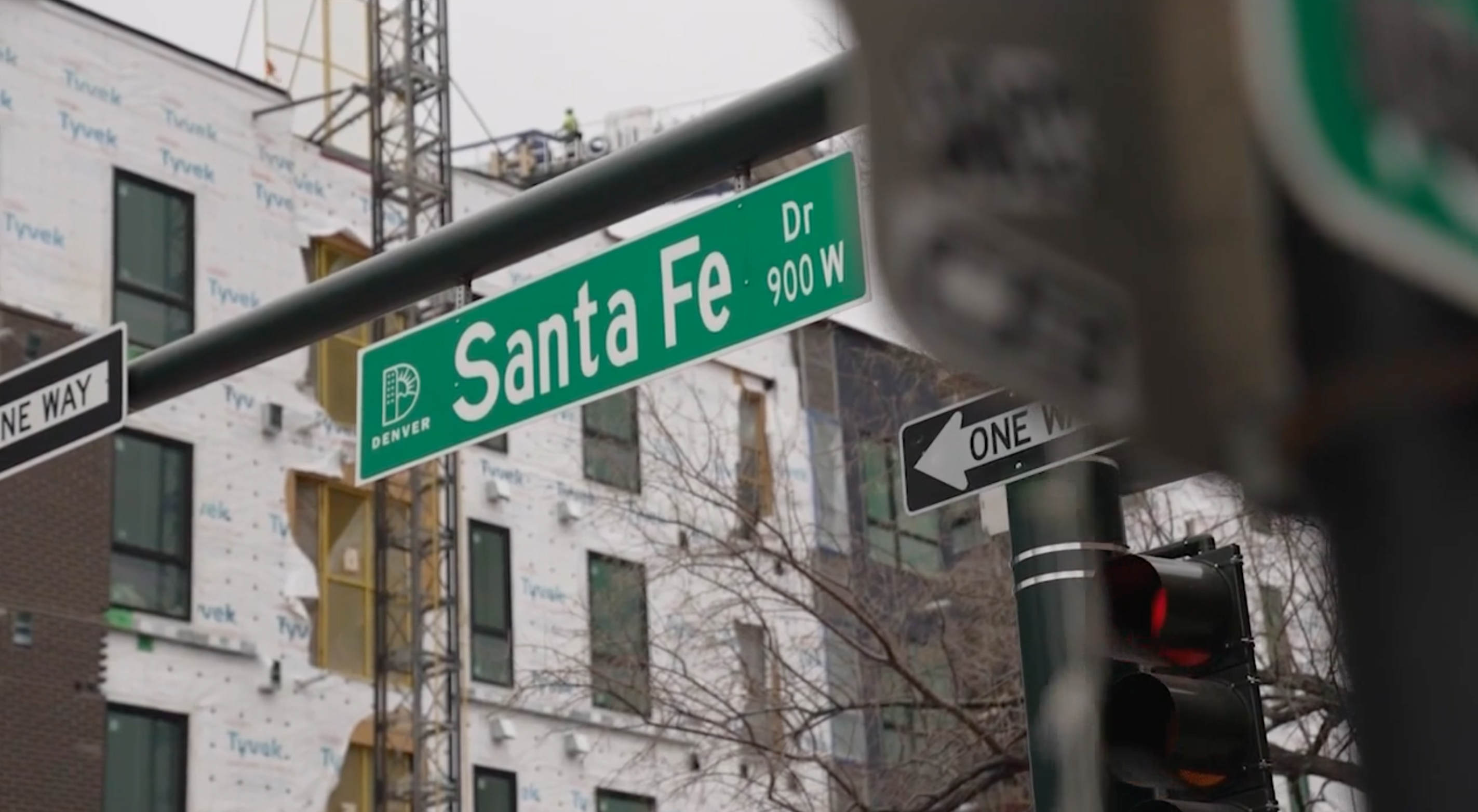
“Art movement moves away from Santa Fe”, 2022
LHP_Intern2022-03-29T00:53:00+00:00“Art movement moves away from Santa Fe District due to buildings being sold “, 03-04-2022
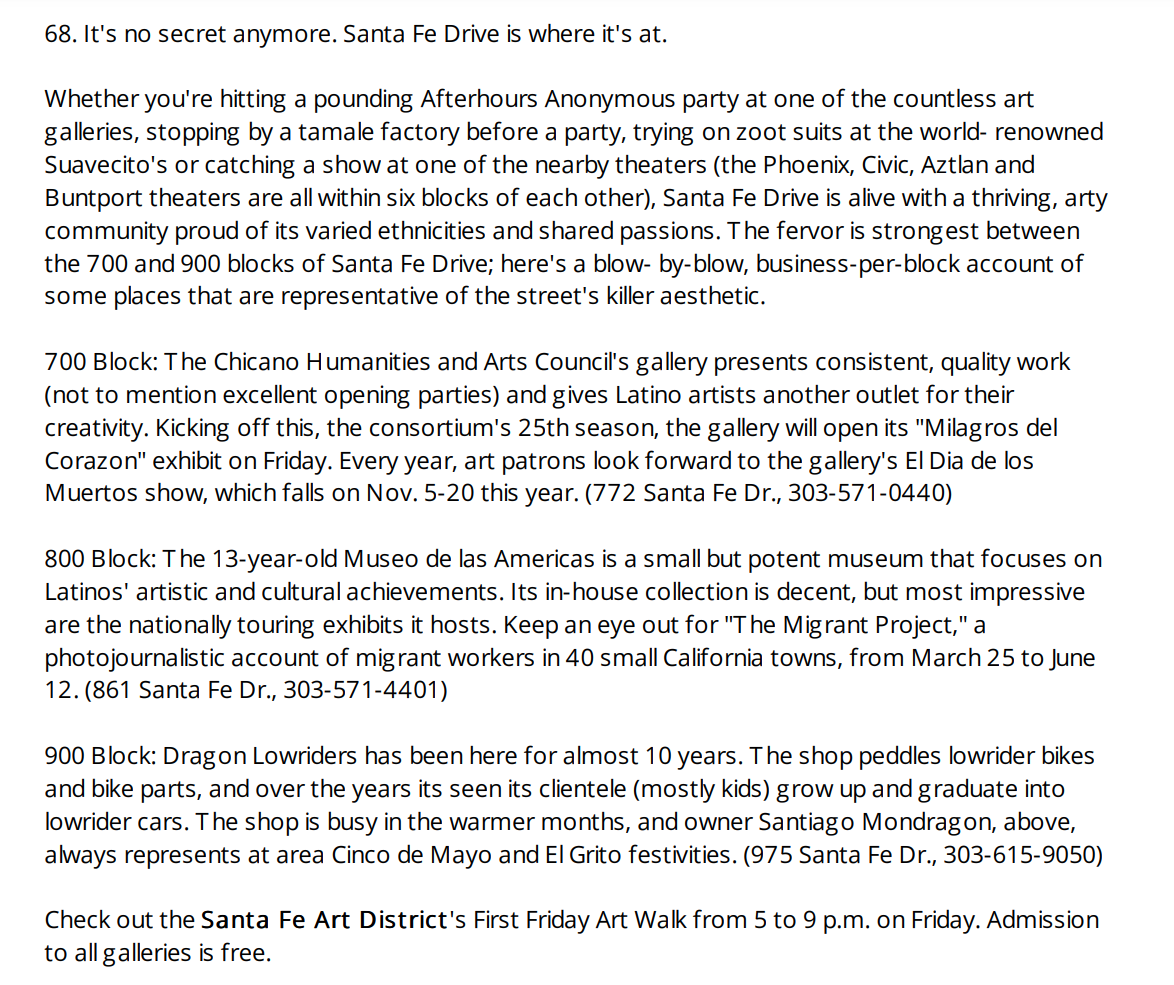
“Santa Fe Art District and its roots to the chicano culture”, 2004
LHP_Intern2022-03-29T00:53:00+00:00“Santa Fe Art District and its inspirational roots to the chicano culture”, Style 100 section STL, 02-01- 2004
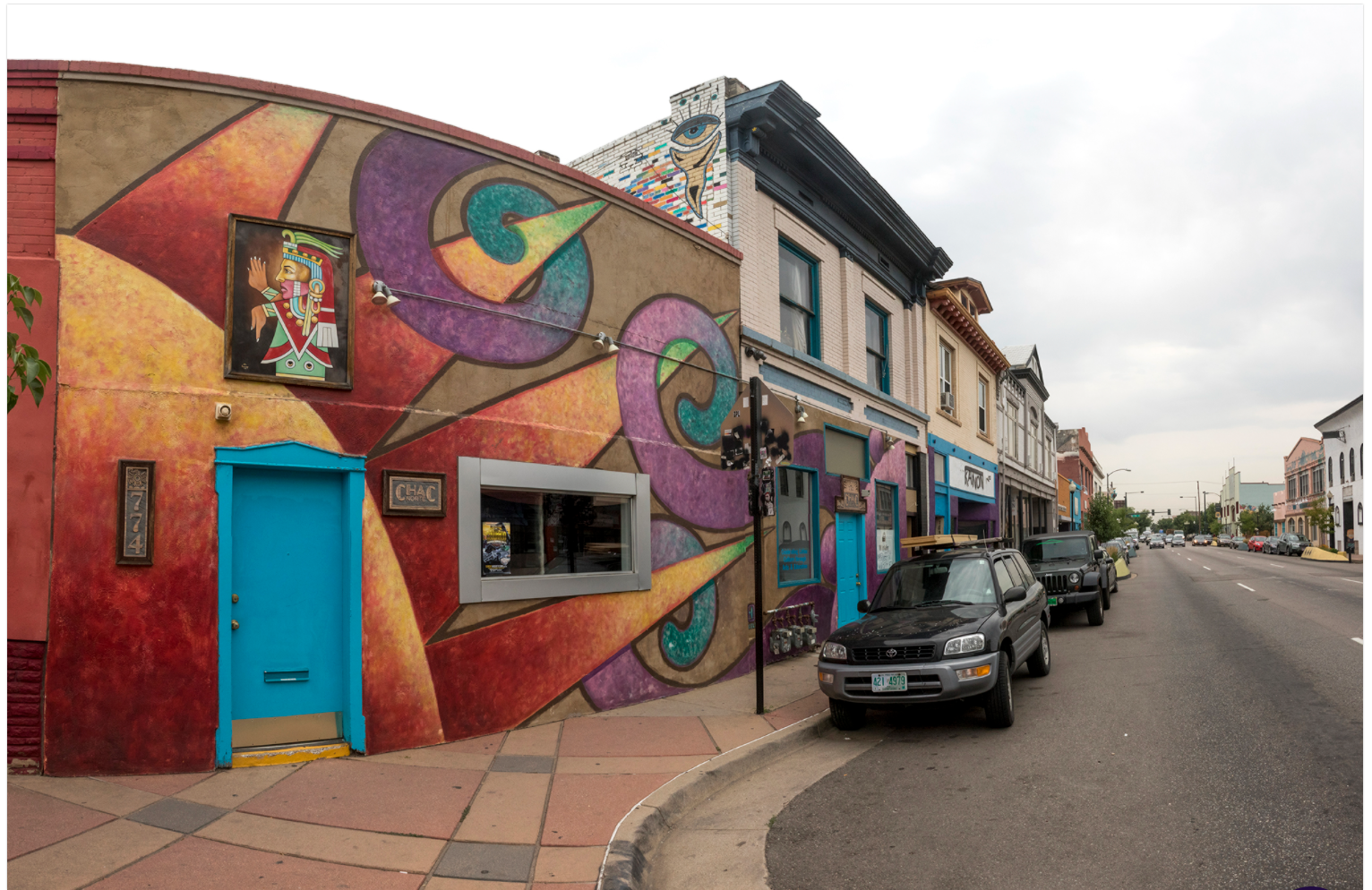
“Santa Fe Art District Moves”, 2022
LHP_Intern2022-03-29T00:52:59+00:00“Santa Fe Art District Moves to Lakewood after being payed out for its removal”,by Kyle Harris, 03-02- 2022
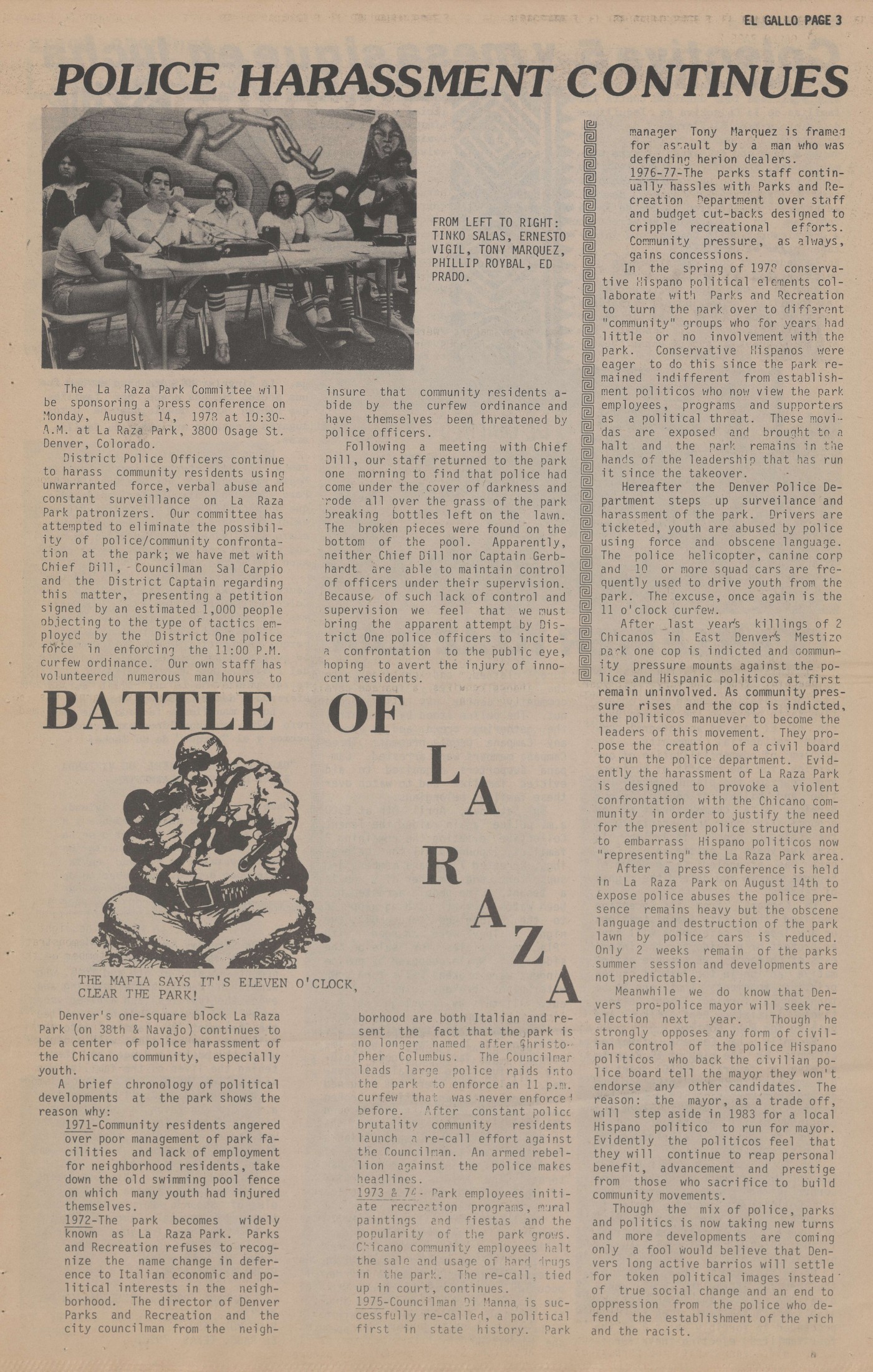
Battle of La Raza Park
LHP_Intern2022-03-29T00:52:06+00:00Entry in August 1978 El Gallo newspaper detailing the continued police presence and harassment of community members at La Raza Park.

“Children at Escuela Tlatelolco at aftercare program”, 2007
LHP_Intern2022-03-29T00:51:04+00:00“Children at Escuela Tlatelolco enjoying aftercare program, the school increases its enrollment”,by Christ Schneider, 05-16- 2007
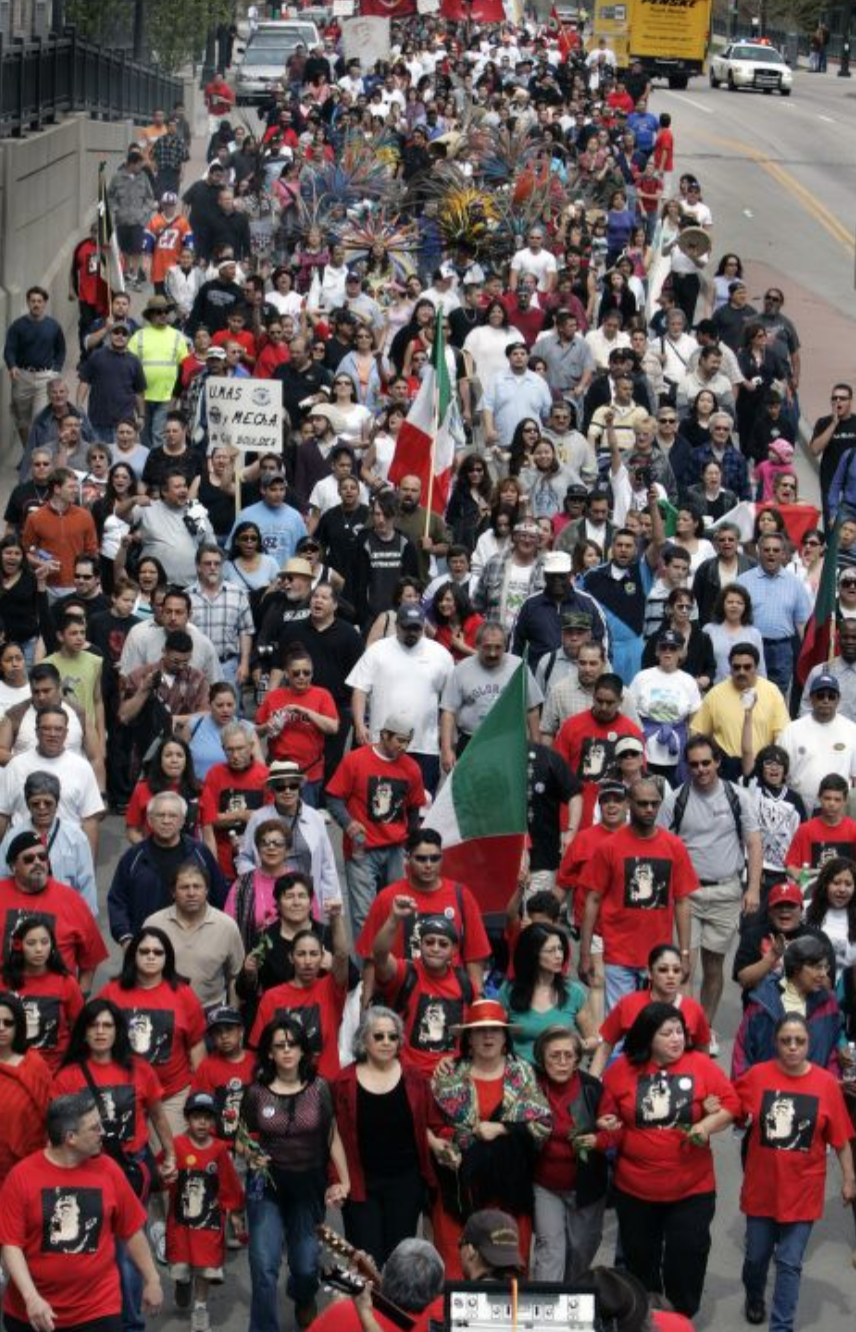
“The walk for a “Revolutionary memory of Rodolfo “Corky” Gonzales””, 2005
LHP_Intern2022-03-29T00:51:04+00:00“The walk for a “Revolutionary memory of Rodolfo “Corky” Gonzales” founder of Escuela Tlatelolco”, by Dennis Schroeder, 04-17-2005
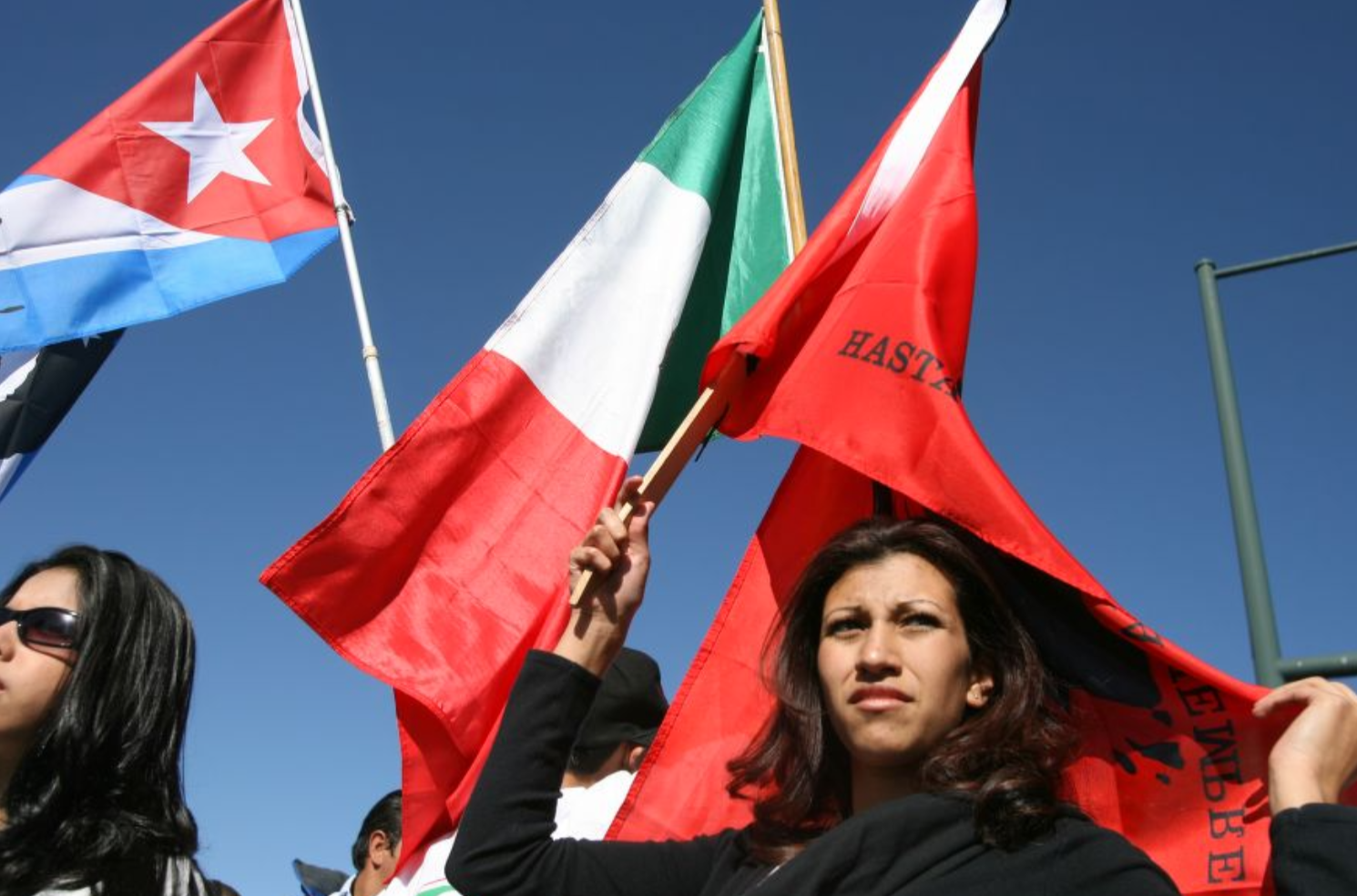
“Student at Escuela Tlatelolco march in protest to immigration legislation”,2006
LHP_Intern2022-03-29T00:51:03+00:00“Student at Escuela Tlatelolco march together in protest to immigration legislation being considered in Congress”,by David M. Barreda, 04-19-2006
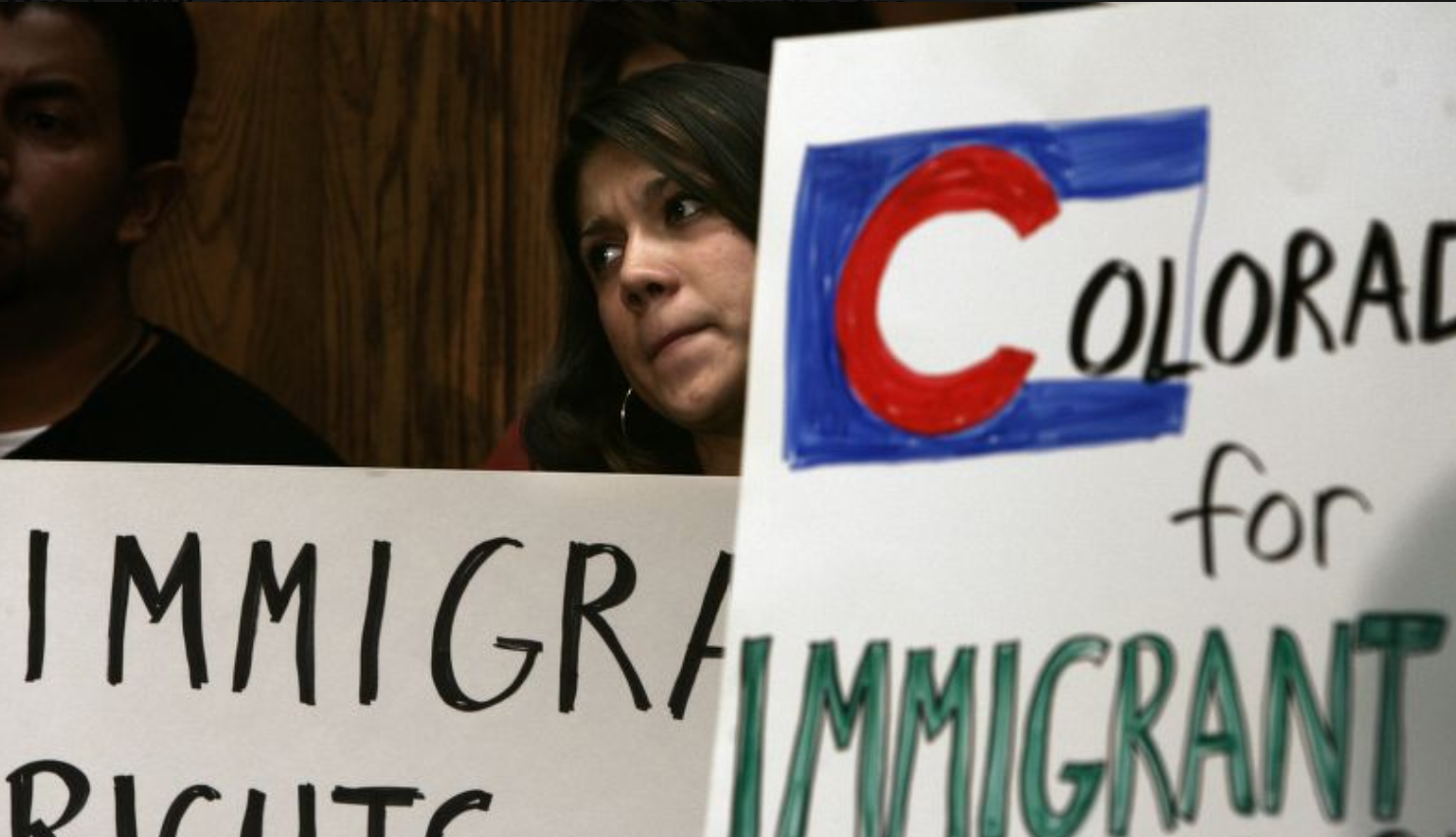
“Students gather at Colorado State Capital Building in protest”, 2005
LHP_Intern2022-03-29T00:51:03+00:00“Students gather at Colorado State Capital Building in protest to Colorado state legislators opposed to immigrant rights”, by Joe Mahoney, 10-05-2005
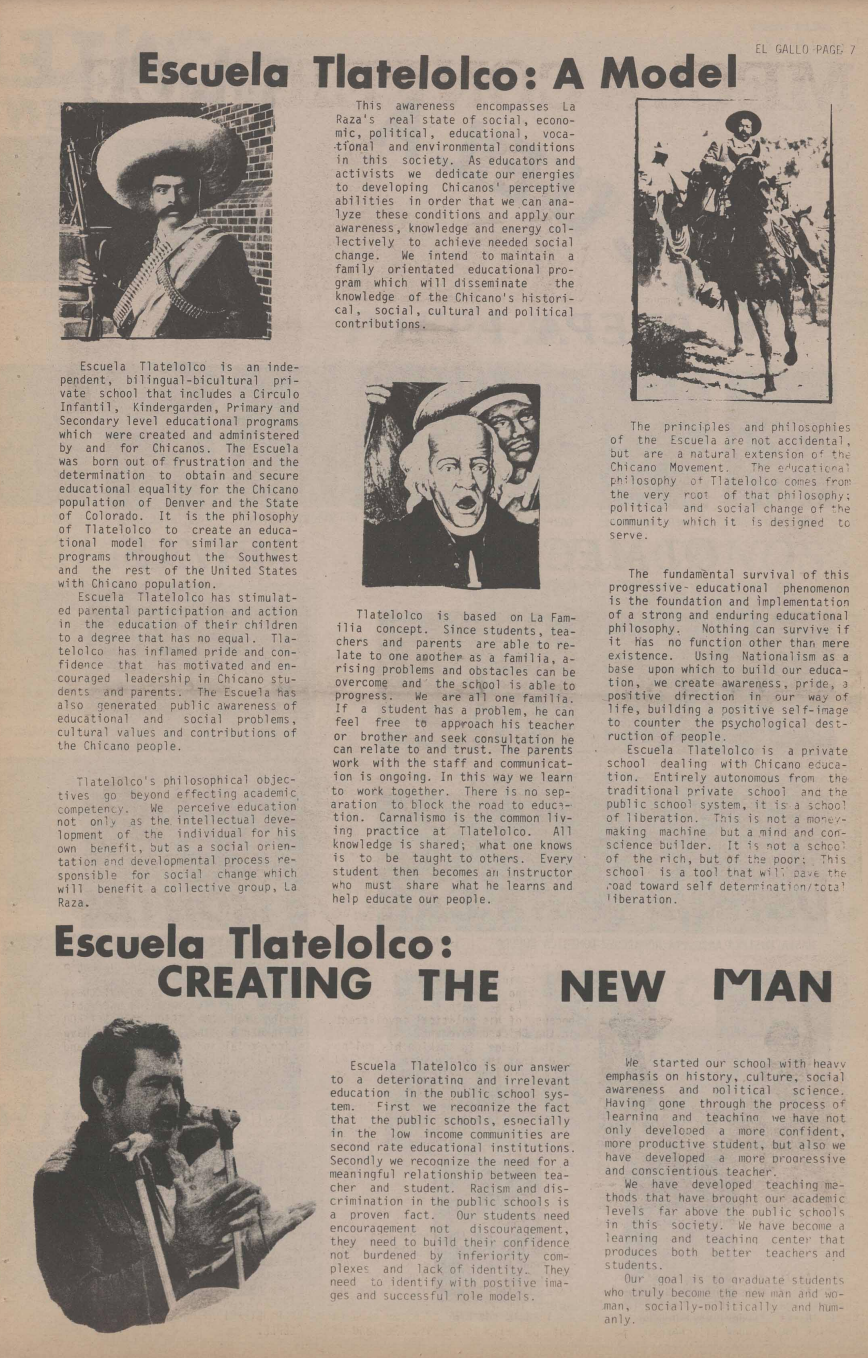
“Escuela Tlatelolco created after Chicano struggle”, 1979
LHP_Intern2022-03-29T00:51:03+00:00“Escuela Tlatelolco a school for Chicanos students was created after Chicano struggle and frustration”,04-01- 1979
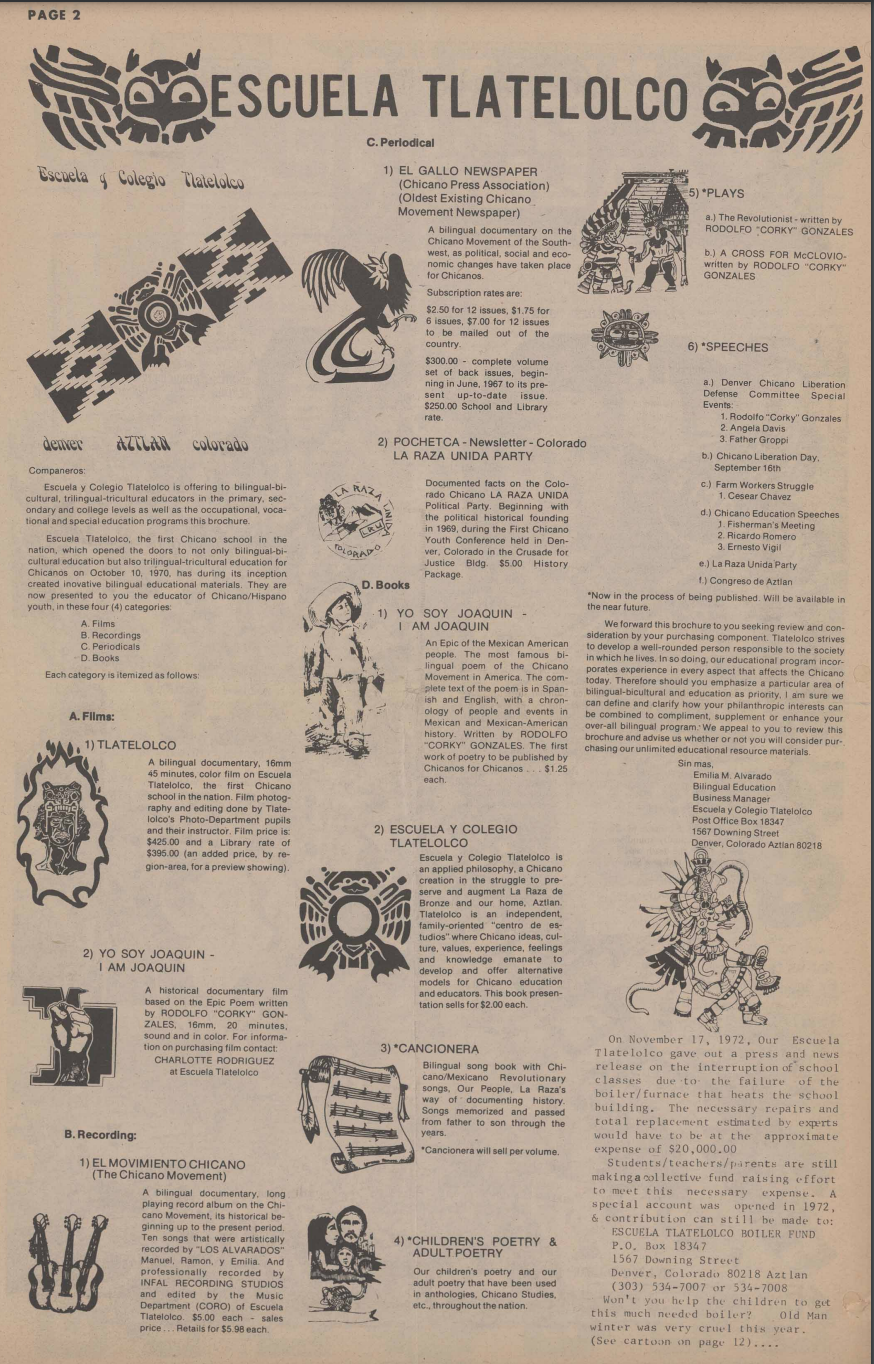
“A look into Escuela Tlatelolco education”,1974
LHP_Intern2022-03-29T00:51:03+00:00“A look into Escuela Tlatelolco educational bilingual and bi-cultural materials and offerings”,02-01-1974
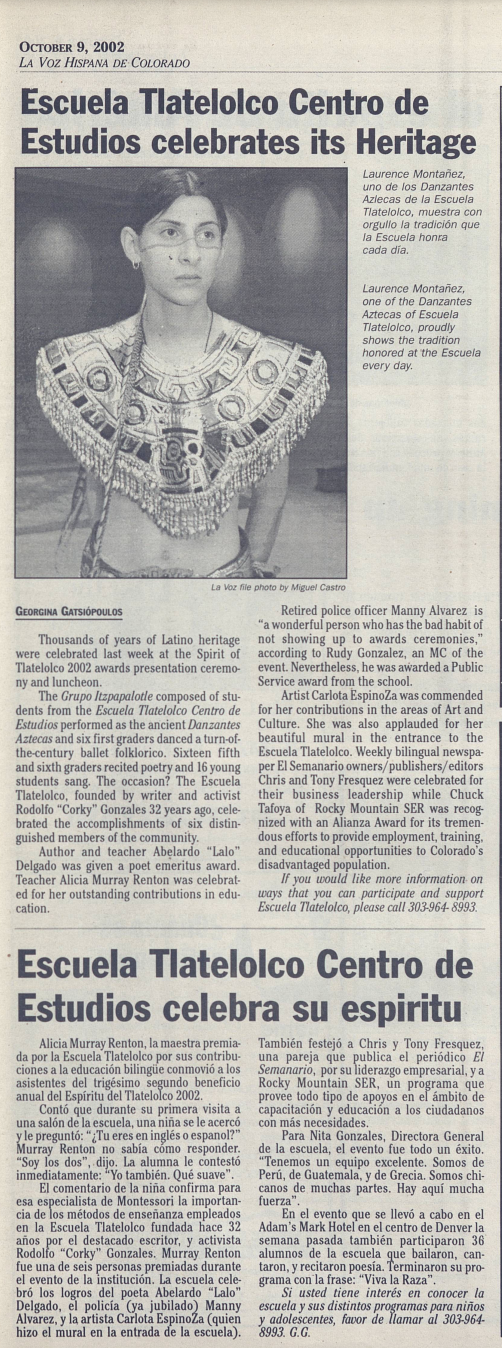
“Escuela Tlatelolco celebrates heritage”, 2002
LHP_Intern2022-03-29T00:51:03+00:00“Escuela Tlatelolco celebrates heritage and accomplishments of its community members”, 10-09-2002
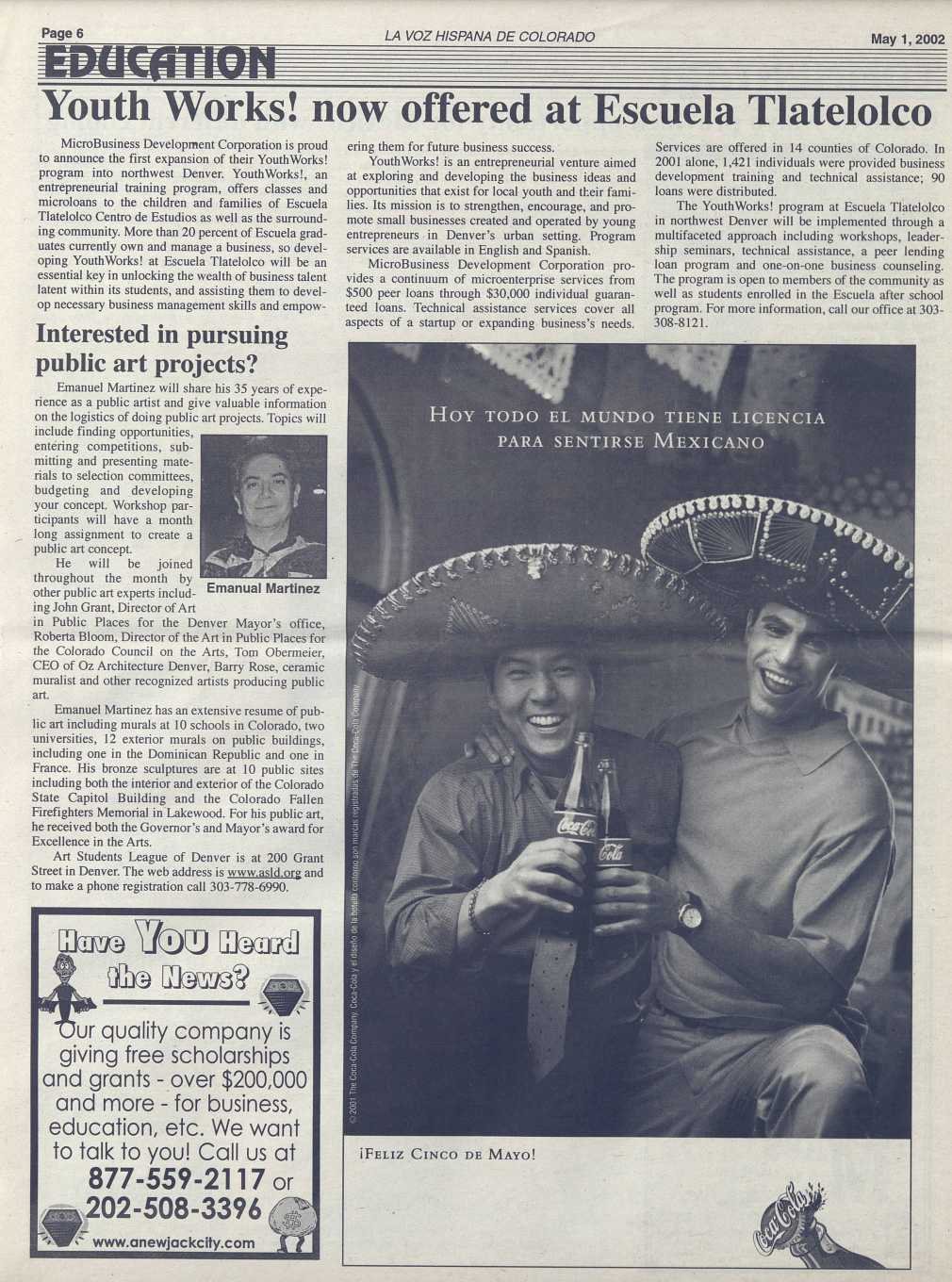
“Escuela Tlatelolco presents “Youth Works!””,2002
LHP_Intern2022-03-29T00:51:02+00:00“Escuela Tlatelolco presents “Youth Works!” a entrepreneurial training program”,05-01-2002
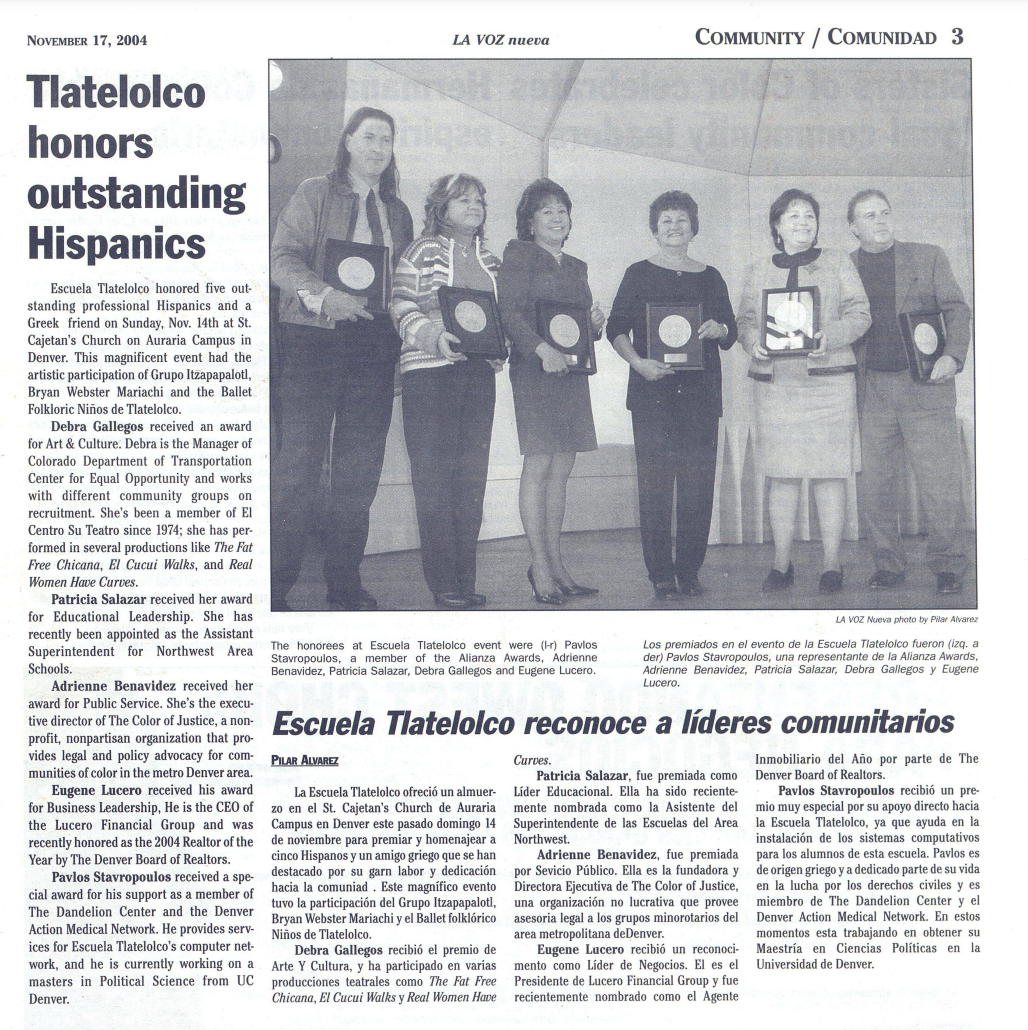
” Escuela Tlatelolco honors community leaders”, 2004
LHP_Intern2022-03-29T00:51:02+00:00” Escuela Tlatelolco honors hard working community leaders with awards”,11-17- 2004
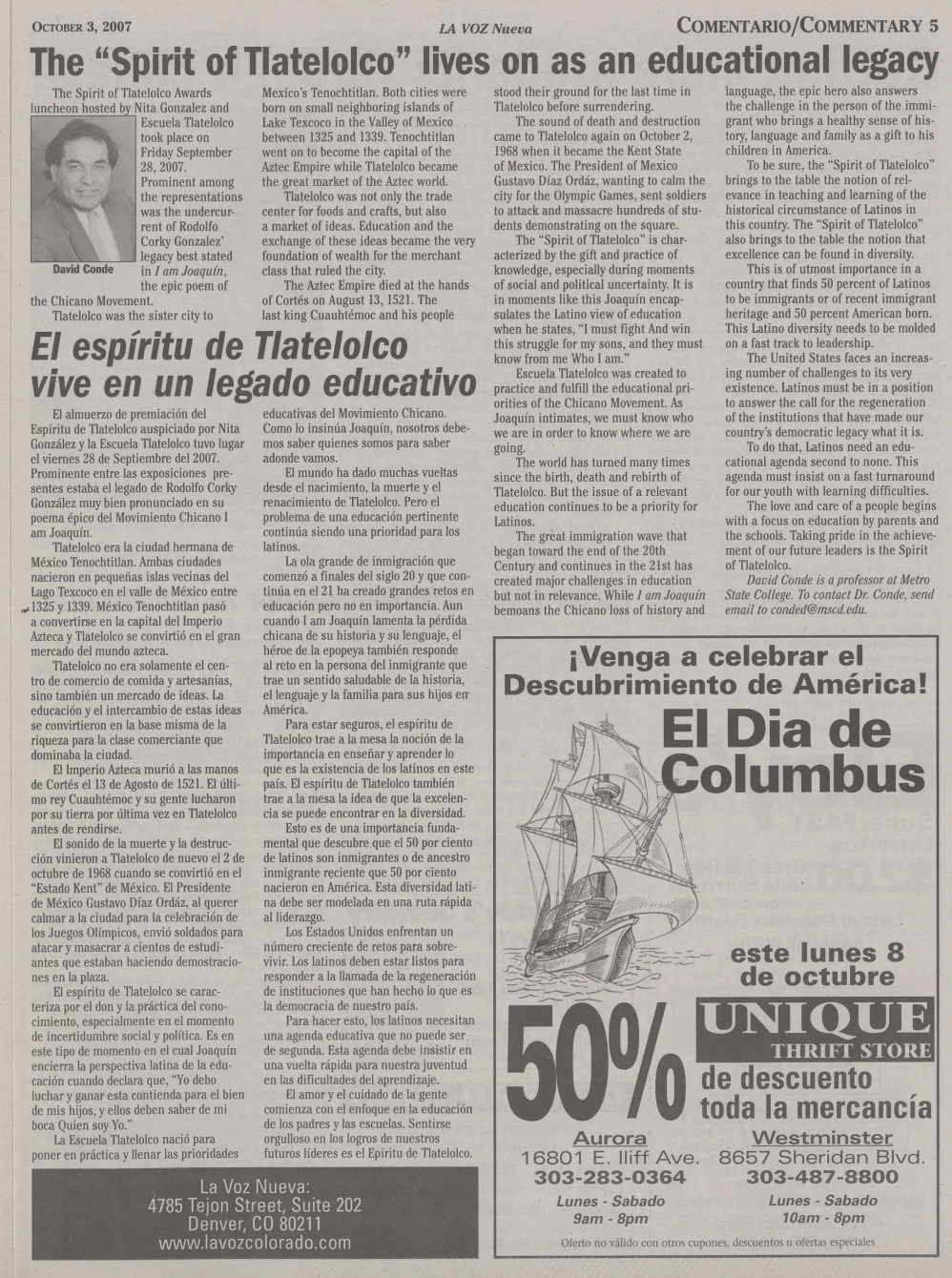
“Behind the name: Escuela Tlatelolco”, 2007
LHP_Intern2022-03-29T00:51:02+00:00“The history behind the name: Escuela Tlatelolco and its spirit in the educational aspect of the Chicano movement”,10-03-2007
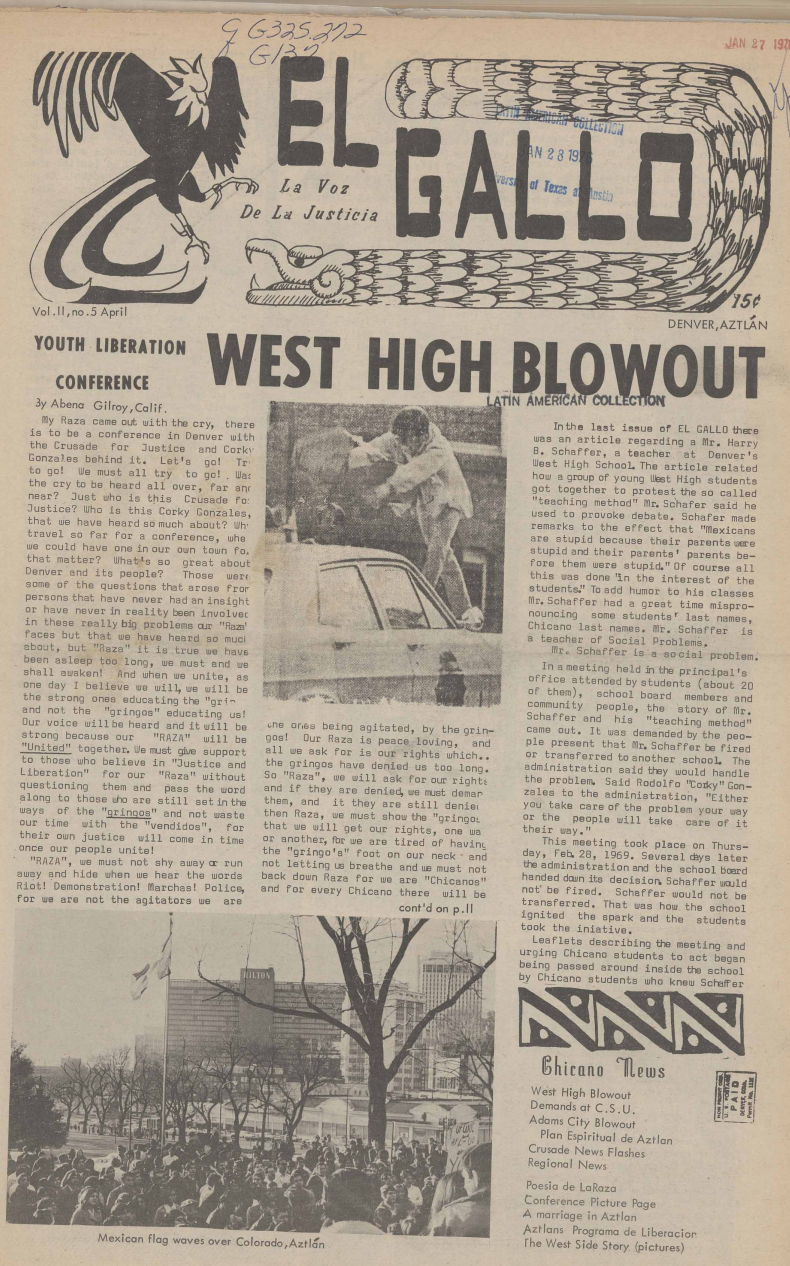
“West High Blowout”, 1969
LHP_Intern2022-03-29T00:51:02+00:00An article on the events of the West High Walkout and what to be done with Mr. Schaffer, Denver, 4-1-1969
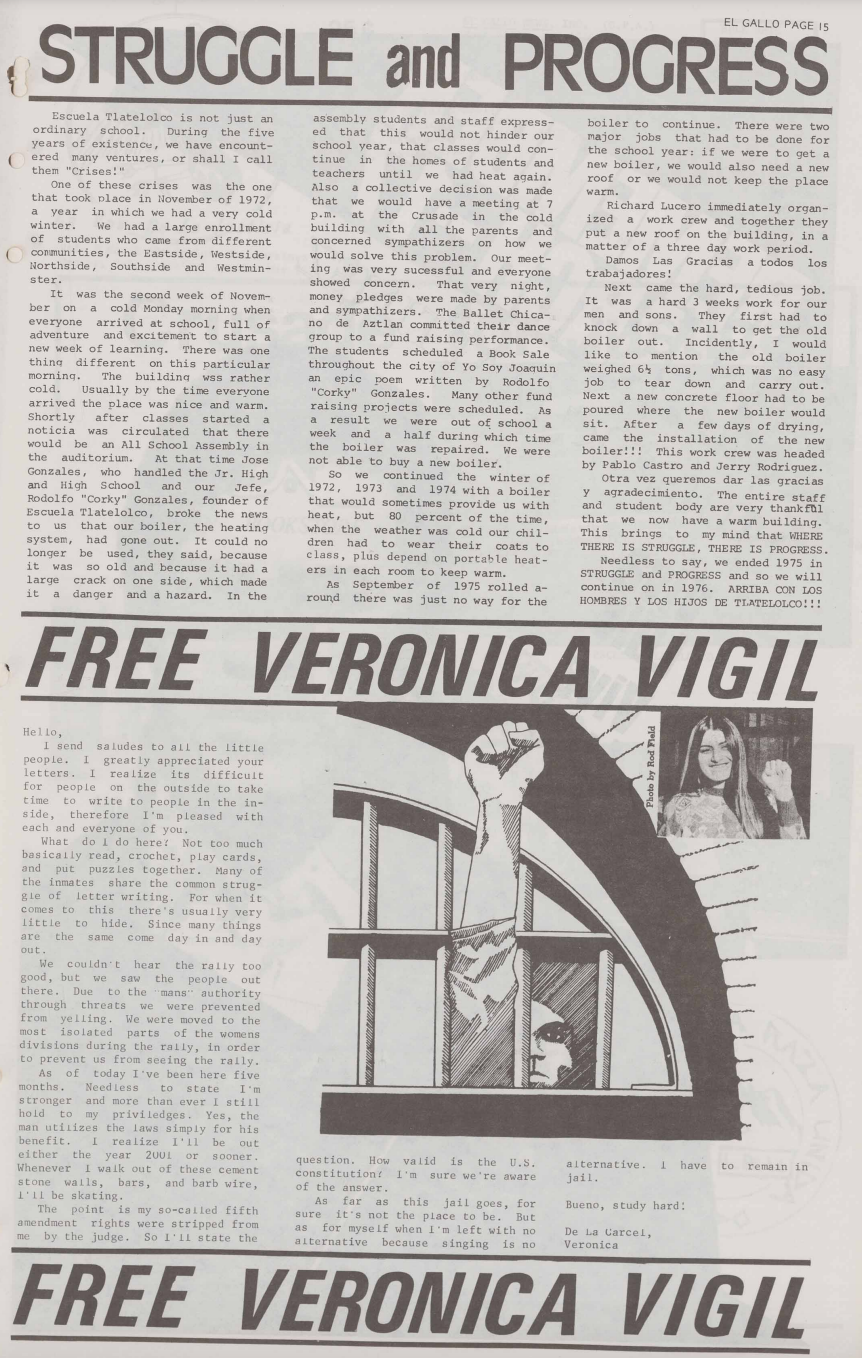
“The progress of the Escuela Tlatelolco”,1976
LHP_Intern2022-03-29T00:51:01+00:00“The process of the Escuela Tlatelolco and its struggles in making it a possibility”,01-01-1976
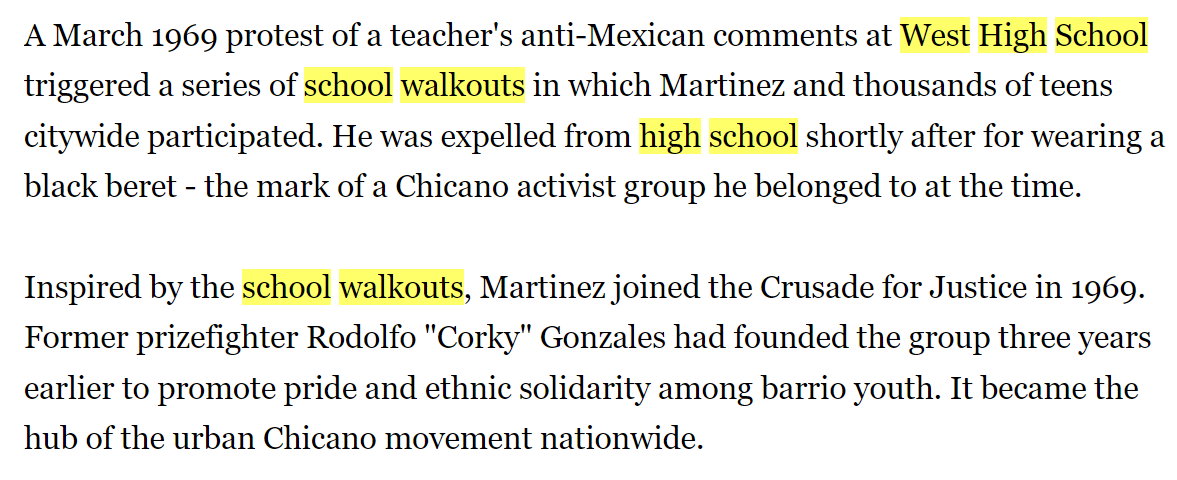
“73 showdown still wounds Book examines young Chicano’s death, legacy”, 1999
LHP_Intern2022-03-29T00:51:01+00:00An article on Luis Martinez and his legacy with the West High Walkouts as his push to join the Movement, By Susan Greene, 3-14-1999
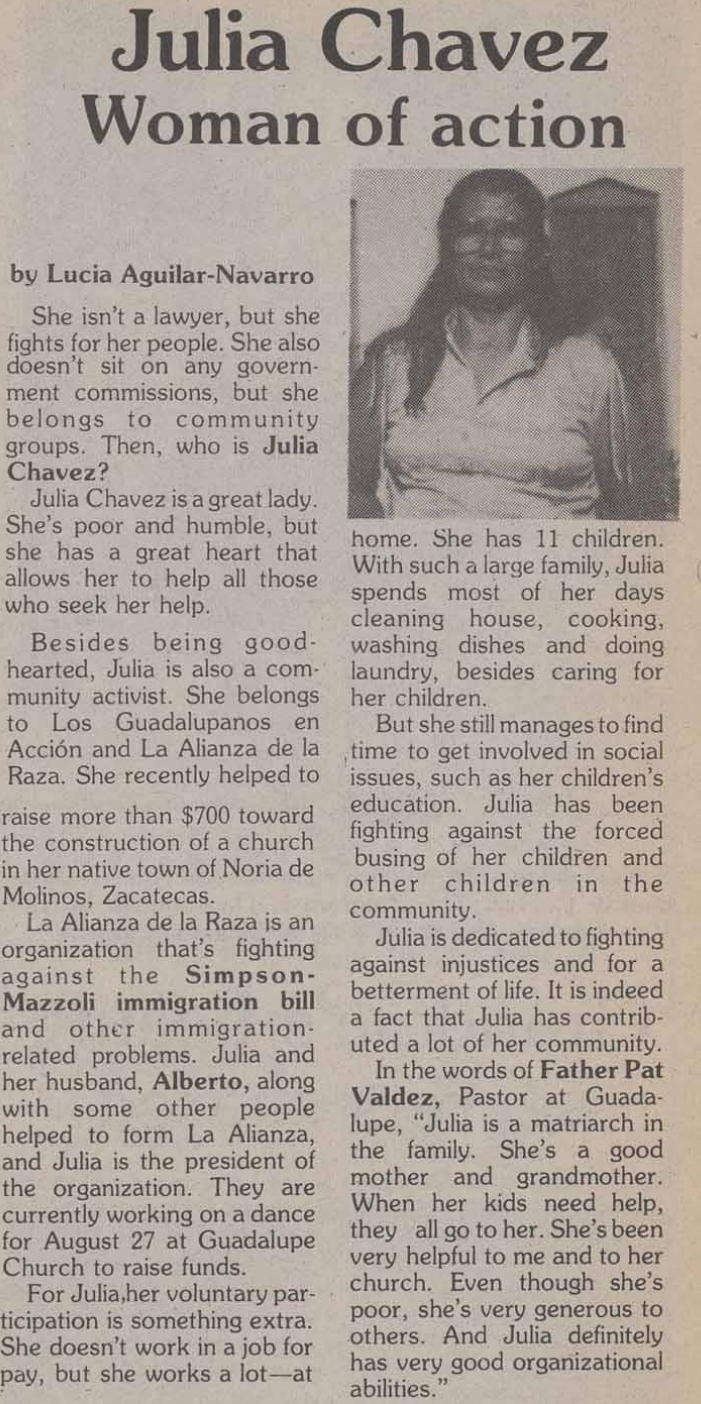
“Julia Chavez, Woman of Action”, 1983
LHP_Intern2022-03-29T00:48:42+00:00A newspaper article on Julia Chavez and her dedication to her community; including her fight against forced busing, by Lucia Aguilar-Navarro, Denver, 8-10-1983

“Unitary Busing Plan is Completed”, 1980
LHP_Intern2022-03-28T23:46:47+00:00“Preliminary ‘Unitary’ Busing Plan is Completed” By Joe Montoya, Denver, 12-15-1980
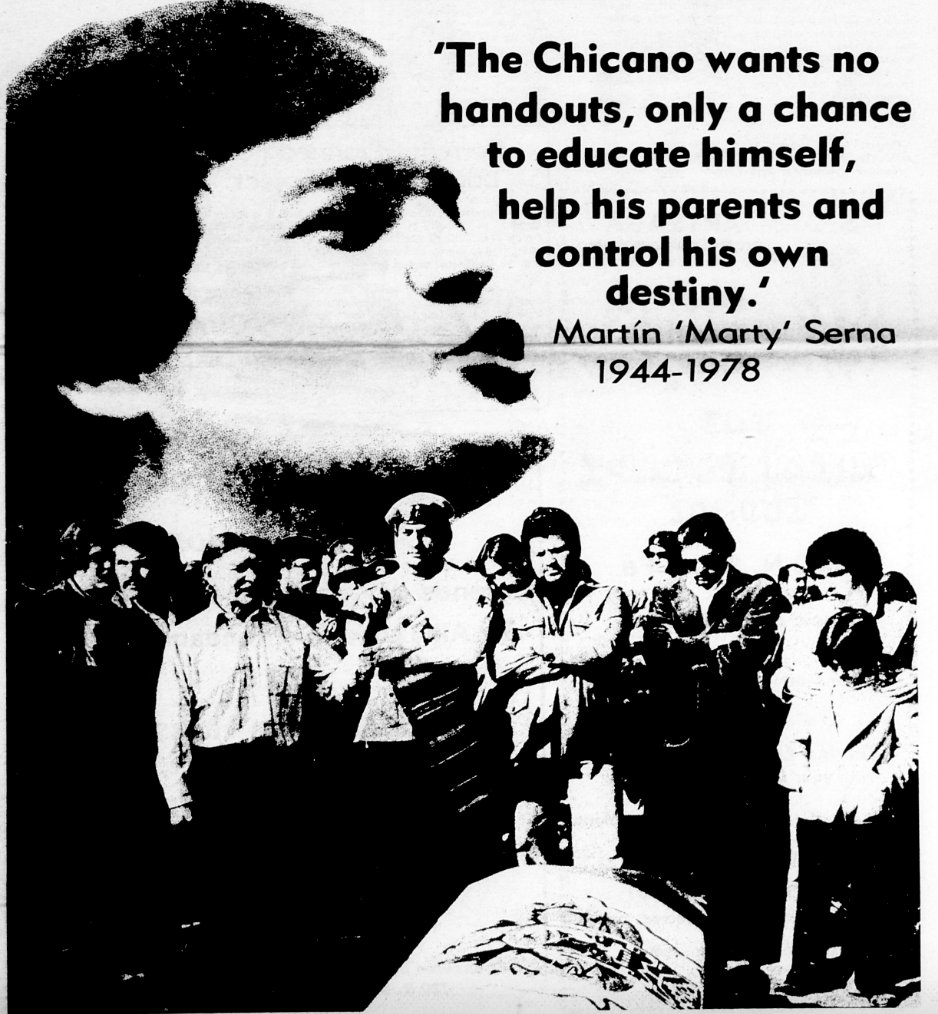
Founder of Brown Berets in Pueblo, passes away
LHP_Intern2022-03-23T00:00:32+00:00Founder of the Brown Berets in Pueblo, Martín Serna, passes away

FBI surveils the “New Left”, including the Brown Berets
LHP_Intern2022-03-22T23:56:19+00:00FBI surveils the “New Left” included the militant Chicano group called the Brown Berets
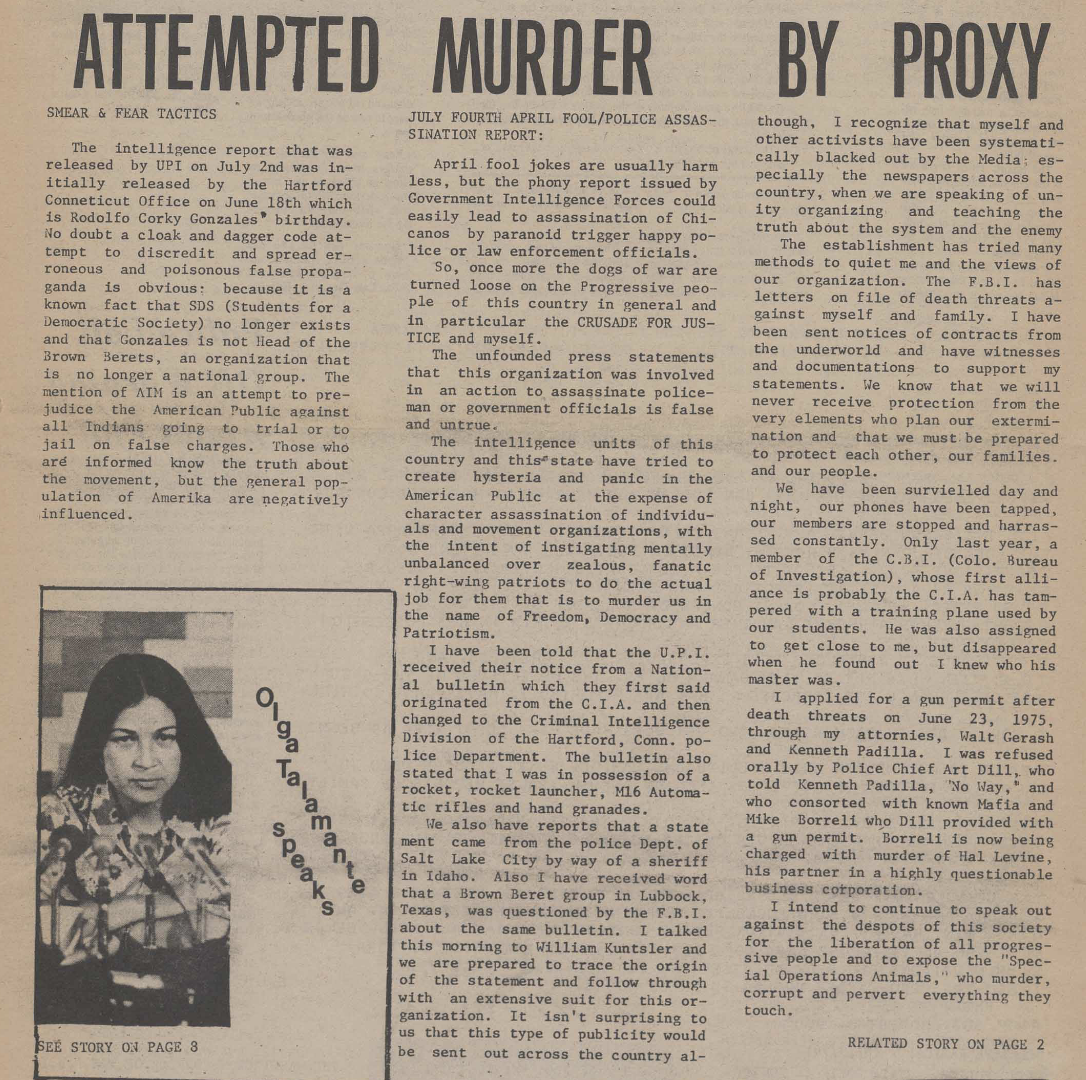
Corky Gonzales denies being the leader of the Brown Berets
LHP_Intern2022-03-22T23:47:23+00:00Corky Gonzales denies the accusations that he is the leader of the Brown Berets
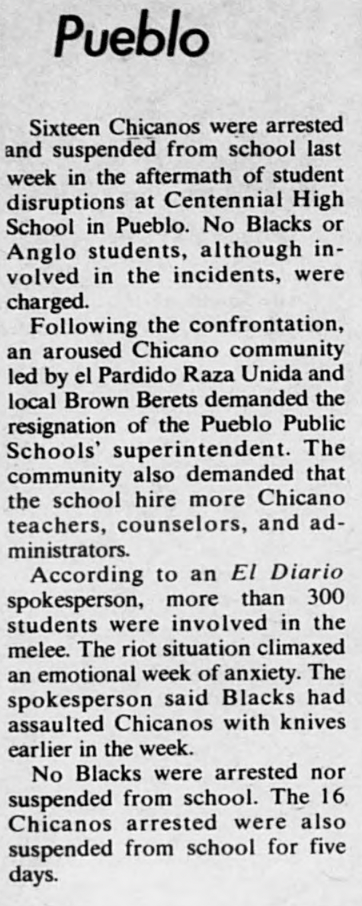
Demonstration led by La Raza Unida Party and the Brown Berets to push for change in Pueblo school
LHP_Intern2022-03-22T23:44:00+00:00Demonstration led by La Raza Unida Party and the Brown Berets which called for the resignation of Pueblo Public Schools’ Superintendent and the hiring of more Chicano staff at Pueblo schools. The demonstration led to the arrest and suspension of 16 Chicano students from Centennial High School
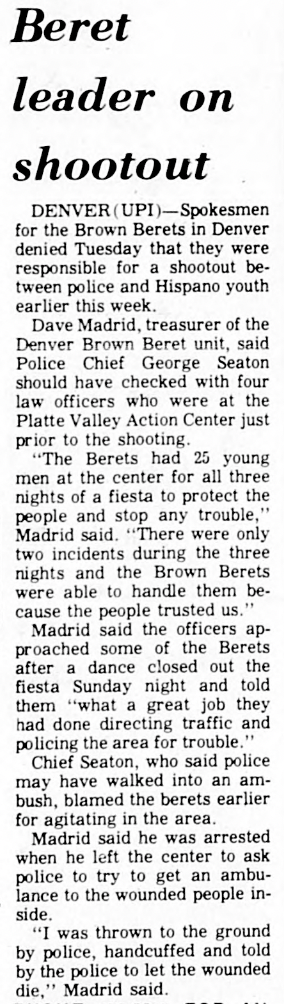
Brown Beret spokesperson denies responsibility in confrontation with police
LHP_Intern2022-03-22T23:39:58+00:00Dave Madrid, spokesperson for the Brown Berets, denies responsibility of the Brown Berets in confrontation with the police at the Platte Valley Action Center.
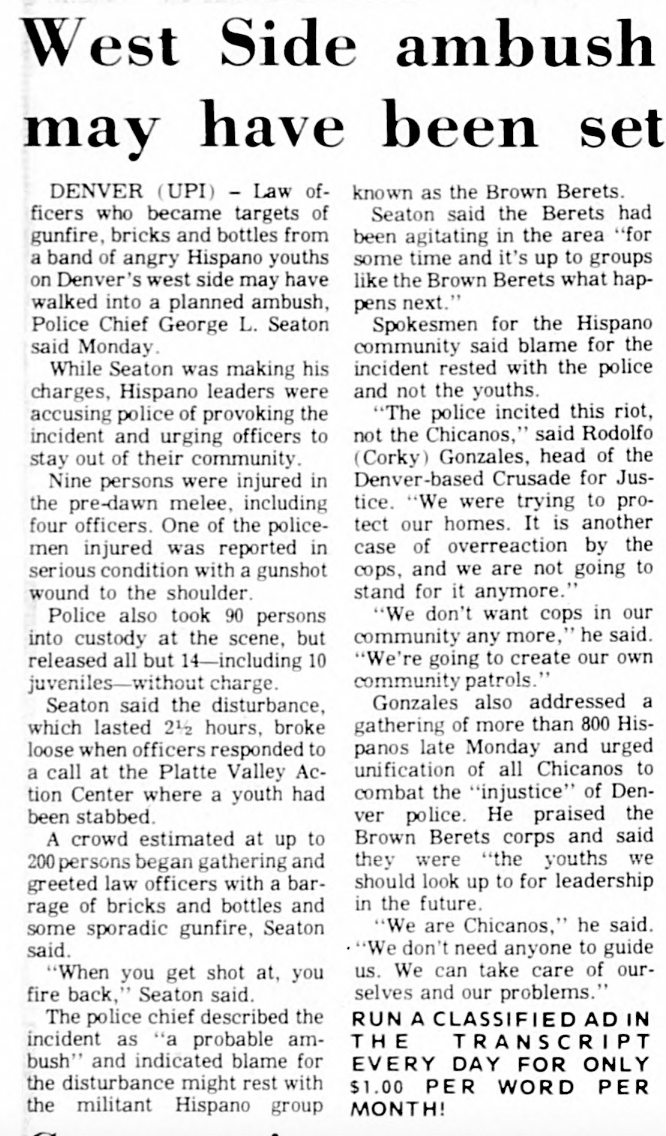
Denver Police blame Brown Berets for inciting violence at the Platte Valley Action Center
LHP_Intern2022-03-22T23:36:02+00:00Denver Police Department accuses the Brown Berets of inciting violence in an incident between Chicano youth and the police. The Chicano community blames the police for inciting the violence.
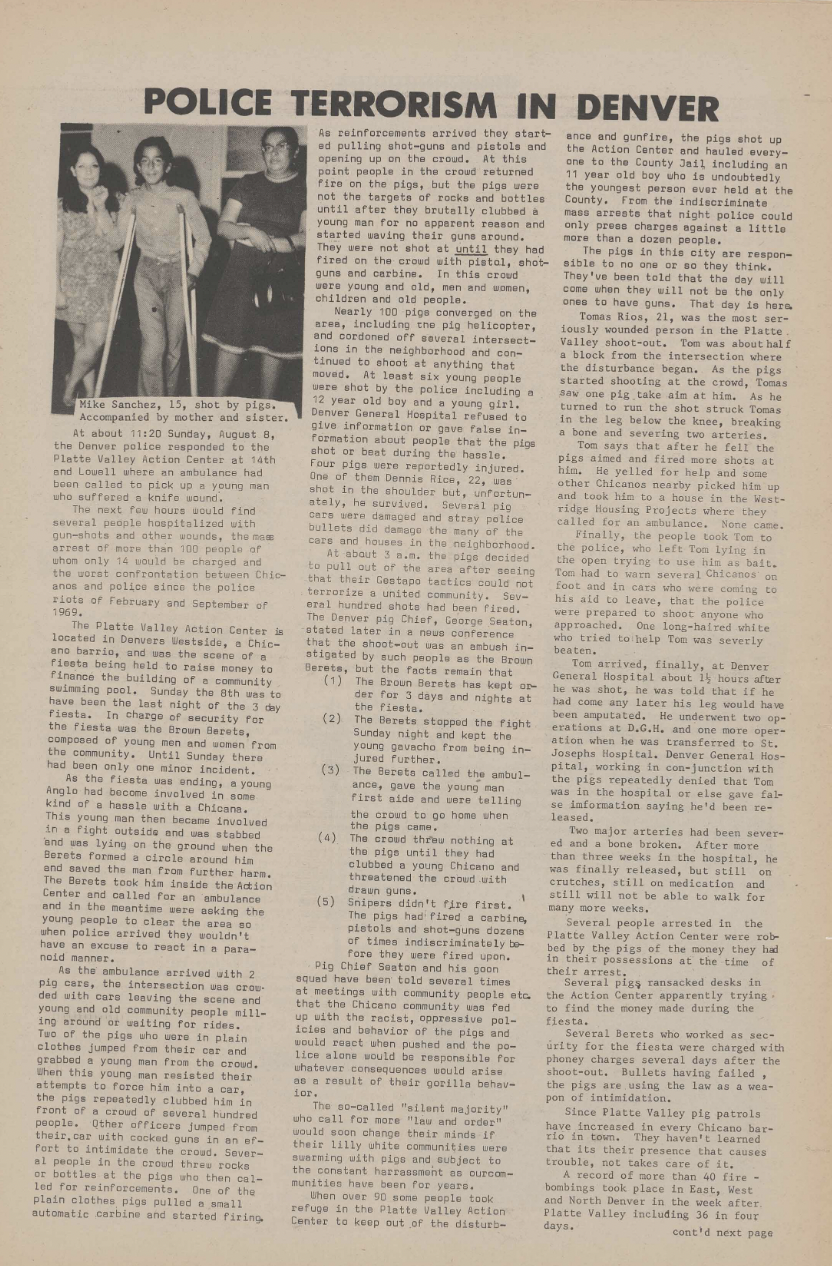
The Brown Berets work security at the Platte Valley Action Center 1971
LHP_Intern2022-03-22T23:31:22+00:00The Brown Berets work security for a fundraiser at the Platte Valley Action Center in Westside Denver. Confrontation breaks out between Chicanos and Denver PD, leads to mass arrests and numerous injuries.
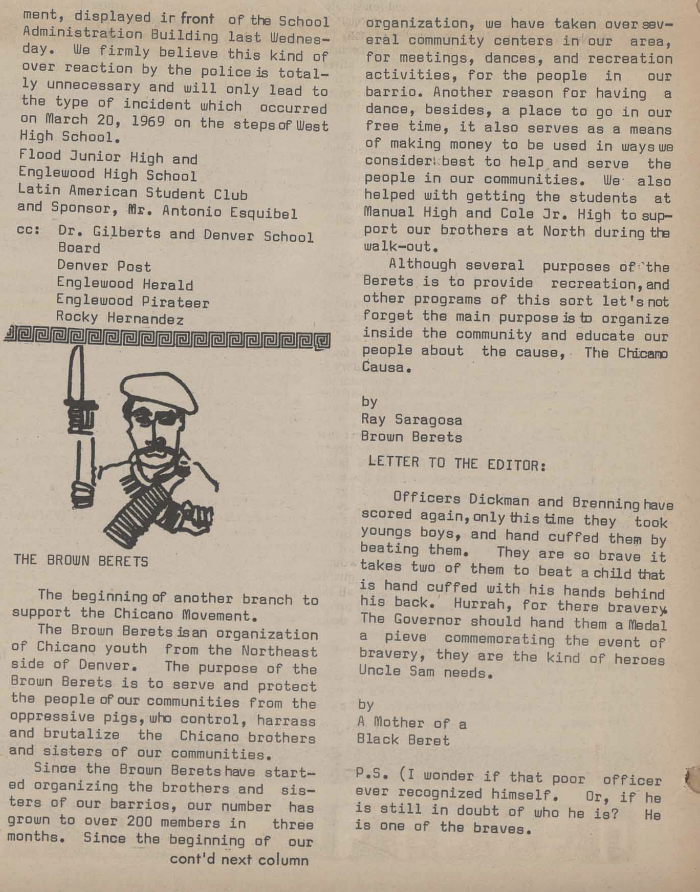
The purpose and founding of the Brown Berets
LHP_Intern2022-03-22T23:23:01+00:00Article on the formation of the Brown Berets, and their purpose
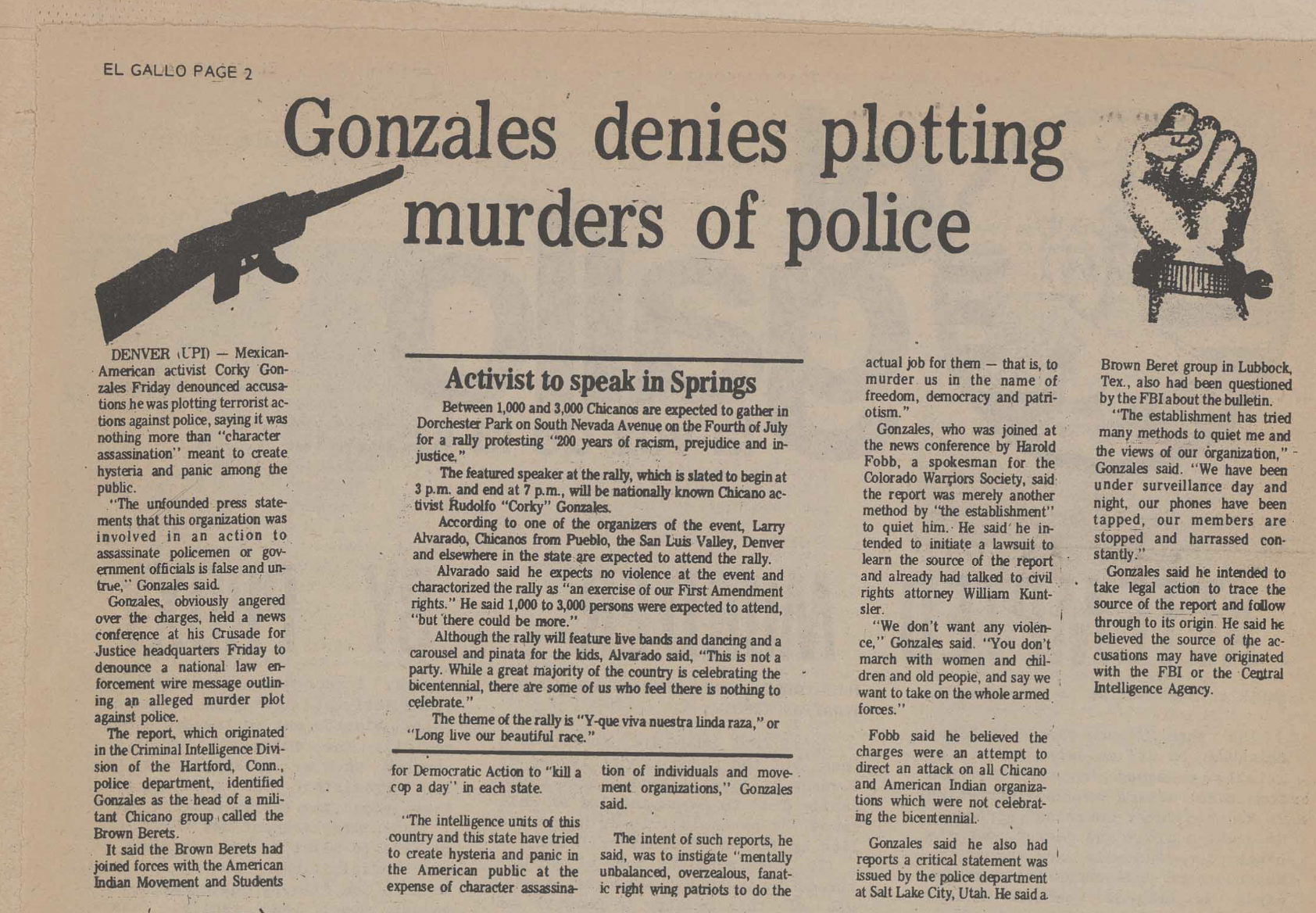
Connecticut Police Department accuses Corky Gonzales and the Brown Berets of planning terrorist activities
LHP_Intern2022-03-22T23:19:45+00:00Report by the Hartford, Connecticut Police Department accuses Corky Gonzales and the Brown Berets of planning terrorist activities against police officers. Corky Gonzales denounces the accusations calling them “character assassinations”.
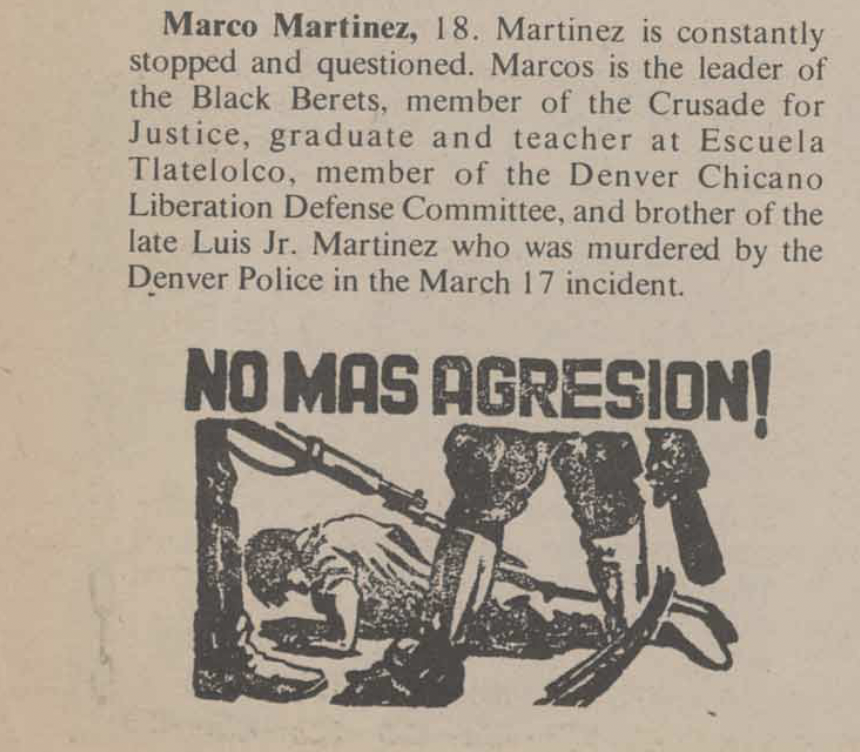
Marco Martinez, leader of the Black Berets 1973
LHP_Intern2022-03-22T23:13:16+00:00A brief article on Marco Martinez, leader of the Black Berets
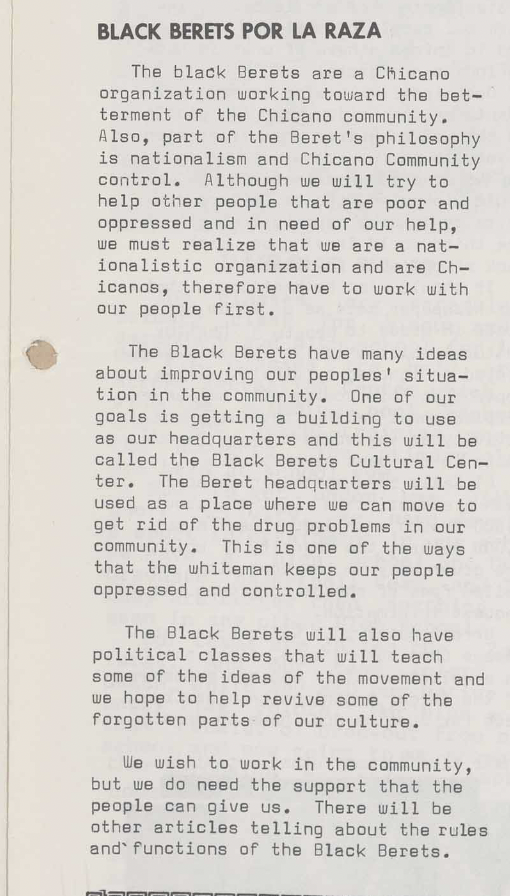
Black Berets plan to build cultural center
LHP_Intern2022-03-22T23:10:14+00:00The Black Berets look to build a cultural center in Denver for the purpose of political education and drug rehabilitation.

Purpose of the Black Berets
LHP_Intern2022-03-22T23:06:17+00:00Newspaper article that explains the purpose of the Black Beret organization
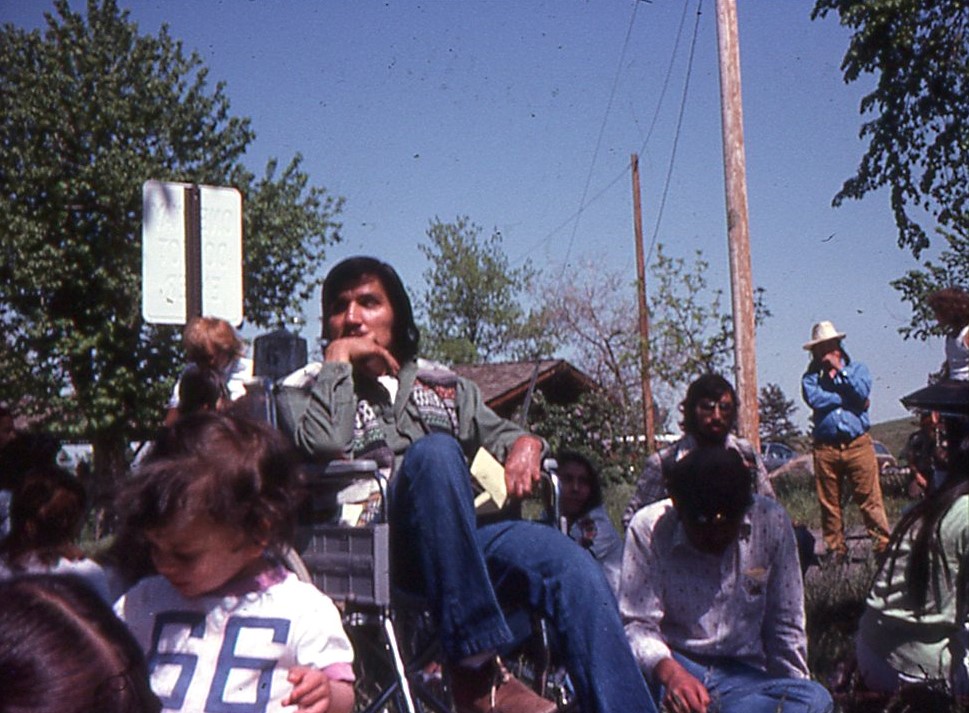
Antonio Alcantar
LHP_Intern2022-03-22T20:32:21+00:00Photo of survivor of Los de Boulder bombing, Antonio Alcantar, at a rally for Los Seis (1974).
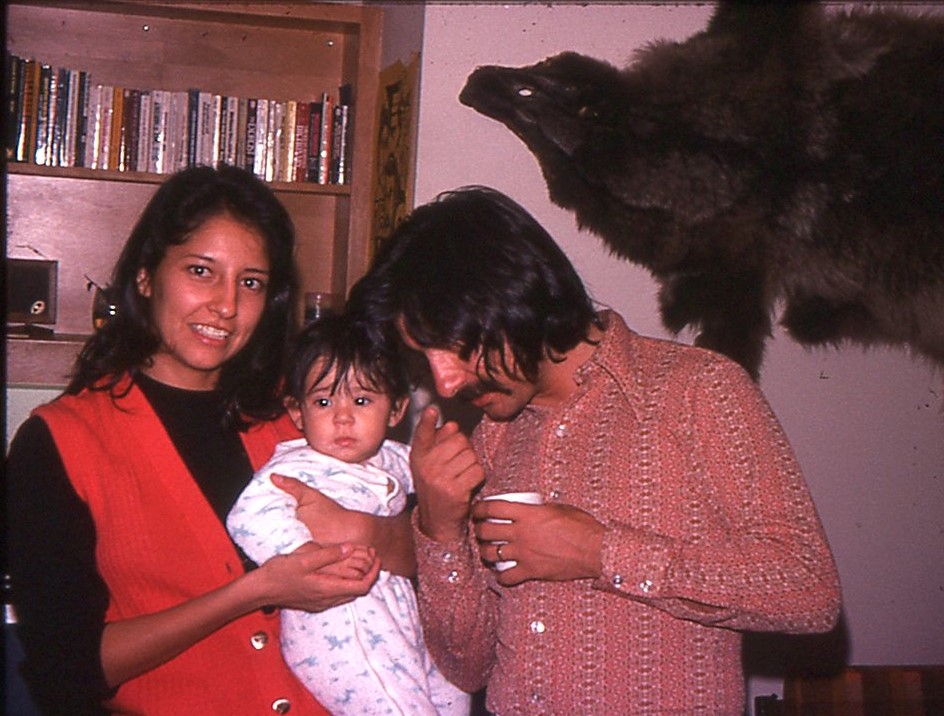
Juan and Debby Espinosa
LHP_Intern2022-03-22T20:31:24+00:00UMAS members Juan and Debby Espinosa (1970s)
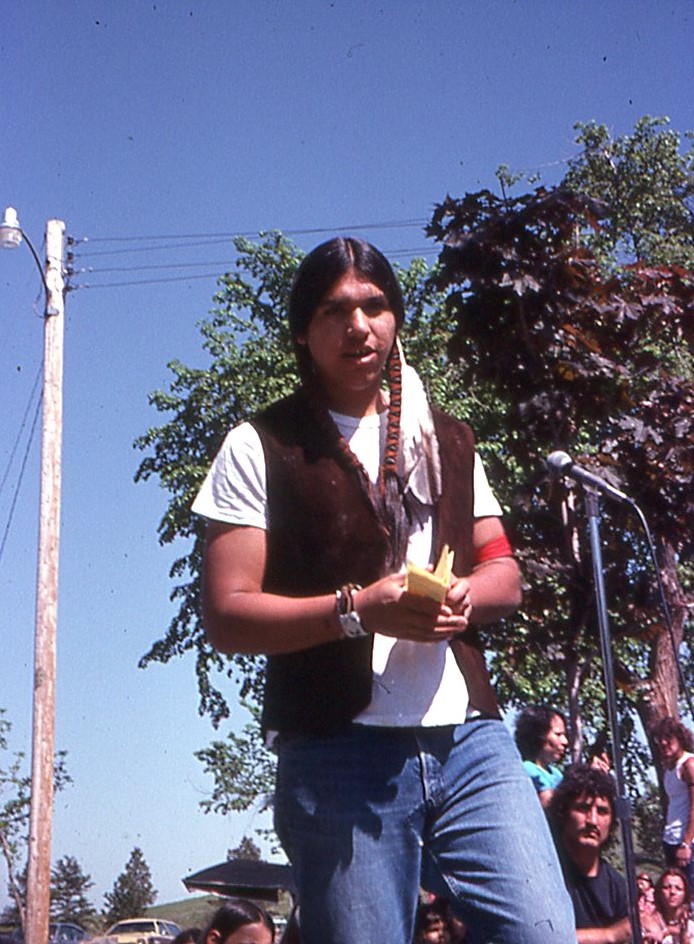
AIM Member
LHP_Intern2022-03-22T20:30:16+00:00Photo of an AIM member speaking at a rally for Los Seis (1974)

Ballet Folklórico de Aztlán
LHP_Intern2022-03-22T20:29:14+00:00Ballet Folklórico de Aztlán perform at a conference for the Crusade for Justice (1970s)
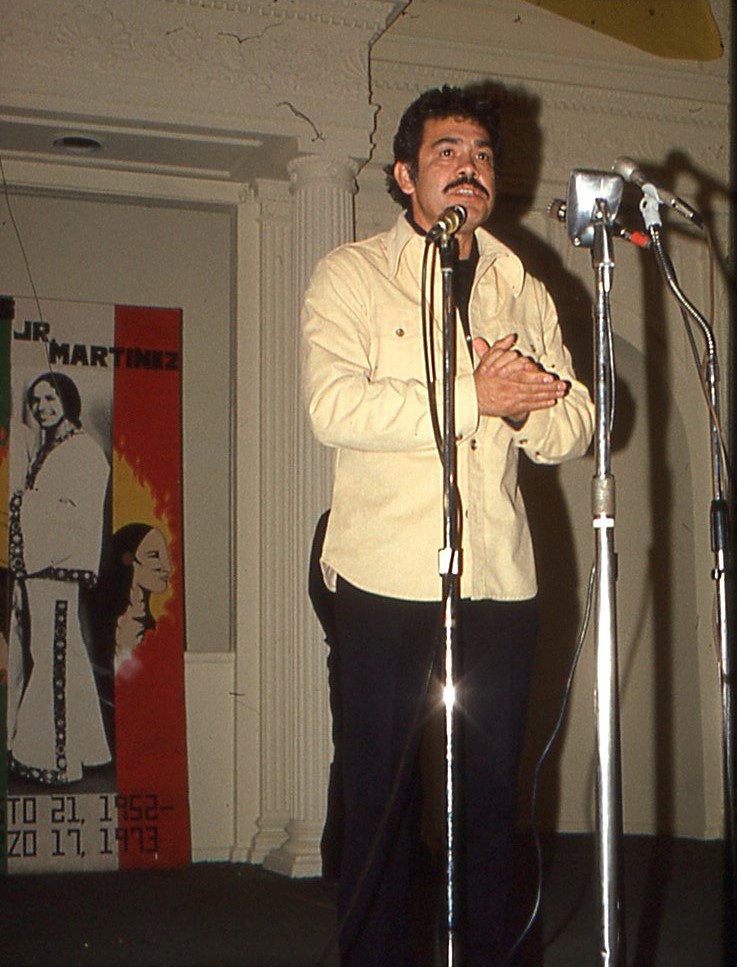
Corky Gonzales speaking at Crusade Conference
LHP_Intern2022-03-22T20:28:15+00:00Photo of Corky Gonzales speaking at a conference held by the Crusade for Justice centered around unity between the Chicano Movement, American Indian Movement, and the Black Power Movement (1970s).

Members of AIM Speak at Crusade Conference
LHP_Intern2022-03-22T20:27:11+00:00Members of AIM speak at a conference held by the Crusade for Justice centered around unity between the Chicano Movement, American Indian Movement, and the Black Power Movement (1970s).
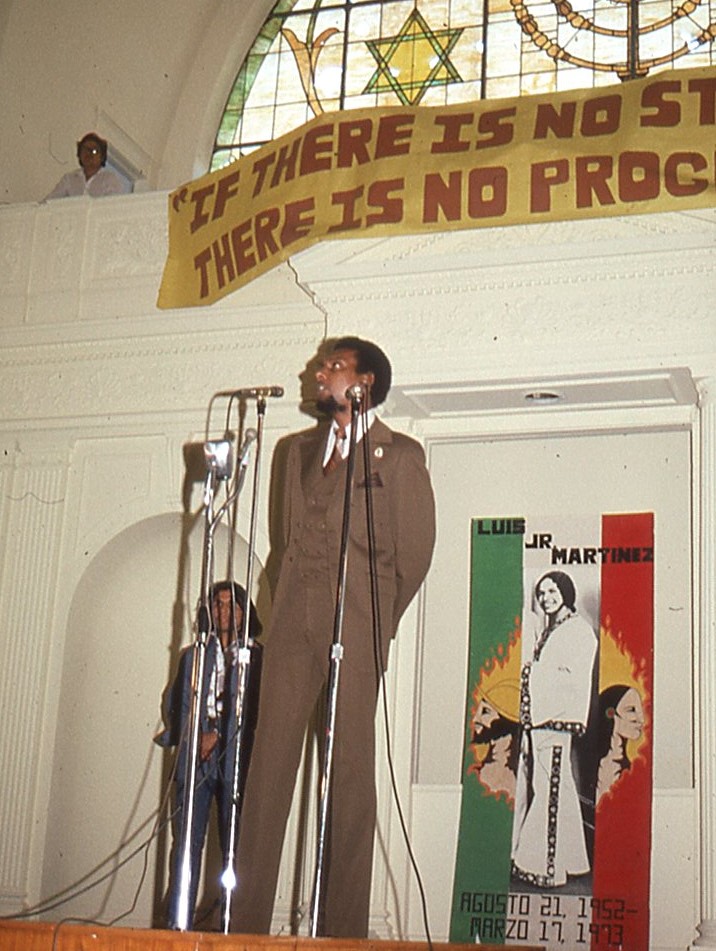
Kwame Ture Speaks at Crusade Conference
LHP_Intern2022-03-22T20:22:51+00:00Photo Kwame Ture speaking at a conference held by the Crusade for Justice centered around unity between the Chicano Movement, American Indian Movement, and the Black Power Movement (1970s).
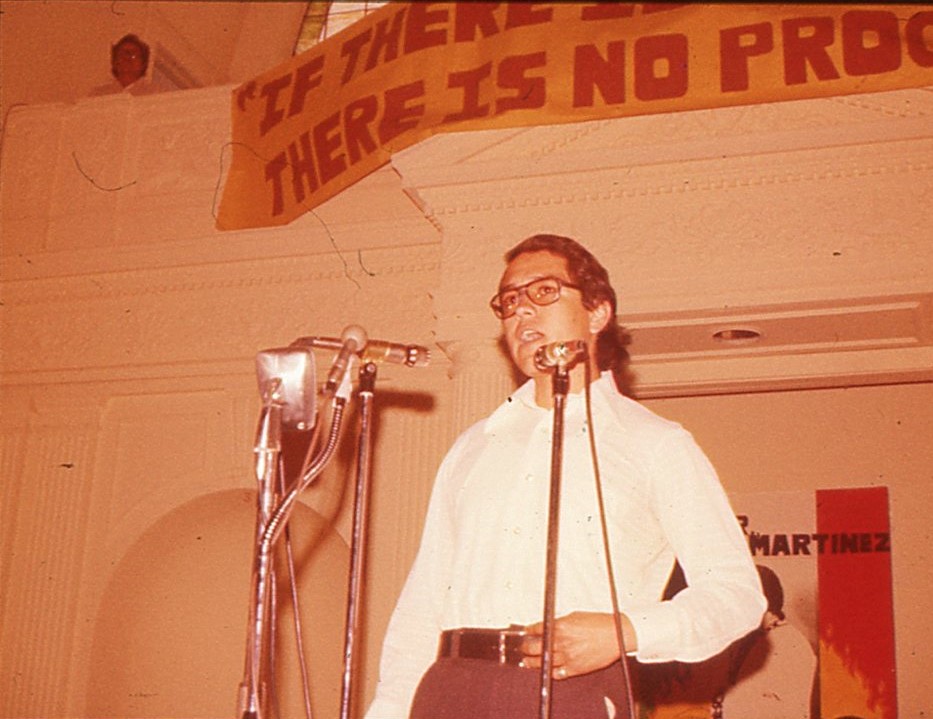
Ernesto Vigil Speaks at Crusade Conference
LHP_Intern2022-03-22T20:21:36+00:00Photo of Ernesto Vigil speaking at a conference held by the Crusade for Justice centered around unity between the Chicano Movement, American Indian Movement, and the Black Power Movement (1970s).
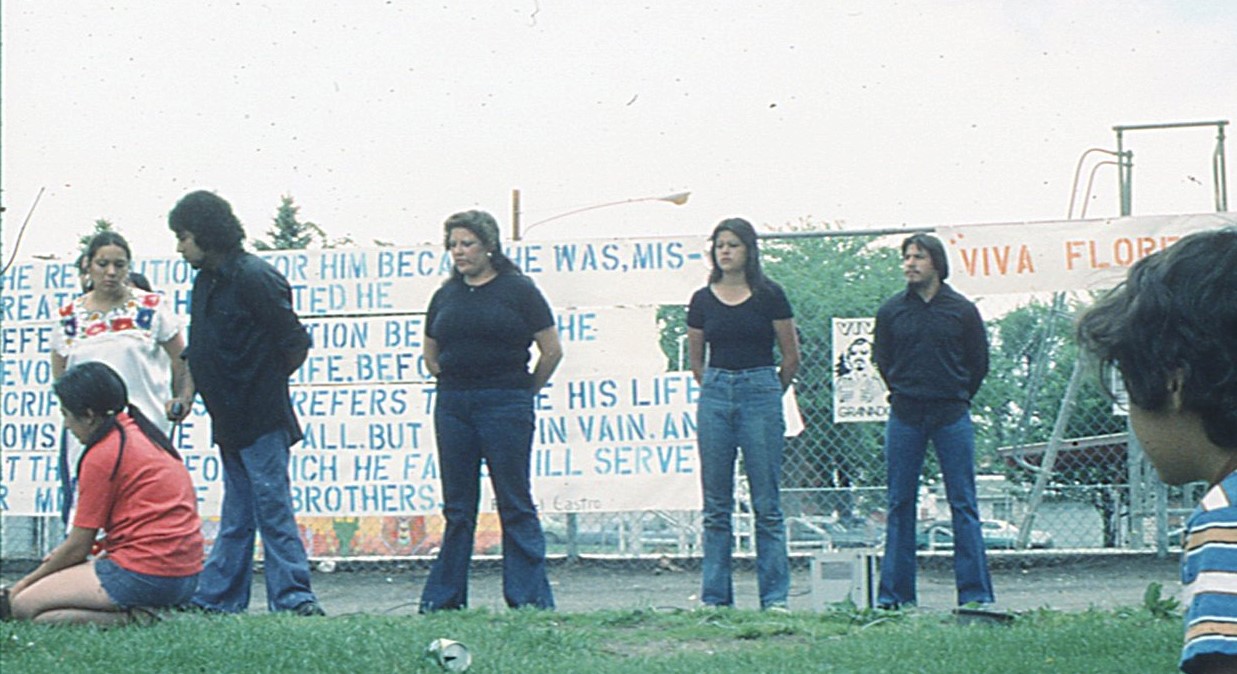
Juanita (Nita) Gonzales at La Raza Park
LHP_Intern2022-03-22T20:19:55+00:00Photo of Nita Gonzales (white shirt) at a demonstration at La Raza Park
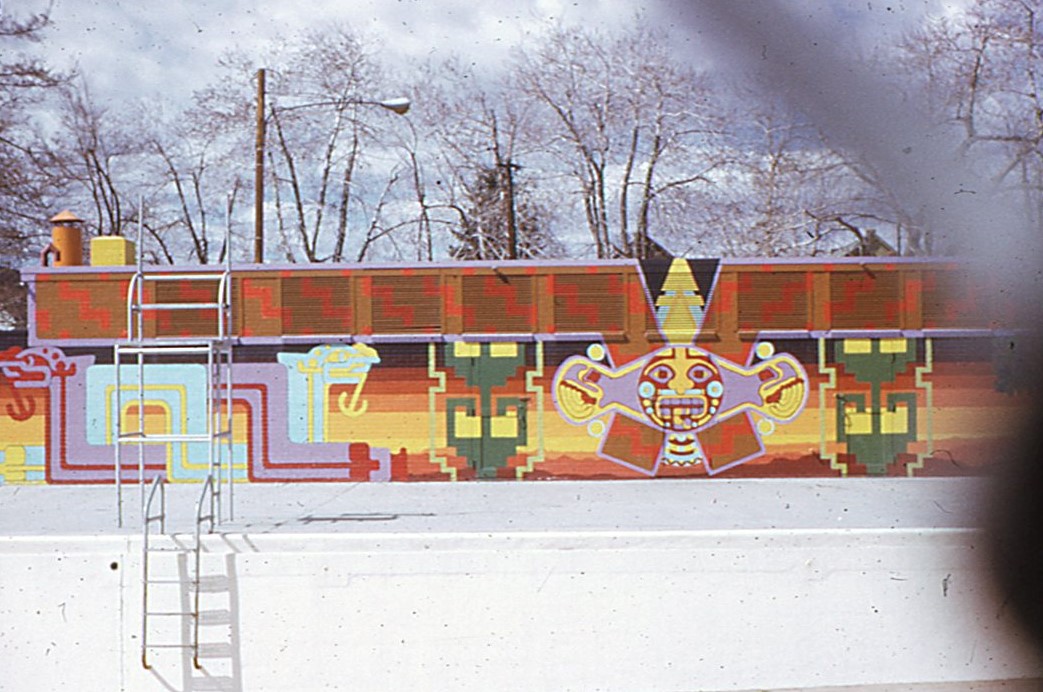
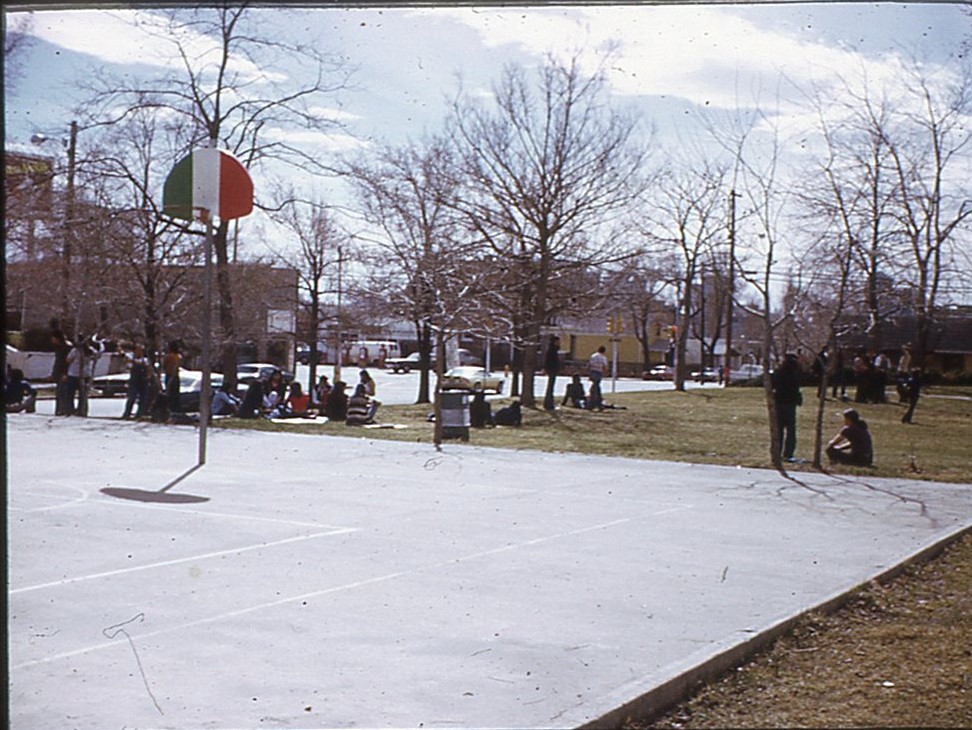
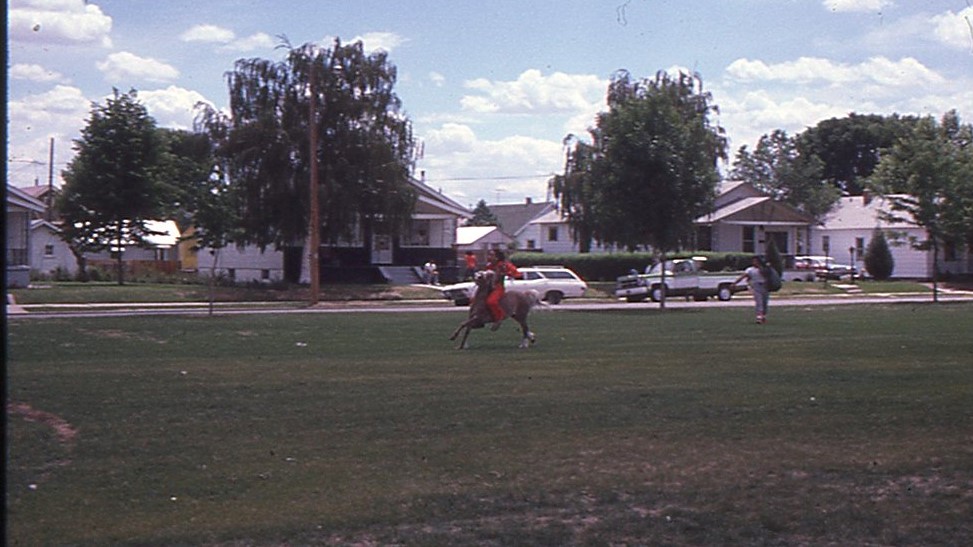
Pony at La Escuela Tlatelolco
LHP_Intern2022-03-22T20:14:26+00:00Photo of a pony being ridden at La Escuela Tlatelolco Event
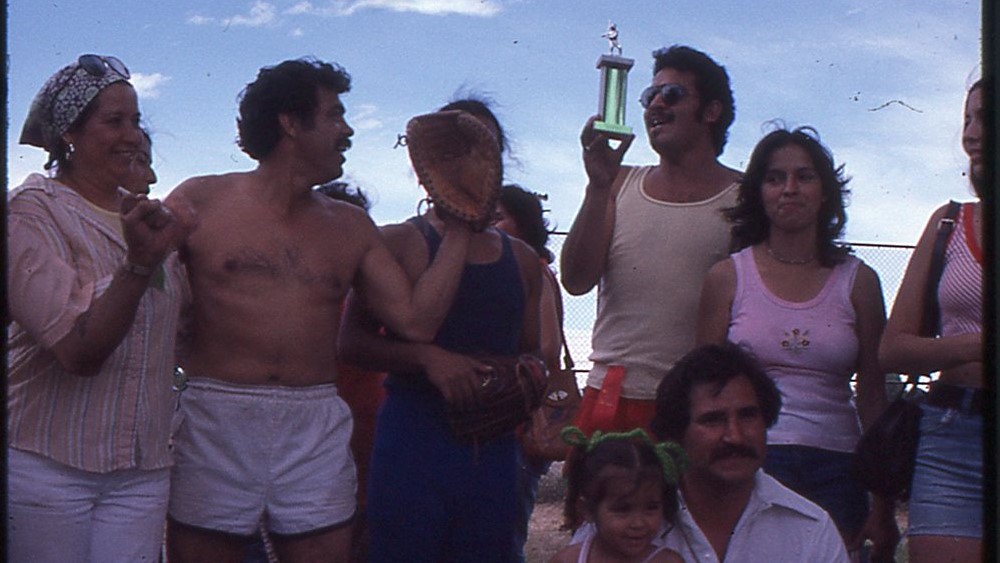
Corky Gonzales and Crusade for Justice Members
LHP_Intern2022-03-22T20:11:19+00:00Corky Gonzales and Crusade for Justice Members at an event for La Escuela Tlatelolco.
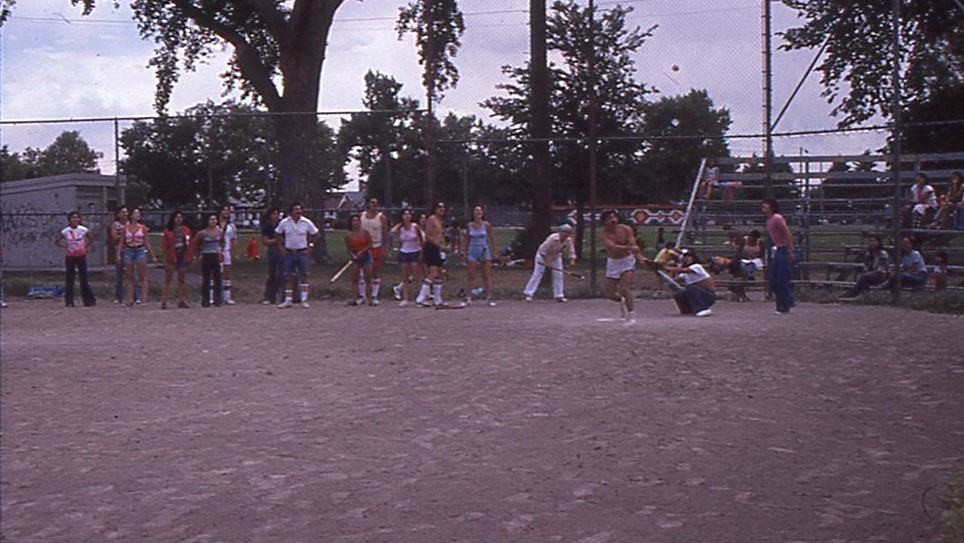
Corky Gonzales at La Escuela Tlatelolco Event
LHP_Intern2022-03-22T20:08:41+00:00Corky Gonzales playing baseball at La Escuela Tlatelolco Event

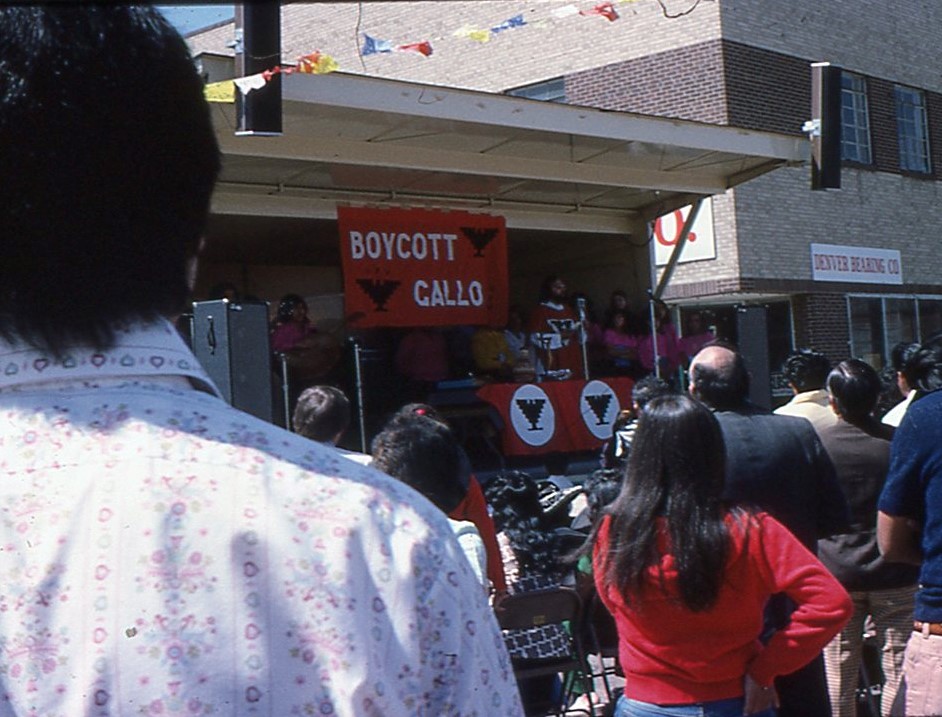
Boycott Gallo
LHP_Intern2022-03-22T20:05:03+00:00UMAS holds an event at Lincoln Park calling for a Boycott on Gallo. Gallo was the largest winery in the country and decided to not renew their contract with the UFW
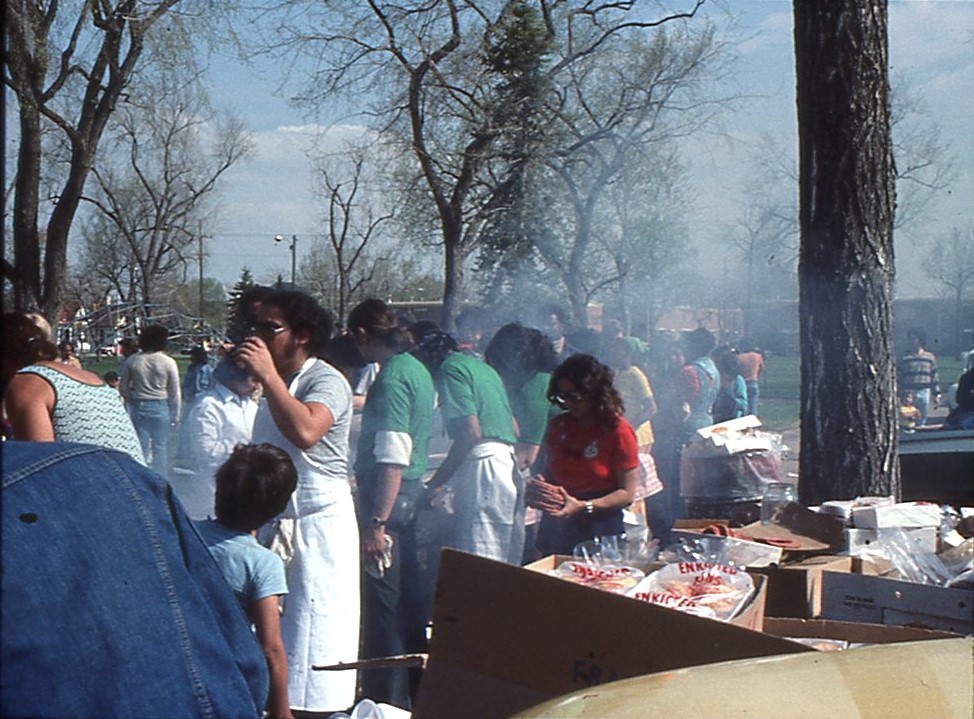
UMAS at Lincoln Park
LHP_Intern2022-03-22T20:02:53+00:00UMAS members serve food to members of the community at Lincoln Park.
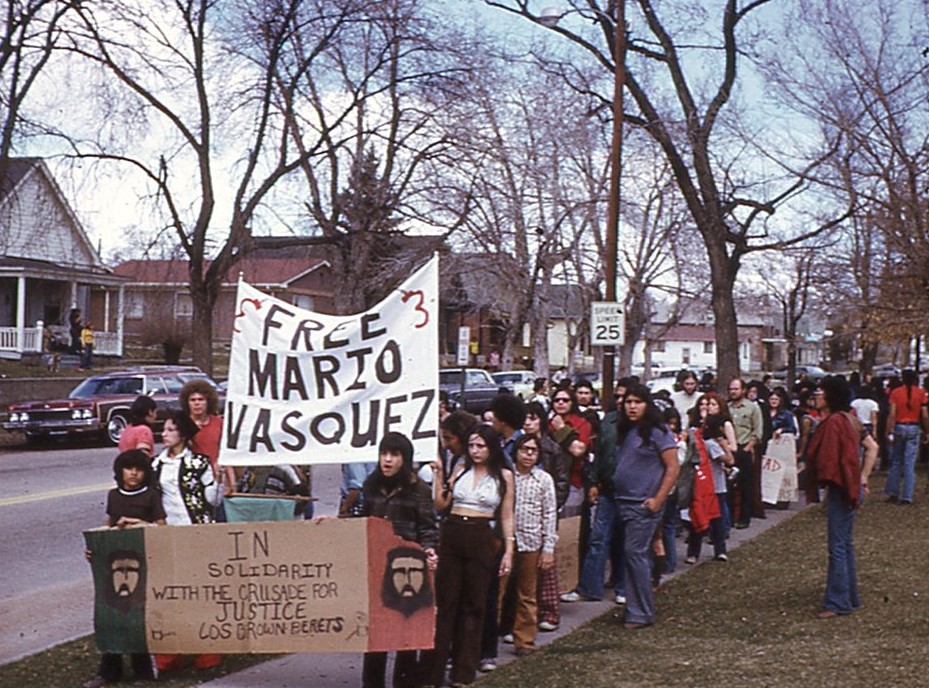
Charlotte Bonsell at Crusade March 1974
LHP_Intern2022-05-02T20:28:13+00:00Charlotte Bonsell (bottom left white shirt) and others march in Denver for Chicano Liberation Day (1974).
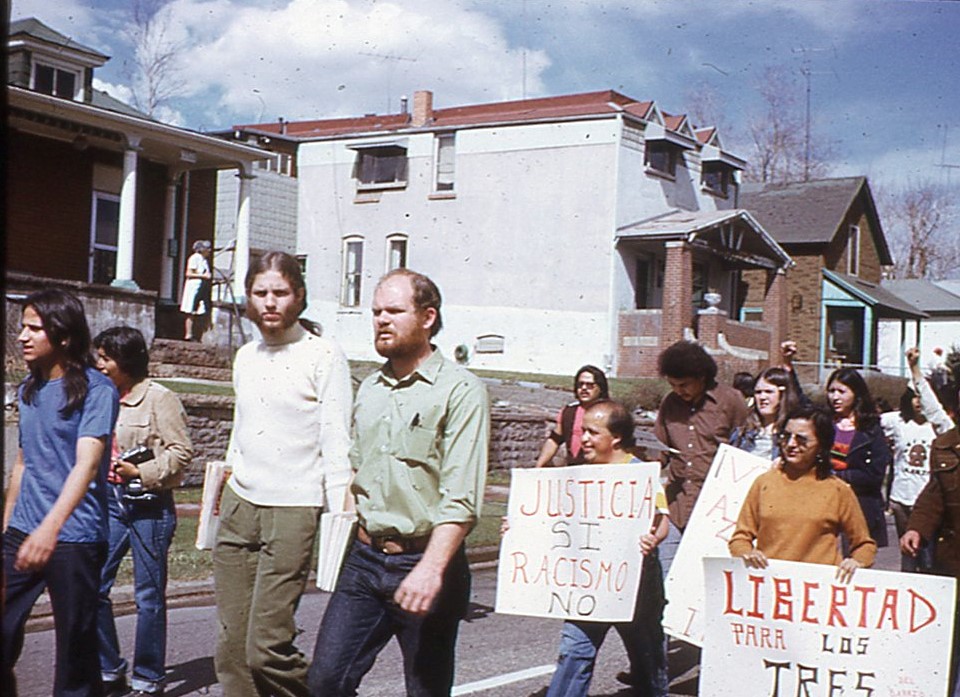
Joe Ulibarri, Cindy Trujillo, Ernesto Valdez, and Jacqui Bonsell at Crusade March 1974
LHP_Intern2022-05-02T20:29:18+00:00Joe Ulibarri (justicia si racismo no), Cindy Trujillo (libertad para los tres), Ernesto Valdez (brown shirt), and Jacqui Bonsell (black jacket) march in Denver for Chicano Liberation Day (1974).
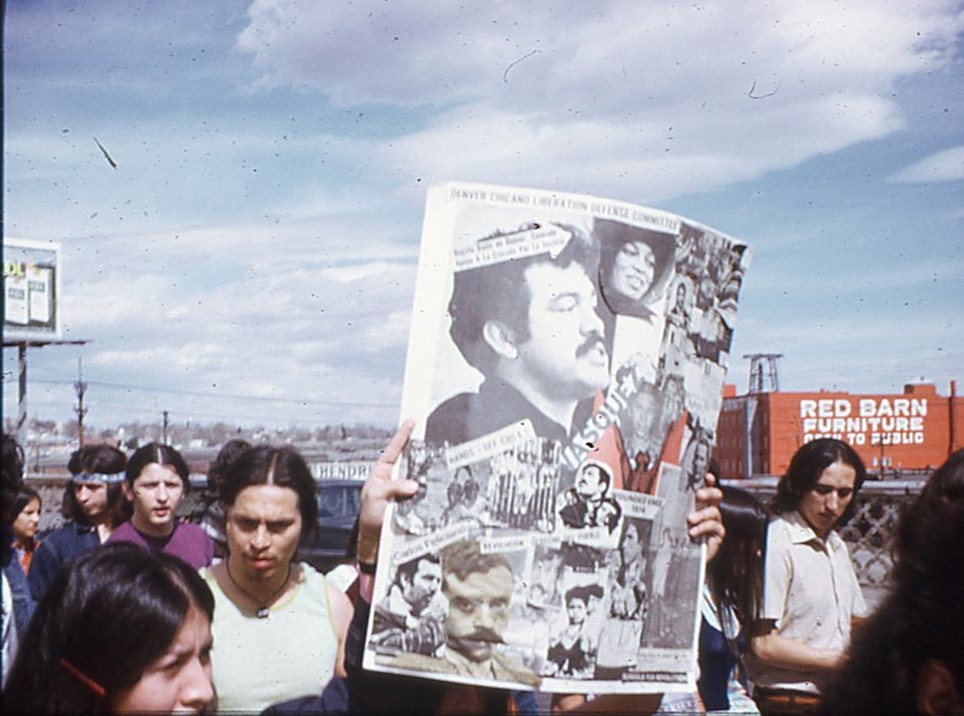
Poster Made by Jacquie Bonsell
LHP_Intern2022-03-22T19:58:22+00:00Poster Made by Jacquie Bonsell at Crusade March 1974
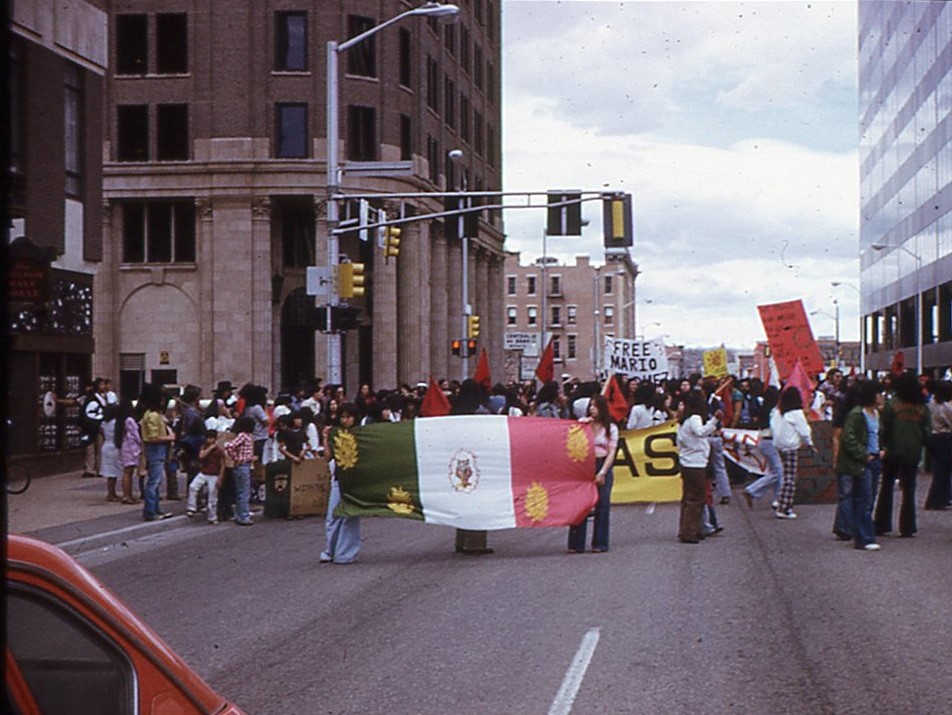
UMAS Flag at Crusade March
LHP_Intern2022-05-02T20:29:59+00:00UMAS members hold flag at Crusade March for Chicano Liberation Day (1974).
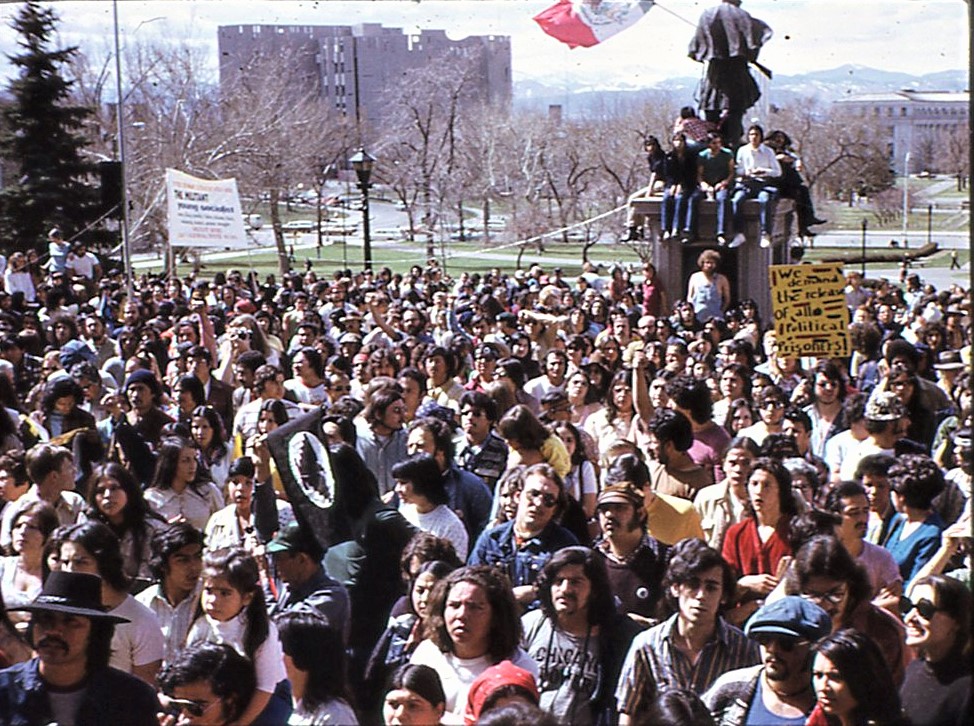
Protesters at Denver Capital
LHP_Intern2022-05-02T20:31:51+00:00An estimated ten thousand people gather at the Denver capital during a march led by the Crusade for Justice for Chicano Liberation Day (1974).
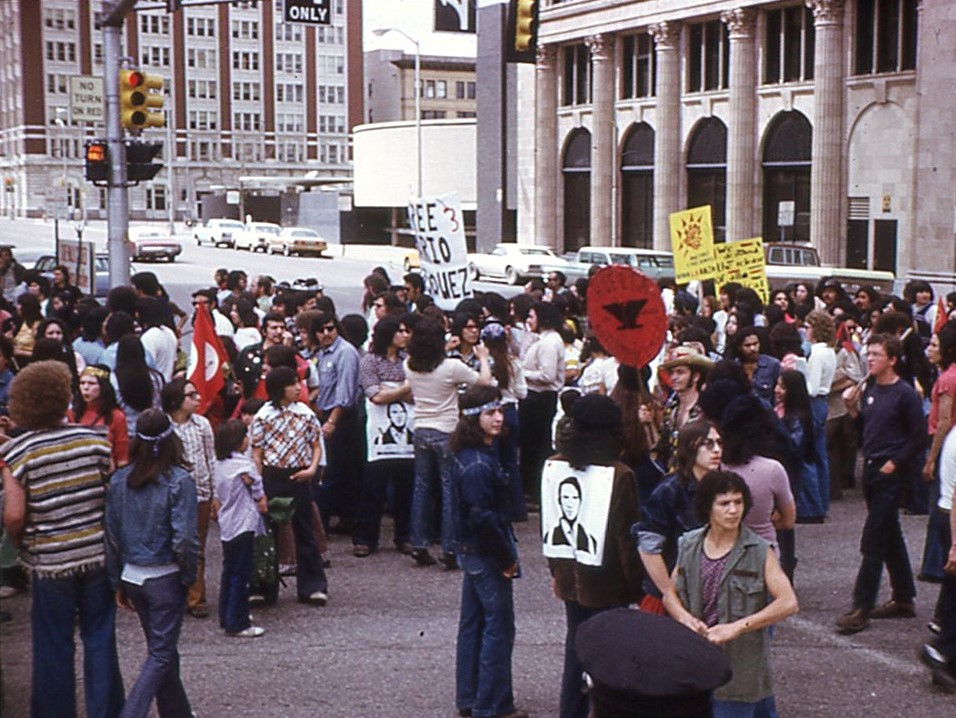
Protesters on 16th and Wazi
LHP_Intern2022-05-02T20:32:30+00:00Protesters gathered on 16th and Wazi in Denver for Chicano Liberation Day. Part of 1974 march put on by the Crusade for Justice.
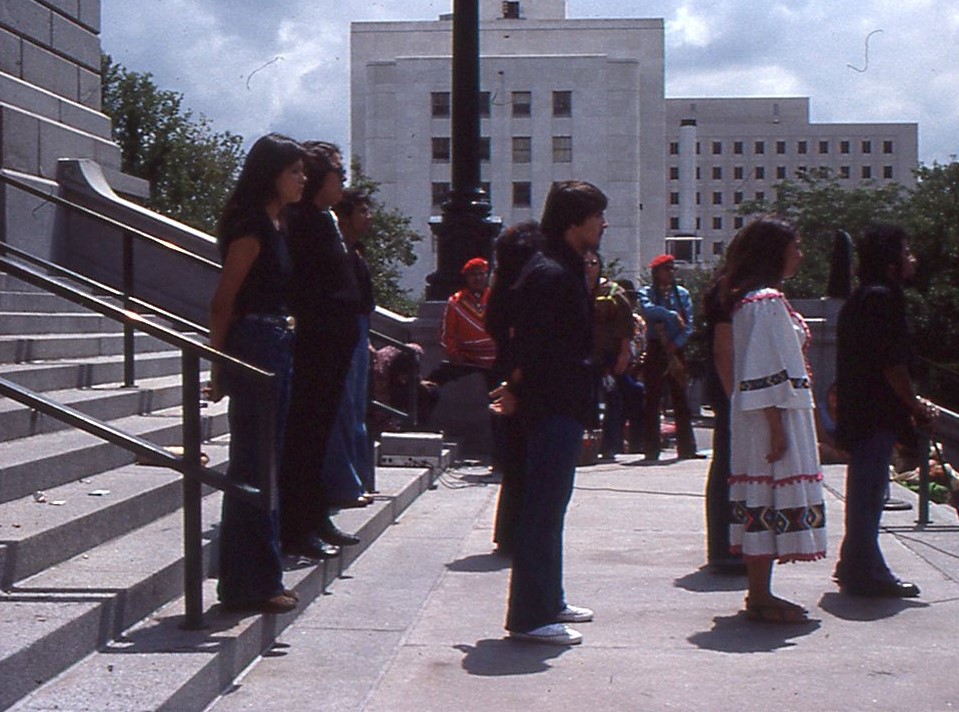
Crusade Members outside the Denver Capital
LHP_Intern2022-03-22T19:50:36+00:00Crusade members standing outside Denver capital (1974)
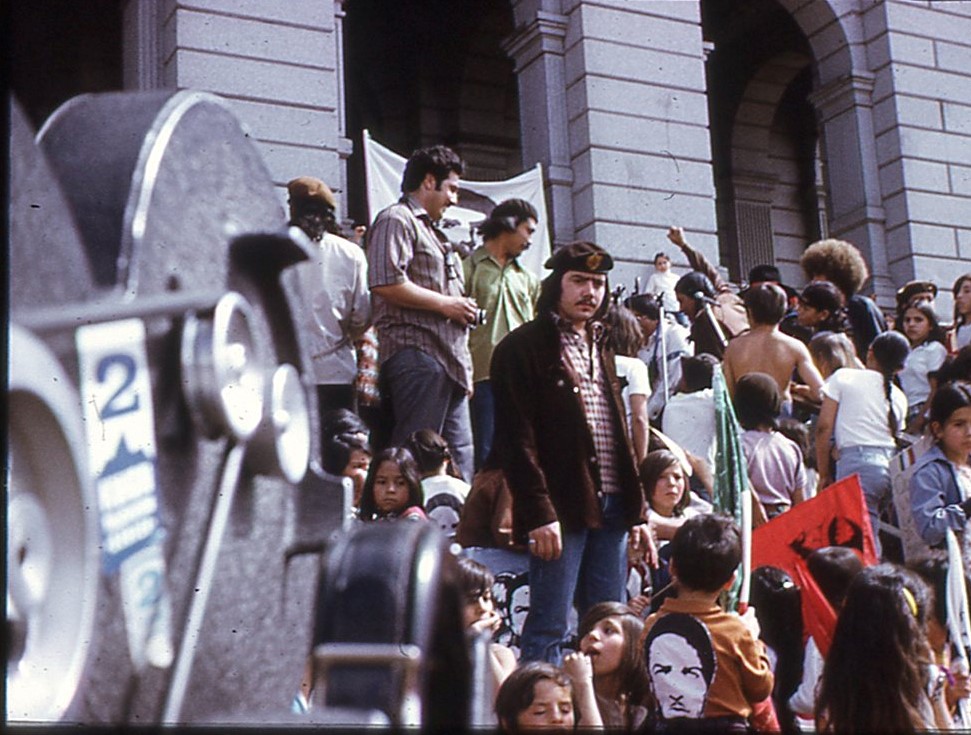
Black Berets Stand Guard
LHP_Intern2022-03-22T19:49:08+00:00Members of the Black Berets guard protesters outside the Denver Capital (1974)
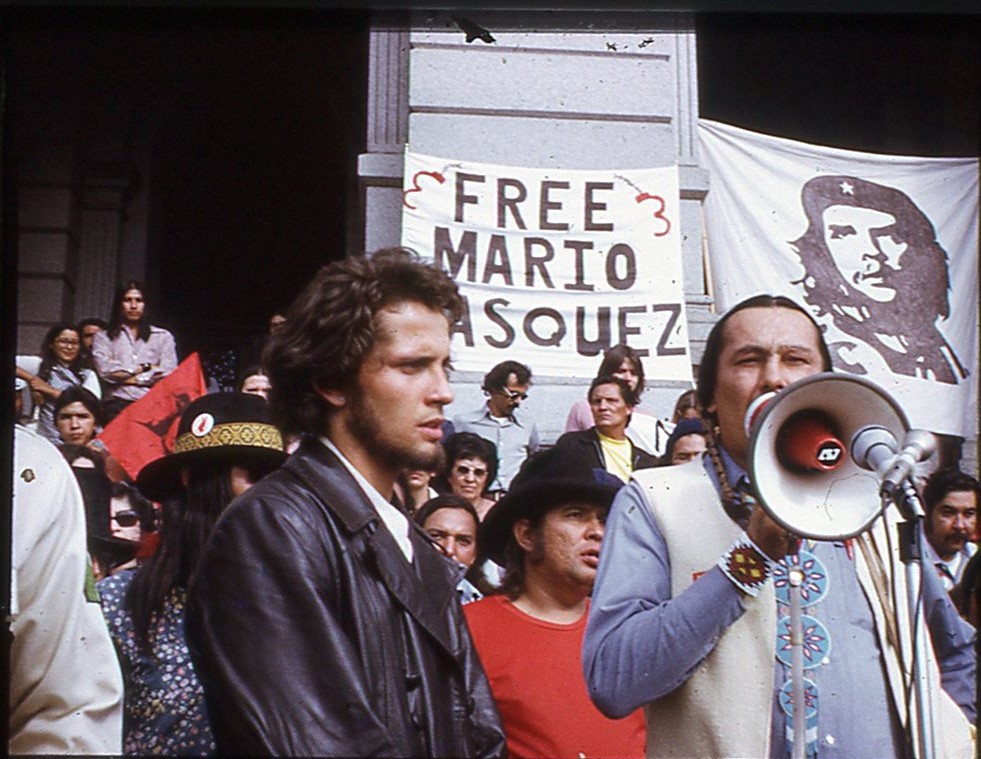
Carlos Zapata and an AIM Member
LHP_Intern2022-03-22T19:47:25+00:00Carlos Zapata (left) and an AIM member (right) at the Denver Capital (1974)
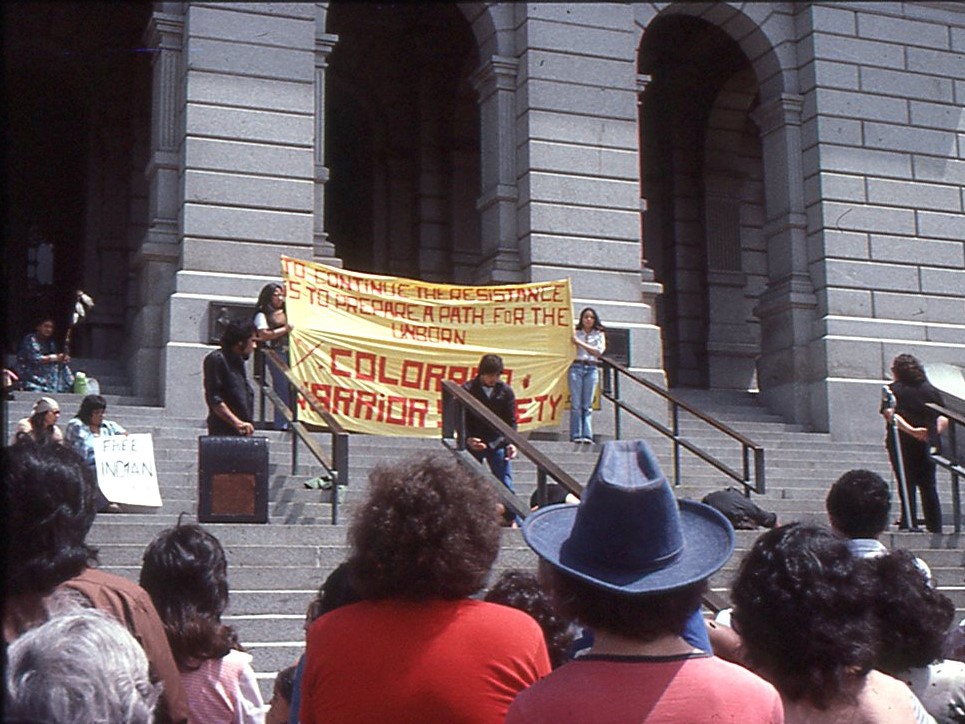
Colorado Warrior Society
LHP_Intern2022-03-22T19:46:16+00:00Members of the Colorado Warrior Society standing outside the Denver Capital 1974
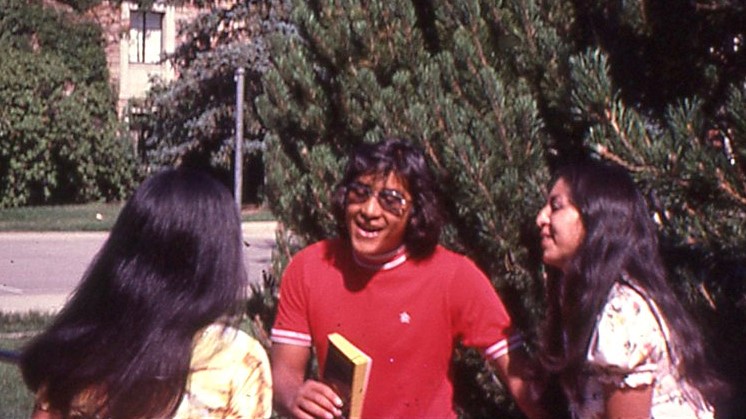
Lilian Hurtado and UMAS Students
LHP_Intern2022-03-22T19:45:02+00:00Lilian Hurtado (far right) and other UMAS students
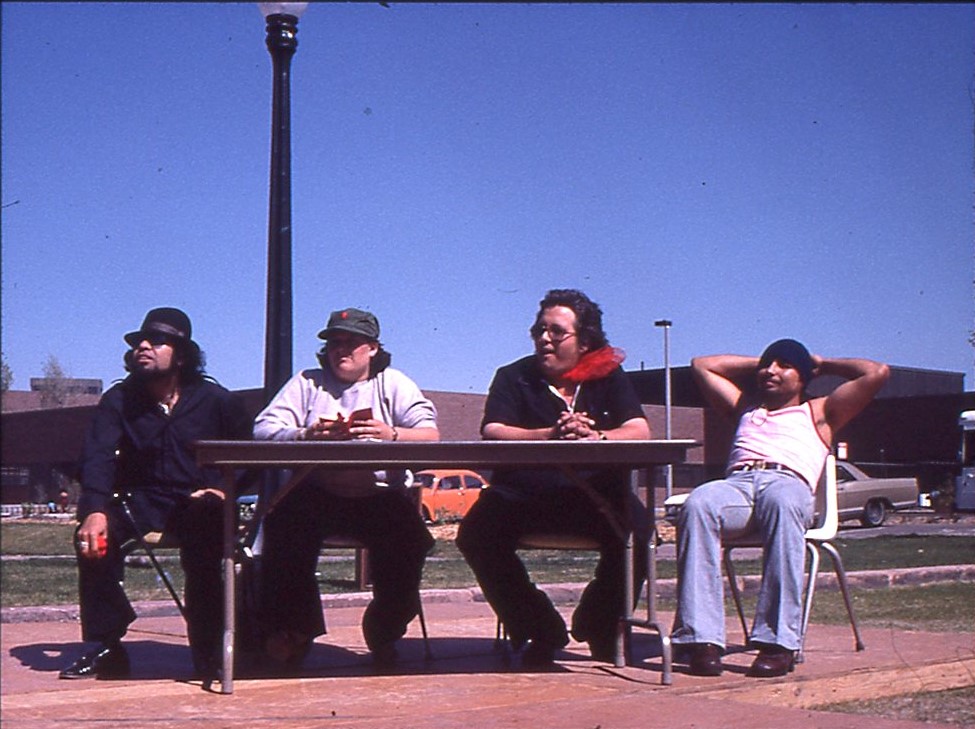
Members of Su Teatro
LHP_Intern2022-03-22T19:42:55+00:00Members of Su Teatro at Metro State College (1976)
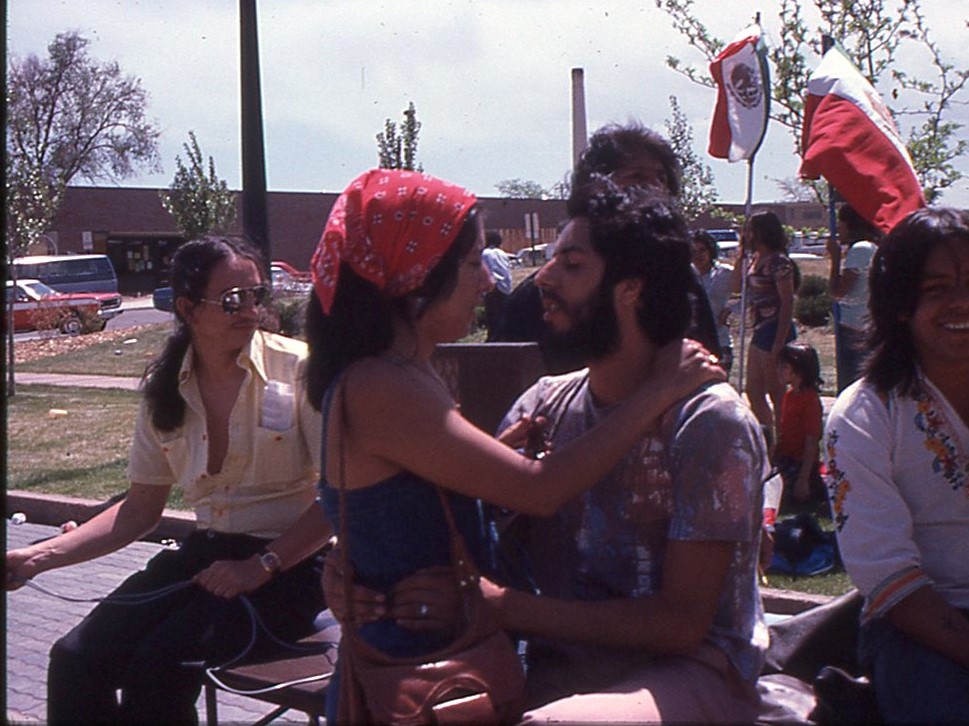
Antonio Bonsell, Sarah and Tom Rael at MSC 1976
LHP_Intern2022-03-22T19:41:08+00:00Antonio Bonsell (yellow), Sarah and Tom Rael at Metro State College 1976.
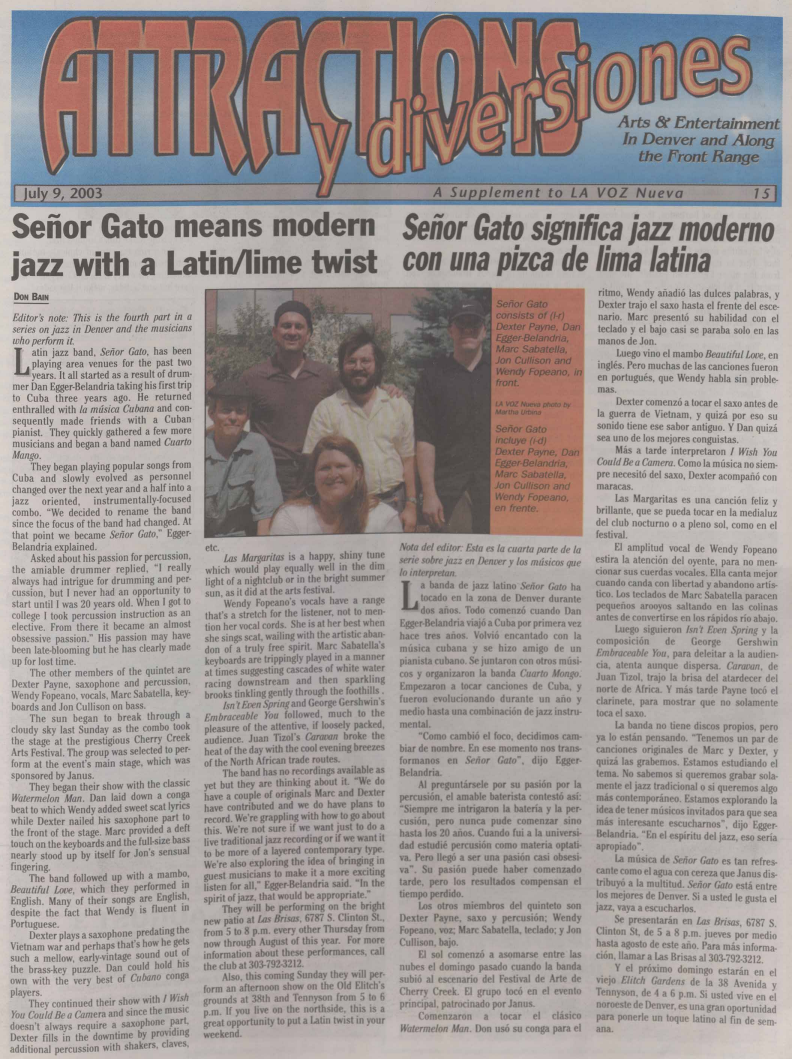
“Señor Gato Jazz”, 2003
LHP_Intern2022-03-21T16:25:00+00:00“Senor Gato a Denver band performs near the Northside”, Denver, 2003
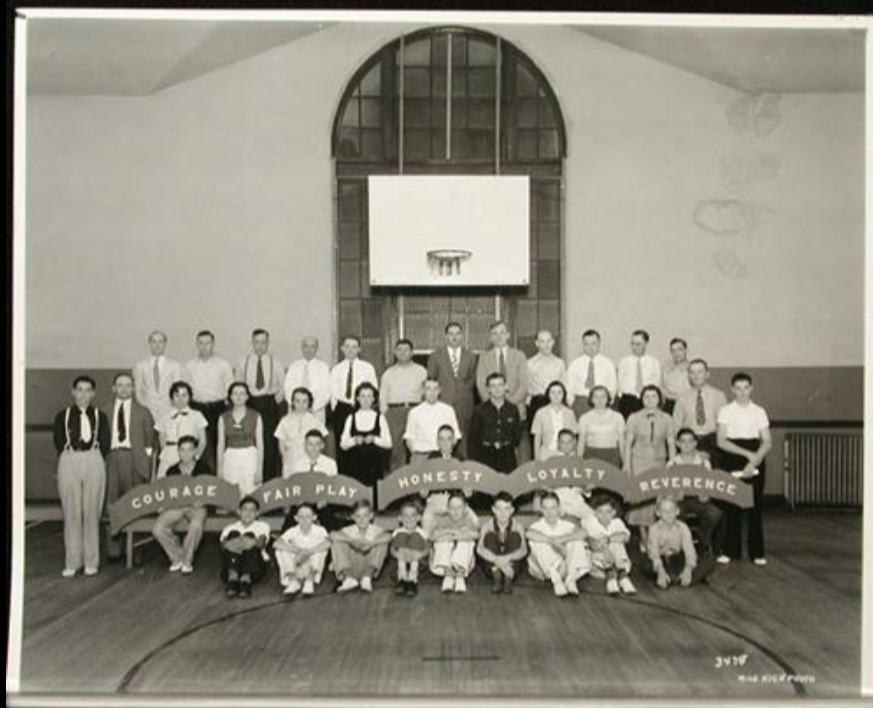
Photo Taken in Northside Community Center, 1938
LHP_Intern2022-03-29T13:53:24+00:00Photo taken in a gymnasium at the Northside Community Center at 36th and Lipan, by Mile High Photo Company, Denver, 1938
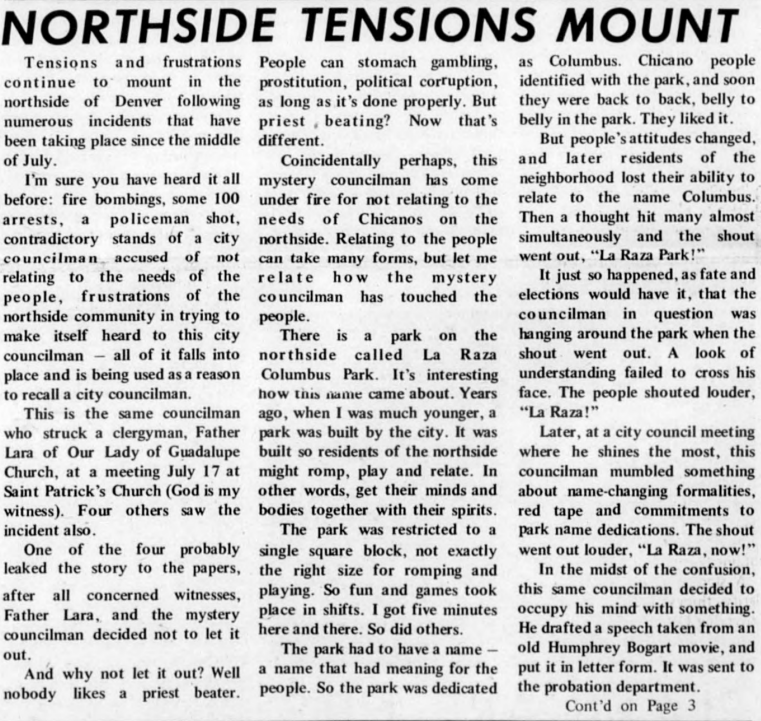
“Northside Tensions”, 1972
LHP_Intern2022-03-21T16:22:29+00:00“Northside Tensions Mount”, Denver, 11-22-1972
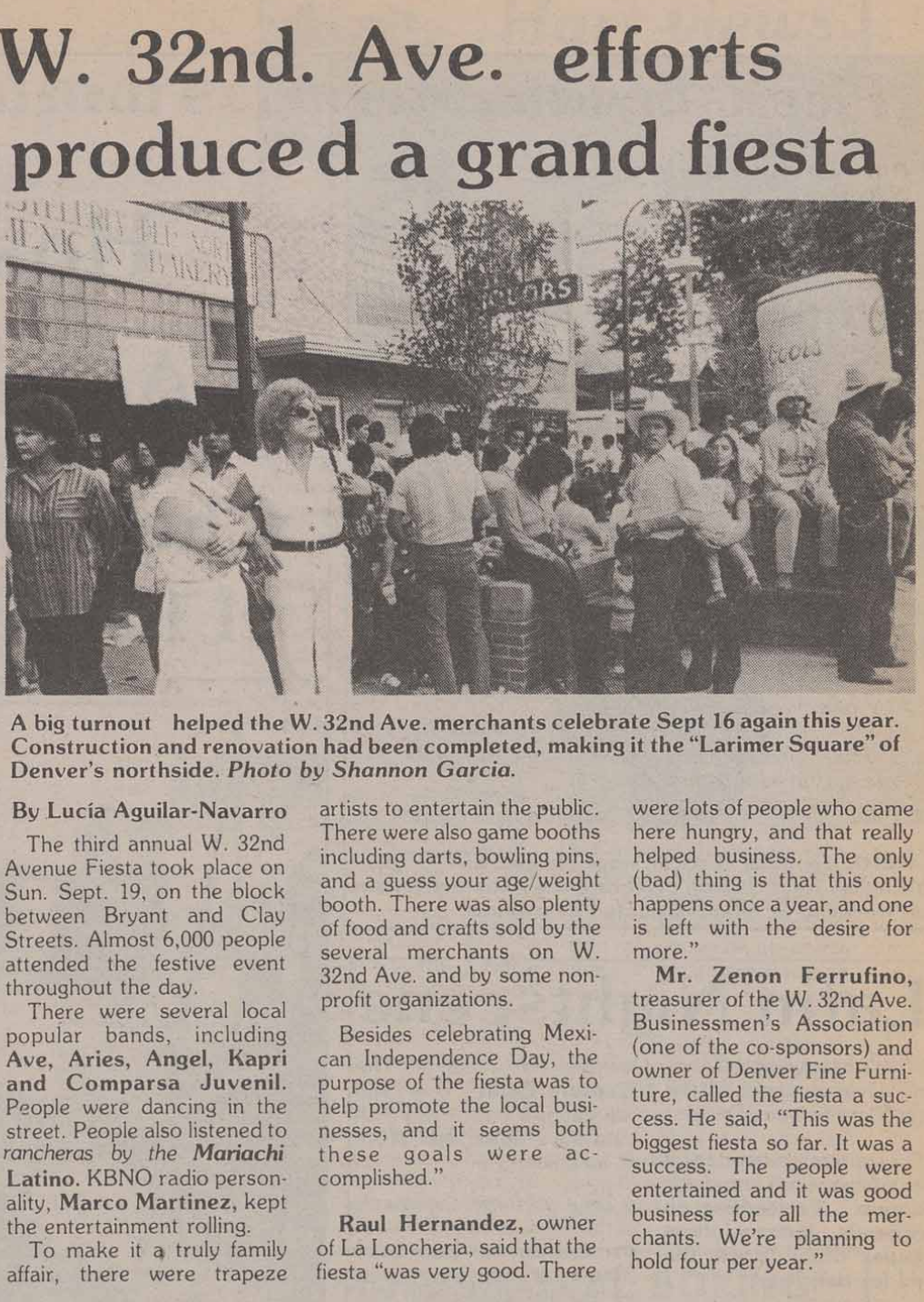
“W. 32nd Ave. Grand Fiesta”, 1983
LHP_Intern2022-03-21T16:21:38+00:00“W. 32nd Ave. Efforts Produced a Grand Fiesta”, By Lucia Aguilar-Navarro, Denver, 9-21-1983
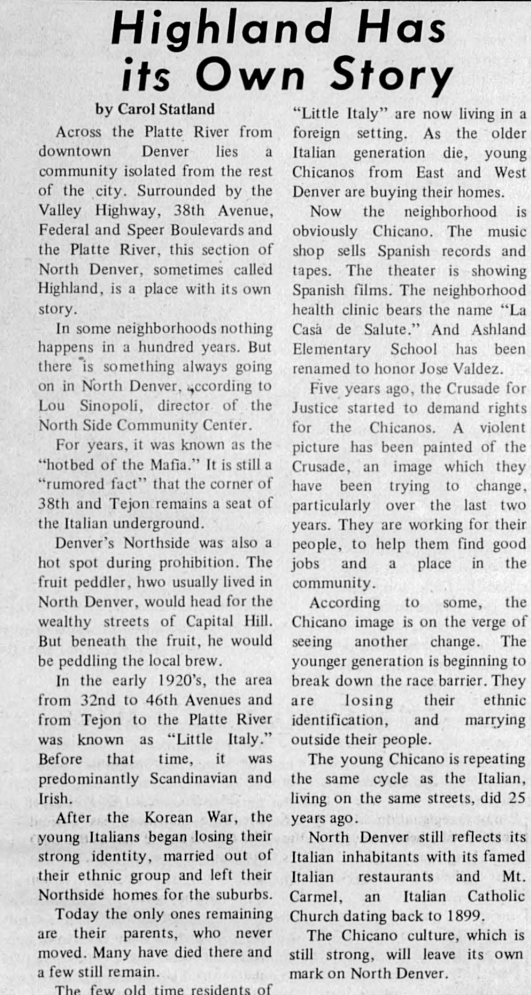
“Highland”, 1974
LHP_Intern2022-03-21T16:20:56+00:00“Highland Has its Own History”, By Carol Statland, Denver, 9-11-1974
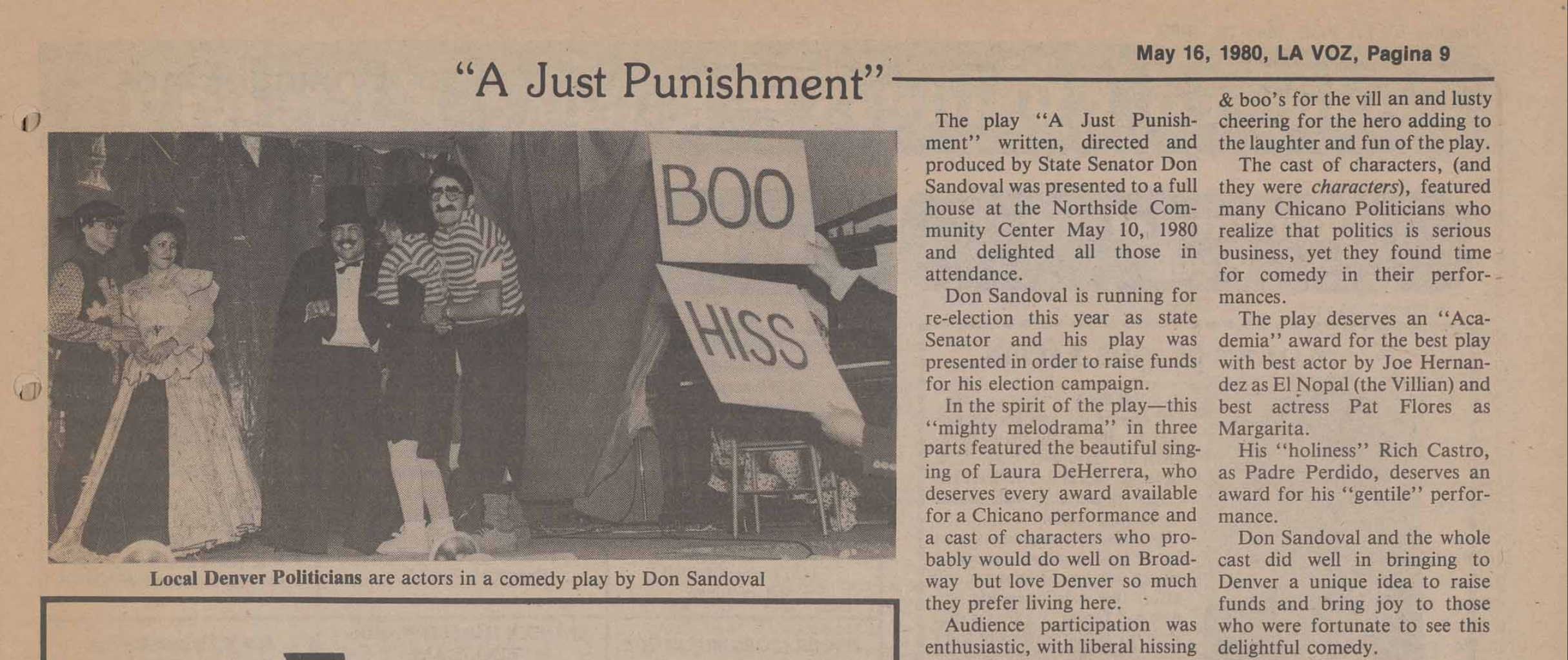
“A Just Punishment”, 1980
LHP_Intern2022-03-21T16:19:58+00:00A play “A Just Punishment” is performed at the Northside Community Center to raise funds for Don Sandoval’s re-election Campaign, Denver, 5-15-1980
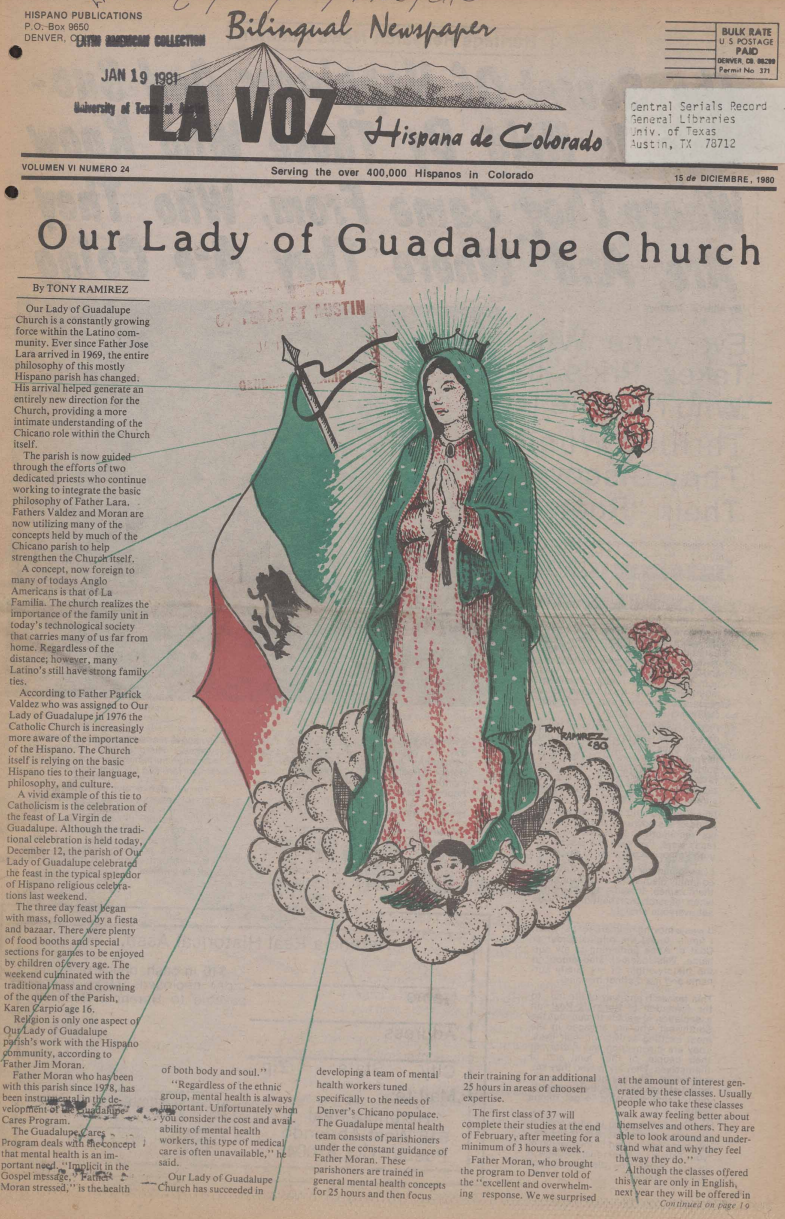
“Our Lady of Guadalupe Church”, 1980
LHP_Intern2022-03-21T16:16:38+00:00Article on the importance of the church in the Chicano community and events, by Tony Ramirez, Denver, 12-15-1980
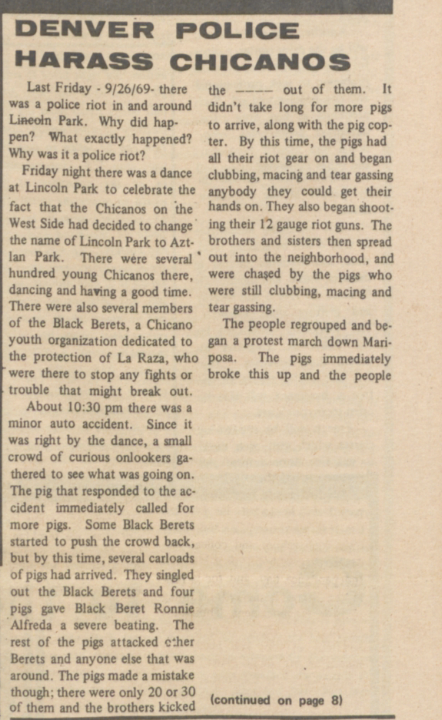
Denver Police Harass Chicanos
LHP_Intern2022-03-14T15:53:42+00:00Members of the Black Berets are attacked by Denver police officers at a fiesta at Aztlan Park.
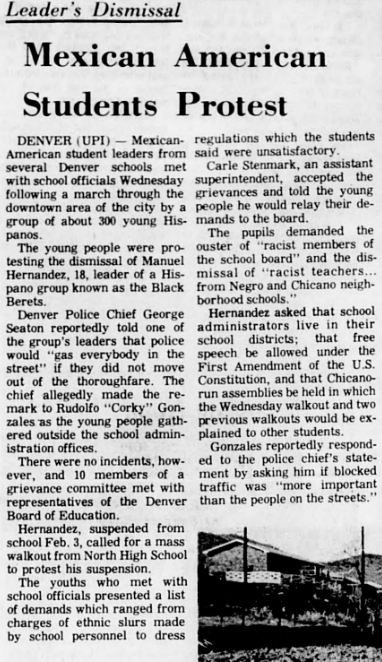
Chicano Students Protest against dismissal of Manuel Hernandez
LHP_Intern2022-03-29T13:28:23+00:00Chicanos march to protest the suspension and arrest of Manuel Hernandez. Hernandez was the student leader of the Black Berets who was suspended from Denver’s North High School for organizing a mass walkout.
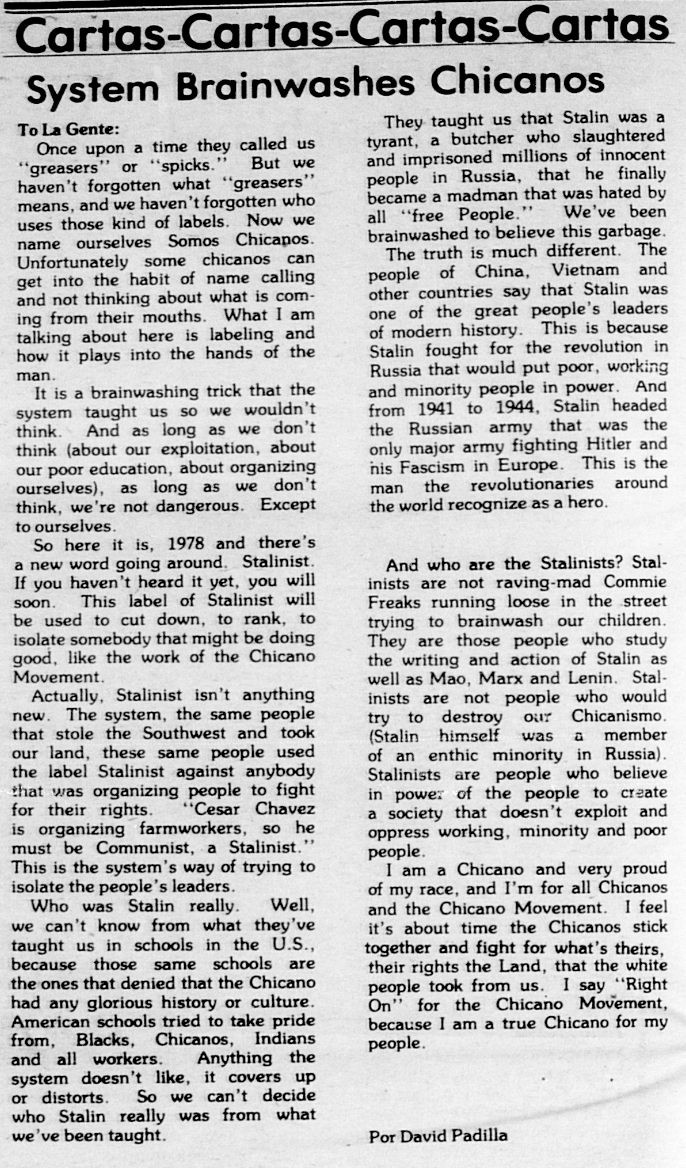
The System Brainwashes Chicanos
LHP_Intern2021-11-22T03:04:31+00:00Article from La Cucaracha in 1978. The article discusses how communism and communist leaders like Stalin have been criticized by the American education system.
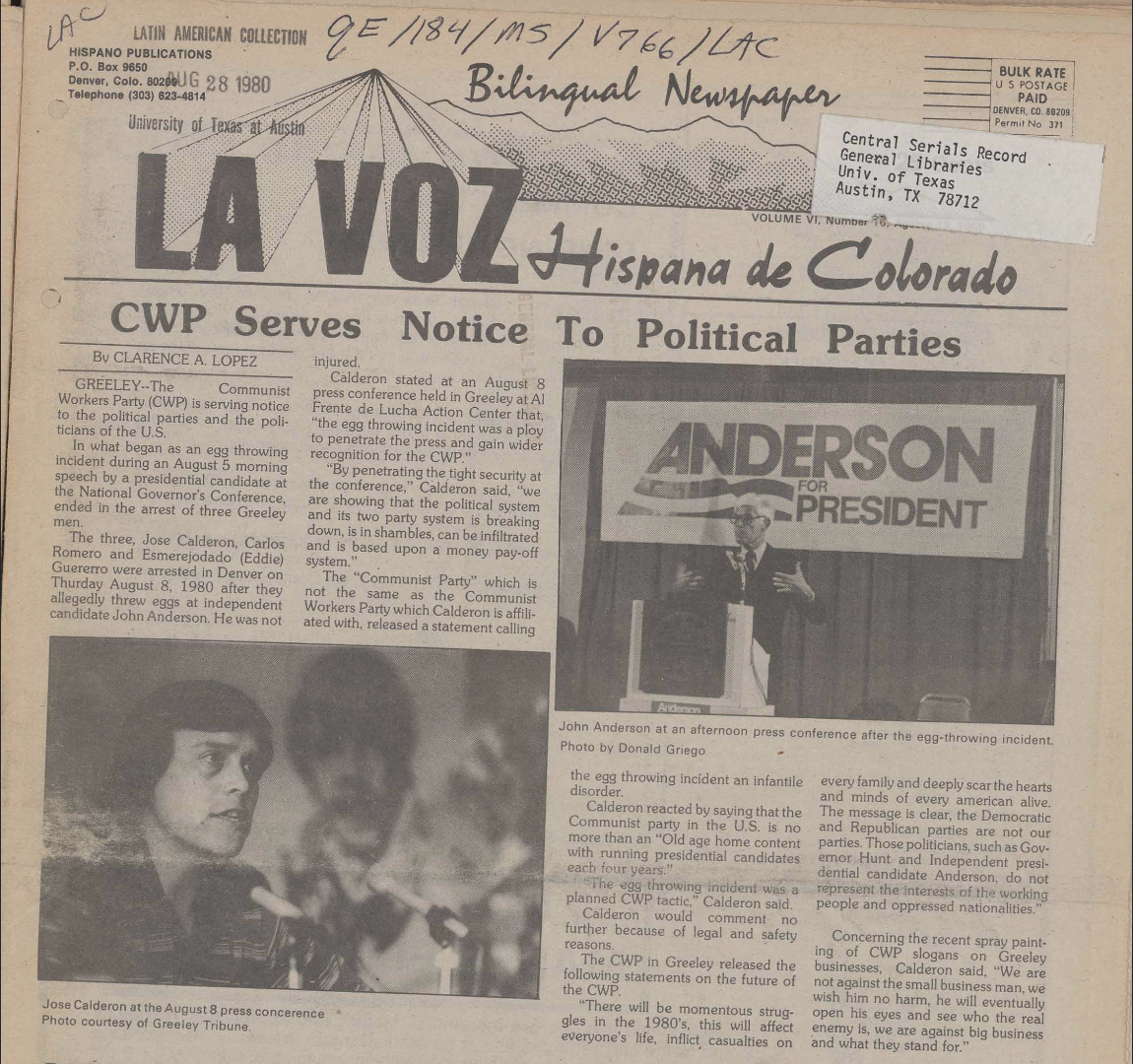
Chicano members of the CWP throw eggs at presidential nominee
LHP_Intern2021-11-22T02:43:44+00:00Chicano members of the Communist Workers Party throw eggs at presidential nominee, John Anderson. One of the members, Jose Calderon, said the incident was a ploy to draw more attention to the CWP.
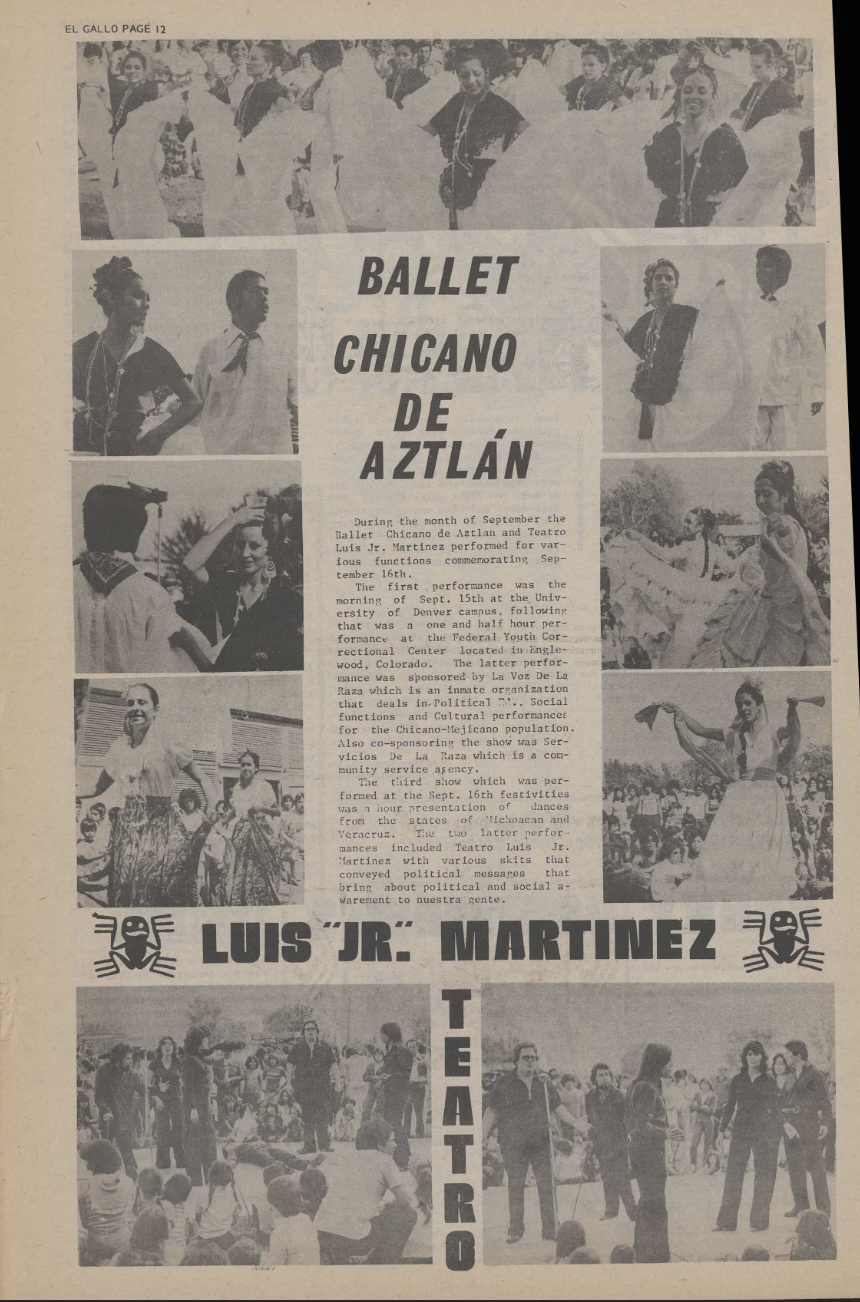
Ballet de Atzlán
LHP_Intern2021-11-22T02:27:24+00:00The Ballet Chicano de Atzlán and Teatro Luis Jr. Martinez performed for various functions commemorating September 16th. The event was held in Englewood, Colorado and the event was co-sponsored by Servicios de la Raza
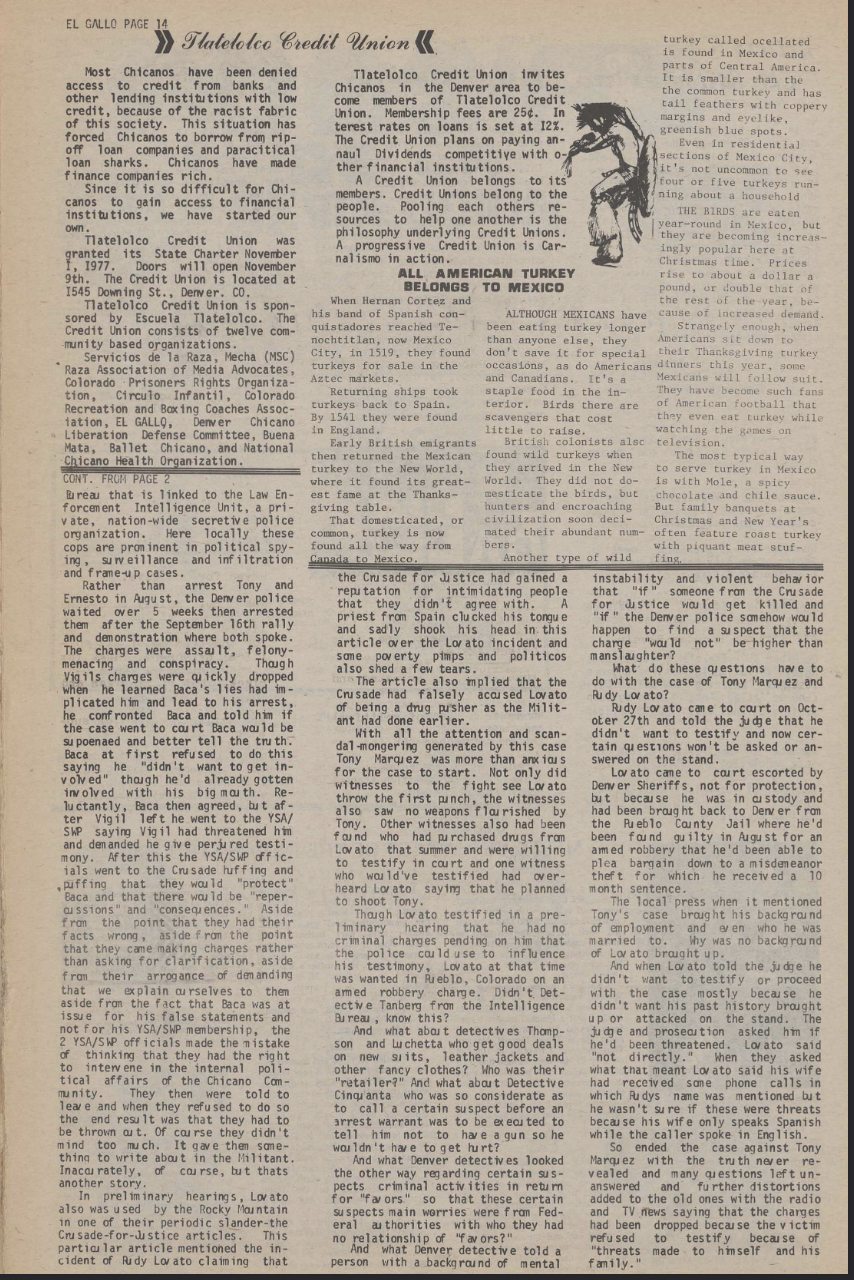
Tlatelolco Credit Union
LHP_Intern2021-11-22T02:17:33+00:00Tlatelolco Credit Union is a bank that was created to help Chicanos as many people were denied loans from traditional lending institutions. Tlatelolco Credit Union was sponsored by twelve community based organizations including Servicios de la Raza. See full source here
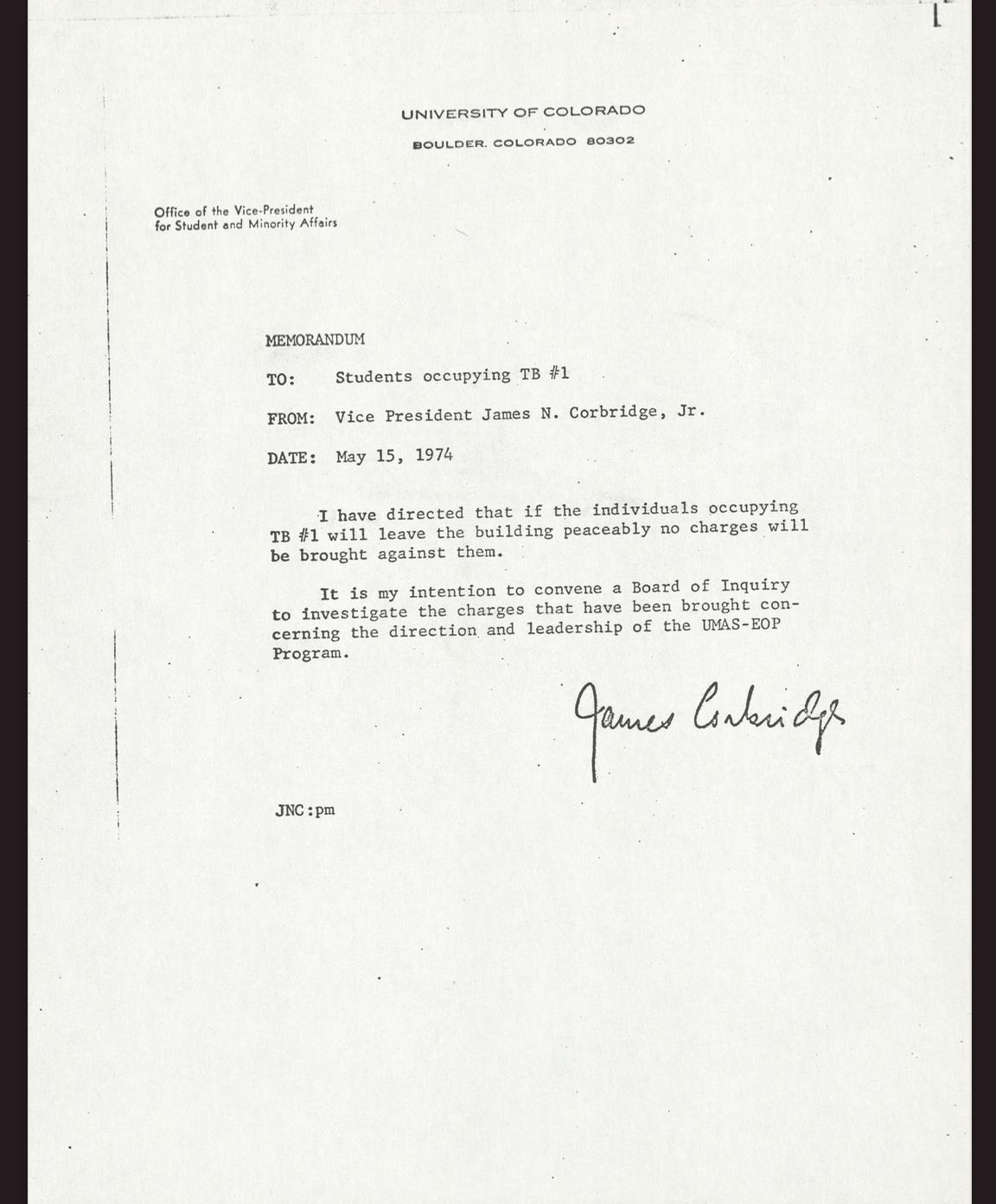
VP Corbridge letter to TB1 protesters
LHP_Intern2021-09-20T20:17:45+00:00VP Corbridge promises that there will be no charges filed against the individuals occupying TB1.
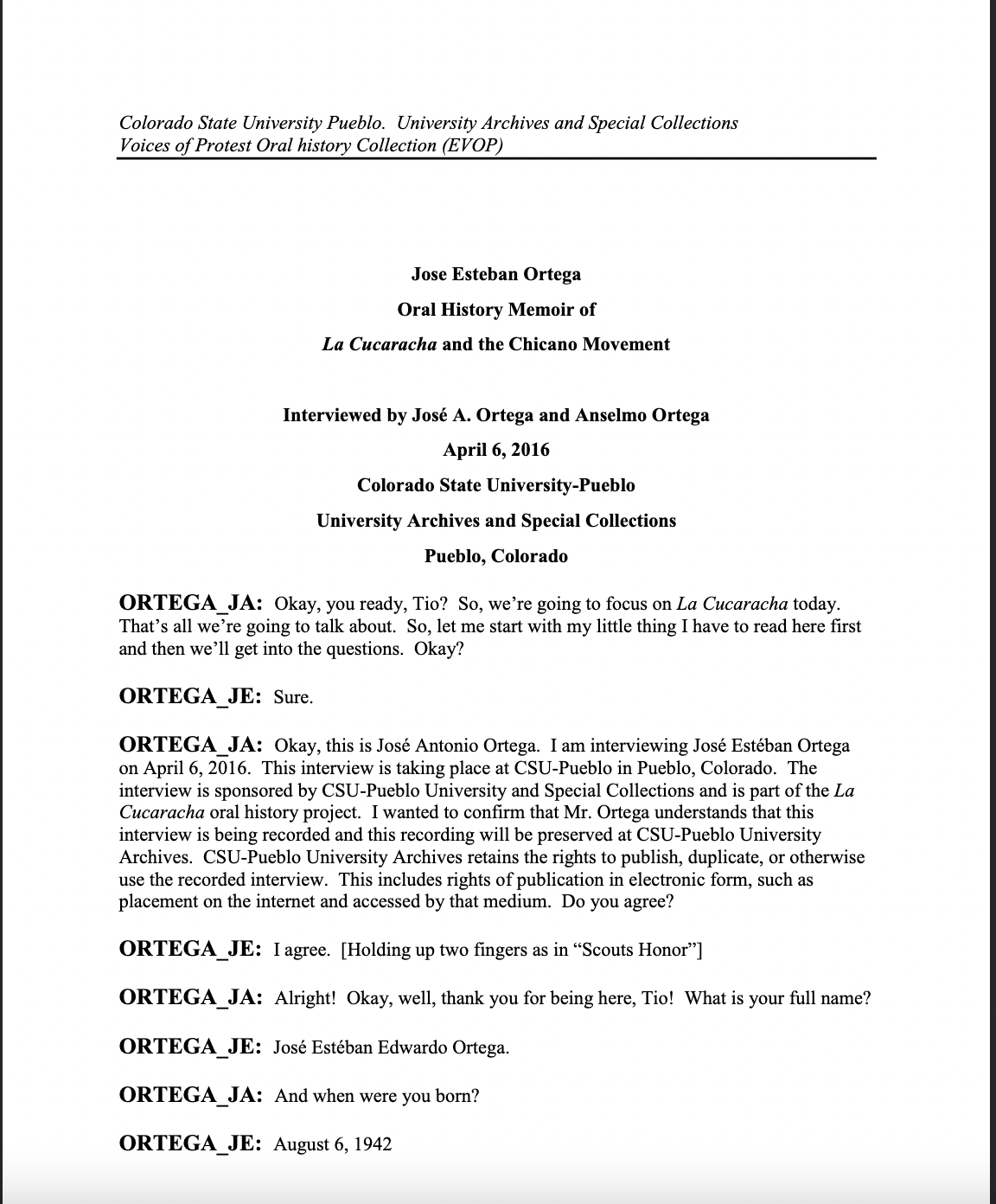
José Estéban Ortega on La Cucaracha
LHP_Intern2021-09-20T20:12:48+00:00Ortega talks about how La Cucaracha was founded, the different topics they covered and the various people and groups they worked with. Complete source here
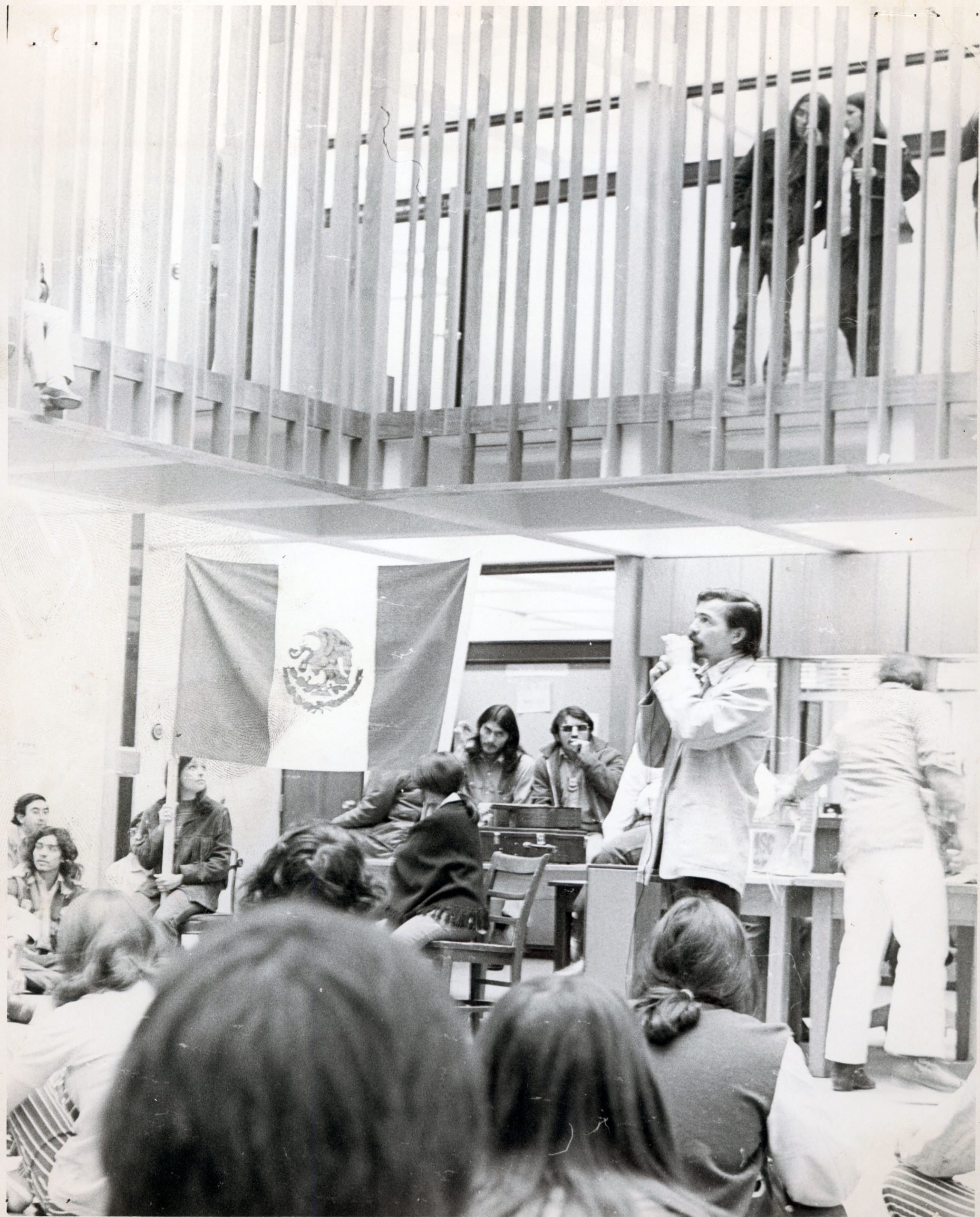
Florencio “Freddy” Granado UMAS EOP Speech
LHP_Intern2021-09-20T19:42:21+00:00Florencio “Freddy” Granado speaking to students during UMAS EOP demonstration in Regent Hall.
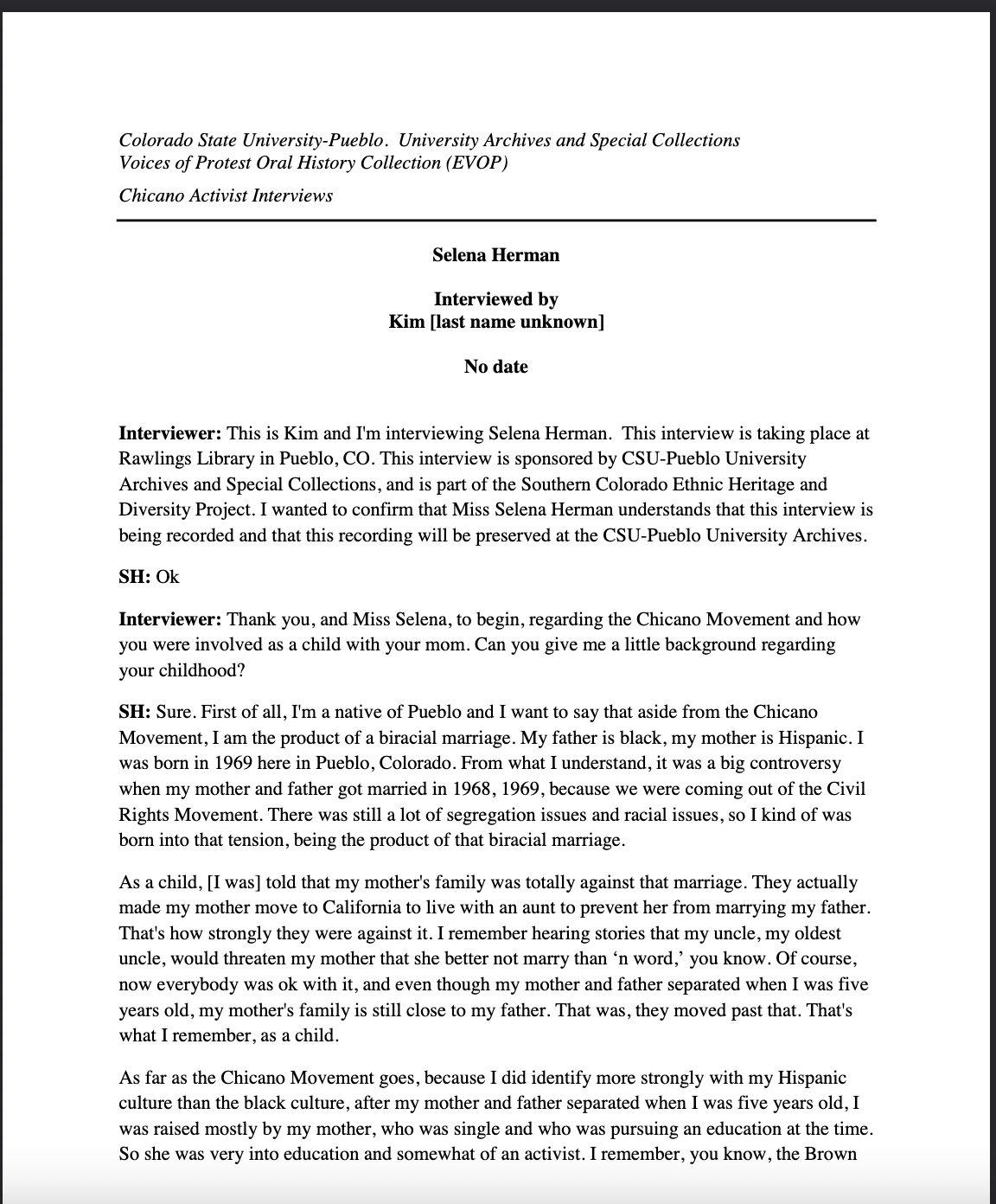
Selena Herman Interview on the early Chicano Movement
LHP_Intern2021-09-20T19:36:38+00:00Herman talks about her heritage and how it relates to issues with the Chicano Movement. Also talks about demonstrating with UMAS at CU Boulder. Complete source here
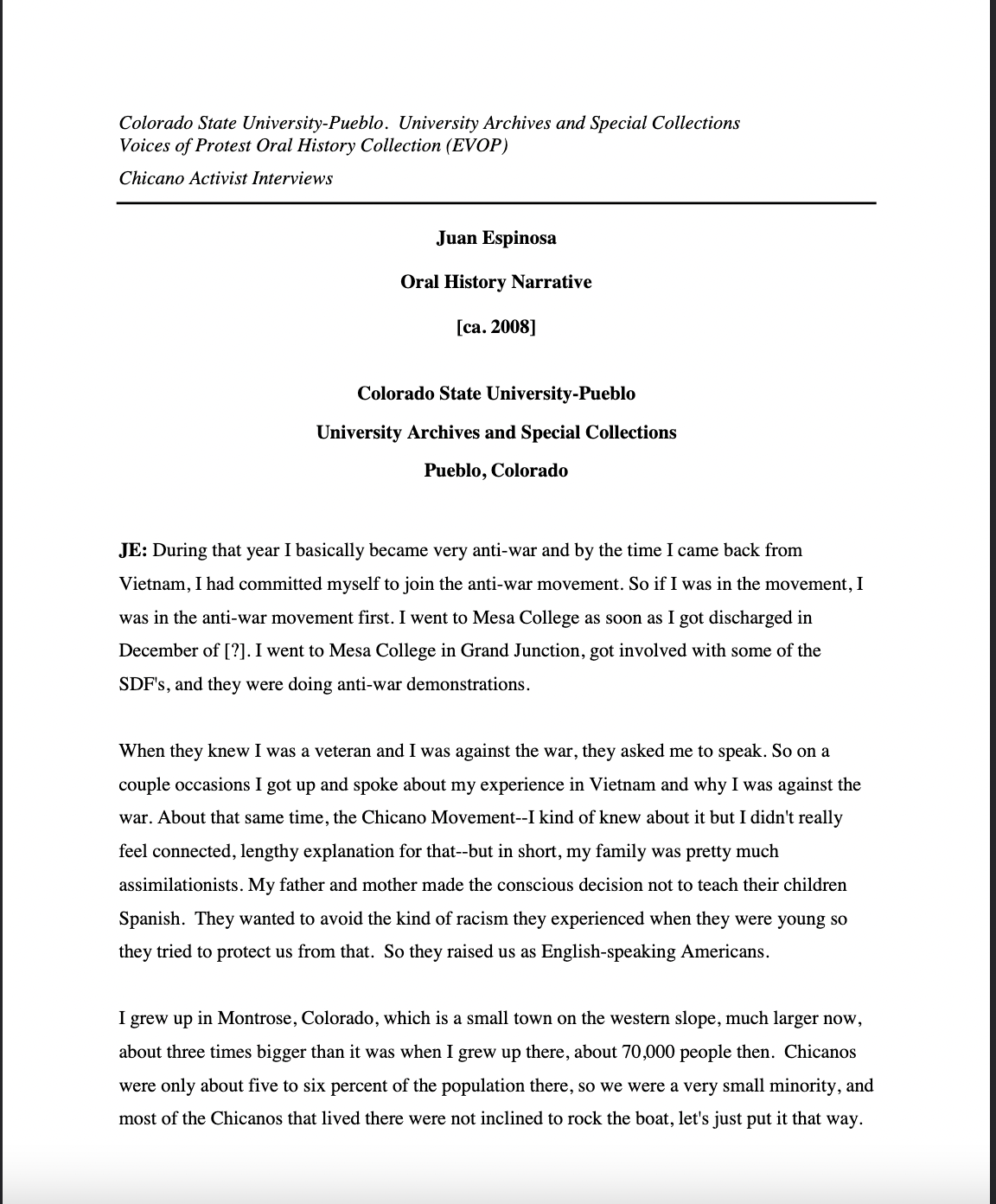
Juan Espinosa Oral History Transcript
LHP_Intern2021-09-20T19:28:23+00:00Juan Espinosa recounts how he joined the Chicano Movement, his involvement with the Regent Hall occupation, and the creation of El Diario. Complete source here
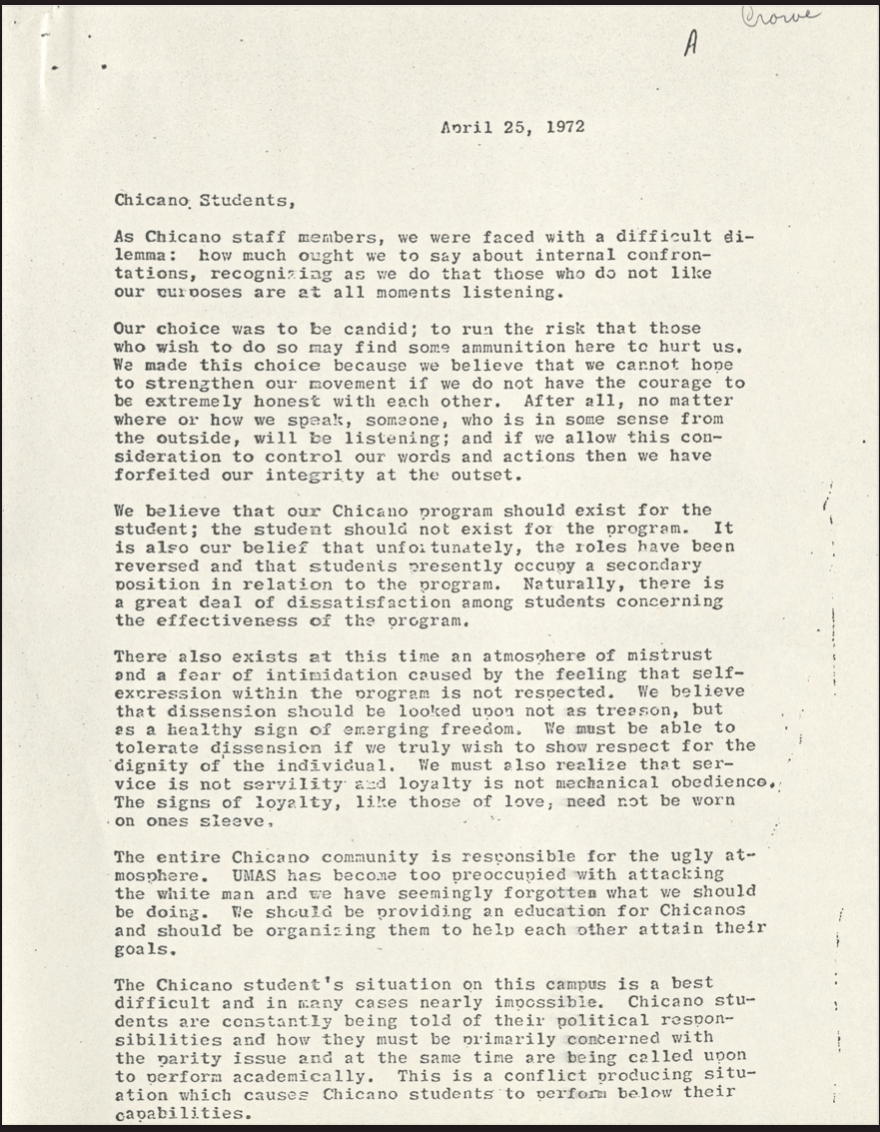
UMAS Administrators to Chicano students
LHP_Intern2021-09-20T19:22:41+00:00Letter written by UMAS administrators scolding Chicano students for the atmosphere around campus and encourages them to focus on their studies rather than the “white man”. Complete source here
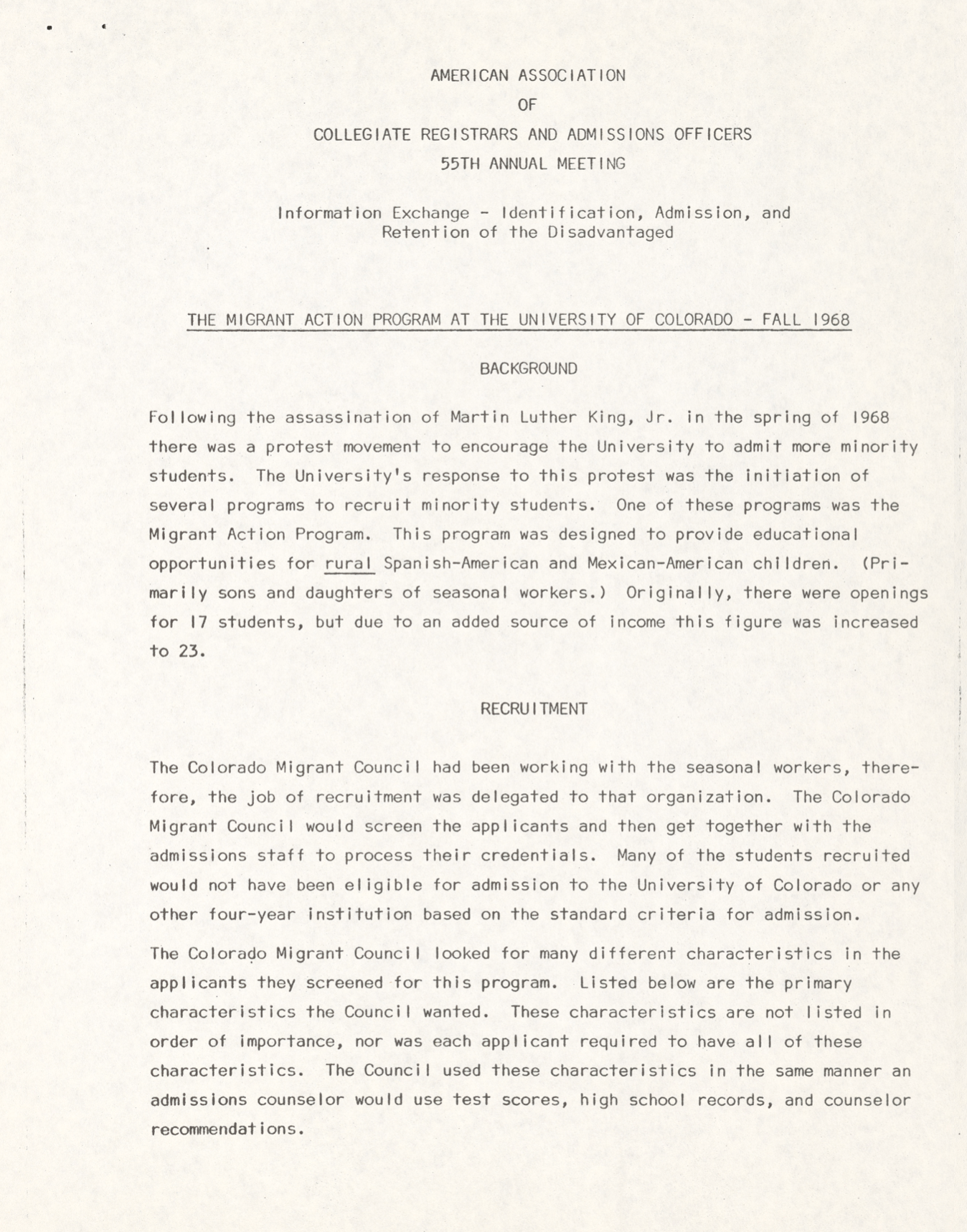
History of the Migrant Action Program
LHP_Intern2021-09-27T03:02:58+00:00A report of the development of the Migrant Action Program and the results of the initial program. View the full document here.
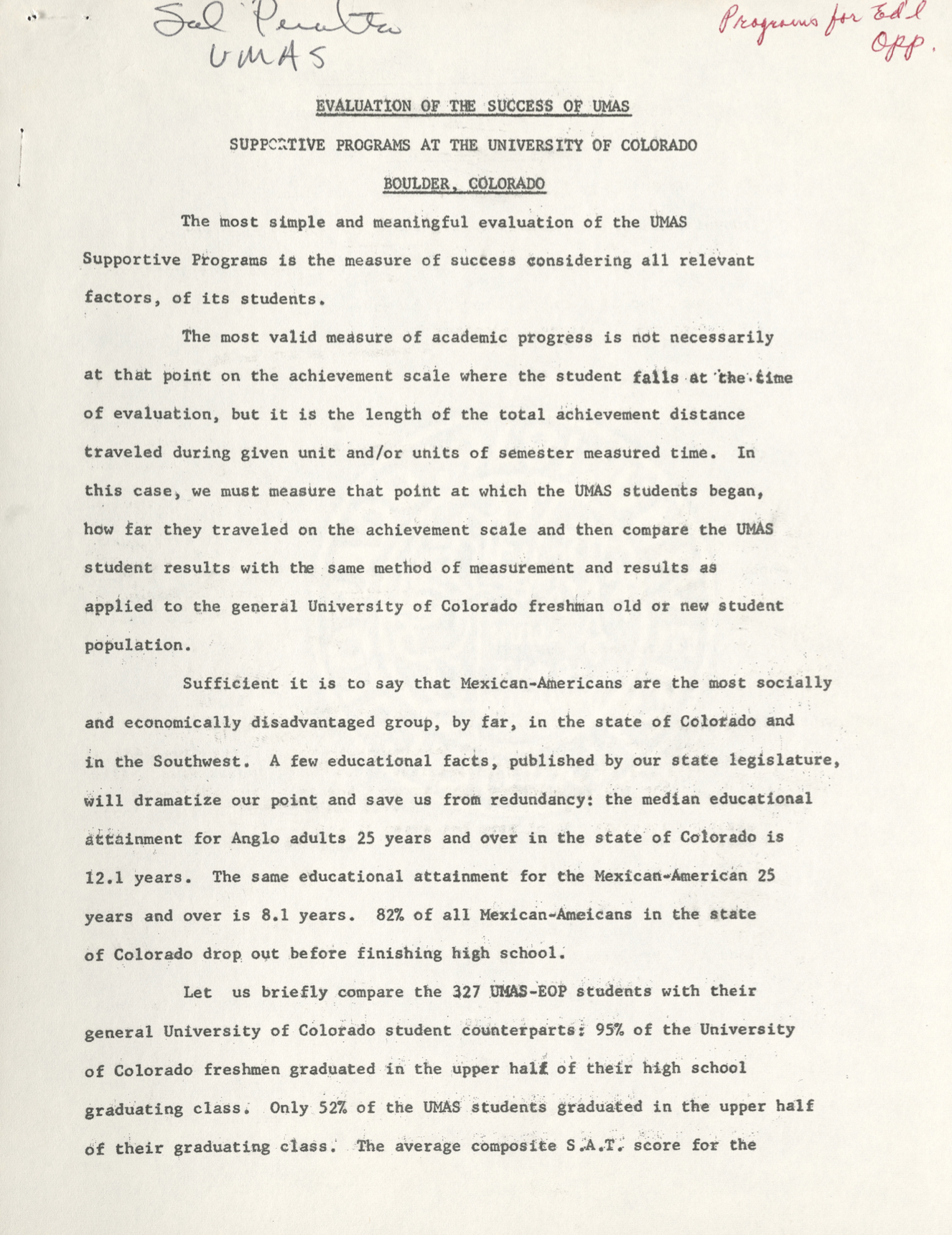
UMAS Success Evaluation
LHP_Intern2021-09-27T03:01:32+00:00Report of UMAS EOP student progress and success rates. View the full document here.
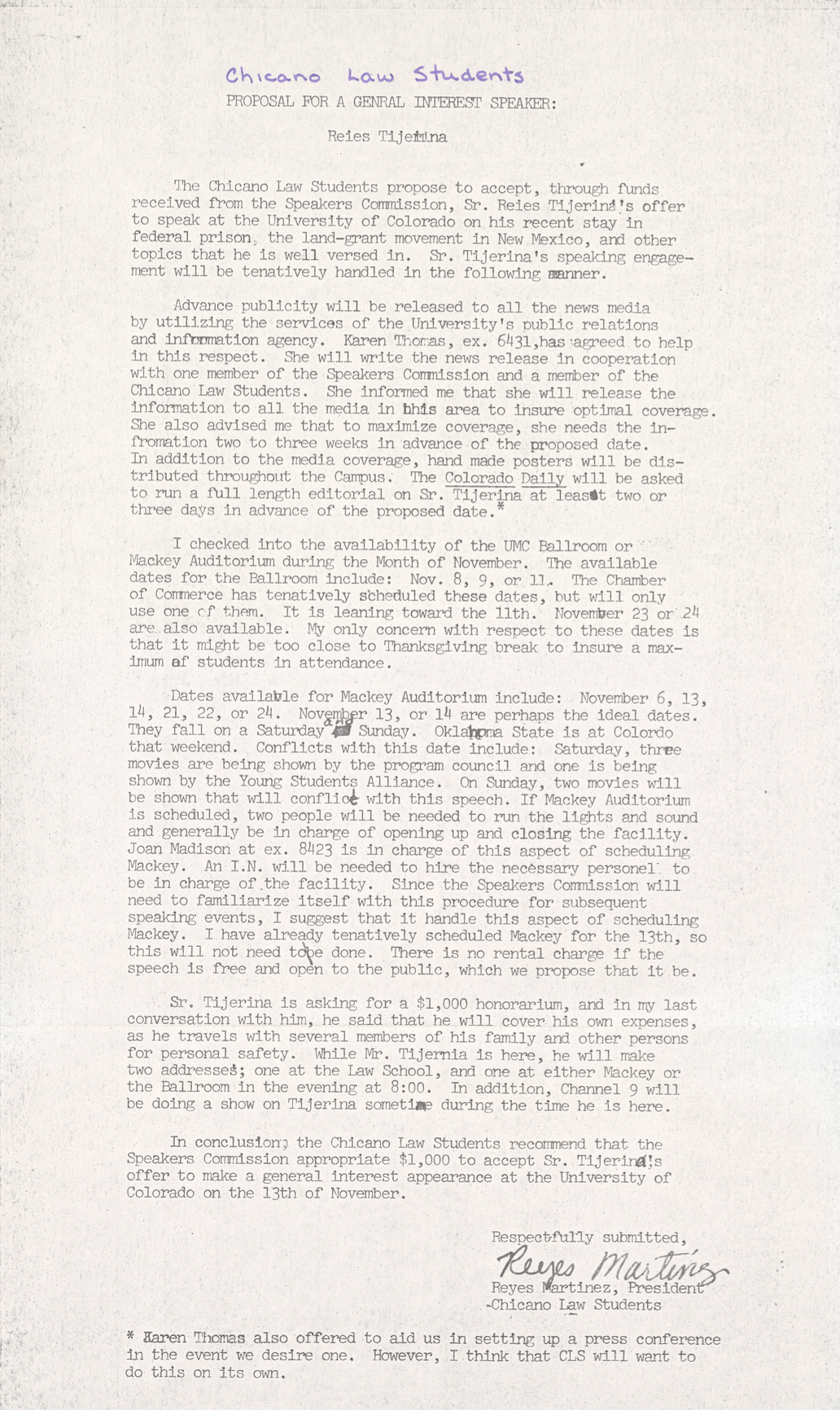
Proposal for Reies Lopez Tijerina to Speak at CU
LHP_Intern2021-09-13T13:39:35+00:00Proposal from the Chicano Law Students to host Reies Lopez Tijerina to speak at CU Boulder after his time in prison after the land grant struggles in Tierra Amarilla, NM.
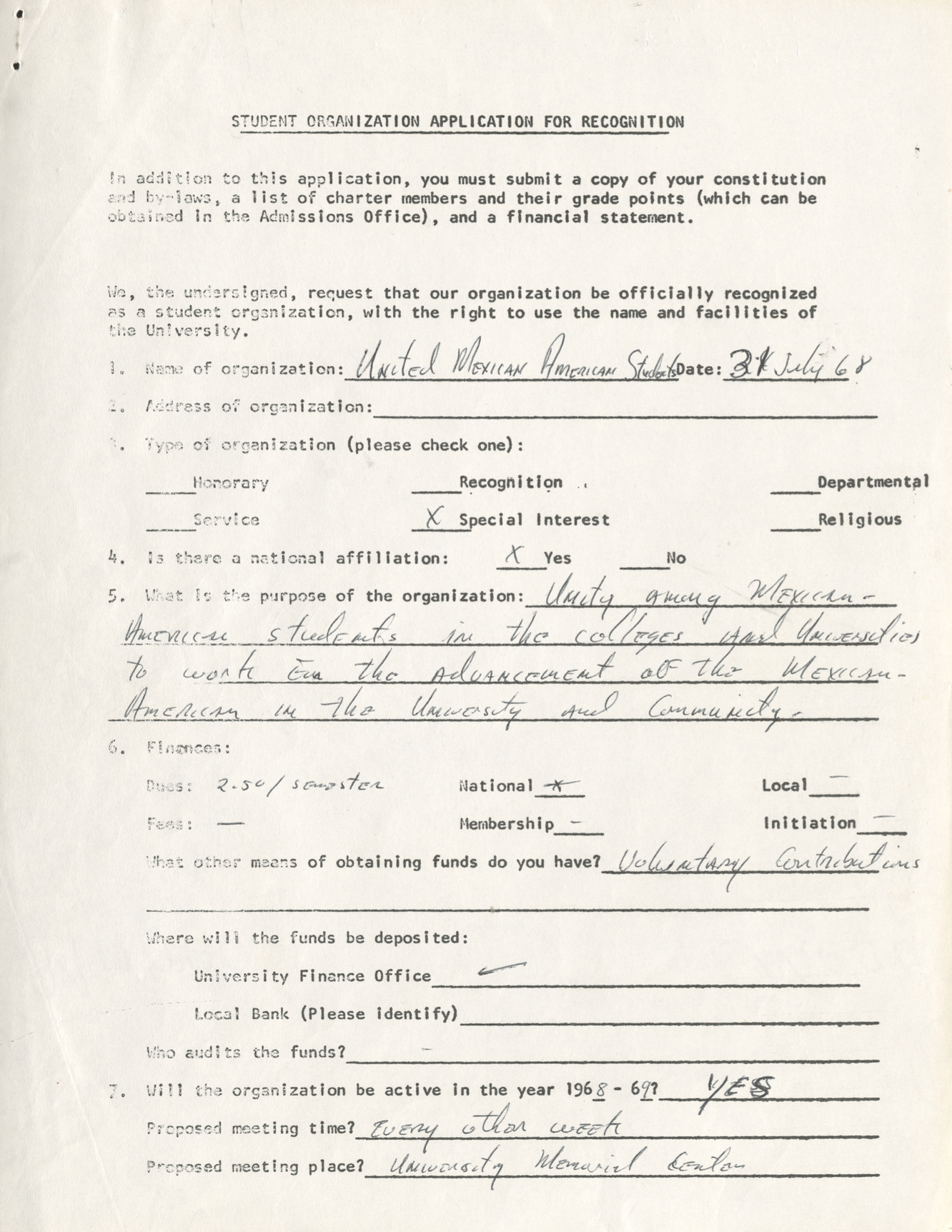
UMAS Application for Student Organization Recognition
LHP_Intern2021-09-27T03:00:14+00:00The original application for university recognition for the United Mexican American Students July of 1968. View the full document here.
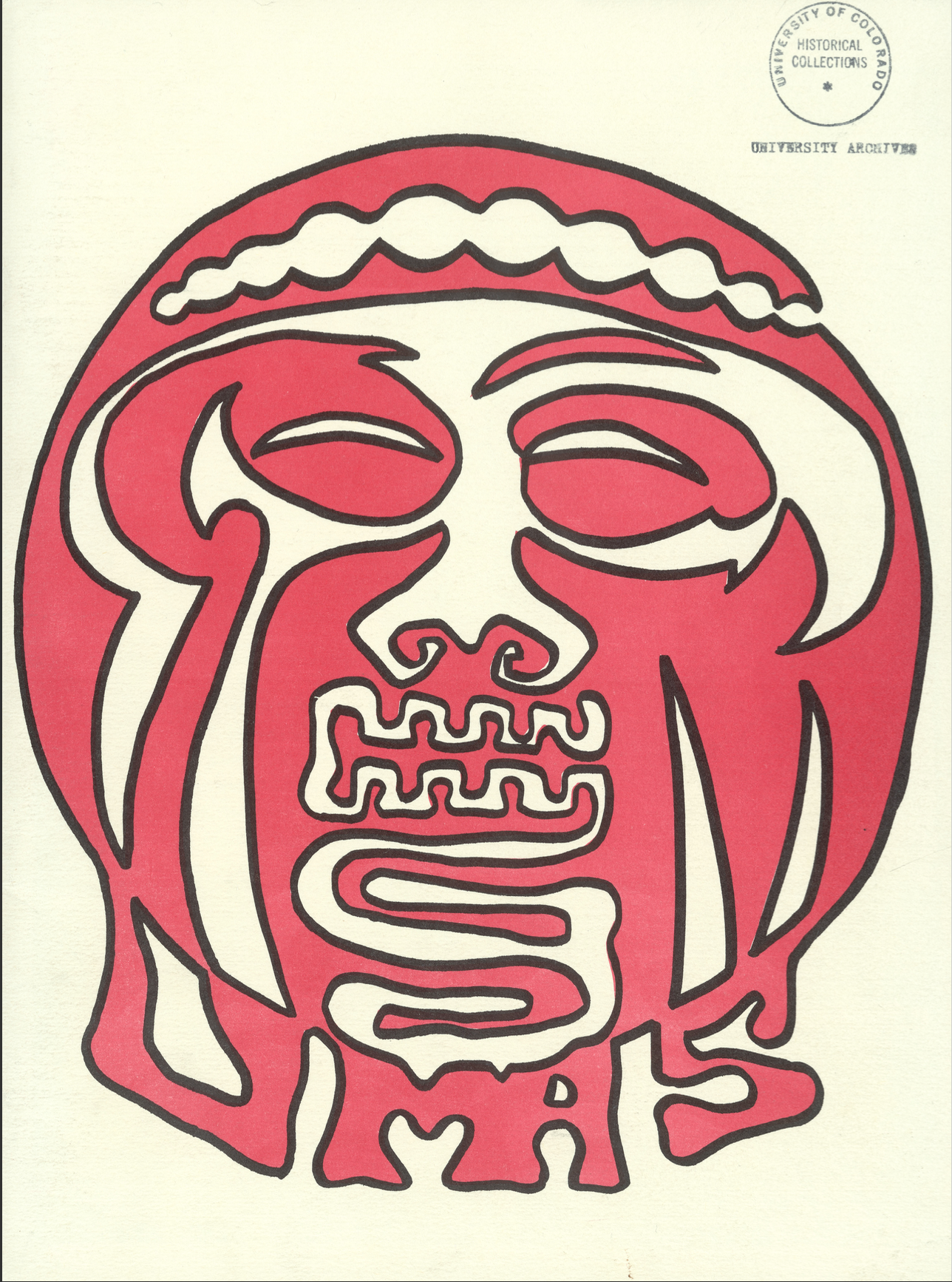
UMAS Political Packet
LHP_Intern2021-09-27T02:59:08+00:00Political packet about the history, political orientation and guiding philosophies of the United Mexican American Students at CU Boulder. View the full document here.
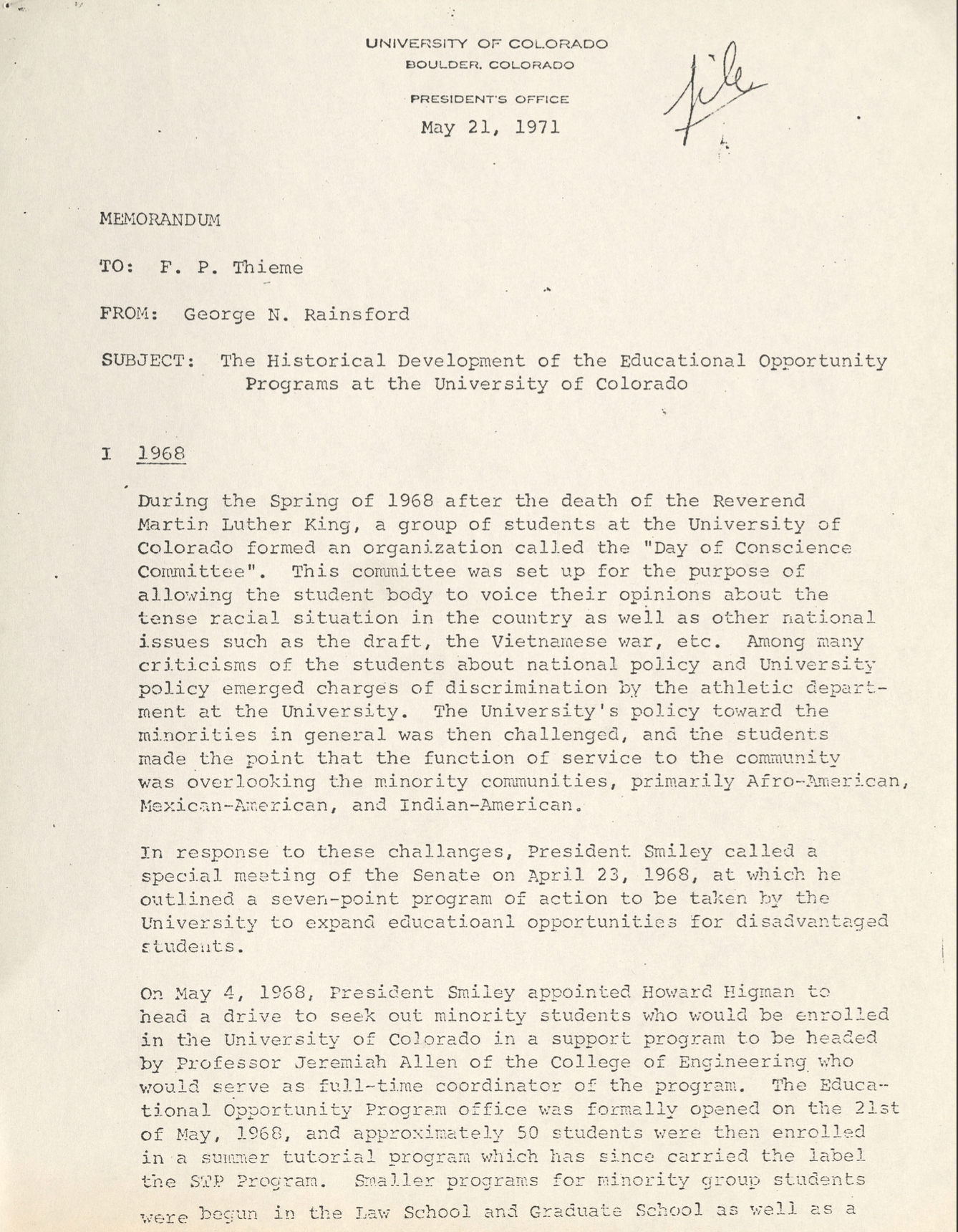
History of UMAS and MAP EOP
LHP_Intern2021-09-27T02:55:08+00:00A memorandum to the CU Boulders President’s Office on the historical development of various educational opportunity programs. View the full document here.
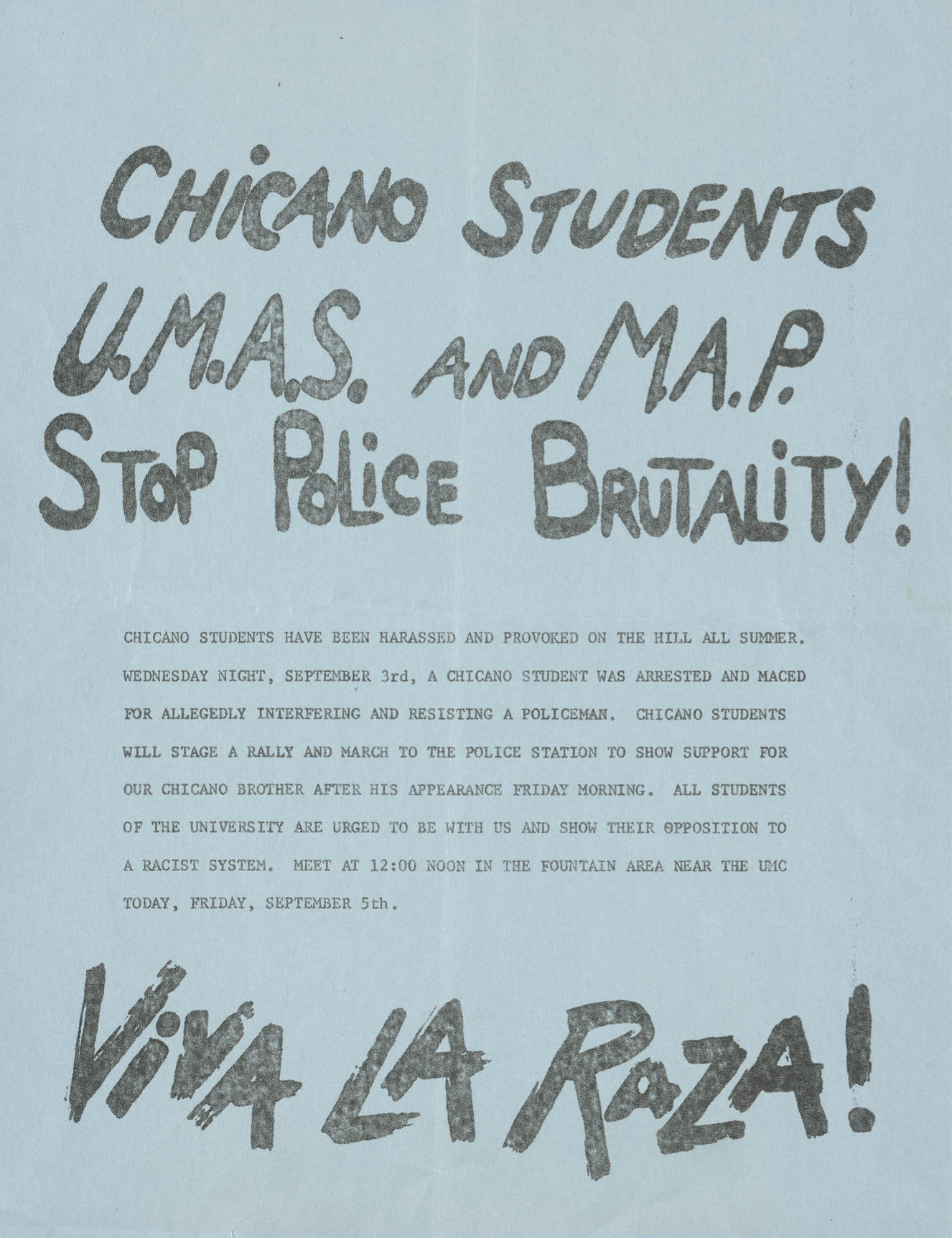
UMAS and MAP Police Brutality Rally Flyer
LHP_Intern2021-09-13T13:41:58+00:00Political flyer calling on Chicano students to support the effort and protest against police brutality on the CU Boulder campus.
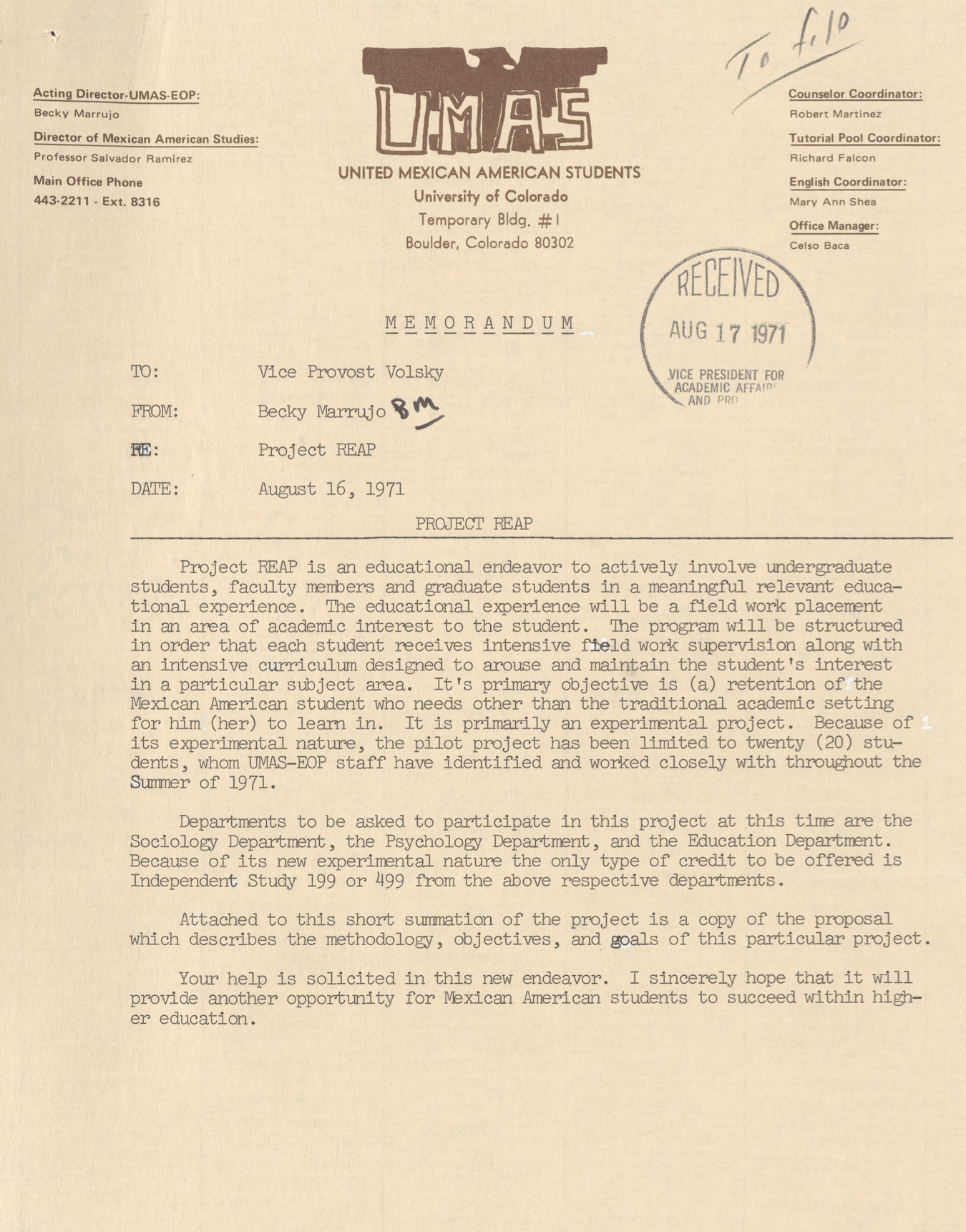
UMAS Project REAP
LHP_Intern2021-09-27T02:53:38+00:00Explanation and proposal from UMAS to establish a related educational activities program (REAP) for students on the CU Boulder campus. View the full document here.

UMAS Coors Boycott Explanation
LHP_Intern2021-09-13T13:42:49+00:00UMAS newsletter detailing the reasons for the Coors Brewing Company Boycott.
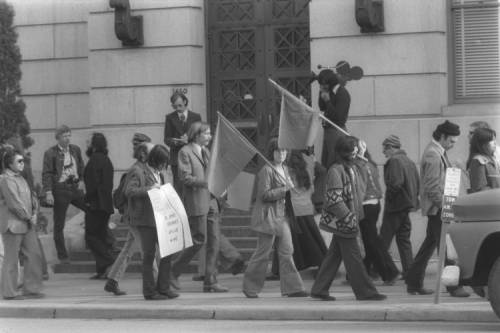
UFW Picketers outside of Denver County building 1975
LHP_Intern2021-09-12T23:21:46+00:00UFW members gathered outside of Denver County building protesting the arrest and jailing of UFW coordinator Jerry Ryan by Judge Robert Cummins.
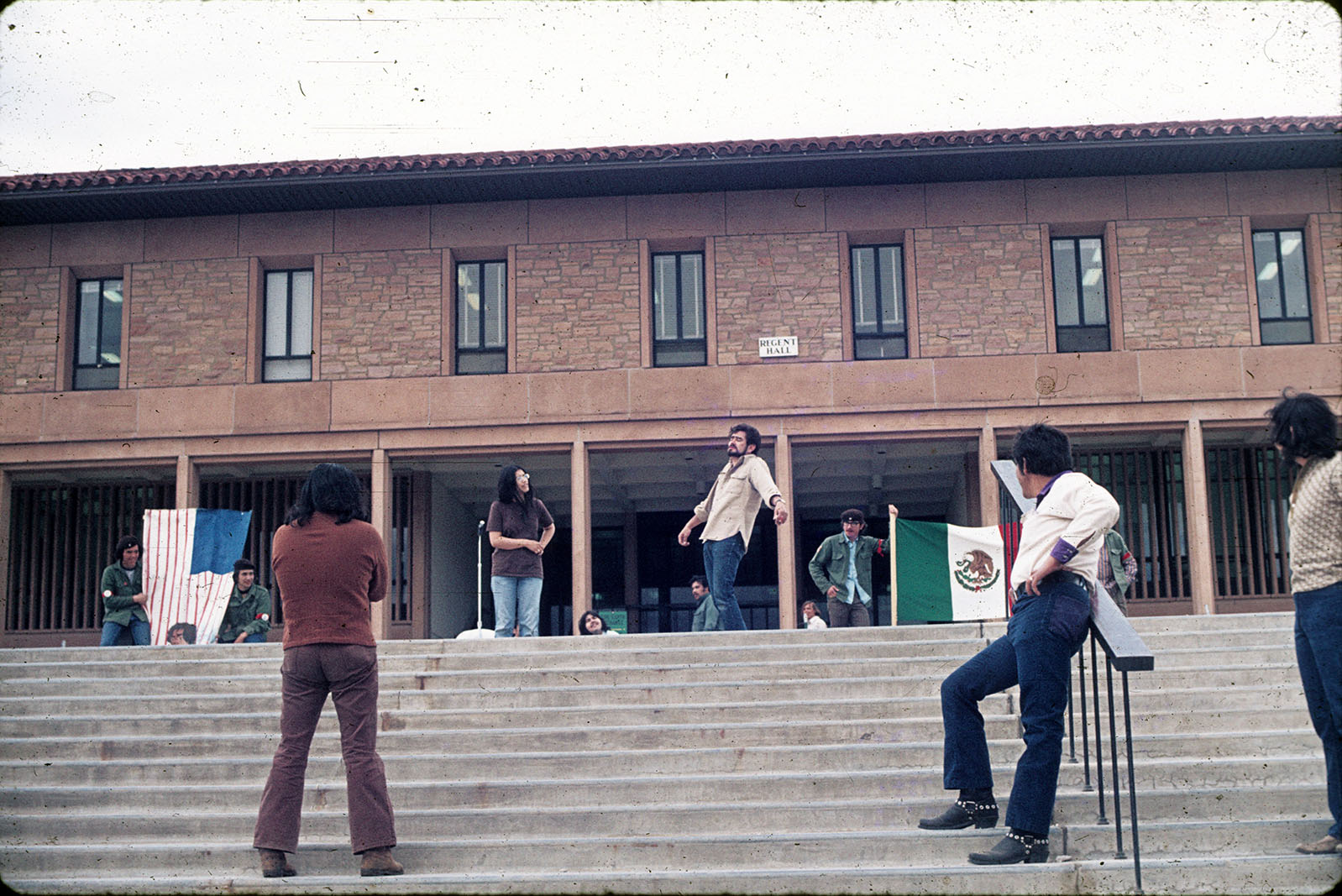
Brian Sanchez Teatro Demonstration
LHP_Intern2021-09-12T23:20:30+00:00Brian Sanchez (center) and other Chicano students perform Teatro outside of CU Boulder administrative building Regent Hall.
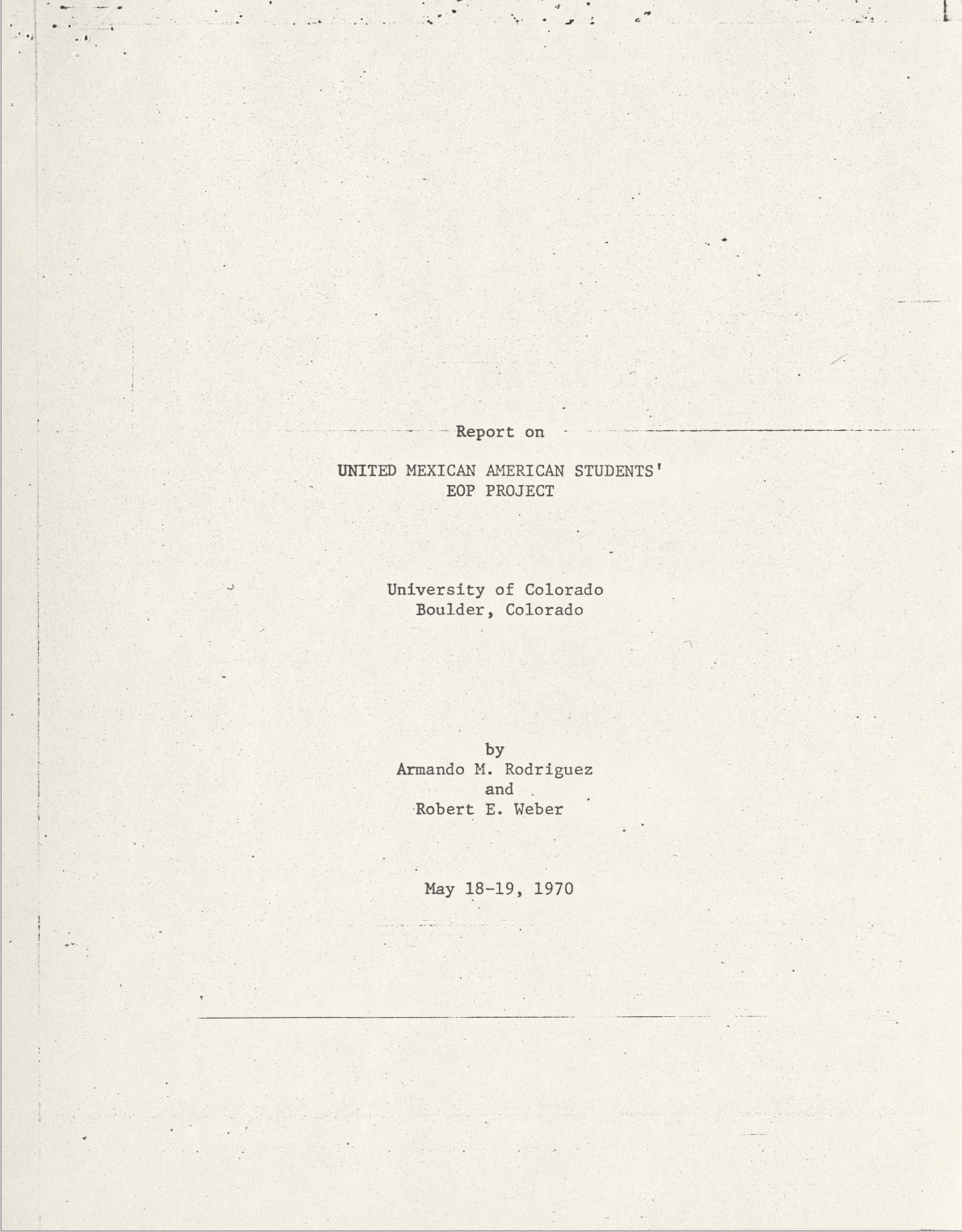
Report on United Mexican American Students’ EOP Project 1970
LHP_Intern2021-09-13T03:48:38+00:00Report on United Mexican American Students’ EOP Project 1970. Click here for the full report
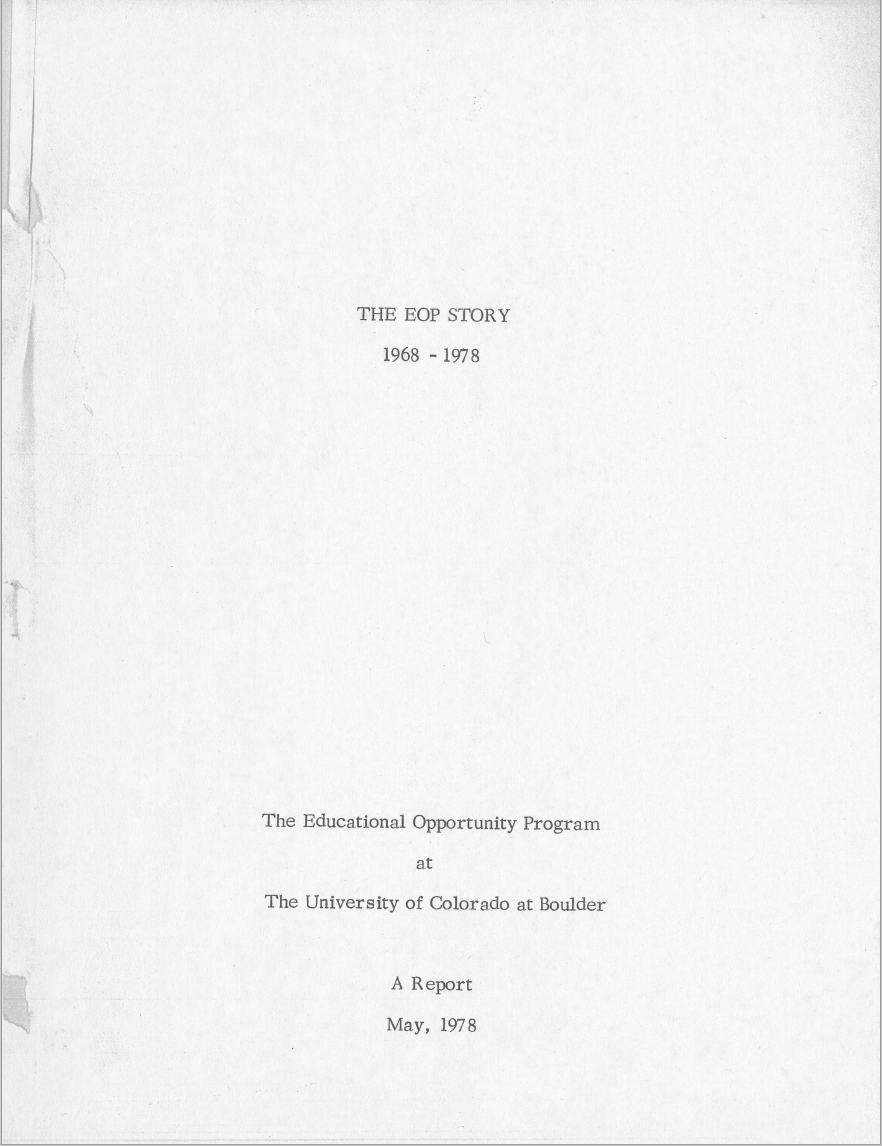
The EOP story 1978
LHP_Intern2021-09-13T03:49:37+00:00The United Mexican American Students (UMAS) Educational Opportunity Program (EOP) story. Click here for the full report
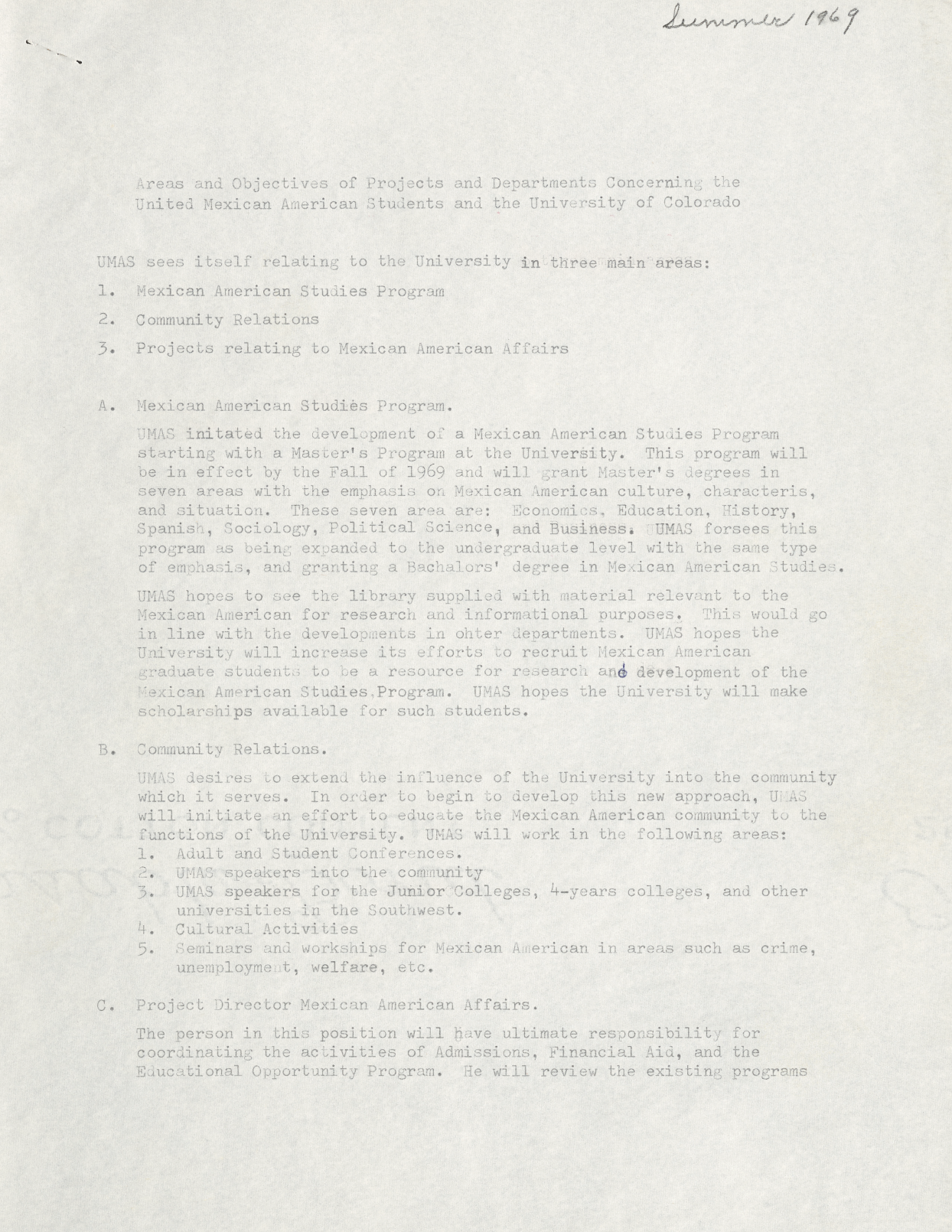
Area and objectives of projects concerning UMAS; Summer 1969
LHP_Intern2021-09-13T03:52:20+00:00Area and objectives of projects concerning United Mexican American Students at the University of Colorado Boulder. Click here for the full report
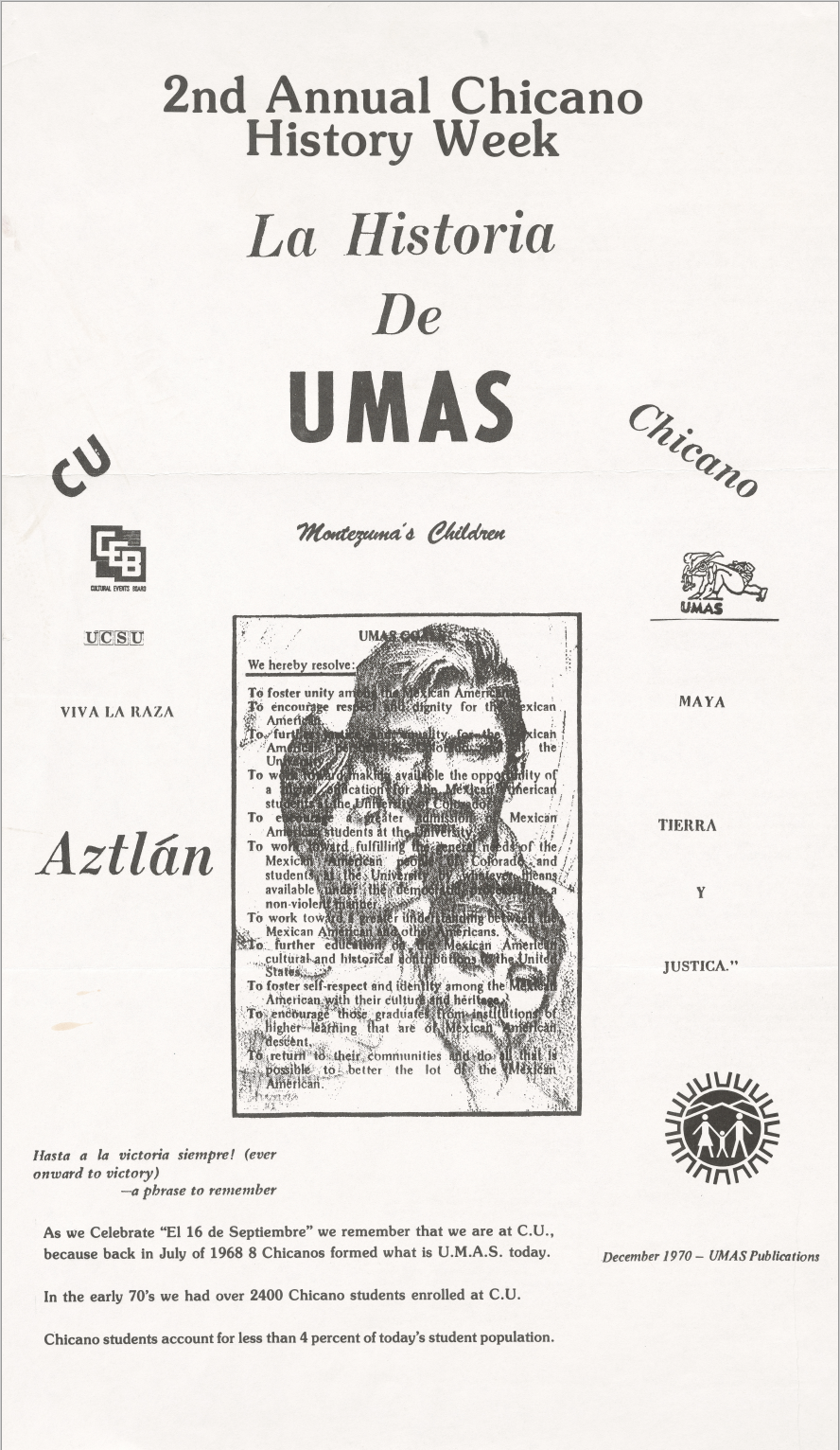
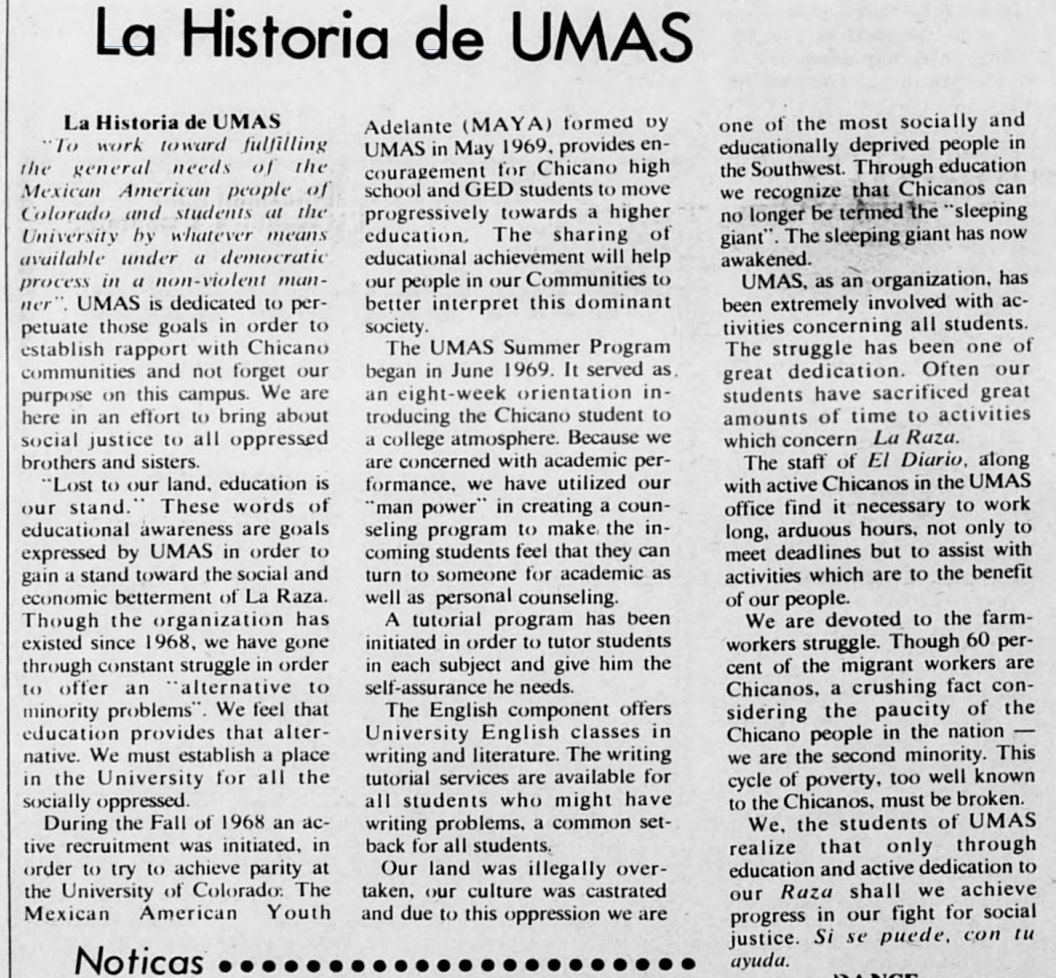
La Historia de UMAS
LHP_Intern2021-09-07T19:32:58+00:00Poster for the 2nd Annual Chicano History Week: La Historia de UMAS. The poster notes, “in the early 1970s, there were 2400 Chicano students enrolled at CU. Chicano students make up less than 4 percent of today’s student population
Historical growth and development and proposal; August 1968-July 1969
LHP_Intern2021-09-13T03:53:31+00:00The Historical growth, development, and proposal of the United Mexican American Students. Click here for the full report
Educational Opportunities Program for Mexican Americans; 1973
LHP_Intern2021-09-13T03:54:18+00:00Educational Opportunities Program for Mexican Americans: Introduction and Objectives. Click here for the full report
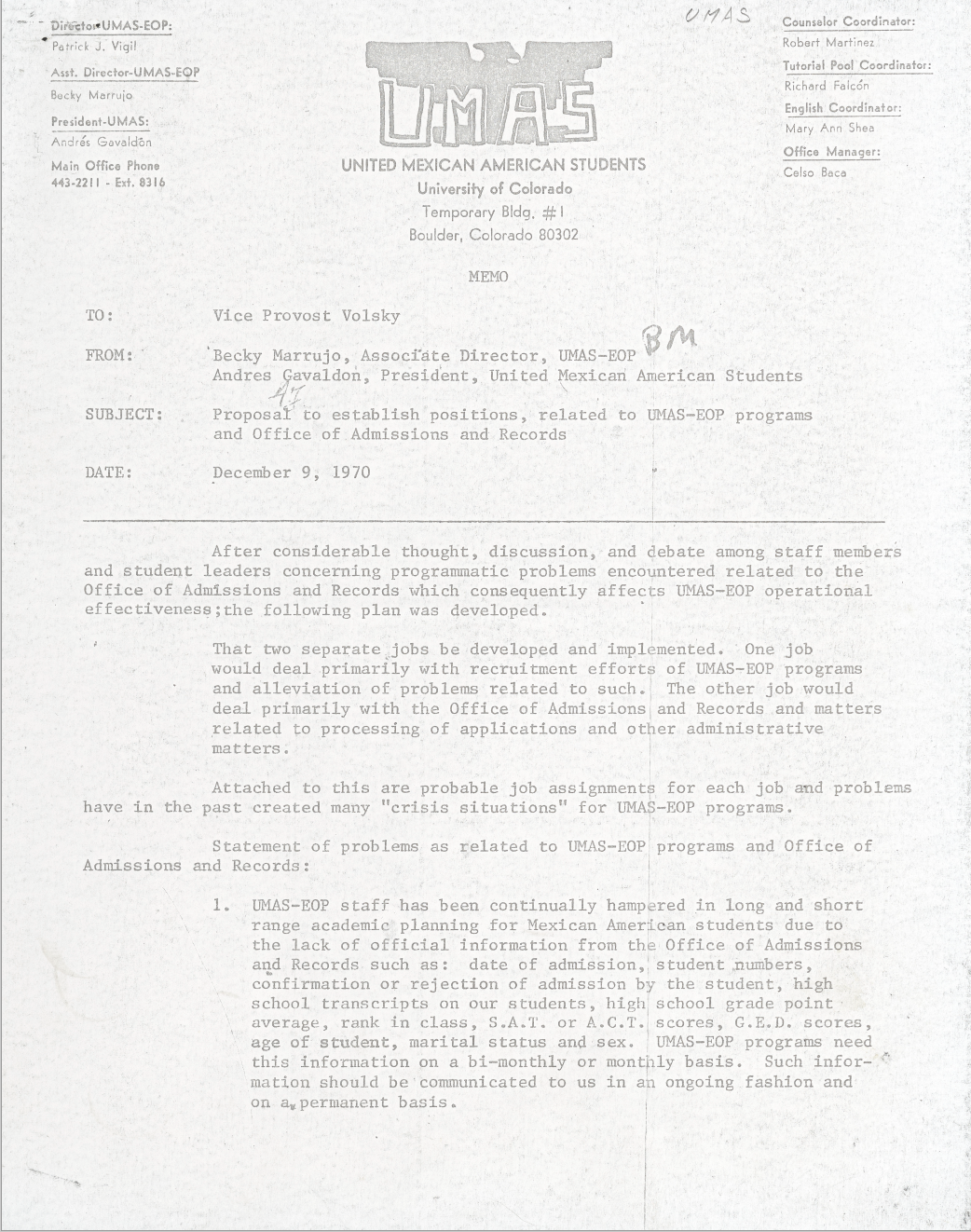
Proposal to establish positions; UMAS EOP; 1970
LHP_Intern2021-09-13T03:55:28+00:00Proposal to establish positions, related to UMAS-EOP programs and Office of Admissions and Records. Click here for the full report
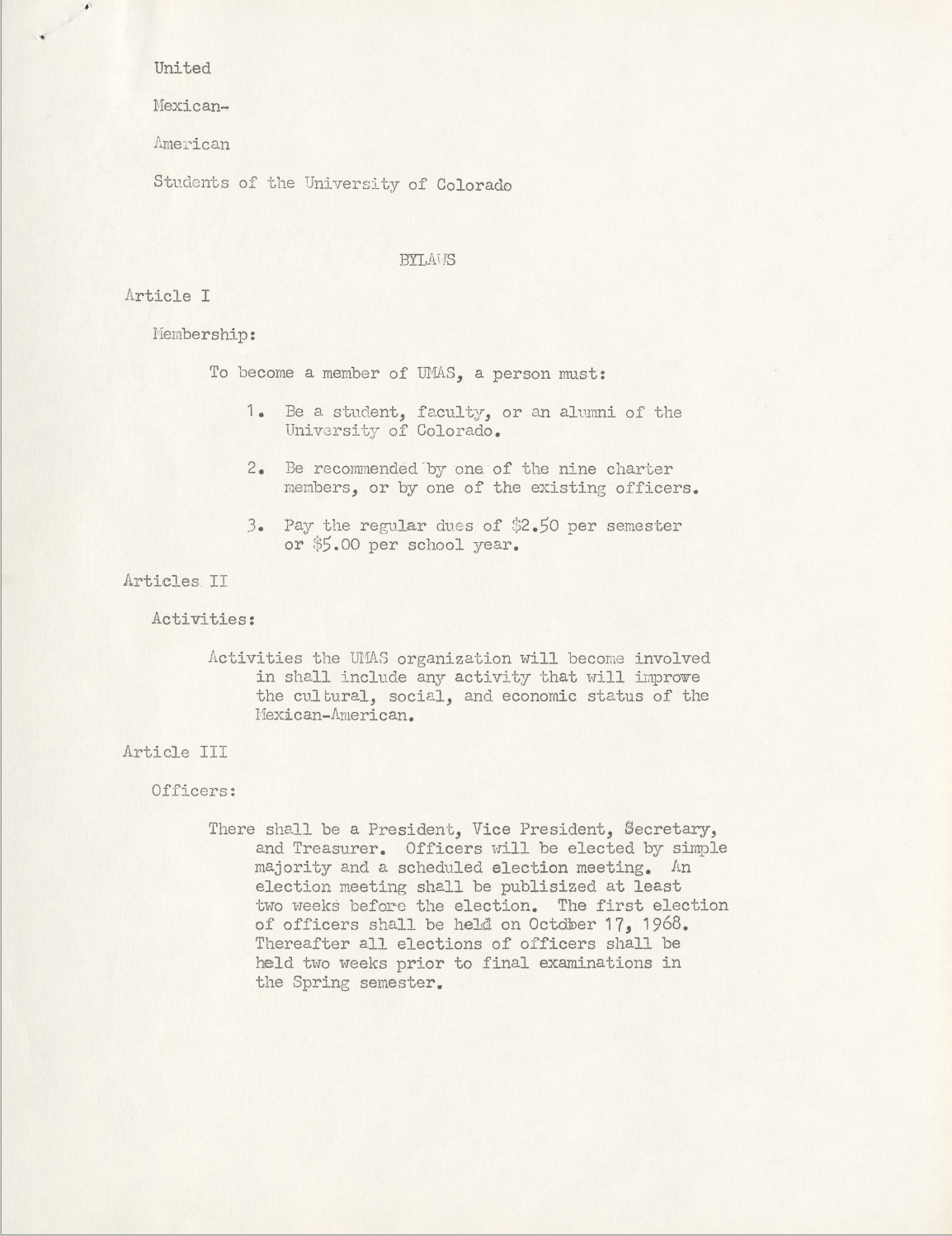
UMAS Bylaws
LHP_Intern2021-09-13T03:56:19+00:00United Mexican-American Students of the University of Colorado bylaws; guidelines; membership requirement. Click here for the full report
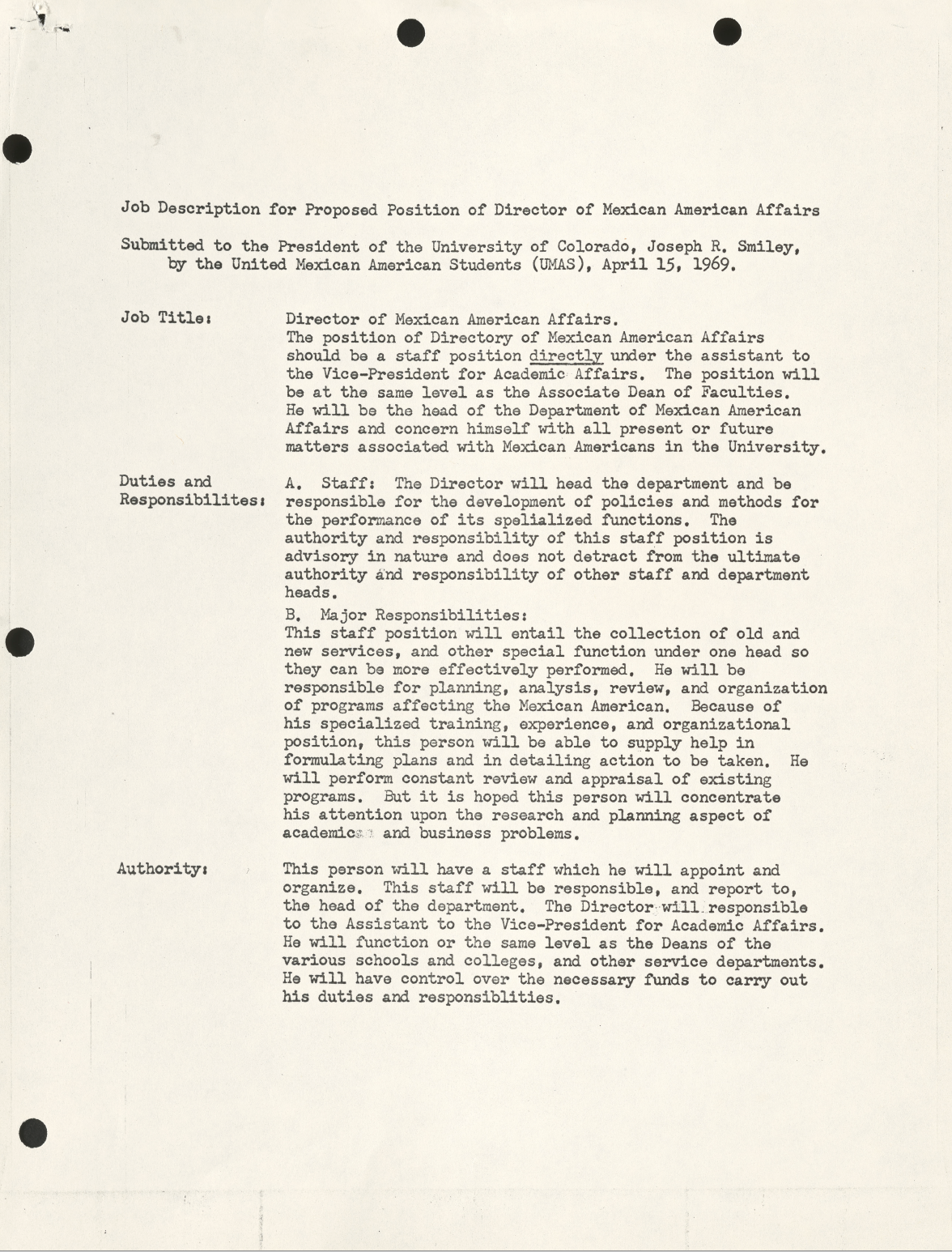
Job Description for Proposed Position of Director of Mexican American Affairs 1978
LHP_Intern2021-09-13T03:57:34+00:00Job description for proposed position of Director of Mexican American Affairs, submitted to President Joseph R. Smiley by the United Mexican American Students (UMAS). Click here for the full report
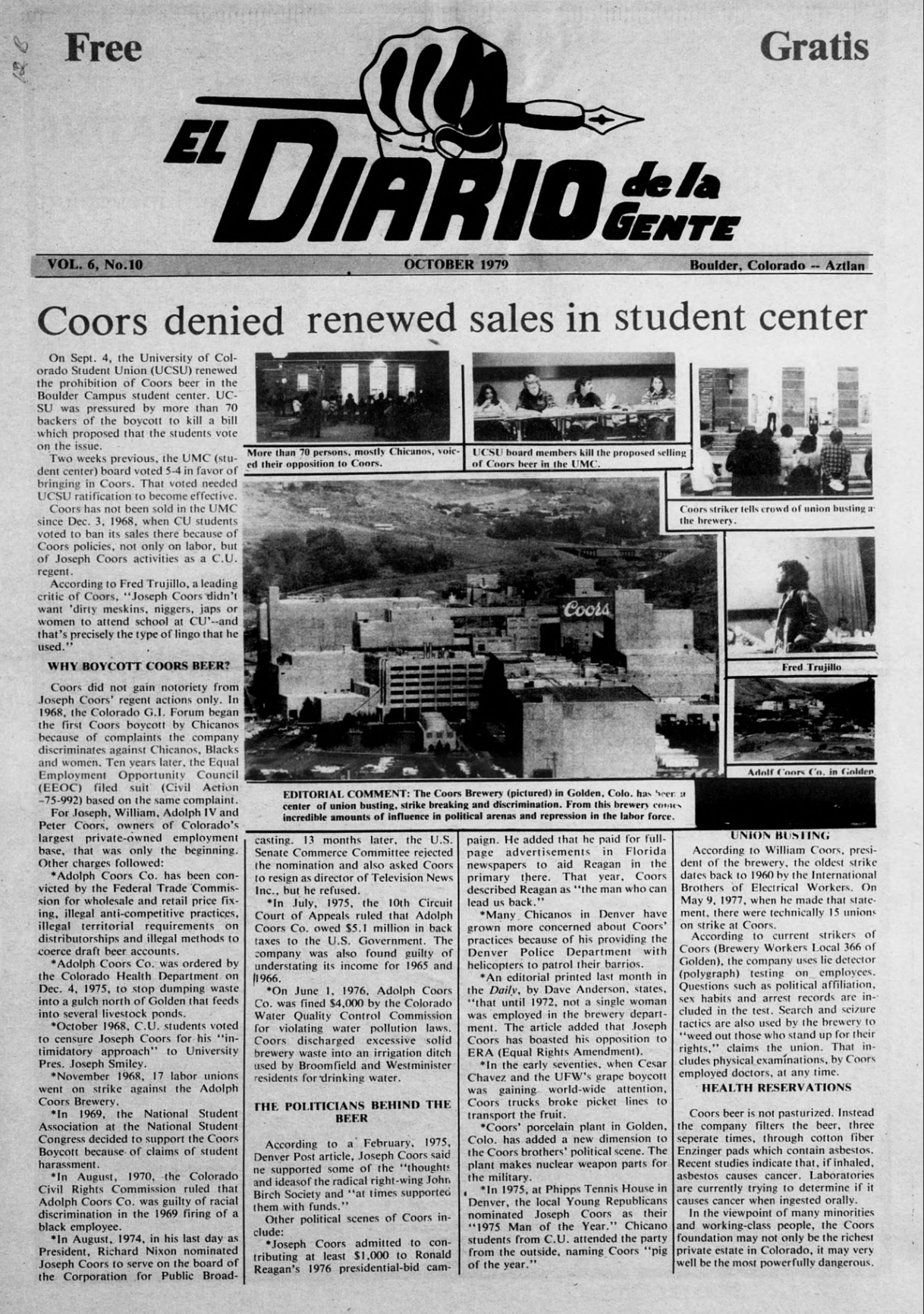
UCSU deny proposition to sell Coors beer in CU campus center 1979
LHP_Intern2021-08-30T18:08:19+00:00Details Student resistance against renewing Coors beer sales in campus student center.
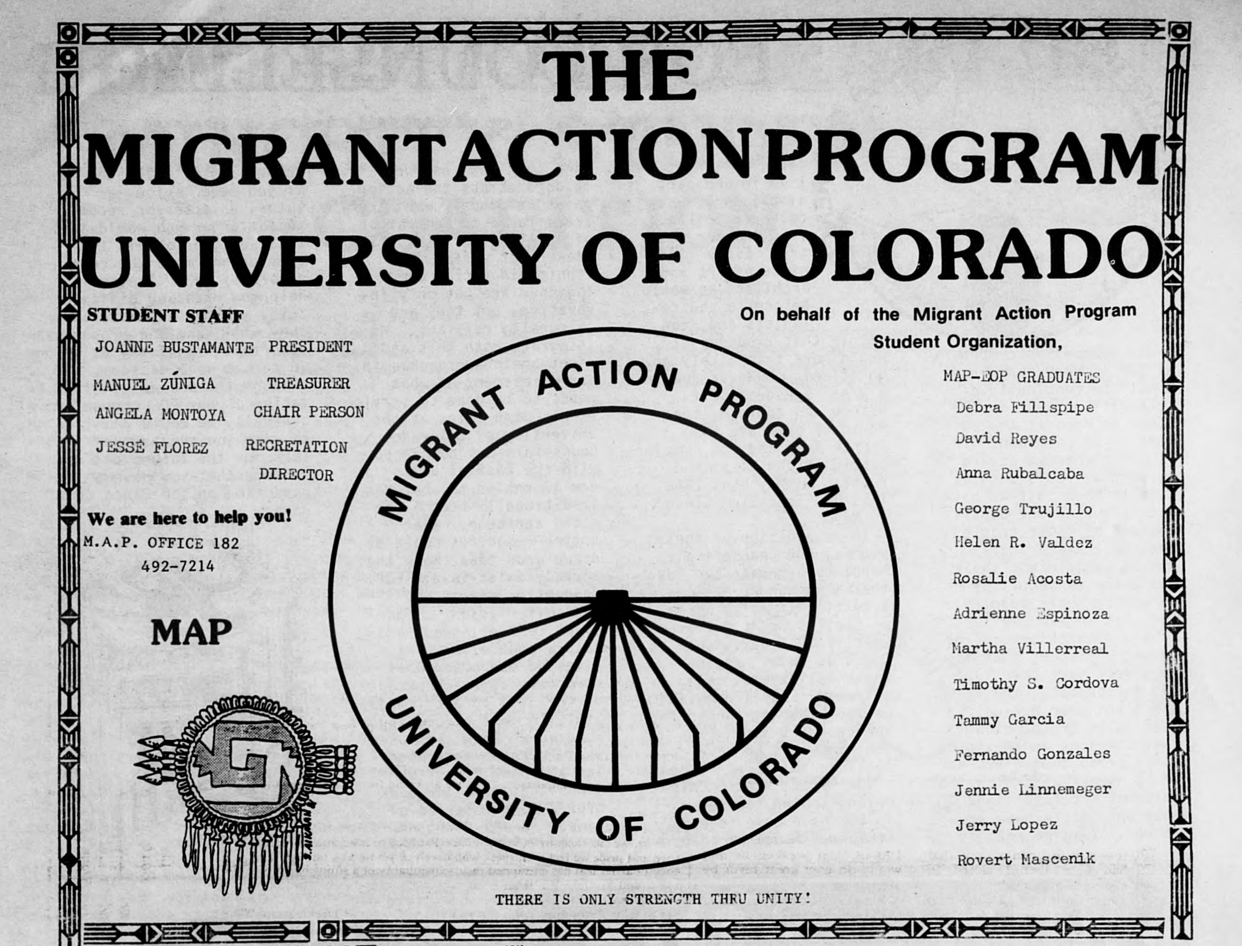
MAP Advertisement
LHP_Intern2021-08-30T18:09:04+00:00Migrant Action Program at CU Boulder Advertises upcoming events and opportunities.
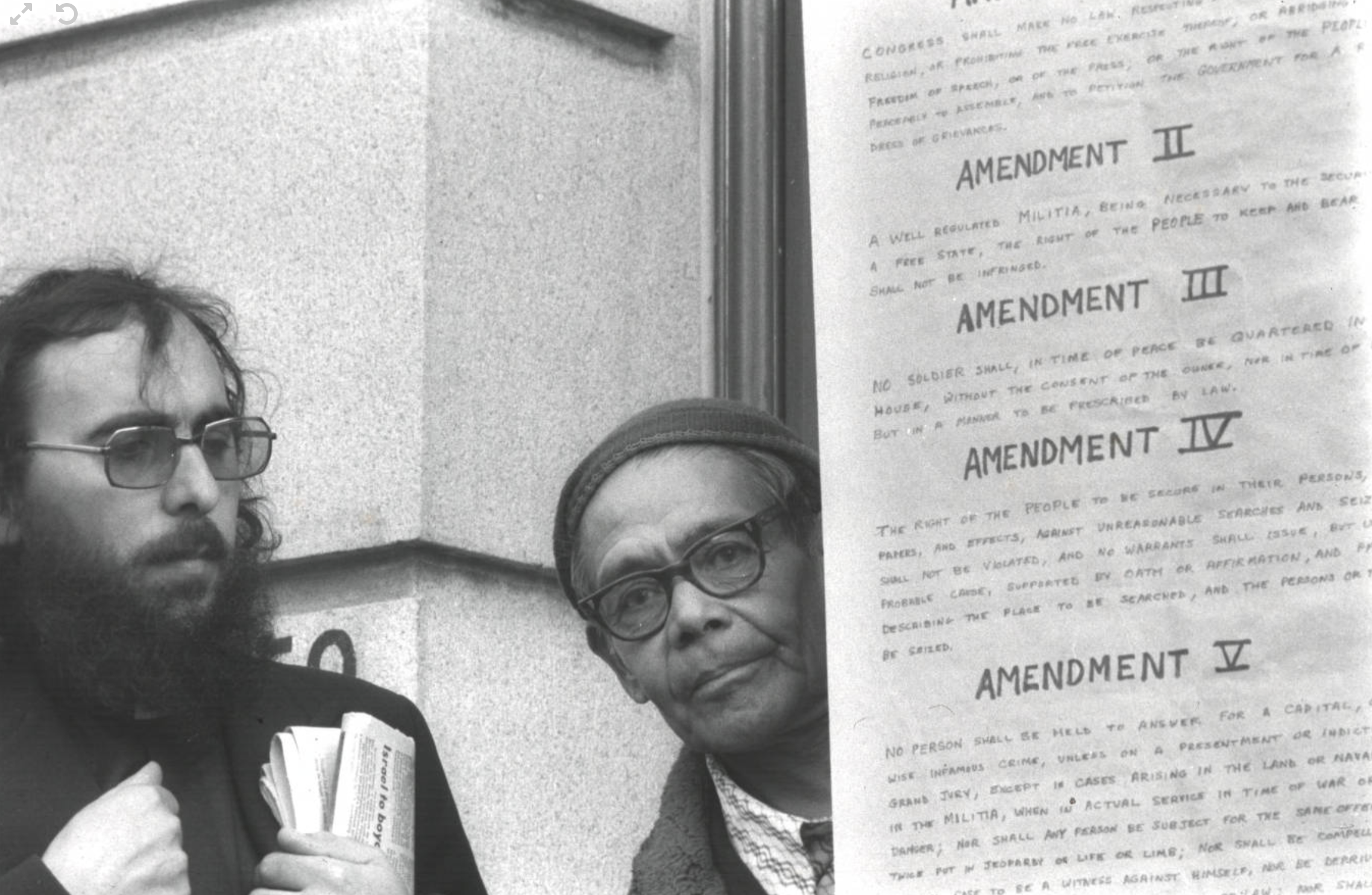
Father Jose Lara and Jesús Valderrama in font of Denver city & county building
LHP_Intern2021-08-25T20:07:48+00:00Father Jose Lara and Jesús Valderrama protesting at the trial and inccareation of UFW activist Jerry Ryan.
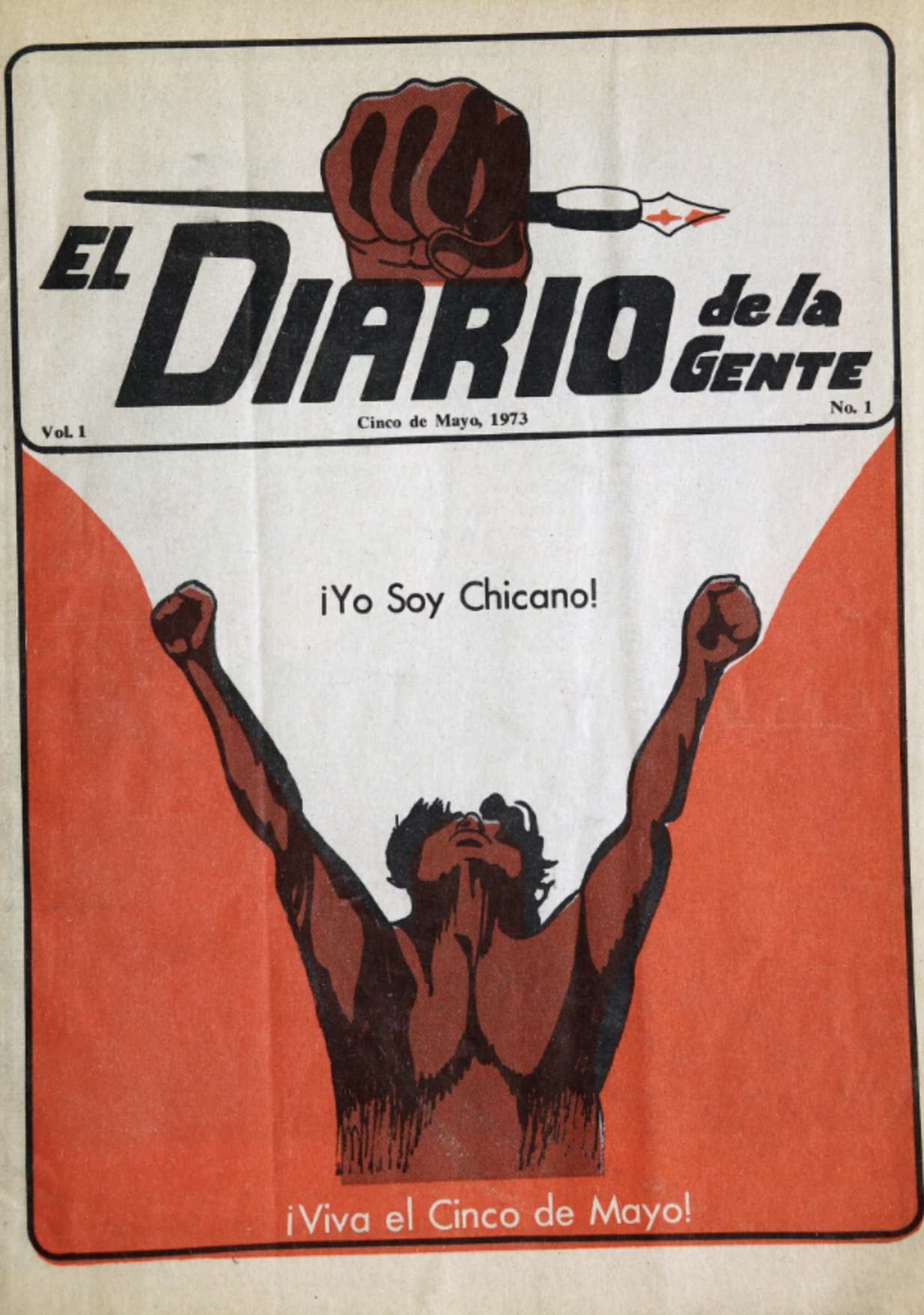
First El Diario Newspaper
LHP_Intern2021-08-25T19:58:48+00:00The first publication of CU Boulder’s UMAS newspaper, El Diario de la Gente 1973.
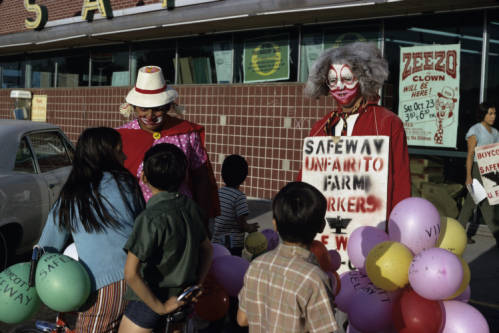
UFW Safeway Boycott Denver 1975
LHP_Intern2021-08-30T18:29:16+00:00Jerry Ryan (right) and other UFW organizer picketing at Safeway, impersonating their mascot “Zeezo the clown”.
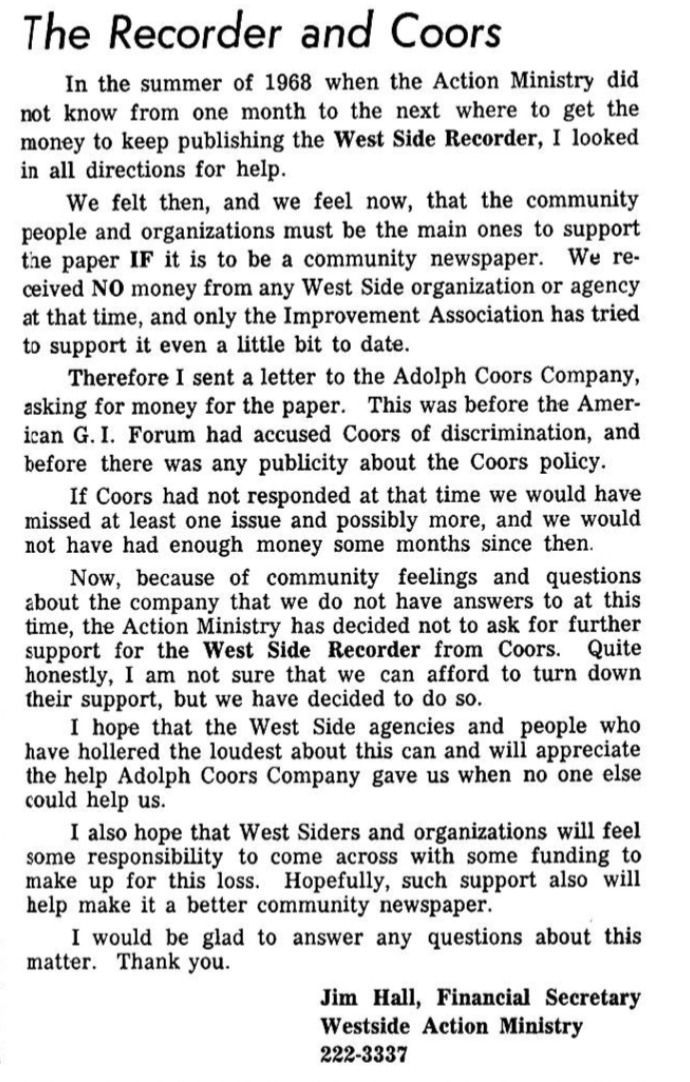
West Side Recorder accepts money from Coors Brewing Co.
LHP_Intern2021-08-25T19:15:37+00:00Financial Secretary of the West SIde Recorder Newspaper admits asking for and accepting money from Coors Brewing Company to fund the newspaper.
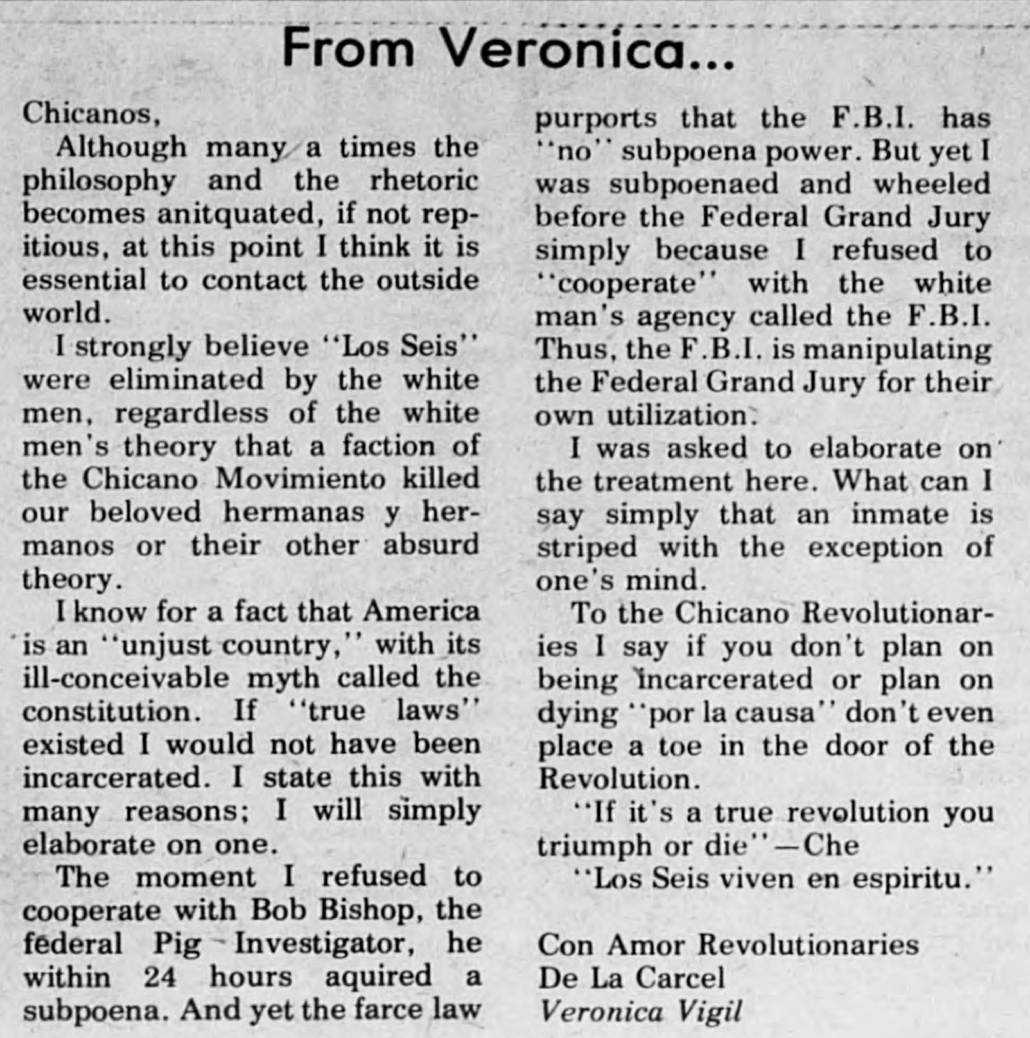
FBI surveillance of Boulder Chicano Movement
LHP_Intern2022-03-29T00:06:16+00:00An account of FBI encounter by Veronica Vigil.
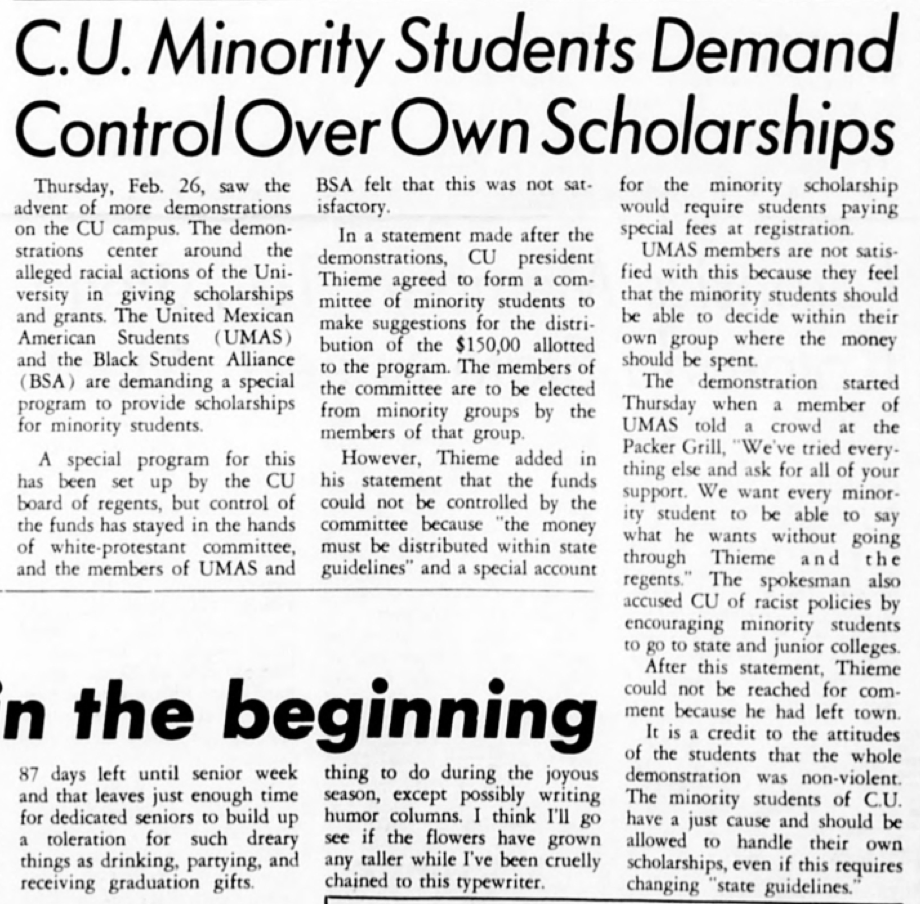
Scholarship Demands at CU Boulder
LHP_Intern2021-08-25T19:02:30+00:00An account of the demands of CU Boulder UMAS and BSA students surrounding scholarship allocation.
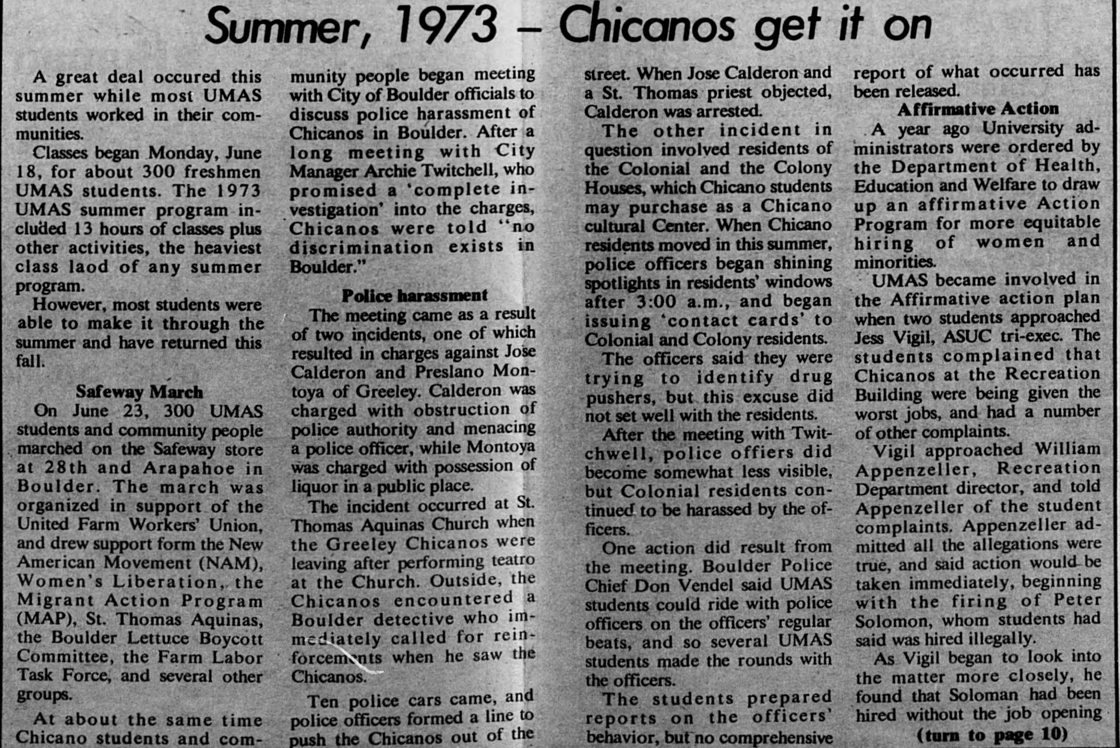
Summer 1973 UMAS Actions
LHP_Intern2021-08-25T18:57:47+00:00A description of the major actions led by CU Boulder UMAS students in the summer of 1973.
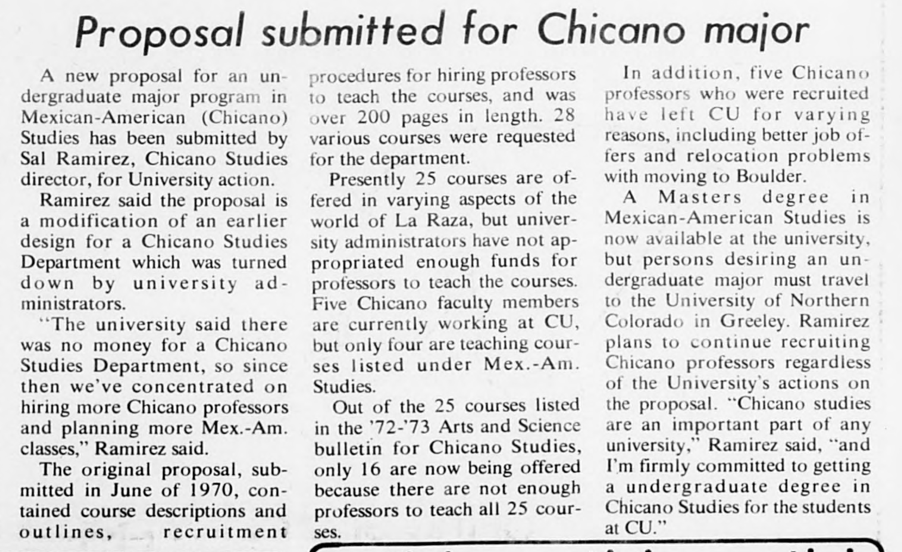
Proposal to Implement Chicano Studies Major
LHP_Intern2021-08-25T18:53:18+00:00A description of the development of a proposal to implement an undergraduate Chicano Studies major at CU Boulder.
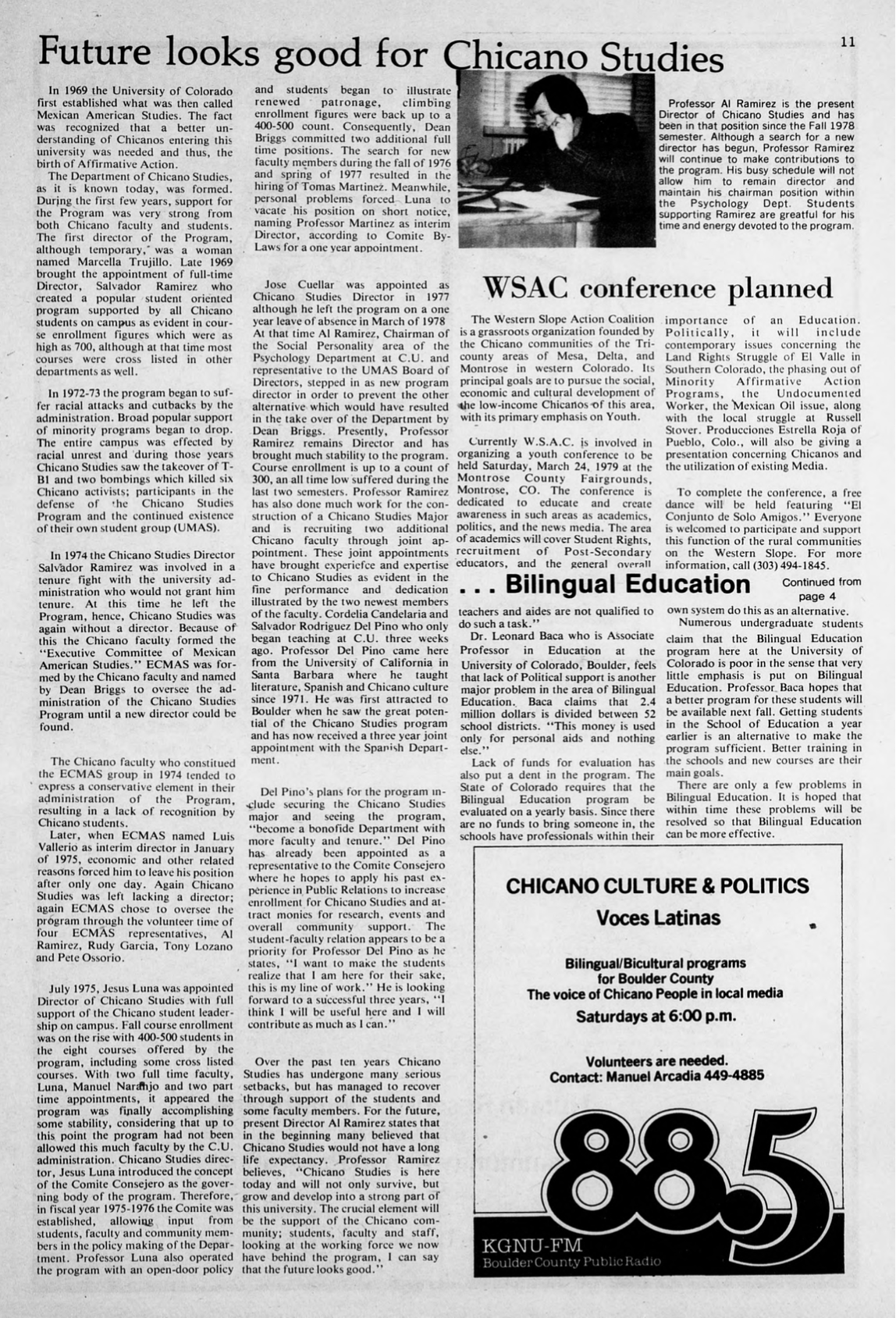
Chicano Studies Developments 1969-1979
LHP_Intern2021-08-25T17:53:26+00:00A timeline of actions taken to push for and improve the Chicano Studies Program at CU Boulder.
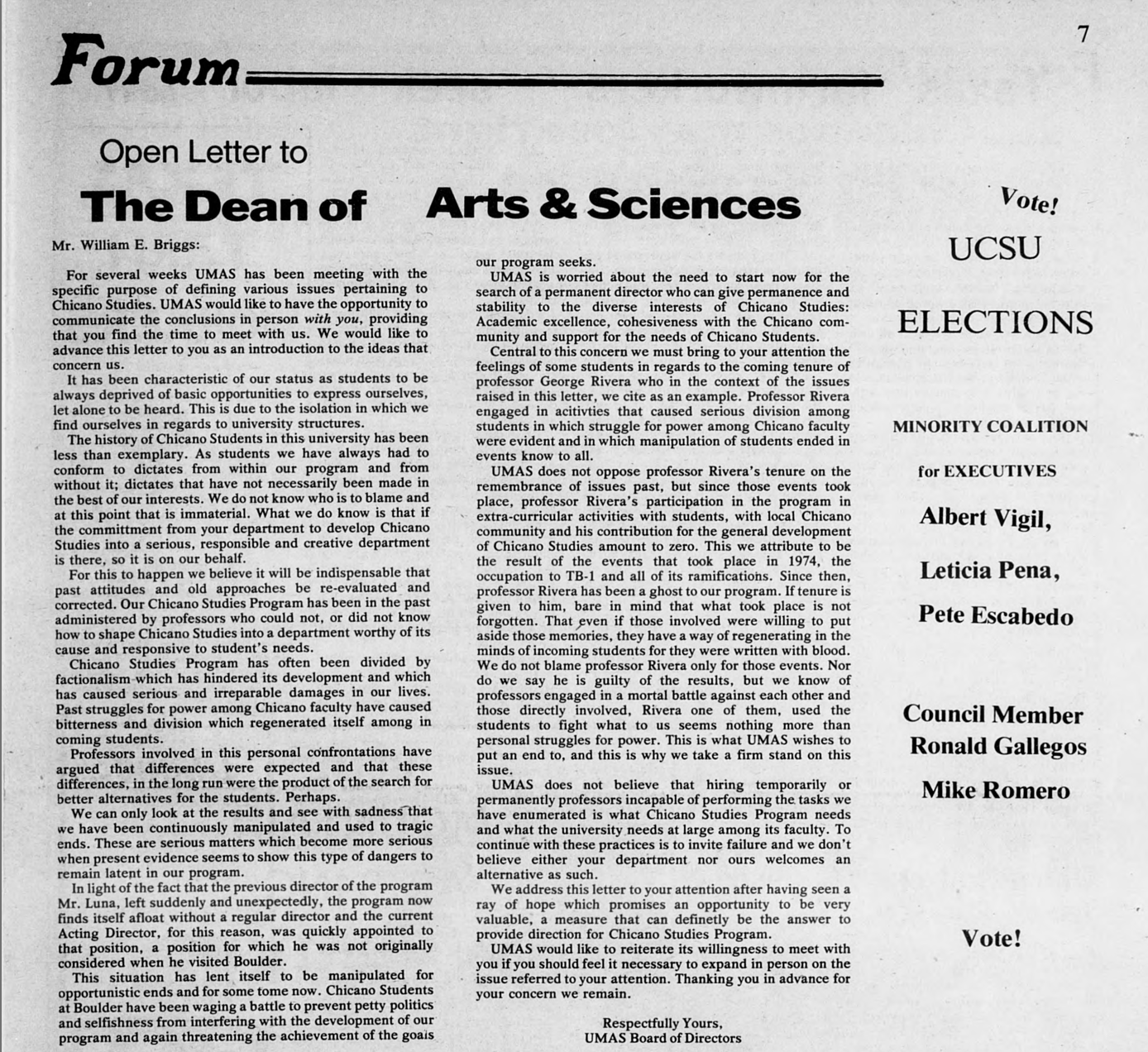
UMAS Open Letter to CU Boulder Dean of Arts & Sciences
LHP_Intern2021-08-25T17:42:26+00:00Letter written by CU Boulder UMAS students calling on the Dean of Arts & Sciences to take action on developing a more intentional Chicano Studies Program.
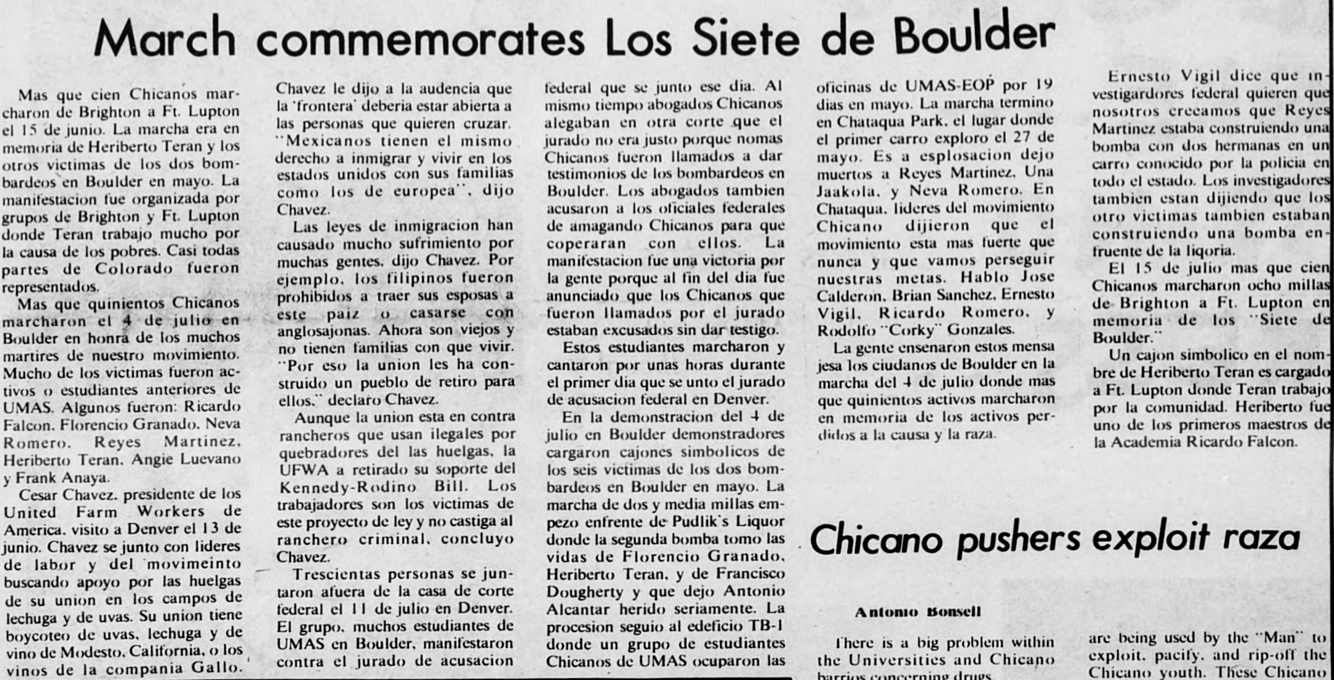
Los Seis Commemorative March
LHP_Intern2021-08-25T17:32:38+00:00An account of the commemorative march held for Los seis de Boulder on June 15th 1974 from Brighton to Fort Lupton CO.
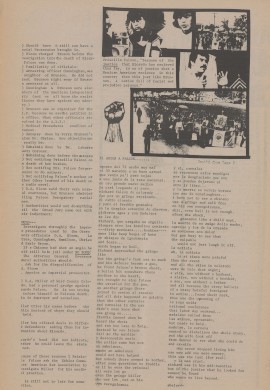
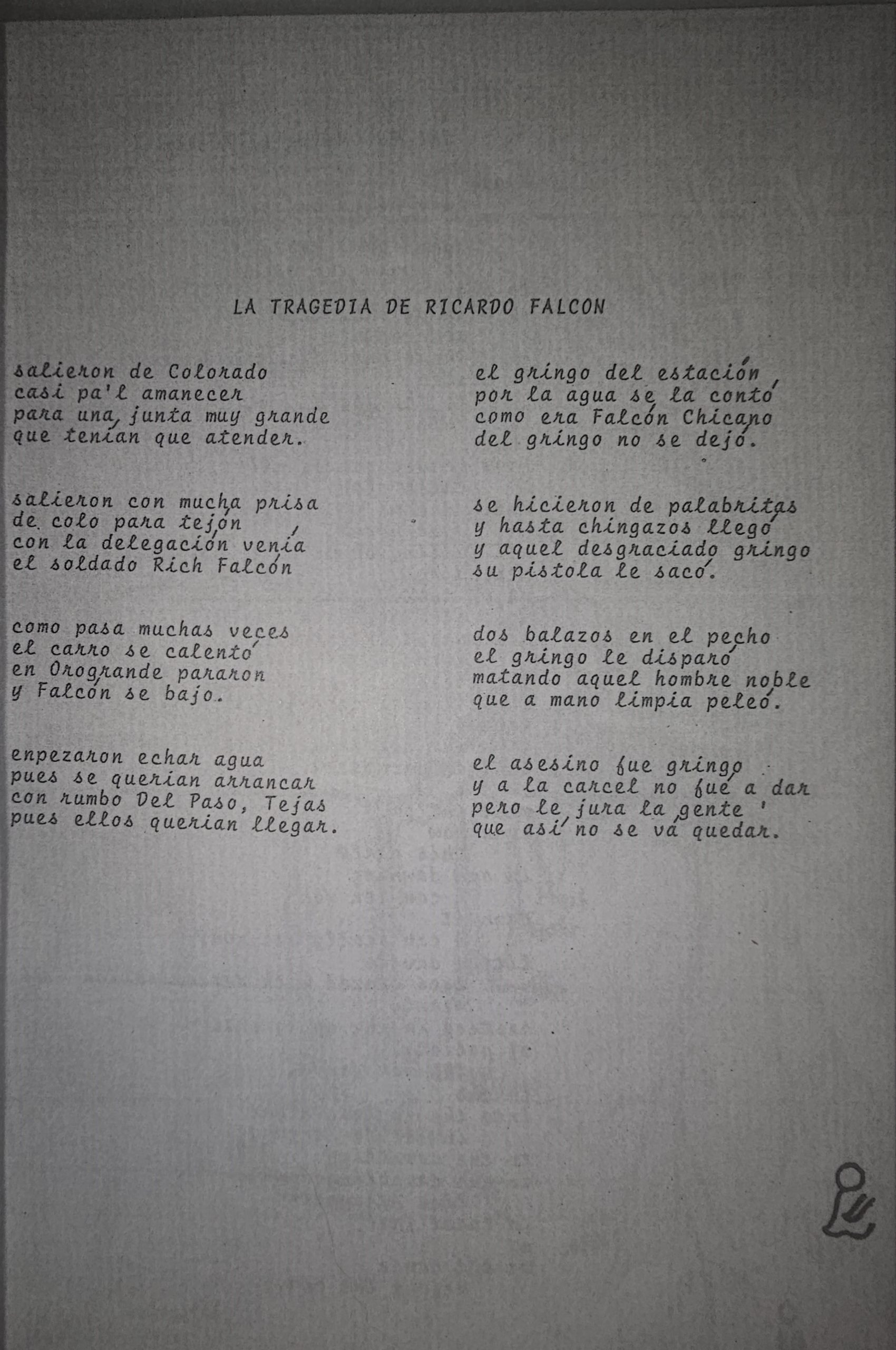
Aftermath of Ricardo Falcon’s Death
LHP_Intern2021-09-27T02:45:38+00:00An account of police and doctor actions after the death of Ricardo Falcon on August 30th 1972. View the full document here.
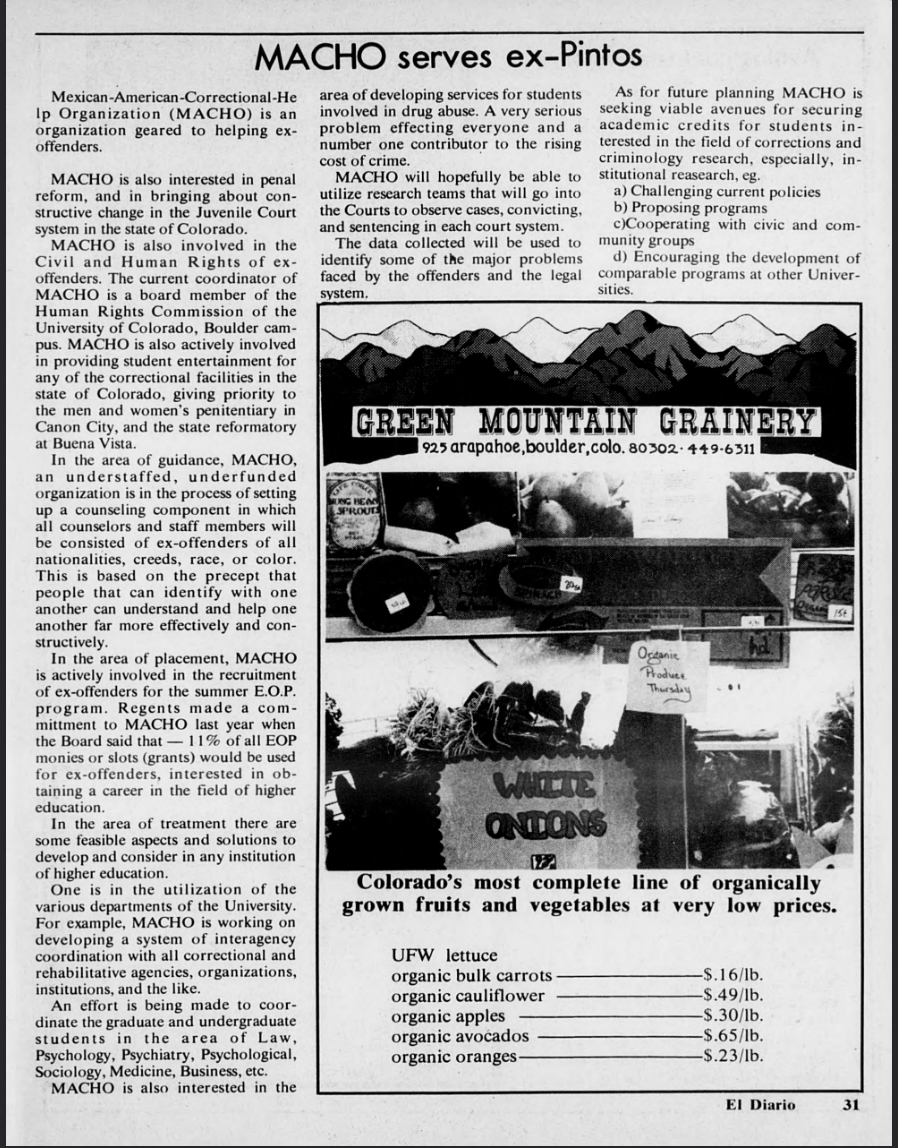
MACHO serves ex pintos
LHP_Intern2021-06-22T14:50:50+00:00Goes further in depth on how MACHO operates
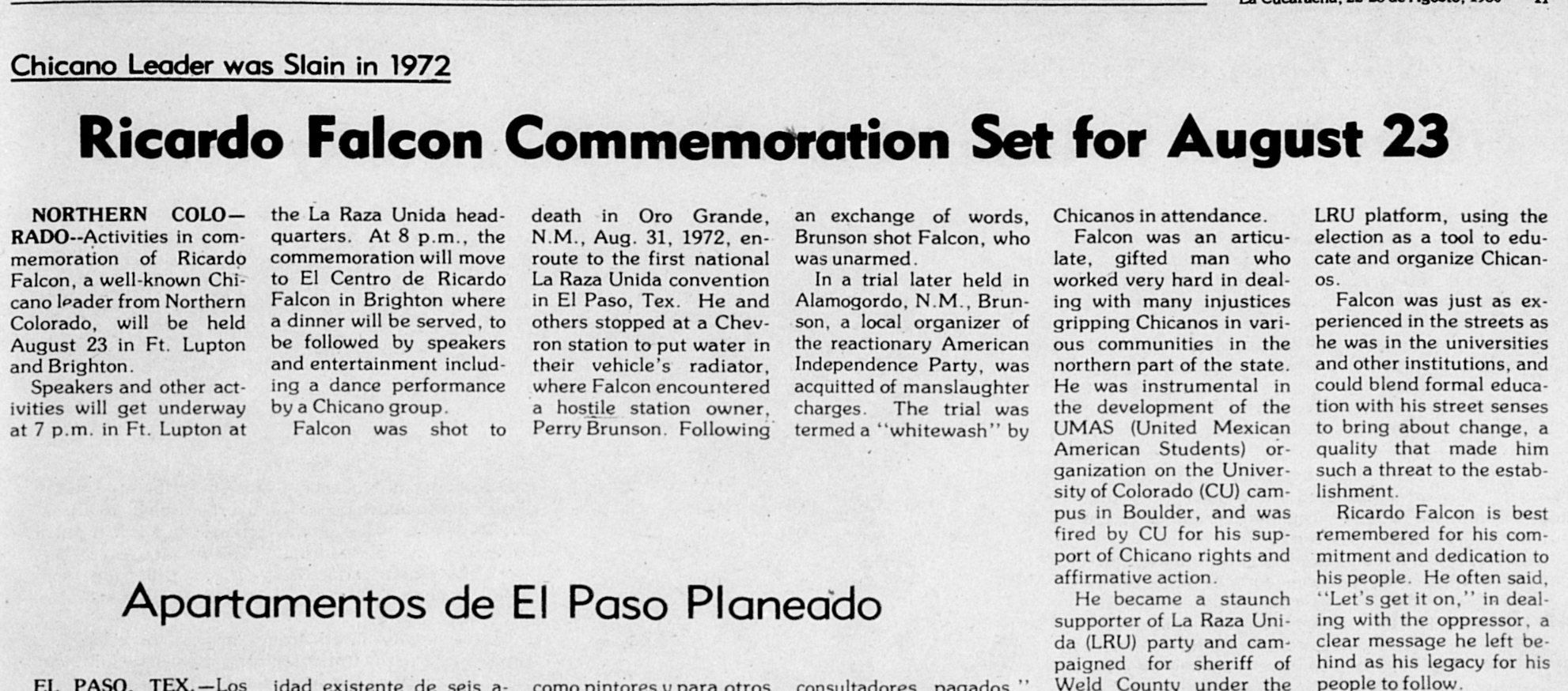
Ricardo Falcon commemoration
LHP_Intern2021-06-22T14:43:18+00:00Activists meet to remember Falcon after his murder
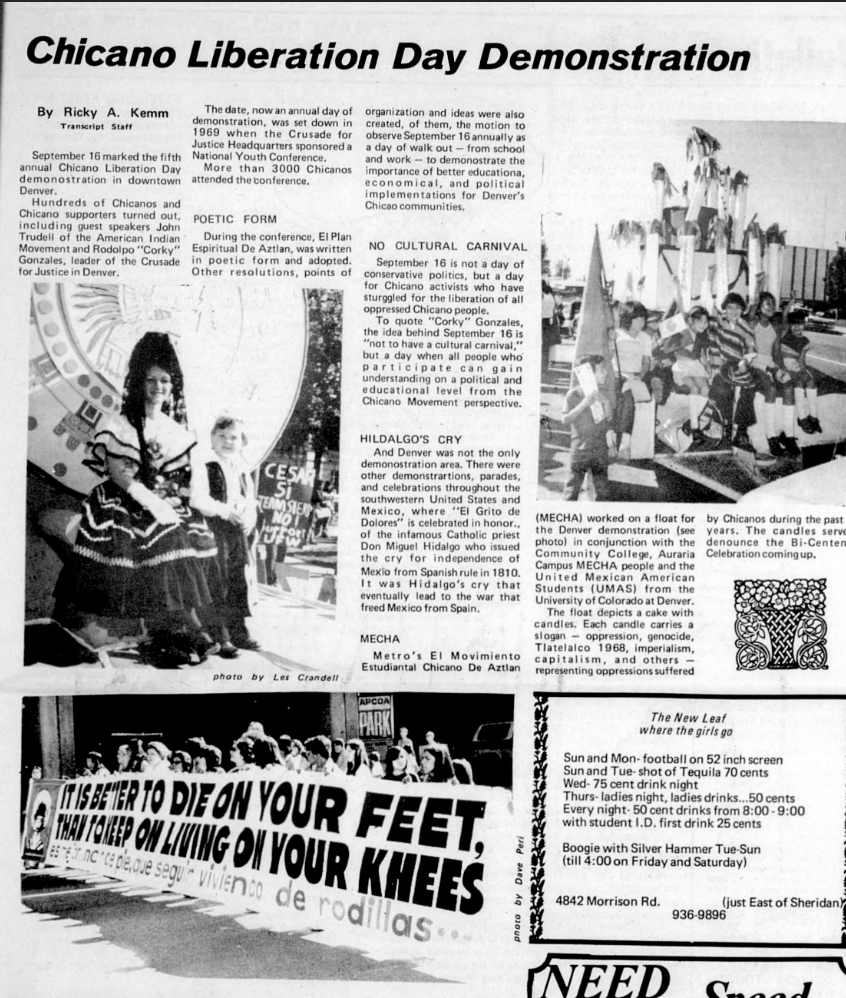
MEChA leads Chicano Liberation Day demonstration
LHP_Intern2021-06-22T14:38:37+00:00MEChA leads a demonstration in Denver to celebrate Chicanos
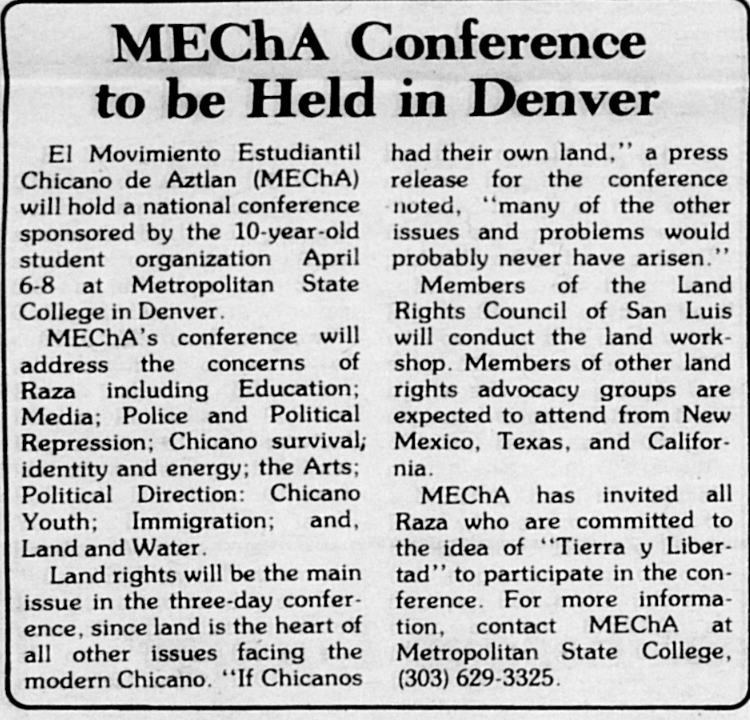
MEChA conference held in Denver 1979
LHP_Intern2021-06-22T14:33:23+00:00MEChA hosted a conference in Denver to discuss issues involving the media, police, and political repression
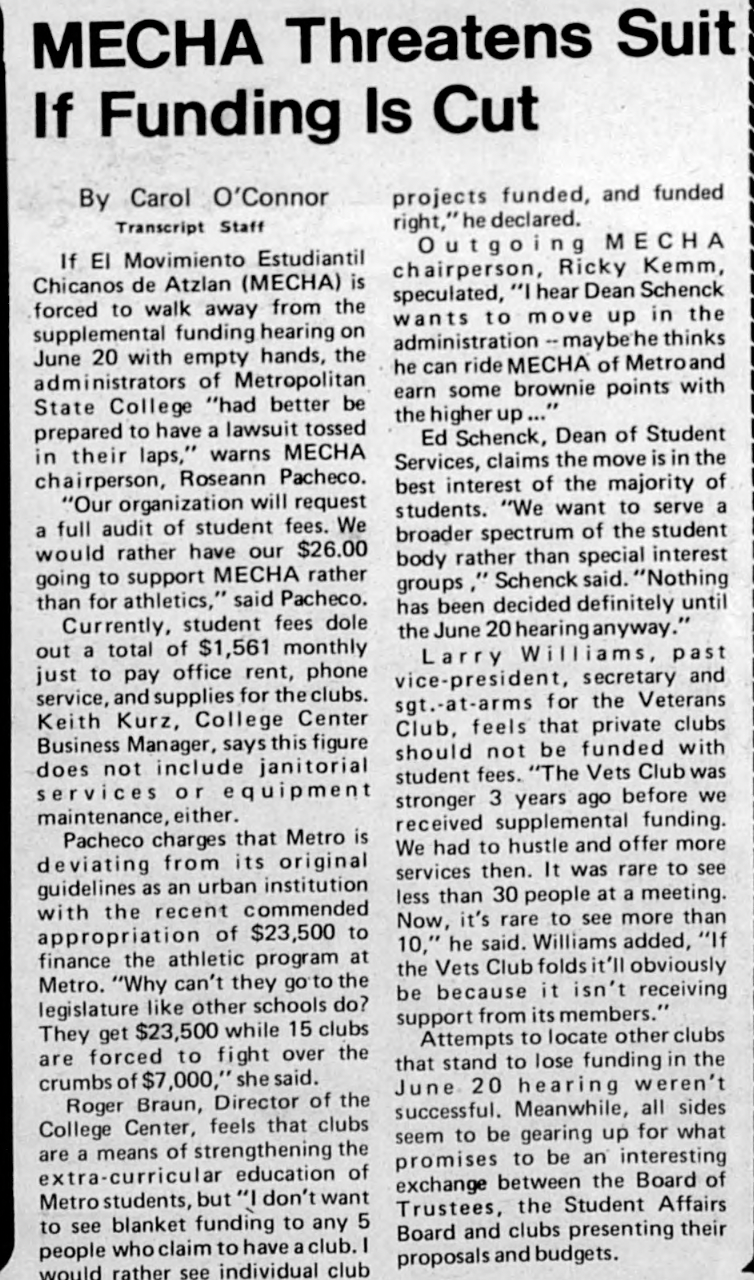
MECHA students threaten lawsuit
LHP_Intern2021-06-21T23:44:56+00:00MECHA students threaten lawsuit at Metro State if their funding is cut
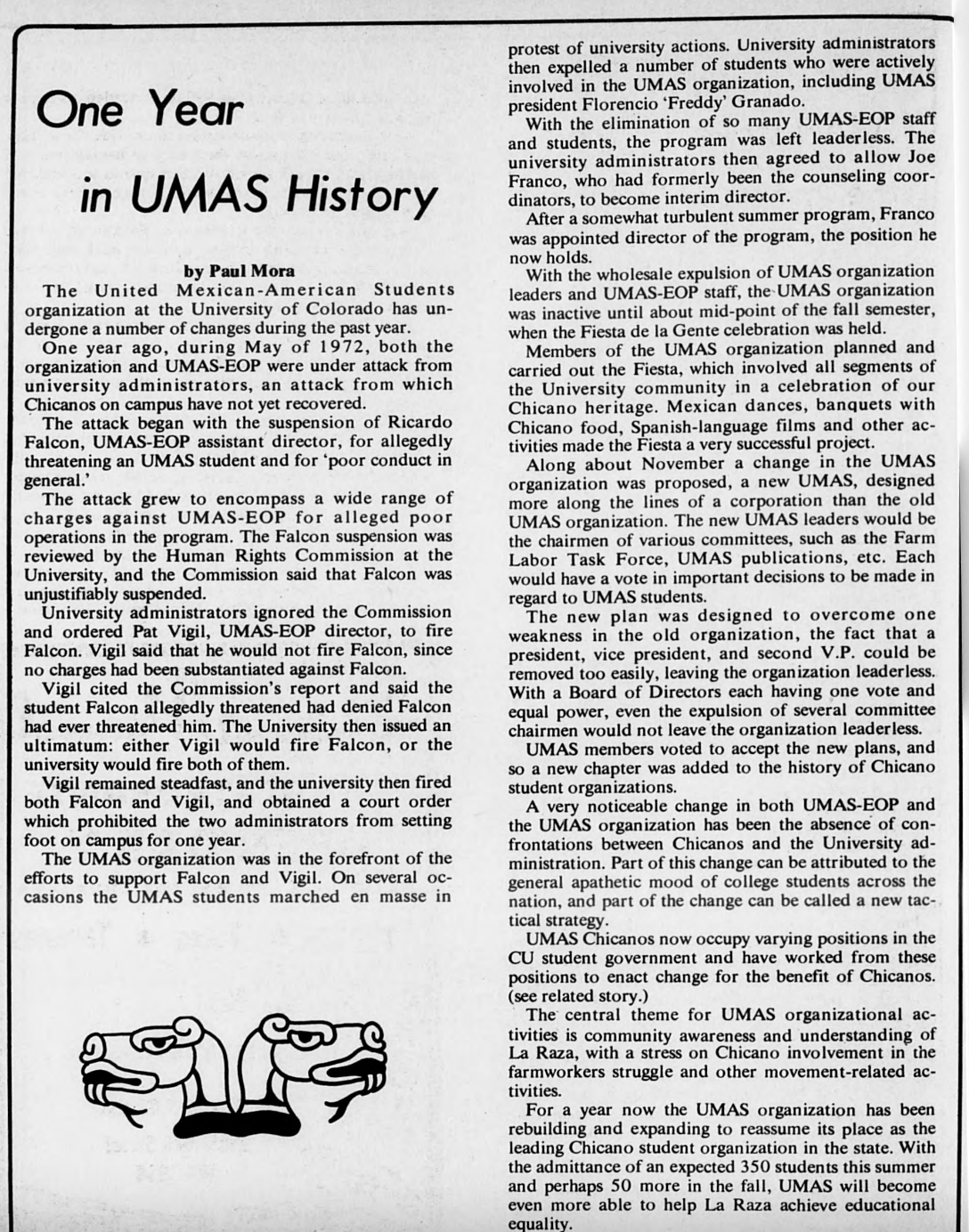
Summary of UMAS actions from 1972-1973
LHP_Intern2021-06-21T23:33:06+00:00Outlines the actions and changes in UMAS the last year
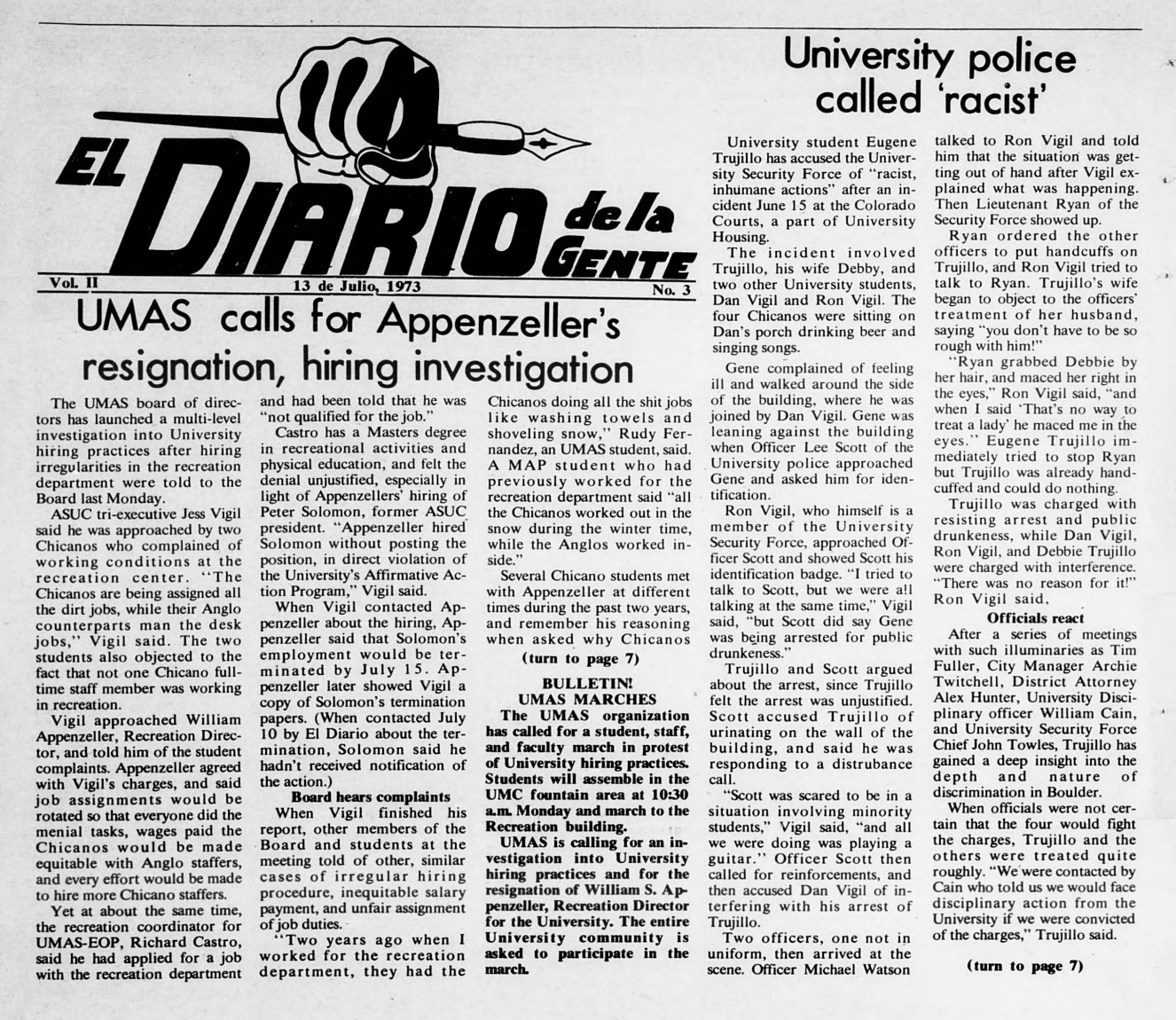
UMAS protests CU hiring practices
LHP_Intern2021-06-21T23:25:44+00:00Students organize to question the university’s hiring practices and call for the firing of a professor.
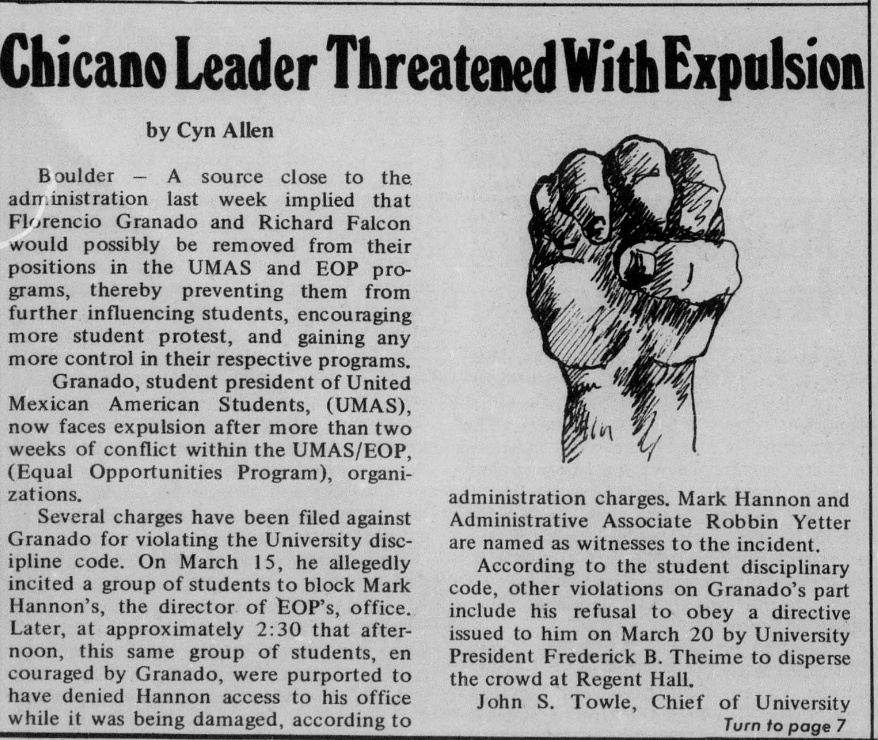
Ricardo Falcon and Florencio Granado face expulsion
LHP_Intern2021-06-21T23:20:15+00:00Granado and Falcon face expulsion due to their involvement in student protests including occupation of Regent Hall
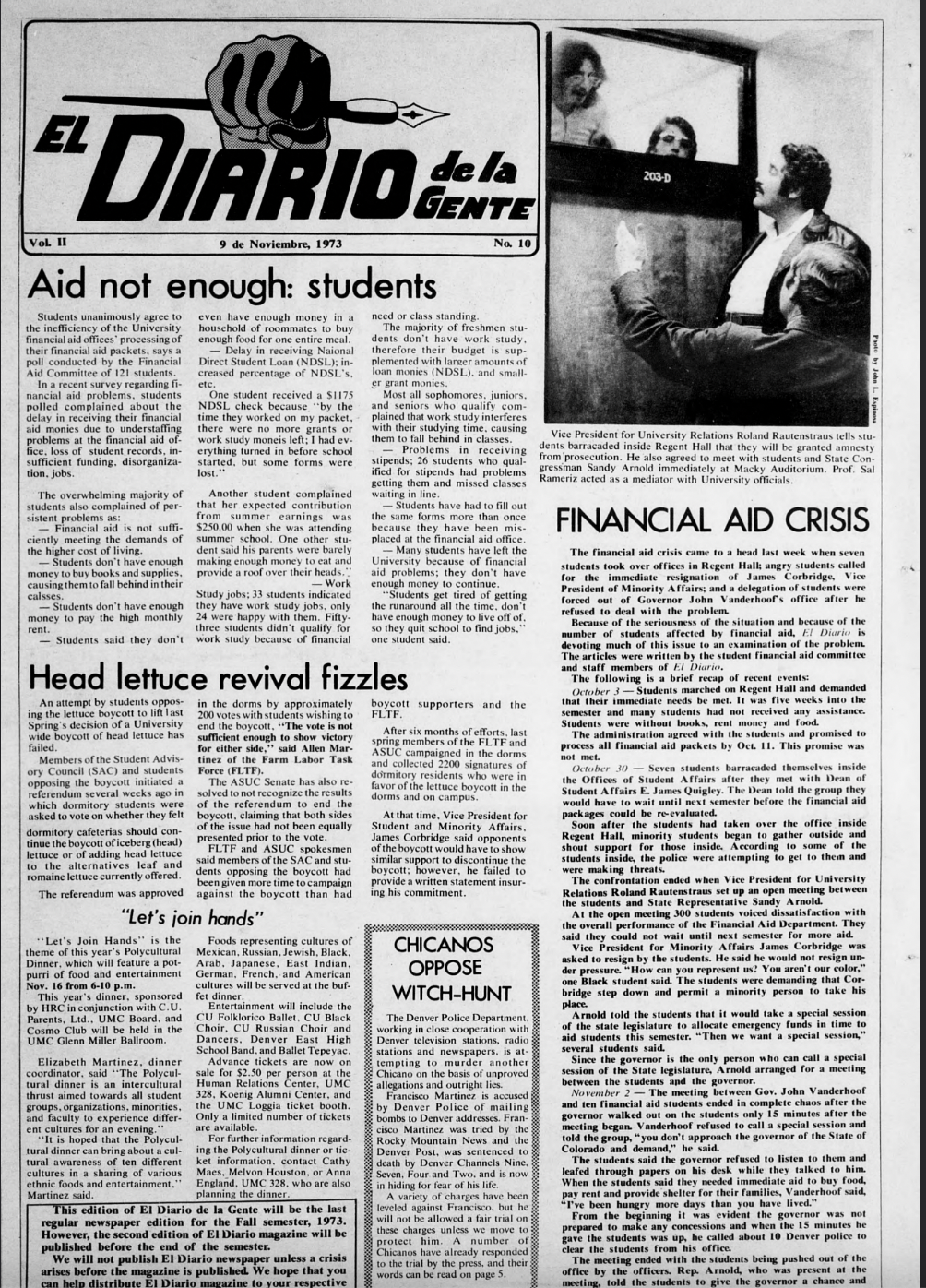
Financial Aid Crisis at Regent Hall
LHP_Intern2021-06-21T22:40:33+00:00Students occupy Regent Hall after lack of financial support.
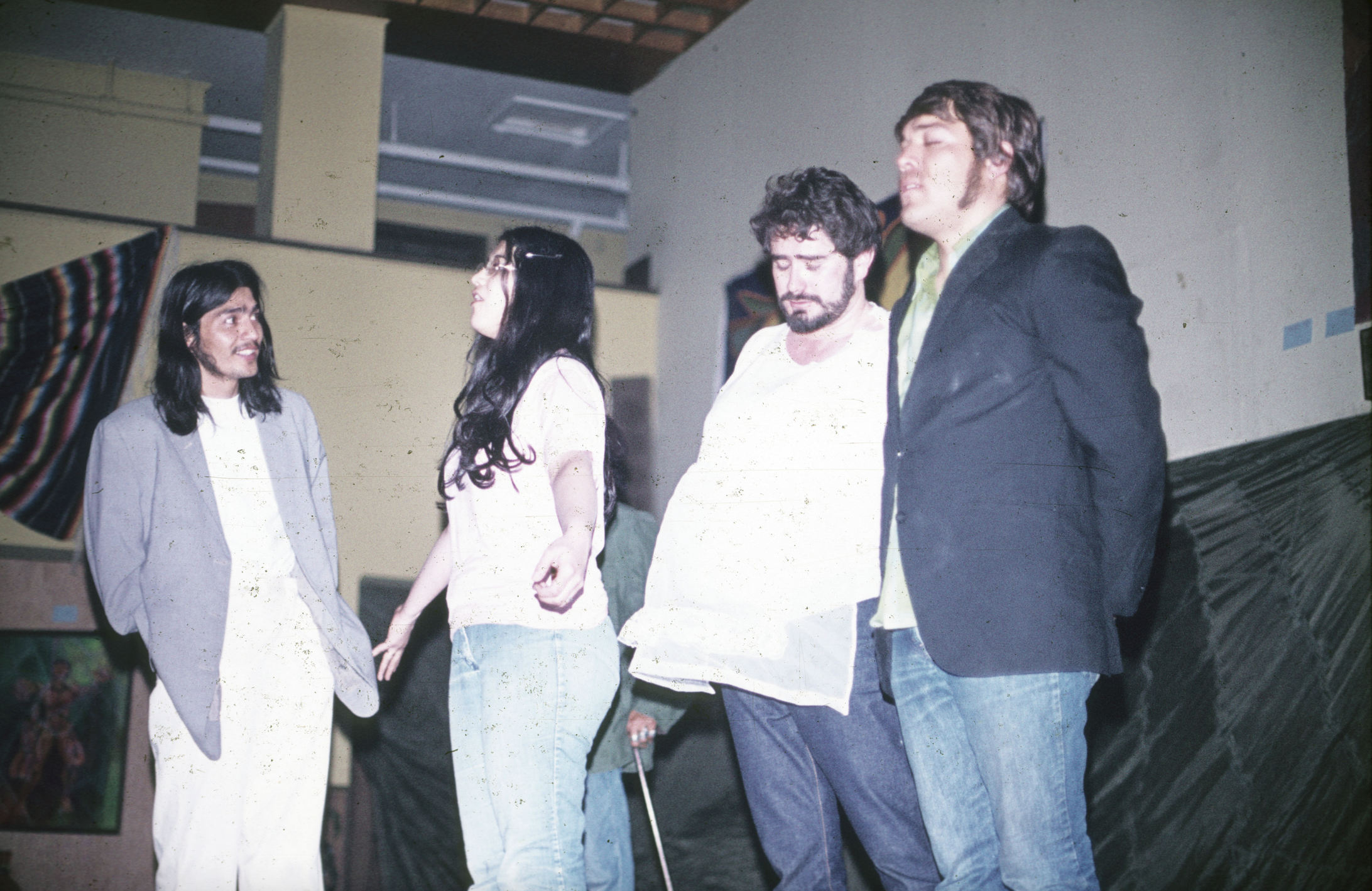
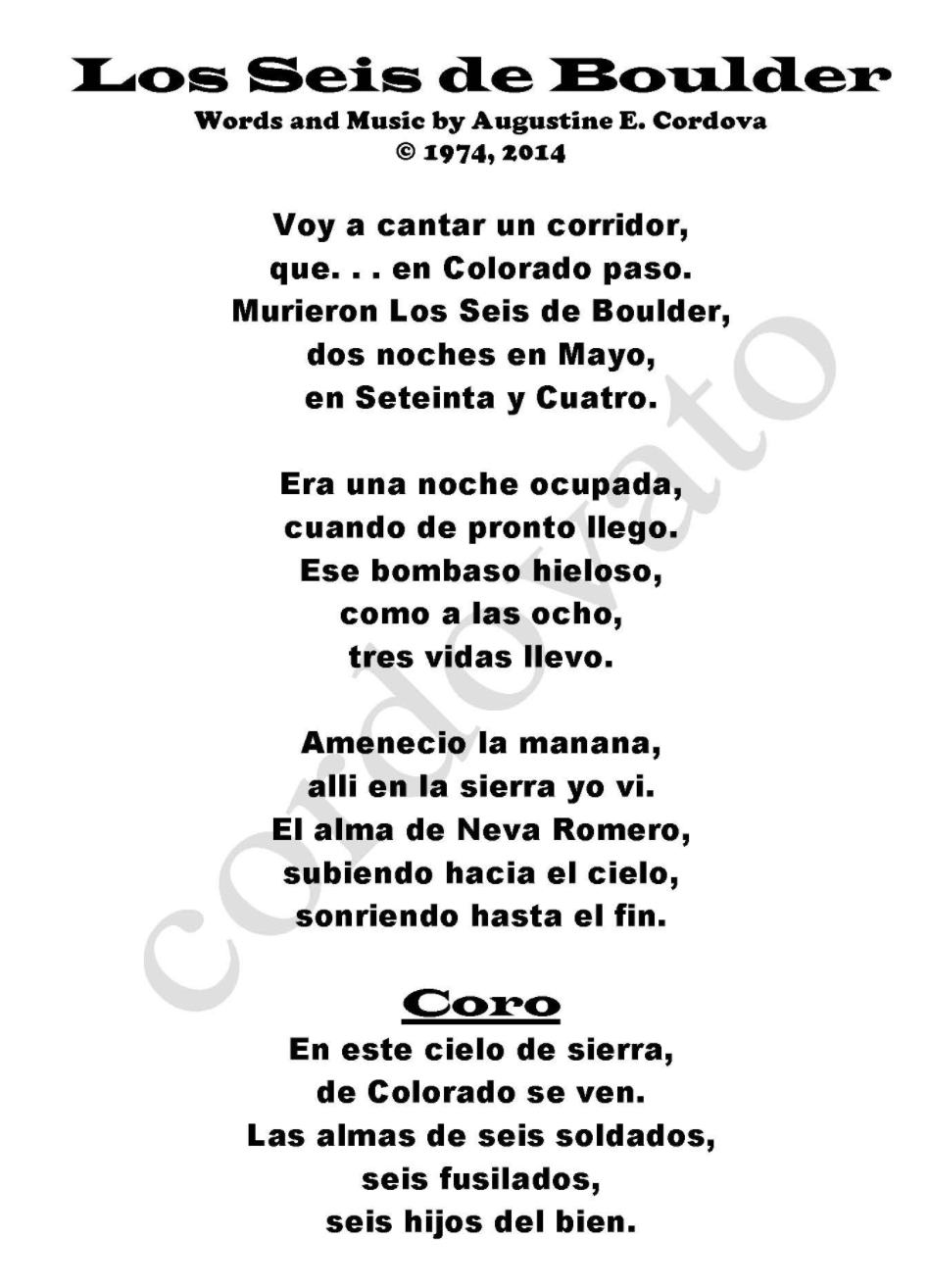
Lyrics to Los Seis de Boulder Corrido (Español)
LHP_Intern2021-06-08T06:05:58+00:00Lyrics to Los Seis de Boulder Corrido (Español). Written and sung by Augustine E. Cordova around 1974; re-recorded in 2014 for the Boulder County Latino History Project

Lyrics to Los Seis de Boulder Corrido (English)
LHP_Intern2021-06-08T05:59:37+00:00Lyrics to Los Seis de Boulder Corrido (English). Written and sung by Augustine E. Cordova around 1974; re-recorded in 2014 for the Boulder County Latino History Project

Lyrics to Yo Soy Chicano Pt.1 (Español)
LHP_Intern2021-06-08T05:57:06+00:00Lyrics to Yo Soy Chicano Pt.1 (Español). Written and sung by Augustine E. Cordova around 1974; re-recorded in 2014 for the Boulder County Latino History Project

Lyrics to Yo Soy Chicano Pt.1 (English)
LHP_Intern2021-06-08T05:52:46+00:00Lyrics to Yo Soy Chicano Pt.1 (English). Written and sung by Augustine E. Cordova around 1974; re-recorded in 2014 for the Boulder County Latino History Project
Yo Soy Chicano Pt.1 (Spanish/Español Audio Recording)
LHP_Intern2022-04-26T16:20:28+00:00Yo Soy Chicano song by Augustine E. Cordova; first half of the song
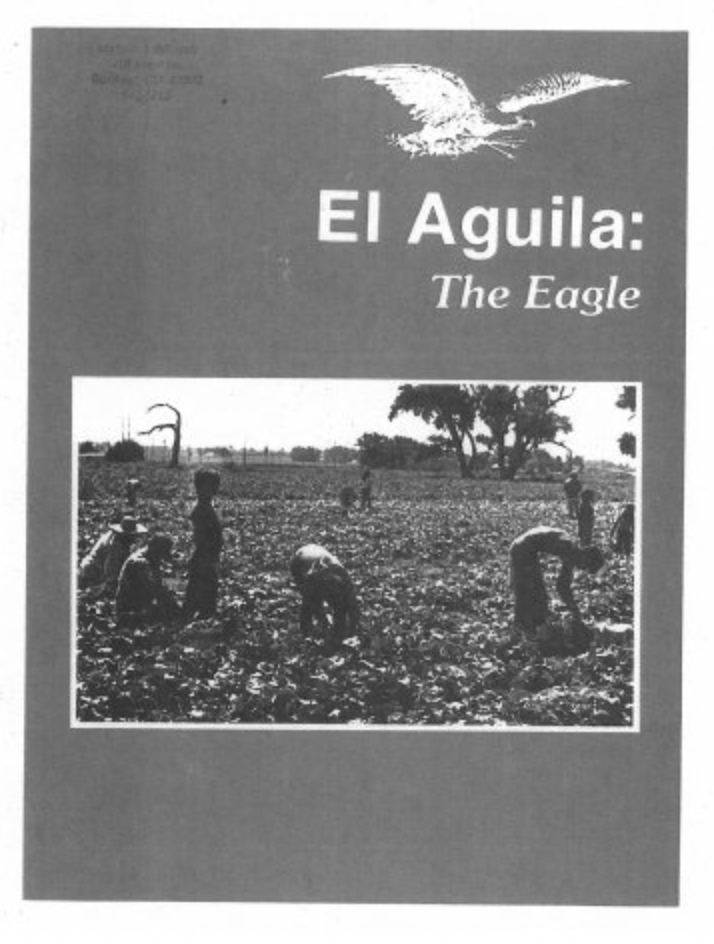
“El Aguila: The Eagle”, written by migrant worker teens, p.1
LHP_Intern2021-06-08T05:15:43+00:00El Aguila, written by migrant worker teens, p. 1
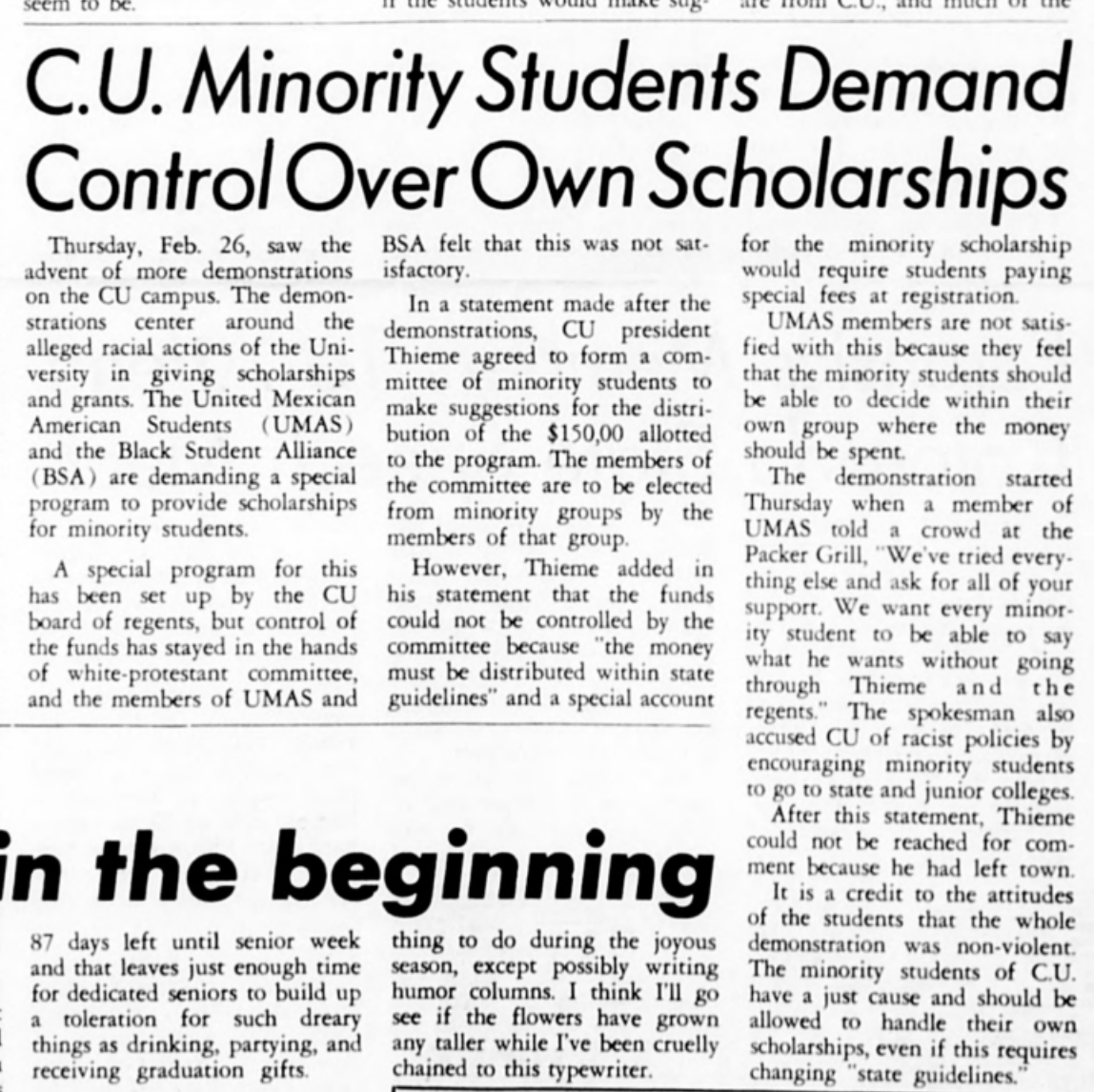
UMAS and BSU call for minority scholarships
LHP_Intern2021-06-08T04:51:53+00:00UMAS and BSU students allege that CU has racist policies and discourages minority students from attending
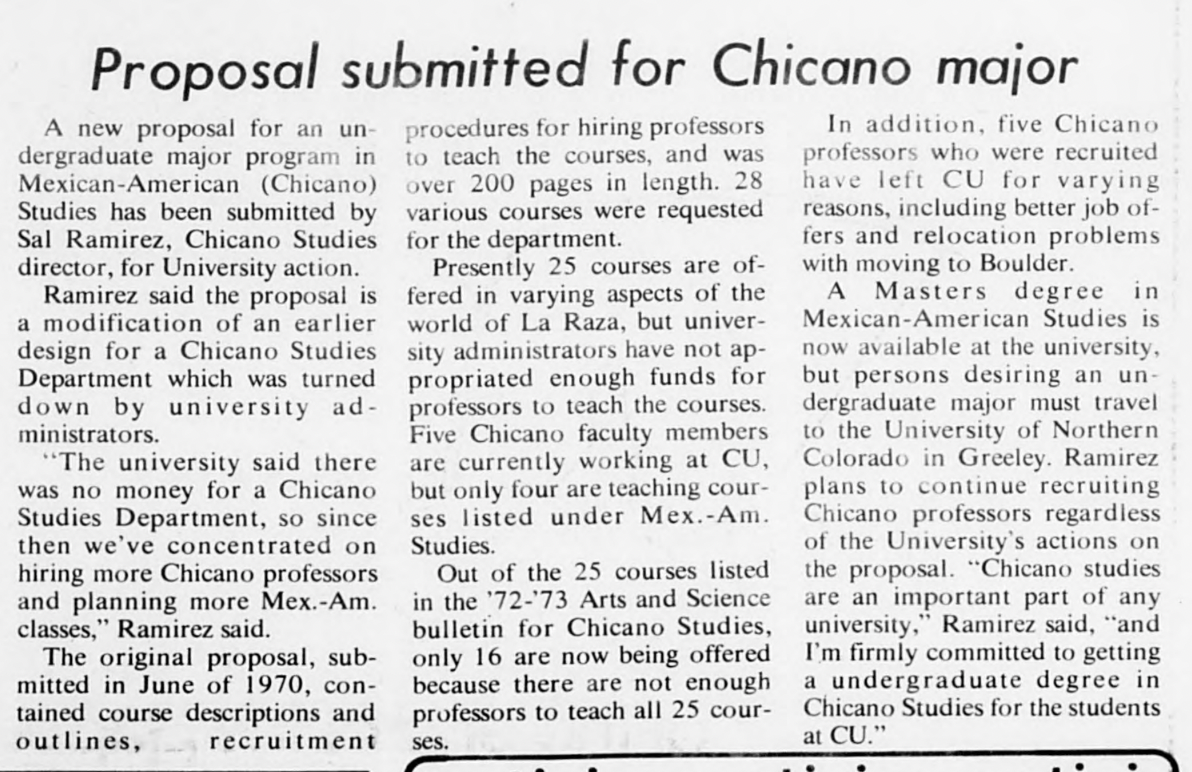
Undergraduate Chicano Studies Major Program
LHP_Intern2021-06-08T04:44:13+00:00A proposition was submitted to create a Chicano Studies major program.
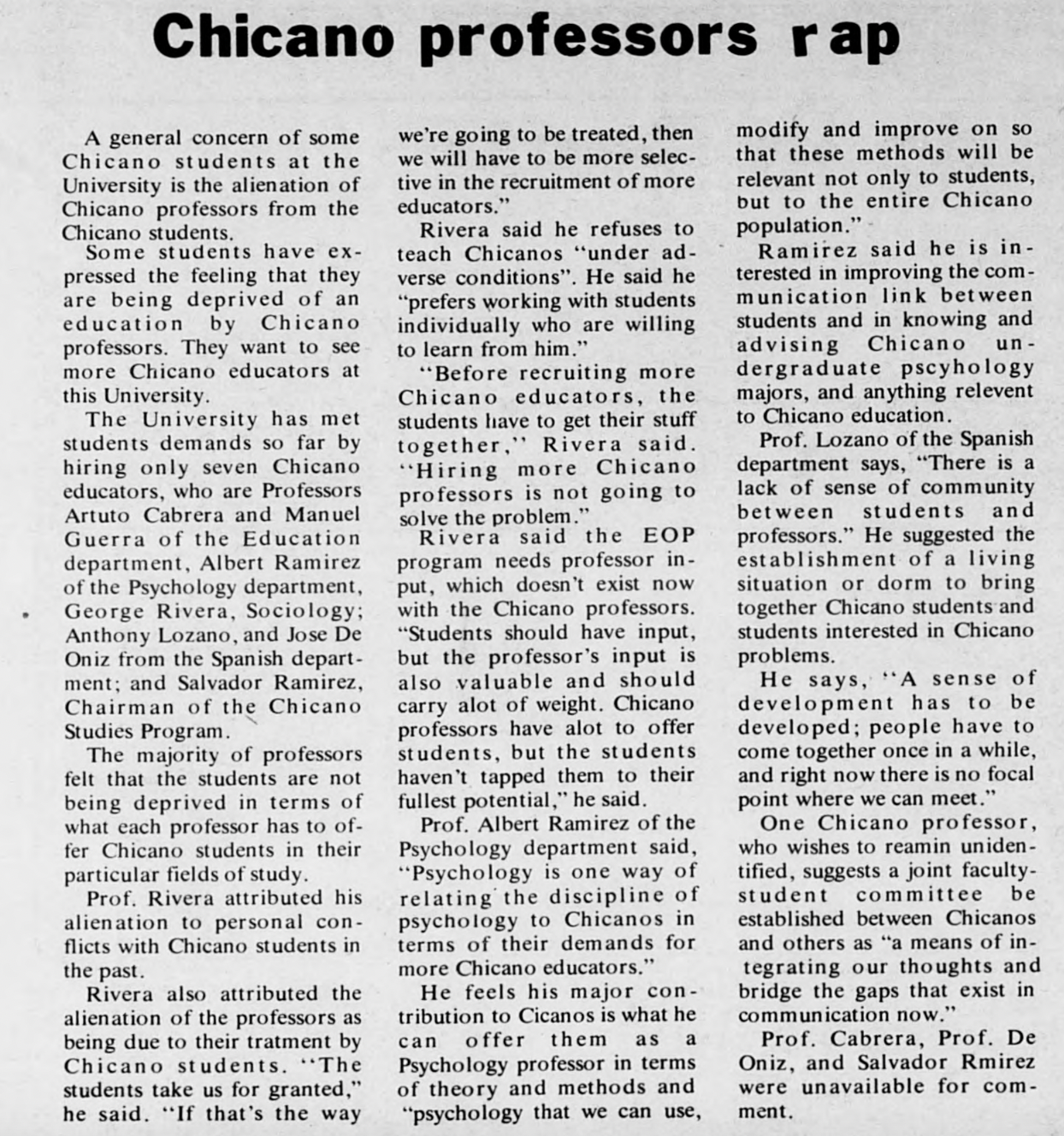
Article calling for the hiring of more Chicano professors
LHP_Intern2021-06-08T04:40:13+00:00El Diario article explaining why CU needs more Chicano professors.
Oral history interview, Ricardo and Anna Garcia, 1977 (audio and summary)
LHP_Intern2021-06-08T04:42:34+00:00Ricardo and Anna Garcia’s interviewed about their experiences being Latino students at a predominately white institution (PWI) link here
Summary: University of Colorado, difficulties of Latino students at; University students, involvement with migrant farmworkers; University housing, quonset huts; Boulder, hippies in; separation between University community and the Boulder community; Alvarado Village, low-income housing in Boulder; housing, low income; Head Start program (lots of information); Follow Through program (lots of information); education, concern with, by parents; health benefits; bilingual education; elementary school language instruction in 1960s; Boulder, Human Relations Commission; political involvement by Latinos

Ricardo Falcón’s Funeral
LHP_Intern2021-06-07T22:22:55+00:00Ricardo Falcón’s casket is draped with red, black, and white UFW flag with the black Huelga Eagle
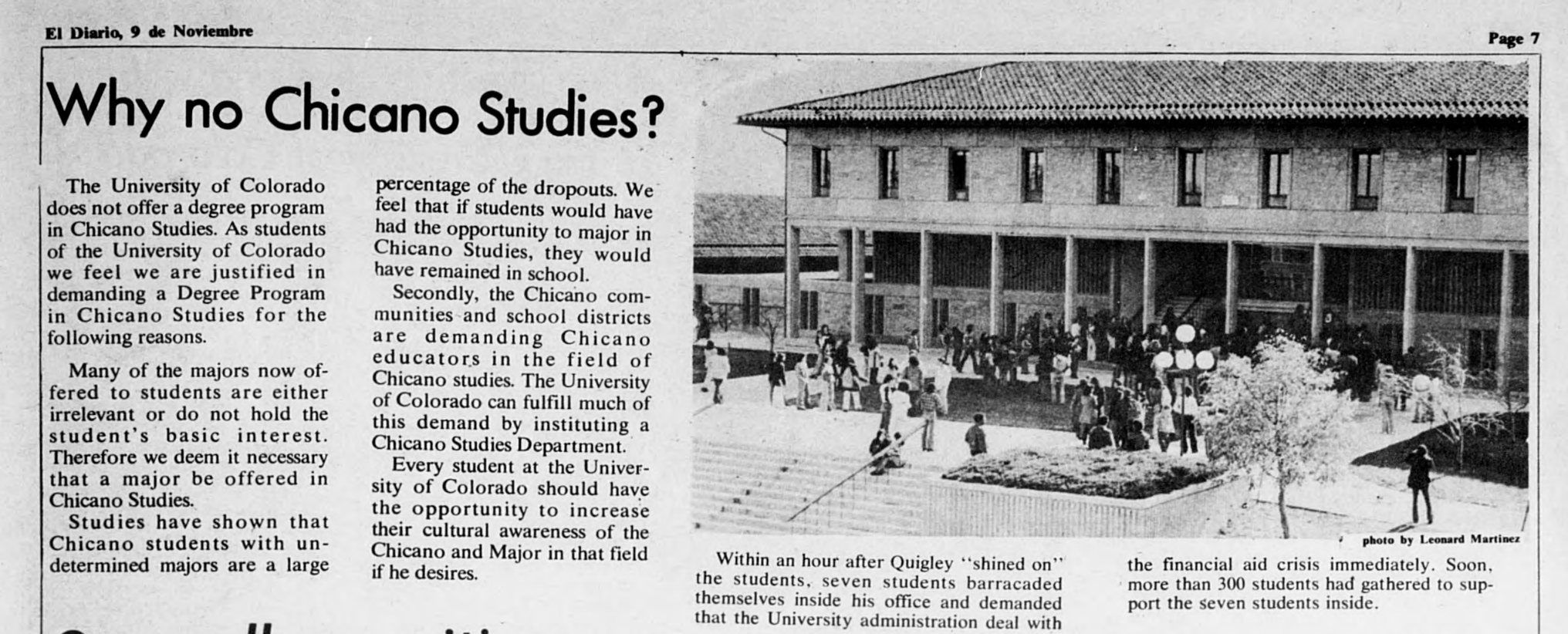
The Case for Chicano Studies
LHP_Intern2021-06-07T22:13:21+00:001973 article in El Diario arguing why Chicano Studies are neccesary at high schools and universities. The article argues that students have the right to learn about their culture and heritage.
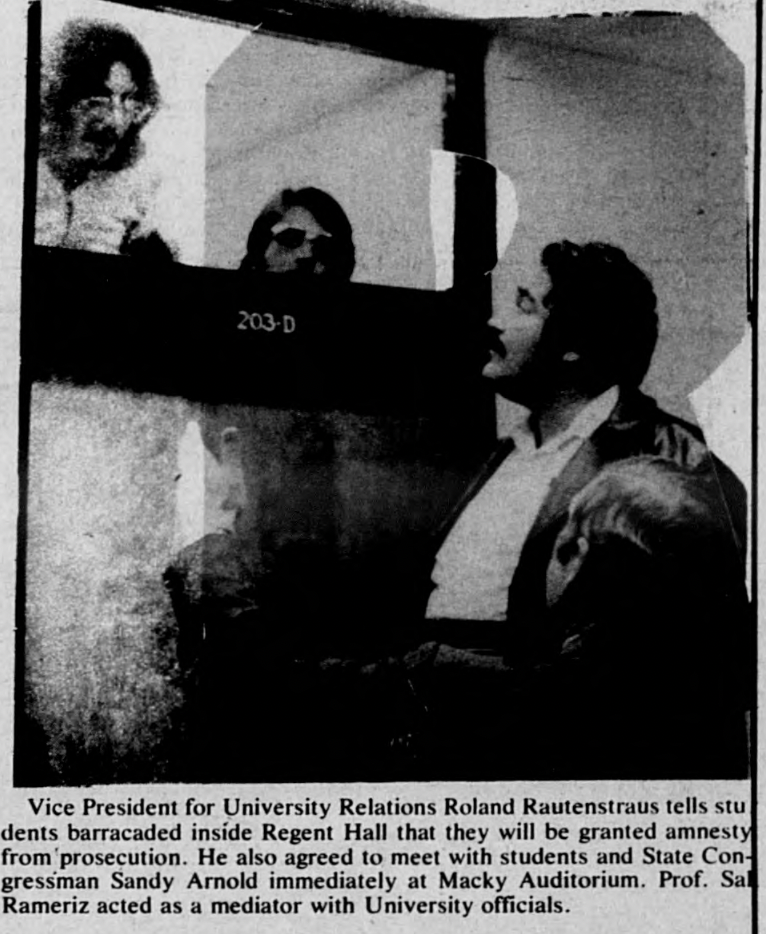
Students occupying Regent Hall granted amnesty
LHP_Intern2021-06-07T21:56:15+00:001974 photo in El Diario by Paul Mora. The article explains how students barricated in Regent Hall were granted amnesty by Vice President for University Relations Roland Rautenstraus. Professor Sal Ramirez served as a mediator between the two sides.
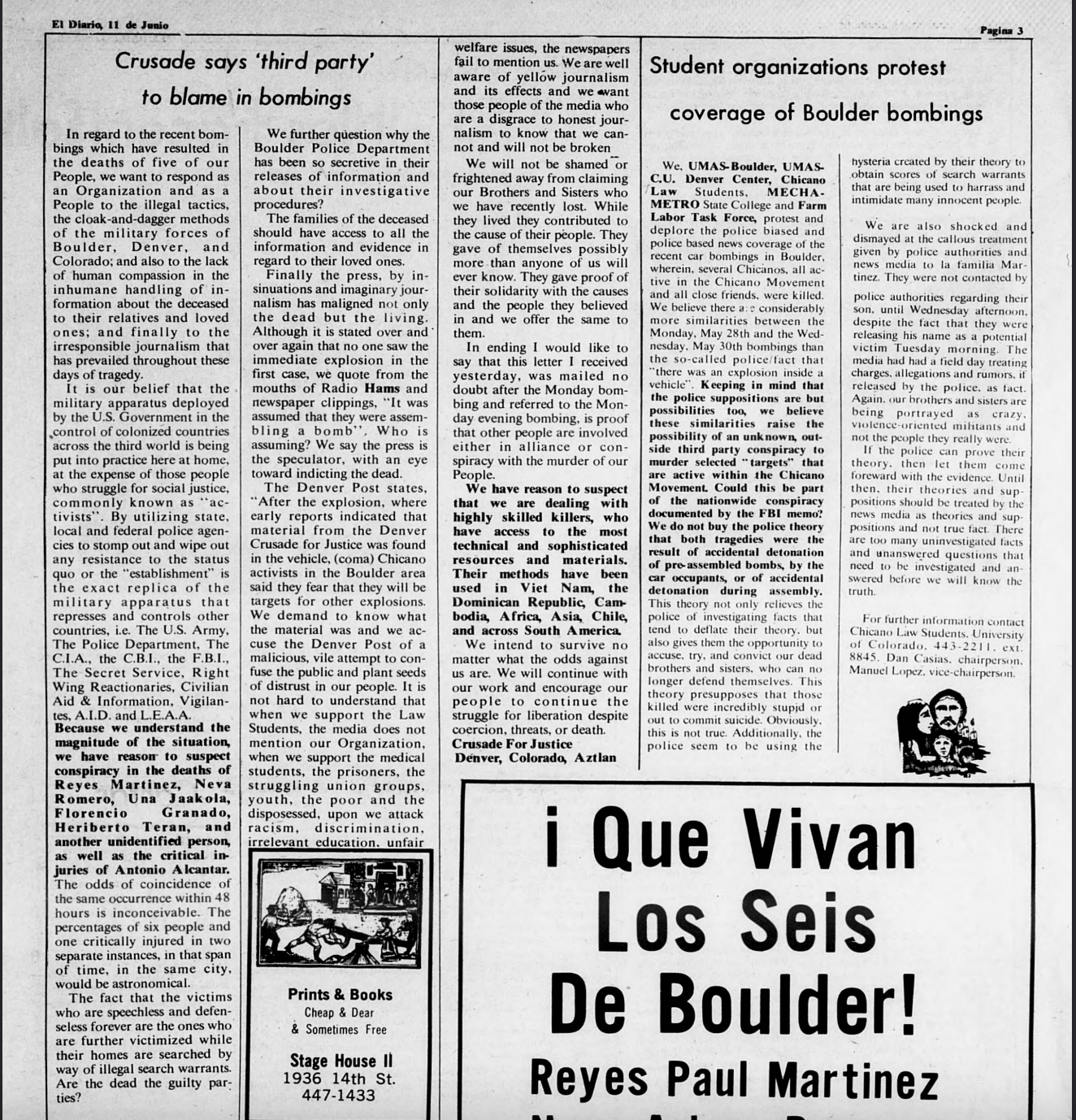
Police Tactics and Los Seis de Boulder
LHP_Intern2021-06-07T21:48:45+00:001974 article in El Diario that claims that many activists do not buy the story that Los Seis self detonated bombs. The article alleges that the police may be involved in the death of Los Seis and that the FBI may have a part in their deaths too (COINTELPRO).

Name change from UMAS to MEChA at Metro 1974
LHP_Intern2021-09-20T21:59:37+00:001974 article in The Auraria Transcript that explains the switch from UMAS to MEChA. Students no longer wanted to use Anglo-American names and instead decided to transition towards a Spanish name. Complete source here
“Boulder’s Chicano Community,” 1978 KGNU radio interview
LHP_Intern2021-06-08T00:24:02+00:00Short radio interview about the founding and its work of the Boulder Chicano Community Project. This recording is of a KGNU radio interview by an unnamed person talking with Jesse Velez Lehmann, Manuel Arcadia, and Regina Vigil about the project “Boulder’s Chicano Community.” They talk about what the project had accomplished and some of its major findings, echoing the topics covered in the two films, “Los Inmigrantes” and “Boulder’s Chicano Community.”
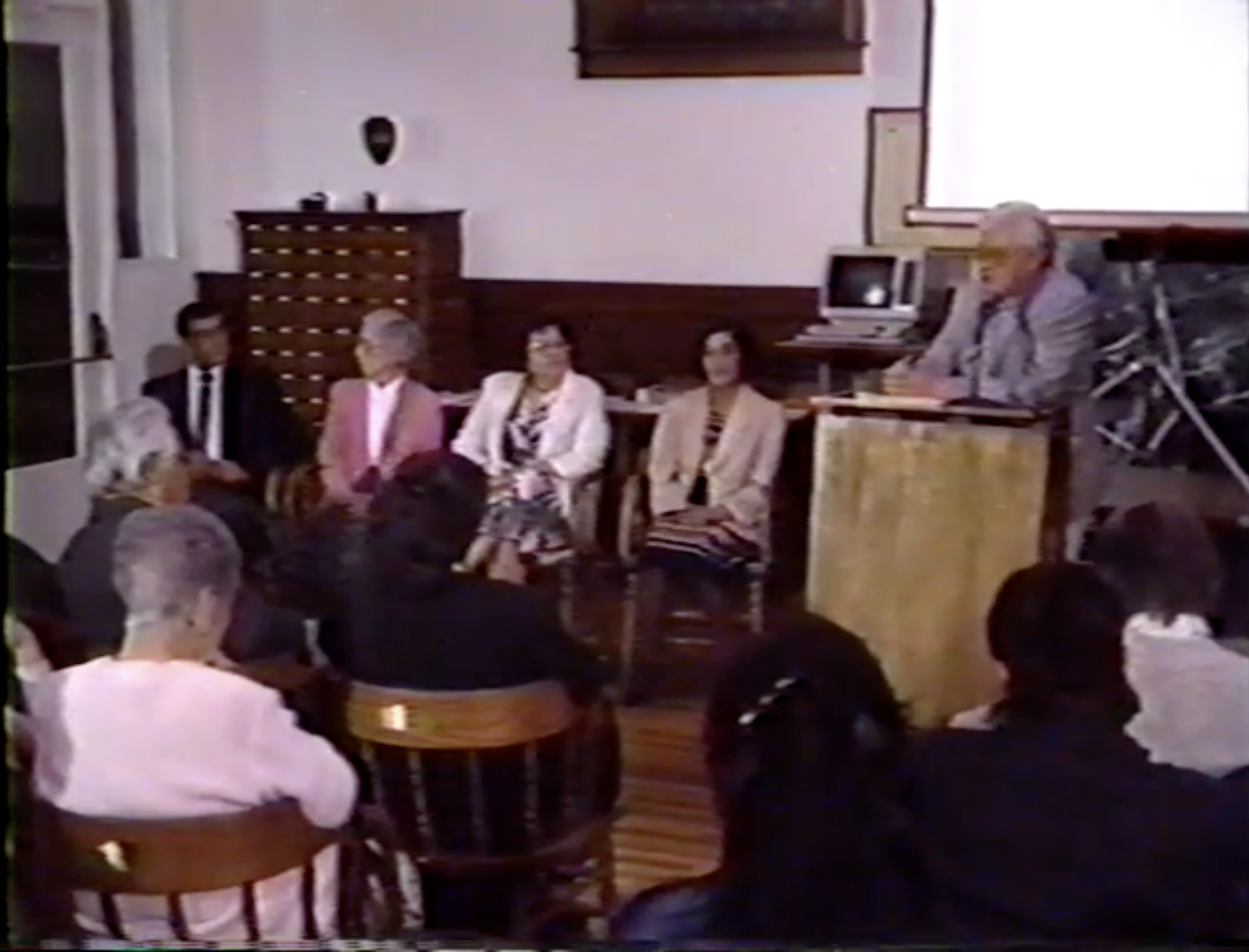
The Boulder Hispanic Experience 1994 Video of “Los Inmigrantes” and a panel discussion
LHP_Intern2021-06-08T00:31:45+00:00Short film of a panel discussion based on the film Los Inmigrantes, 1994
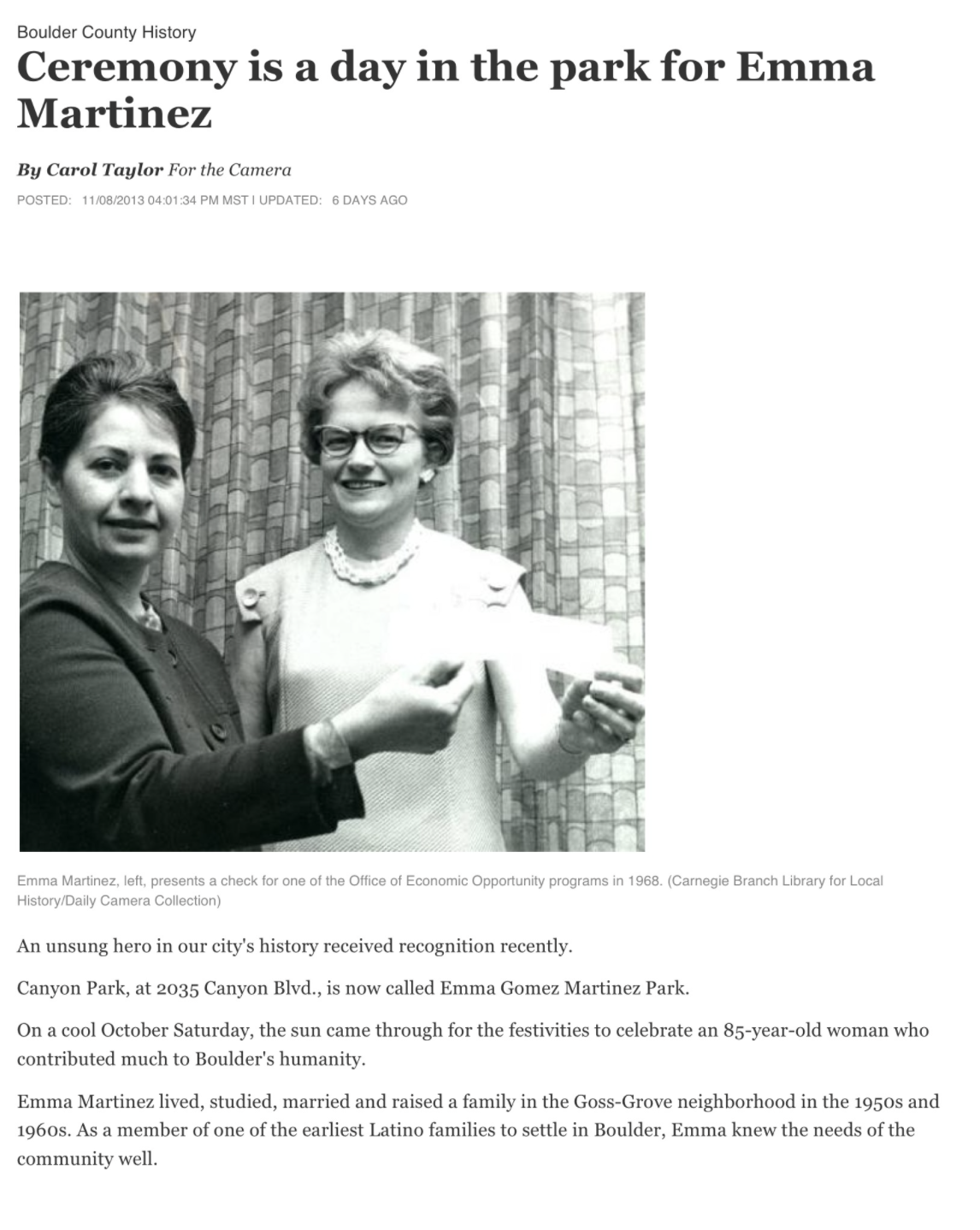
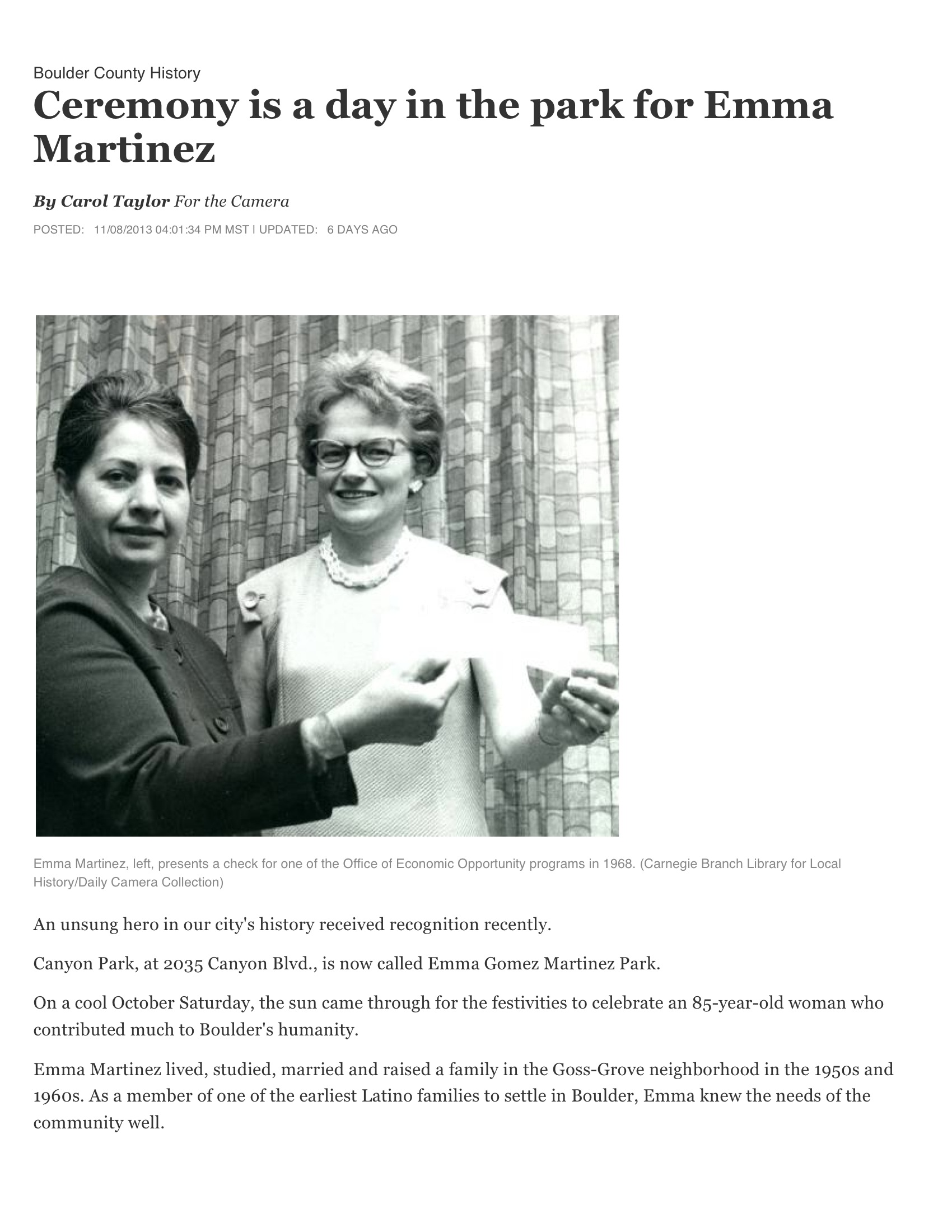
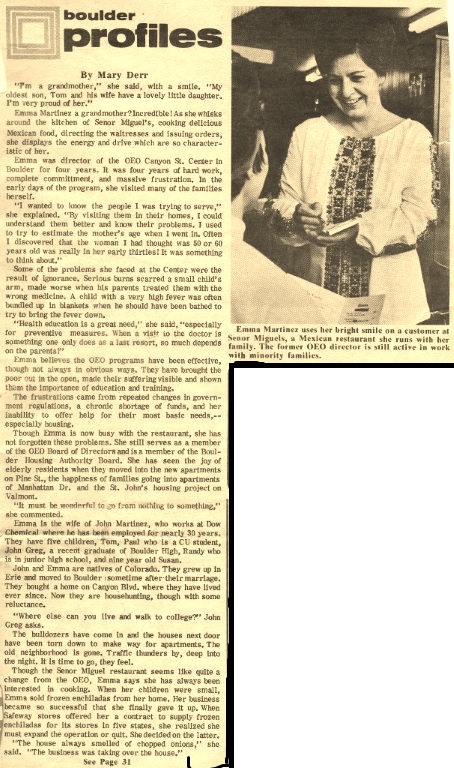
Canyon Park renamed in Emma Gomez Martinez’s honor, 2013
LHP_Intern2021-06-08T00:16:31+00:00Short newspaper article from the Boulder Daily camera announcing the renaming of Canyon Park in honor of Emma Gomez Martinez
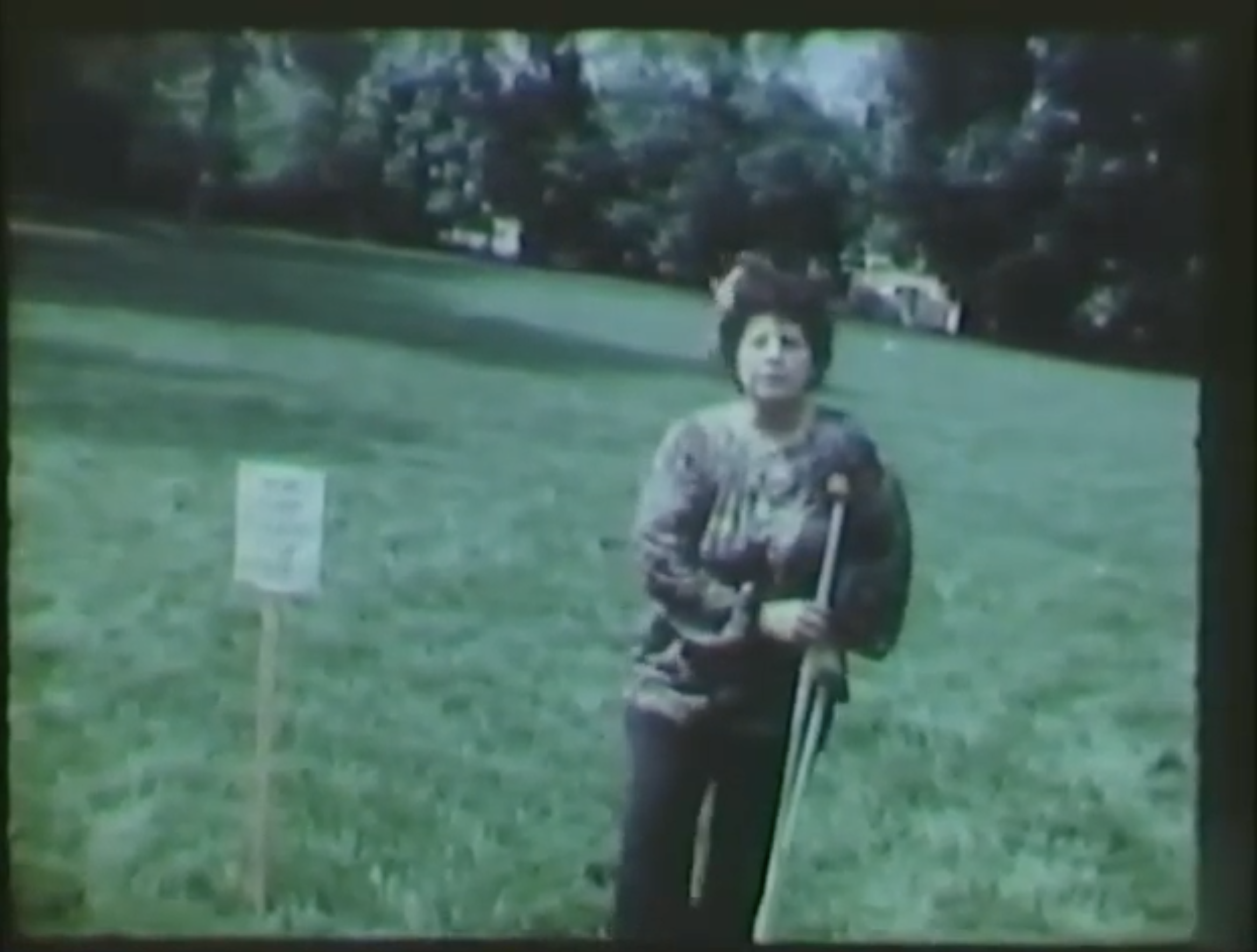
Los Inmigrantes 1979 Film
LHP_Intern2021-06-08T00:33:08+00:00Short film showing interviews of Boulder Chicanos, 1979
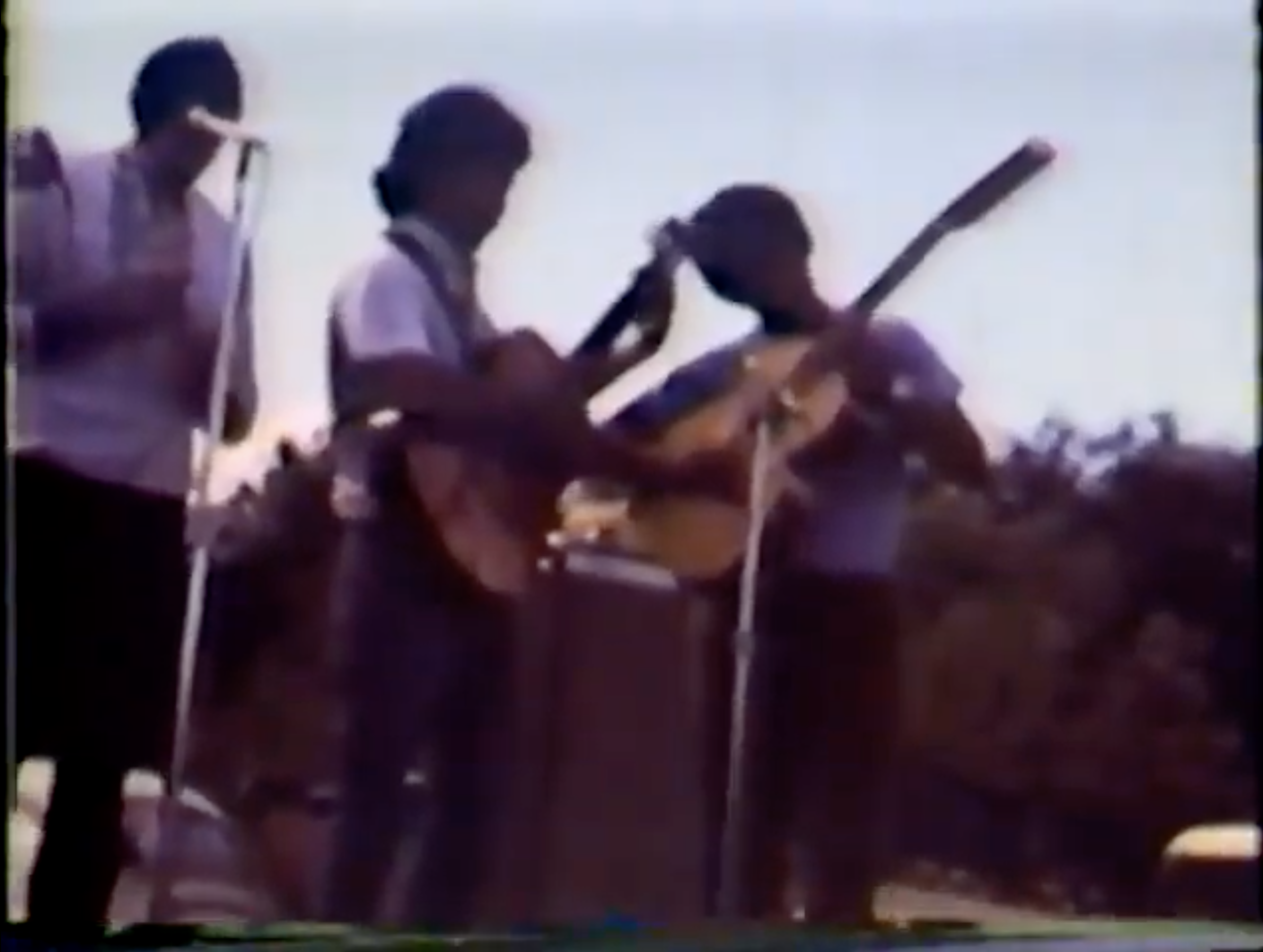
Boulder Chicano Community-1979 Film
LHP_Intern2021-06-08T00:34:21+00:00Short film on Boulder’s Chicano community , Boulder in the 1930s offered the chance for children to get some education and different kinds of jobs; neighborhood around Water + Goss Streets; migrant farm work in San Luis Valley, then in Boulder area; difficulty of attending a city school; isolation of Chicano families from mainstream Boulder life. Sequence of scenes and people
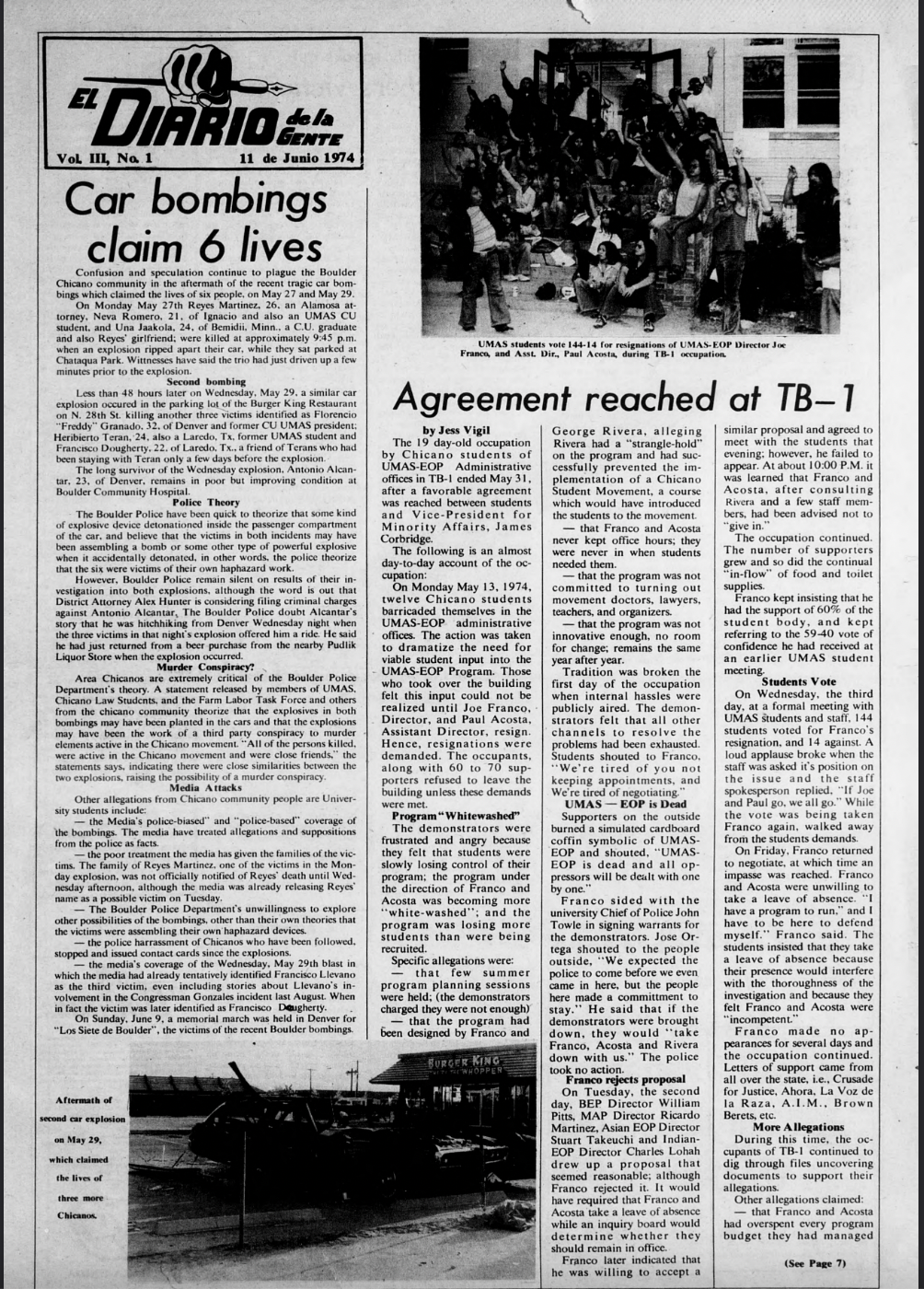
The Events of the TB-1 Occuption
LHP_Intern2021-06-02T04:57:34+00:001974 article written by Jess Vigil for El Diario. This article is a day to day account of the occupation. Students occupied TB-1 on May 13, 1974 in order to call for the resignation of UMAS-EOP administrators Joe Franco and Paul Acosta.
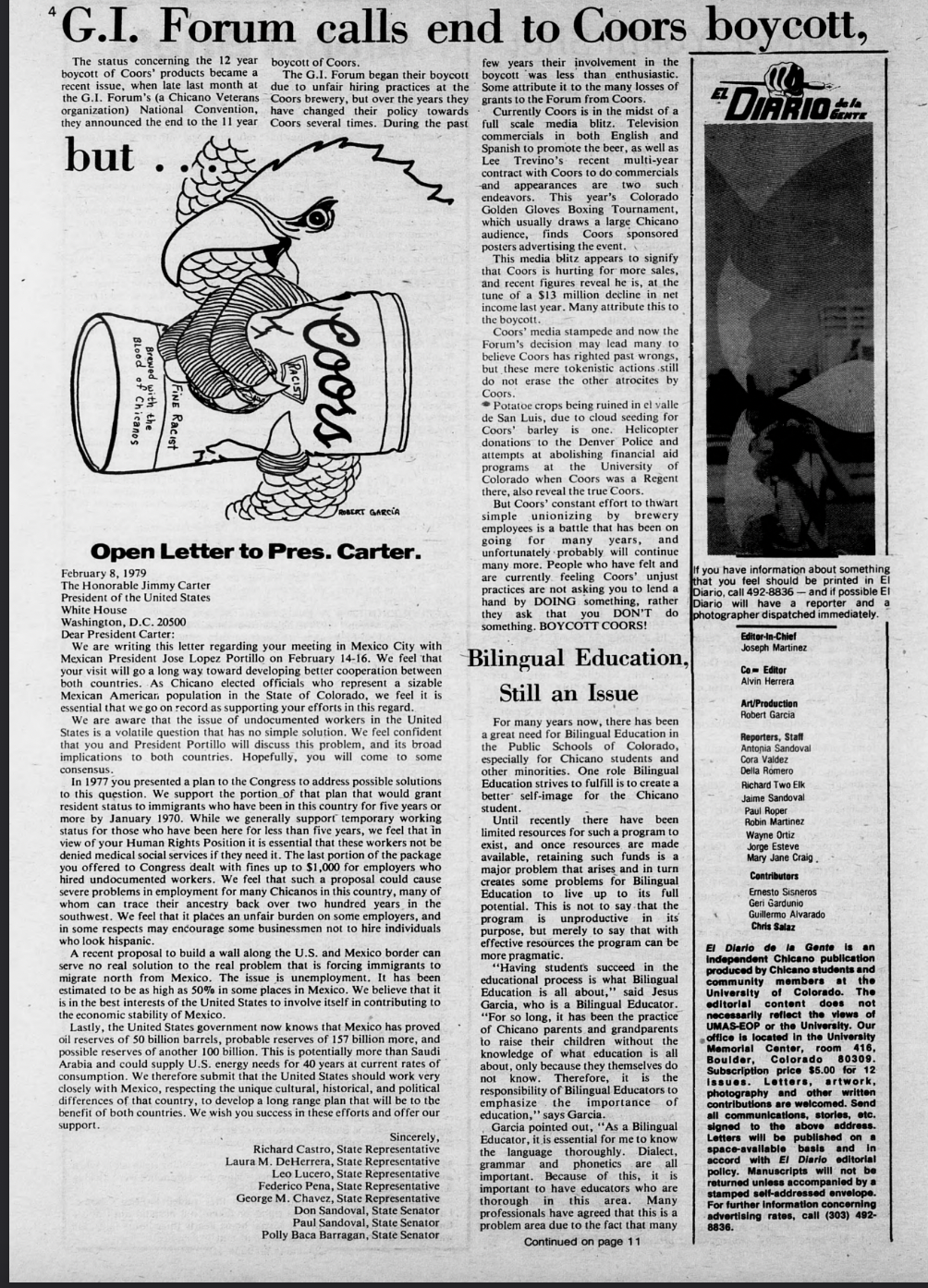
Argument for Bilingual Education in Public Schools
LHP_Intern2021-06-08T00:31:52+00:00Newspaper article in El Diario which argues for bilingual education in Denver Public Schools. The article argues that bilingual education is good for uplifting the self-image of Chicanos as it allows for students to perform better in classes that they may have struggled in previously.

Los Seis de Boulder Corrido
LHP_Intern2021-06-10T18:14:32+00:00Recording of Augustine Cordova singing the first part of his “Los Seis de Boulder,” written in 1974 and re-recorded in 2014; in the style of a corridor. Link here
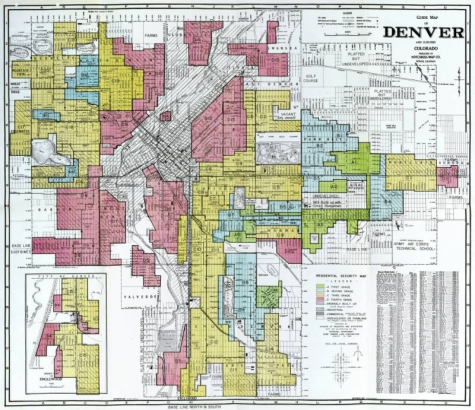
Denver Redlining Map, 1938
LHP_Intern2020-09-10T00:22:54+00:00Redlining map of Denver from 1938
Neighborhoods are ranked from most to least desirable, assigned grades A, B, C, D, and color coded green, blue, yellow, red (respectively)
08-15-1938
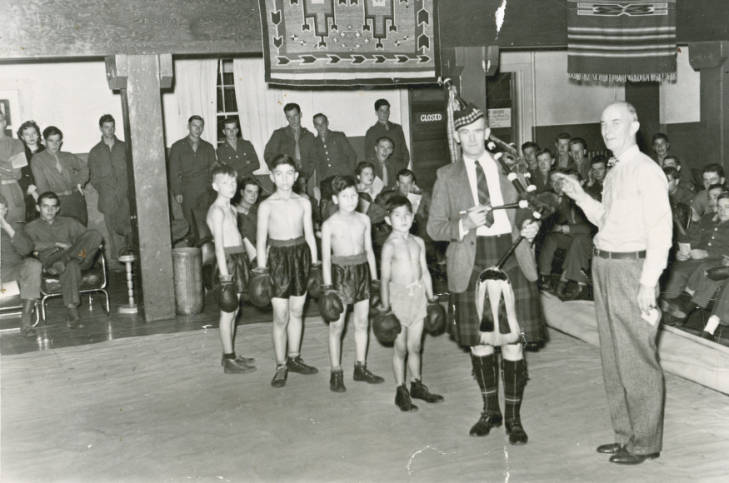
Young boys boxing
LHP_Intern2020-09-09T21:11:28+00:00A group of boys, including James Maestas, box as part of an exhibition for the US Military at Lowry Air Froce Base in Aurora, 1943
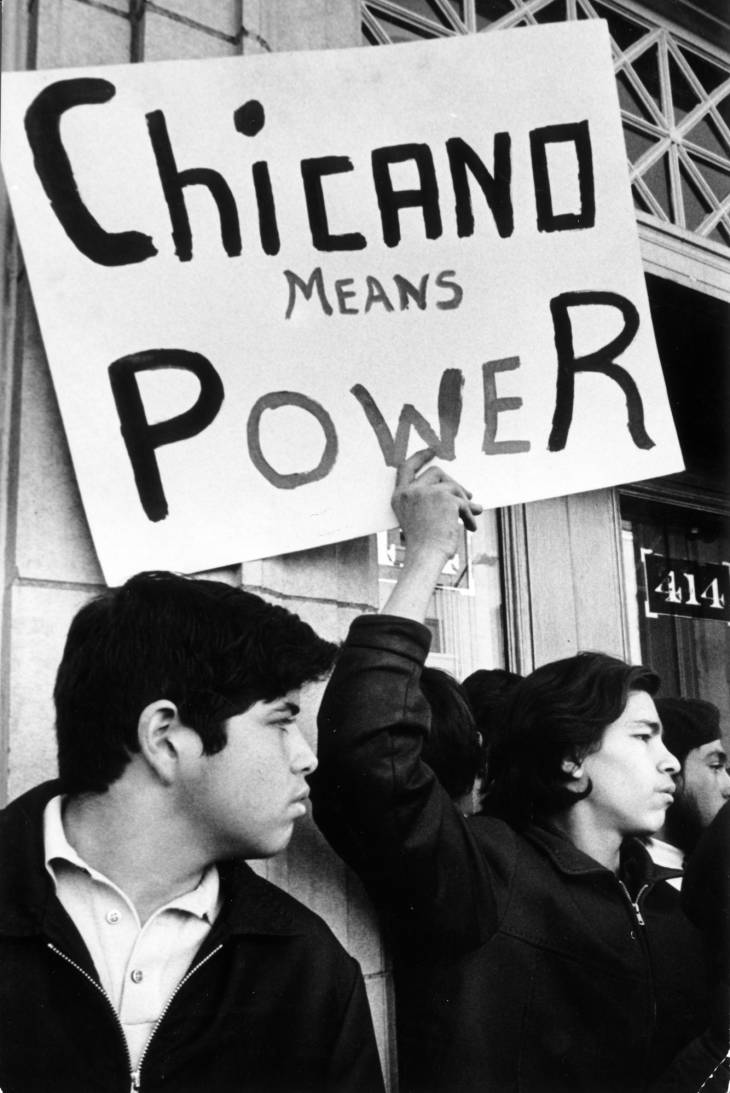
Protests after the Denver bus bombing
LHP_Intern2020-09-09T21:07:00+00:00Protest in Denver after the Denver bus bombing case, 02-11-1970

Brown Berets protesting Coors, 1973
LHP_Intern2020-09-09T20:52:19+00:00Pictures (taken by Juan Espinosa) of the Brown Berets marching with protesters in Denver, protesting Coors Brewing policies against Chicano workers, c. 1973
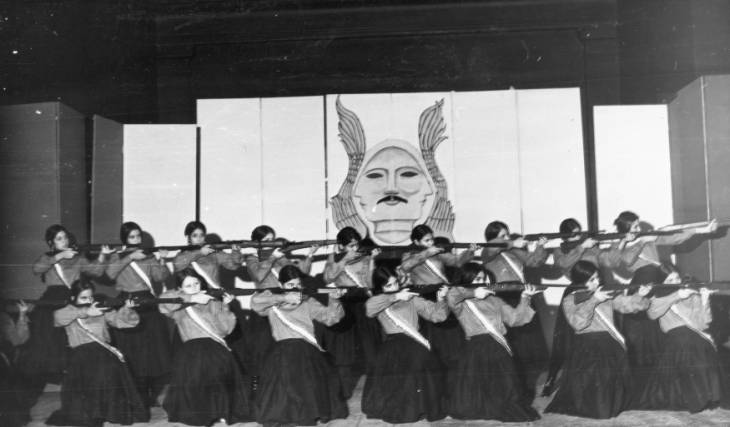
Ballet Chicano de Aztlán, 1970
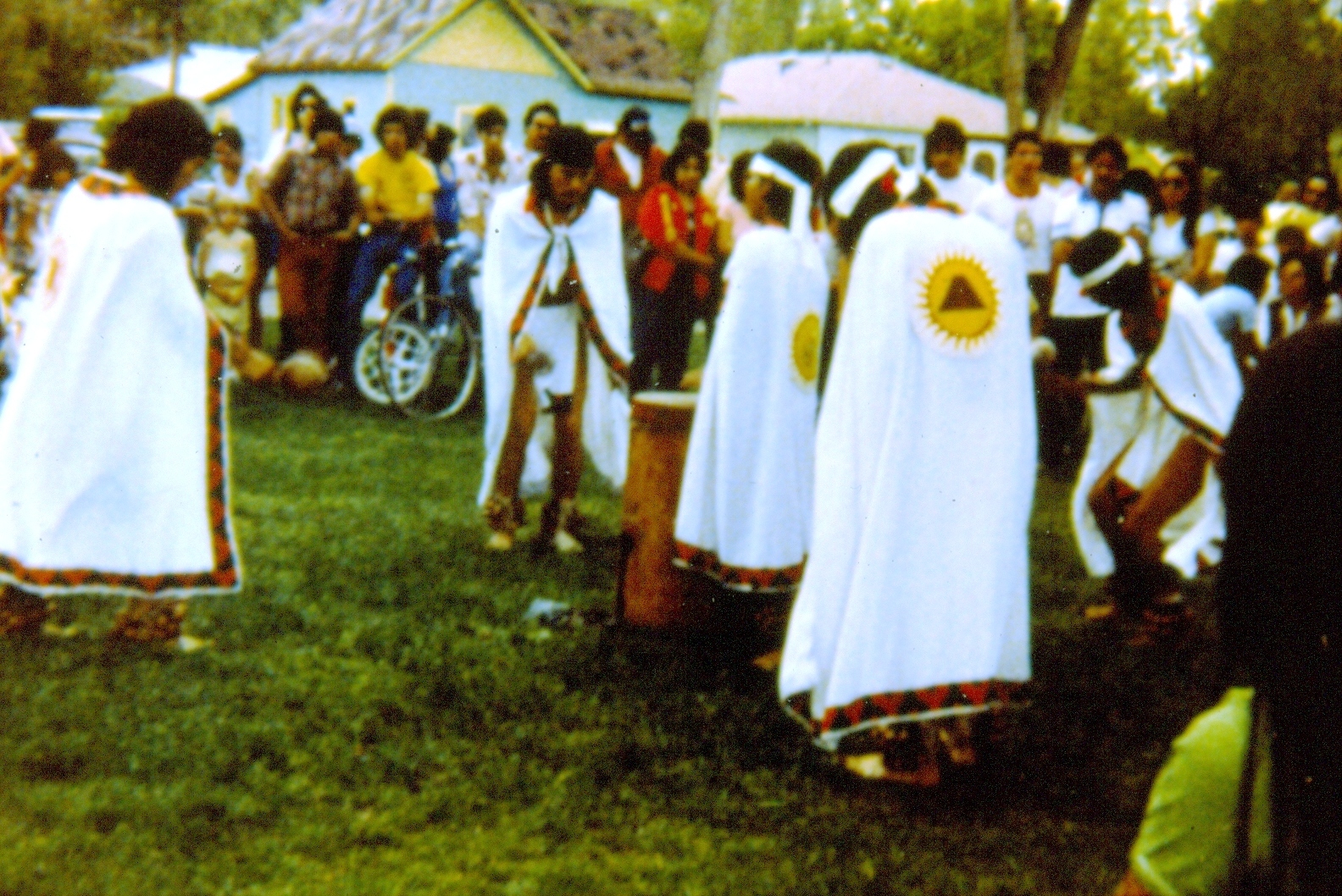
LHP_Intern2020-09-09T20:47:21+00:00The Ballet Chicano de Aztlán, a dance group part of the Crusade for Justice, dance in Mexican costume
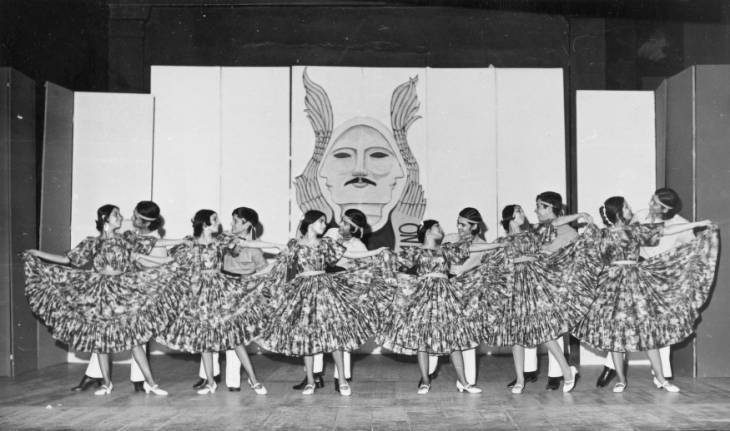
Ballet Chicano de Aztlán, 1970
LHP_Intern2020-09-09T20:45:57+00:00The Ballet Chicano de Aztlán, a dance group part of the Crusade for Justice, dance in Mexican costume
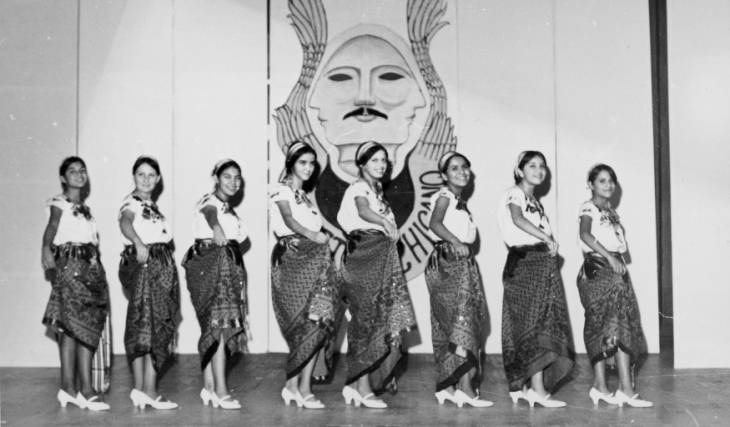
Ballet Chicano de Aztlán, 1970
LHP_Intern2020-09-09T20:44:15+00:00The Ballet Chicano de Aztlán, a dance group part of the Crusade for Justice, dance in Mexican costume
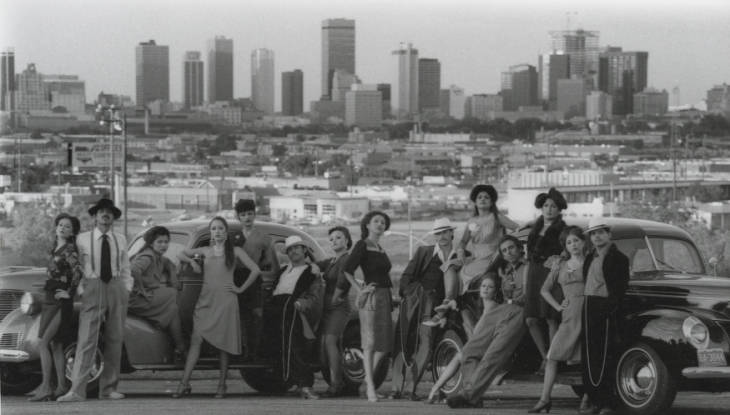
National Chicano Theatre in Denver, 1981
LHP_Intern2020-09-09T20:32:47+00:00Members of the National Chicano Theatre, directed by Enrique Montano, on stage in Denver, and posing before the Denver skyline c. 1981
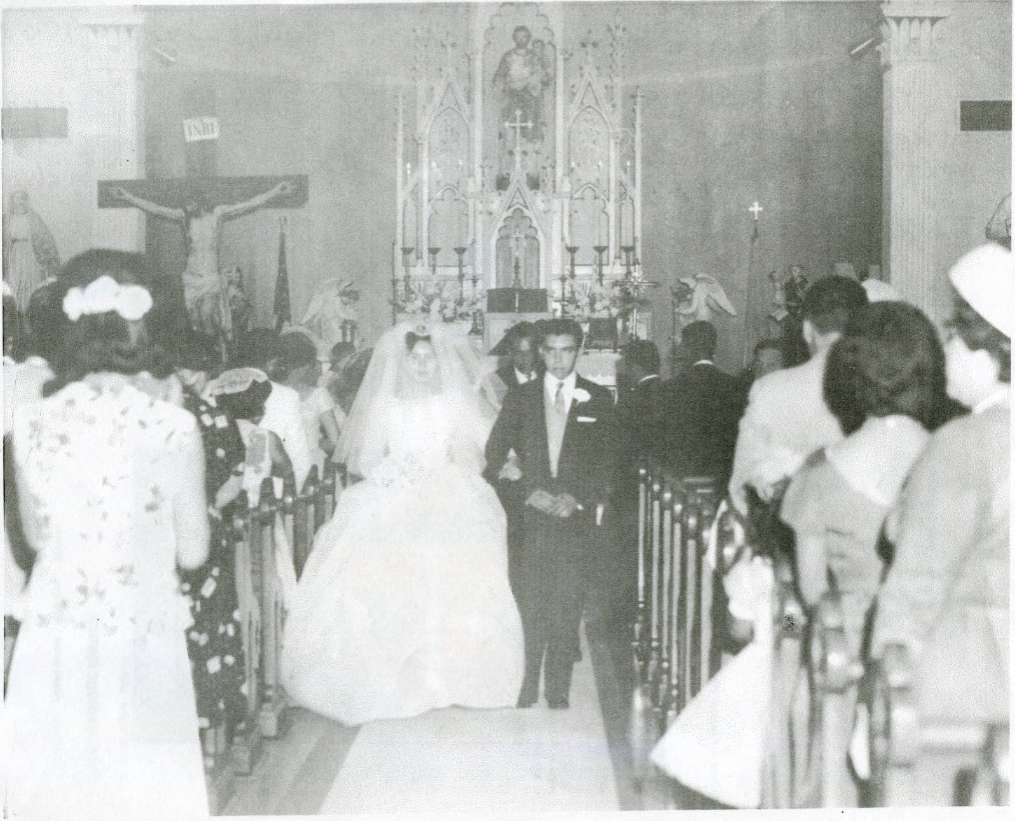
Muñiz Wedding
LHP_Intern2020-09-09T20:21:37+00:00Muñiz Wedding at St. Joseph’s Church in Globeville, 10-15-1966
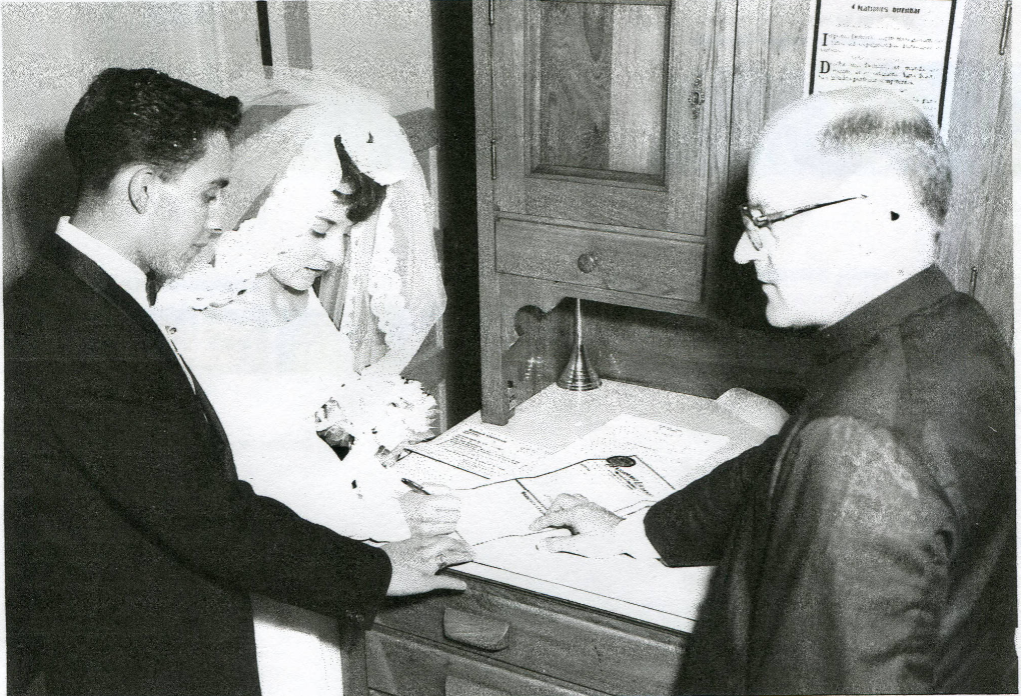
Herrera Wedding in Globeville
LHP_Intern2020-09-09T20:15:55+00:00Herrera Wedding in Globeville, c. 1966
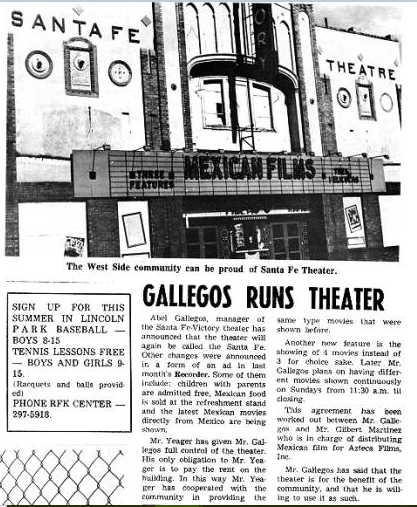
“Gallegos Runs Theater” 1970
LHP_Intern2020-08-30T02:28:21+00:00“Gallegos Runs Theater: West Side community can be proud of Santa Fe Theater” article talks about programs to make theater more accessible to the community, with Spanish language movies, Mexican food, children admitted free, extended screenings, etc, 05-01-1970
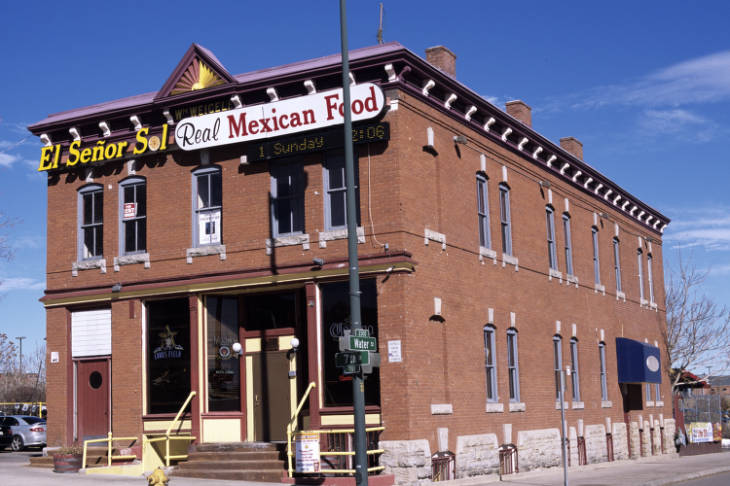
El Señor Sol Real Mexican Food, 2009
LHP_Intern2020-08-30T02:28:19+00:00Picture of El Señor Sol Real Mexican Food in the Jefferson Park neighborhood, 2009
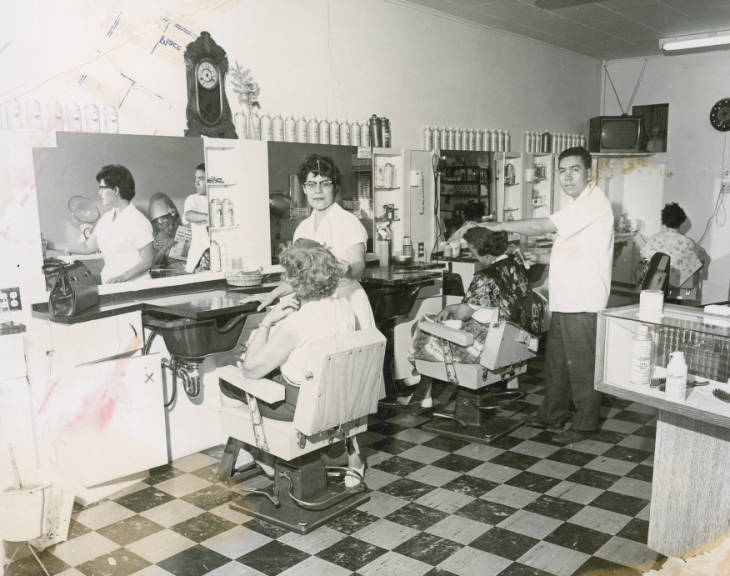
Mr. James Beauty Salon
LHP_Intern2020-08-30T02:28:18+00:00Picture of Mr. James Beauty Salon in Chaffee Park, owned by James Maestas and his aunt Toni Maestas, 1957
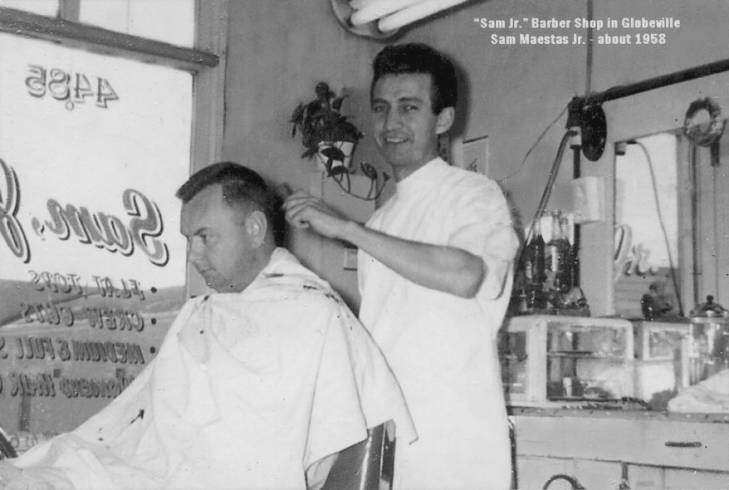
Sam Jr., barber shop in Globeville, c. 1958
LHP_Intern2020-08-30T02:28:17+00:00Picture of “Sam Jr.” a barber shop in Globeville owned by Sam Maestas Jr., c. 1958
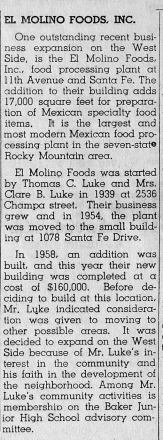
West Side Businesses, 1964
LHP_Intern2020-09-09T21:24:23+00:00“West Side Business Firms” article discusses several new businesses in the neighborhood, including El Molino Foods 05-01-1964
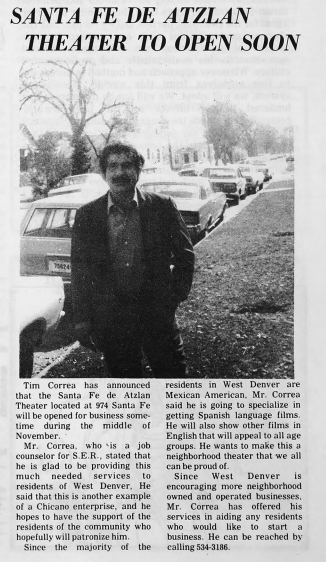
Santa Fe de Atzlan Theater Opening, 1972
LHP_Intern2020-08-30T02:28:14+00:00“Santa Fe de Atzlan Theater to Open Soon” new theater featuring Spanish language and import Mexican films opening in West Side neighborhood 11-01-1972
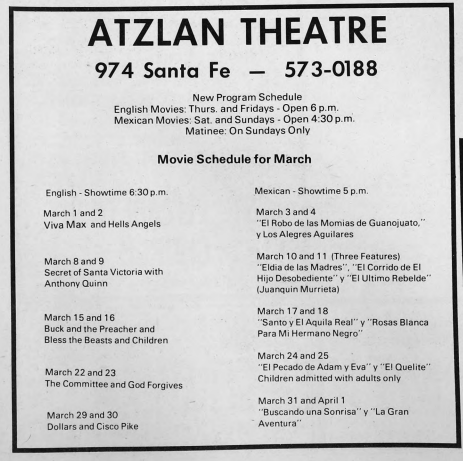
Santa Fe de Atzlan Theatre, 1973
LHP_Intern2020-08-30T02:28:13+00:00Program Schedule for the new Atzlan Theatre with Spanish and English movies, 02-01-1973
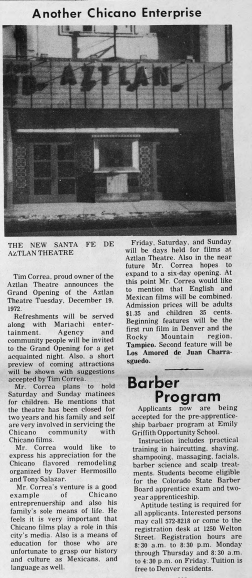
The New Santa Fe de Aztlan Theatre, 1972
LHP_Intern2020-08-30T02:28:11+00:00Newspaper article and picture on the new Santa Fe de Aztlan Theatre, owned by Tim Correa 12-01-1972
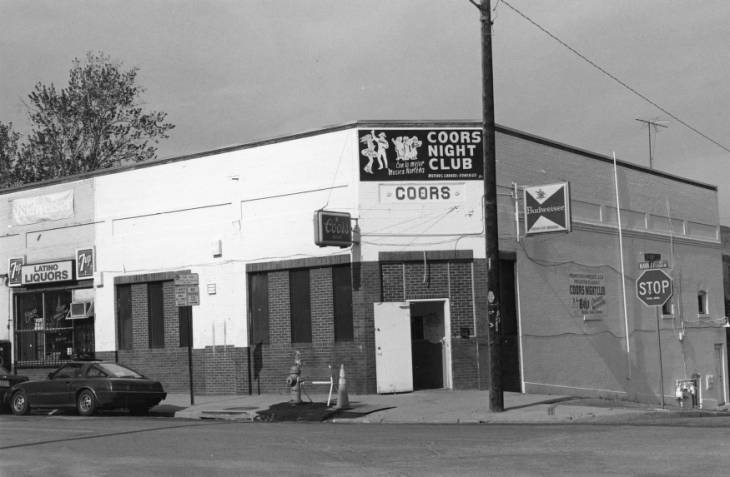
The Coors Night Club and Latino Liquors
LHP_Intern2020-08-30T02:28:10+00:00Picture of two Latino owned businesses at 3400 Navajo Street in the Highland neighborhood, 1996
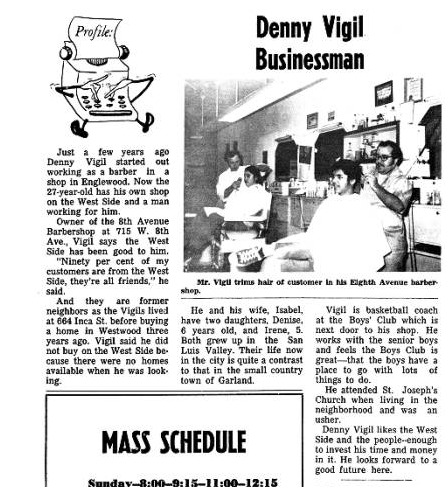
Vigil’s Barber Shop 1971
LHP_Intern2020-08-30T02:27:31+00:00Denny Vigil’s Barber shop in Westside, Denver, 01-01-1971
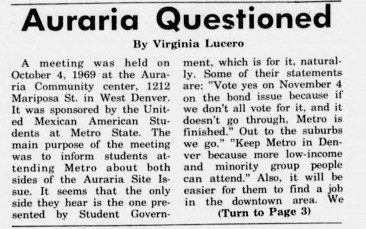
Development of Auraria Campus in Downtown, 1969
LHP_Intern2020-08-30T02:27:29+00:00“Auraria Questioned” by Virginia Lucero, article explores Mexican American student opinion on the development of the Auraria campus in downtown, impact on West Side communities 10-27-1969
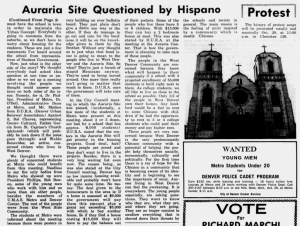
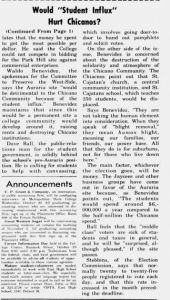
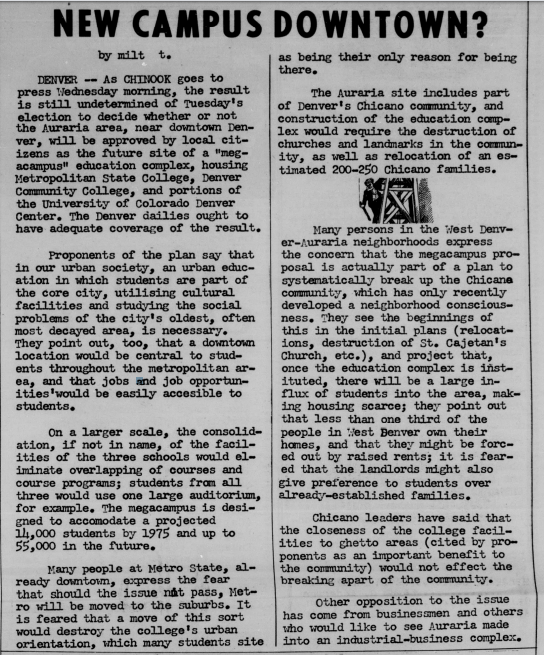
“New Campus Downtown?” 1969
LHP_Intern2020-08-30T02:27:28+00:00“New Campus Downtown” article by Milt T., discusses local election that decides urban development plans for downtown, including new Auraria campus, 11-6-1969
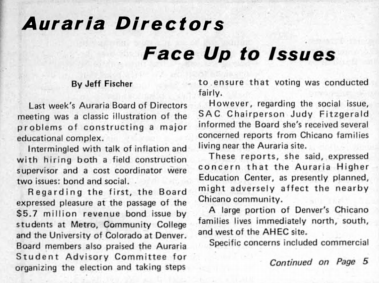
“Auraria Directors Face up to Issues” 1974
LHP_Intern2020-08-30T02:27:26+00:00“Auraria Directors Face up to Issues” article discusses impact on Chicano community of Auraria campus development, 10-16-1974
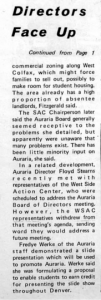
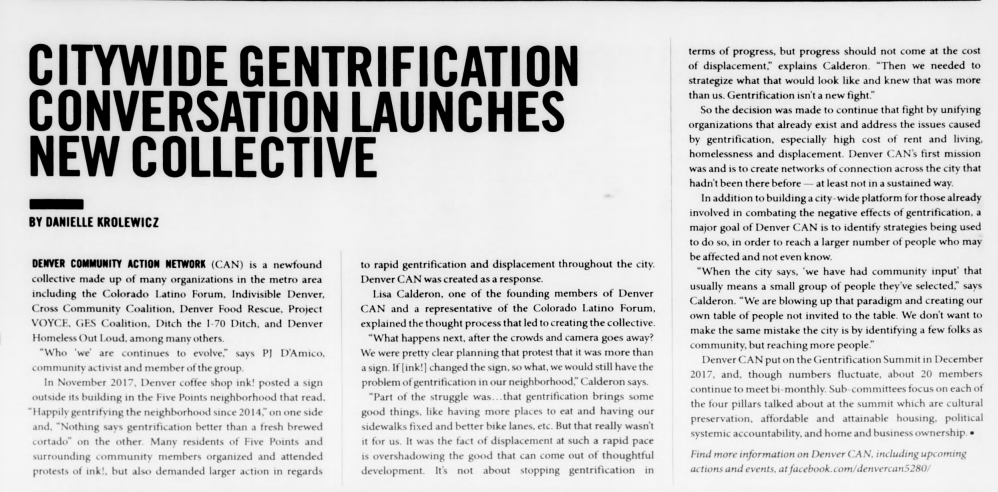
“Citywide Gentrification Conversation Launches new Collective” 2018
LHP_Intern2020-08-30T02:27:25+00:00“Citywide Gentrification Conversation Launches new Collective” artcile by Danielle Krolewicz discusses displacement, impact of gentrification on Denver’s lower income and minority populations 03-01-2018
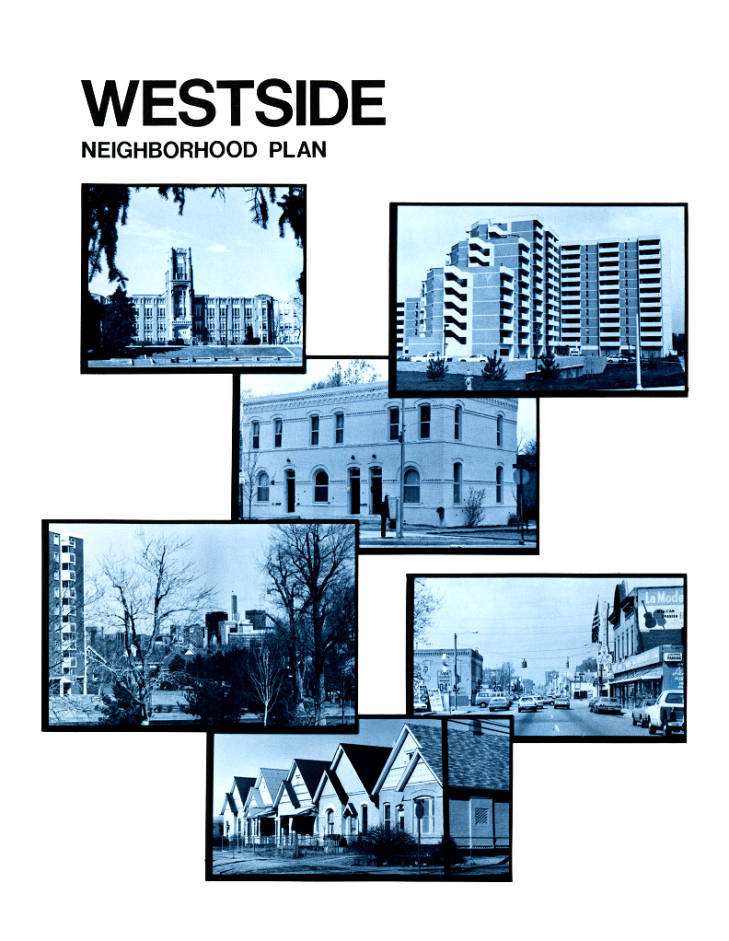
Westside Neighborhood Plan, 1982
LHP_Intern2020-09-09T21:27:15+00:00Neighborhood plan for Westside development, with focus on residential needs, education, and environment, 1982
To read the full neighborhood plan, visit https://digital.denverlibrary.org/digital/collection/p15330coll6/id/884
“Growing Food Justice” 2014
LHP_Intern2020-09-09T21:34:06+00:00Article on urban development and urban food deserts, Elyria Swansea neighborhood, 03-01-2014
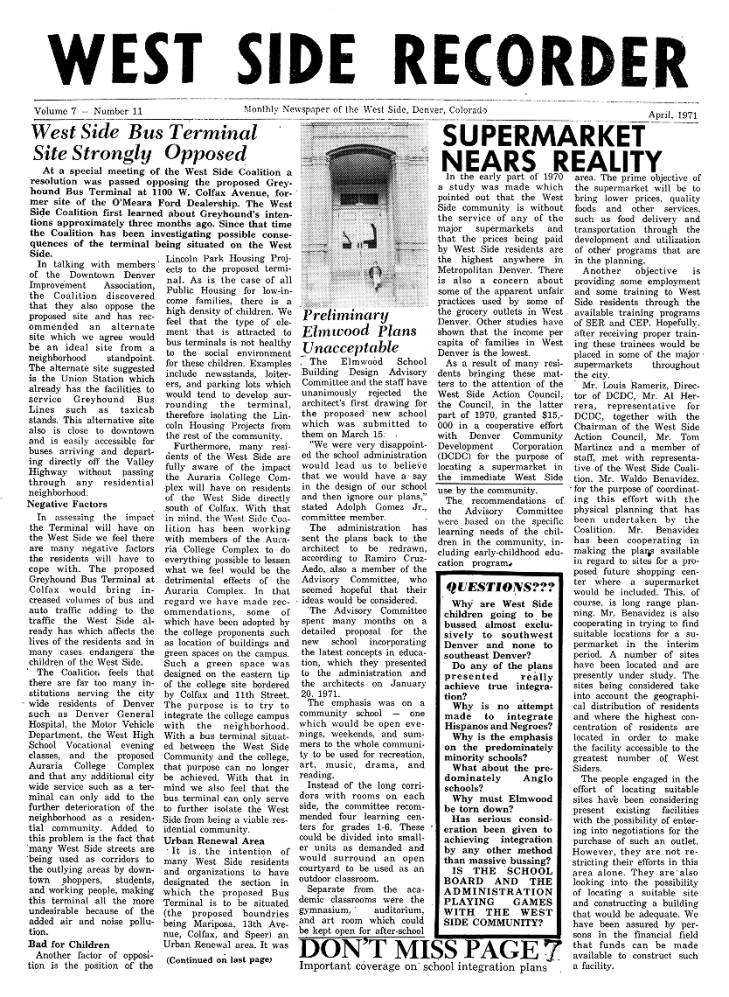
“Supermarket nears Reality” 1971
LHP_Intern2020-08-30T02:27:19+00:00Article on the difficulties of obtaining affordable food in Westside neighborhoods and the benefits of urban development plans, 04-01-1971

“The Changing Face of East Colfax” c. 2014
LHP_Intern2020-09-09T21:36:19+00:00Article on the tensions of development in Denver neighborhood with substantial minority and immigrant populations, 12-01-2014
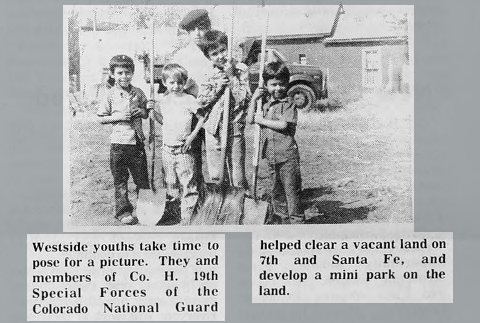
Westside kids help clear land for park development, 1972
LHP_Intern2020-08-30T02:27:17+00:00Picture of a group of young Westsiders helping to clear land at 7th and Santa Fe (Lincoln Park neighborhood) to develop a park, 11-01-1972
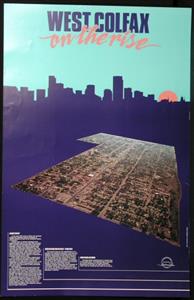
“West Colfax on the rise” 1987
LHP_Intern2020-08-30T02:27:15+00:00Poster by the Denver Planning Office showing a map of the West Colfax neighborhood against a downtown silhouette, 1987
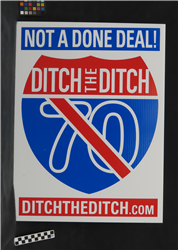
“Ditch the Ditch” sign against I-70 Expansion, 2019
LHP_Intern2020-08-30T02:27:14+00:00Poster in English and Spanish protesting the expansion of I-70 through Globeville and Elyria-Swansea, displacing many vulnerable populations, 2016-2019
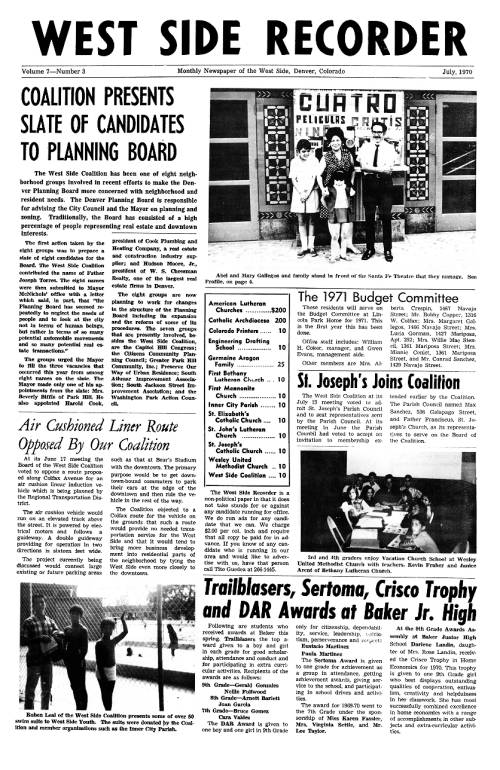
“Coalition Presents Slate of Candidates to Planning Board”
LHP_Intern2020-08-30T02:27:13+00:00Article on efforts to get more ordinary West Side citizens on the Denver Planning Board to represent neighborhood interests, 07-01-1970
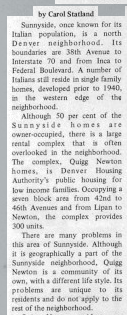
“Quigg Newton struggles to become a community”
LHP_Intern2020-09-09T21:39:14+00:00Article detailing the lack of amenities, food desert, and problems in Sunnyside neighborhood, 12-04-1974
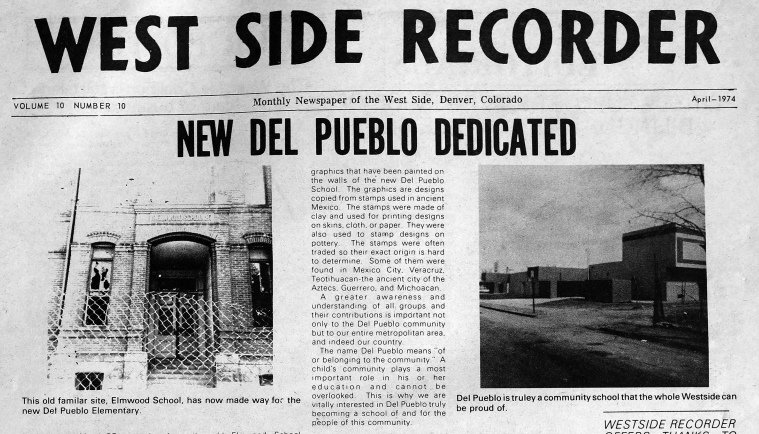
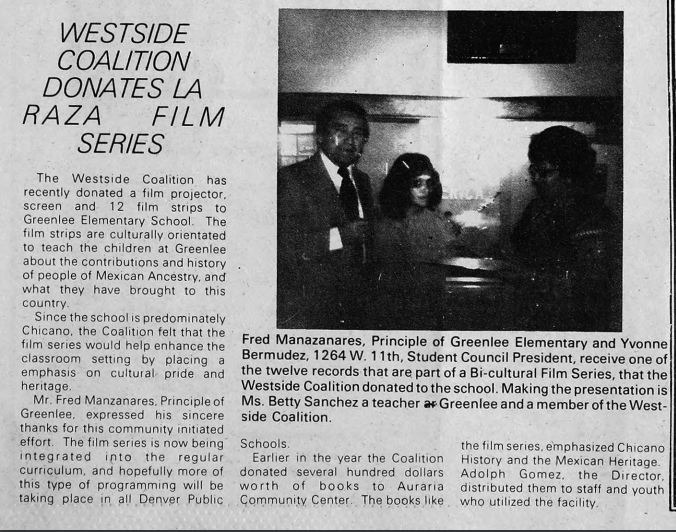
“Westside Coaltiion donates La Raza film series”, 1974
LHP_Intern2020-08-30T02:27:09+00:00Article on a donation of films on Mexican culture to Greenlee Elementary, a predominately Chicano school, to help with history and cultural education, 1974
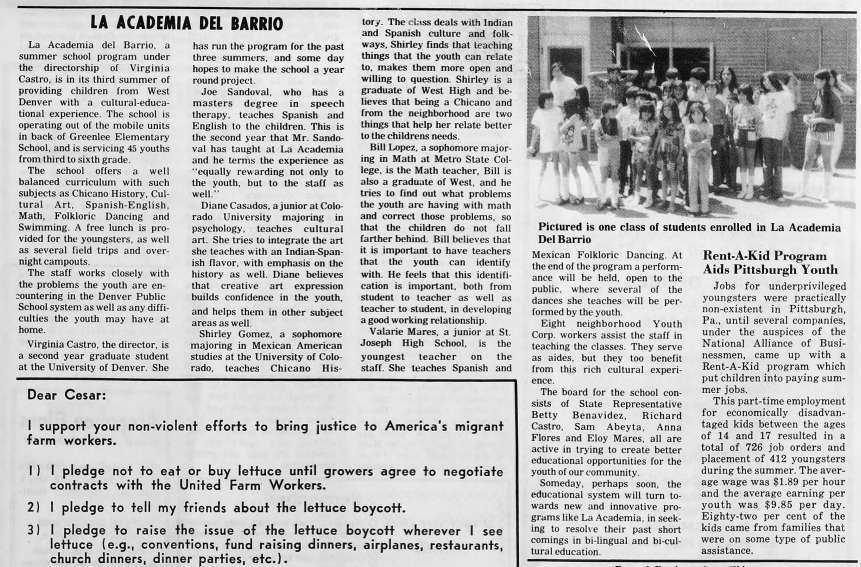
La Academia del Barrio
LHP_Intern2020-08-30T02:27:07+00:00Article on a summer school program behind Greenlee Elementary for Chicano history, culture, art; 08-01-1973
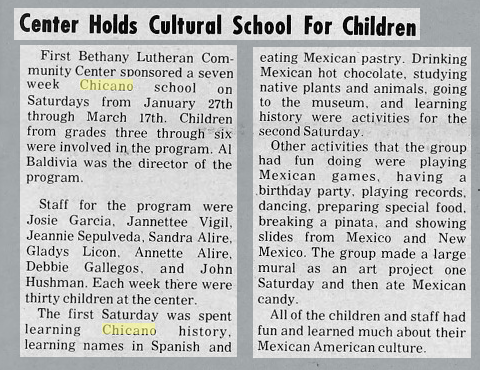
“Center holds cultural school for children” 1973
LHP_Intern2020-08-30T02:27:06+00:00Article on a Chicano school program at First Bethany Lutheran Community Center, 03-01-1973
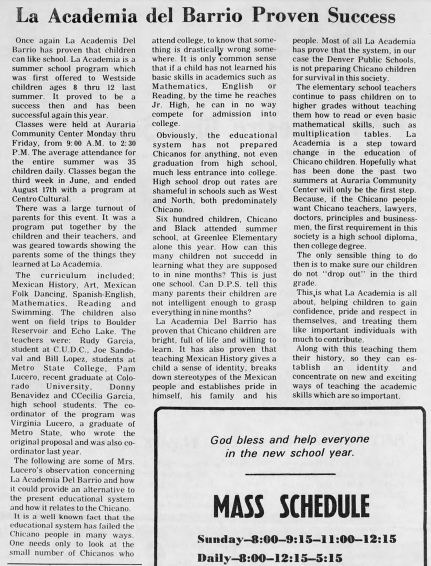
“La Academia del Barrio Proven Success”
LHP_Intern2020-08-30T02:27:05+00:00Article on the Academia del Barrio Chicano cultural and history classes for children in Westside, 1971
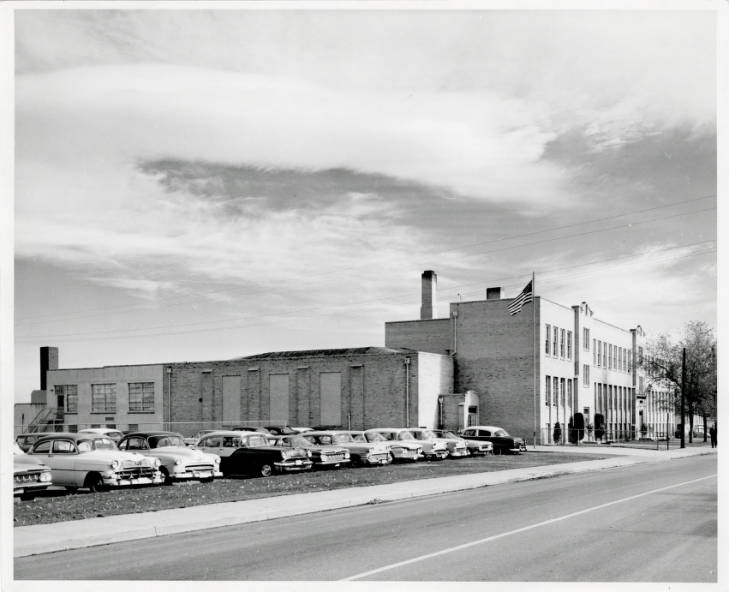
Westwood School, undated
LHP_Intern2020-08-30T02:26:37+00:00Photo of Westwood School, which later became Castro Elementary, in the Westwood neighborhood
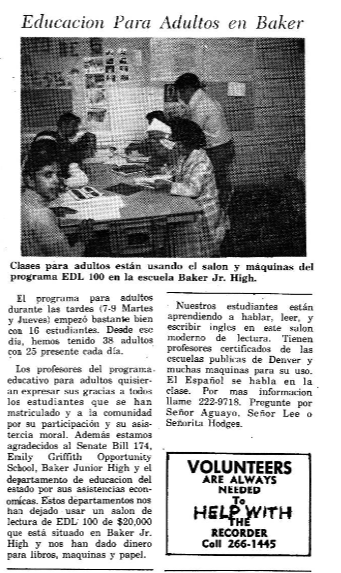
Adult Education, 1971
LHP_Intern2020-08-30T02:26:34+00:00Article “Educacion para adultos en Baker” adult education classes at Baker Jr. High, article in Spanish, 1971
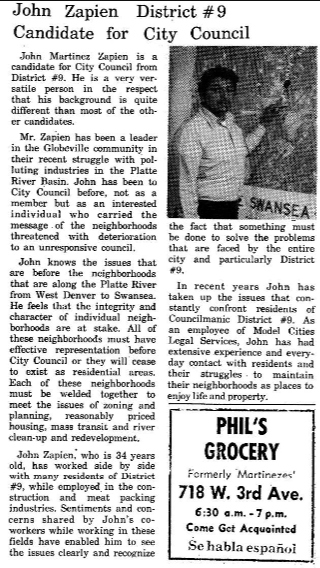
John Zapien runs for 9th District
LHP_Intern2020-08-30T02:26:33+00:00Article “John Zapien District #9 Candidate for City Council” Globeville city council election 1971
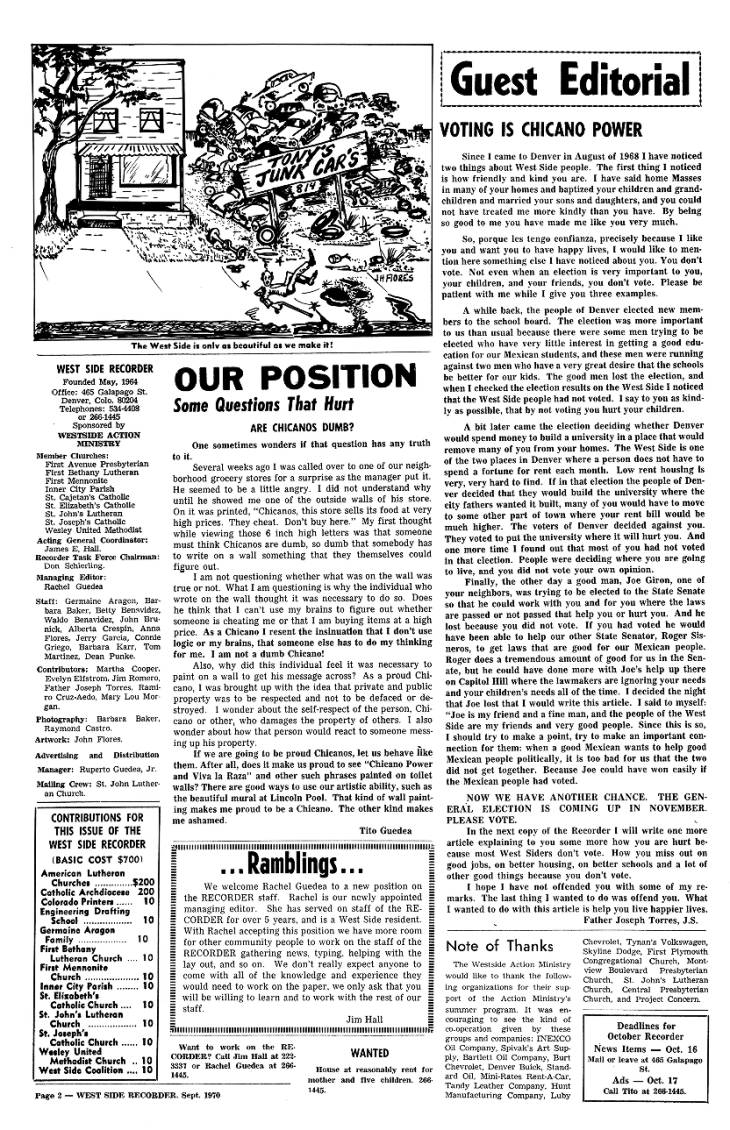
“Voting is Chicano Power”, 1970
LHP_Intern2020-08-30T02:26:32+00:00Article on why it is so important for Chicanos to vote, 09-01-1970
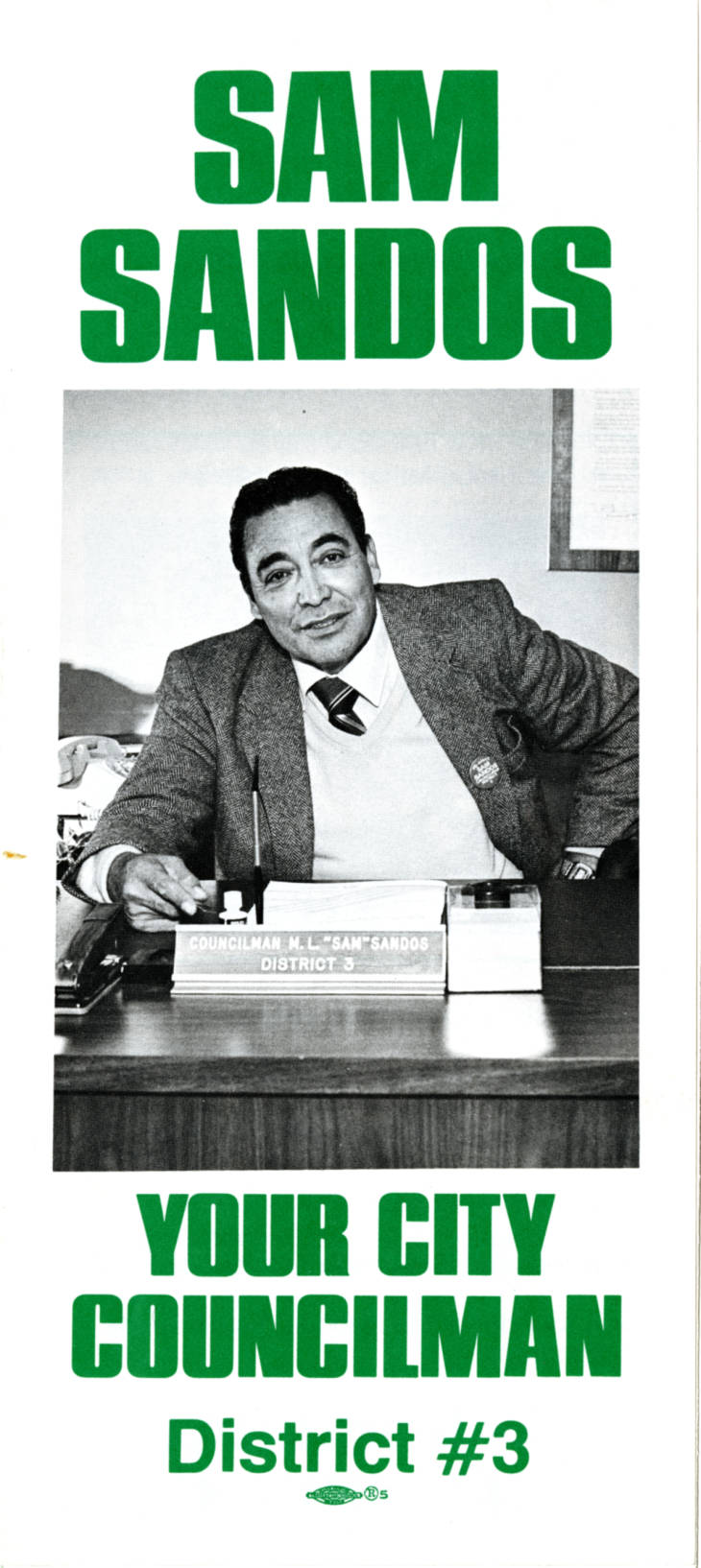
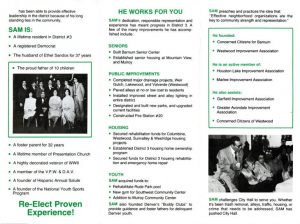
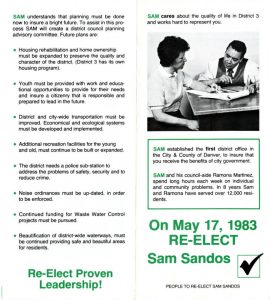
Re-elect Sam Sandos, City Councilman District #3, 1983
LHP_Intern2020-08-30T02:26:30+00:00Pamphlet from Sam Sandos campaign for city councilman, District #3, 1983
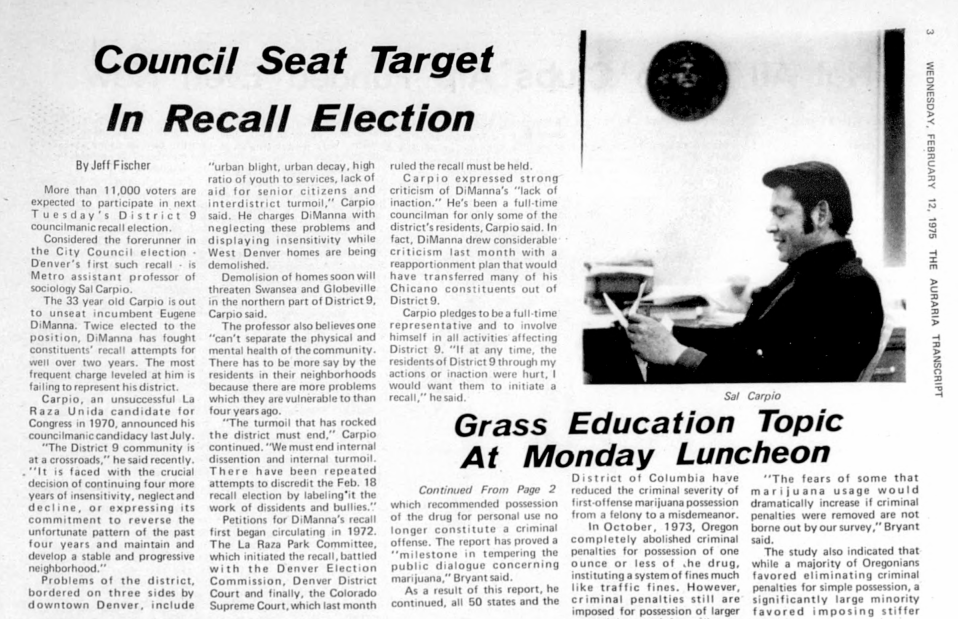
Council Seat Recall Election, 1975
LHP_Intern2020-08-30T02:26:29+00:00Article on a council recall election for District 9 (Globeville), against incumbent Eugene DiManna, and former La Raza Unida candidate Sal Carpio, 02-12-1975
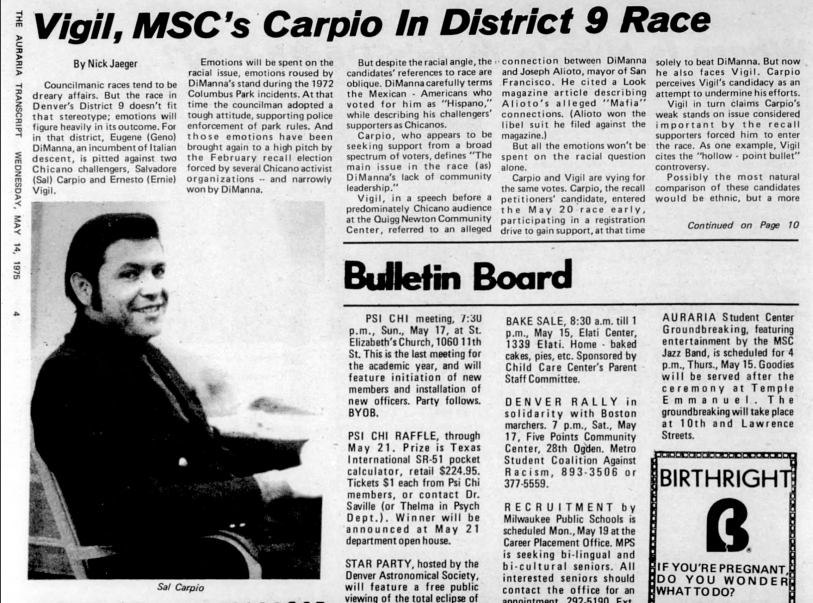
“Vigil, MSC’s Carpio in District 9 Race” 1975
LHP_Intern2020-08-30T02:26:27+00:00Article on city council district 9 (Globeville) race, which has two Chicanos and an Italian-American running 05-14-1975
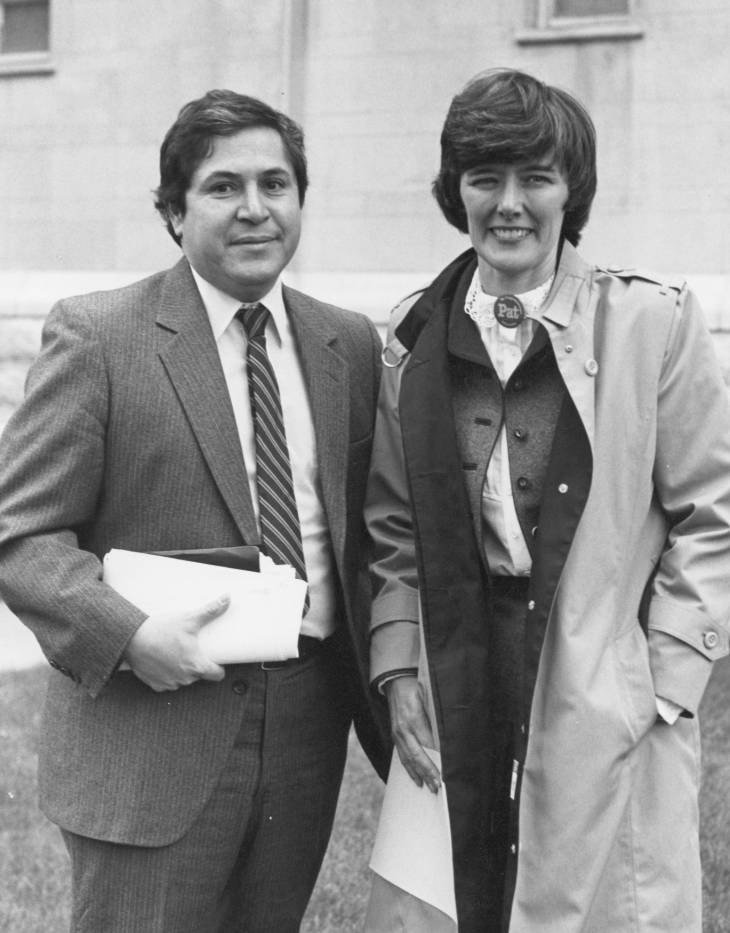
Picture of Rich Castro and Pat Schroeder
LHP_Intern2020-08-30T02:26:26+00:00State Representative Rich Castro and Congresswoman Pat Schroeder outside the Colorado State Capitol Building, 1980s
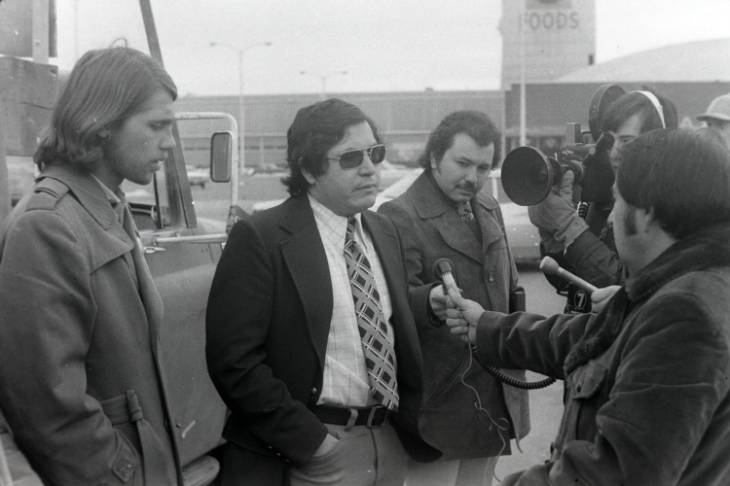
Rich Castro speaking on Gallo Wine Boycott
LHP_Intern2020-08-30T02:26:25+00:00Picture of State Senator Rich Castro speaking on the Gallo Wine Boycott, c. 1975
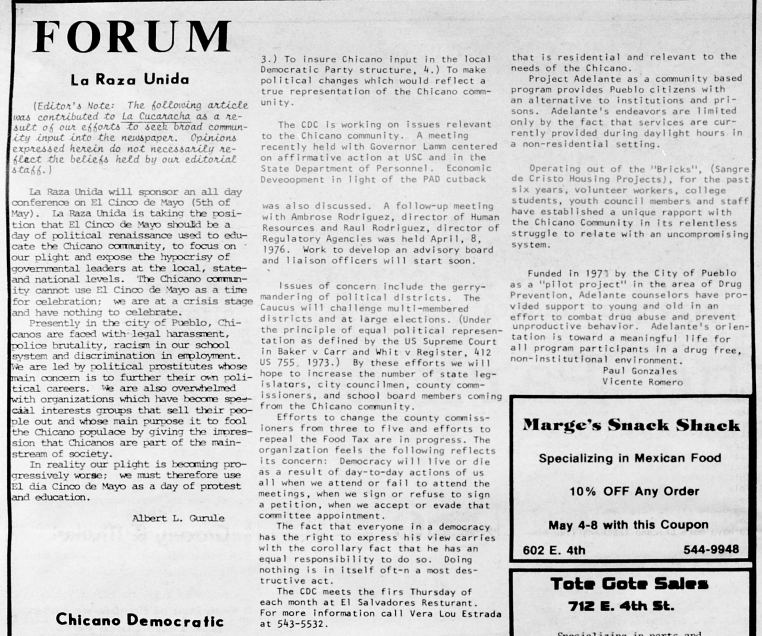
“La Raza Unida” 1976
LHP_Intern2020-08-30T02:26:23+00:00Article on La Raza Unida party and what it is doing to help Chicanos, mostly in Pueblo, but this is a larger movement, 05-03-1976
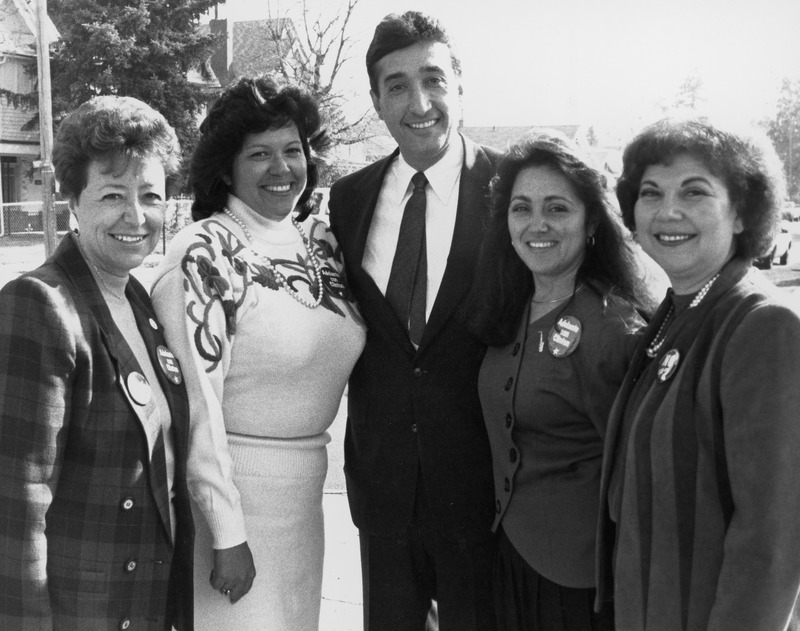
Picture of Hispanic politicians, 1985
LHP_Intern2020-08-30T02:26:22+00:00Photo of Hispanic politicians at Cinco de Mayo celebration in Denver: Ramona Martinez, Cecilia Garcia, Henry Cisneros, Debbie Ortega, and Polly Baca, May 1985
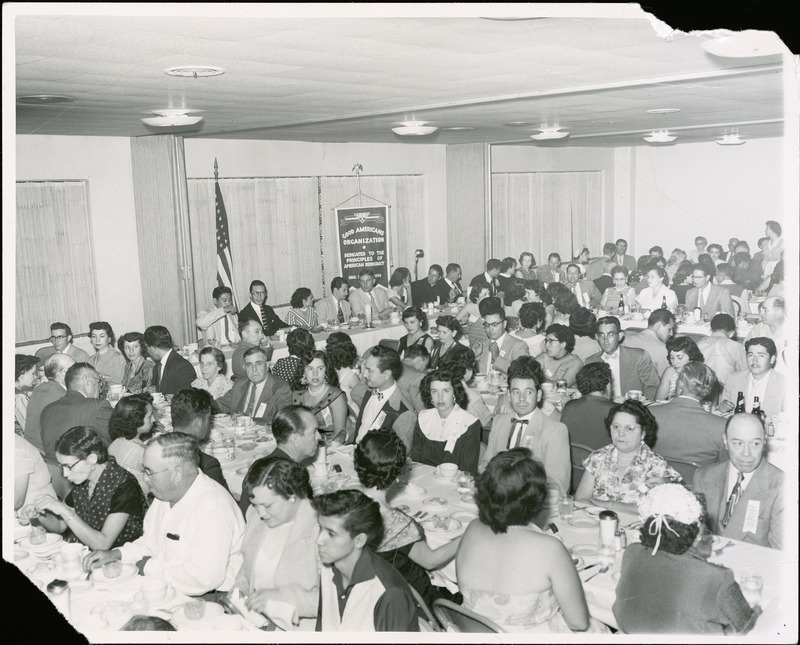
Good Americans Organization banquet in Denver, c. 1954
LHP_Intern2020-08-30T02:26:21+00:00Photo of Mexican Americans attending a meeting of the Good Americans Organization, c. 1954
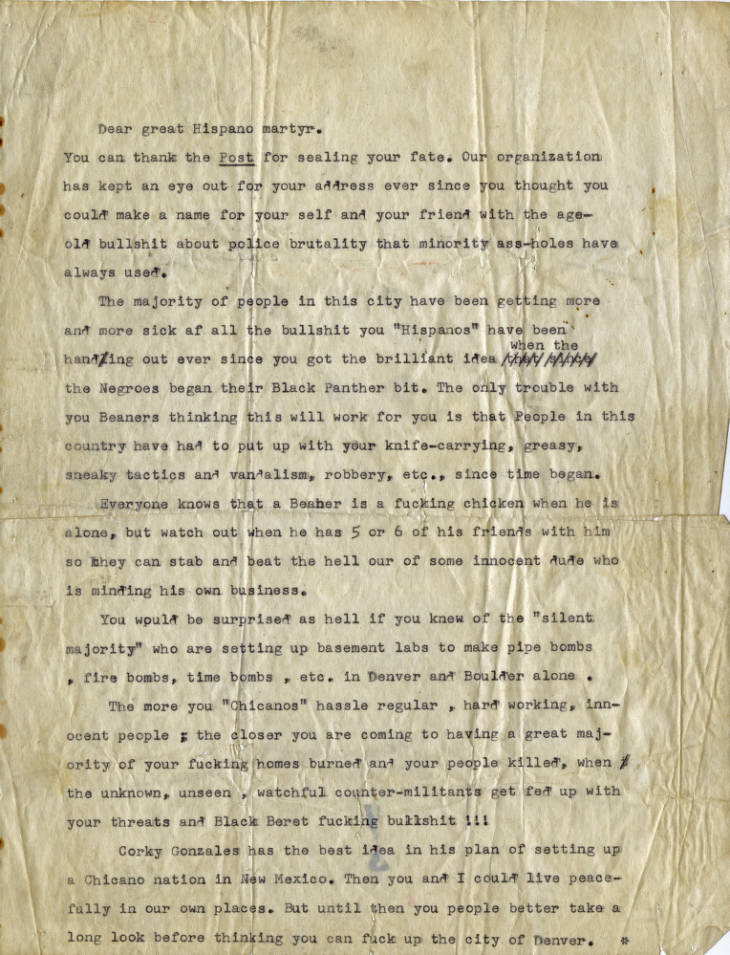
Example of hate mail Chicano politician Richard Castro received
LHP_Intern2020-08-30T02:26:19+00:00CW: Language; example of racist hate mail Rich Castro received, c. 1970
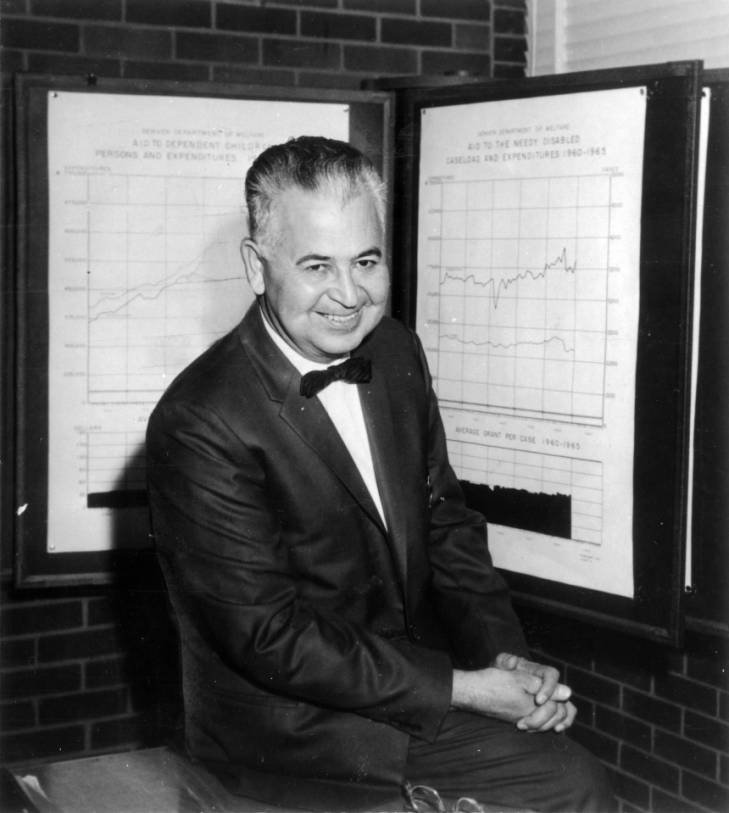
Picture of Bernard Valdez, Colorado Welfare Department
LHP_Intern2020-08-30T02:26:18+00:00Picture of Bernard Valdez, employee at Colorado Welfare Department in Denver, 02-07-1965
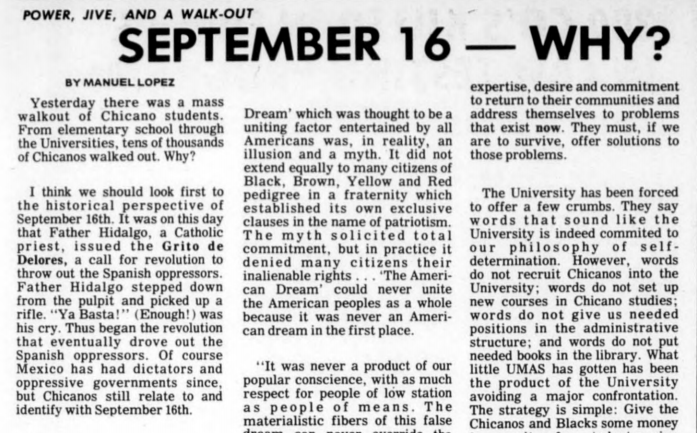
“Power, Jive, and a Walk-Out: September 16–Why?” 1969
LHP_Intern2020-09-09T21:50:51+00:00Article on a nation wide Chicano student walk out and why CU Denver students participate 09-17-1969

Photo of Mexican American protesters at Denver School
LHP_Intern2022-04-19T16:54:49+00:00Photo of Mexican American protesters at Denver West High school, holding sign “We need a Chicano Principal, we Need More Chicano Teachers”, 1969

Photo of Latino students on walk-out from West High School, 1969
LHP_Intern2022-04-19T16:53:54+00:00Photo of Latino students during “walk-out” in March 1969 at West High School
“Chicano Students’ Demands at West High”
LHP_Intern2022-04-19T16:53:26+00:00Article on Chicano students demanding dismissal of a racist teacher, and inclusion of Mexican history/culture/literature in the school curriculum
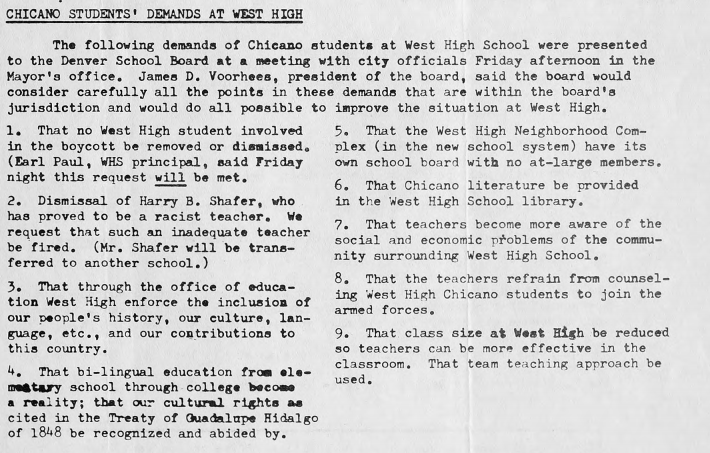
Latino protests against West Side High School
LHP_Intern2020-09-09T21:52:34+00:00Actions taken by the Westside Action Ministry to protest racial issues at West Side High School, 03-01-1969
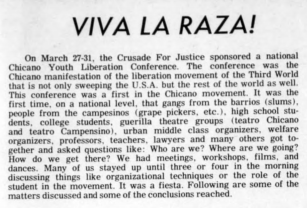
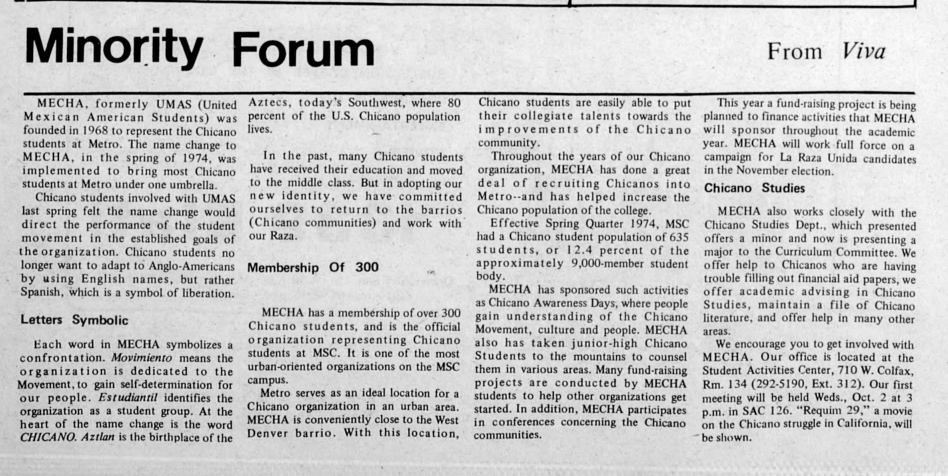
MECHA, 1974
LHP_Intern2020-08-30T02:25:24+00:00Article on MECHA’s (Movimiento Estudiantil Chicano Aztlan) activities at Metro State
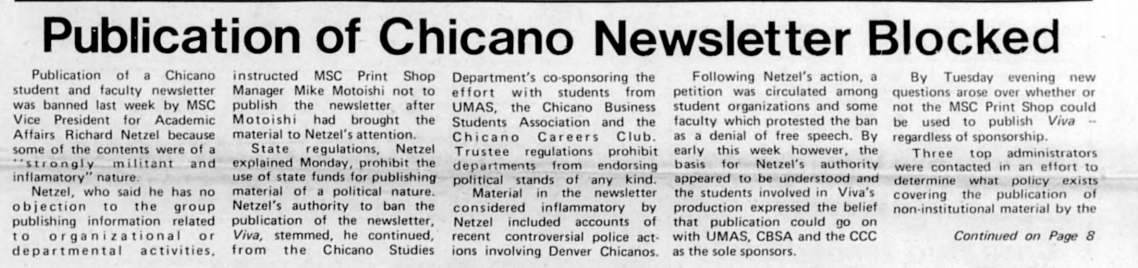
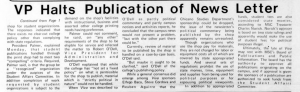
Chicano Student Newsletters as Protest
LHP_Intern2020-08-30T02:25:23+00:00“Publication of Chicano Newsletter Blocked,” article on Chicano students activism at Metro State, 02-20-1974
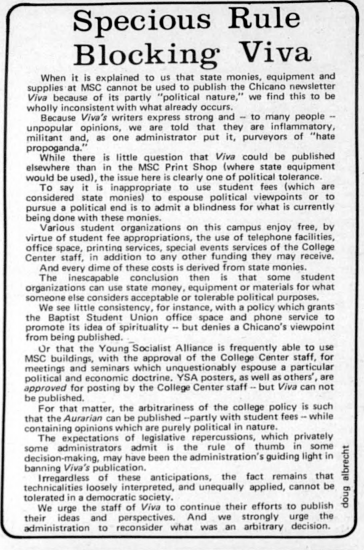
“Specious Rule Blocking ‘Viva'” 1974
LHP_Intern2020-08-30T02:25:20+00:00Article on why Chicano newspapers are blocked on campus, student activism, 02-27-1974
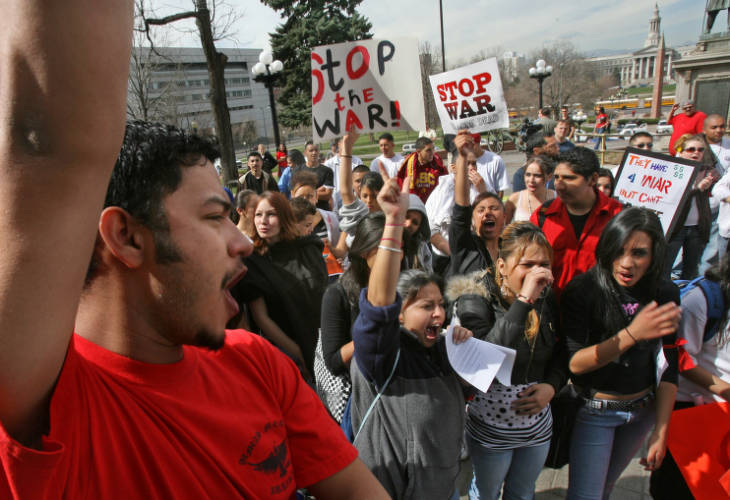
Metro State student at anti-war protest, 2007
LHP_Intern2020-08-30T02:25:19+00:00Metro State student Enrique Castillo and several Latino students at anti-war protest at the State Capitol Building in Denver, 03-22-2007
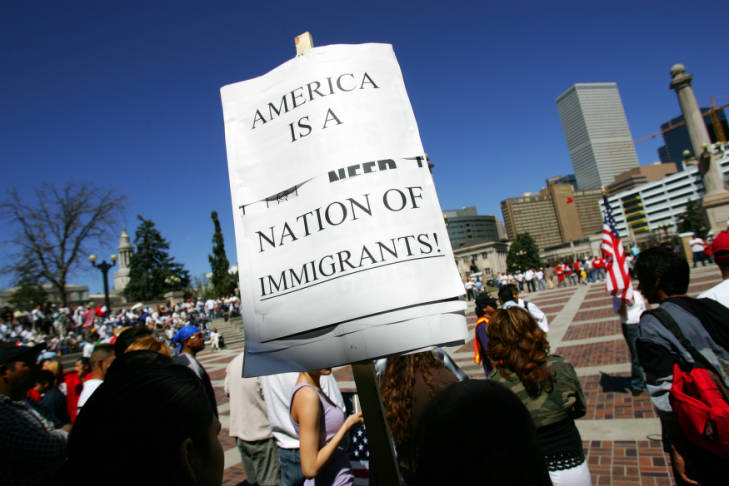
Brighton High School students protest immigration reform
LHP_Intern2020-08-30T02:25:16+00:00Giselle Avita, Brighton High School student, at National Day of Action protest, Denver 2006
O’Connell Middle School (Lakewood) Walkout, 2006
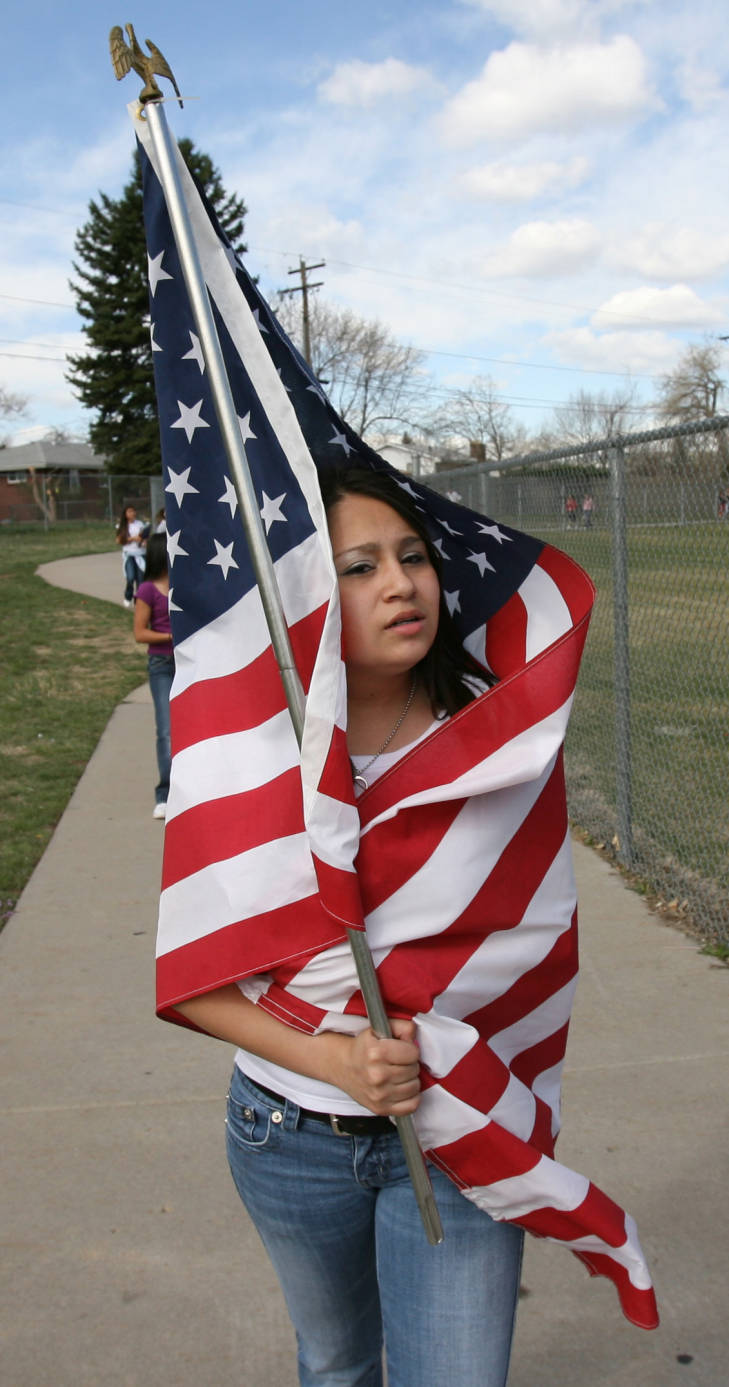
LHP_Intern2020-08-30T02:25:15+00:00Kristeena Gallegos, student at O’Connell Middle School, during walkout protesting racist principal’s comments, 04-11-2006
Protest after Denver bus bombing, 1970
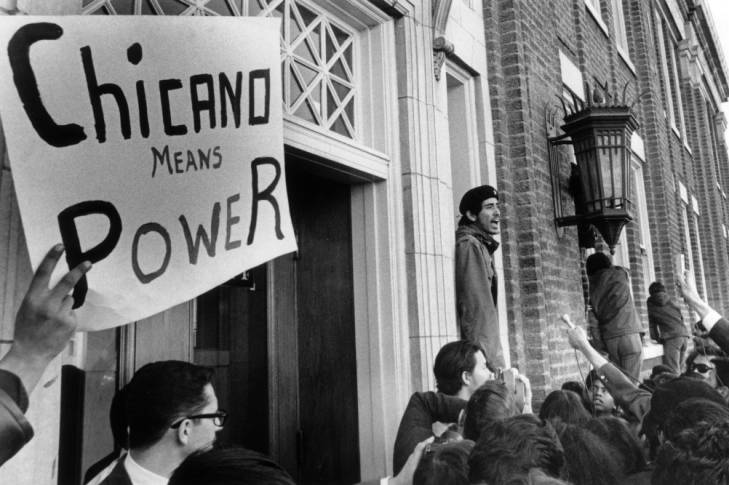
LHP_Intern2020-09-09T21:04:59+00:00Protest in Denver after the Denver bus bombing case, 02-11-1970
“Solidarity Day Called for Activists” 1974
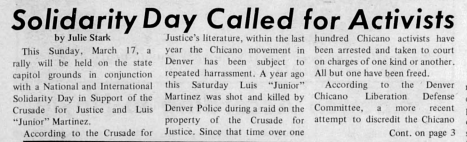
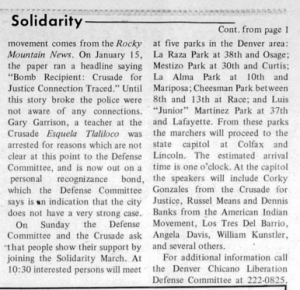
LHP_Intern2020-08-30T02:25:12+00:00Solidarity rally held at the State Capitol in support of the Crusade for Justice, 03-13-1974

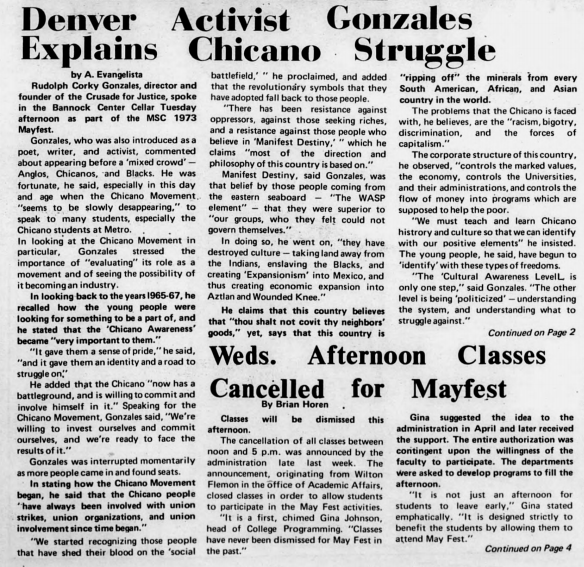
Rodolpho Corky Gonzales speaks at Metro State, 1973
LHP_Intern2022-03-30T17:48:46+00:00“Denver Activist Gonzales Explains Chicano Struggle” speech by Corky Gonzales at Metro State, 1973
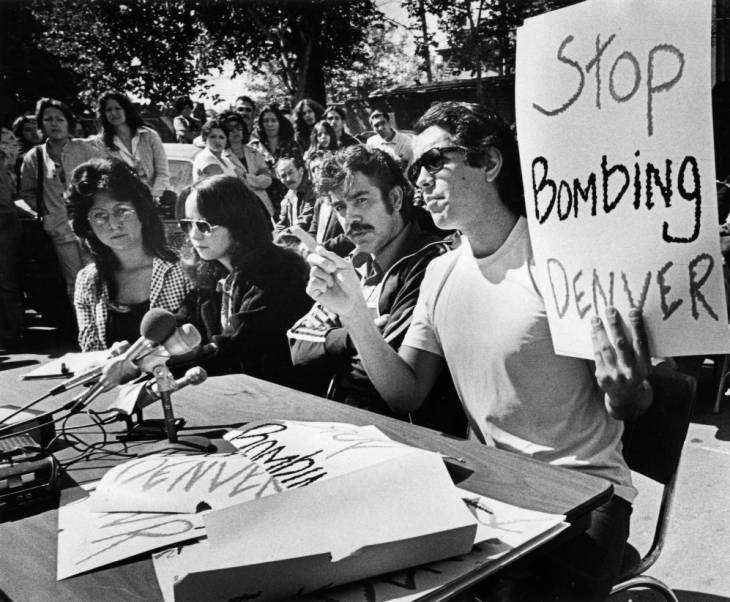
“Stop Bombing Denver” 1975
LHP_Intern2022-03-30T17:47:40+00:00Maria Cerna, Rosemary Quinano Ornelas, Rodolfo “Corky” Gonzales and Ernesto Vigil at press conference with sign that reads “Stop Bombing Denver”, 09-20-1975
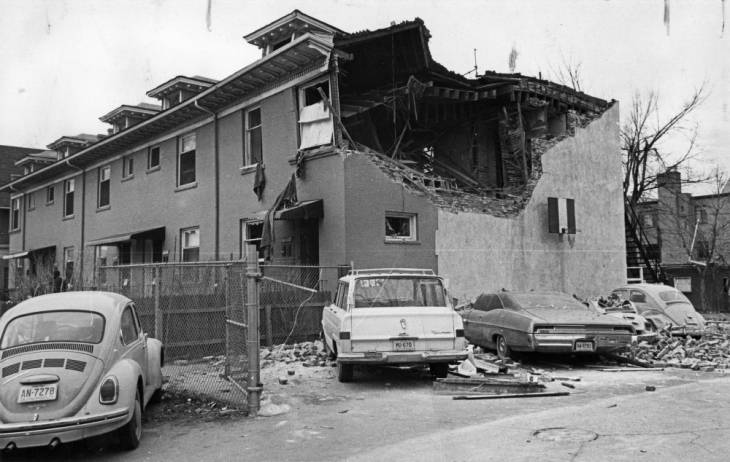
Damaged apartment building after a battle between police and Crusade for Justice, 1973
LHP_Intern2020-08-30T02:25:08+00:00Photo of damaged apartment building at 1567 Downing Street, Denver, after an explosion and gun battle between Crusade for Justice and Police, 03-18-1973

Protest on 15th St., Denver, 1960s
LHP_Intern2022-03-30T17:46:26+00:00Mexican American protesters carry banner “It Is Better to Die On Your Feet Than to Keep On Living On Your Knees,” “Es Mejor Morir de Pie, Que Seguir Viviendo de Rodillas” down 15th St. in Denver, late 1960s
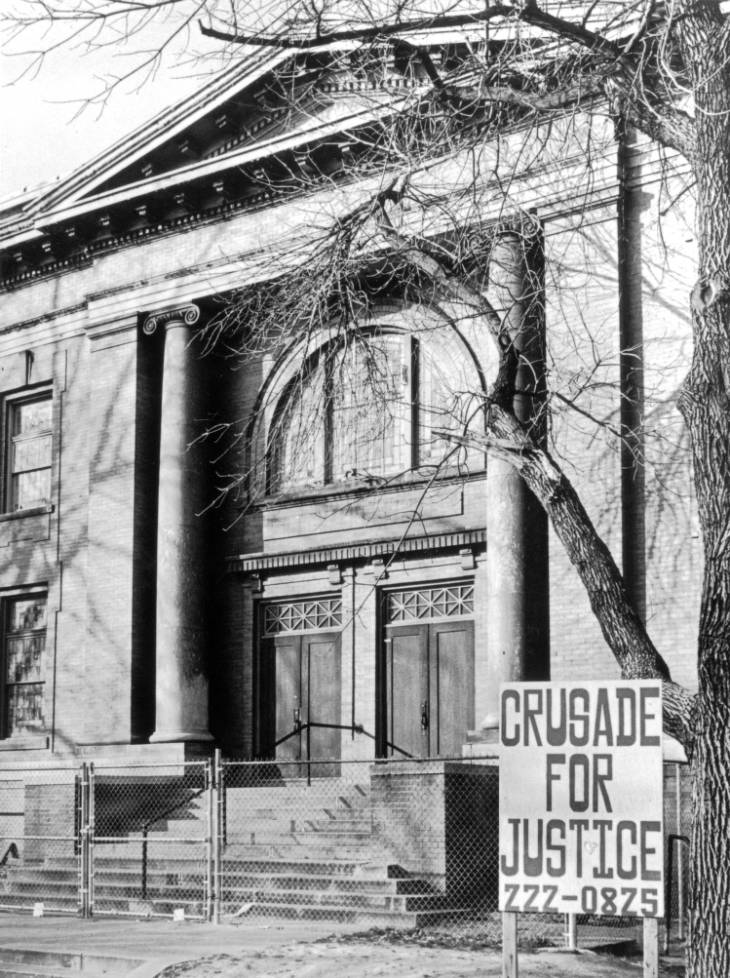
Crusade for Justice building, undated
LHP_Intern2022-03-30T17:45:37+00:00Undated photo of the Crusade for Justice Building, at 1567 Downing Street, Denver
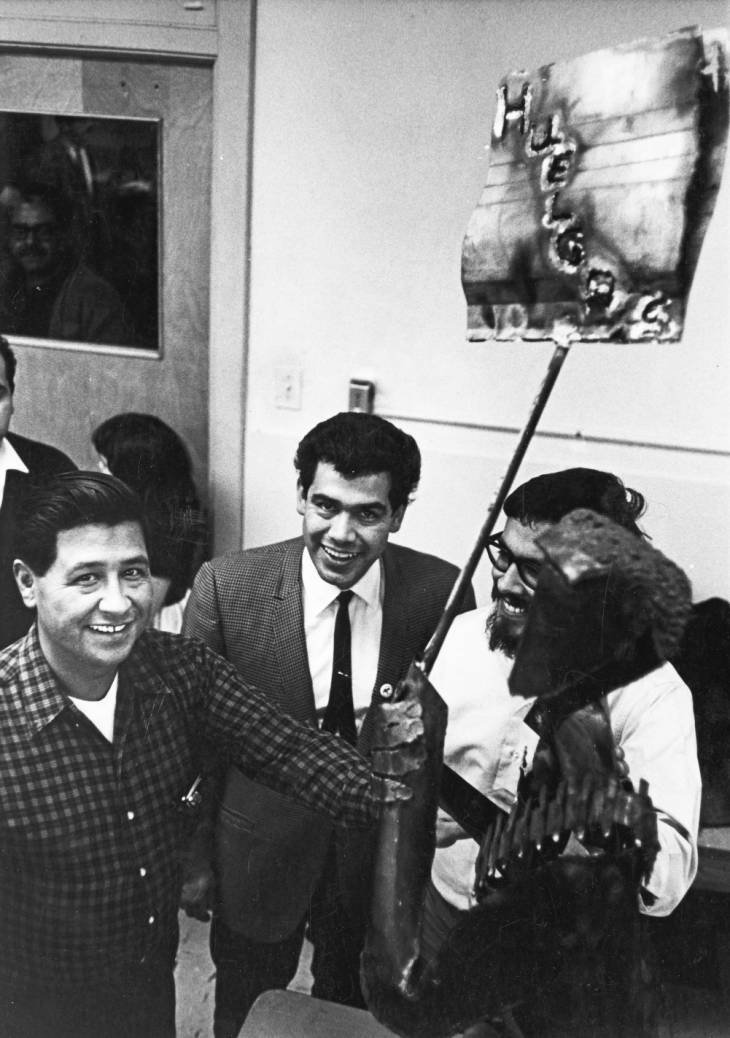
Corky Gonzales, Cesar Chavez, and artist Carlos Santistevan
LHP_Intern2020-08-30T02:25:04+00:00Corky Gonzales, Cesar Chavez, and artist Carlos Santistevan, sometime in 1960s in Denver
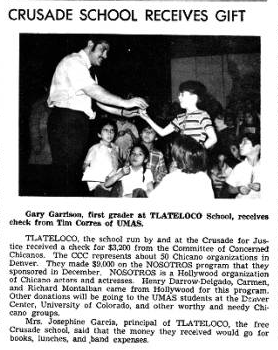
Crusade for Justice’s school TLATELOCO
LHP_Intern2020-08-30T02:25:02+00:00Article on money raised for TLATELOCO, the school operated by the Crusade for Justice, 01-01-1971
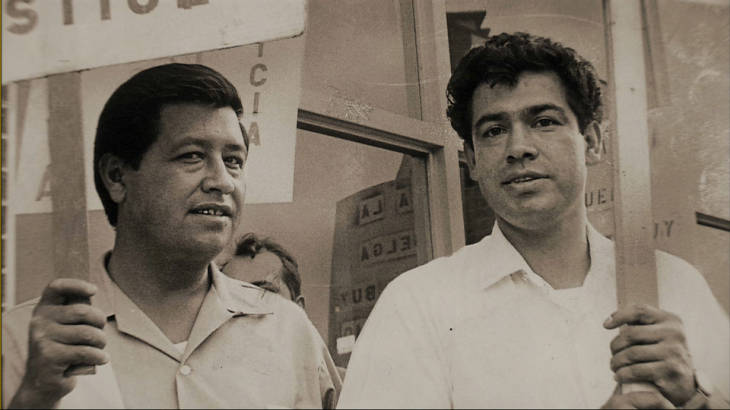
Corky Gonzales and Cesar Chavez, 1966
LHP_Intern2020-08-30T02:25:01+00:00Picture of founders of Crusade for Justice, Corky Gonzales and Cesar Chavez, 1966
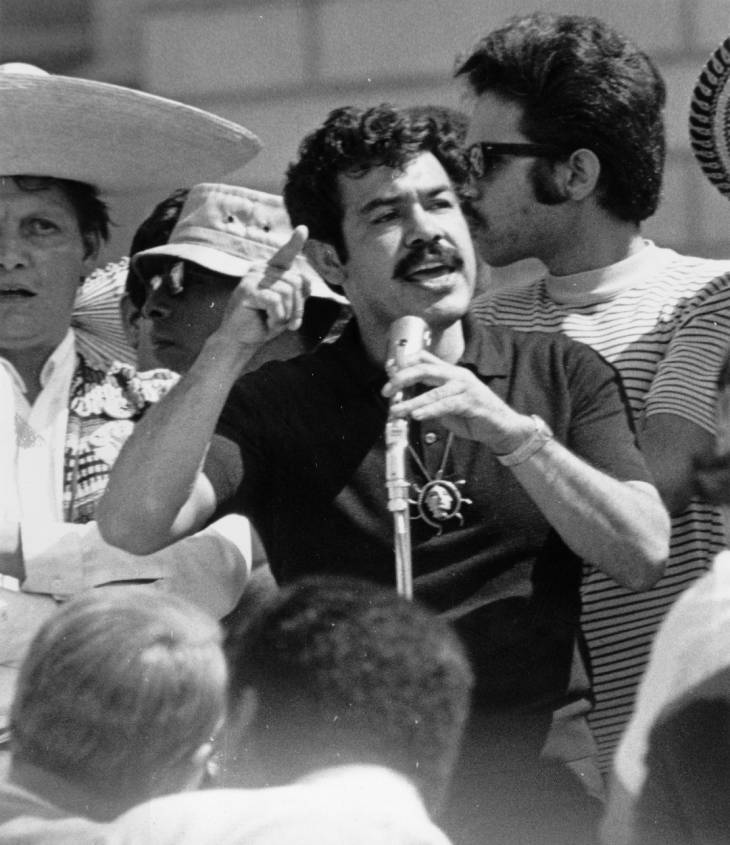
Corky Gonzales speaking at rally
LHP_Intern2022-03-30T17:44:35+00:00Corky Gonzales speaking at rally in Denver, 1960s

Crusade for Justice pickets Post Office
LHP_Intern2022-03-30T16:30:40+00:00Latinos picket the Denver post office for discriminating against Mexican-American workers, 02-04-1969
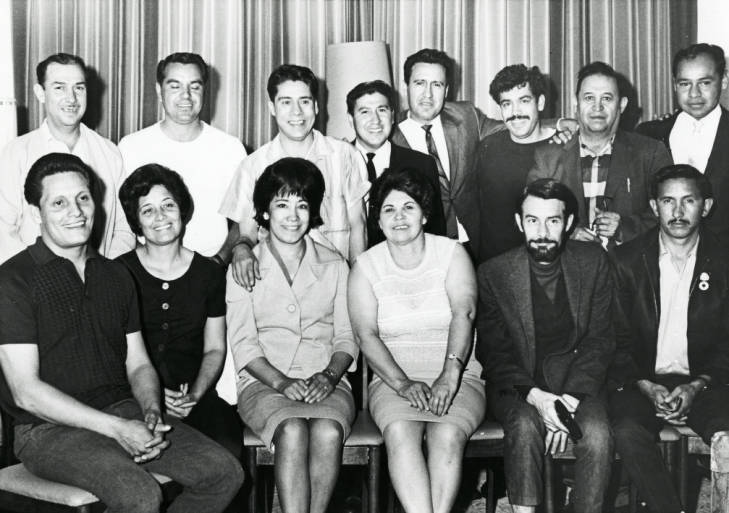
Crusade for Justice Founders, late 1960s
LHP_Intern2020-08-30T02:24:37+00:00Picture of Corky Gonzales with donors and other founders of the Crusade for Justice, c. 1966-1970

Chicano Liberation Day demonstration, 1975
LHP_Intern2020-09-09T21:57:05+00:00Article with pictures of the Crusade for Justice’s Chicano Liberation Day demonstration in downtown Denver, 09-16-1975
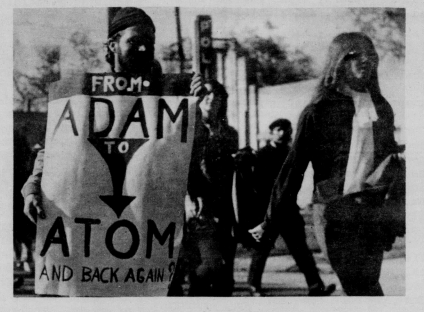
“Sunday walk for peace” 1969
LHP_Intern2020-09-09T21:58:29+00:00“Sunday Walk for Peace” Article on an anti-war demonstration in downtown Denver, organized by several groups including Crusade for Justice, 11-13-1969
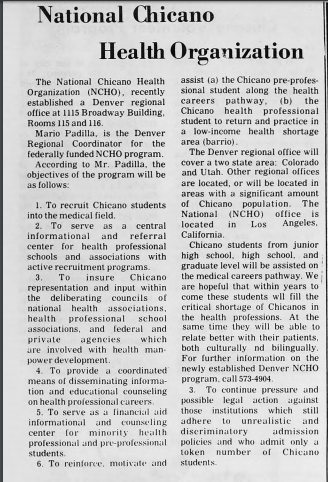
“National Chicano Health Organization” 1972
LHP_Intern2020-08-30T02:24:34+00:00Article on efforts to get more Latinx students into medical schools and health professions
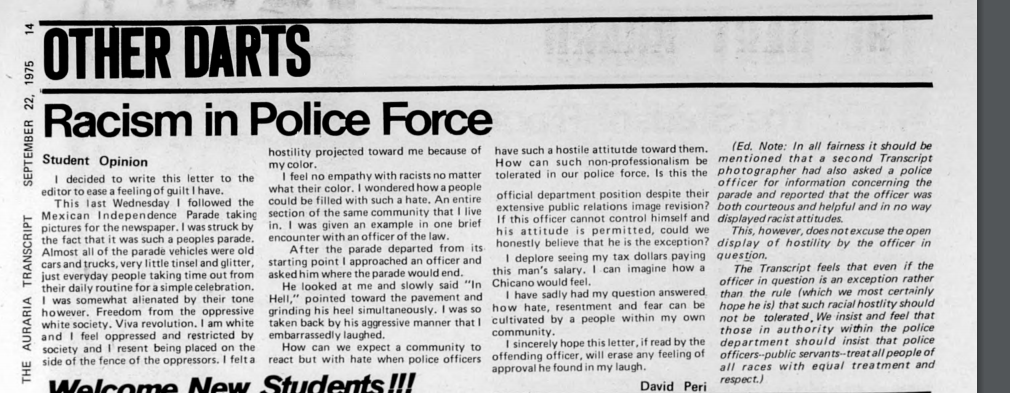
“Racism in Police Force” article
LHP_Intern2020-08-30T02:24:32+00:00Article on policing issues in the Chicano community
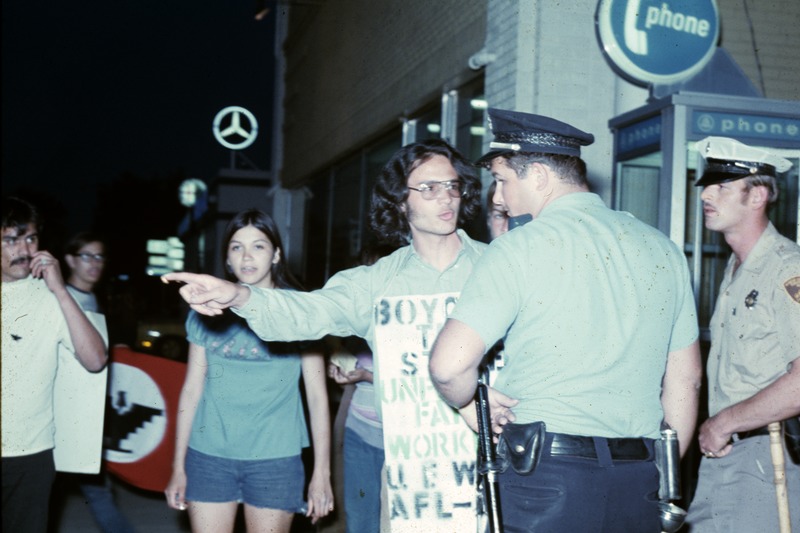
“Chester Ruiz negotiates with police at picket line”
LHP_Intern2020-08-30T02:24:30+00:00Picture of protesters talking with police at a protest in Denver, 1971
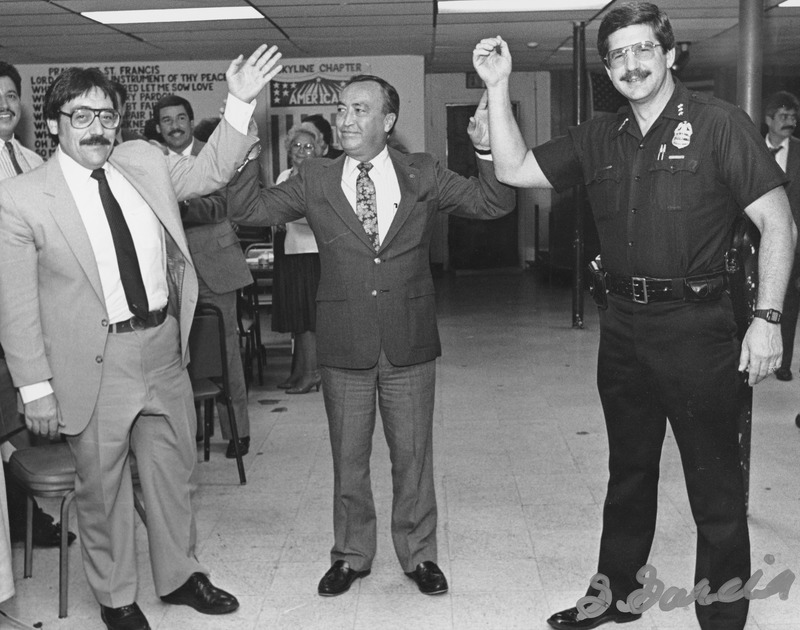
Latino men on the Denver police force
LHP_Intern2020-08-30T02:24:28+00:00Picture of George Sandoval, Ari Zavaras (Chief of Police) and Manual martinez (Manager of Safety) c. 1987
Teenagers arrested during picket, 1975
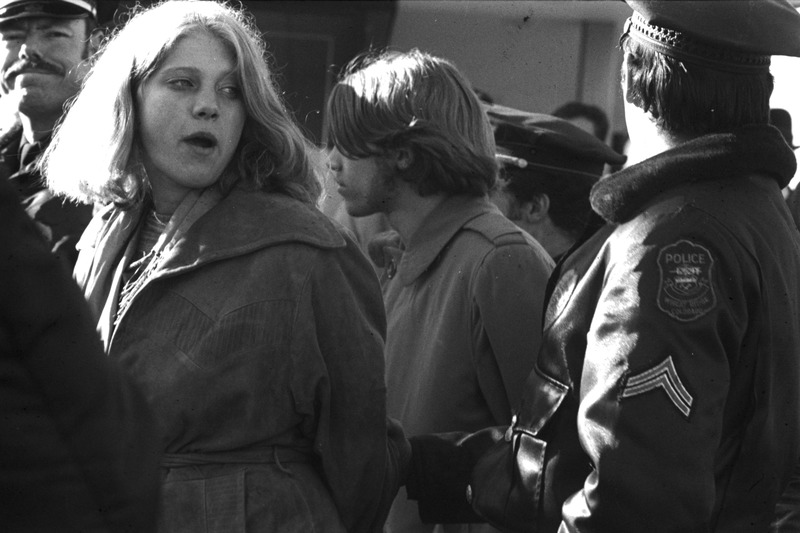
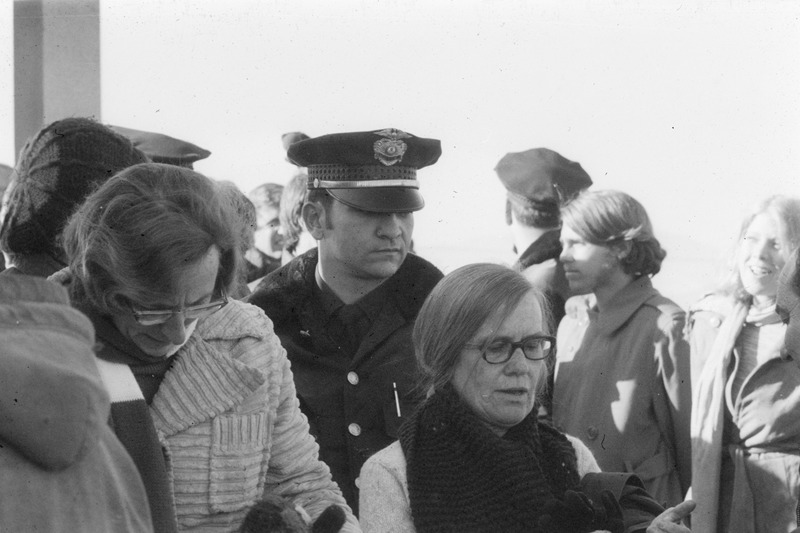
LHP_Intern2020-08-30T02:24:27+00:00Two teenagers, Mike Wilzoch and Michelle Hobart, arrested at a UFWA boycott at Applejack Wine & Spirits in Wheat Ridge, c. 1975
Police make arrests at picket of local liquor store
LHP_Intern2020-08-30T02:24:25+00:00Police, in full riot gear, arrest everyone participating in UFWA picket of local liquor store Applejack Wine & Spirits in Wheat Ridge, 1975
Chicano spokesmen give complaints about recent police actions
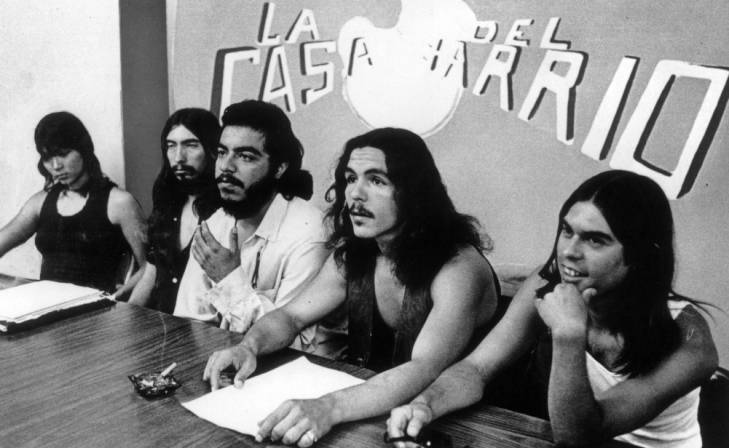
LHP_Intern2020-08-30T02:24:24+00:00Mexican-American spokespeople Martha Medrano, Esquiel Lovato, Larry Aragon, Antonio Martinez, and Larry Lovato hold press conference to issue complaints regarding police actions and arrests, 07-31-1972
Chicano band “Brown Obsidian”
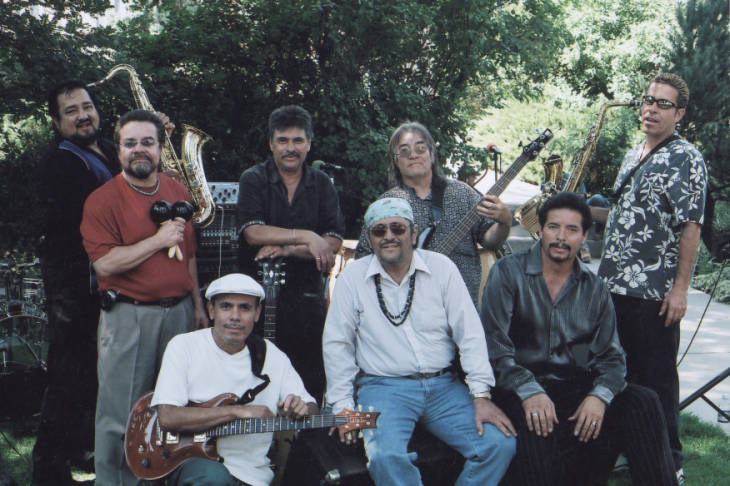
LHP_Intern2020-08-30T02:24:23+00:00Brown Obsidian pose with instruments in Denver

Ramon Del Castillo performs poetry reading “Vato Loco Presents: King Crack”, c. 2005
LHP_Intern2020-08-30T02:24:21+00:00Ramon Del Castillo, poet and professor of Chicano Studies at Metro State, performs a poetry reading
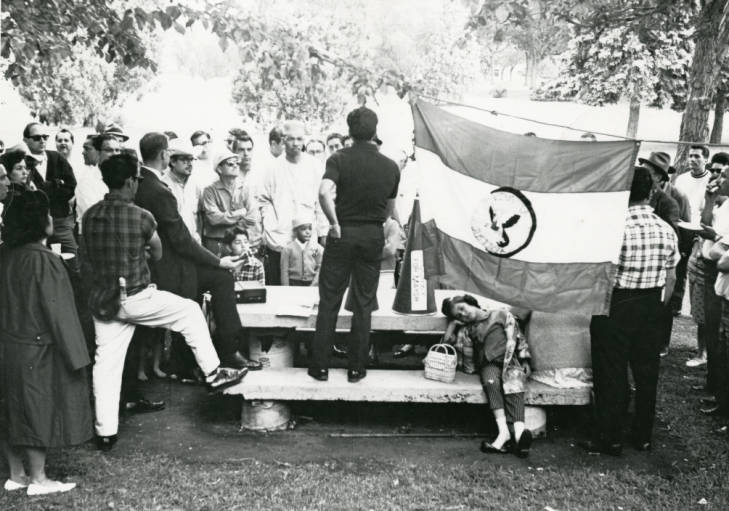
Corky for Mayor
LHP_Intern2020-08-30T02:24:20+00:00Rodolfo Corky Gonzales speaks during a Corky for Mayor event, Denver, 1967
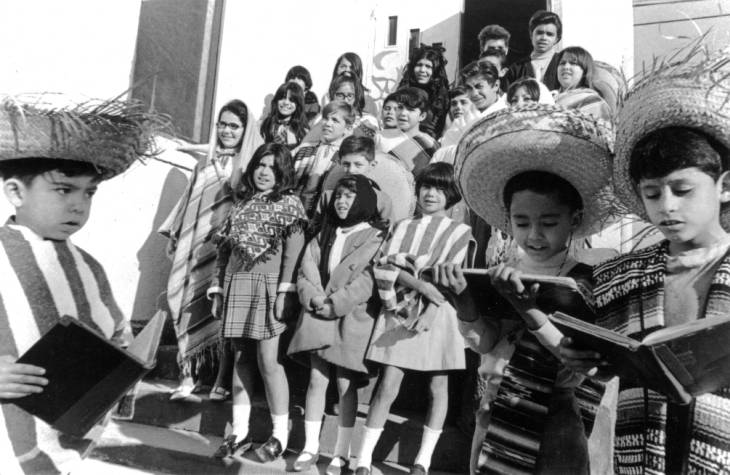
Group of kids rehearse for Los Posadas celebration, 1969
LHP_Intern2020-08-30T02:24:19+00:00Group of young kids rehearse for Los Posadas, a traditional Mexican Advent Christmas celebration, at the Centro Cultural
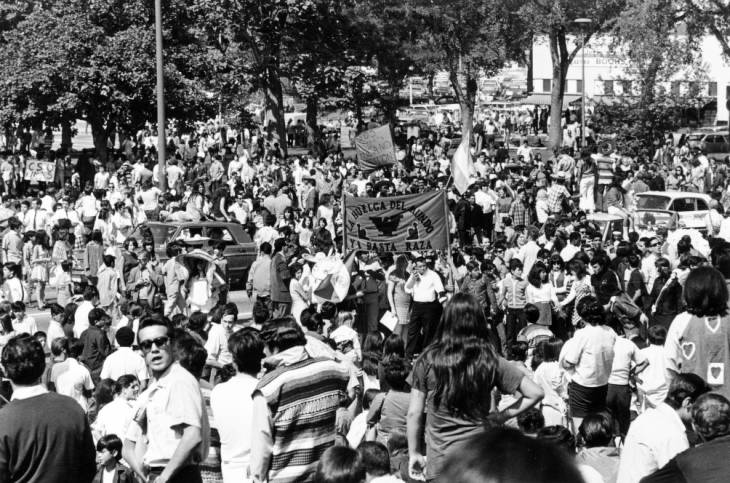
Large Mexican Independence Day celebration, 1969
LHP_Intern2020-08-30T02:24:17+00:00Large Denver celebration of Mexican Independence Day, 09-16-1969
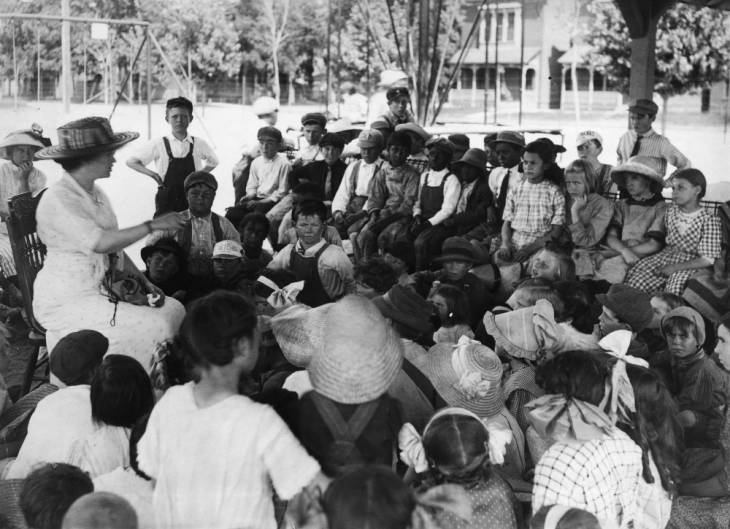
Children’s story time at the Denver Public Library, 1920s
LHP_Intern2020-08-30T02:24:16+00:00Children listen to a story by a Denver Public Library employee in a Denver Park, 1920s-1930
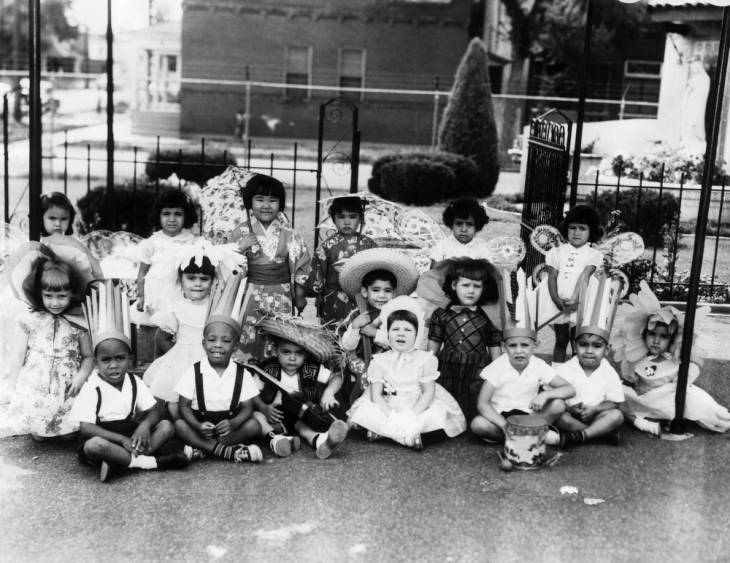
Children’s day nursery 1960
LHP_Intern2020-08-30T02:24:15+00:00Children’s day nursery in Five Points neighborhood, Denver, 1960

Federico Peña mayoral campaign
LHP_Intern2020-08-30T02:24:13+00:00Denver mayoral candidate Federico Peña at a rally on the steps of the City and County building in Denver, 1983
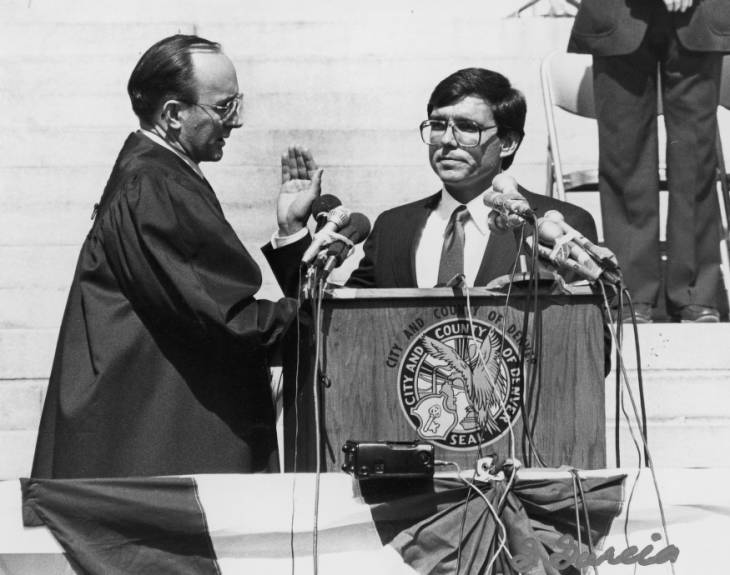
Mayor Federico Peña being sworn in
LHP_Intern2020-08-30T02:24:12+00:00Denver’s first Hispanic mayor, Federico Peña, sworn in on the steps of the City and County Building, 1983
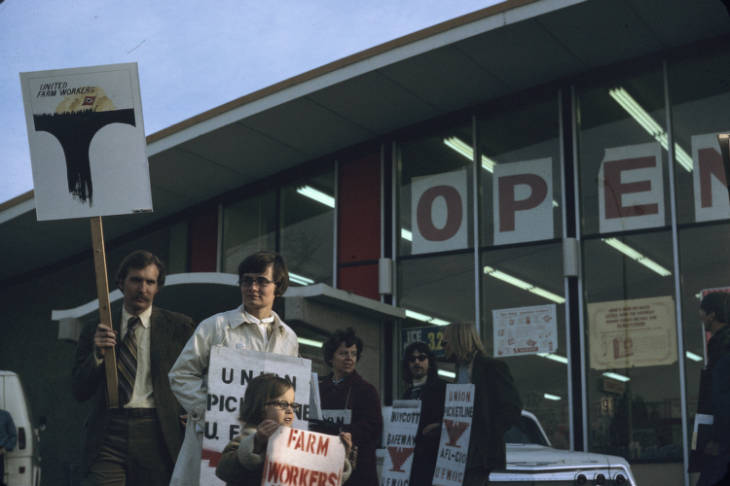
Grape boycott at Safeway store, 1970s
LHP_Intern2020-08-30T02:24:11+00:00UFWA protesters picket a Safeway in Denver, mid 1970s
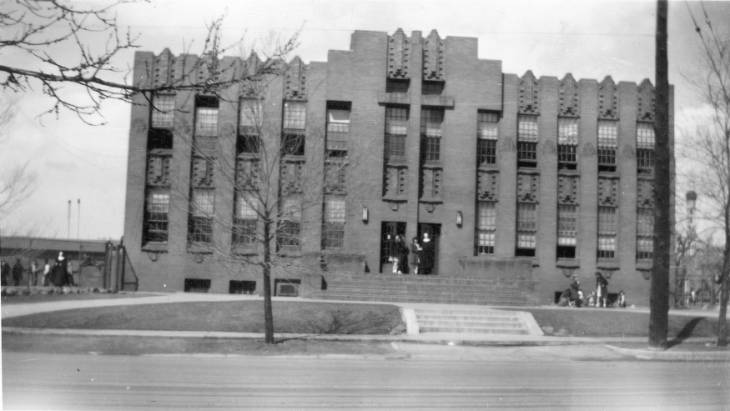
St. Cajetan’s Elementary school, 1940s
LHP_Intern2020-08-30T02:23:49+00:00St. Cajetan’s Elementary, near 9th and Lawrence in the Auraria neighborhood, late 1940s
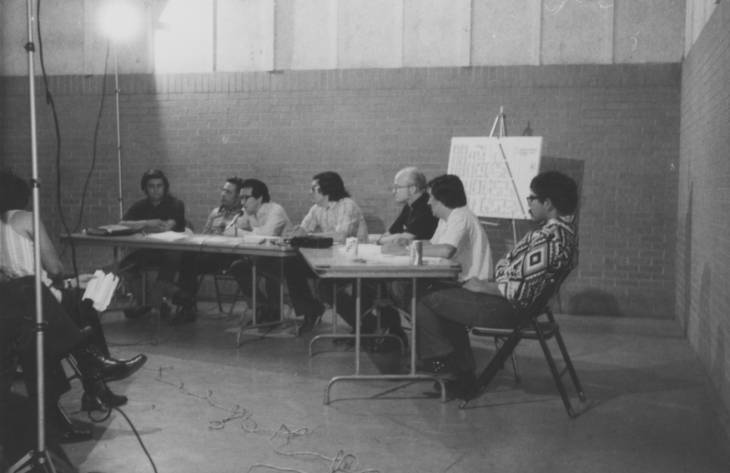
West Side Coalition meeting discusses urban development issues
LHP_Intern2020-08-30T02:23:48+00:00West Side Coalition meeting, composed of many Mexican Americans, discusses West Denver development and city planning, which is being left out of current city plans. c. 1973
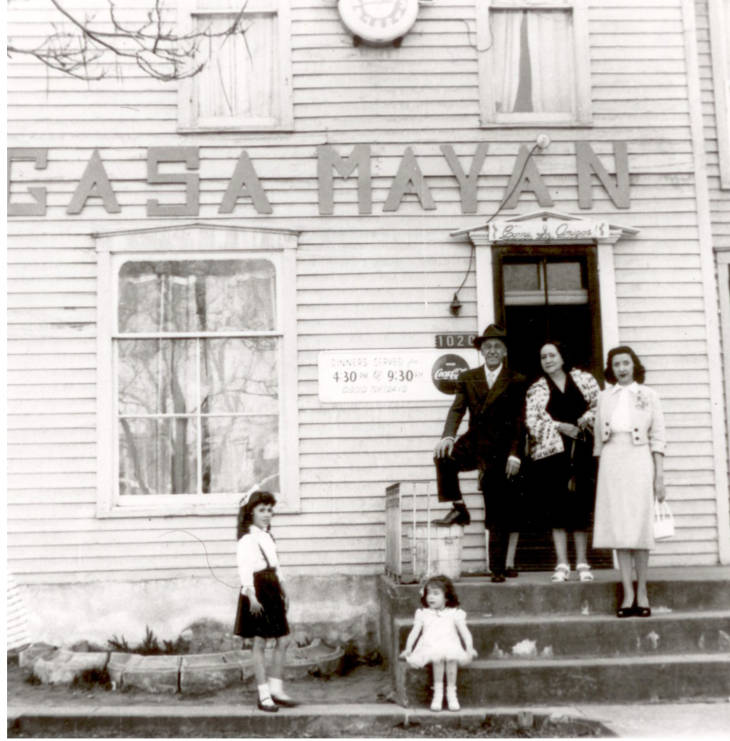
Casa Mayan restaurant, 1958
LHP_Intern2020-08-30T02:23:47+00:00Gonzales family poses outside of their restaurant Casa Mayan, located at 1020 9th St. in Auraria neighborhood, 1958
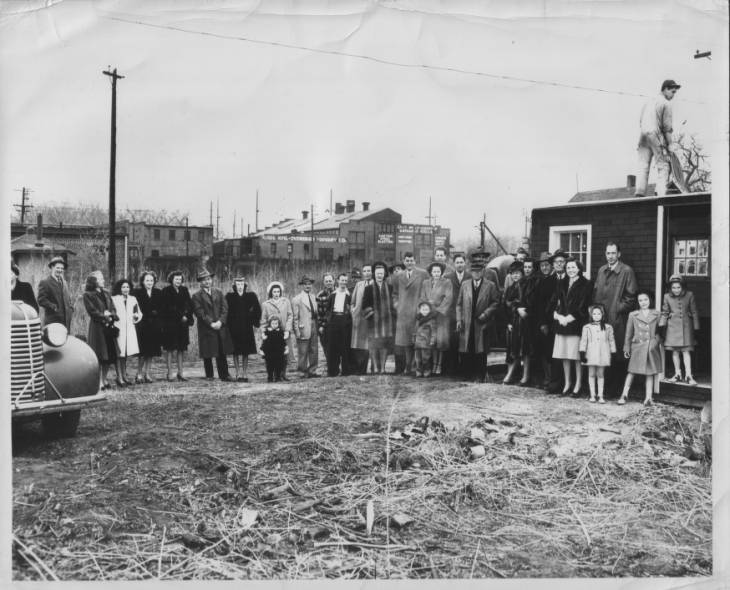
Peerless Printing Company & employees
LHP_Intern2020-08-30T02:23:46+00:00Employees pose in front of the Peerless Printing Company, at 20th and Broadway in the Five Points Neighborhood, c. 1950
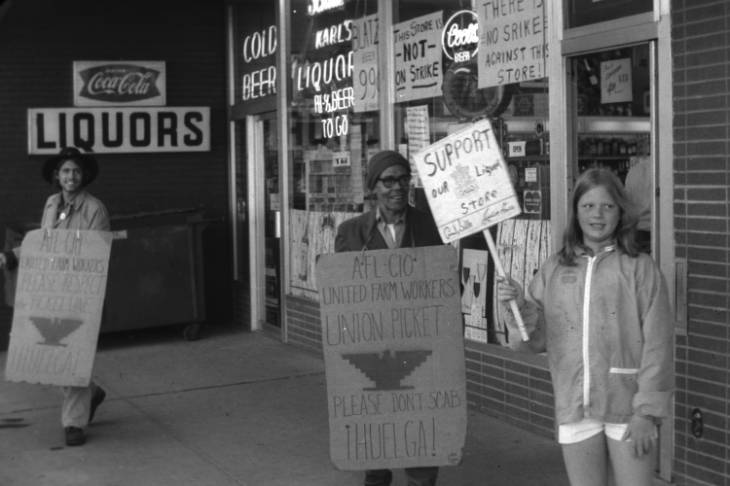
AFW Picket Karl’s Liquors
LHP_Intern2020-08-30T02:23:44+00:00Jesús Valderrama pickets Karl’s Liquors on West Colfax for selling Gallo Wine. The daughter of the owner of Karl’s Liquors, stands beside him with a sign that reads: “Support Our Liquor Store.”
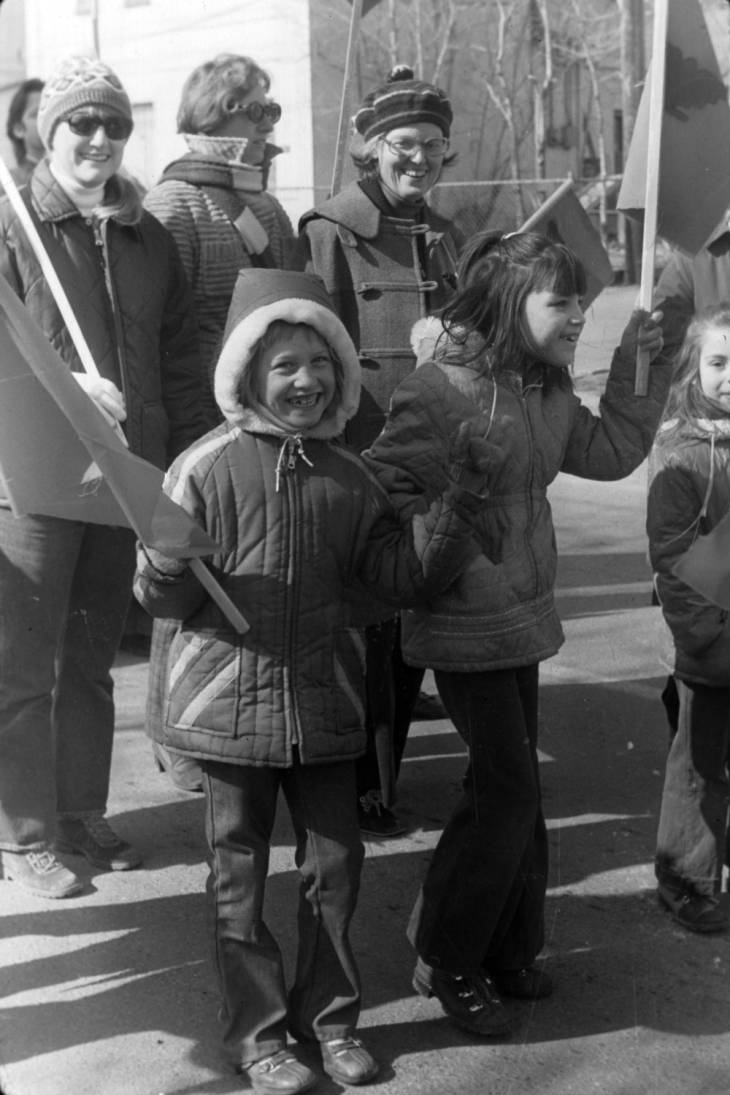
Children participate in march with the AFL-CIO United Farm Workers of America
LHP_Intern2020-08-30T02:39:05+00:00Children march with the AFL-CIO United Farm Workers of America for the Gallo Wine boycott, Denver, 1975
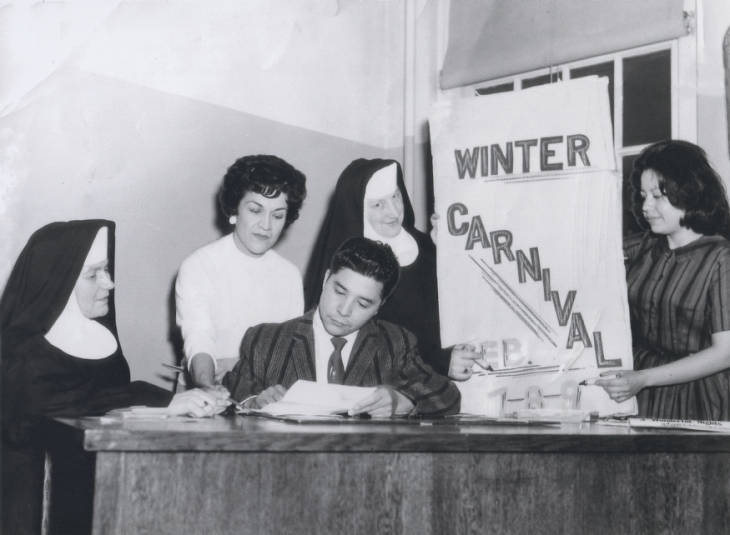
St. Cajetan’s Catholic School prepares for the Winter Carnival, 1961
LHP_Intern2020-08-30T02:23:42+00:00Students and nuns prepare for St. Cajetan’s Winter Festival, 1961
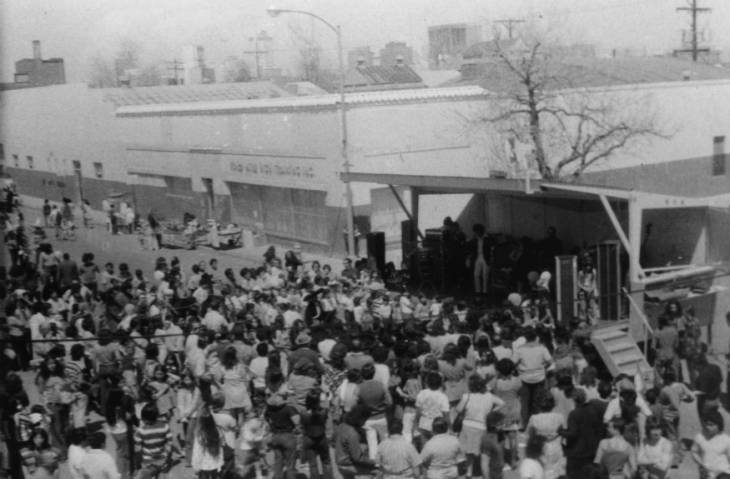
Cinco de Mayo Celebration in Lincoln Park/ La Alma
LHP_Intern2020-08-30T02:23:40+00:00Crowd gathers to listen to music during Cinco de Mayo festival, organized by the West Side Coalition, Lincoln Park/La Alma neighborhood, 1973

Unidentified mariachi musicians, 1950s
LHP_Intern2020-08-30T02:23:38+00:00Unidentified mariachi musicians, 1950s
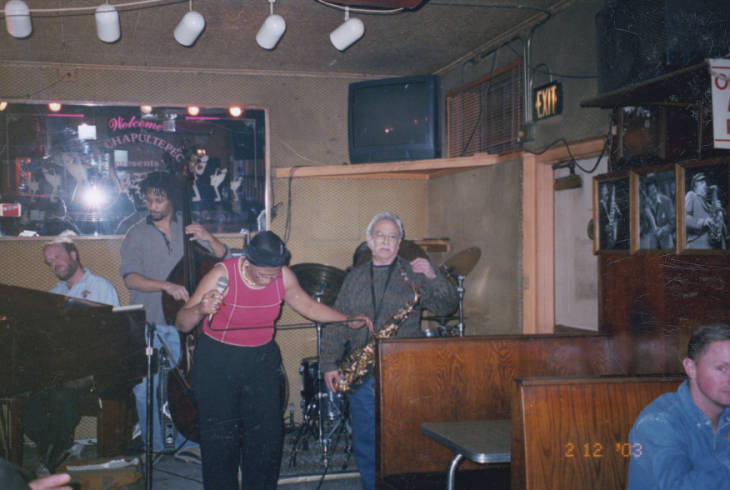
Freddy Rodriguez and the Jazz Connection, 1983
LHP_Intern2020-08-30T02:23:37+00:00Freddy Rodriguez and the Jazz Connection, performing at the El Chapultepec Jazz Club at 1962 Market Street in Denver, 1983
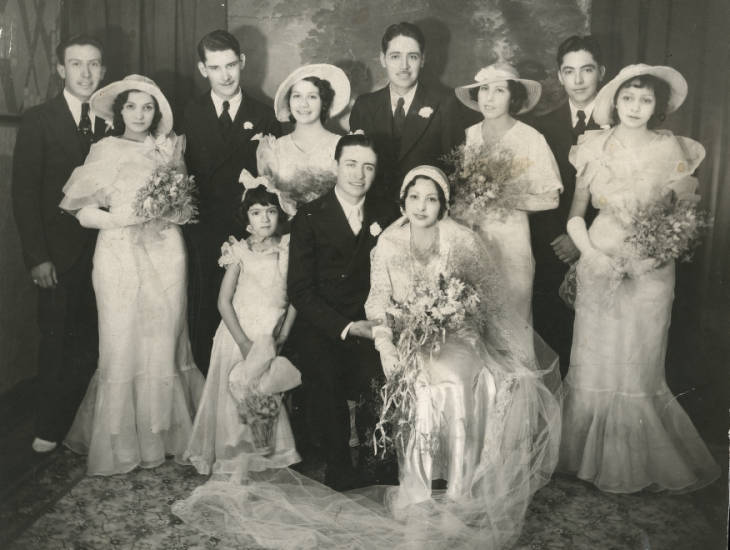
Gallegos wedding party, St. Cajetan’s Church
LHP_Intern2020-08-30T03:00:52+00:00Gallegos wedding party, St. Cajetan’s Church in the Auraria neighborhood, 1934
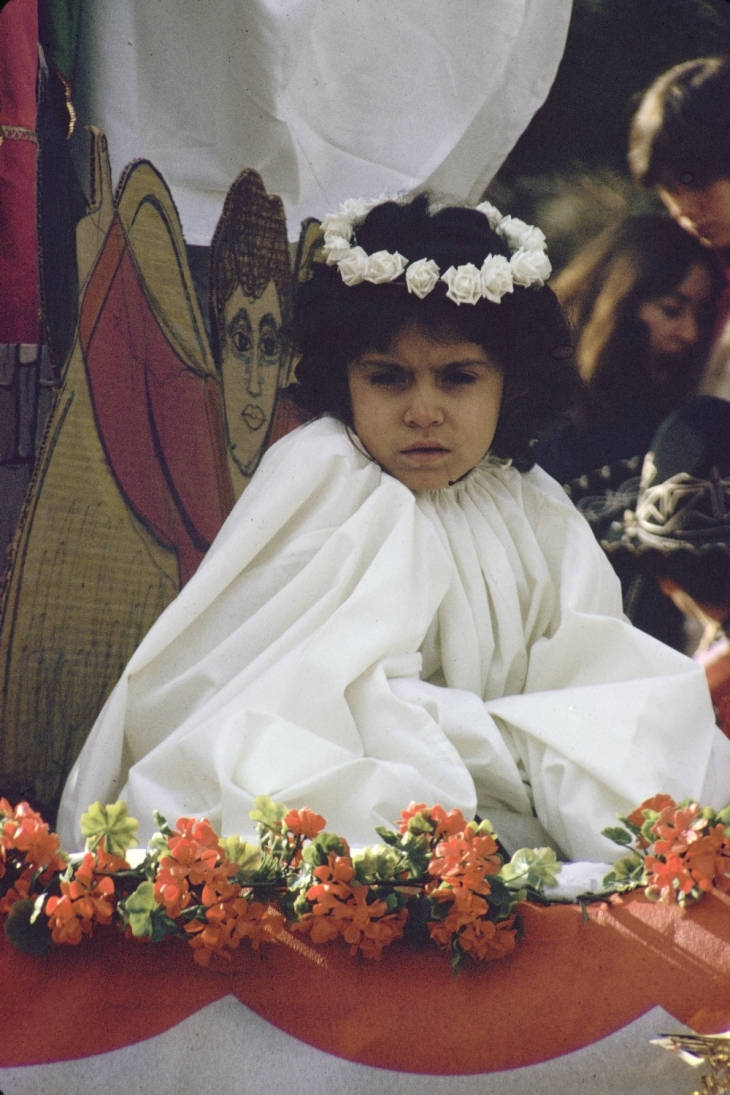
Our Lady of Guadalupe Fiesta
LHP_Intern2020-08-30T02:23:34+00:00A young girl rides on a float in a parade at the Our lady of Guadalupe fiesta in Denver, 1970s
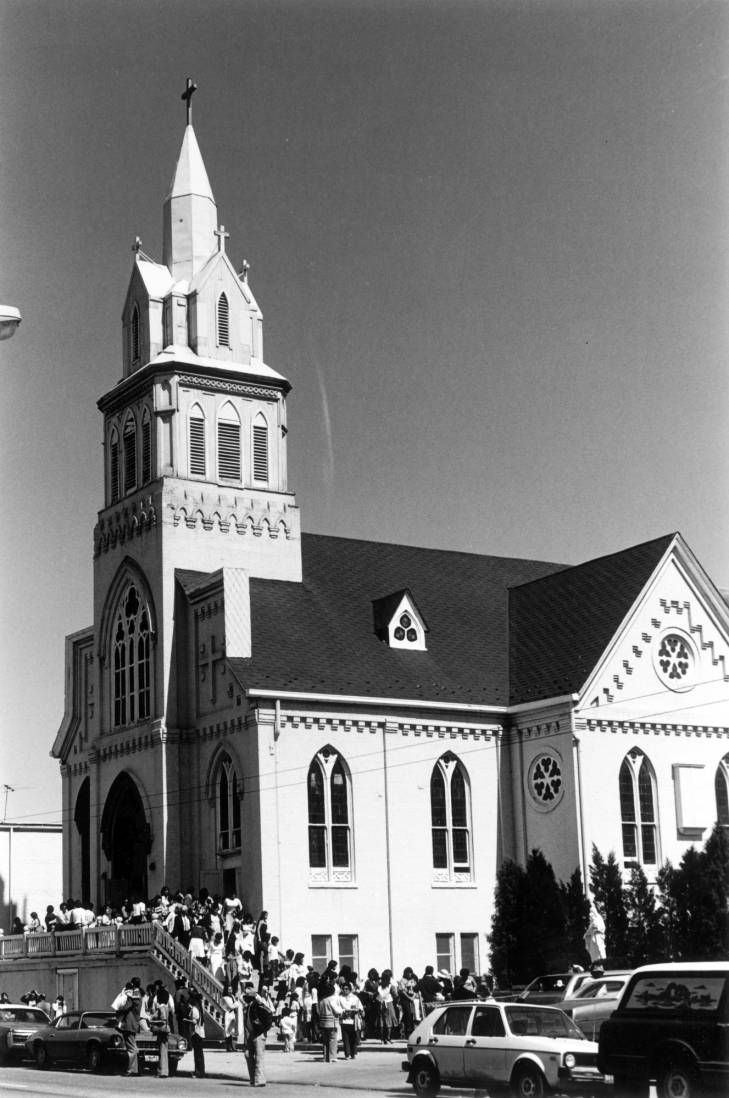
Easter Mass, Sacred Heart Catholic Cathedral, 1979
LHP_Intern2020-08-30T02:23:33+00:00Crowd departs after Easter Mass, Sacred Heart Catholic Cathedral, at 2760 Larimer Street in the Five Points (Curtis Park) neighborhood, 1979
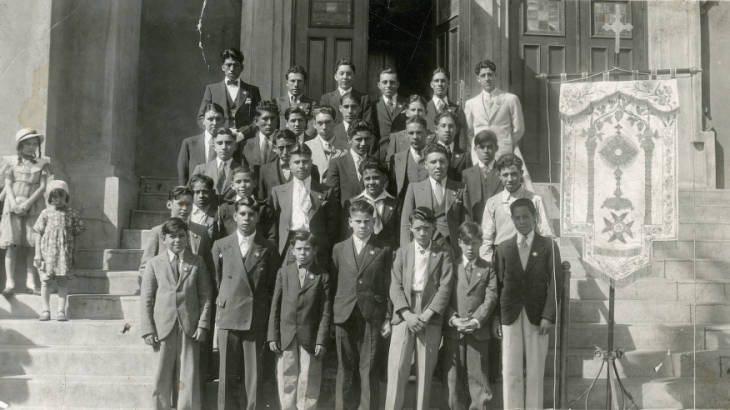
St. Cajetan’s Holy Name Society
LHP_Intern2020-08-30T02:23:32+00:00Group of young men called the Holy Name Society stand on the steps of St. Cajetan’s at 1190 9th Street in the Auraria neighborhood, 1933
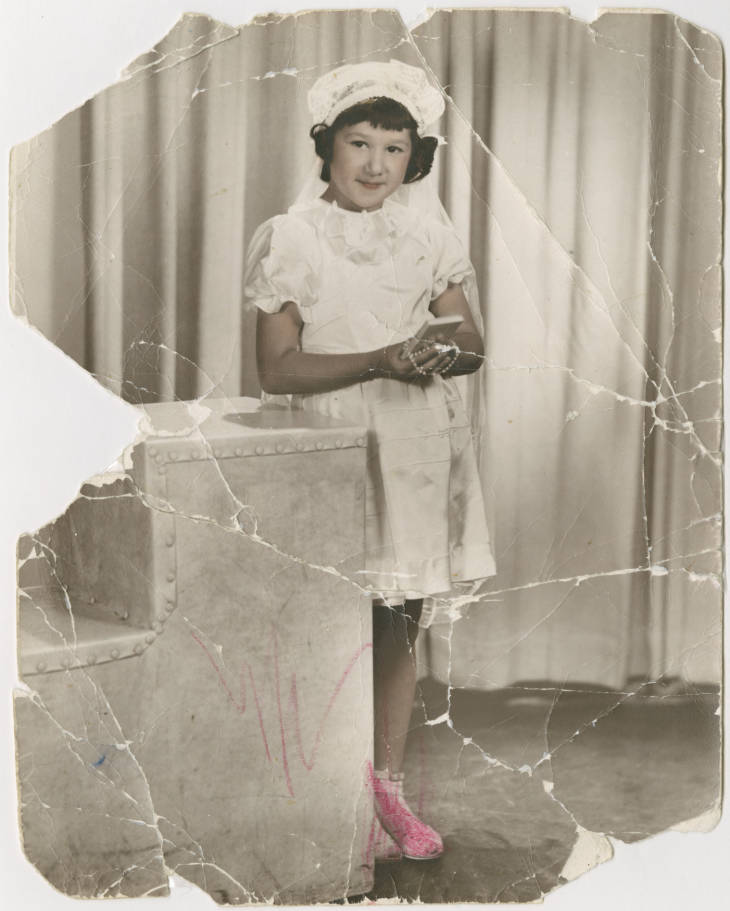
Corrine Baca’s First Communion
LHP_Intern2020-08-30T02:23:31+00:00Corrine Baca’s First Communion at St. Cajetan’s Church, Auraria neighborhood, 1947
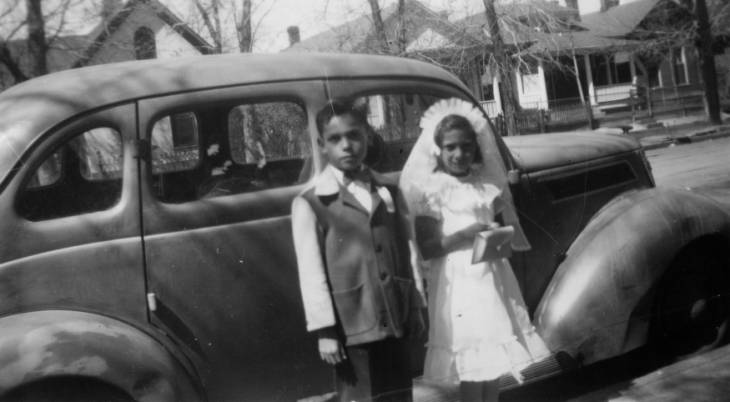
Children prepare for First Communion, 1948
LHP_Intern2020-08-30T02:23:29+00:00Jerry Rodriguez and Jackie Torres dressed up for their First Communion, 1948
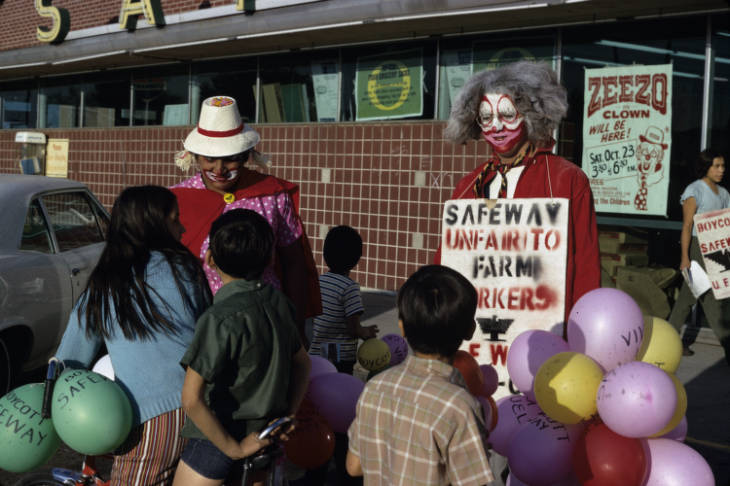
Zeezo the Clown pickets Safeway on behalf of the UFWA
LHP_Intern2020-08-30T02:23:27+00:00Zeezo the Clown impersonator stands outside of a Safeway store in Denver, talking to children and holding a sign that says “Safeway Unfair to Farm Workers”
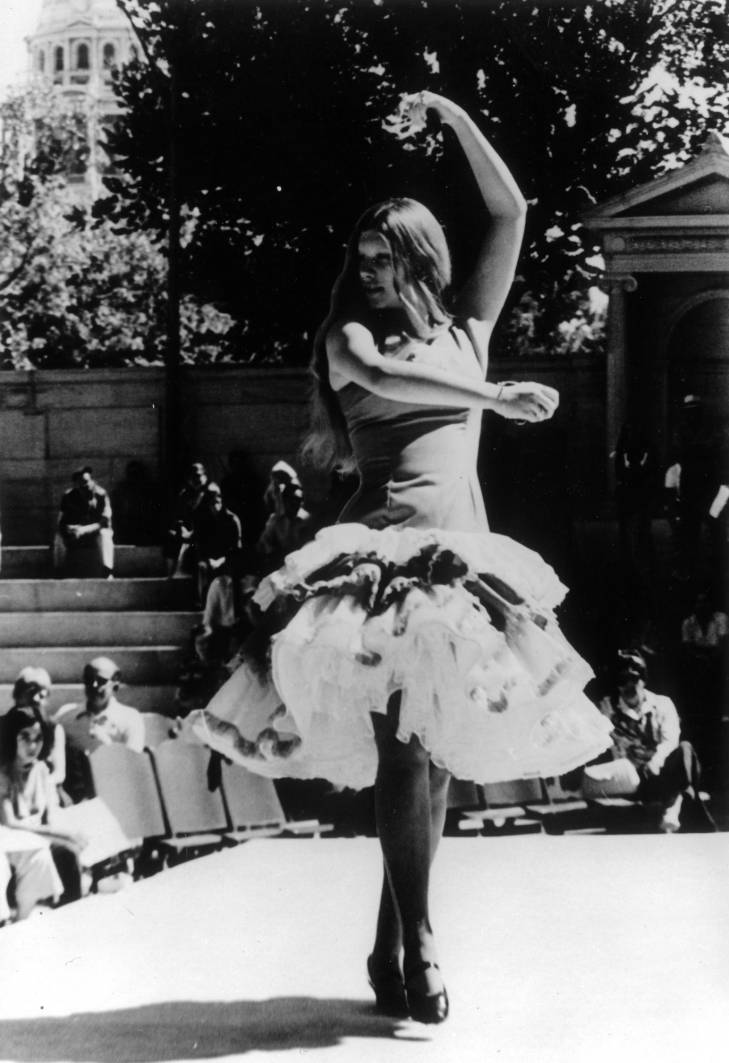
Flamenco Dancer
LHP_Intern2020-08-30T02:51:42+00:00A woman dances flameno at the Civic Center in Denver, late 1960s
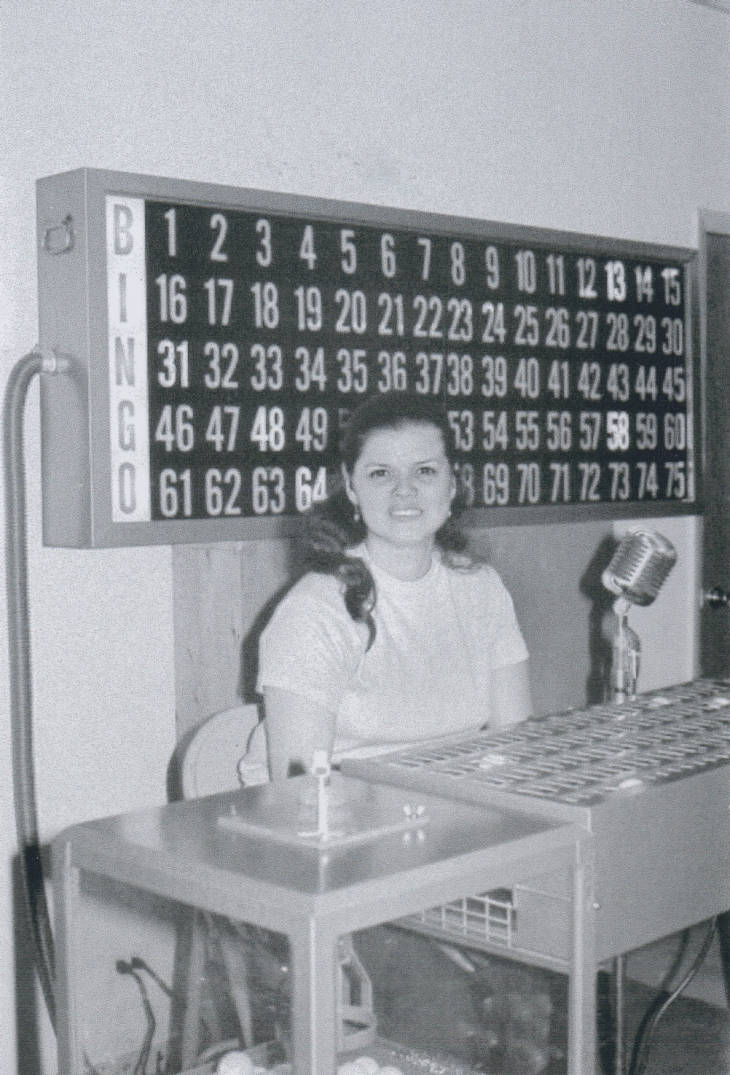
Helen Ankele calling bingo
LHP_Intern2020-08-30T02:23:24+00:00Ankele calls bingo at St. Cajetan’s School in Auraria, late 1950s

Los Cochinos, Hispanic biker club
LHP_Intern2020-08-30T02:23:23+00:00Los Chocinos member Dave Valdez, poses in Denver with his bike, between 2005-2009
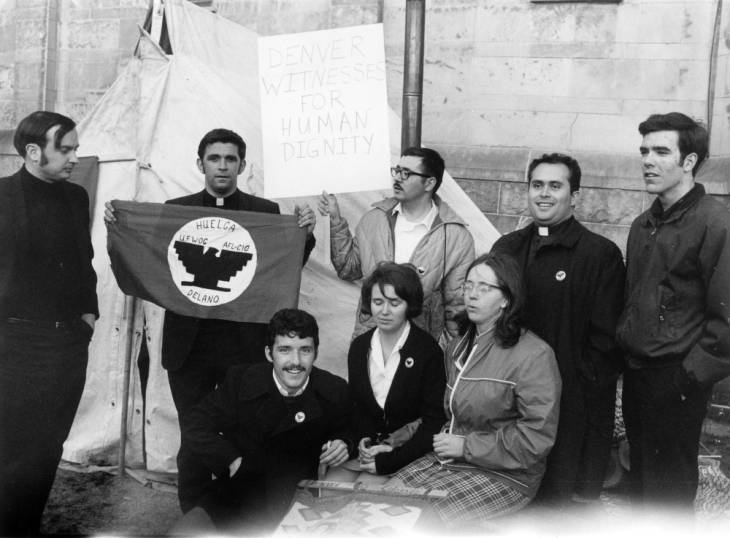
Protest to improve migrant workers living conditions
LHP_Intern2020-08-30T02:22:52+00:00Small group gathers at the Capitol Building in Denver to protest for improved living conditions for migrant workers, 1969
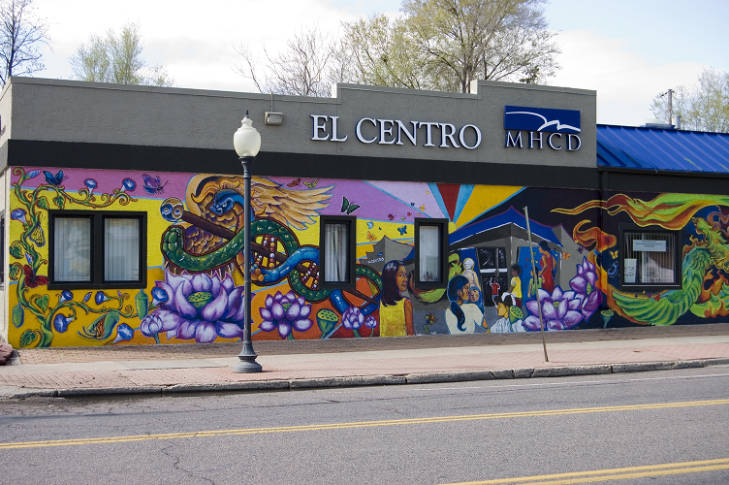
Mural on El Centro Mental Health Center of Denver, 2010
LHP_Intern2020-08-30T02:22:51+00:00Mural by Carlos Fresquez illustrates families and the rising sun, the hope of a new beginning and a new day, 2010
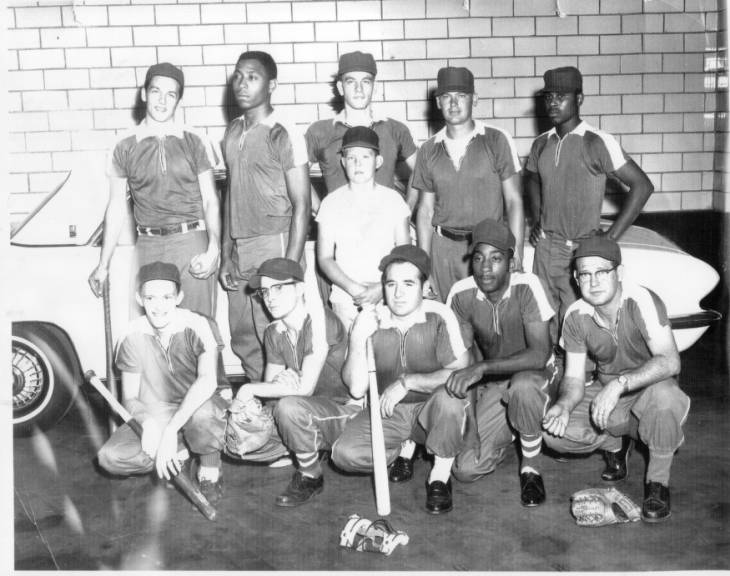
Mexican American & African American baseball team, late 1950s
LHP_Intern2020-08-30T02:22:49+00:00A Latino and Black youth baseball team, late 1950s
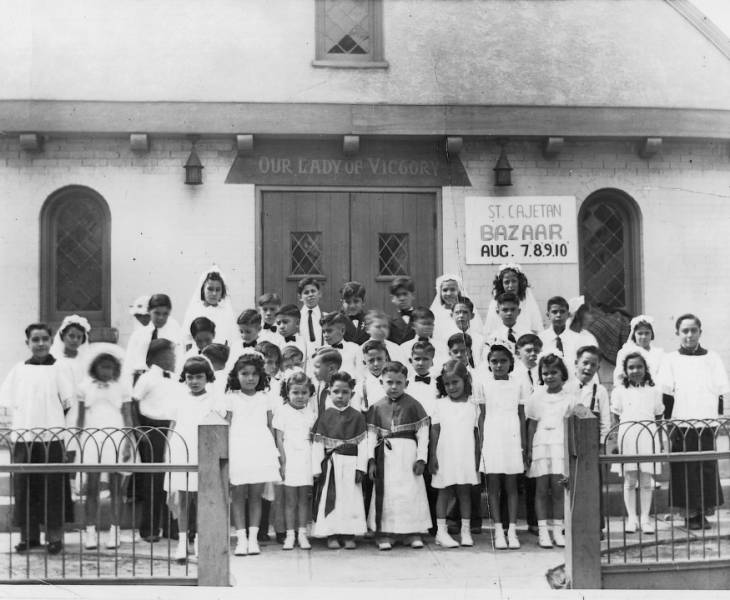
Group of children pose for their First Communion, 1942
LHP_Intern2020-08-30T02:22:48+00:00Chidlren pose in front of Our Lady of Victory Mission, at 12th and Umatilla St. in the Lincoln Park/La Alma neighborhood, 1942
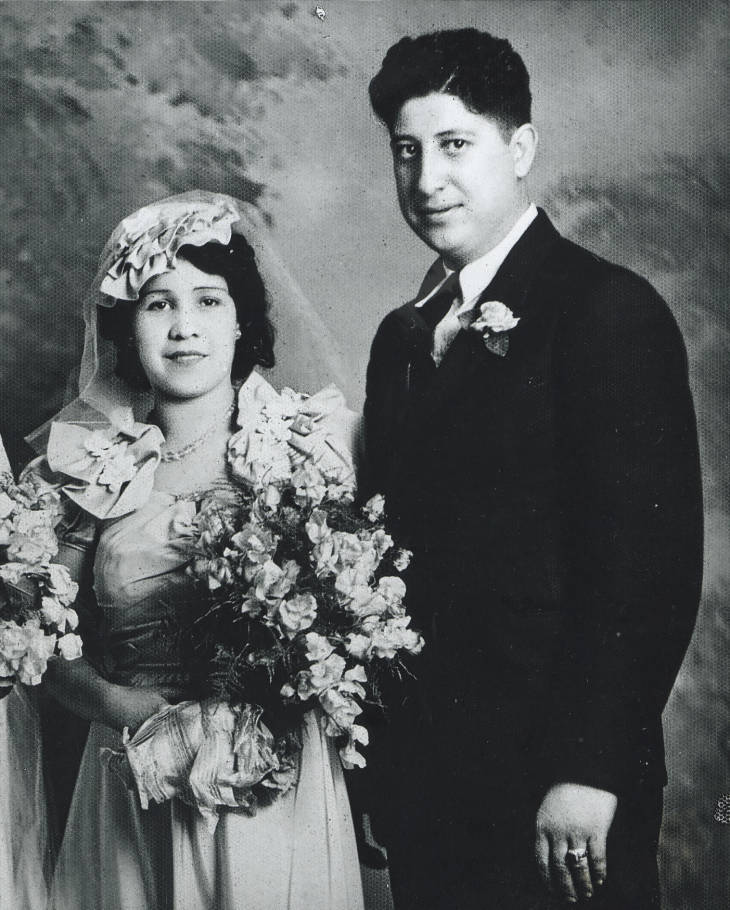
Wedding portrait of the Hanny’s, 1940s
LHP_Intern2020-08-30T03:01:11+00:00Wedding portrait of Frank Hanny and Josephine Montoya, married at St. Cajetan’s in Denver in the 1940s
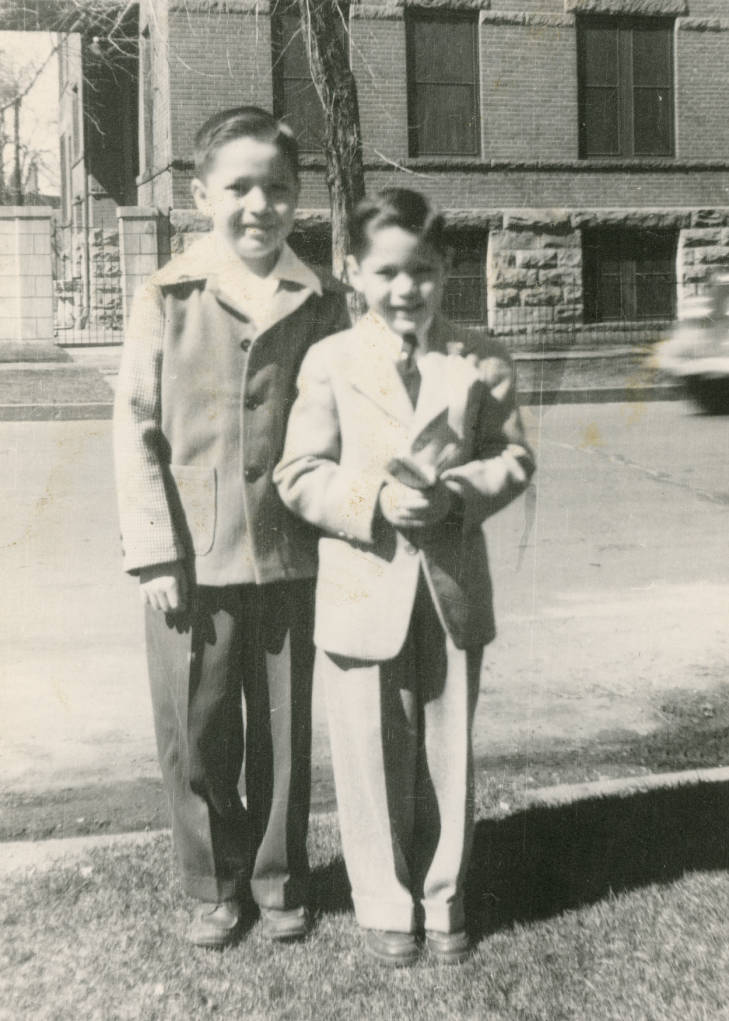
Gallegos boys’ First Communion, 1947
LHP_Intern2020-08-30T02:22:45+00:00Picture of Larry and Don Gallegos posing in the Auraria neighborhood before their First Communion, 1947
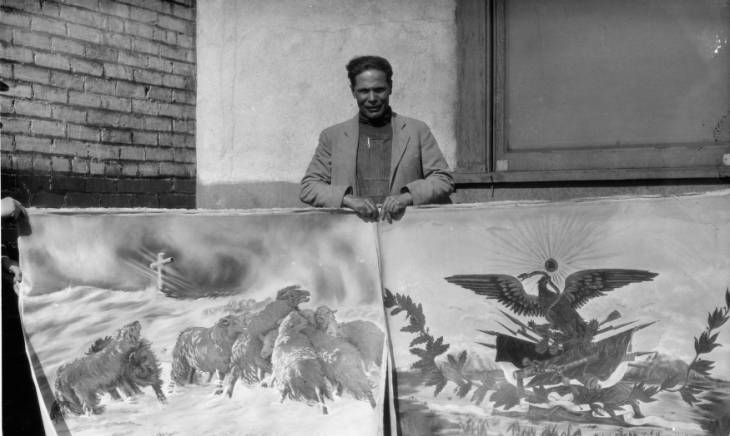
Ciriaco Arellano with two paintings, c. 1930
LHP_Intern2020-08-30T02:22:44+00:00Mexican immigrant artist Ciriaco Arellano poses with two of his paintings in Denver, c. 1930
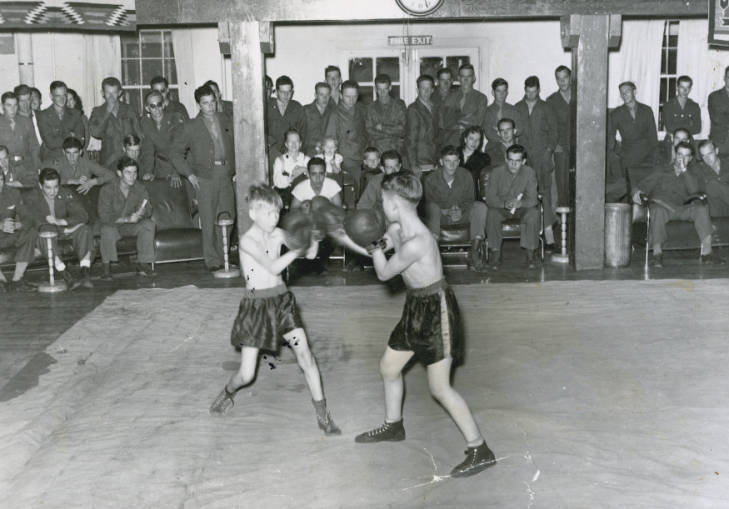
James Maestas boxing
LHP_Intern2020-09-09T21:09:11+00:00A group of boys, including James Maestas, box as part of an exhibition for the US Military at Lowry Air Froce Base in Aurora, 1943
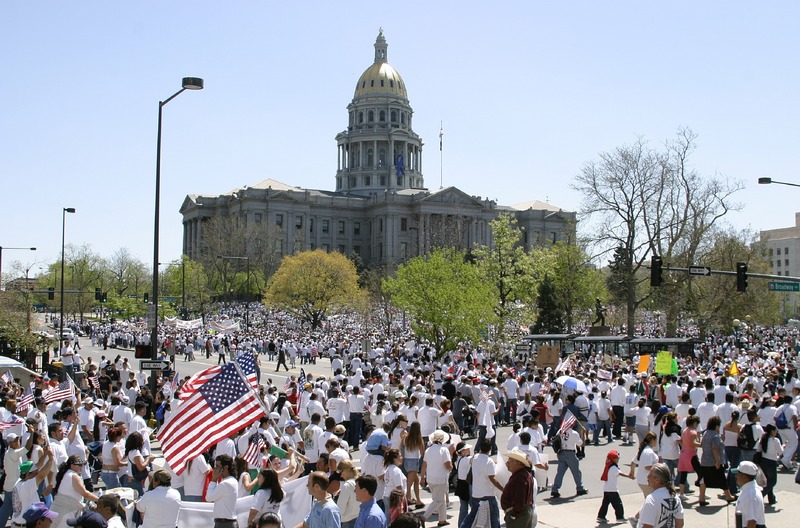
Immigration rights rally, Capitol Building
LHP_Intern2020-08-30T02:22:41+00:00an Immigration rights rally at the State Capitol Building in Denver, drew 50,000 people, 03-25-2006
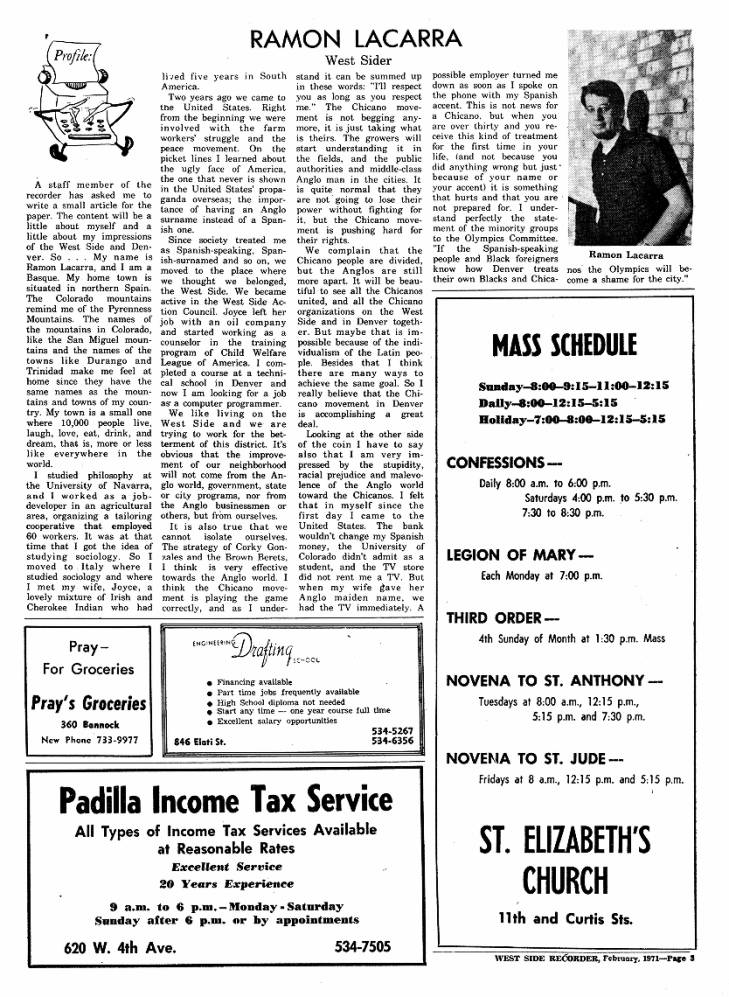
Ramon Lacarra interview
LHP_Intern2020-08-30T02:22:40+00:00newspaper article where Ramon Lacarra talks about immigrating to Denver, its Hispanic community, 1971
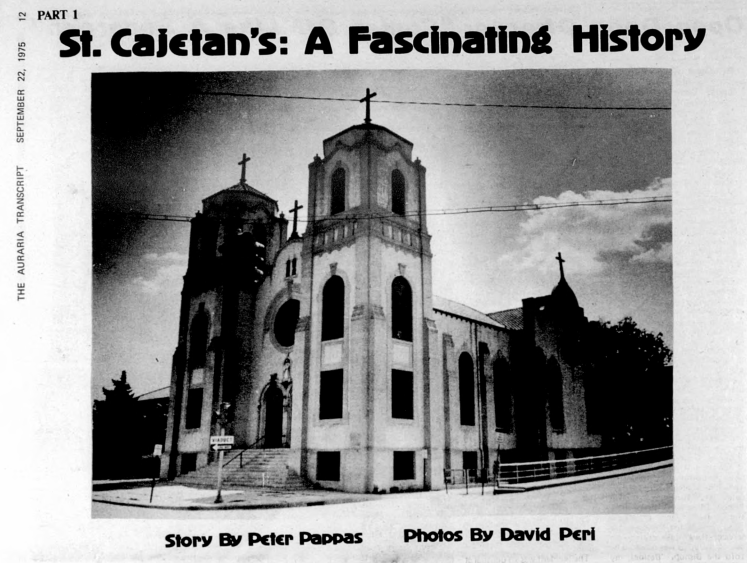
St. Cajetan’s Future, 1975
LHP_Intern2020-09-09T22:06:21+00:00Article on the historic St. Cajetan’s and its future in the Auraria neighborhood as it becomes an urban university campus 09-22-1975
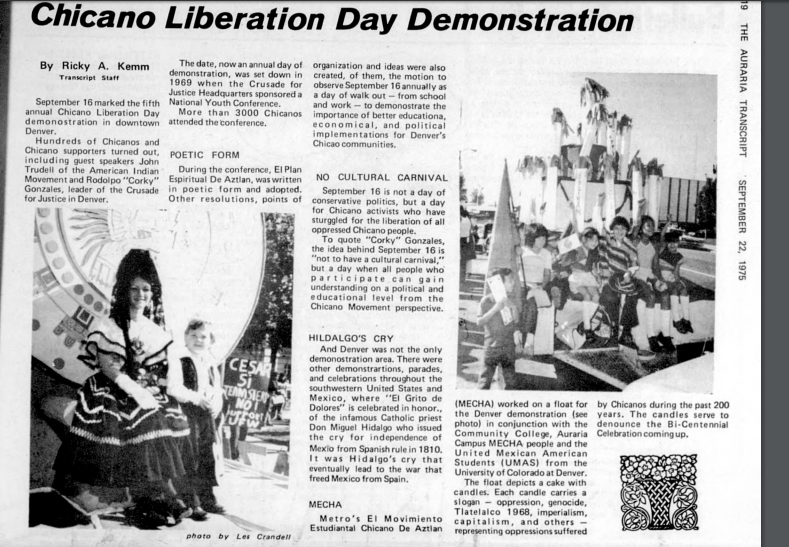
Chicano Liberation Day 1975
LHP_Intern2020-08-30T02:22:37+00:00Article “Chicano Liberation Day Demonstration” by Ricky A. Kemm on Denver’s celebrations for the day, which are not a “cultural carnival” but rather more political, 09-22-1975
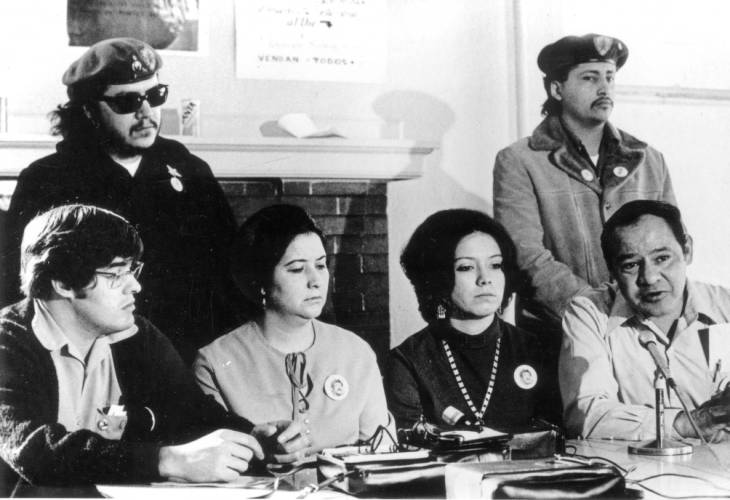
Chicano Leaders, 1960s
LHP_Intern2020-08-30T02:22:36+00:00Joe Gonzales, Geraldine Gonzales, Nita Gonzales and John Haro, Chicano leaders, Crusade for Justice, Denver, 1960s
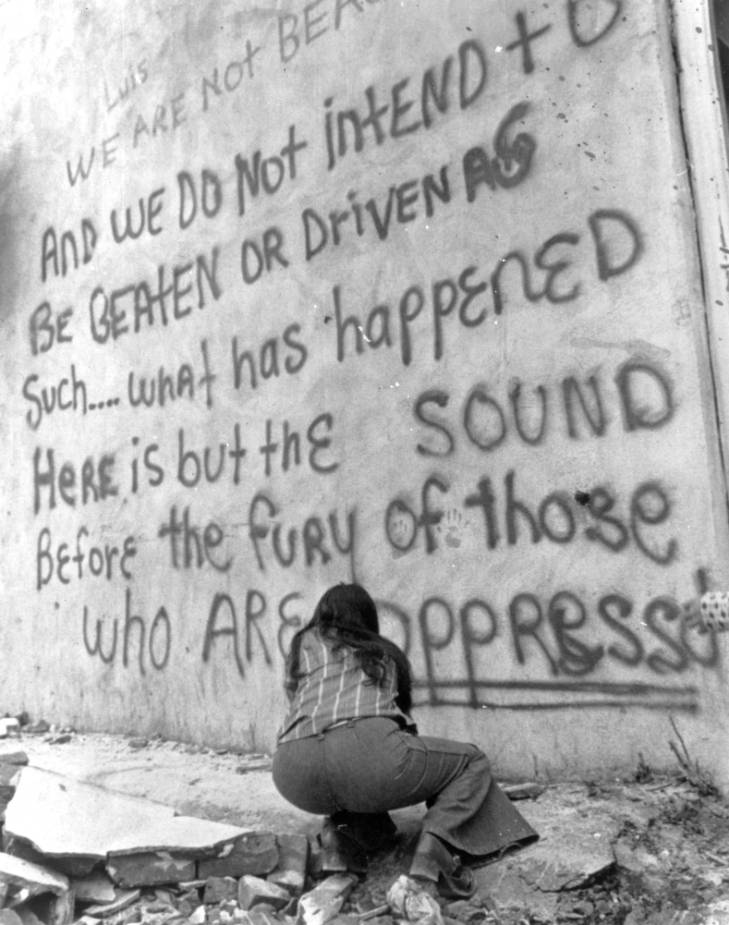
Woman spray paints defiant message
LHP_Intern2020-08-30T02:22:34+00:00An unidentified woman spray paints a message on a wall of an apartment building at 1547 Downing Street, which was damaged in an explosion and shootout between Denver police and the Chicano community, 03-16-1973
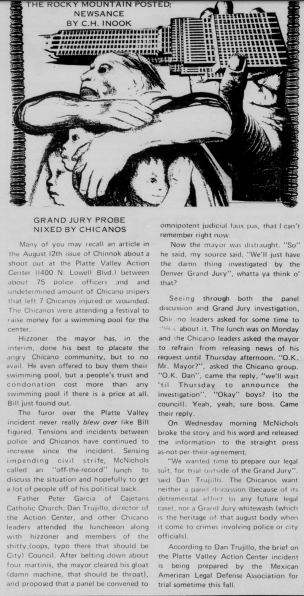
Platte Valley Action Center Shootout, 1971
LHP_Intern2020-08-30T02:22:33+00:00Article “Grand Jury Probe Nixed by Chicanos” on the investigation into the shootout between police and Chicanos at the Platte Valley Action Center at 1400 N. Lowell Blvd, 09-16-1971
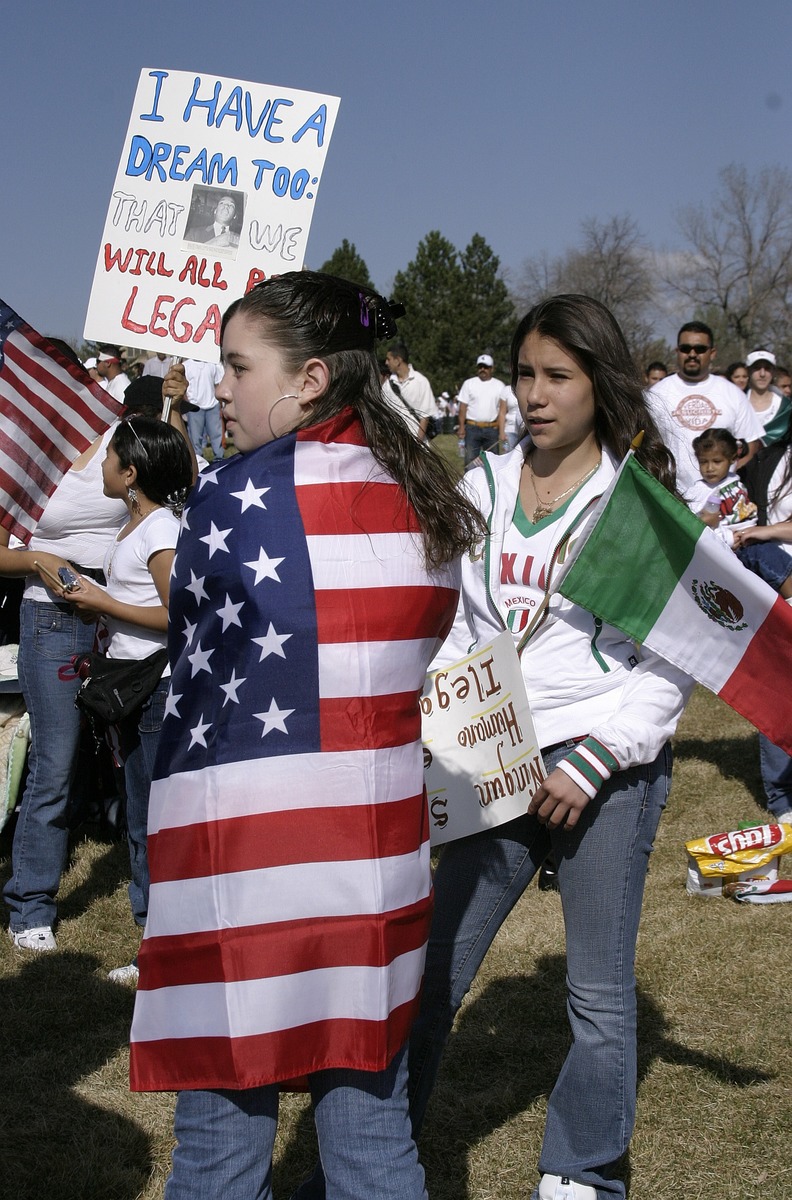
Immigration rally at the Civic Center, Denver
LHP_Intern2020-08-30T02:22:32+00:00Young women attend an immigration rally, Civic Center, Denver, 03-25-2006
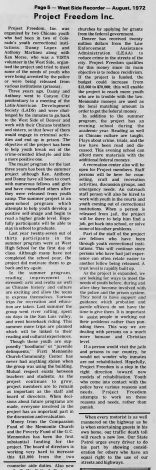
Project Freedom
LHP_Intern2020-08-30T02:22:31+00:00Project Freedom, organized by two Chicano youths Danny Lopez and Anthony Martinez, helps youths who have had run ins with the law 08-01-1972
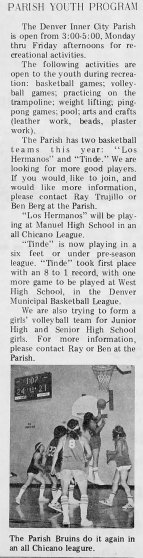
Parish Youth Basketball Teams
LHP_Intern2020-08-30T02:22:29+00:00Article on Parish basketball teams “Los Hermanos” and “Tinde” and their games this season, 11-01-1973
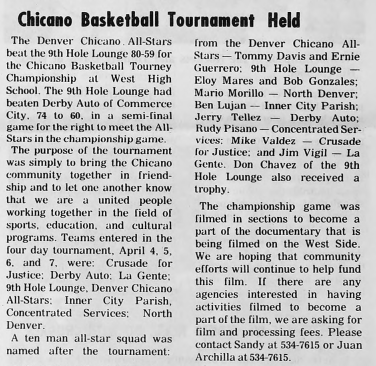
Chicano basketball tournament
LHP_Intern2020-08-30T02:22:28+00:00Denver Chicano All Stars vs. 9th Hole Lounge, annual Chicano basketball championship at West High School, 05-01-1972
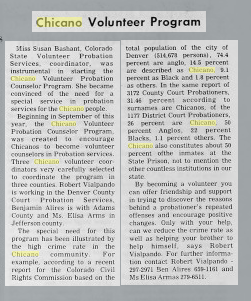
Chicano volunteer program
LHP_Intern2020-08-30T02:22:27+00:00Program to set up services for Chicanos on probation, help them navigate their rights, offer support 11-01-1972
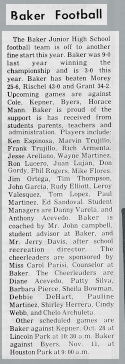
Baker Football
LHP_Intern2020-08-30T02:21:51+00:00Short article on the Baker Jr. High School football team, their scheduled games
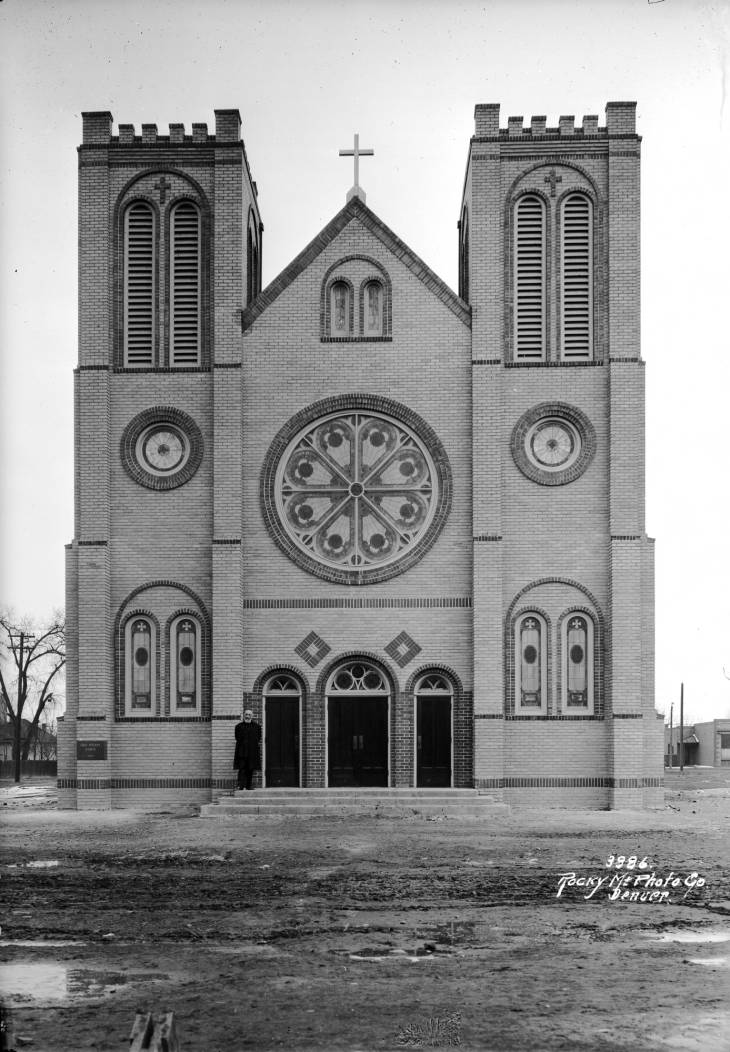
Holy Rosary Church
LHP_Intern2020-08-30T02:21:49+00:00Holy Rosary Church at 4695 Pearl Street, Globeville, 1920s
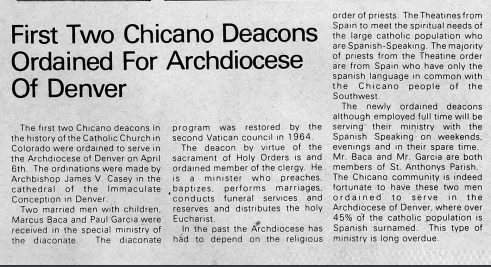
Denver’s first two Chicano Deacons
LHP_Intern2020-08-30T02:21:48+00:00“First Two Chicano Deacons Ordained for Archdiocese of Denver” article 04-01-1974
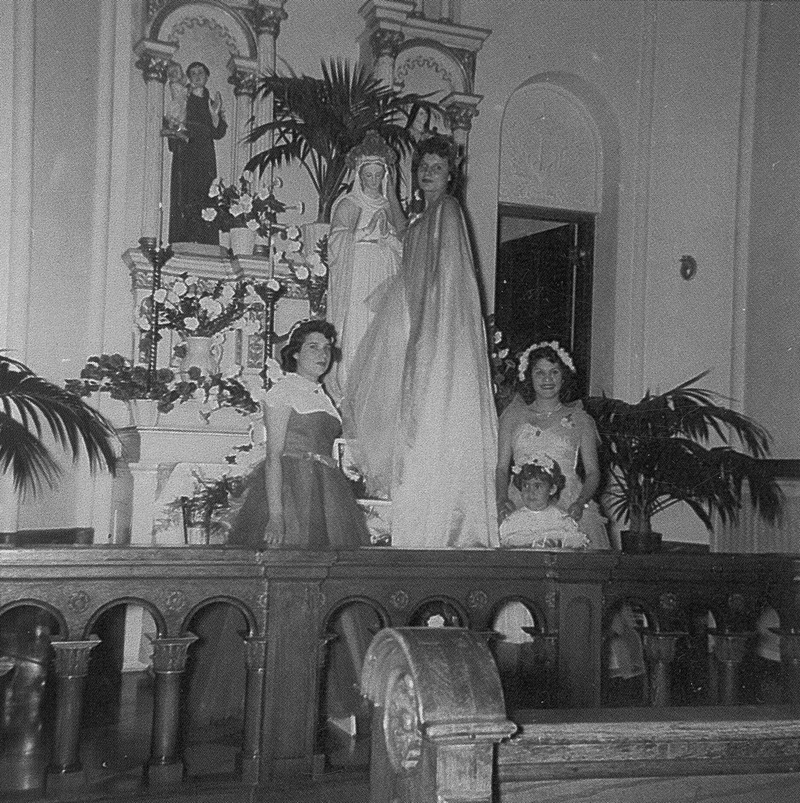
Young Ladies Sodality meeting, 1952
LHP_Intern2020-08-30T02:21:47+00:00May crowning event, at the Young Ladies Sodality meeting, St. Cajetan’s, 1952
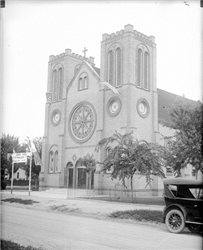
Holy Rosary Church, Globeville neighborhood, 1920
LHP_Intern2020-08-30T02:21:46+00:00Picture of Holy Rosary Church in Globeville, 1920s
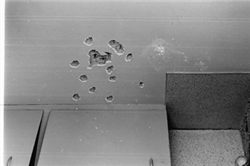
Bullet holes at the Crusade for Justice
LHP_Intern2022-03-30T16:32:24+00:00Picture of bullet holes in the Crusade for Justice building following a police shoot out, 1973
photo by Juan Espinosa
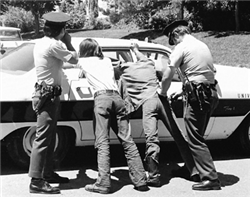
Police frisking Chicano boys
LHP_Intern2020-08-30T02:21:43+00:00Photo by Juan Espinosa of police frisking Chicano boys against their car, early 1970s
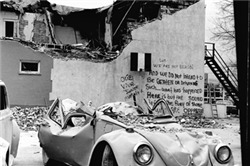
Photo of aftermath of police bombing of a Crusade for Justice Building
LHP_Intern2022-03-30T17:43:23+00:00Photo of aftermath of police bombing of a Crusade for Justice Building, 1973
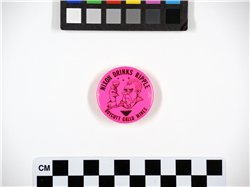
Political button boycott Gallo Wines
LHP_Intern2020-08-30T02:21:41+00:00Political button with caricature of Nixon, says “Nixon Drinks Ripple: Boycott Gallo Wines”, c. 1970

Political buttons Chicano Civil Rights
LHP_Intern2020-08-30T02:21:39+00:00Political buttons that read “Razasi Raza Razasi Si : Migra No” Chicano Civil Rights Movement Button, 1970s
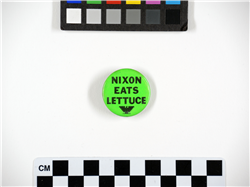
Nixon Eats Lettuce
LHP_Intern2020-08-30T02:21:38+00:00Political button “Nixon eats Lettuce” by the UFWA to support the lettuce boycott
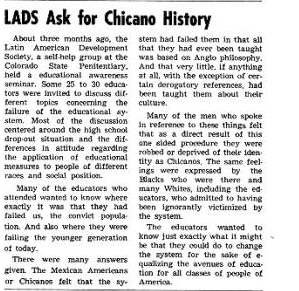
“LADS ask for Chicano History”
LHP_Intern2020-08-30T02:21:37+00:00Article on Latino inmates at the Colorado State Penitentiary who argue if Chicano students learned more about their own history, they’d do better in school and be less prone to a life of crime

Bilingual classes at Baker Jr. High School
LHP_Intern2020-08-30T02:21:36+00:00article “Pupils learn their culture”
Baker Jr. High’s new bilingual classes have been taking kids on field trips, showing movies, partcipating in school exchange programs, etc. 05-01-1970
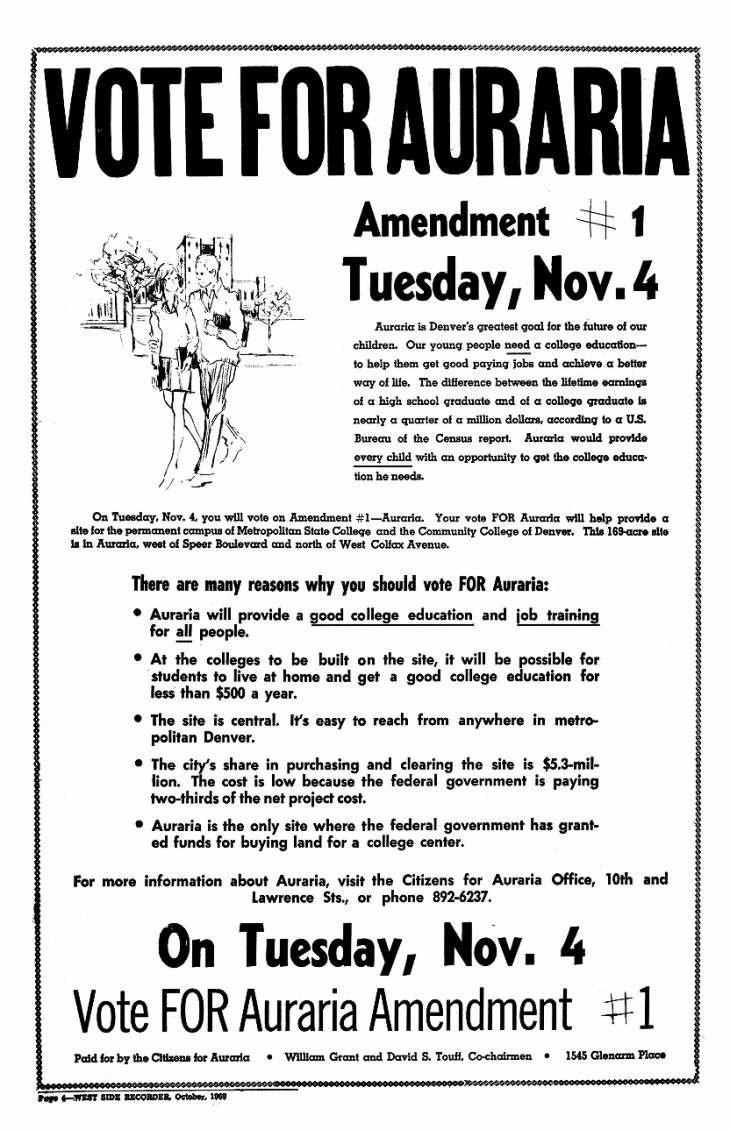
“Vote for Auraria” ad
LHP_Intern2020-08-30T02:21:34+00:00large newspaper ad urging citizens to vote for the Auraria campus proposal, 10-01-1969
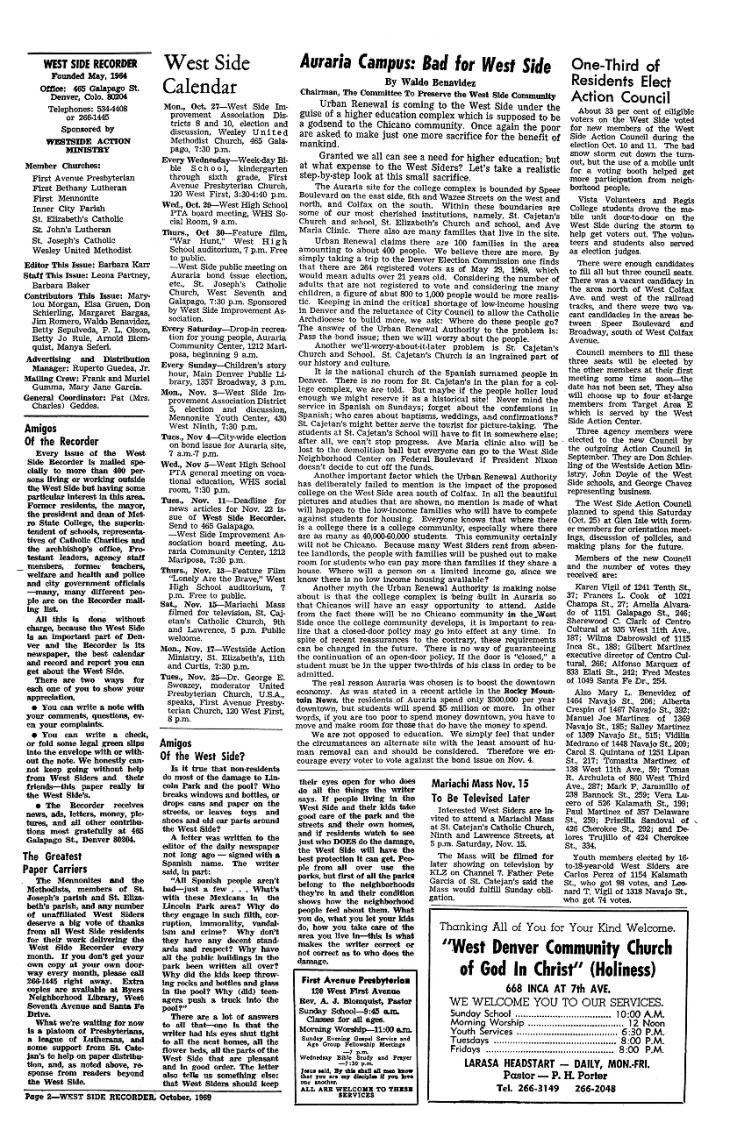
“Auraria campus bad for West Side”
LHP_Intern2020-08-30T02:21:33+00:00“Auraria Campus bad for West Side” article argues that the new campus will disrupt community life, displace low income residents, and might not help Chicano community access higher education etc; 10-01-1969
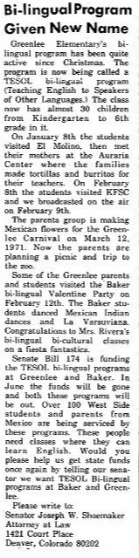
“Bilingual program given new name”
LHP_Intern2020-08-30T02:21:32+00:00Article on Greenlee Elementary’s bilingual program converting to TESOL, a state funded program 1971
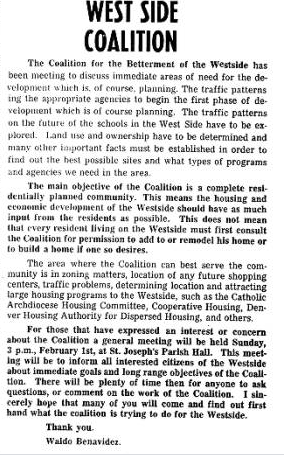
West Side Coalition community planning
LHP_Intern2020-08-30T02:21:31+00:00article by Waldo Benavidez on the new “Coalition for the Betterment of teh Westside” and its plans for urban and community development, 01-01-1970
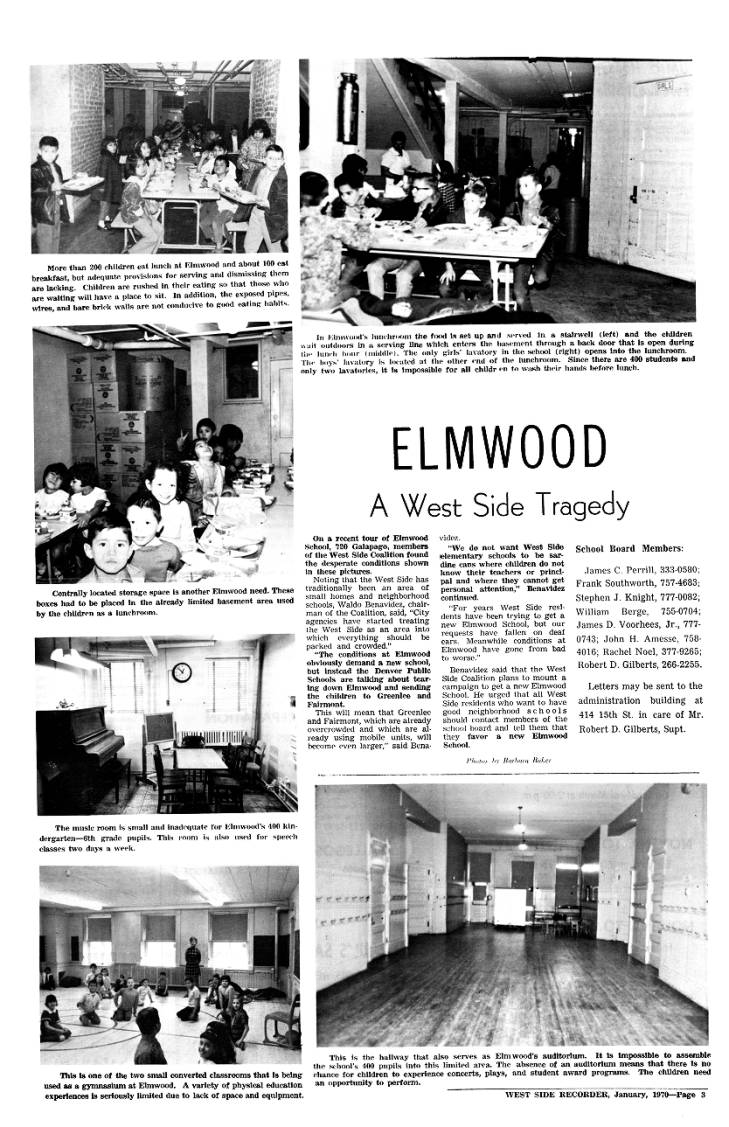
“Elmwood: A West Side Tragedy”
LHP_Intern2020-08-30T02:21:29+00:00article with lots of pictures on the deplorable state of Elmwood School, at 720 Gallapago, 01-01-1970
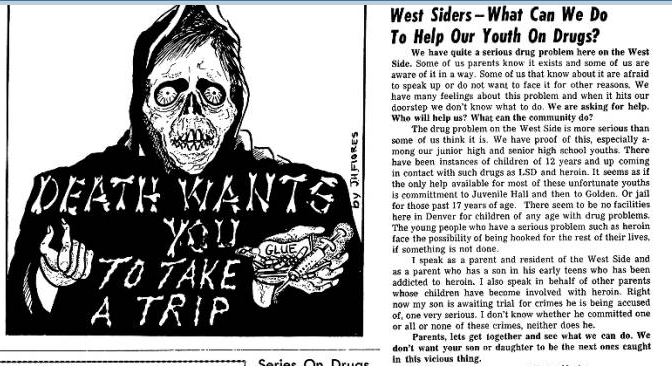
“West Siders – What can we do to help our youth on drugs?”
LHP_Intern2020-08-30T02:21:28+00:00“West Siders – What can we do to help our youth on drugs?” article talks about the drug problem among teens in the community and resulting crimes, calls for parents to pull together to come up with solutions, 01-01-1971
“Spanish for the Spanish Speaking”
LHP_Intern2020-08-30T02:21:27+00:00“Spanish for the Spanish Speaking” article on a new Spanish language class at West Side High School for students already fluent to study their language in depth, 01-01-1971
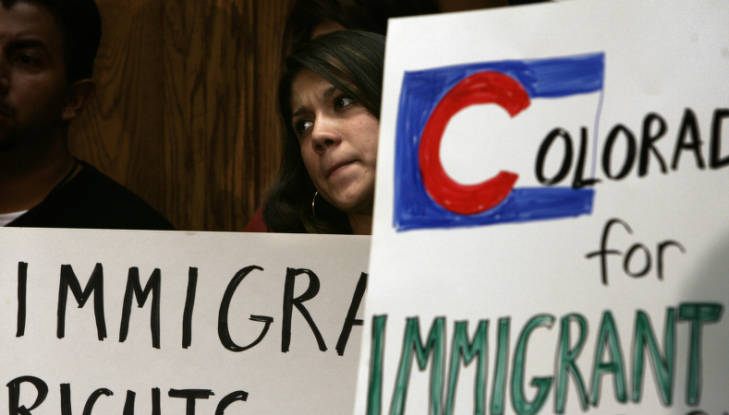
Denver student at the Colorado Capitol immigration discussion
LHP_Intern2020-08-30T02:25:17+00:00Angelica Garcia, student at Escuela Tlatelolco Centro de Estudios in Denver, protesting Coloradan legislators who participated in “citizen patrols” at US-Mexican border, 10-05-2005
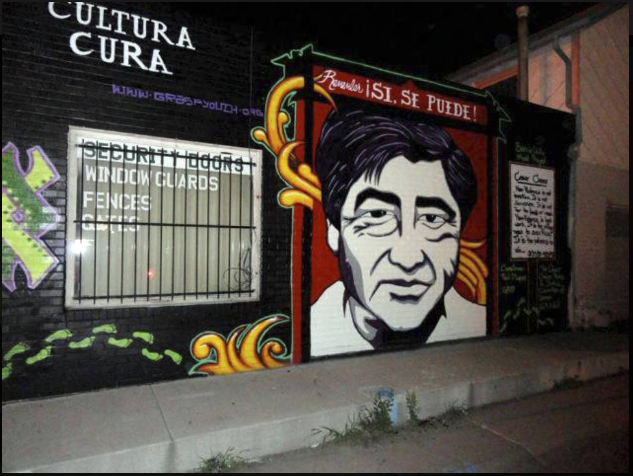
Cesar Chavez Mural by Javier Flores
LHP_Intern2020-08-30T02:28:22+00:00Cesar Chavez Mural by Javier Flores at Morrison Road and Lowell Blvd (Westwood neighborhood) c. 2010
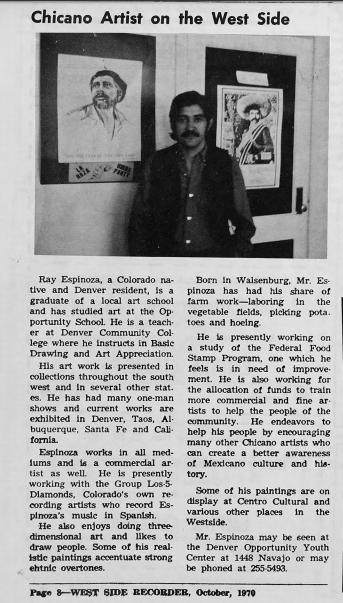
Chicano Artist Ray Espinosa
LHP_Intern2020-08-30T02:28:23+00:00article on Ray Espinosa, artist in West Side and art instructor at Denver Community College, working to bring awareness of Mexicano culture/history
West Side Recorder vol. 7, no. 6, 10-1-1970
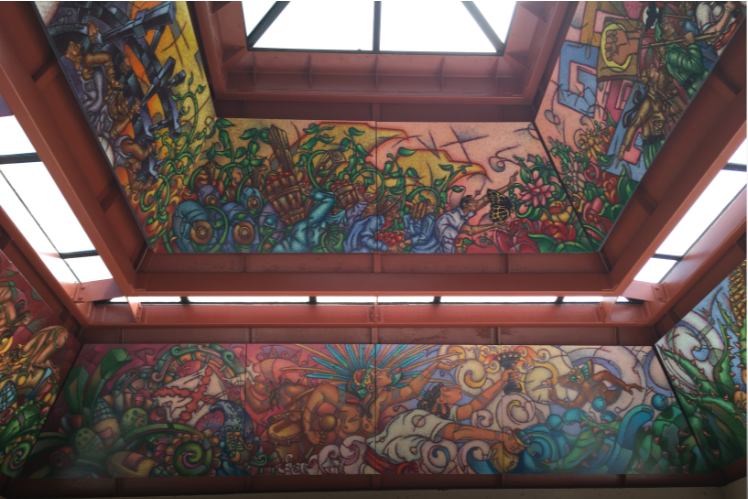
La Raza Park Mural “El Viaje” by David Ocelotl Garcia
LHP_Intern2020-09-09T19:59:24+00:00mural in La Raza Park, Sunnyside by David Ocelotl Garcia illustrating the Mexican peoples’ history (2016)
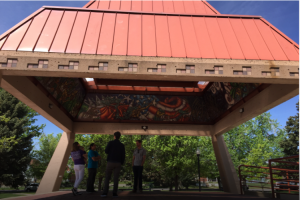
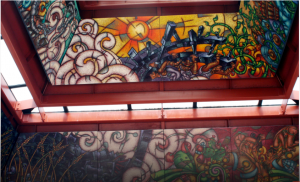
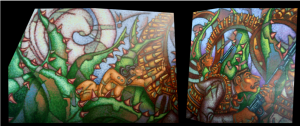
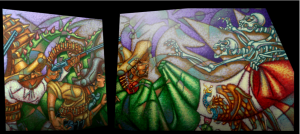

La Alma mural by Emanuel Martinez
LHP_Intern2020-08-30T02:28:26+00:00mural at the La Alma Recreation Center in Lincoln Park by Emanuel Martinez, showing the Hispanic soul of the Westside community (1973)
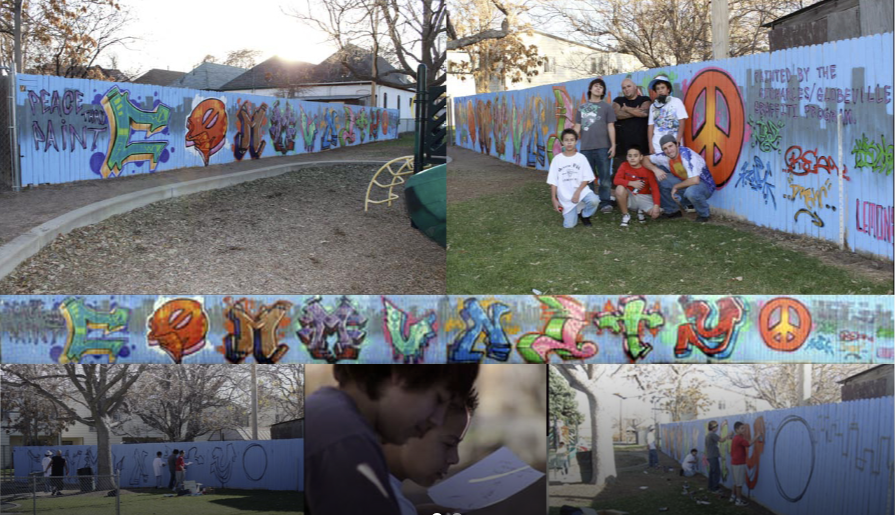
Globeville Recreation Center Murals
LHP_Intern2020-08-30T02:28:27+00:00Youth created mural at the Globeville Recreation Center, with the help of YNIG, undated
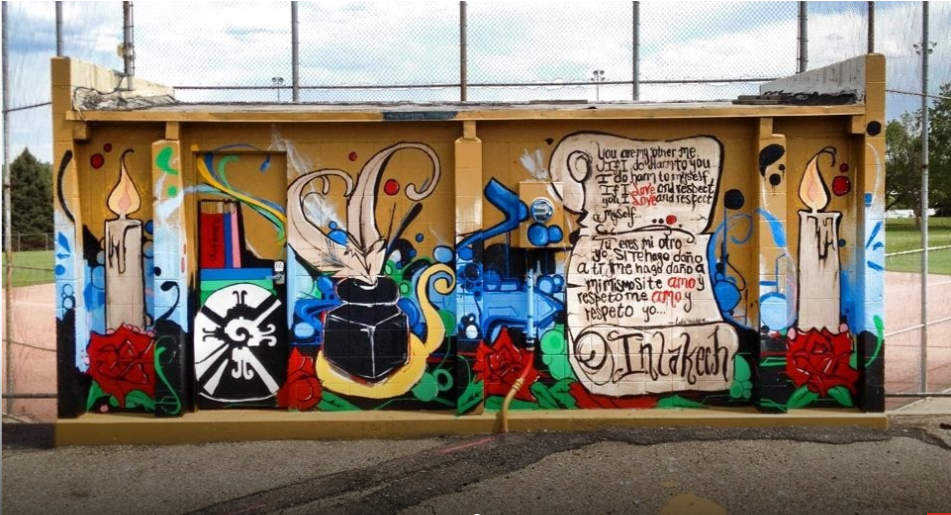
Mural in Ruby Hill Park
LHP_Intern2020-08-30T02:28:28+00:00Mural in Ruby Hill Park (1501 W. Jewell Ave) by Jay Jaramillo and Nadia Saldana-Spiegle, depicting a scroll with Spanish text, ink, candles, c. 2013
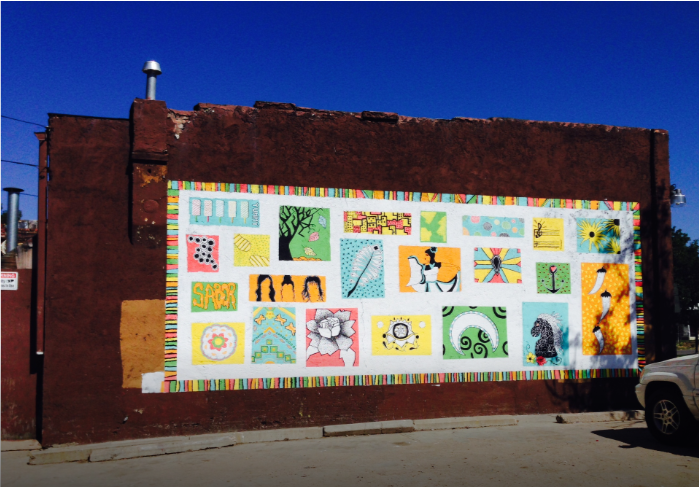
Mural “Como Sabor” by Alexandria Jimenez
LHP_Intern2020-08-30T02:28:29+00:00Mural “Como Sabor” by Alexandria Jimenez in the Five Points Neighborhood (2014)
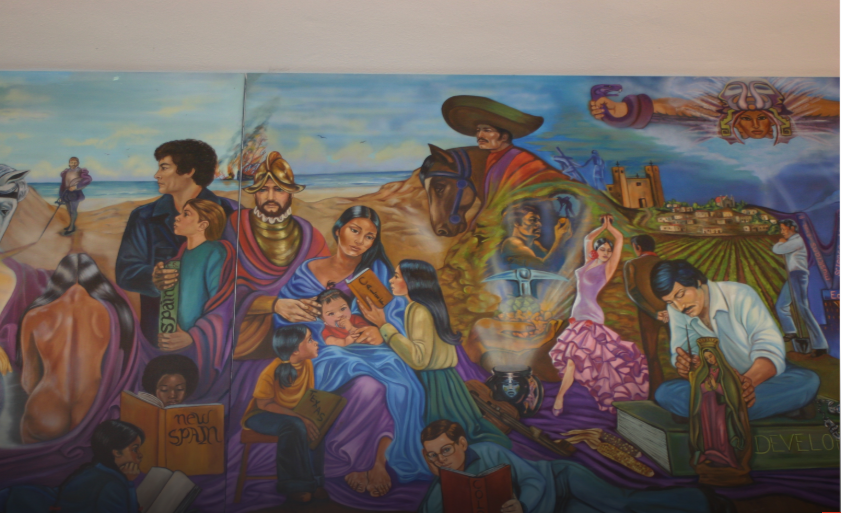
Mural “Pasado, Presente, Futuro” by Carlota Espinoza
LHP_Intern2020-08-30T02:28:31+00:00Mural “Pasado, Presente, Futuro” by Carlota Espinoza at the Byers Branch Library in Lincoln Park (1977)
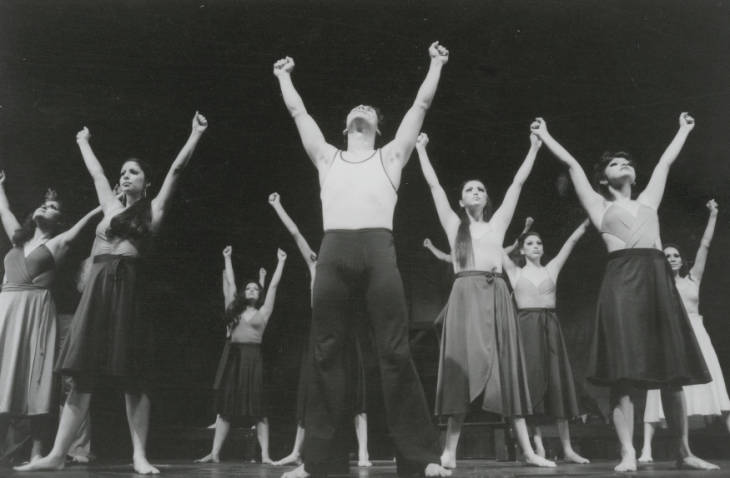
National Chicano Theater Group in Denver
LHP_Intern2020-09-09T20:31:43+00:00Members of the National Chicano Theatre, directed by Enrique Montano, on stage in Denver, c. 1981
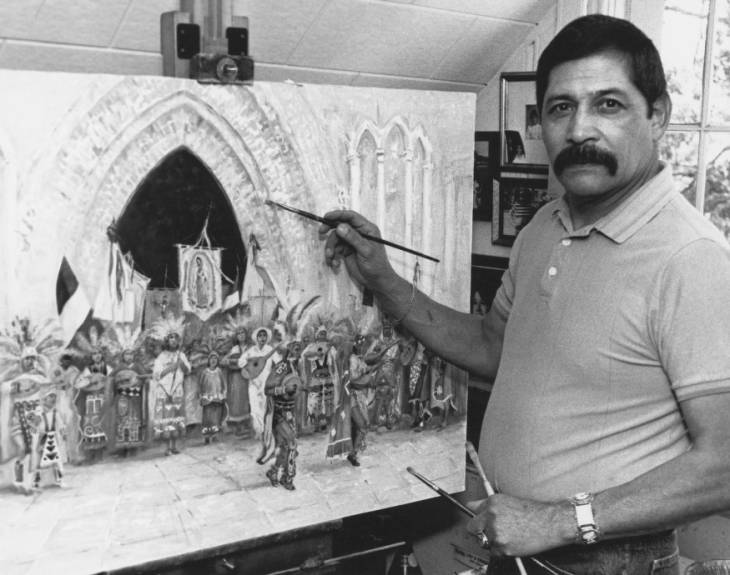
Artist John Flores, 1991
LHP_Intern2020-08-30T02:28:33+00:00Artist John Flores poses with one of his paintings, c. 1991
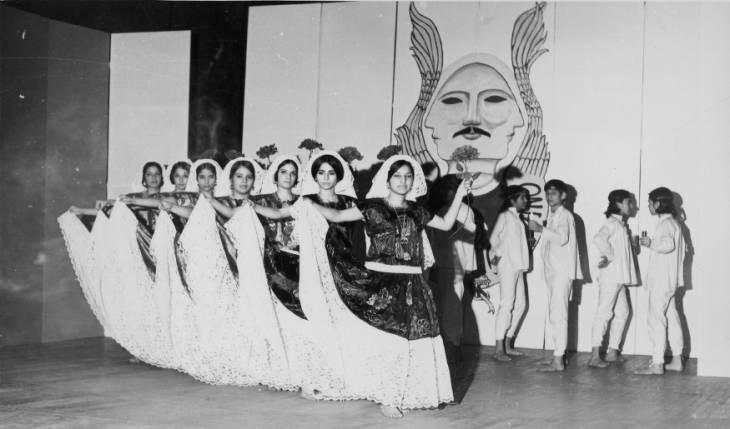
Ballet Chicano de Aztlán, 1970
LHP_Intern2020-09-09T20:34:40+00:00The Ballet Chicano de Aztlán, a dance group that was part of the Crusade for Justice, dance in Mexican costume
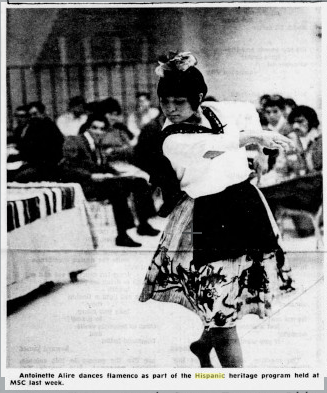
Young girl dances during Hispanic Heritage Program, 1969
LHP_Intern2020-08-30T02:52:17+00:00Antoinette Alire dances flamenco during Hispanic heritage program at Metro State, 03-03-1969
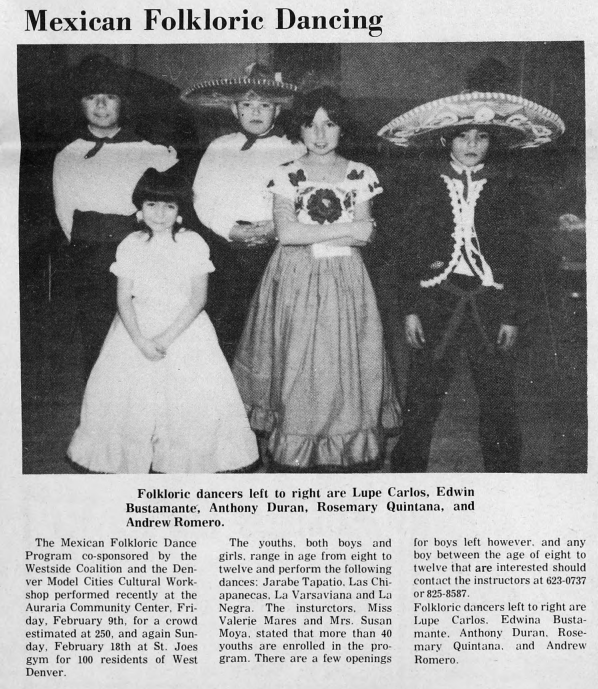
Mexican Folkloric Dance Program, 1973
LHP_Intern2020-08-30T02:53:58+00:00Dancers Lupe Carlos, Edwin Bustamante, Anthony Duran, Rosemanry Quintana, Andrew Romero perform at the Denver Model Cities Cultural Workshop, 02-01-1973
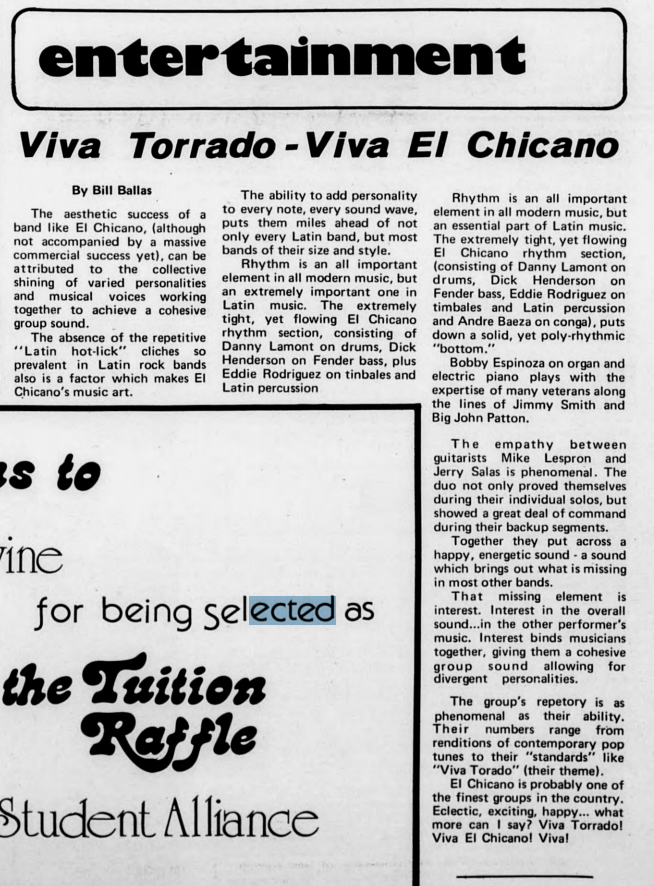
Rock band “El Chicano,” 1973
LHP_Intern2020-08-23T20:48:58+00:00“Viva Torrado – Viva El Chicano” article by Bill Ballas analyzing local rock band El Chicano
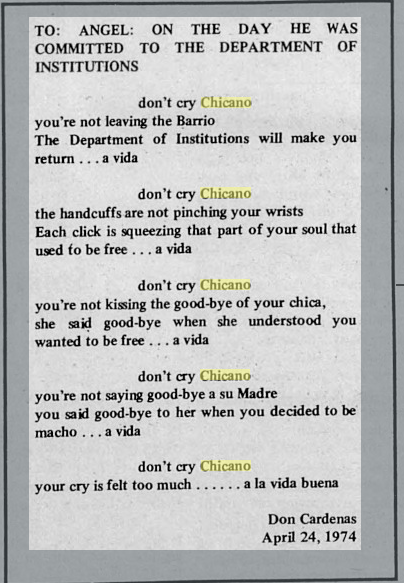
Poem by Don Cardenas, 1974
LHP_Intern2020-08-23T20:48:10+00:00“To: Angel: On the day he was Committed to the Department of Institutions” by Don Cardenas, 04-24-1974
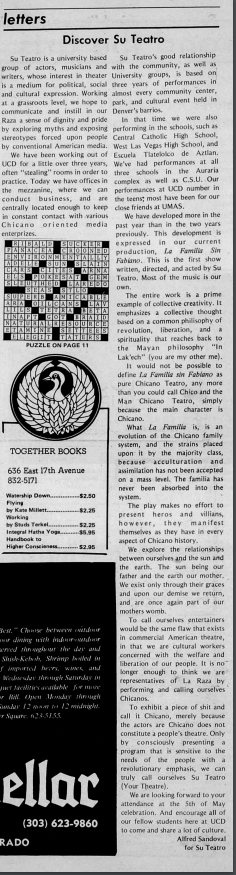
Discover Su Teatro, 1975
LHP_Intern2020-08-23T20:47:19+00:00About “Su Teatro” a university theatre and musical group who perform political pieces for the Denver Chicano community, in neighborhood theatres and parks
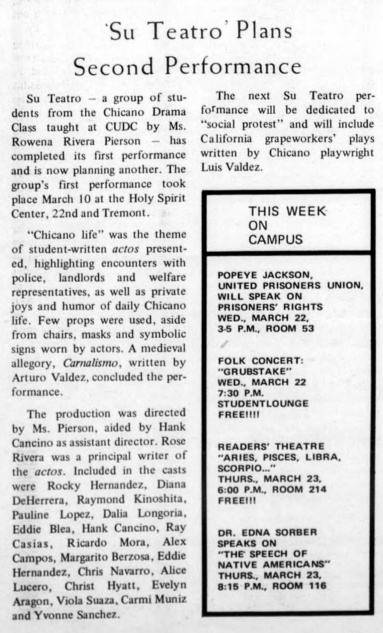
Discover Su Teatro Plans Second Performance, 1972
LHP_Intern2020-08-23T20:46:29+00:00About “Su Teatro” a university theatre and musical group who perform political pieces for the Denver Chicano community, in neighborhood theatres and parks

Artist Carlos Frésquez
LHP_Intern2020-08-23T20:45:29+00:00Artist Carlos Frésquez, with one of his works “La Raza Cosmica”, 2005
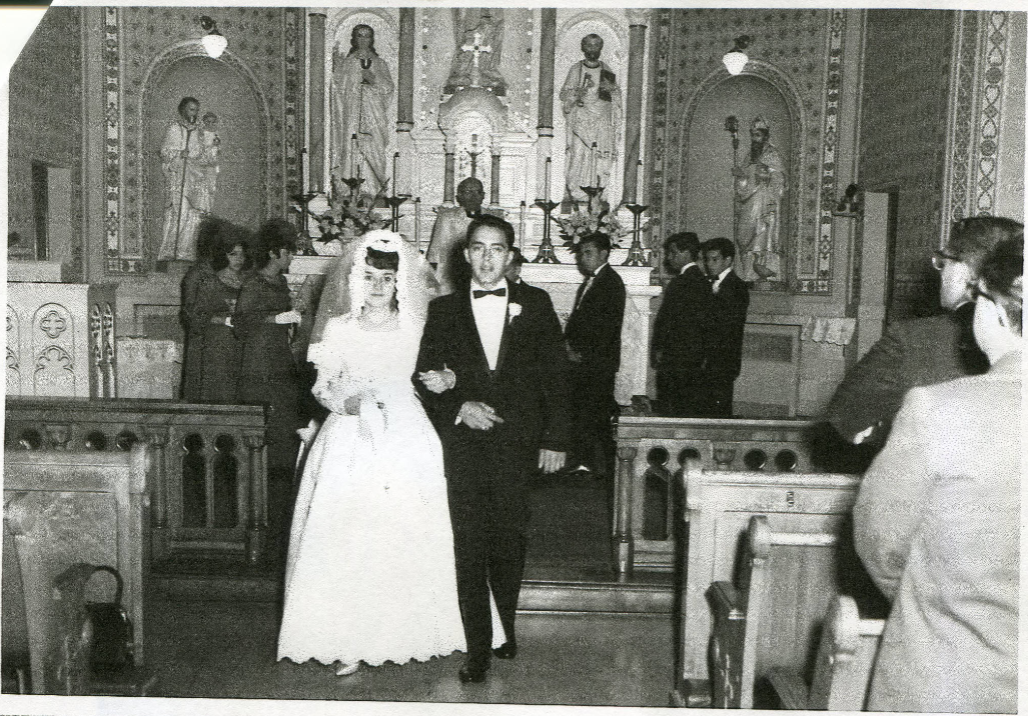
Herrera Wedding in Globeville
LHP_Intern2020-09-09T20:13:03+00:00Herrera Wedding in Globeville, c. 1966
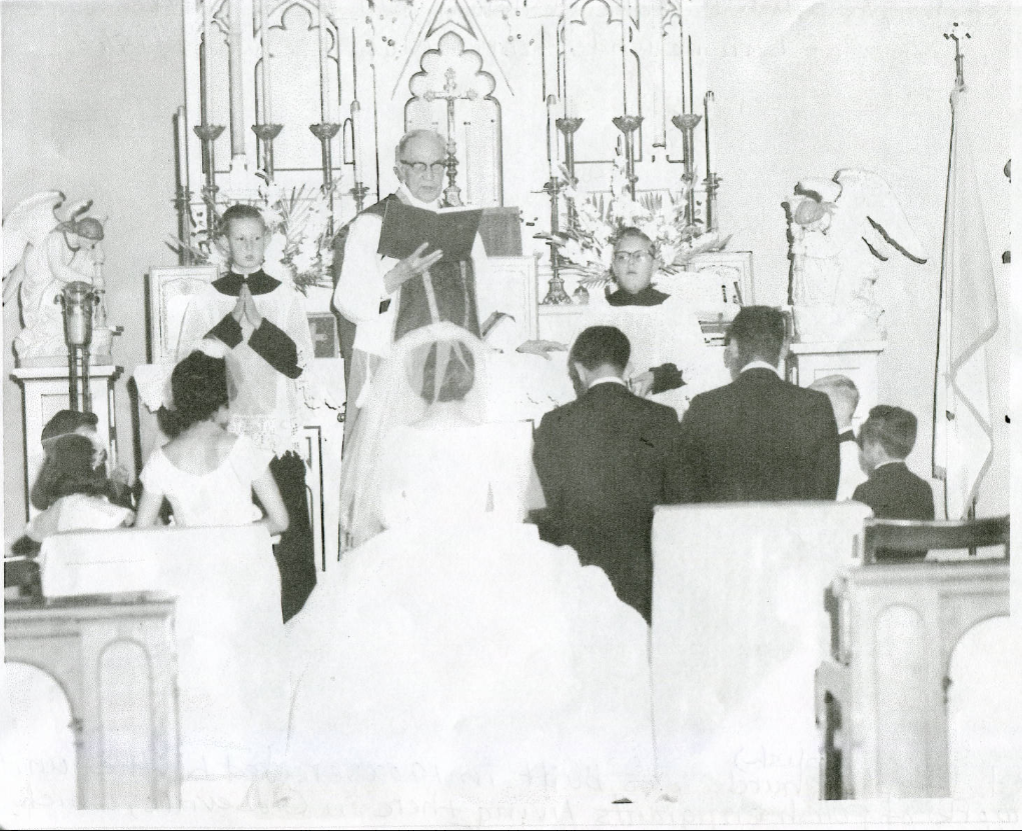
Muñiz Wedding
LHP_Intern2020-09-09T20:18:04+00:00Muñiz Wedding at St. Joseph’s Church in Globeville, 10-15-1966
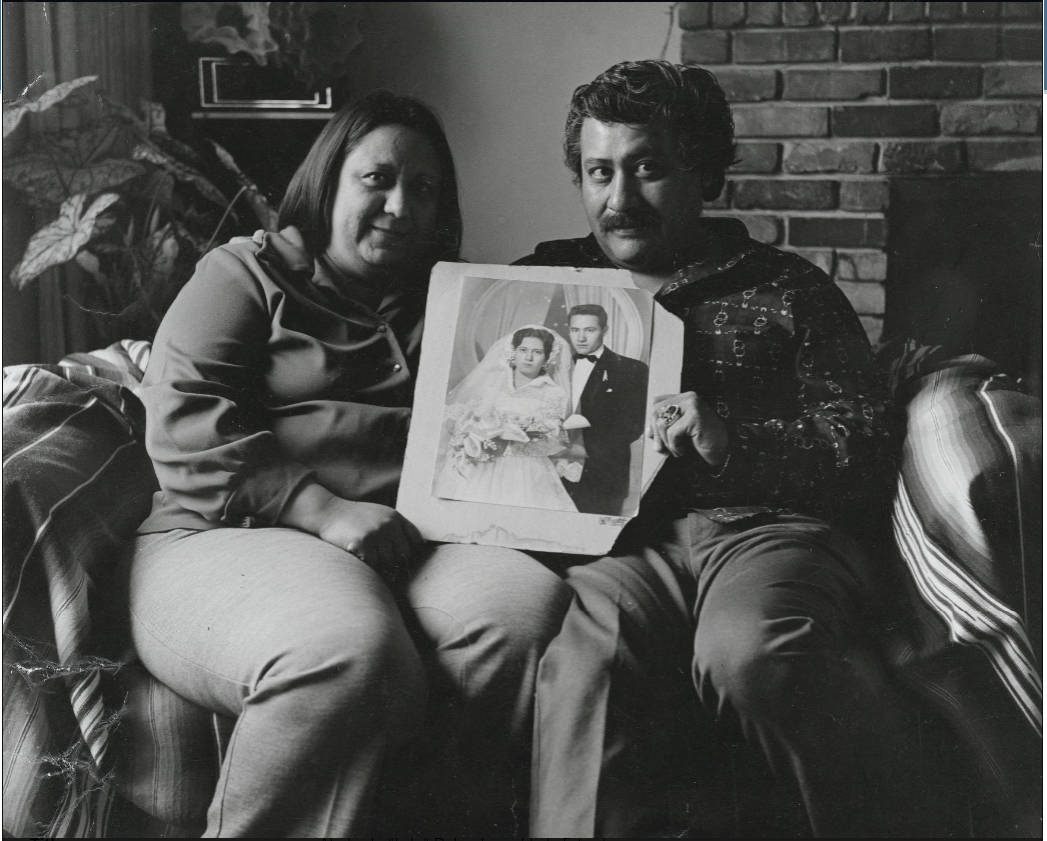
Abelardo and Lola Estrada Delgado Wedding
LHP_Intern2020-08-30T03:02:45+00:00Picture of Abelardo “Lalo” Delgado and his wife Lola Estrada Delgado holding their wedding picture (c. 1981)
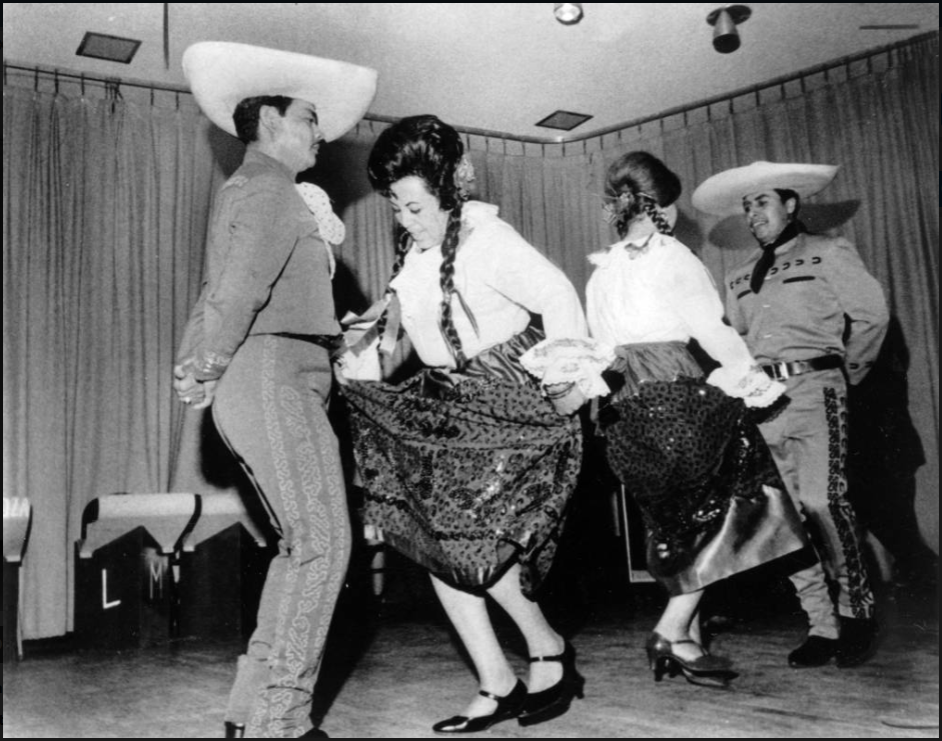
Mexican Independence Day Celebration at the Colorado Grange Building, Denver
LHP_Intern2020-08-23T20:41:32+00:00Mexican Americans performing a traditional dance at a Mexican Independence Day celebration at the Colorado Grange Building in Jefferson Park neighborhood of Denver (c. 1968)
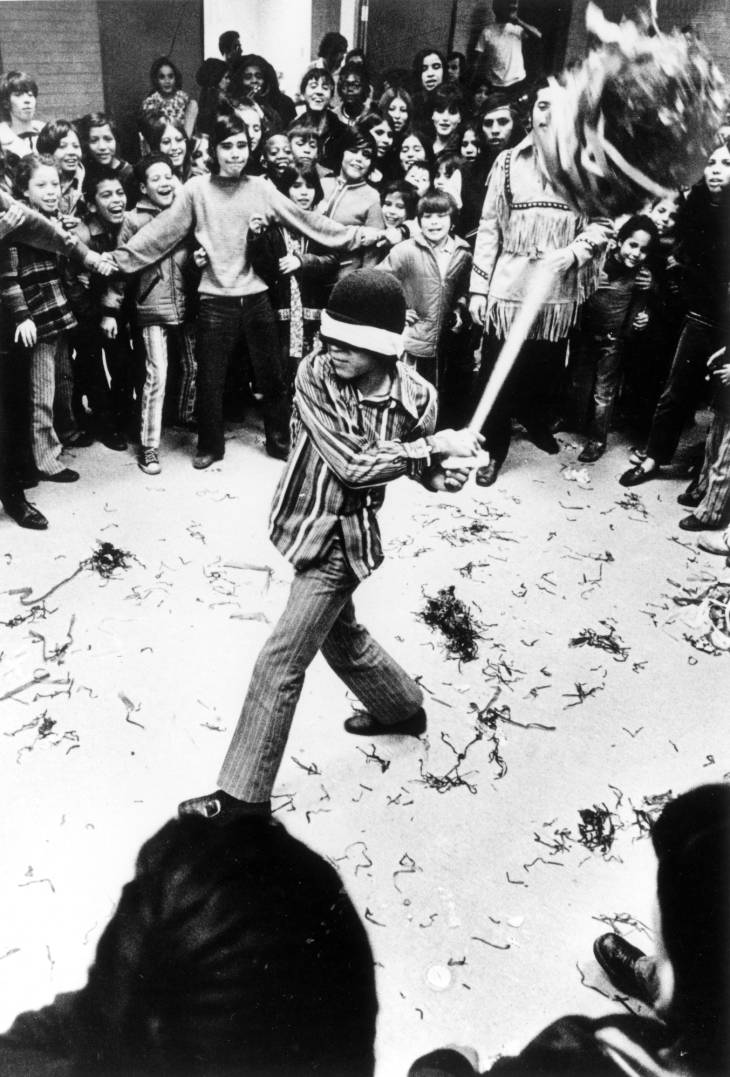
Piñata Party
LHP_Intern2020-08-23T20:40:27+00:00A group of Chicano children with a piñata at a party, Denver, c. 1970s
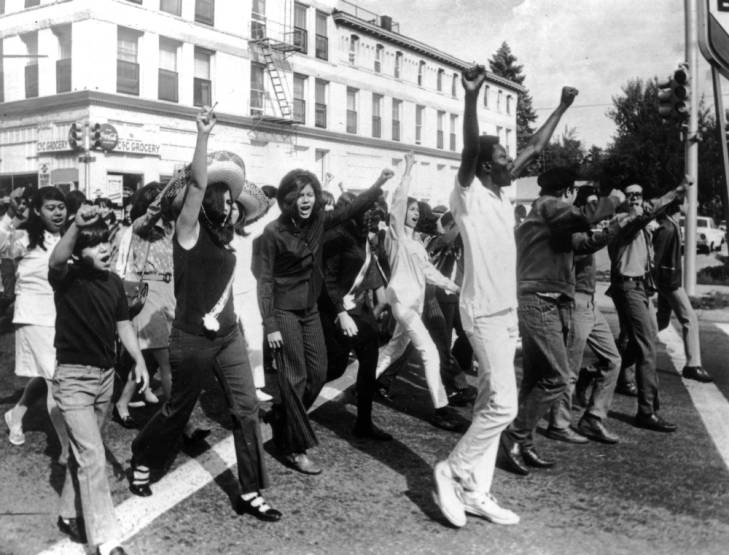
Mexican Independence Day Celebration and March
LHP_Intern2020-08-23T20:37:39+00:00Chicanos and African Americans march on 32nd Ave. in Denver to commemorate Mexican Independence Day (09-16-1969)
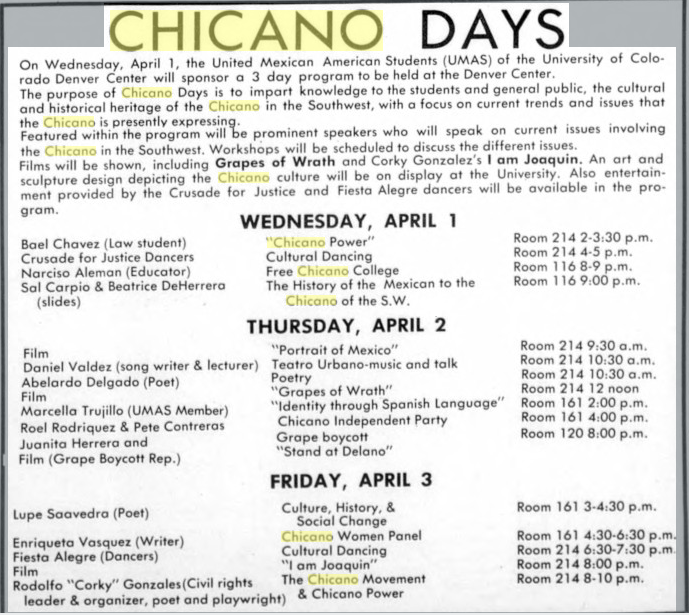
Chicano Days Schedule
LHP_Intern2020-08-23T20:32:00+00:00Article showing the Chicano Days celebrations schedules at the University of Colorado Denver in April 1970
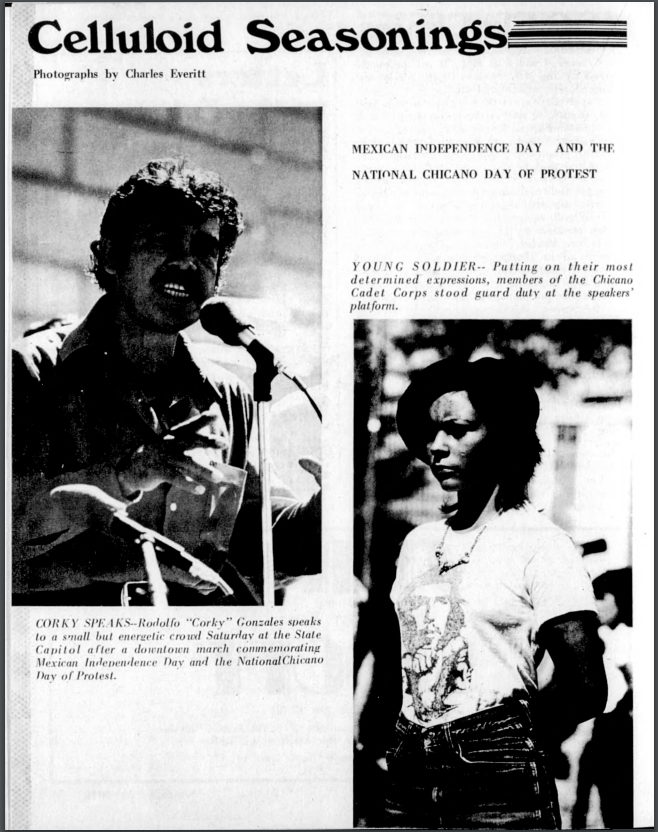
Mexican Independence Day and the National Chicano Day of Protest
LHP_Intern2020-08-23T20:31:03+00:00Article in student newspaper Cherry Creek Pioneer – Metro State with pictures of the annual Mexican Independence Day and the National Chicano Day of Protest in 1976
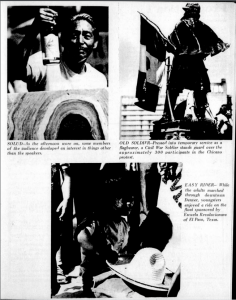
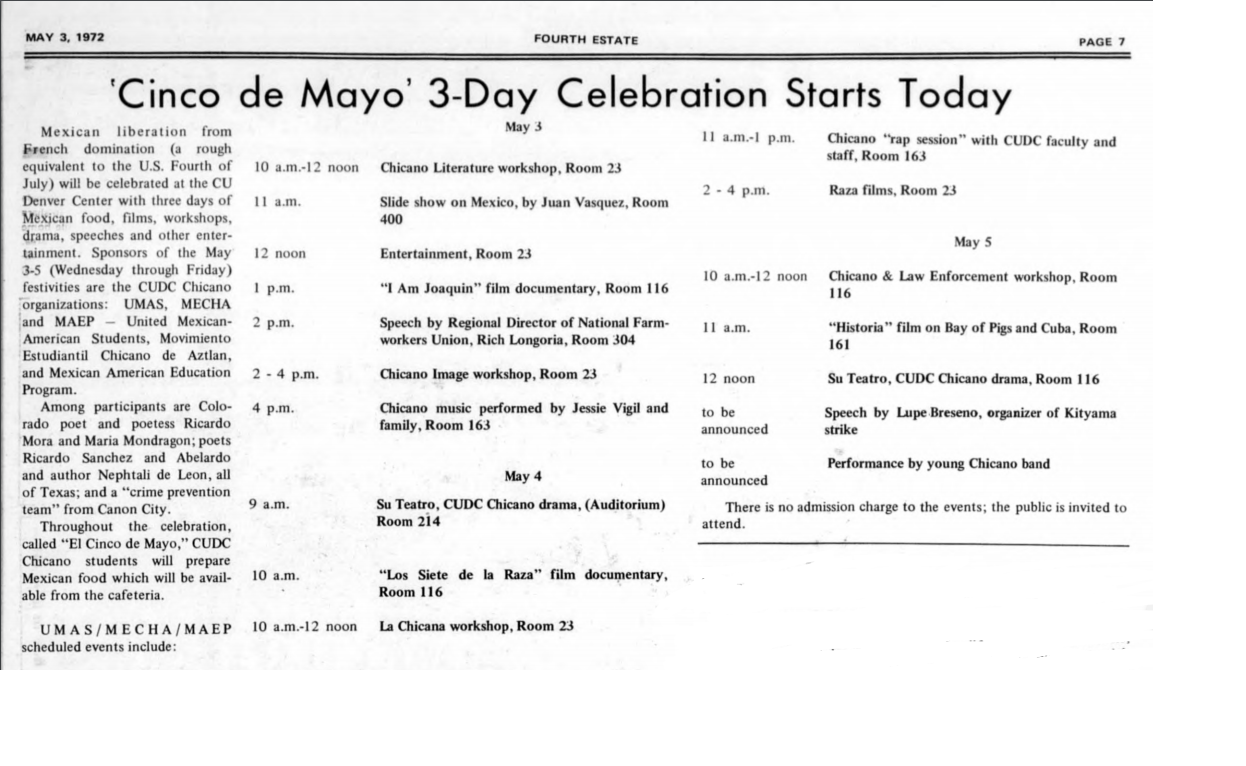
Cinco de Mayo Celebrations at the University of Colorado Denver
LHP_Intern2020-08-23T20:30:00+00:00Article in the Fourth Estate–University of Colorado Denver, on a three day celebration of Cinco de Mayo, emphasizing Chicano culture and food with documentaries, music, theatre, and workshops 05-03-1972
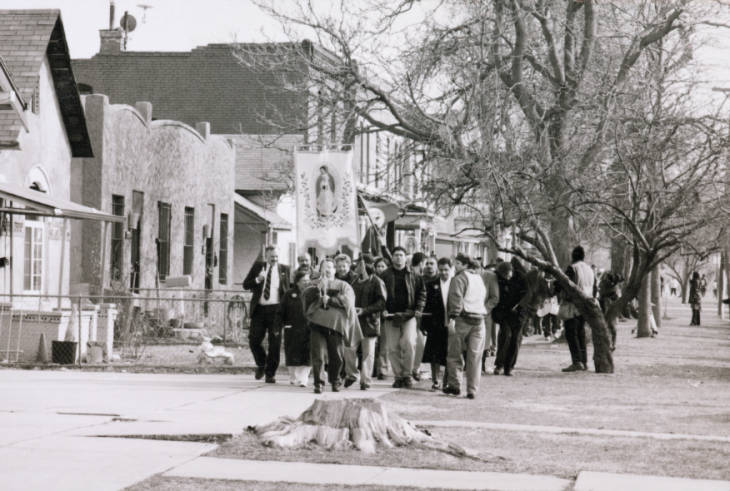
March celebrating Cesar Chavez Day
LHP_Intern2020-08-23T20:29:09+00:00Picture of marchers led by Ramon del Castillo celebrating the first Colorado Cesar Chavez Day in Denver
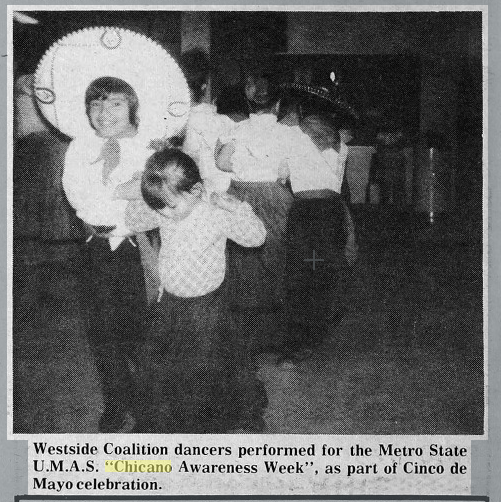
Children dancers at “Chicano Awareness Week,” 1973
LHP_Intern2020-08-30T02:54:43+00:00Westside Coalition children dancers perform at Metro State as part of “Chicano Awareness Week,” part of the Cinco de Mayo celebration 05-01-1973
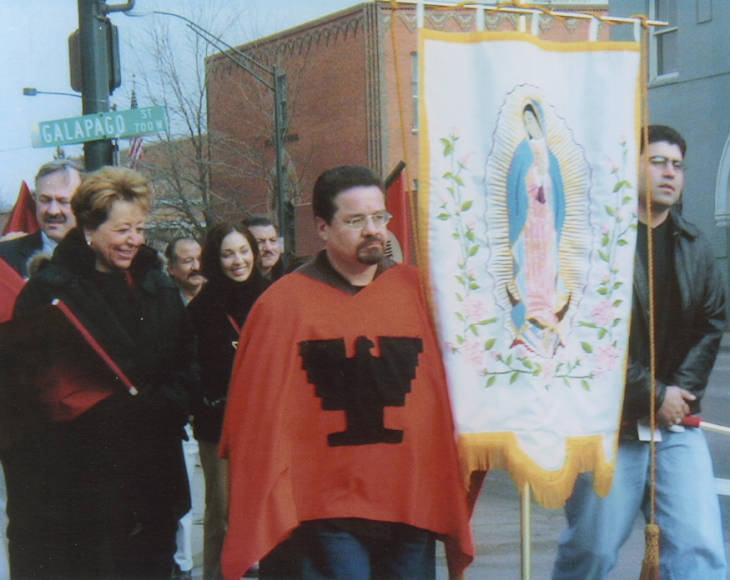
La Alma/Lincoln Park Cesar Chavez Day March
LHP_Intern2020-08-23T20:23:42+00:00Cesar Chavez Day, annual march in Lincoln Park neighborhood, with councilwoman Ramona Martinez, 2002
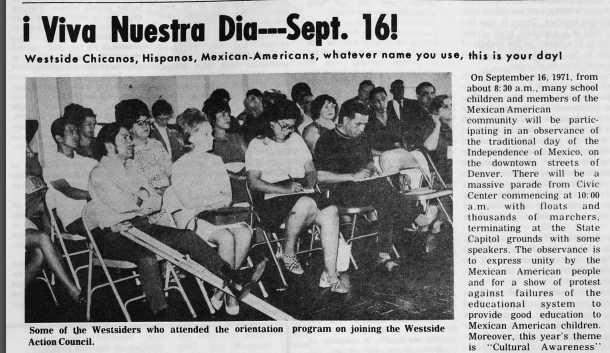
Viva Nuestra Dia
LHP_Intern2020-09-09T22:02:00+00:00Article on celebrating September 16 in Westside, 09-16-1971
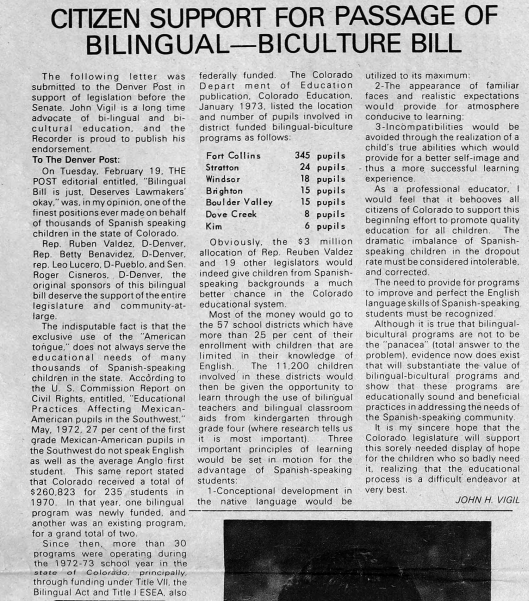
Citizen support for bilingual education bill, 1974
LHP_Intern2020-08-23T18:58:41+00:00“Citizen support for passage of bilingual-bicultural bill” copy of letter in the Denver Post on how the bilingual education bill would benefit Colorado students, 04-01-1974

Bilingual Bill Introduced
LHP_Intern2020-08-23T18:57:51+00:00“Bilingual Bill Introduced” article on a new bill introduced in the state legislature by representatives Betty Benavidez and Roger Cisneros to add Spanish language classes and support for Colorado elementary school students
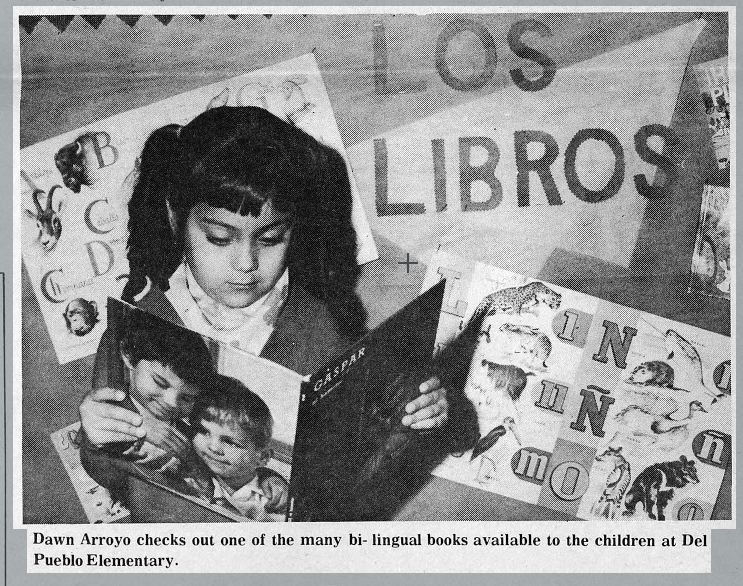
Bilingual Library for Westside School
LHP_Intern2020-08-23T18:57:04+00:00Newspaper picture of young student at Del Pueblo Elementary checking out new bilingual books at school library
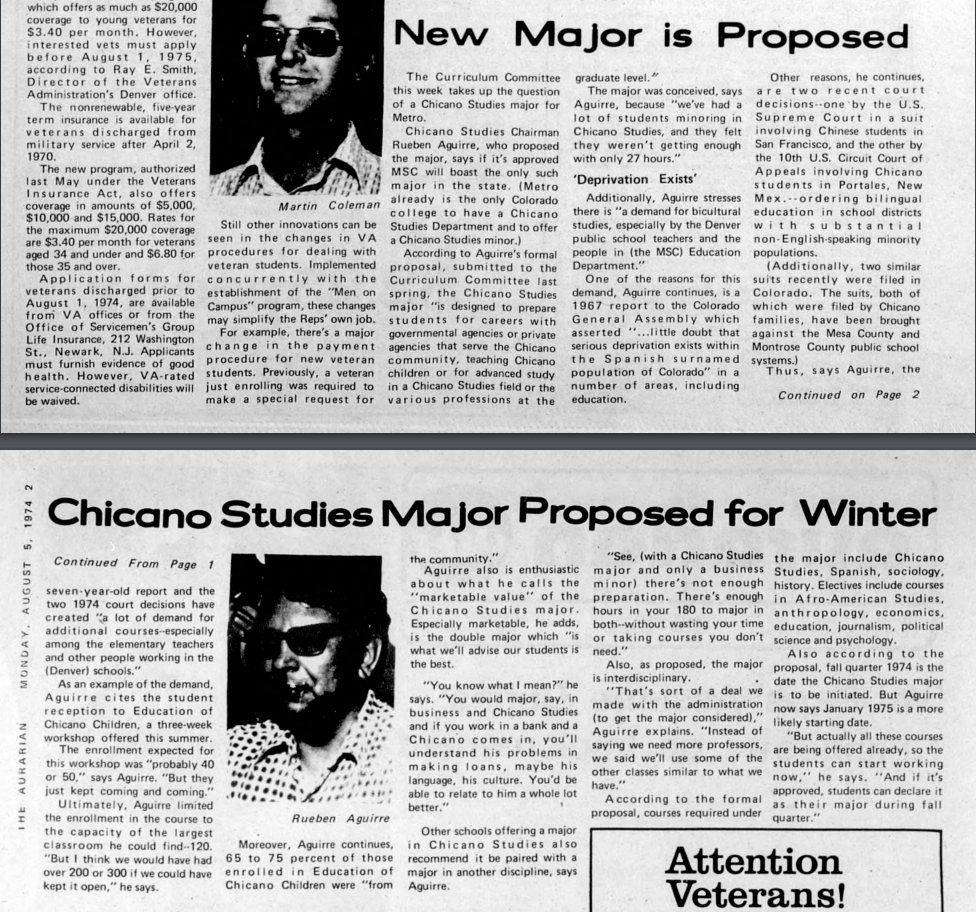
Proposing a Chicano Studies major
LHP_Intern2020-08-23T18:56:21+00:00Article on Metro State considering the addition of Chicano Studies and how this will benefit Chicano and other students 08-05-1974
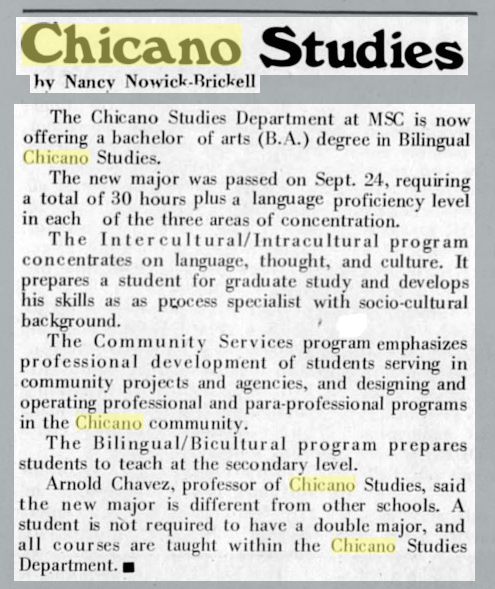
Career trajectories for Chicano studies students
LHP_Intern2020-08-23T18:55:33+00:00Article “Chicano Studies” by Nancy Nowick-Brickell discusses the three different concentrations within Metro State’s Chicano studies program and how they prepare students for different careers 10-20-1976
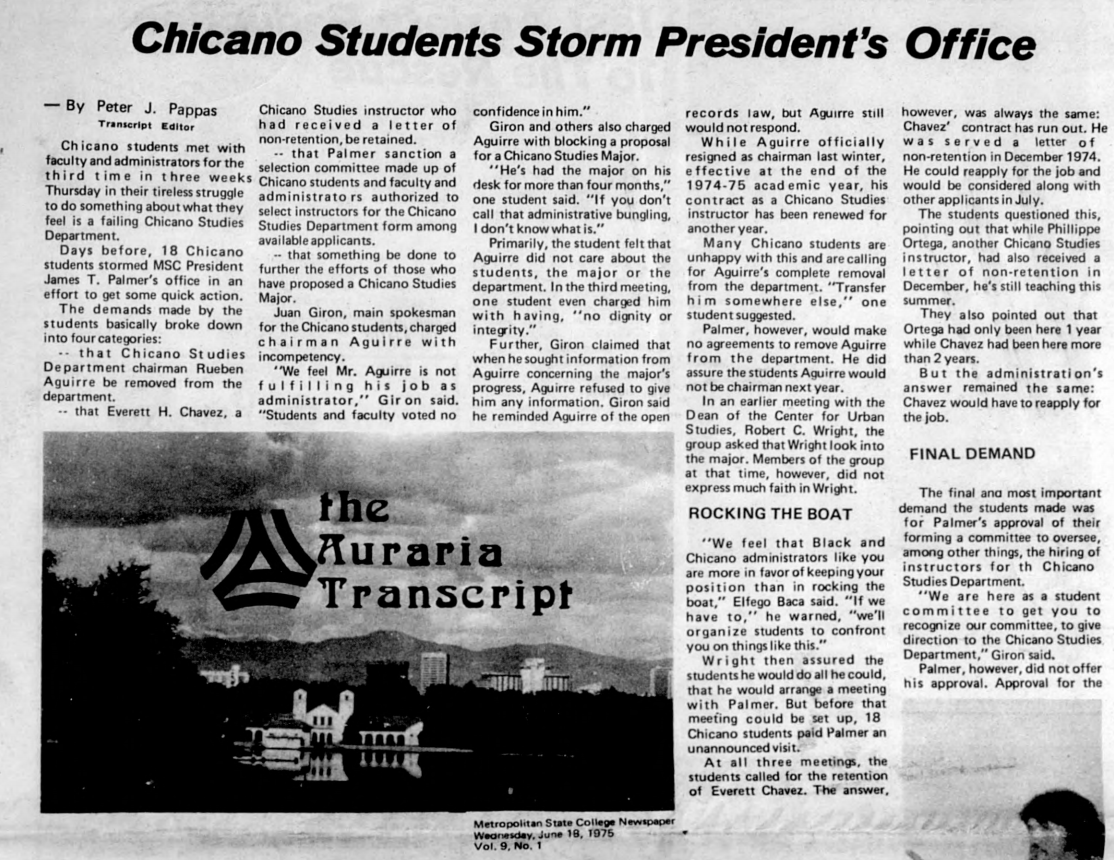
Student disappointment with Chicano Studies Program at Metro State, 1975
LHP_Intern2020-08-23T18:54:30+00:00Article “Chicano Students Storm President’s Office’ by Peter J. Pappas in the Auraria Transcript discussing the failures and shortcomings in the Chicano Studies Program (06-18-1975)
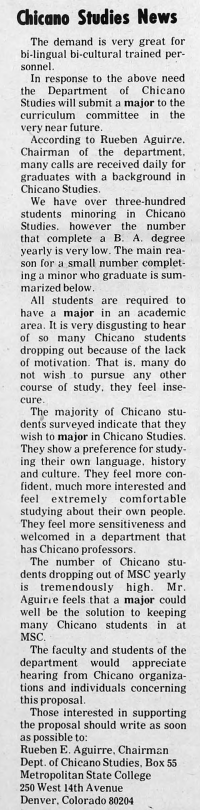
Chicano studies major helps students succeed
LHP_Intern2020-08-23T18:53:39+00:00Article “Chicano Studies News” in community paper West Side Recorder on how Chicano studies encourages university students to succeed and finish their degrees 06-01-1973
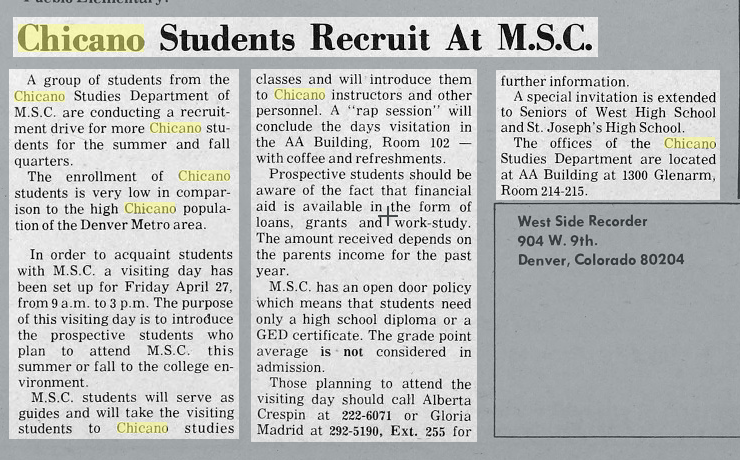
Recruiting students for Chicano Studies
LHP_Intern2020-08-23T18:52:46+00:00Article “Chicano Students Recruit at MSC” in community paper West Side Recorder on an open day to encourage prospective students to the Chicano studies program, with various application and financial aid assistance 04-01-1973
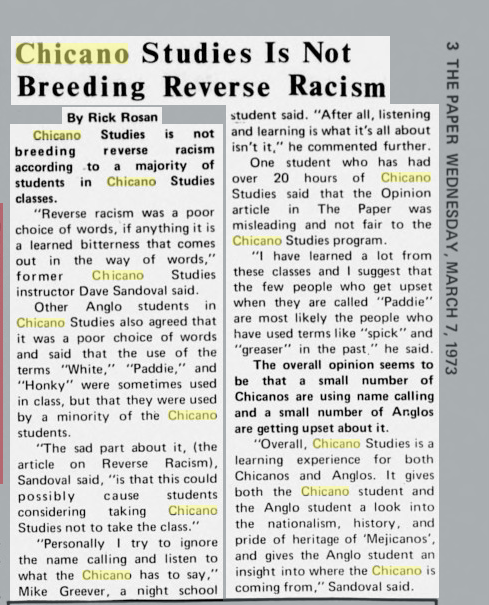
Controversy with Chicano Studies Programs, 1973
LHP_Intern2020-08-23T18:51:41+00:00Article “Chicano Studies is not Breeding Reverse Racism” by Rick Rosan in The Paper – Metro State (03-07-1973)
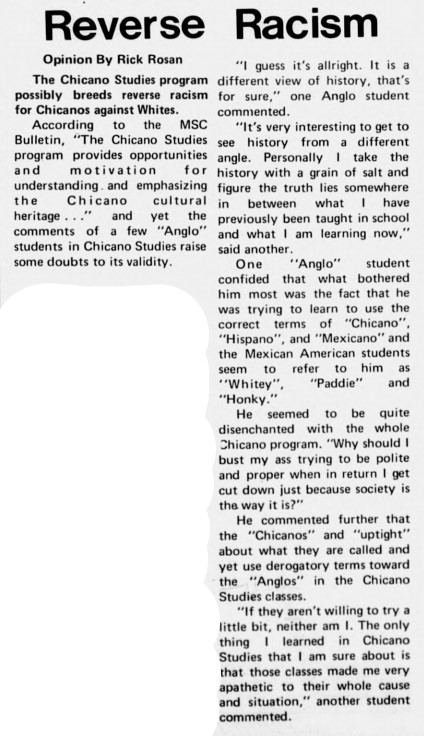
Allegations of Racism in Chicano Studies, 1973
LHP_Intern2020-08-23T18:50:26+00:00Article “Reverse Racism” by Rick Rosan in The Paper – Metro State alleges that Chicano studies provides opportunity for reverse racism 02-28-1973
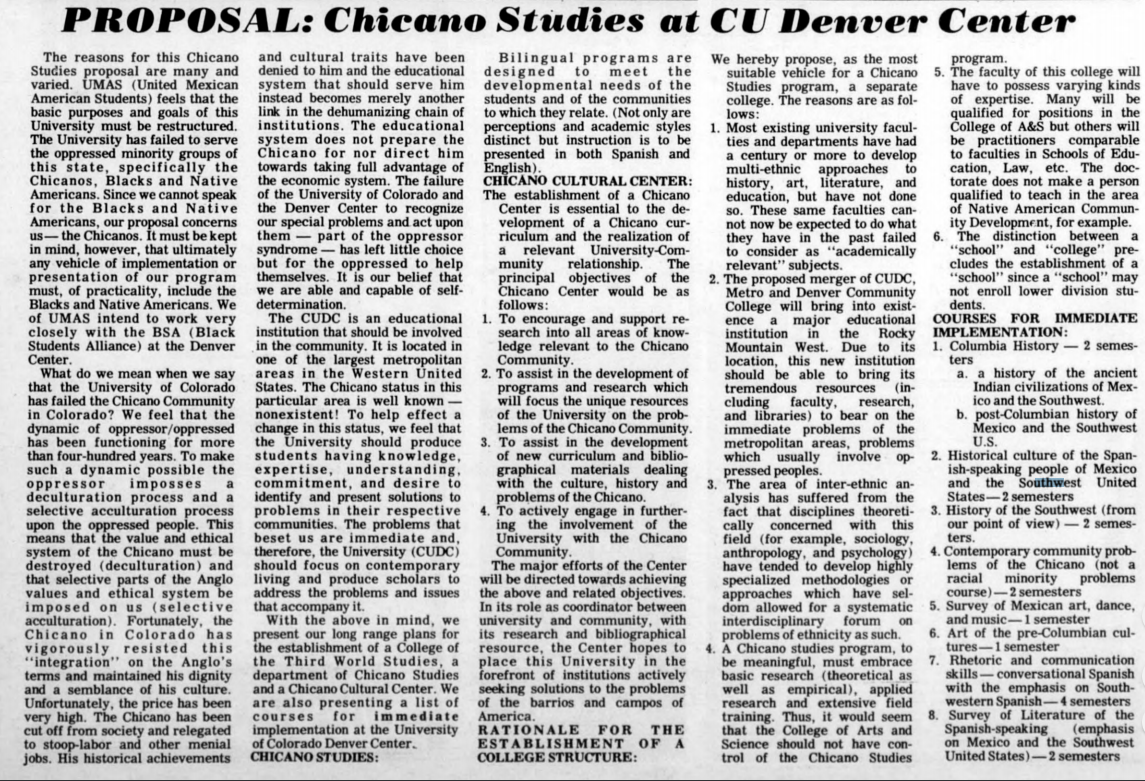
Proposal for Chicano Studies at CU Denver, 1969
LHP_Intern2020-08-23T18:48:25+00:00Article “Proposal: Chicano Studies at CU Denver Center” in the Fourth Estate – University of Colorado Denver 04-30-1969
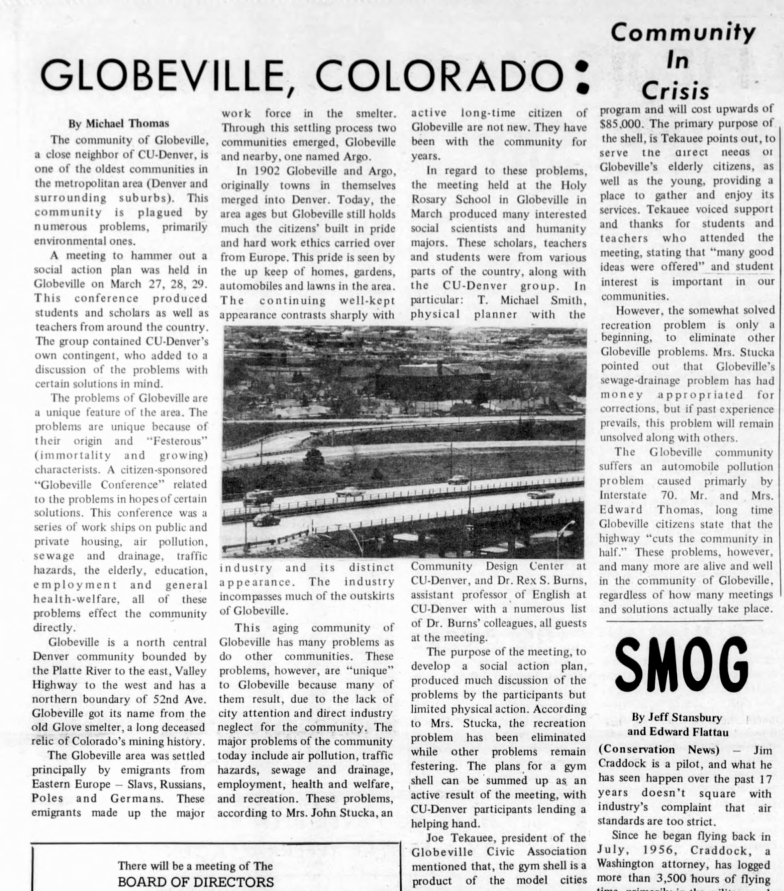
“Globeville, Colorado: Community in Crisis,” 1973
LHP_Intern2020-08-23T18:47:33+00:00Article about the challenges facing Globeville, 04-17-1973
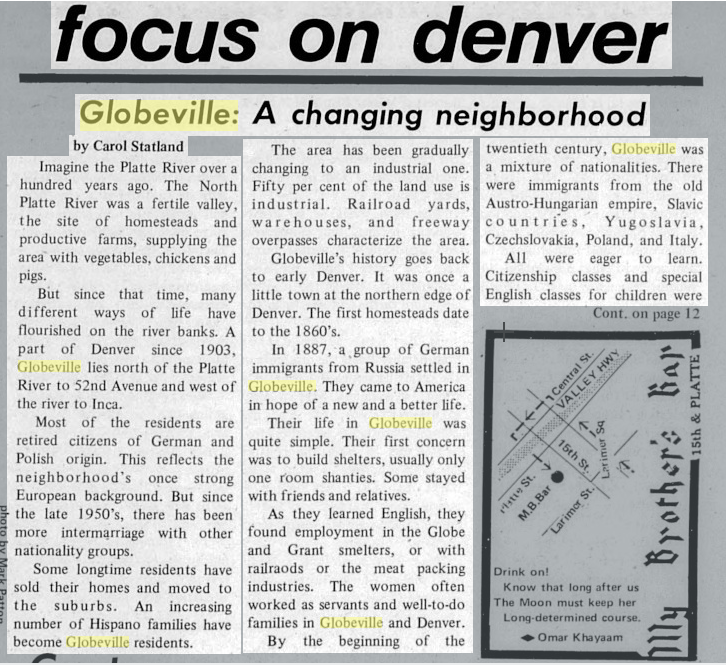
“Globeville: A changing neighborhood,” 1974
LHP_Intern2020-08-23T18:44:48+00:00Article with history of ever changing Globeville and its history of minority populations 11-20-1974
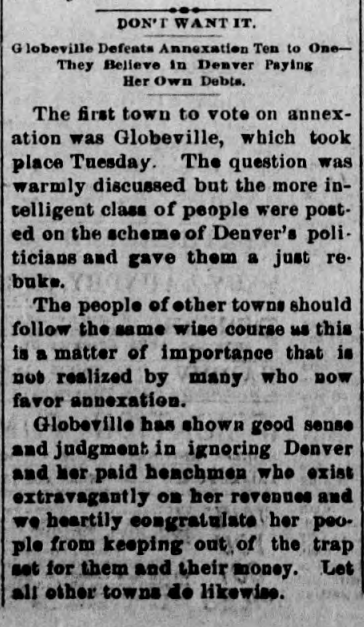
“Globeville defeats Annexation Ten to One,” 1893
LHP_Intern2020-08-23T18:43:10+00:00Article on failure of Globeville to annex into Denver, distrust of Denver’s “paid henchmen” 09-01-1893
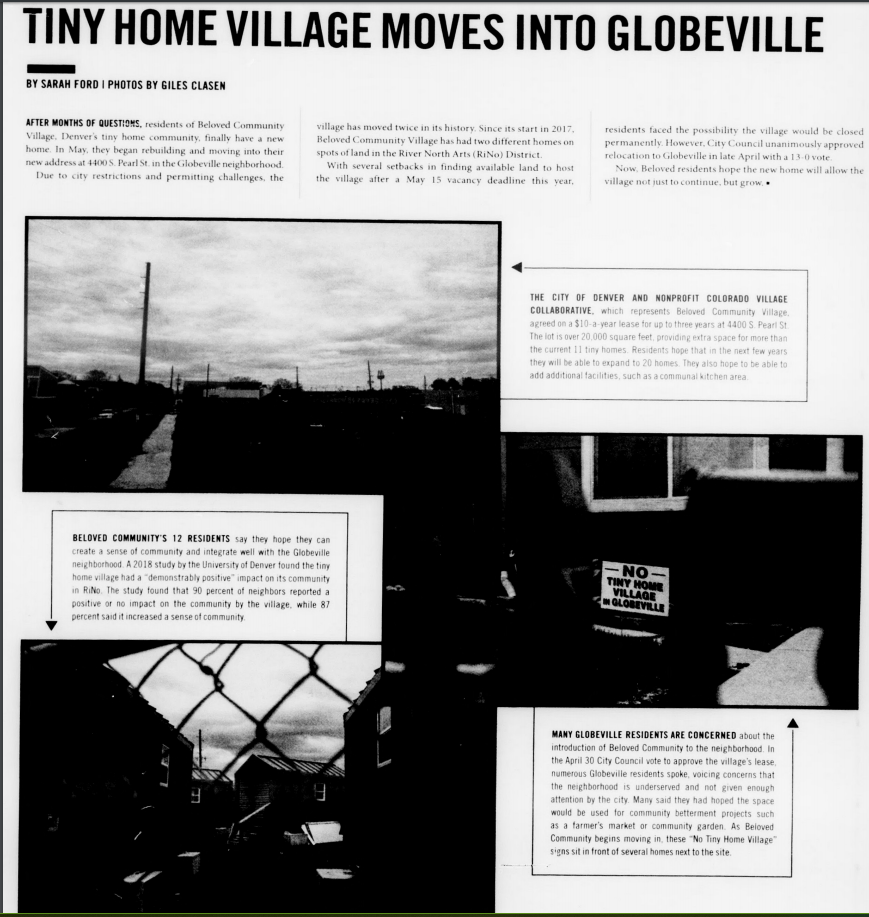
“Tiny Home Village Moves into Globeville,” 2019
LHP_Intern2020-08-23T18:41:49+00:00Article on a new fad in Globeville that has residents concerned, 06-01-2019
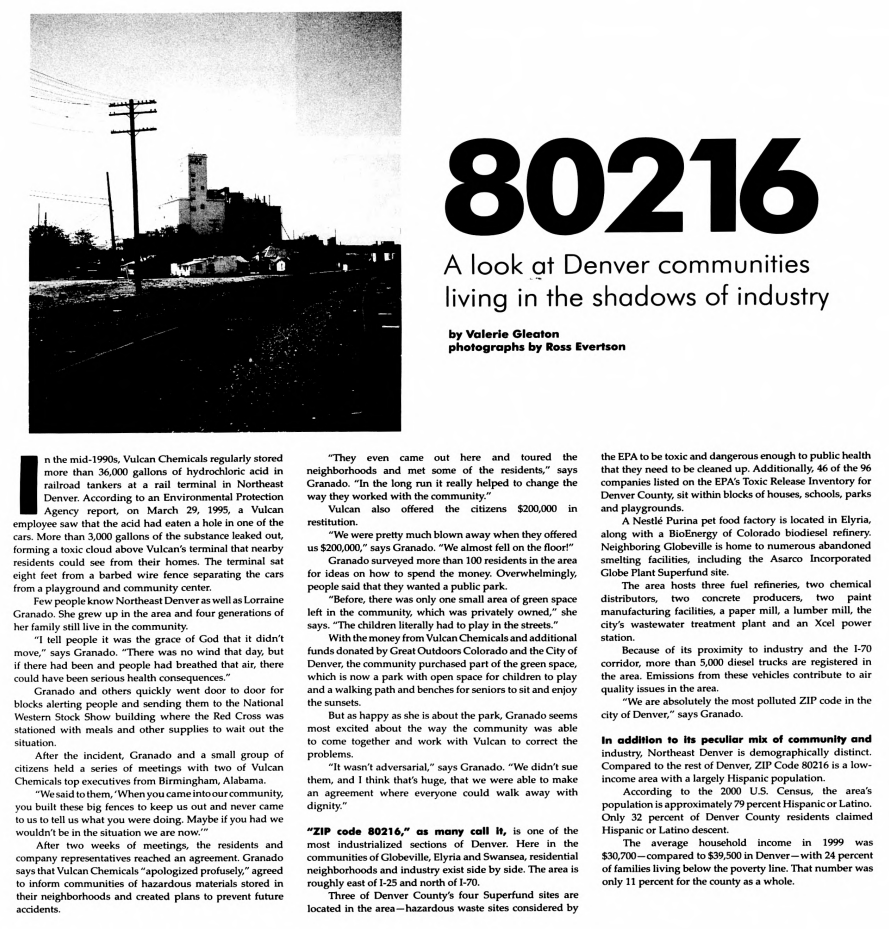
“80216: A look at Denver communities living in the shadows of industry,” 2008
LHP_Intern2020-08-23T18:40:53+00:00Article on how industrialization has impacted Globeville, environment, residents 06-01-2008
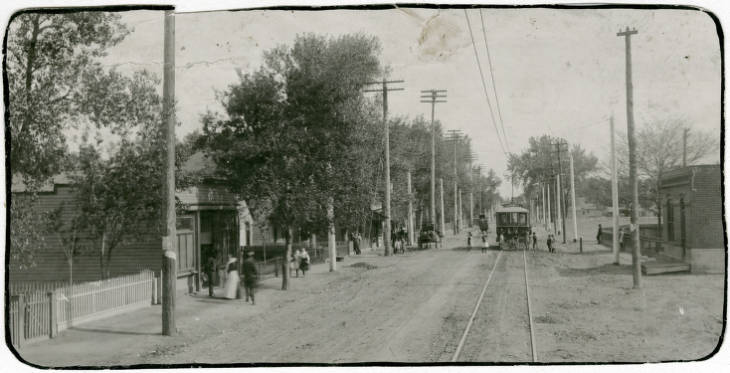
Globeville street, c. 1908-1915
LHP_Intern2020-08-23T18:39:27+00:00Picture of an electric tram going down a street in Globeville, 1908-1915
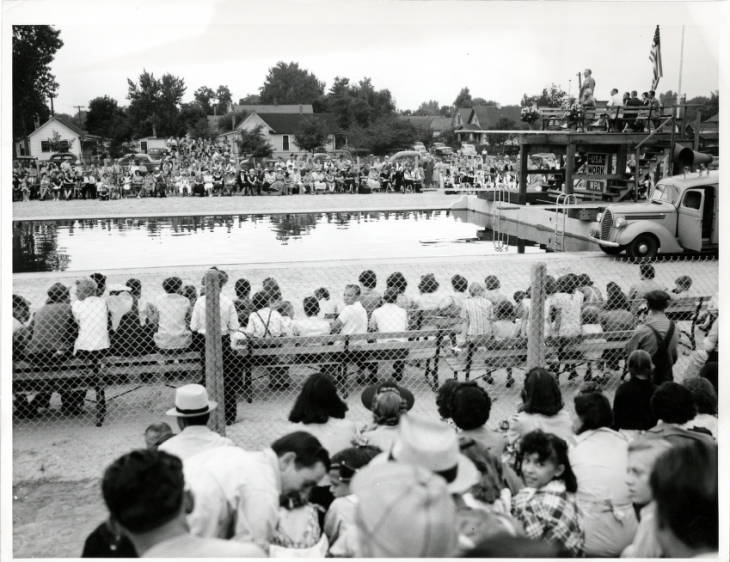
Globeville swimming pool dedication, 1940
LHP_Intern2020-08-23T18:37:45+00:00Picture of crowds at the opening of the new community swimming pool in Globeville, 07-20-1940
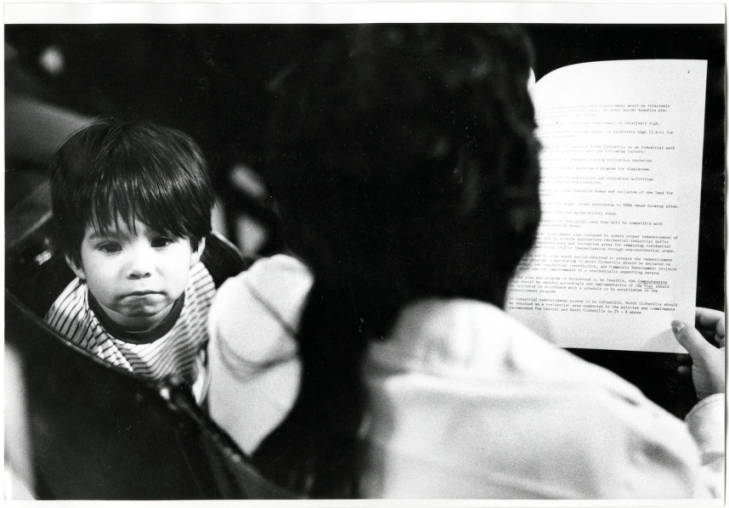
Globeville redevelopment meeting, 1975
LHP_Intern2020-08-23T18:36:33+00:00Picture of Duane Tafoya, age 3, with his mother at a public meeting on Globeville development, 10-05-1975

Picketing Super Serve Drugs, 1975
LHP_Intern2020-08-23T18:34:49+00:00Picture of picketers in front of Super Serve Drugs in Sunnyside, 1975
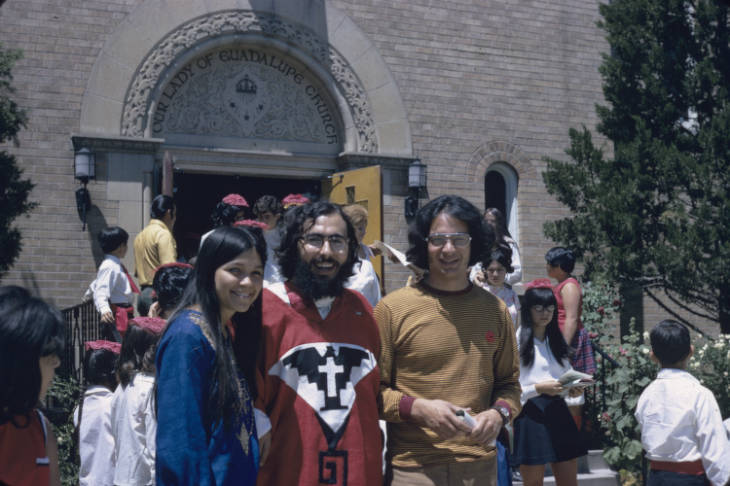
Father José Lara, 1971
LHP_Intern2020-08-23T18:33:42+00:00Picture of Father José Lara wearing a chasuble with the United Farm Workers of America Aztec eagle, Our Lady of Guadalupe Church, Highland neighborhood, 1971
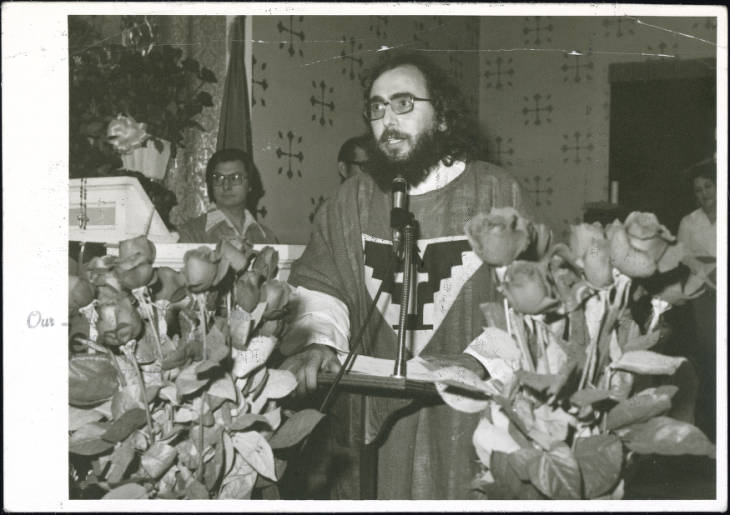
Father José Lara, c. 1970
LHP_Intern2020-08-30T02:36:27+00:00Picture of Father José Lara wearing a chasuble with the United Farm Workers of America Aztec eagle, probably Highland neighborhood, c. 1970
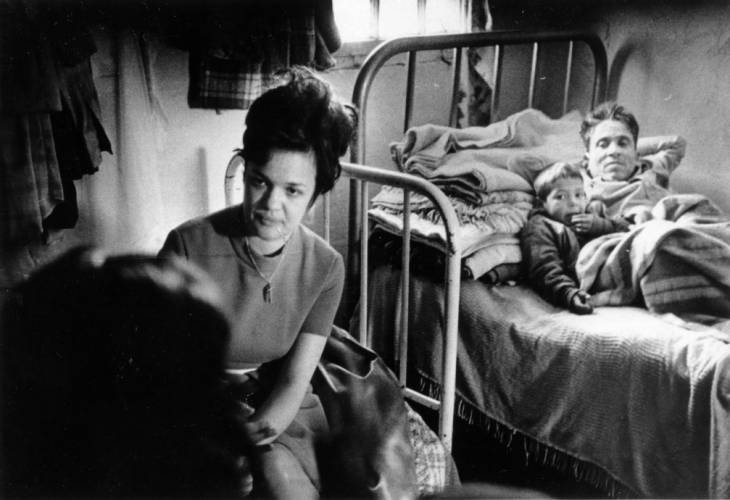
Nun hears migrant worker problems, 1971
LHP_Intern2020-08-30T02:35:14+00:00Picture of a nun listening to a migrant worker while a man and young boy look on, Denver, 1971
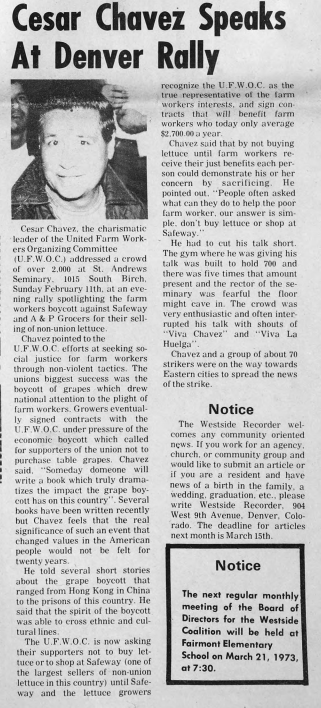
“Cesar Chavez Speaks at Denver Rally,” 1973
LHP_Intern2020-08-23T18:31:27+00:00Article on Chavez visit to Denver to speak on grape boycott, 02-01-1973
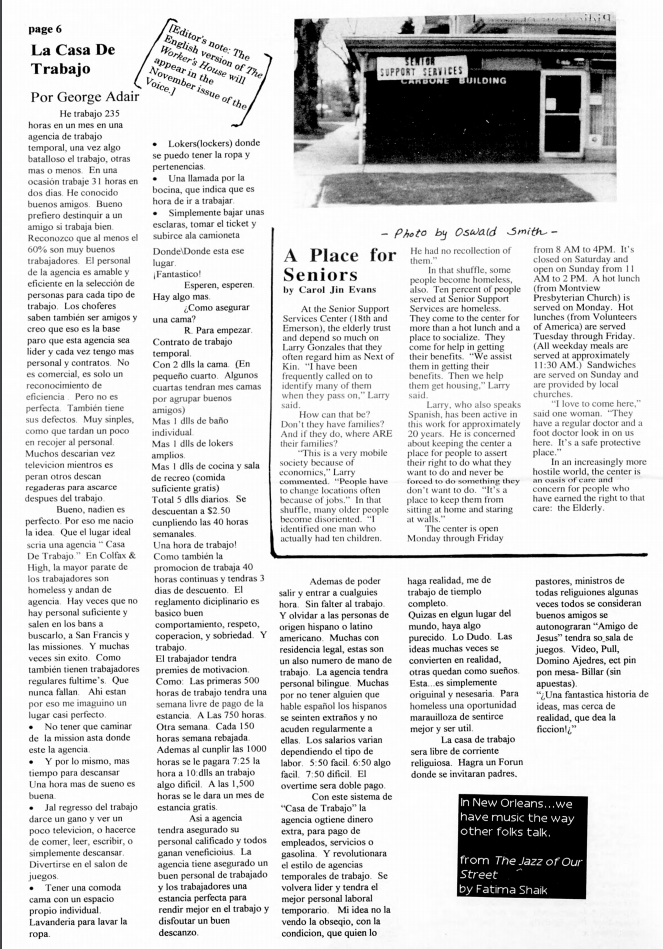
“La Casa de Trabajo,” 1998
LHP_Intern2020-08-23T18:30:41+00:00Article on homelessness, work, and identity for Latinx homeless in Denver, 1998

United Farm Workers march in Denver, c.1975
LHP_Intern2020-08-23T18:30:00+00:00Picture of UFW members marching down Broadway in Denver, boycott of grapes, lettuce, California wine c. 1975
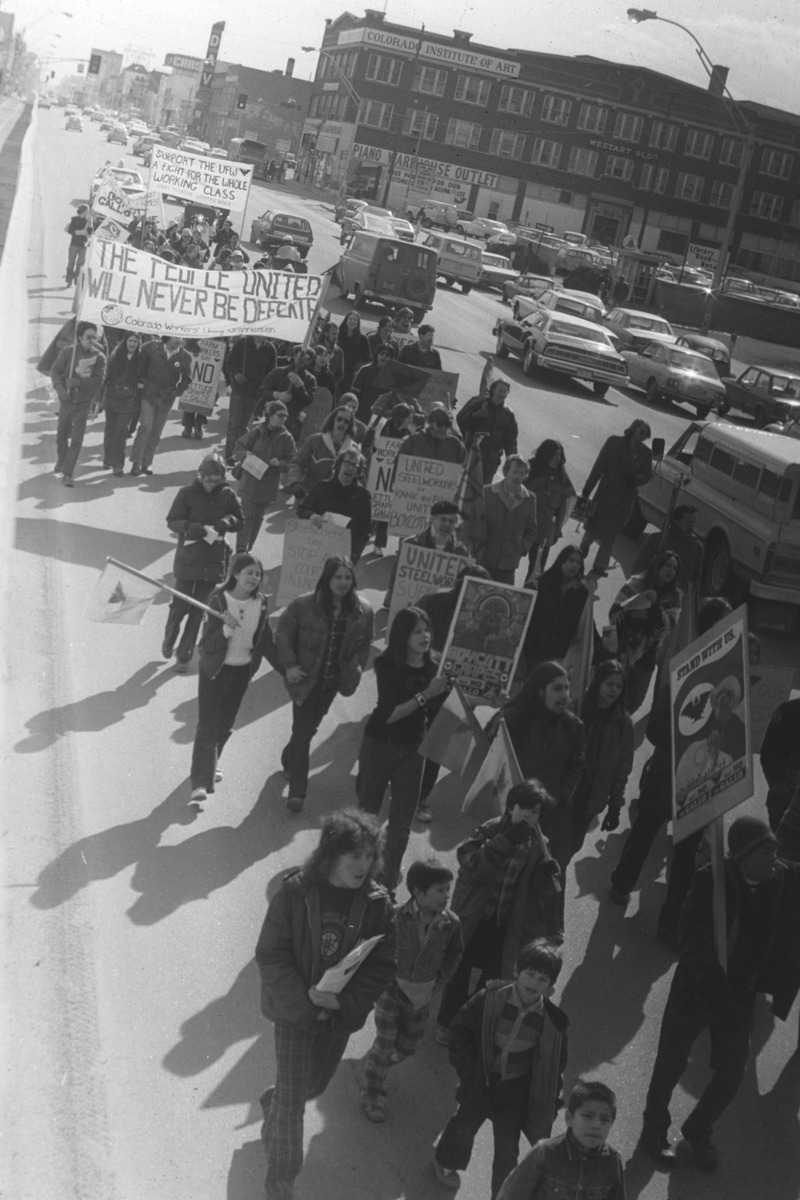
Gallo Wine Boycott March, 1975
LHP_Intern2020-08-23T18:28:29+00:00Picture of UFW members marching down Broadway in Denver, boycott of grapes, lettuce, California wine c. 1975

Photo of young boy protesting Coors, 1973
LHP_Intern2020-08-30T02:56:52+00:00Picture of a young Chicano boy holding a sign that reads “Chicanos Boycott Coors,” Denver, 1973
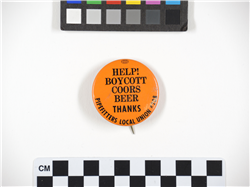
Boycott Coors Pin, c. 1977
LHP_Intern2020-08-23T18:26:51+00:00Political pin from the Pipefitters Local Union #208, reads “Help! Boycott Coors Beer, Thanks”, Denver, 1977
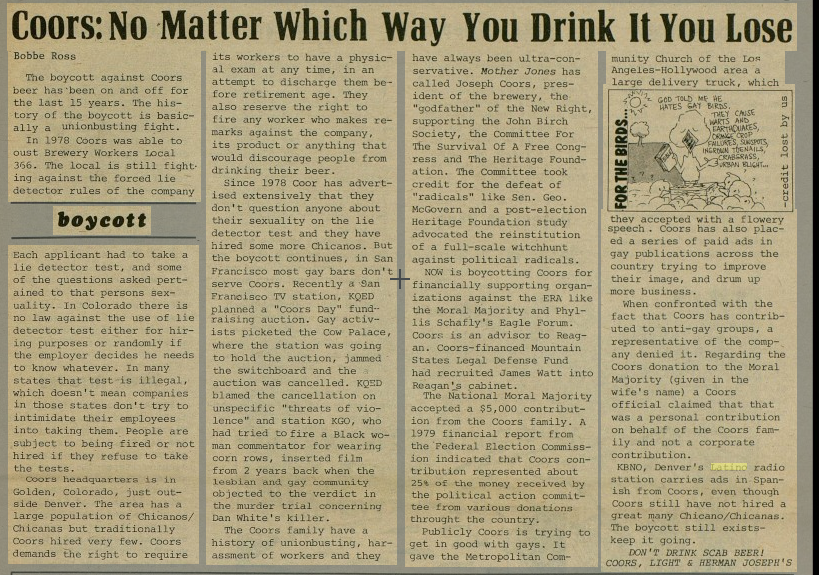
“Coors: No Matter Which Way you Drink it you Lose” 1981
LHP_Intern2020-08-23T18:26:02+00:00“Coors: No Matter which way you Drink it You Lose,” in the Big Mama Rag, discussing the labor issues around Coors and its mistreatment of minority population employees

Brown Berets protesting Coors, 1973
LHP_Intern2020-09-09T20:50:07+00:00Pictures (taken by Juan Espinosa) of the Brown Berets marching with protesters in Denver, protesting Coors Brewing policies against Chicano workers, c. 1973
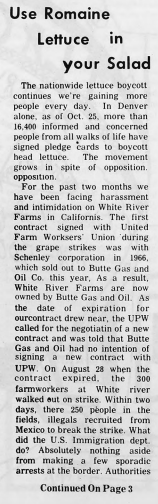
“Use Romaine Lettuce in your Salad” 1971
LHP_Intern2020-08-23T18:06:05+00:00“Use Romaine Lettuce in your Salad” article urging West Siders to continue the lettuce boycott to support Mexican agricultural laborers throughout the US, 11-01-1971
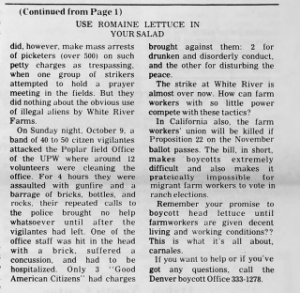

Buy and Boycott lists to support farm workers, 1974
LHP_Intern2020-08-23T18:04:16+00:00Graphic showing what wines to support and which to boycott while supporting the Mexican farm workers in California , West Side Recorder newspaper, 1974
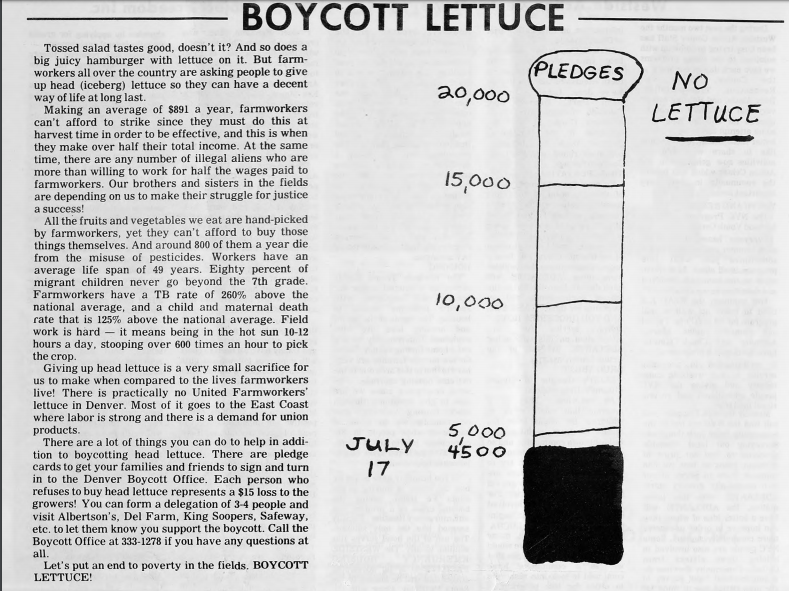
Boycott Lettuce Campaign in Denver, 1973
LHP_Intern2020-08-23T18:03:32+00:00Article on boycotting lettuce in Westside, 08-01-1973
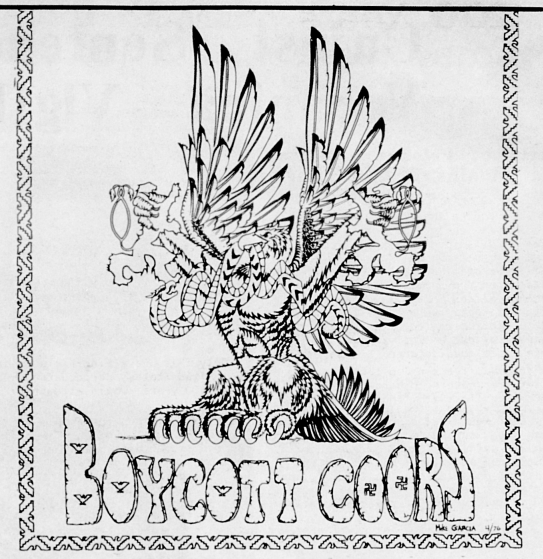
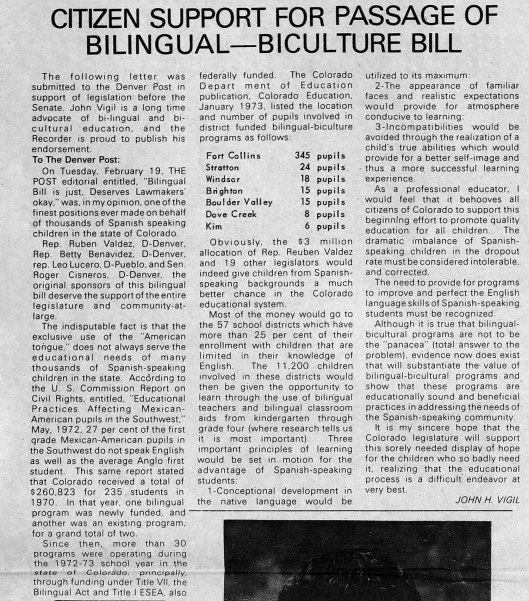
Citizen support for bilingual education bill
LHP_Intern2020-08-23T17:54:31+00:00“Citizen support for passage of bilingual-bicultural bill” copy of letter in the Denver Post on how the bilingual education bill would benefit Colorado students, 04-01-1974
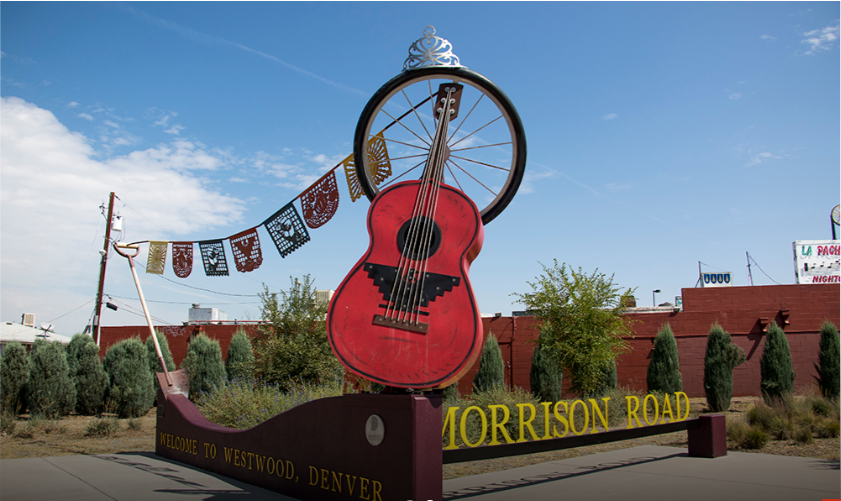
Sculpture “Un Corrido para la Gente” by Carlos Frésquez
LHP_Intern2020-08-23T17:44:59+00:00Sculpture “Un Corrido para la Gente” by Carlos Frésquez at the Morrison Road Gateway in Westwood (2009)
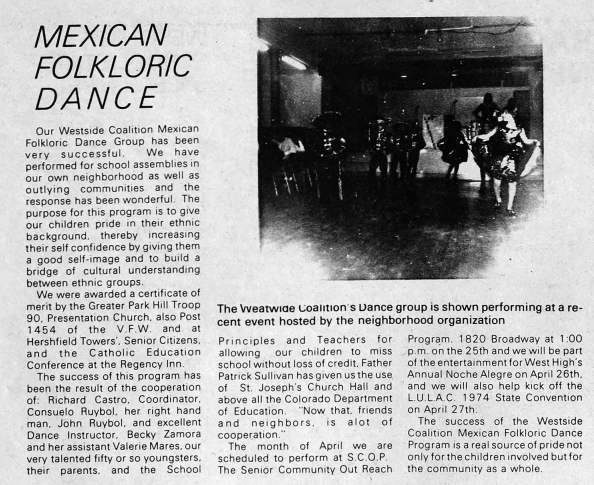
“Mexican Folkloric Dance” 1974
LHP_Intern2020-08-30T02:55:17+00:00Article on the Westside Coalition Mexican Folkloric Dance Group and their recent performances, with picture, 1974
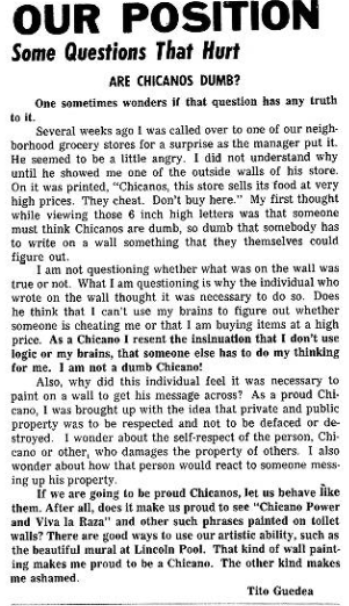
Impact of Graffiti in Chicano Neighborhoods
LHP_Intern2020-08-18T20:21:30+00:00Article “Our Position: Some Questions that Hurt; are Chicanos Dumb?” by Tito Guedea
graffiti on a business in Westside/Auraria and resentment caused
West Side Recorder Volume 7 No 5, 9-1-1970
Margaret Apodaca Interview
LHP_Intern2020-05-12T22:35:39+00:00Margaret talks about growing up in Valdez, a small community near the Frederick Mine, and about her grandfather, father, and husband, who were all miners. 7.6 mins.
Frank Colangelo Interview
LHP_Intern2020-05-12T22:33:49+00:00Frank, who grew up outside of Tercio on the western edge of the Purgatory River Valley, discusses his life in a mining community. 4.2 mins.
Jerry Renner Interview
LHP_Intern2020-05-12T22:32:15+00:00Jerry talks about the camaraderie found in a coal mining crew and how important it was in the life of a miner. 6.5 mins.
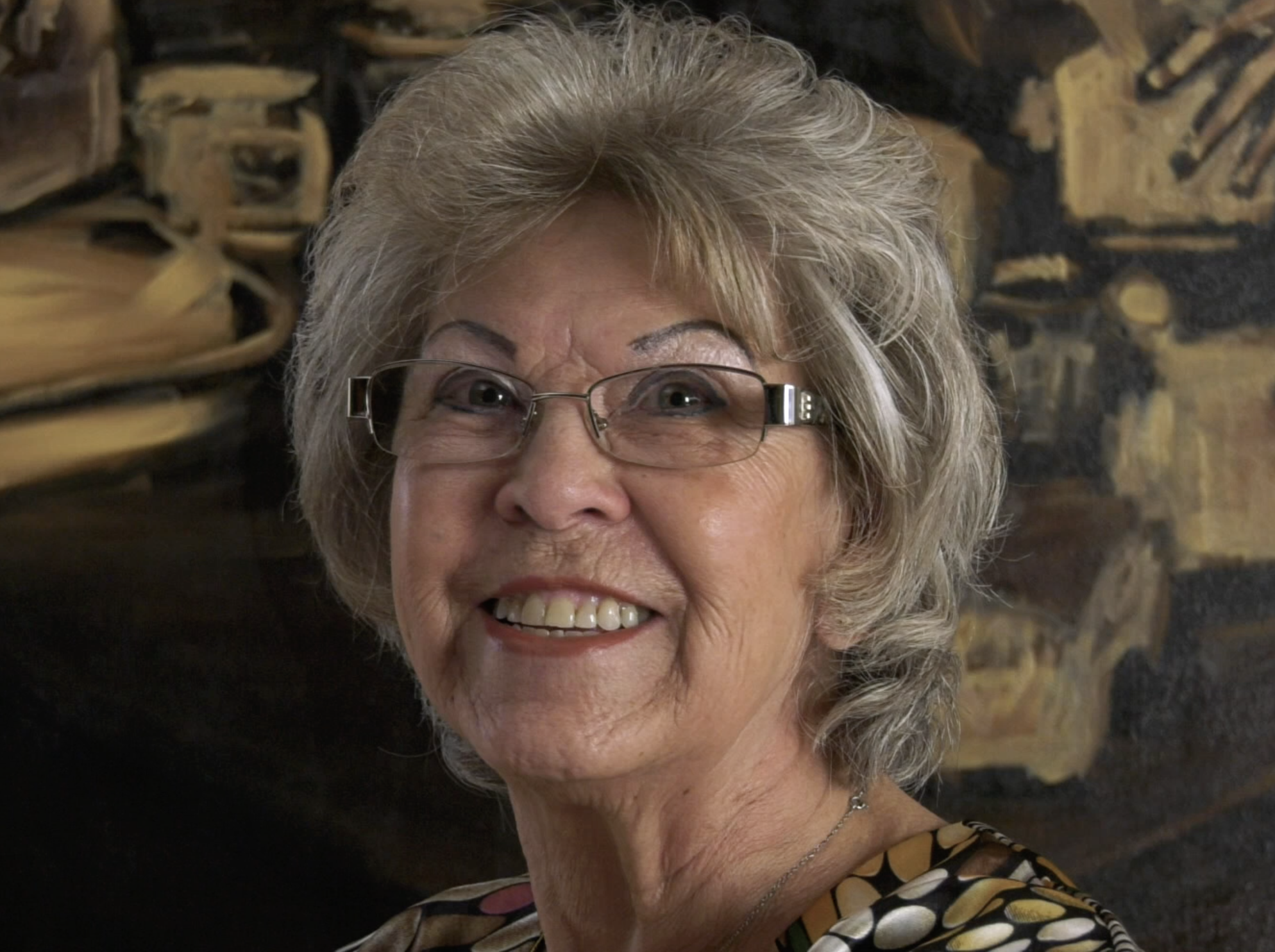
Beatriz Truxillo Morgan Interview
LHP_Intern2020-05-12T22:29:54+00:00Beatriz shares her story as the daughter of a coal miner. Growing up in the Purgatory River Valley west of Trinidad, she relates what day-to-day life was like in the small mining communities there, and how her father worked in the coal mines and as a cowpuncher 7.3min.
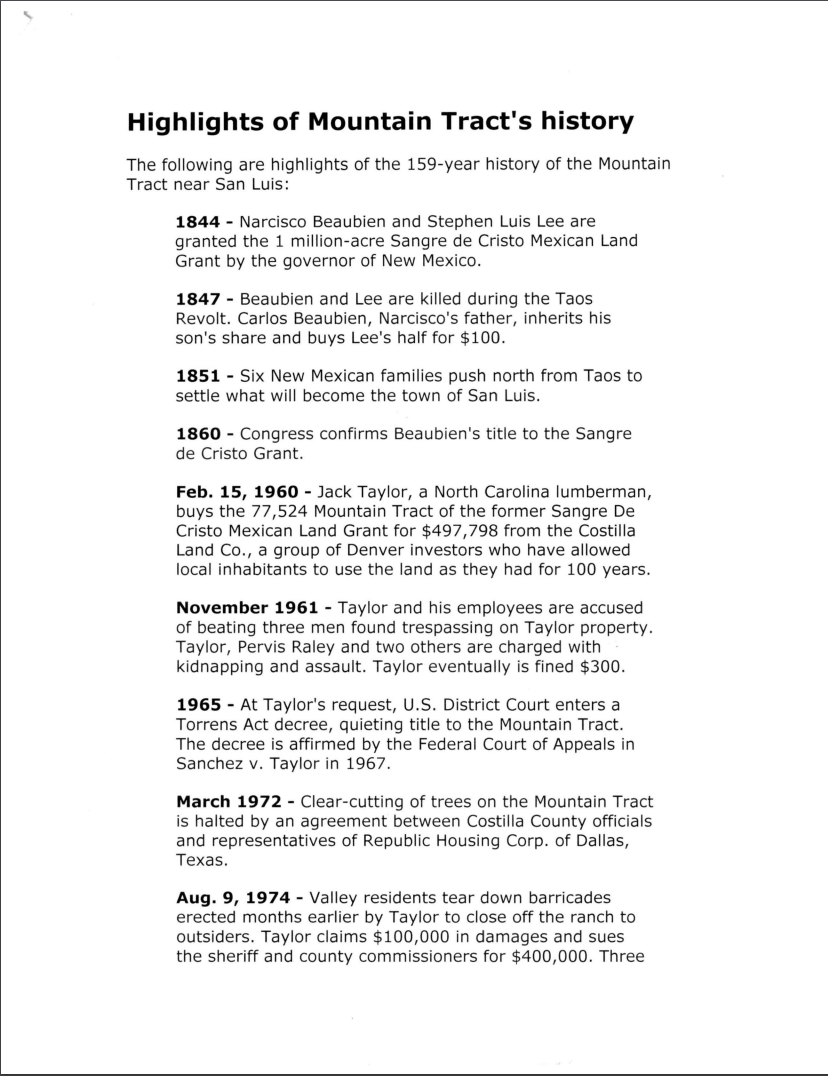
Highlights of Mountain Tract’s History
LHP_Intern2022-10-19T23:52:31+00:00A list of dates and important events concerning Taylor Ranch and the legal battles over it. Starts with 1844 grant by officials in New Mexico, the part of Mexico, to Narcisco Beaubien and Stephen Luis Lee of the Sangre de Cristo Land Grant, containing 1 million acres; the grant was confirmed to Beaubien in 1860 by the U.S. Congress. What became the Taylor Ranch was included in Beaubien’s grants. First page only displayed.
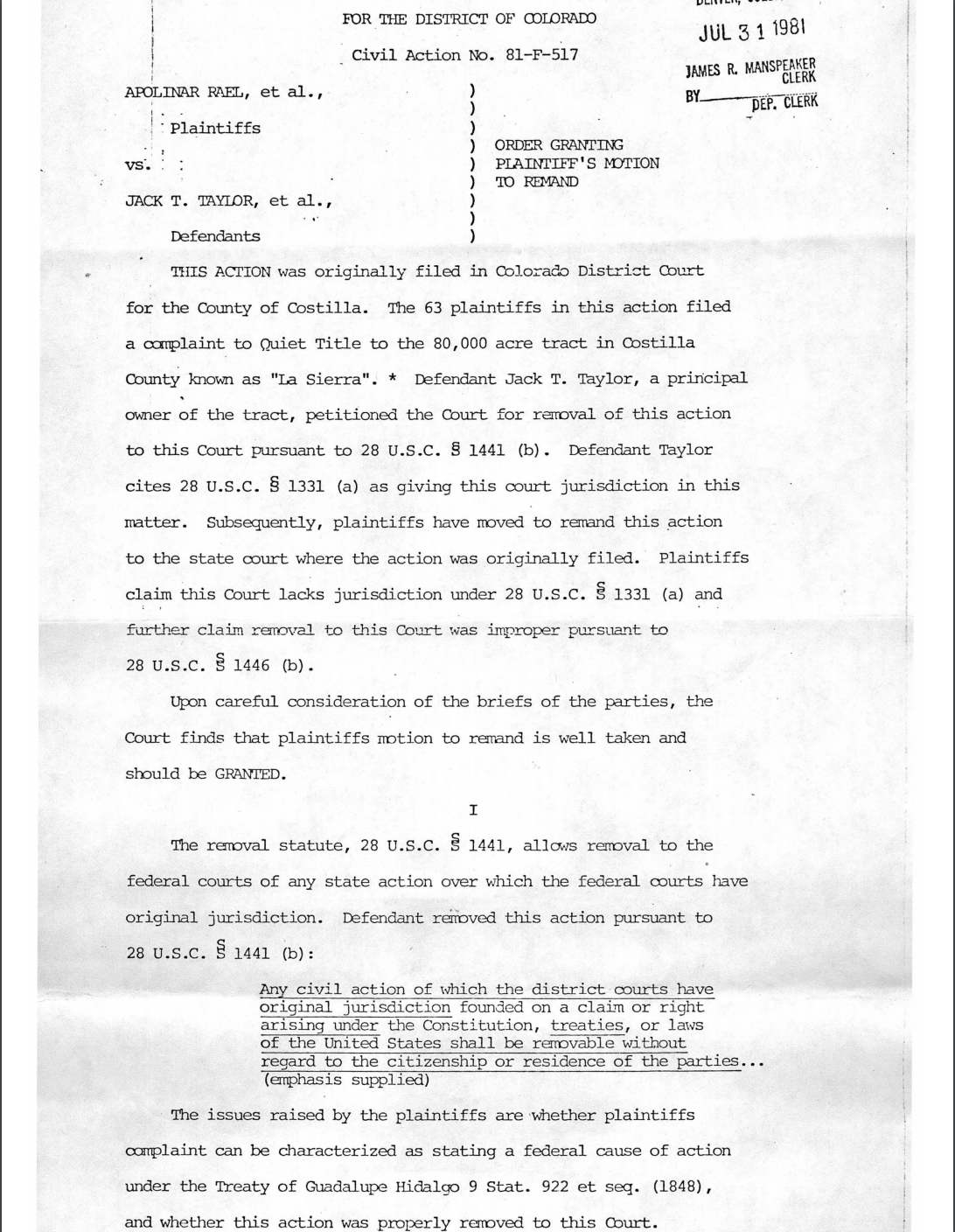
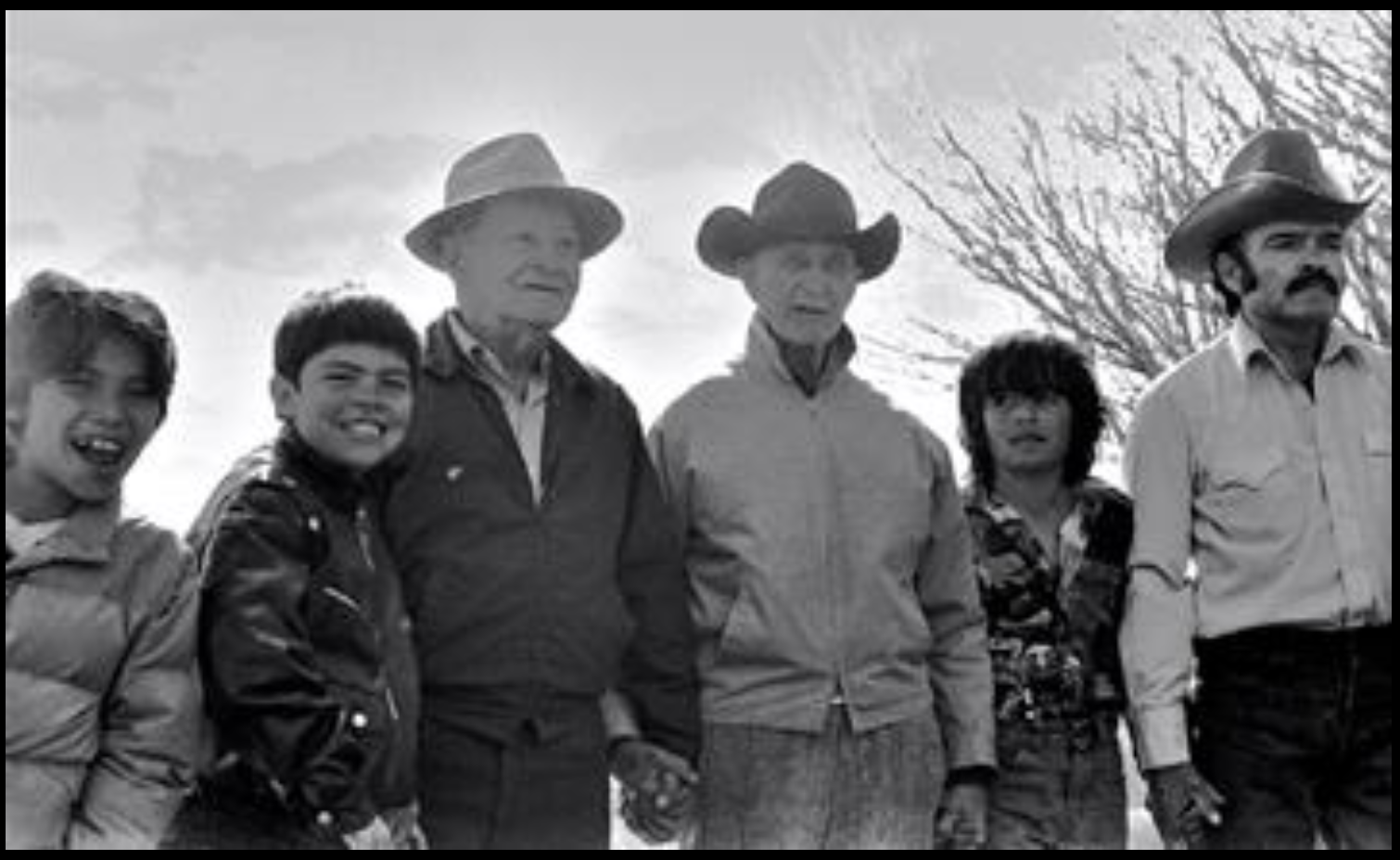
Photo of descendants of Hispanic land grant holders at a gathering at Taylor Ranch, 1981
LHP_Intern2020-05-12T23:18:27+00:00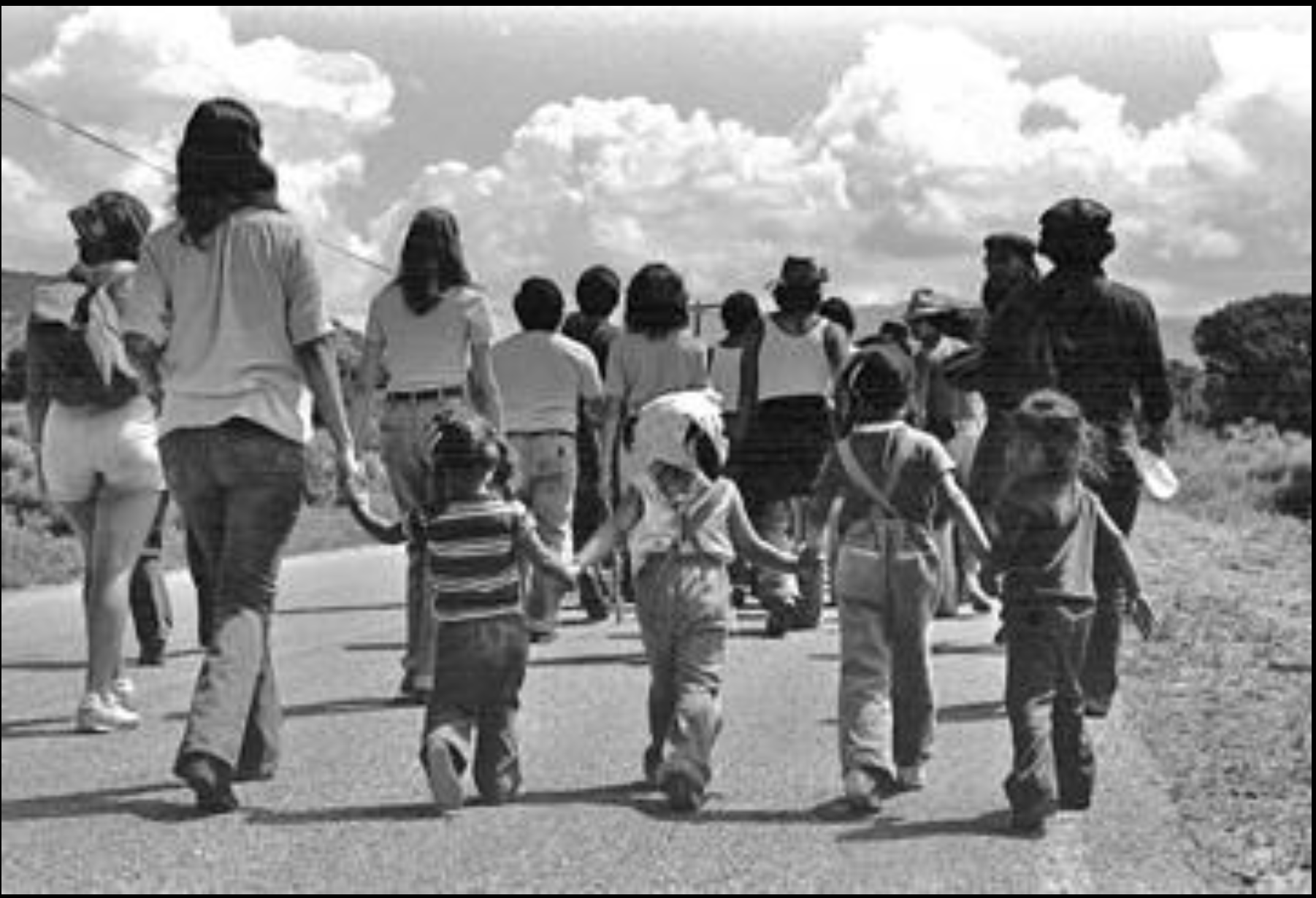
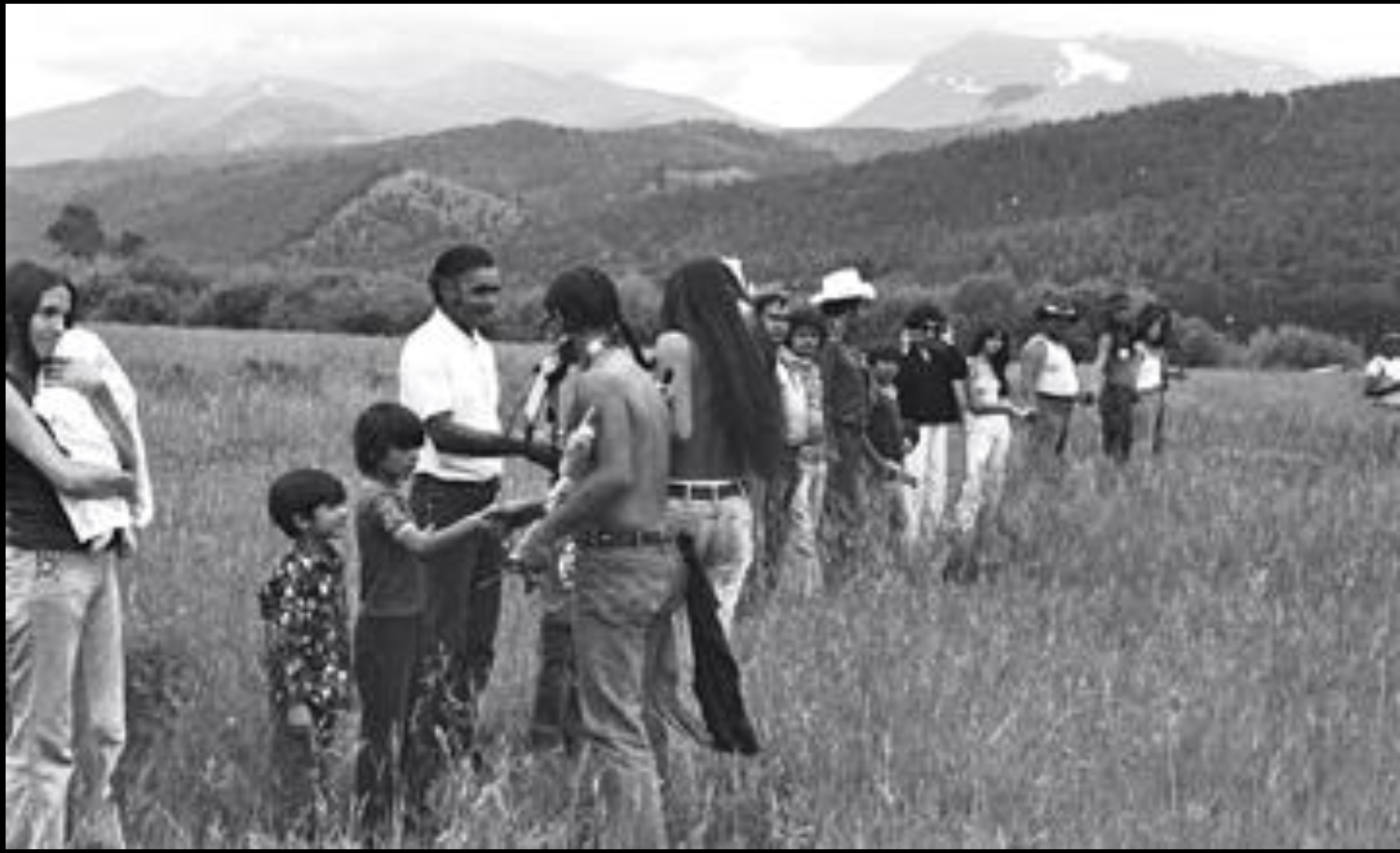
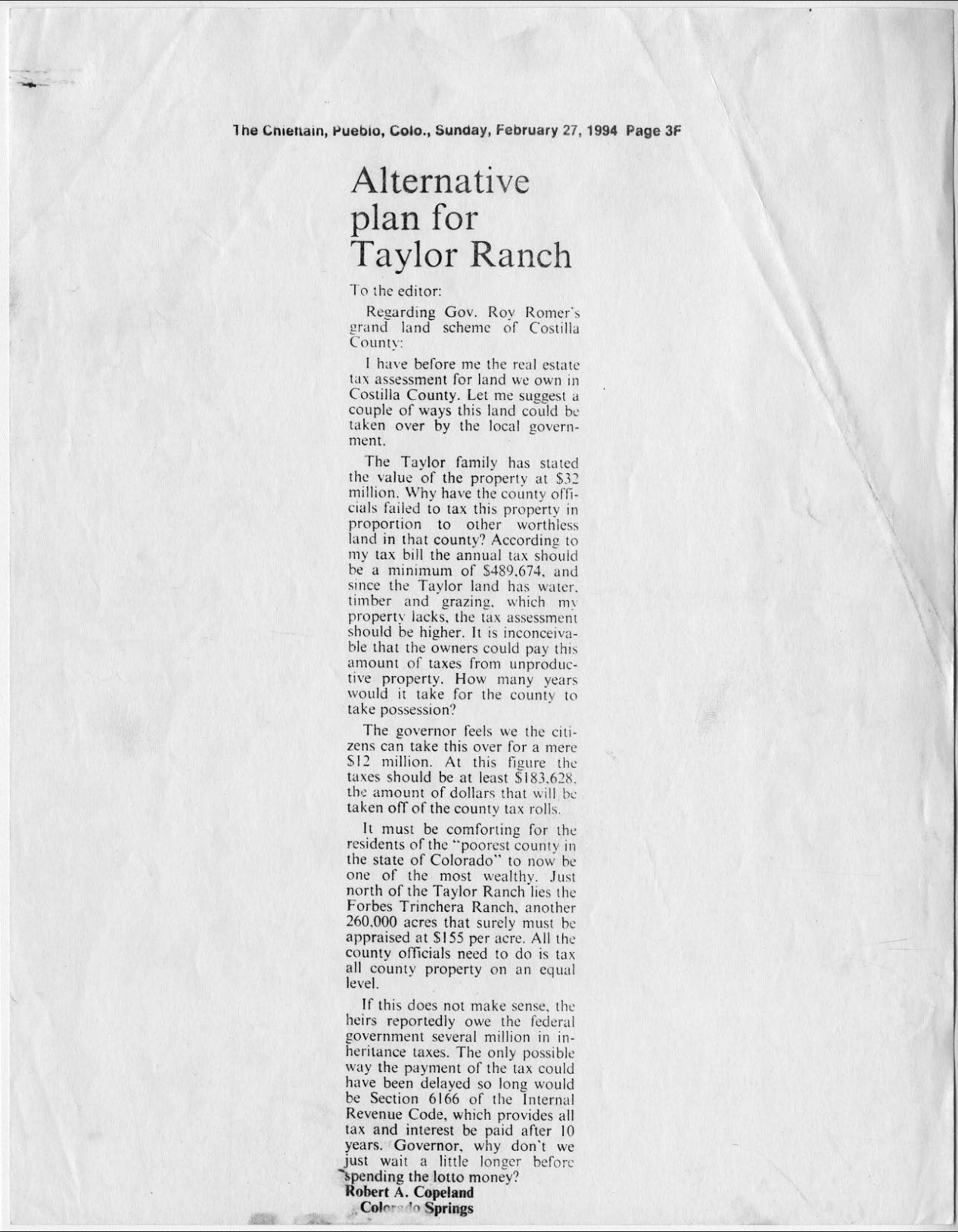
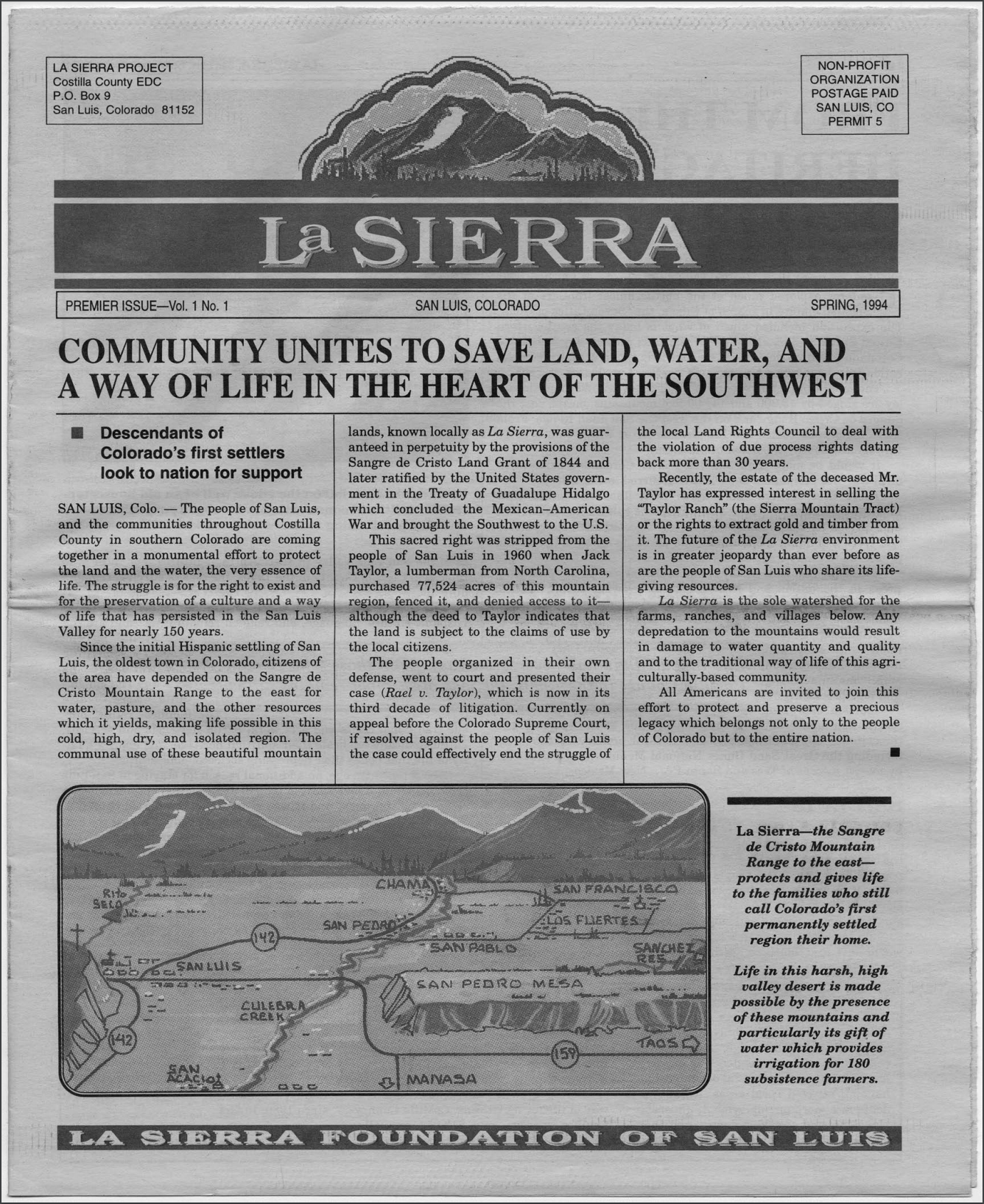
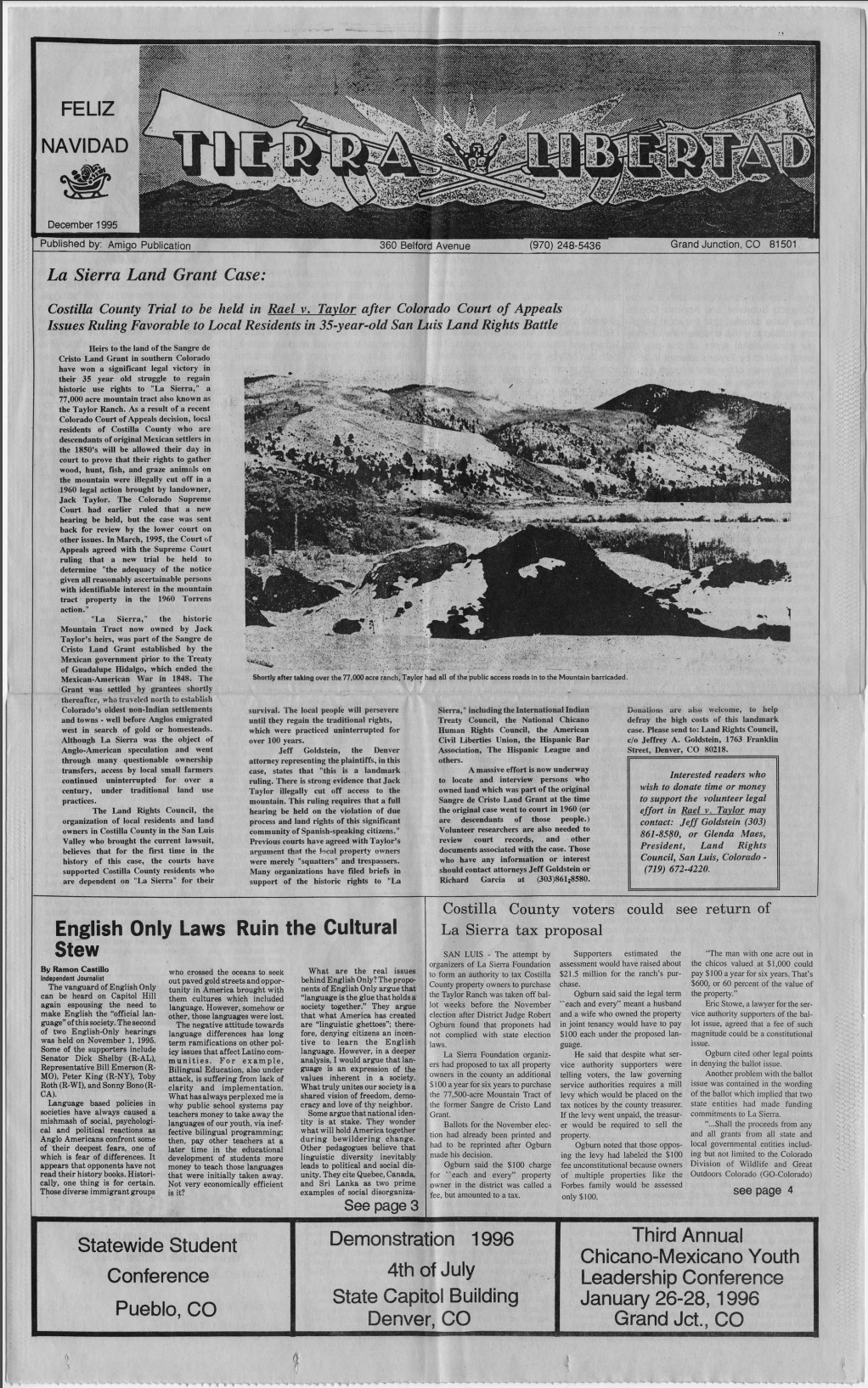
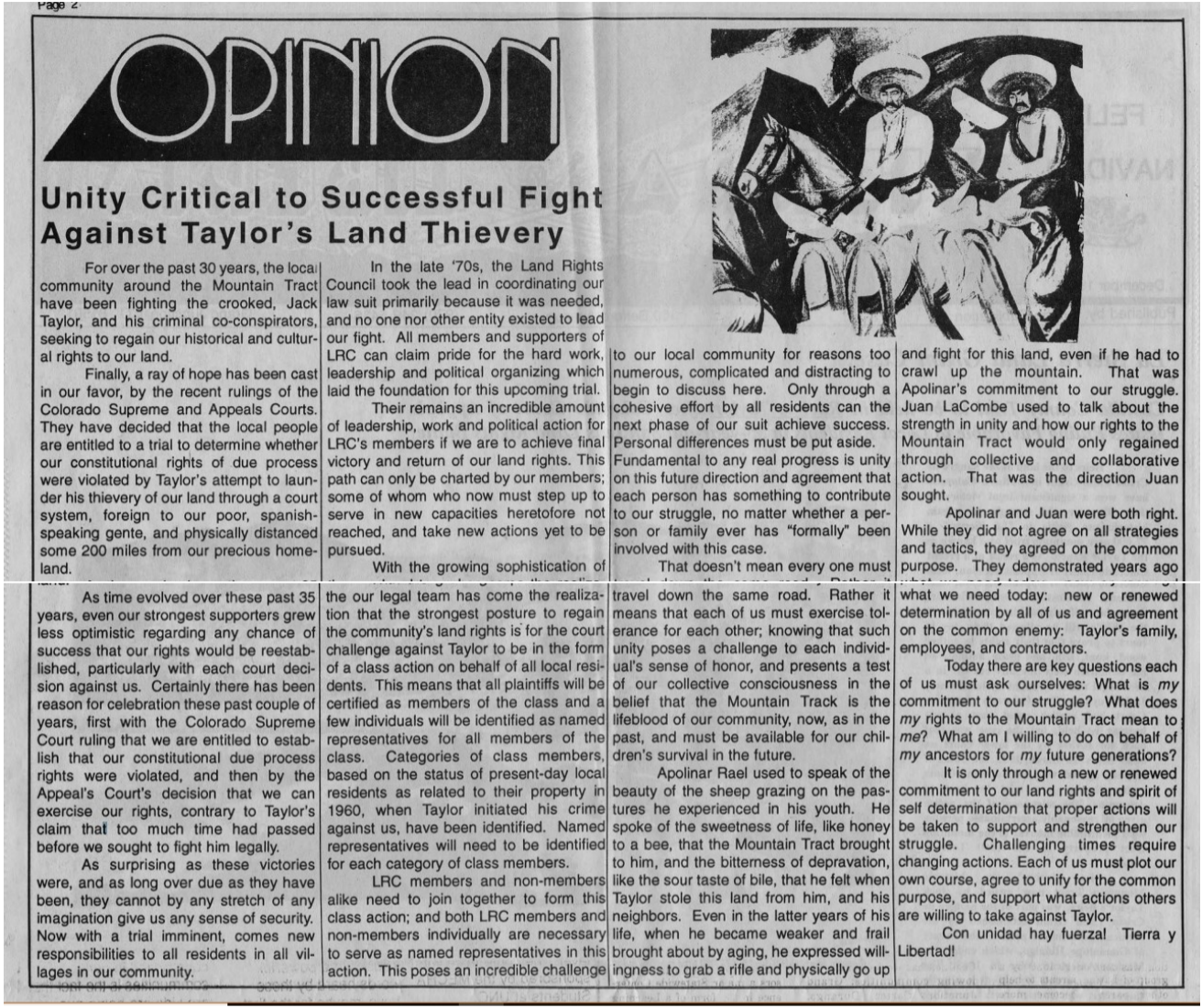
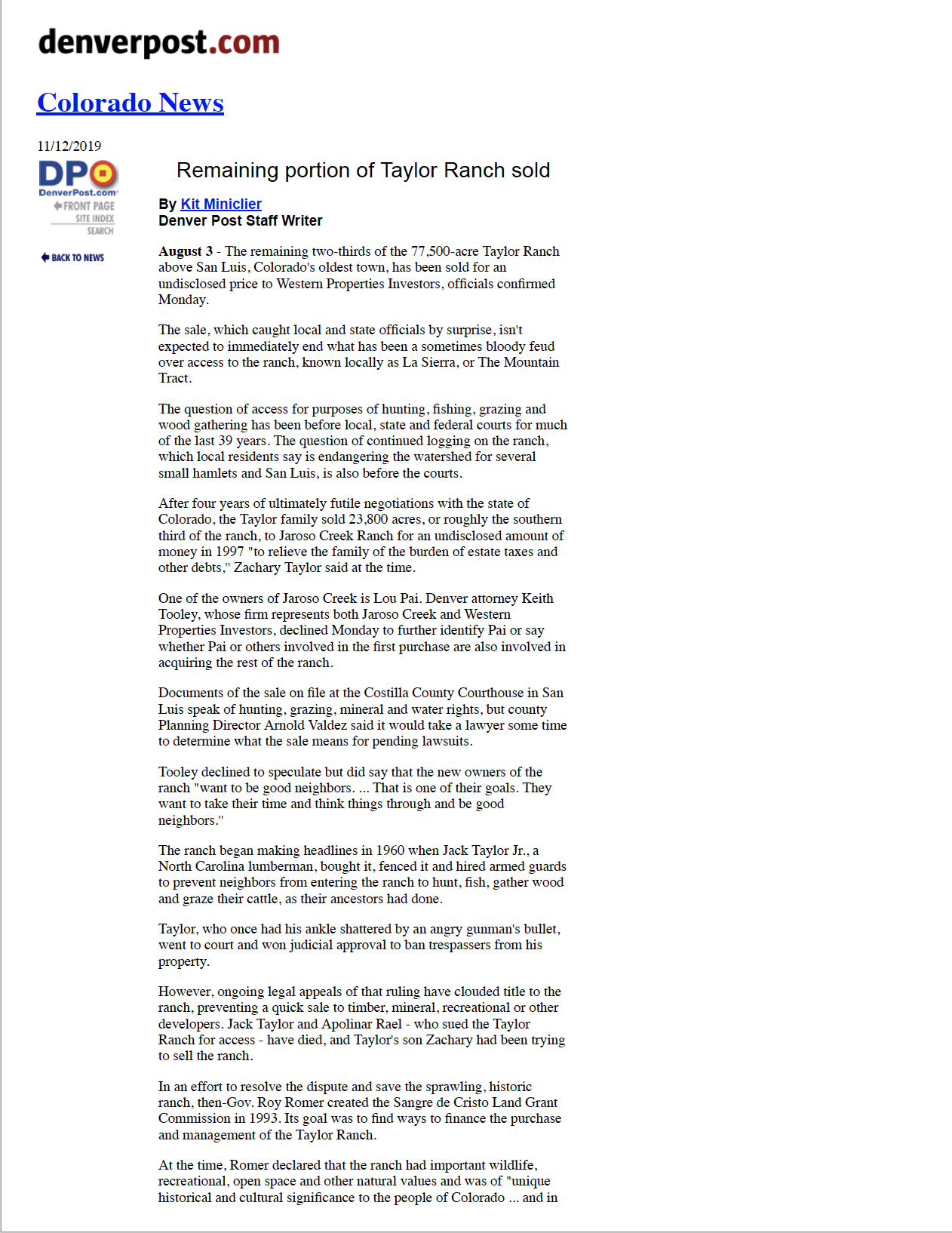
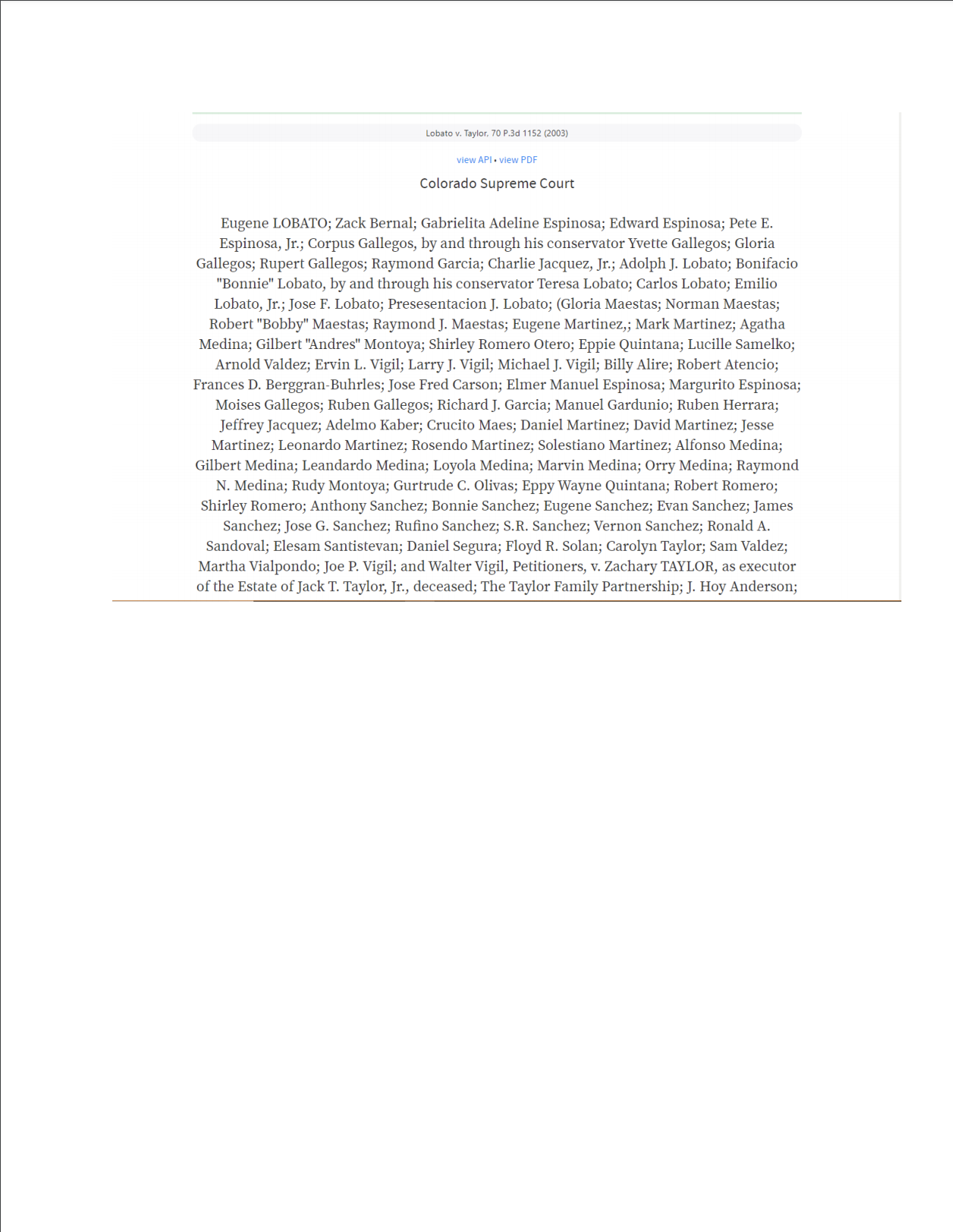
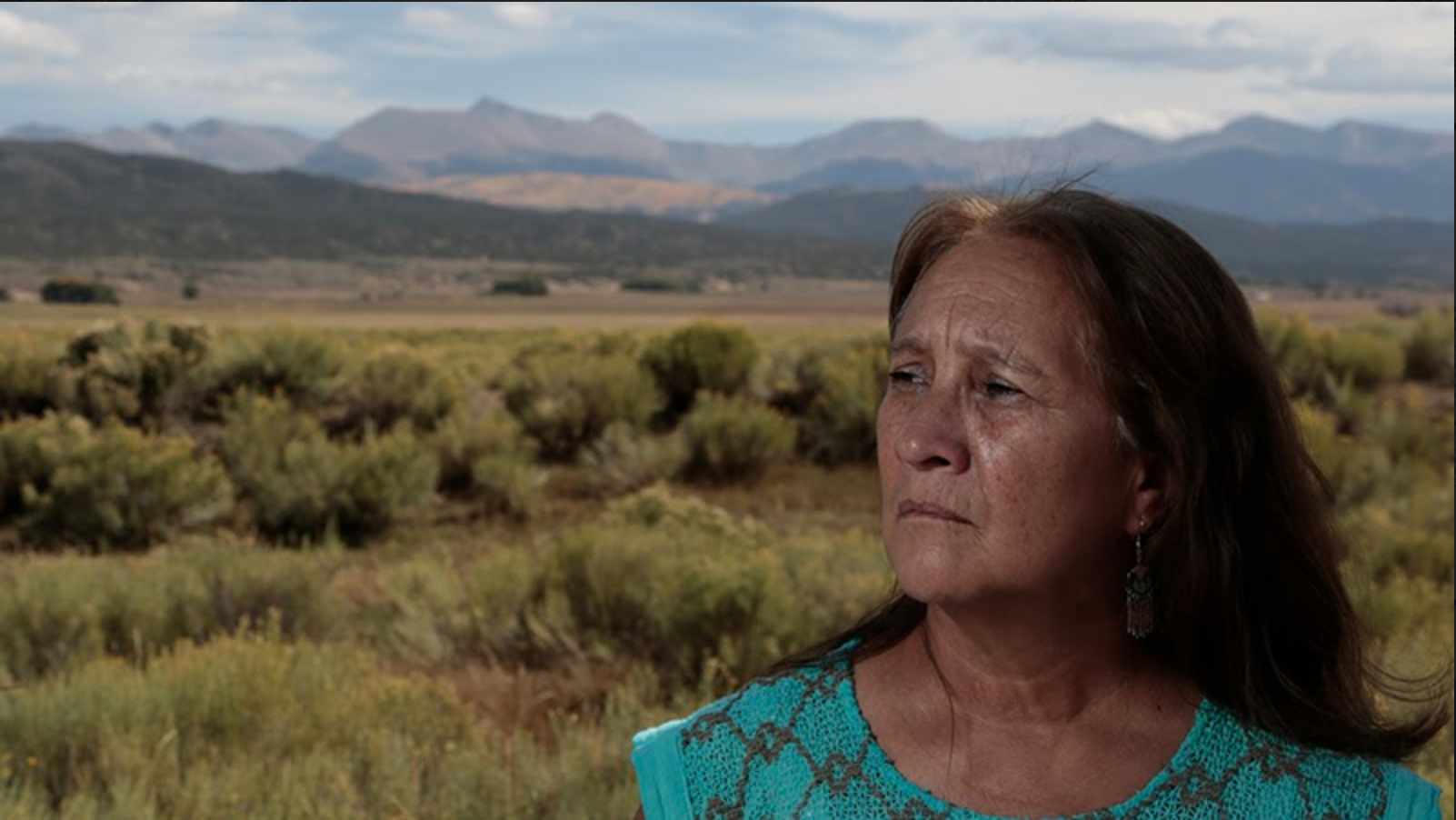
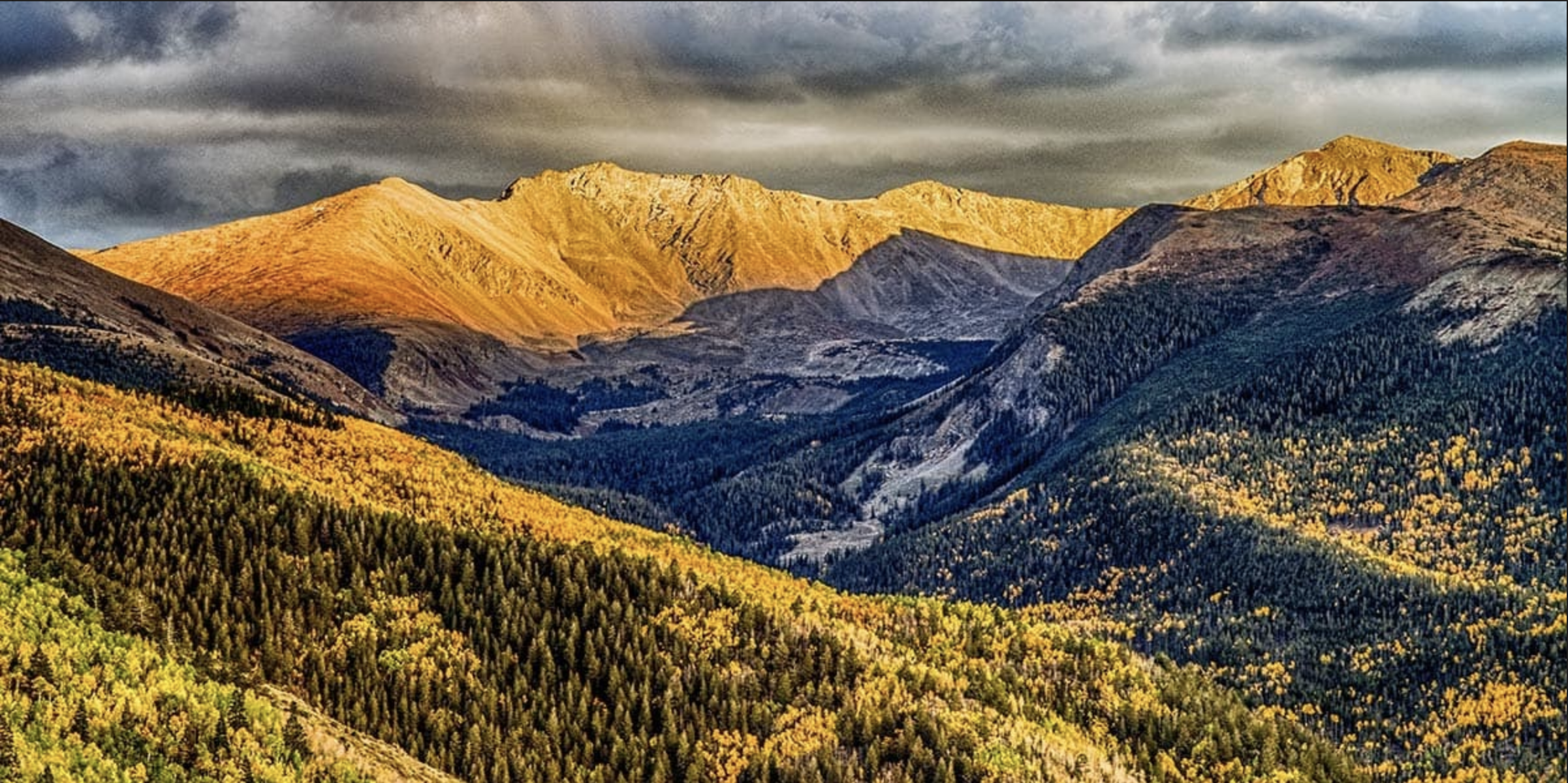
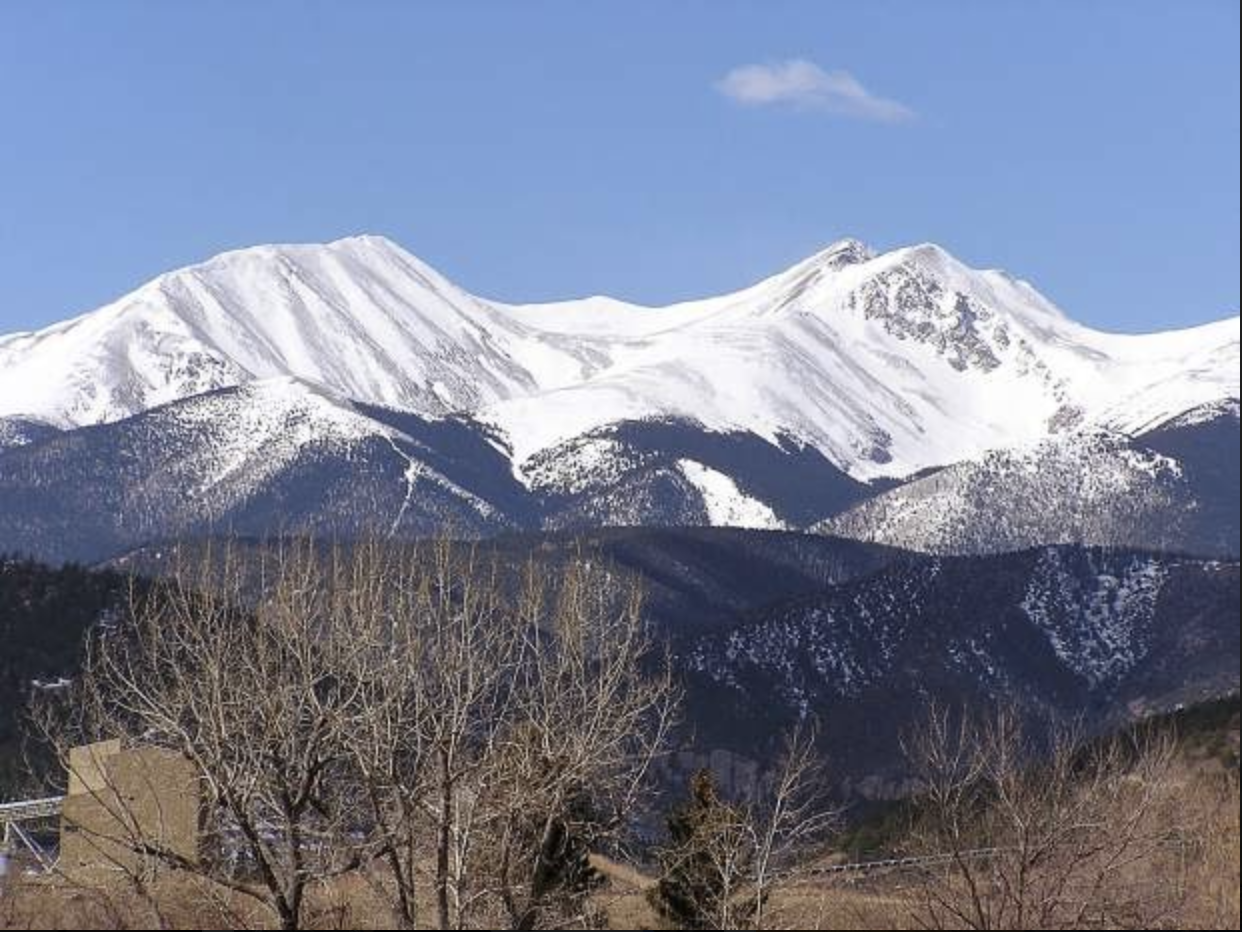
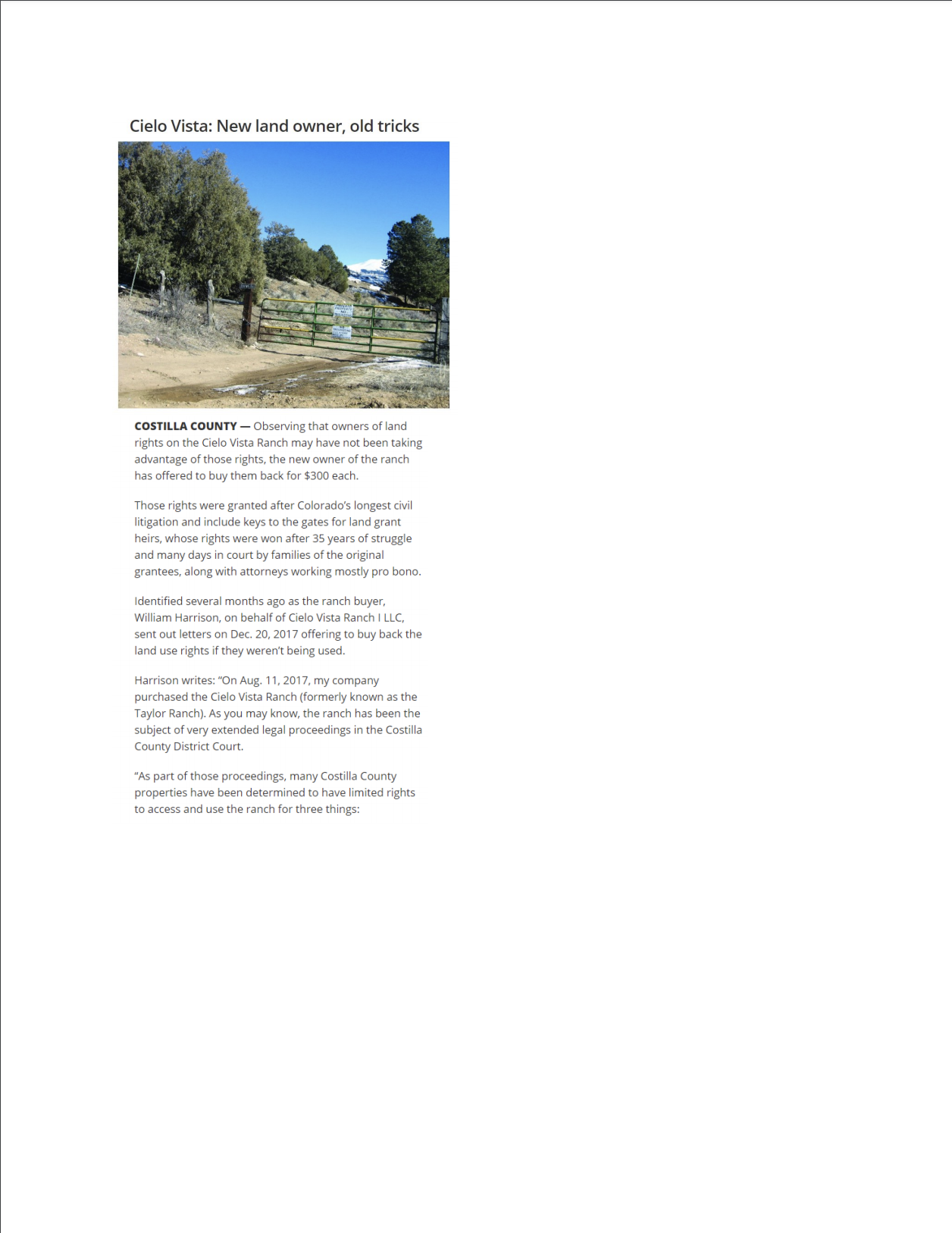
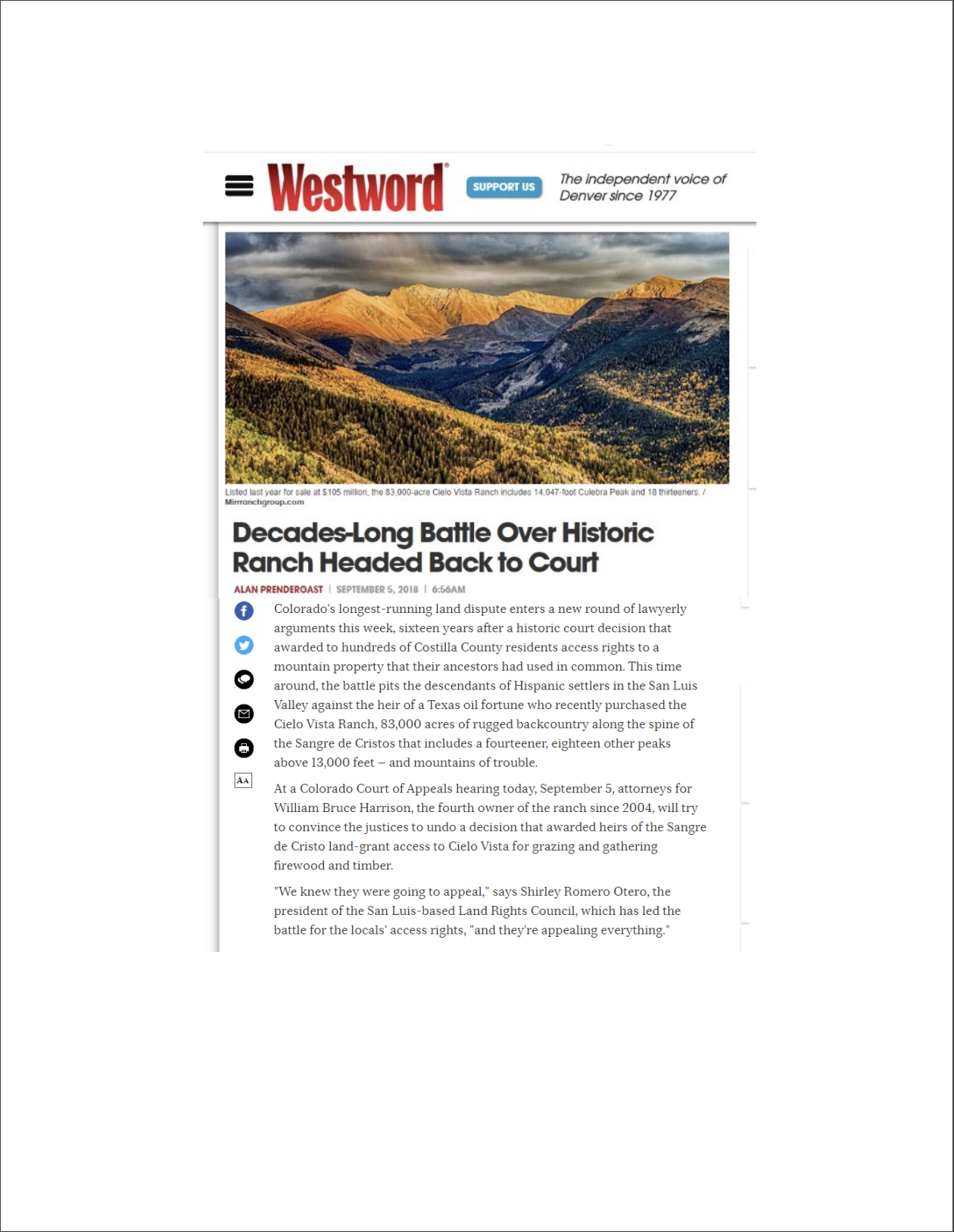
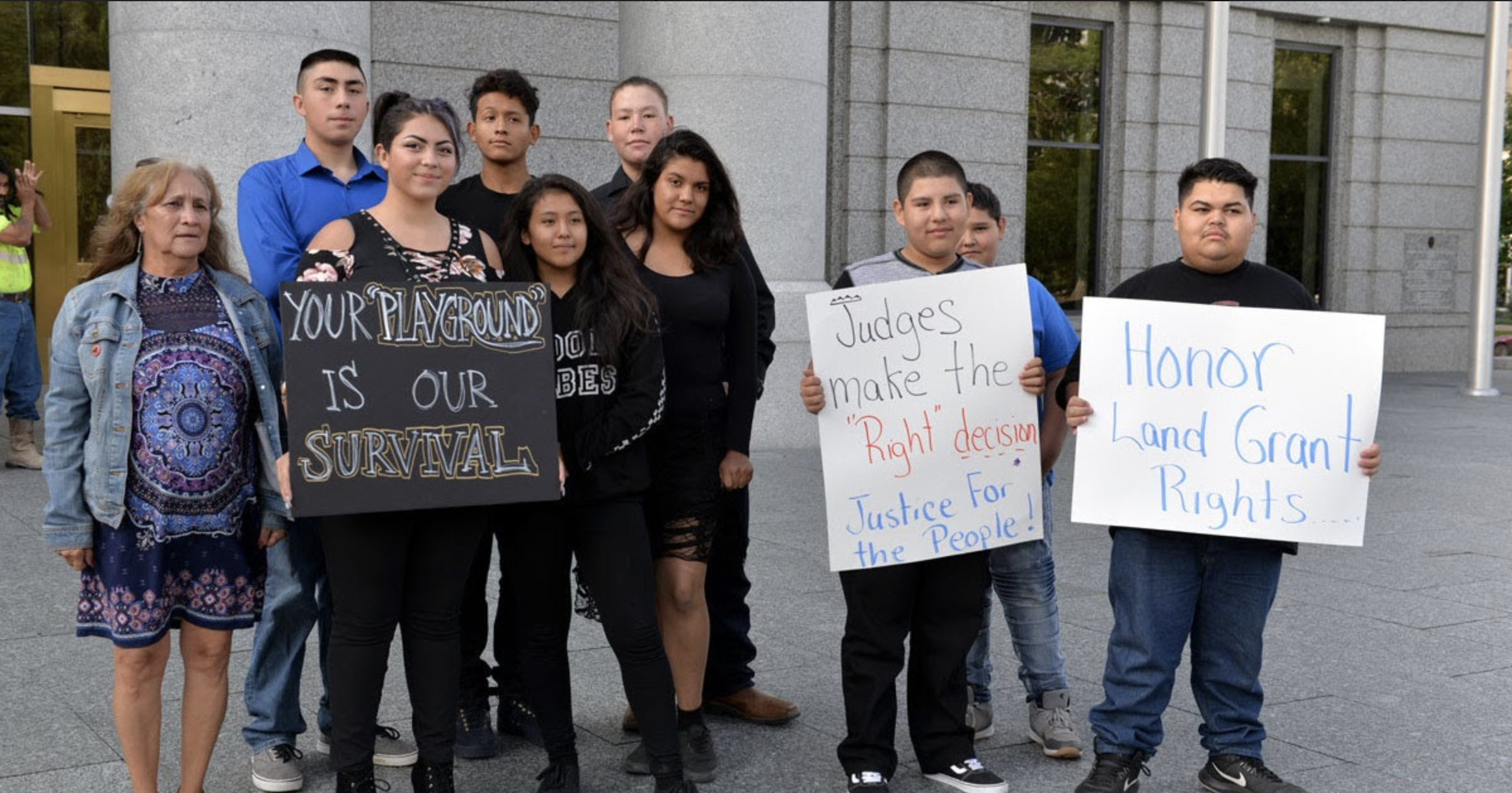
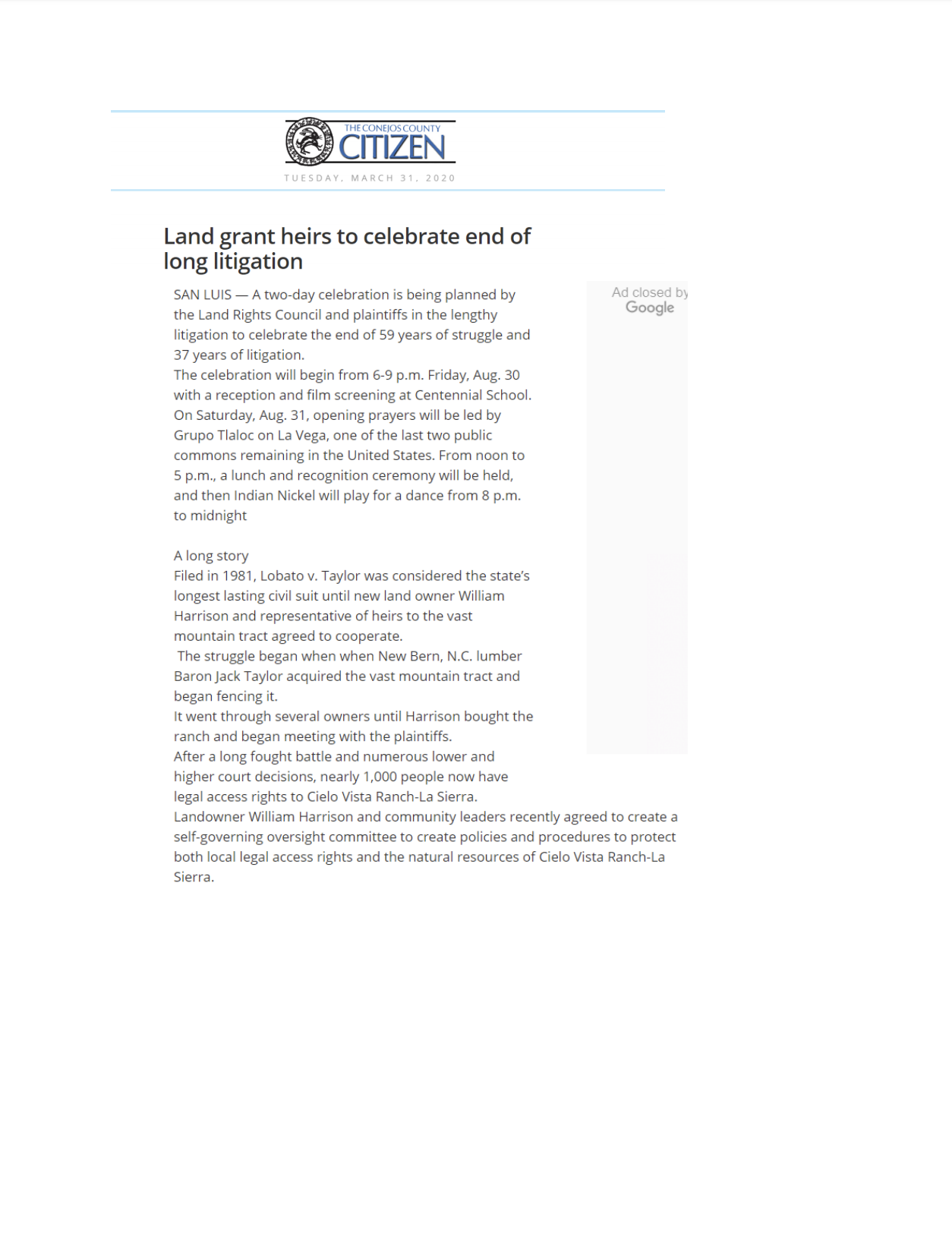
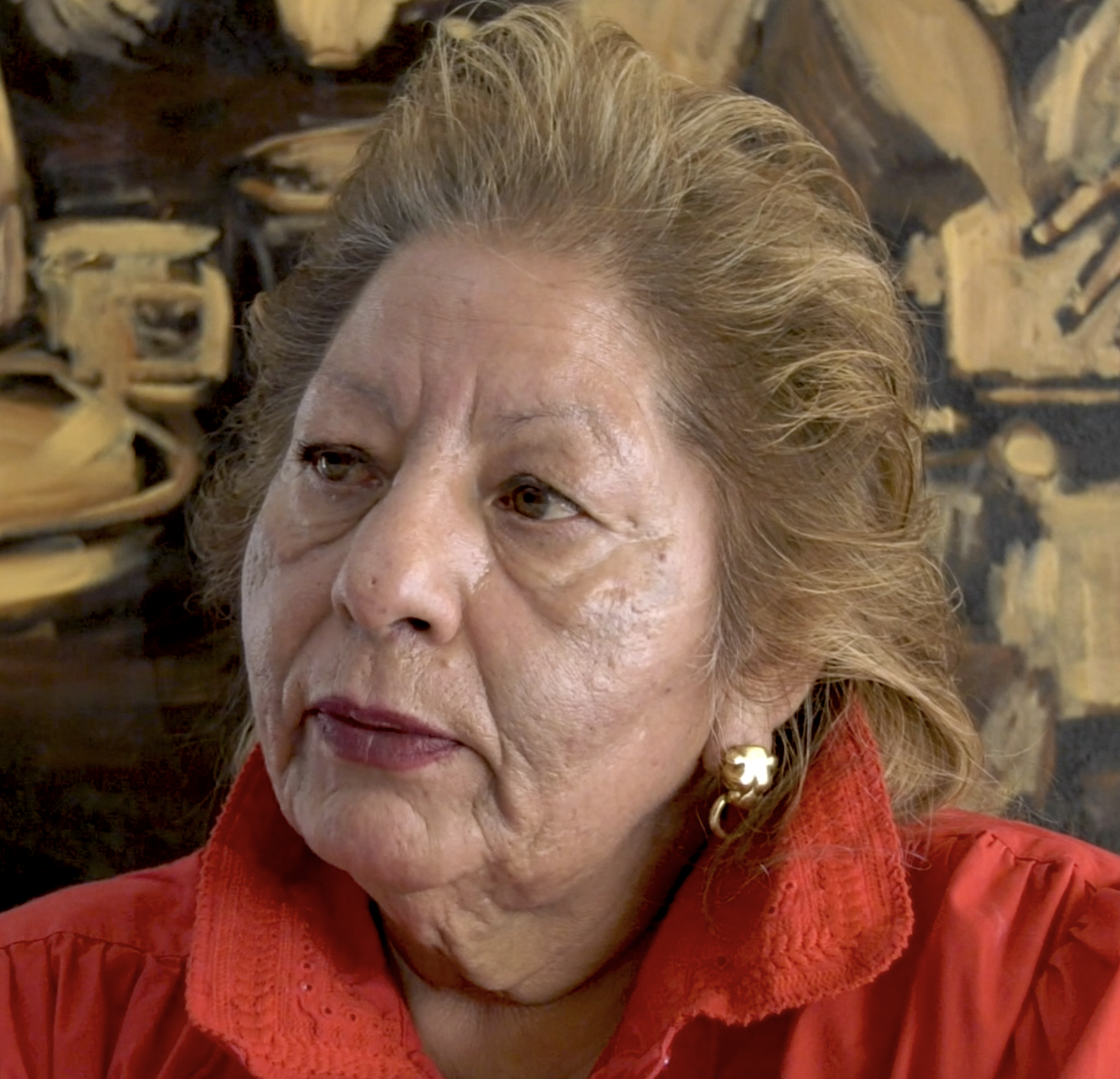
Sue “Sister Sledge” Erdman Interview
LHP_Intern2020-05-12T22:43:37+00:00Sue tells the story of what life was like as one of the few women miners working underground alongside the men. 10.2 mins.
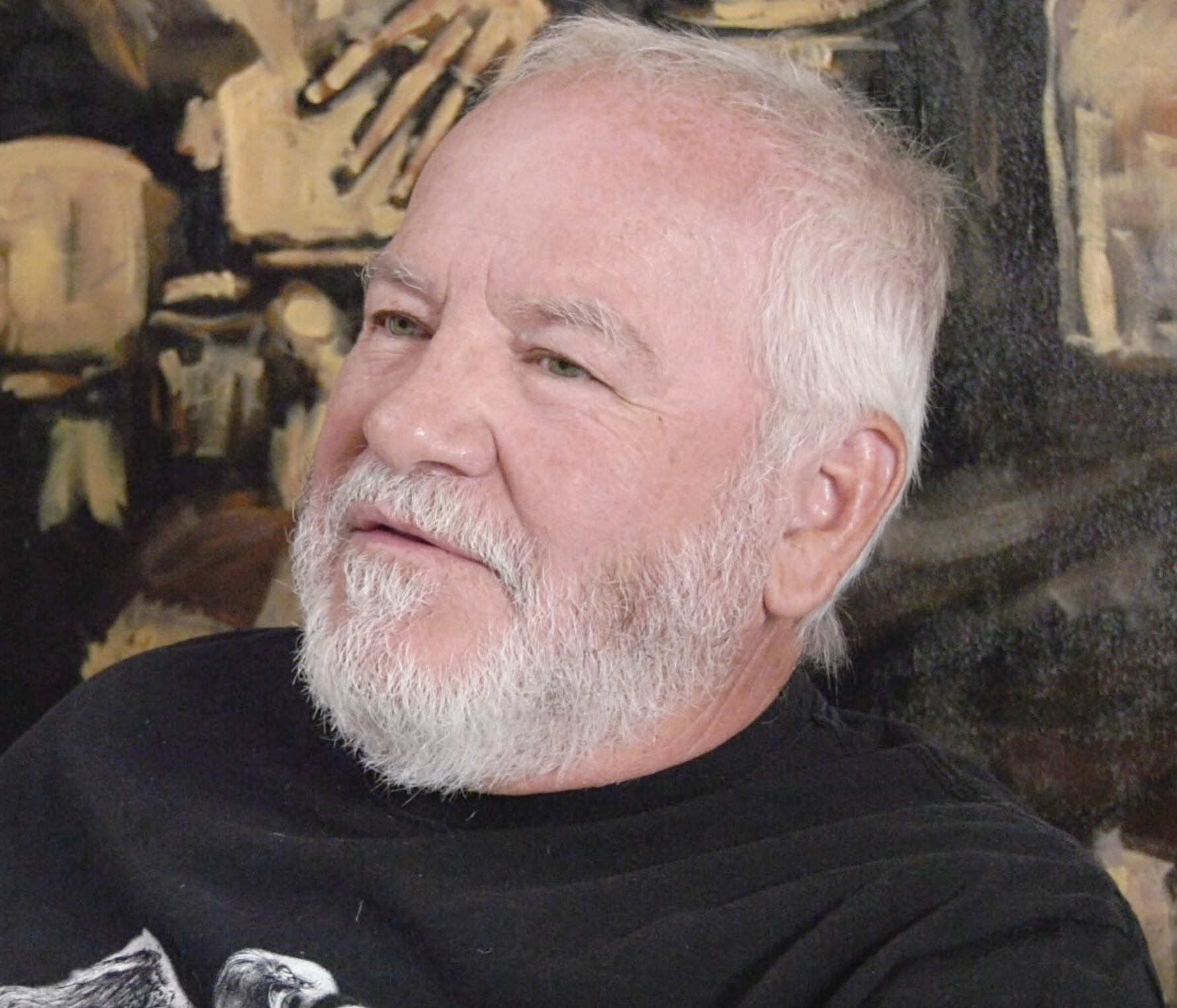
Robert Apodaca Interview
LHP_Intern2020-05-12T22:40:24+00:00Robert, who was a miner at the Allen Mine west of Trinidad, discusses what life was like growing up in a mining town in the mid-20th century. 7.5 mins.
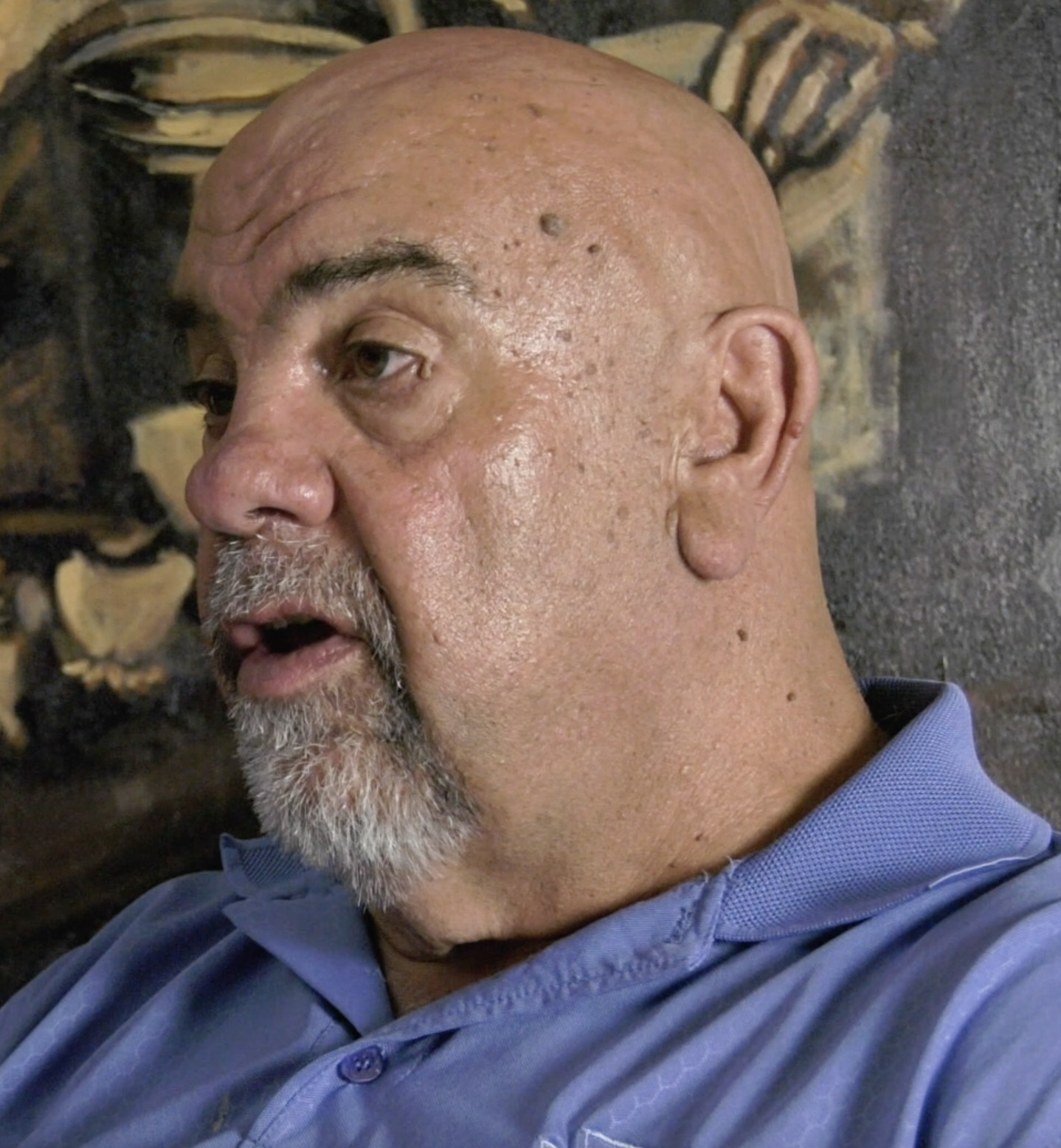
Robert Butero Interview
LHP_Intern2020-05-12T22:42:13+00:00Robert discusses life in the mining town of Sopris, which now rests below the waters of Trinidad Reservoir, and the roles that the mining company played in the day-to-day lives of the people who lived there. 6.1 mins.
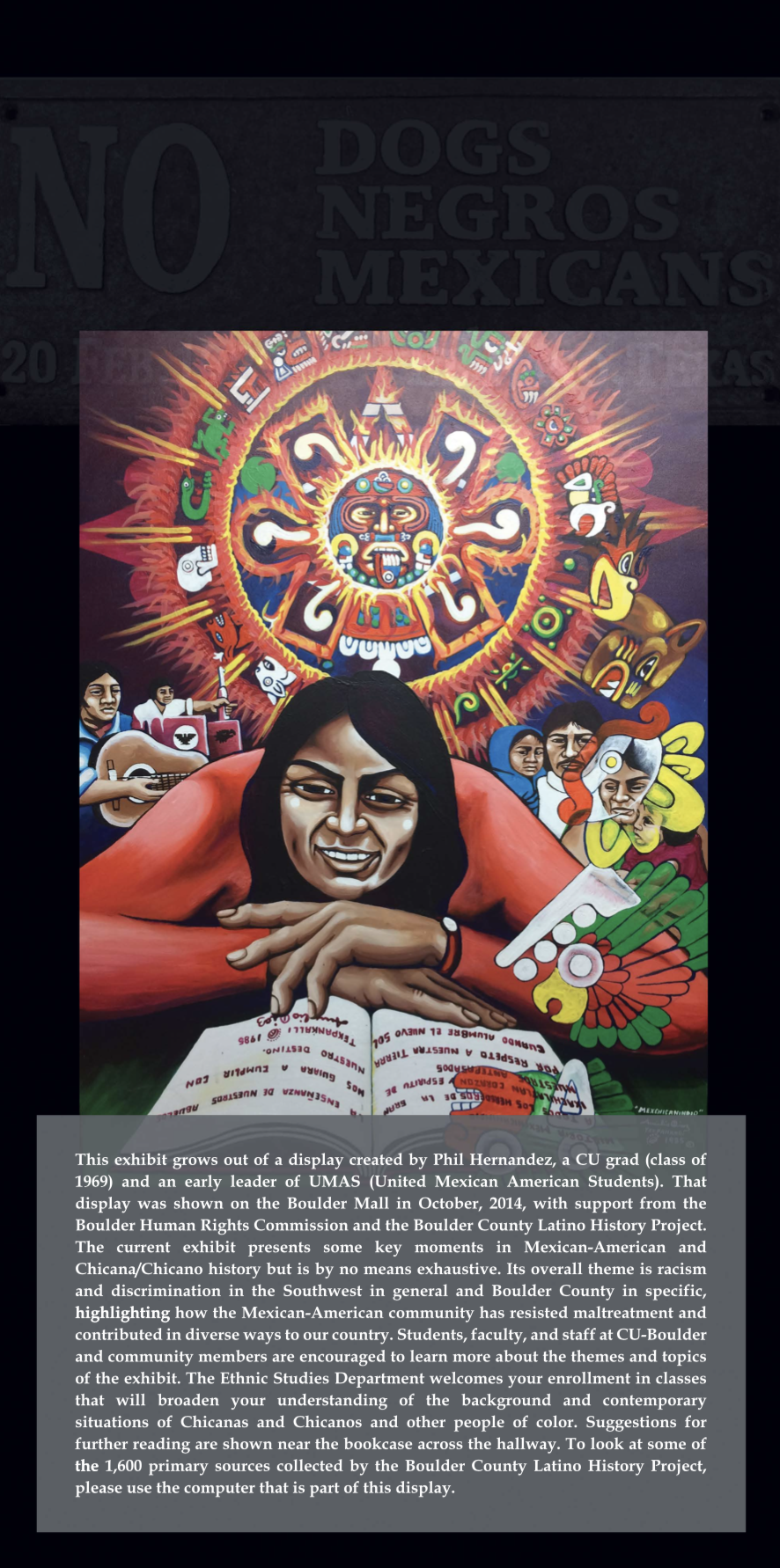
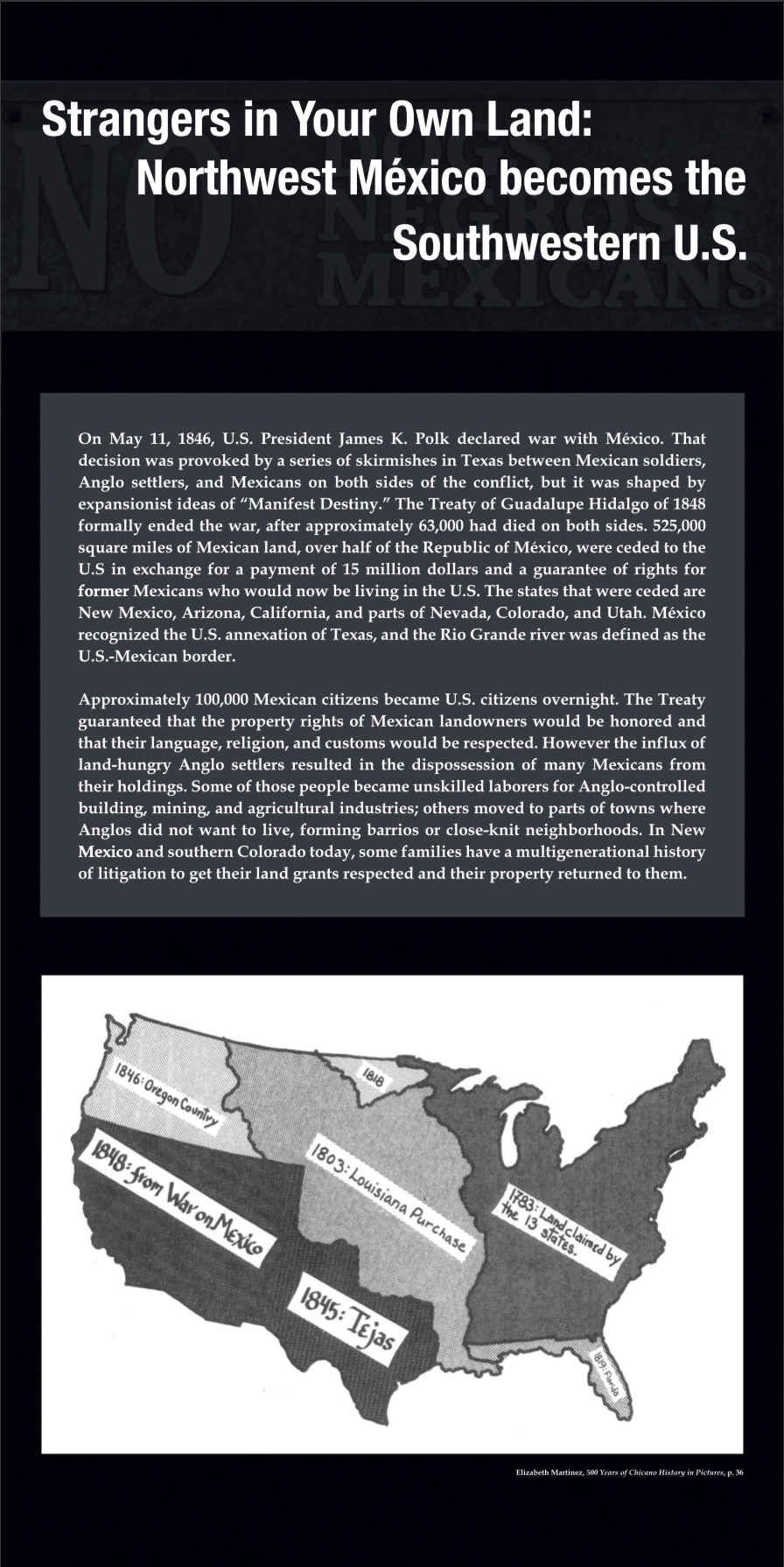
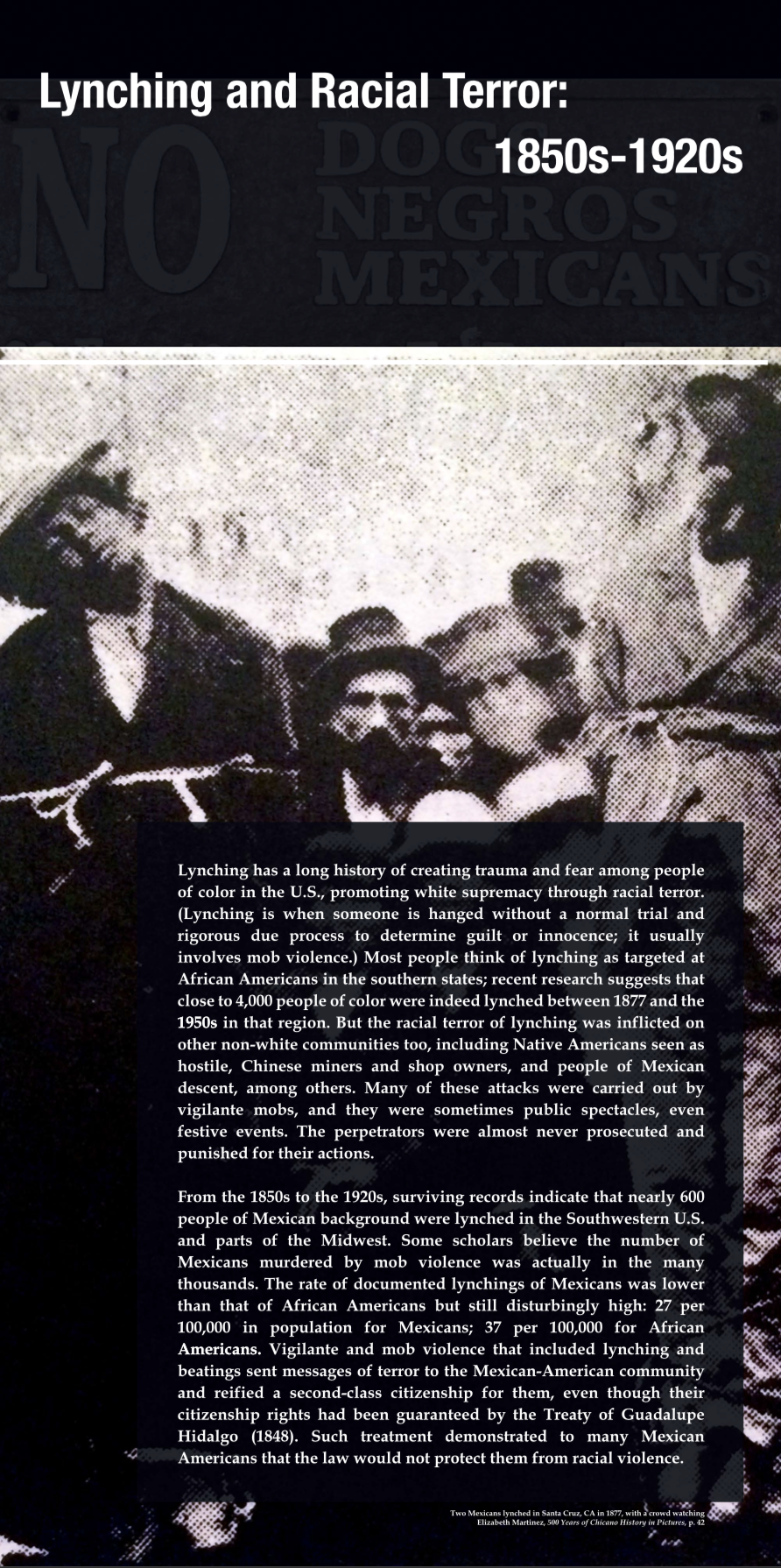
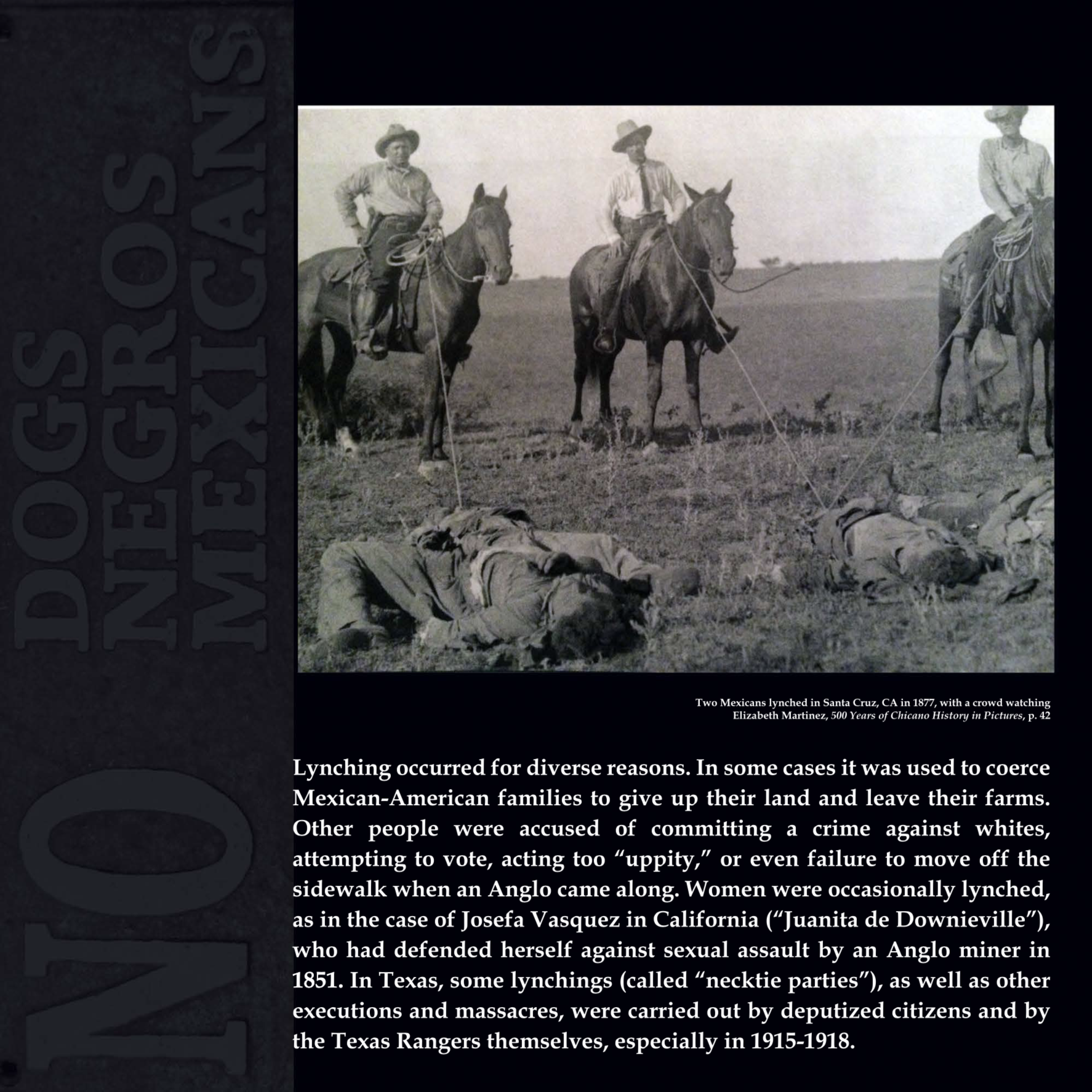
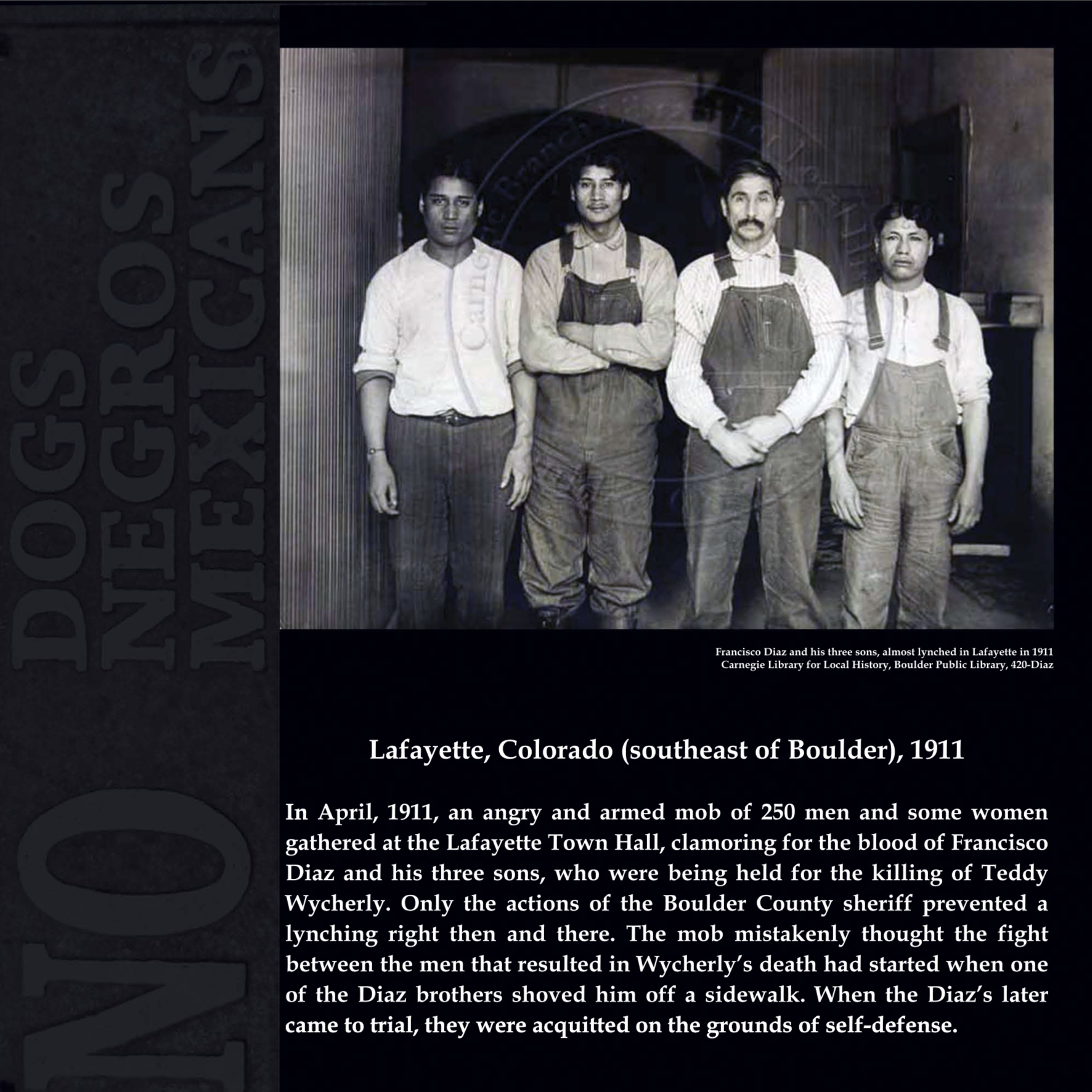
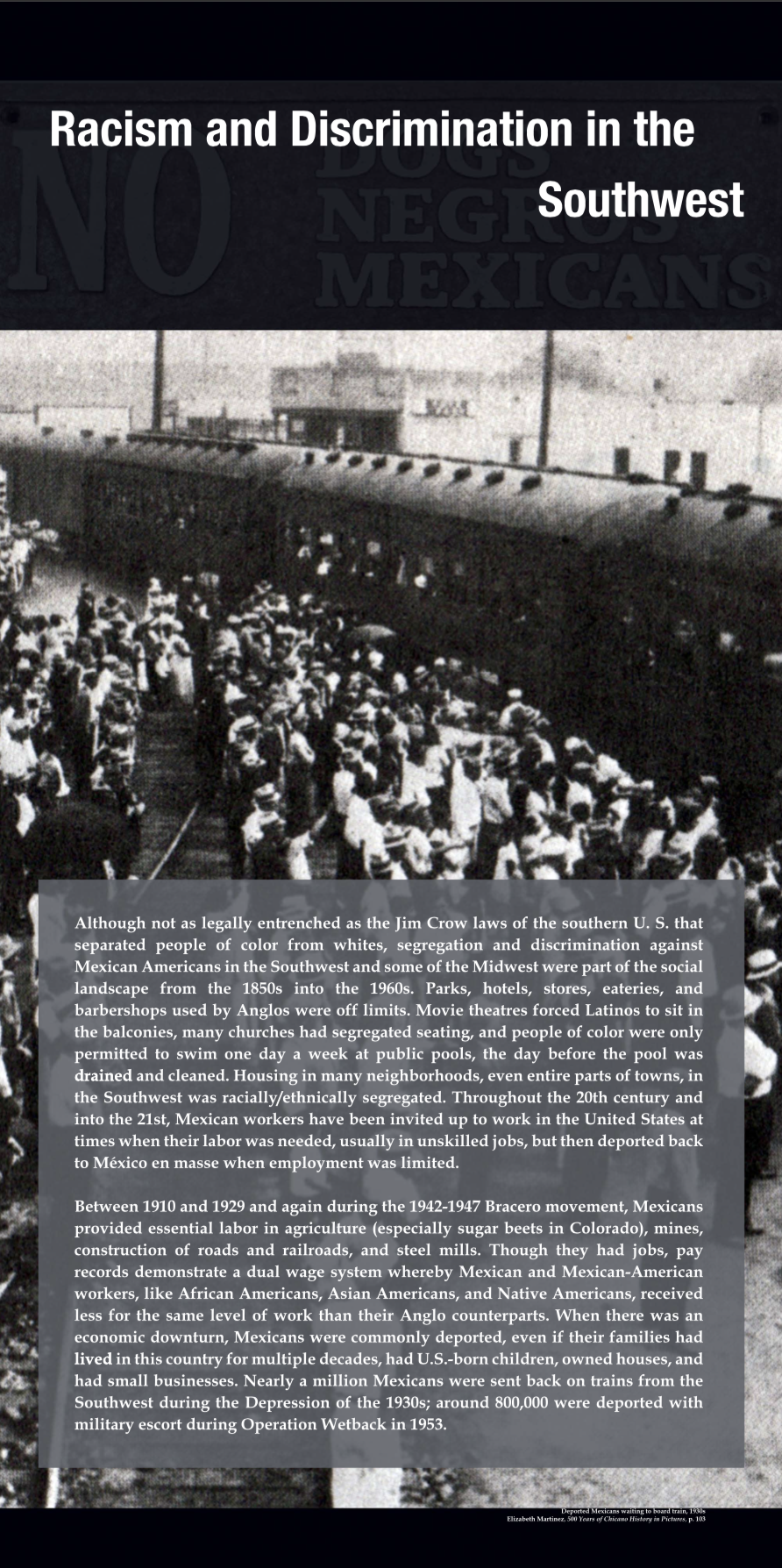
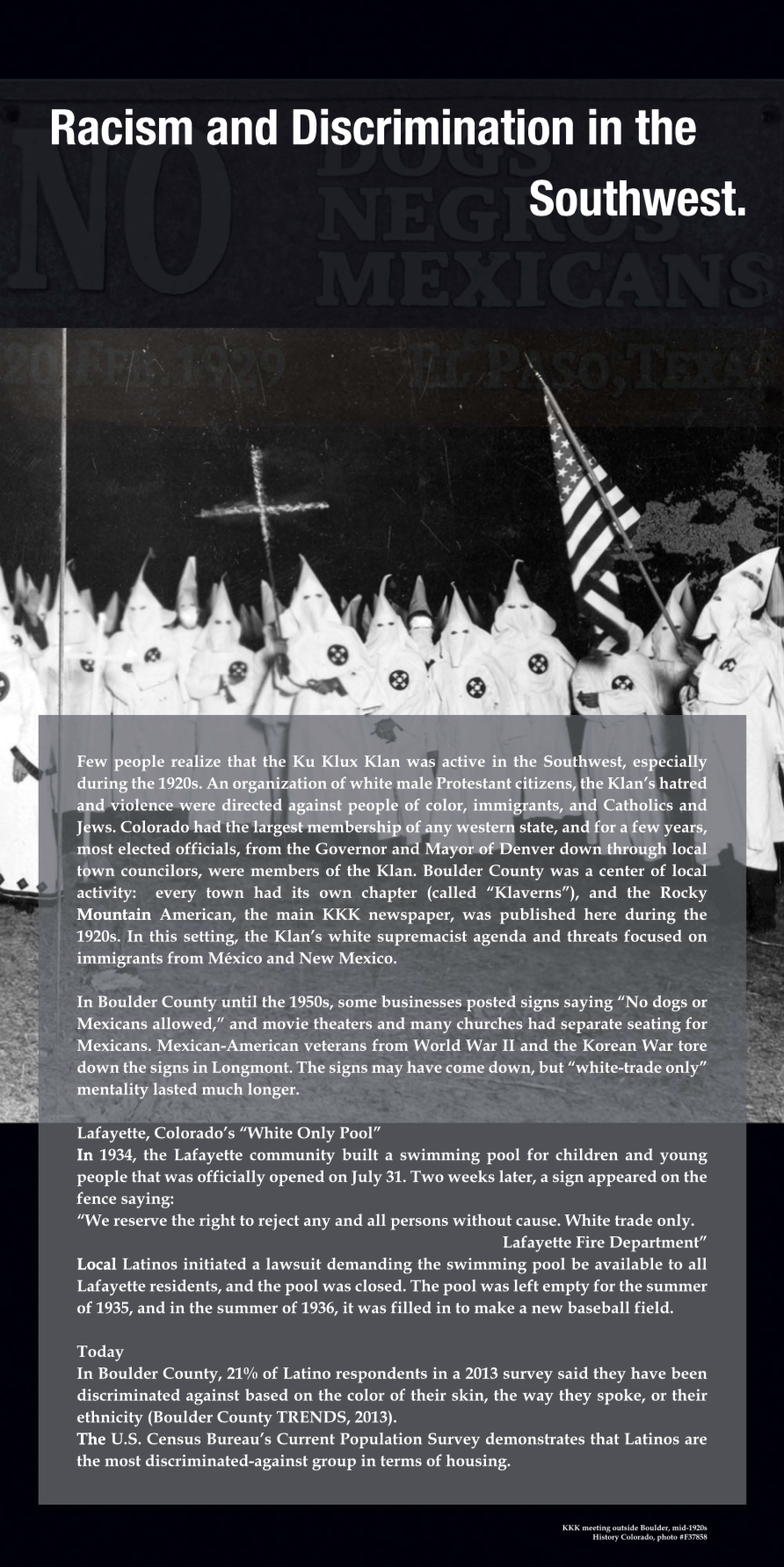
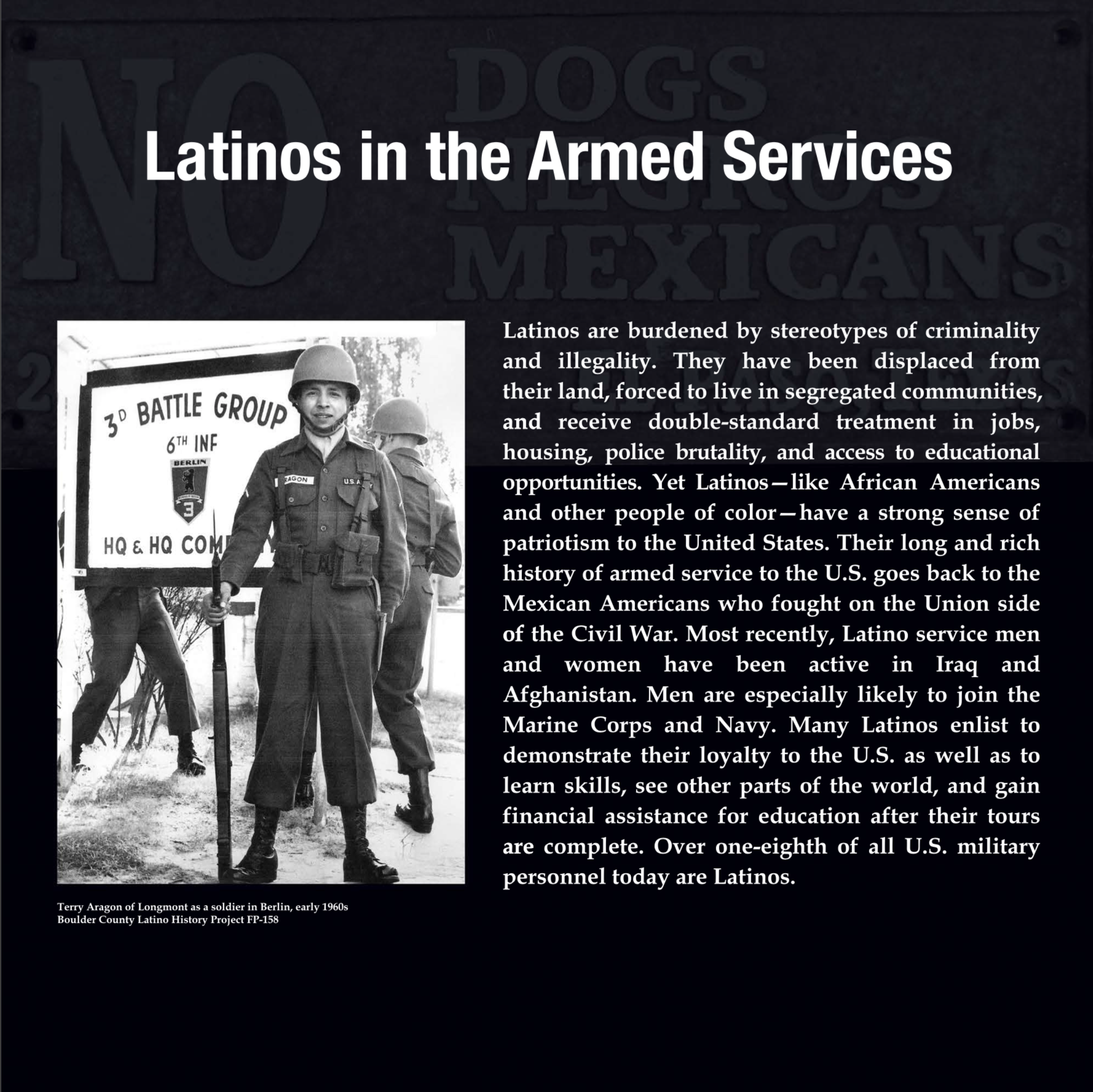
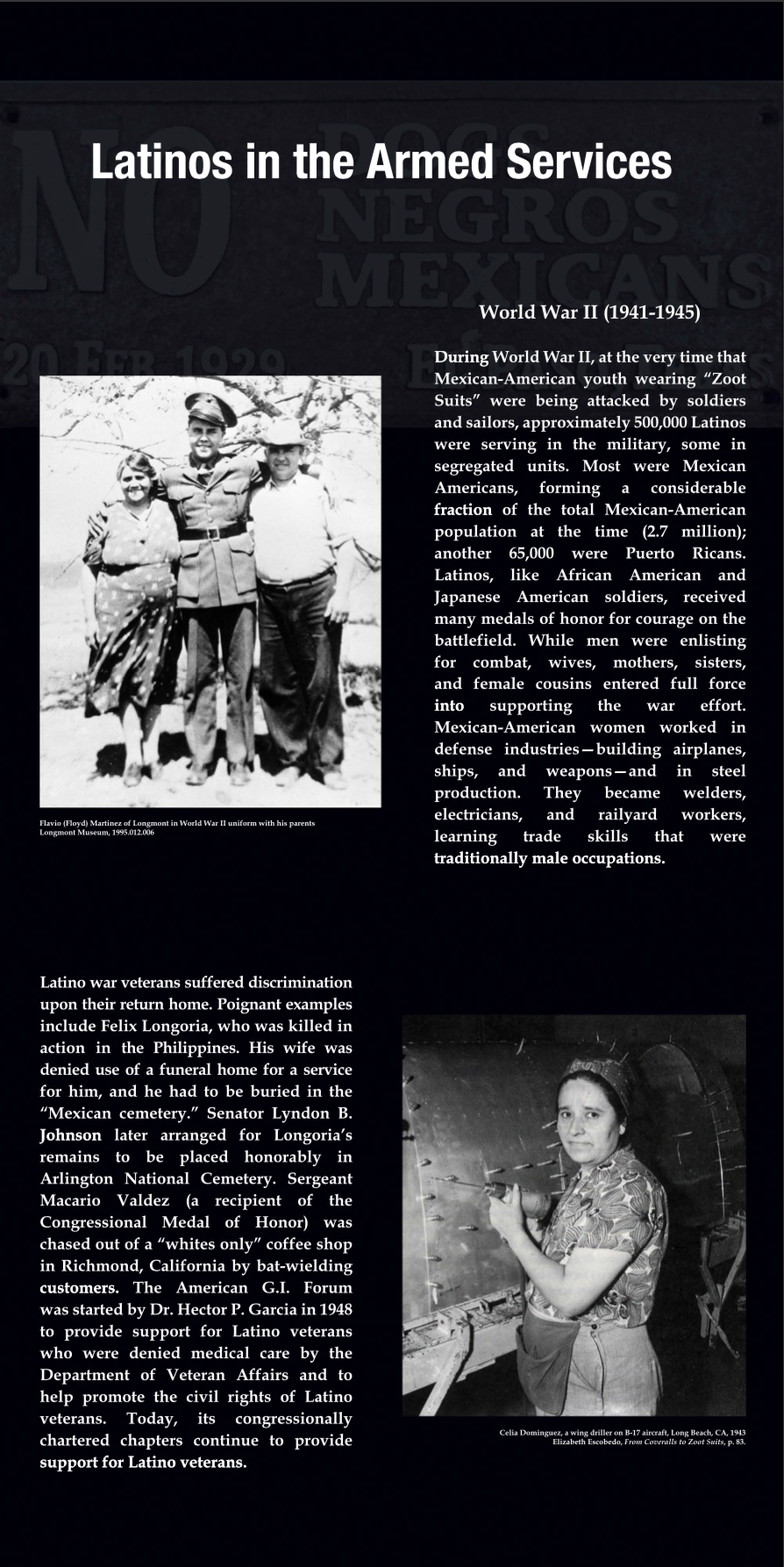
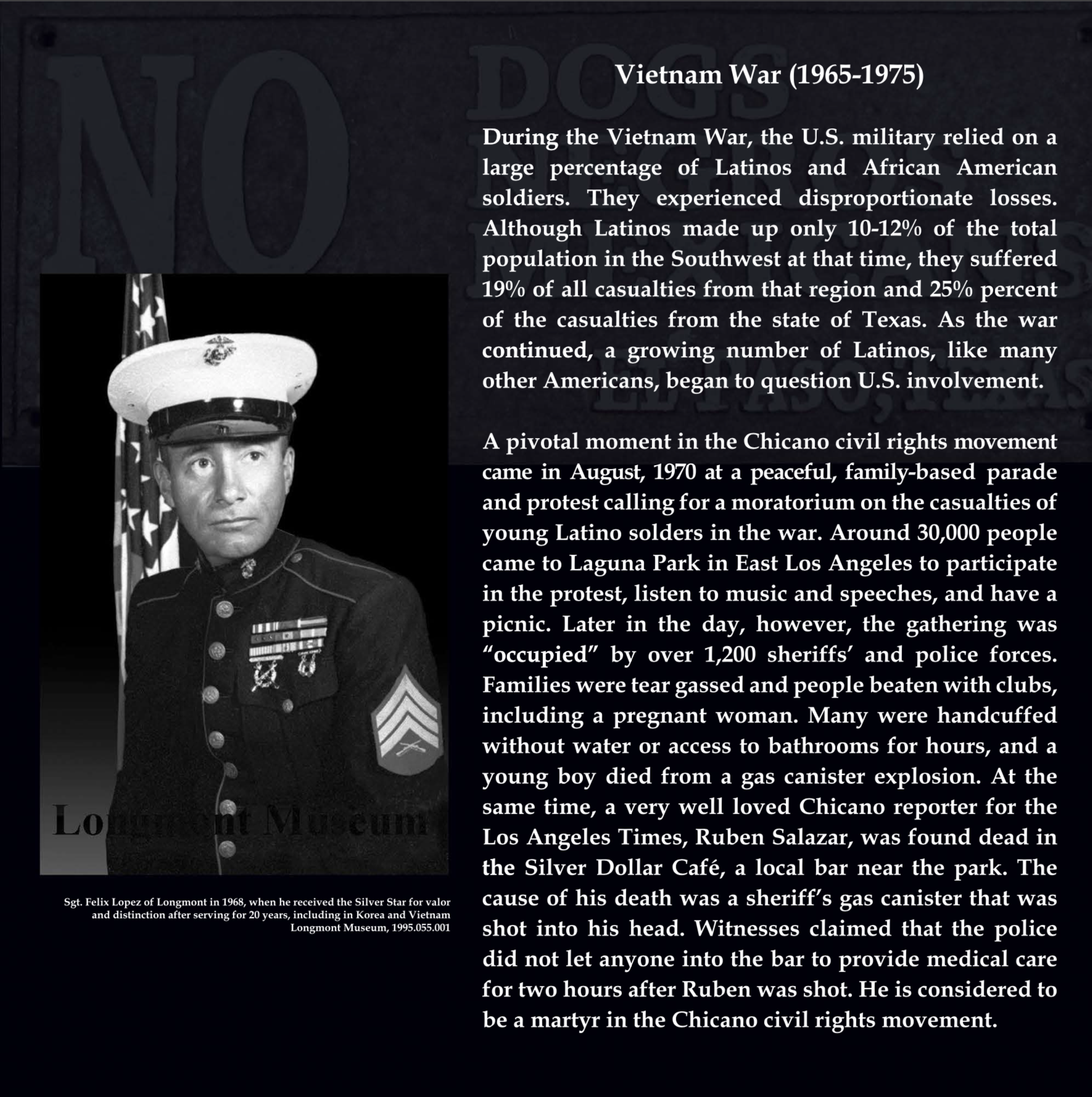
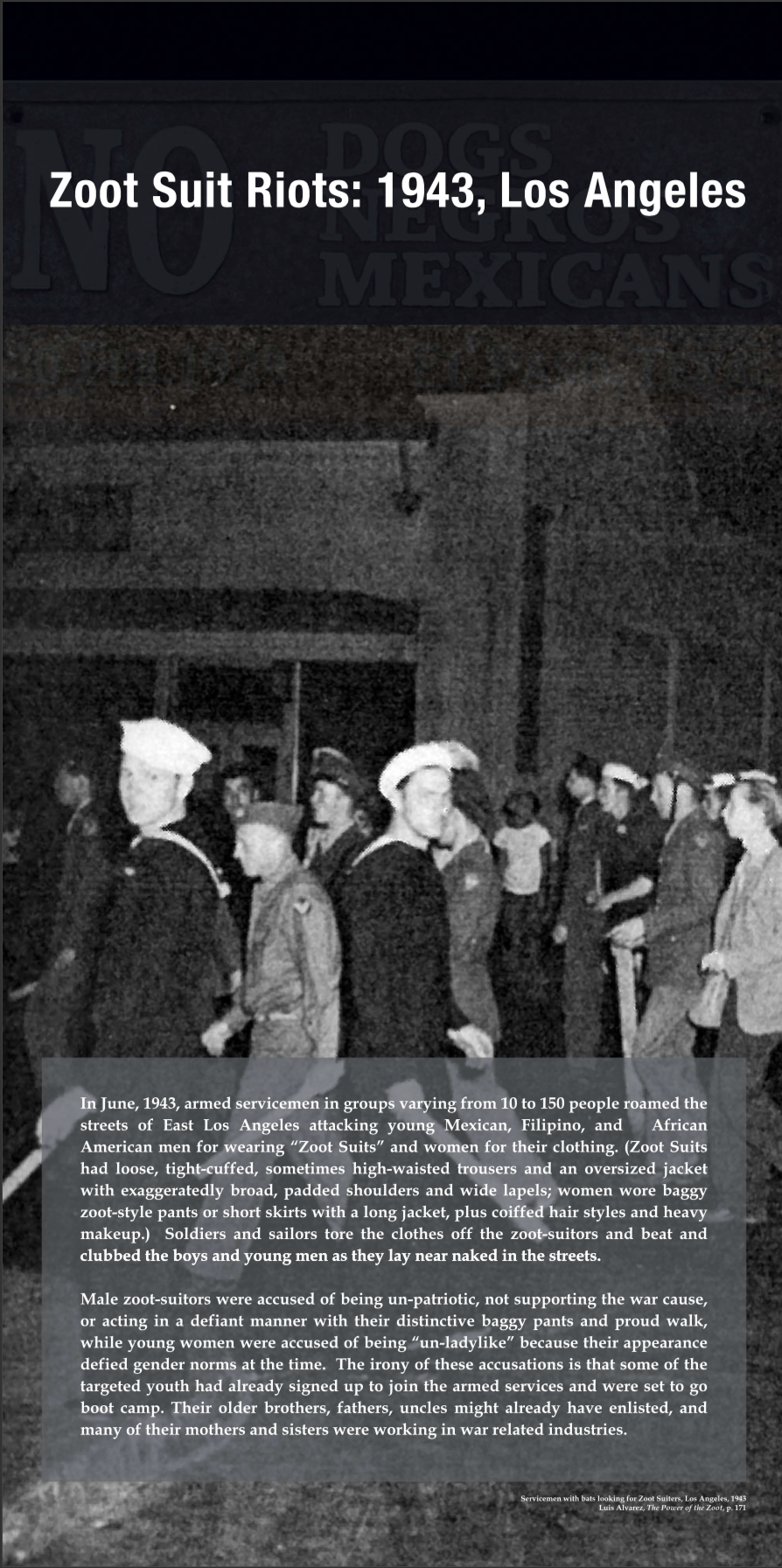
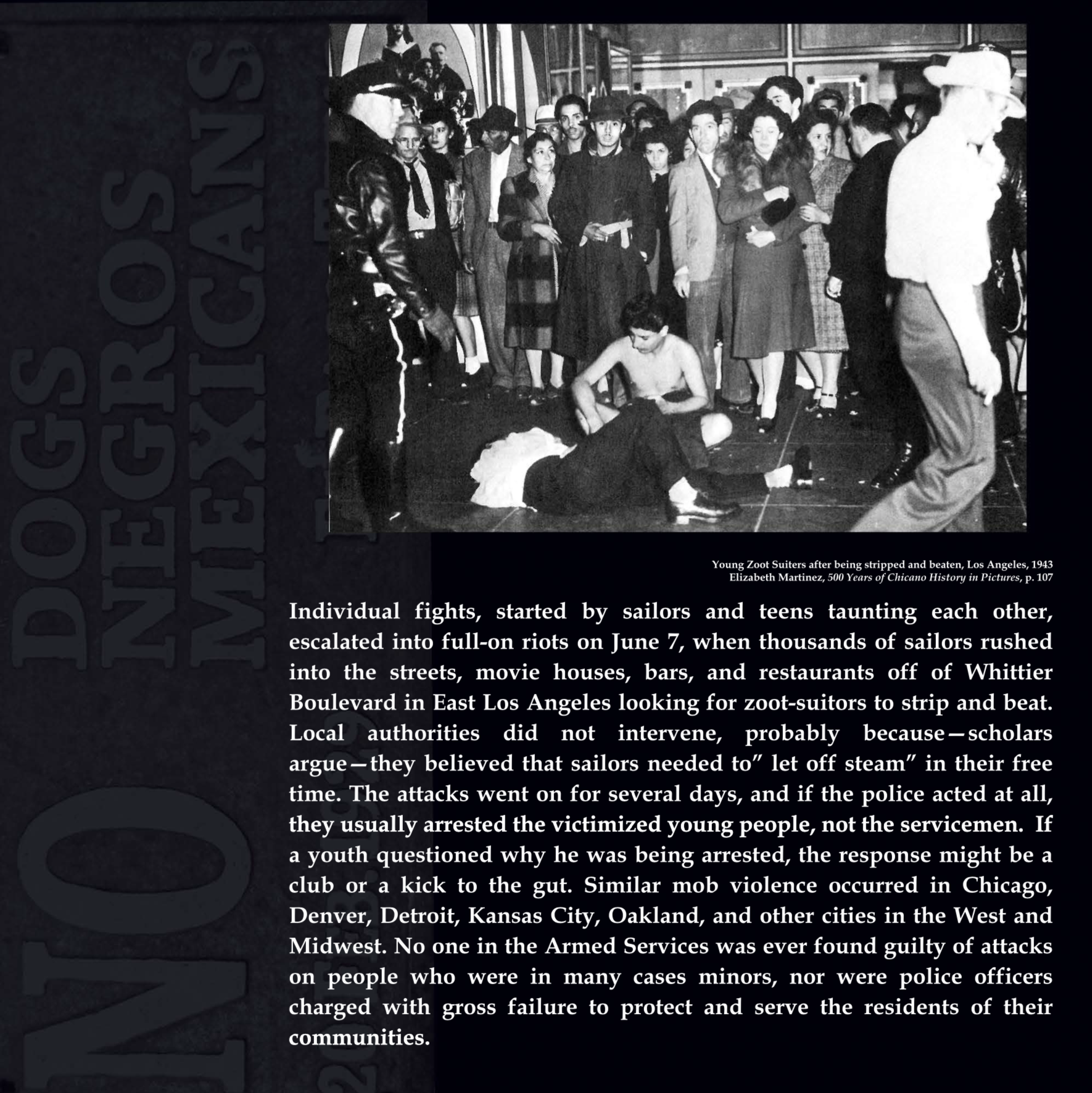
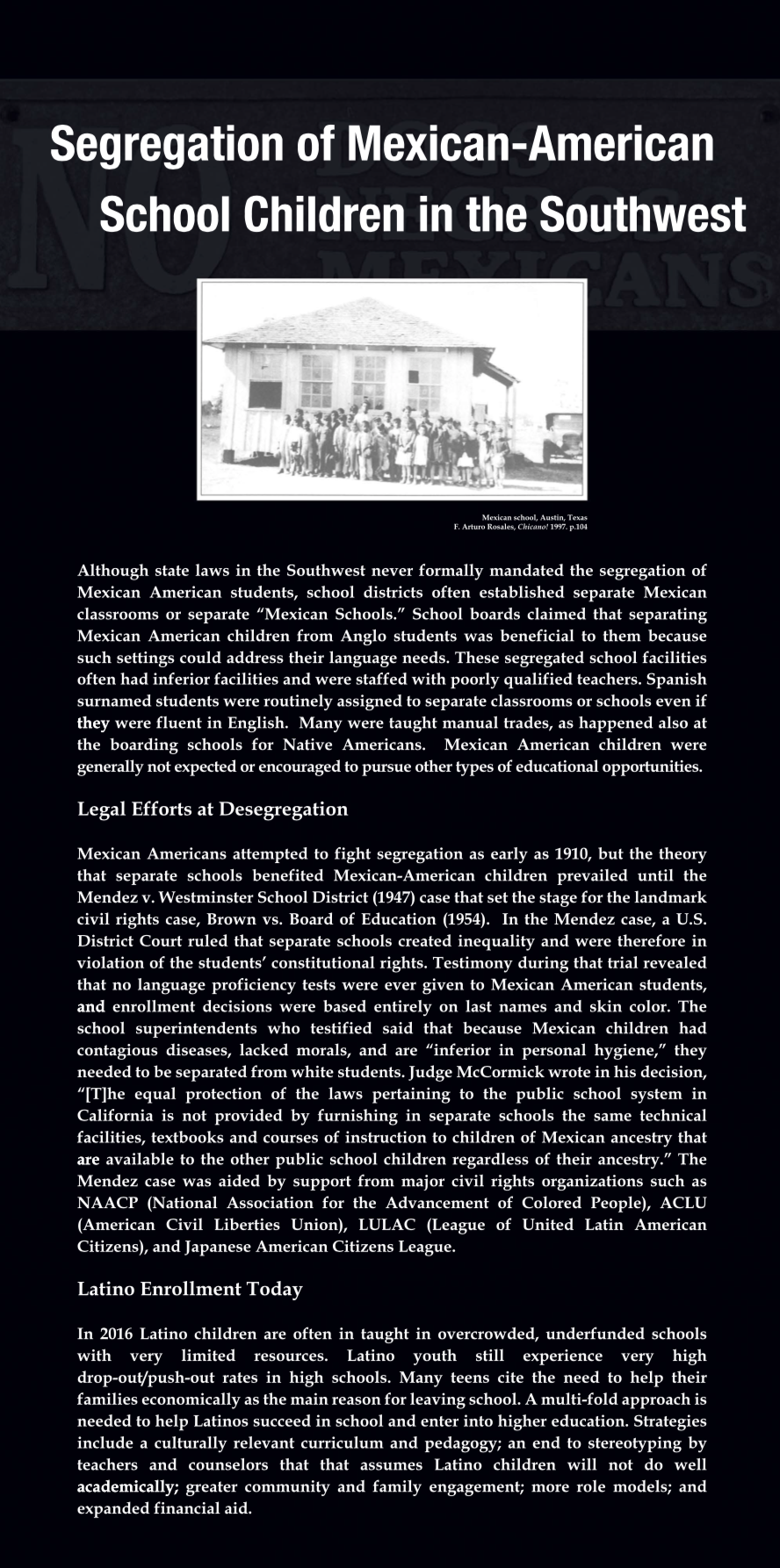

Group of protesters in Center, CO
LHP_Intern2019-09-25T02:59:15+00:00Group of protesters in Center, CO

United Farm Workers of America members and supporters hold a rally for the lettuce workers who are on strike
LHP_Intern2019-10-11T04:06:34+00:00Striking against the Finerman Company in Center, CO., 1970

Hermanos del Concilio #19, Alamosa, Colorado
LHP_Intern2019-09-25T03:00:00+00:00Hermanos del Concilio #19, Alamosa, Colorado

Bust portrait of Celedonio Mondragon
LHP_Intern2019-09-25T03:01:28+00:00founder of la Sociedad Protección Mutua de Trabajadores Unidos. Original portrait located in the SPMTU hall in Antonito, CO
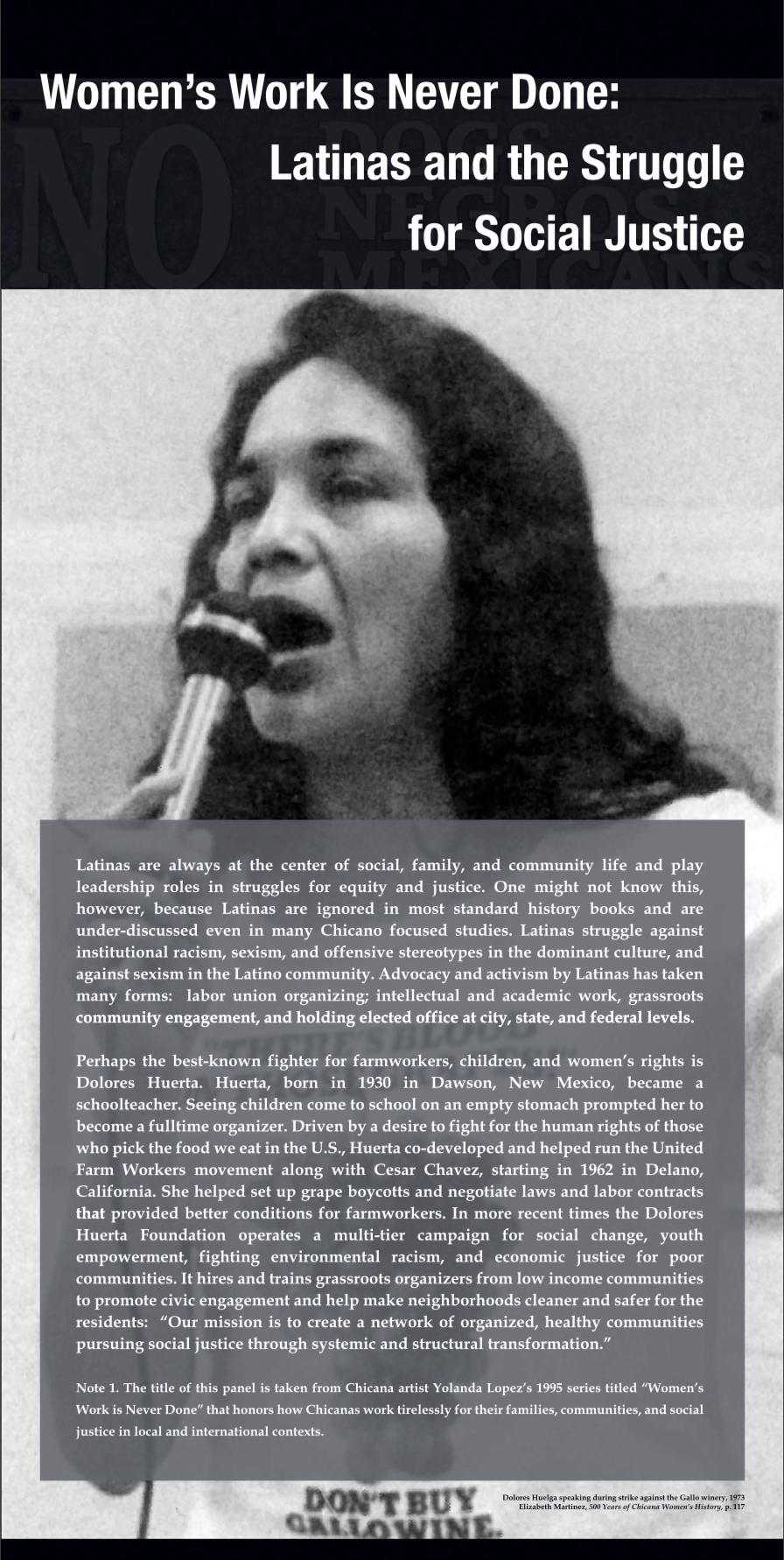
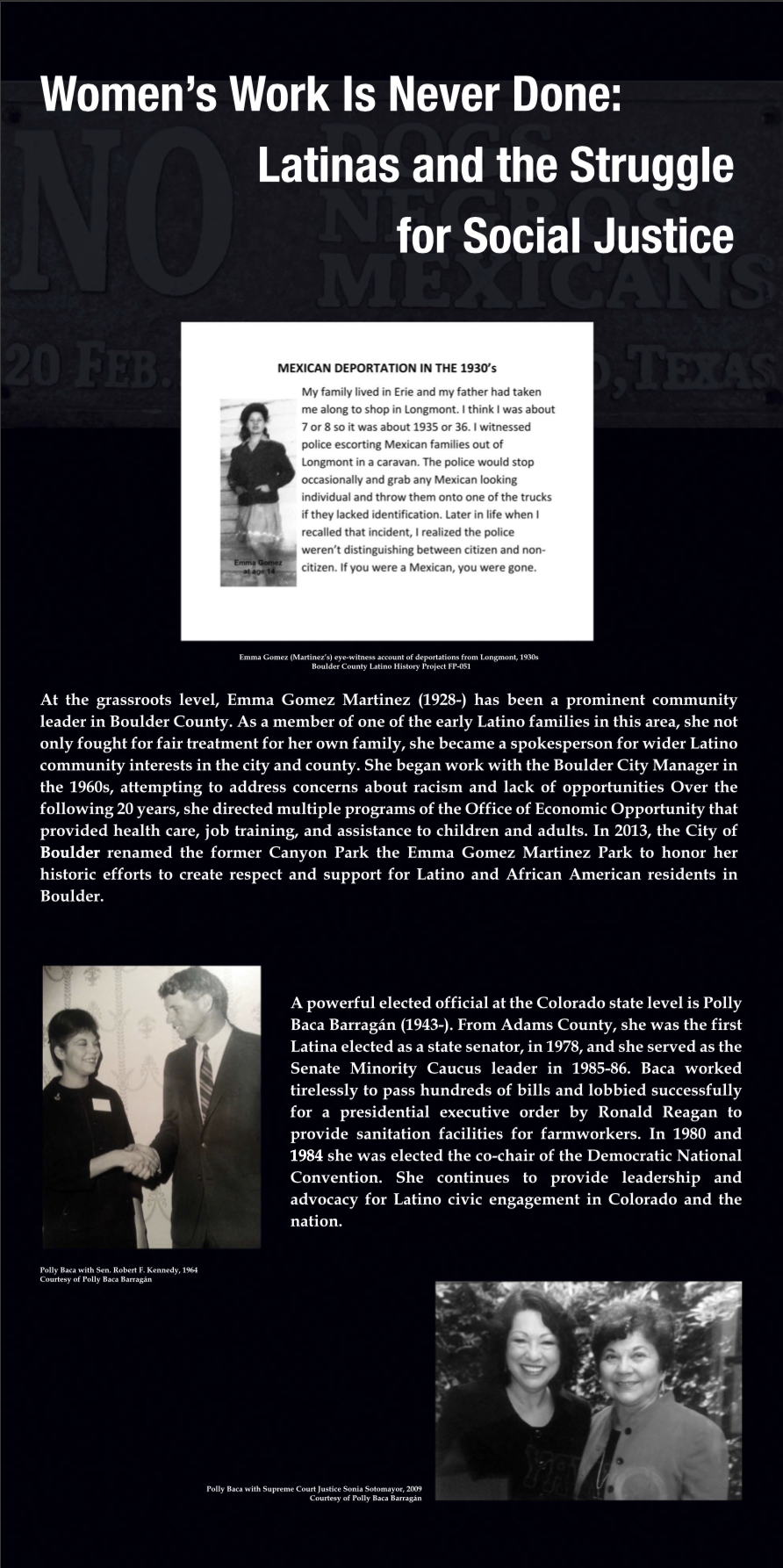
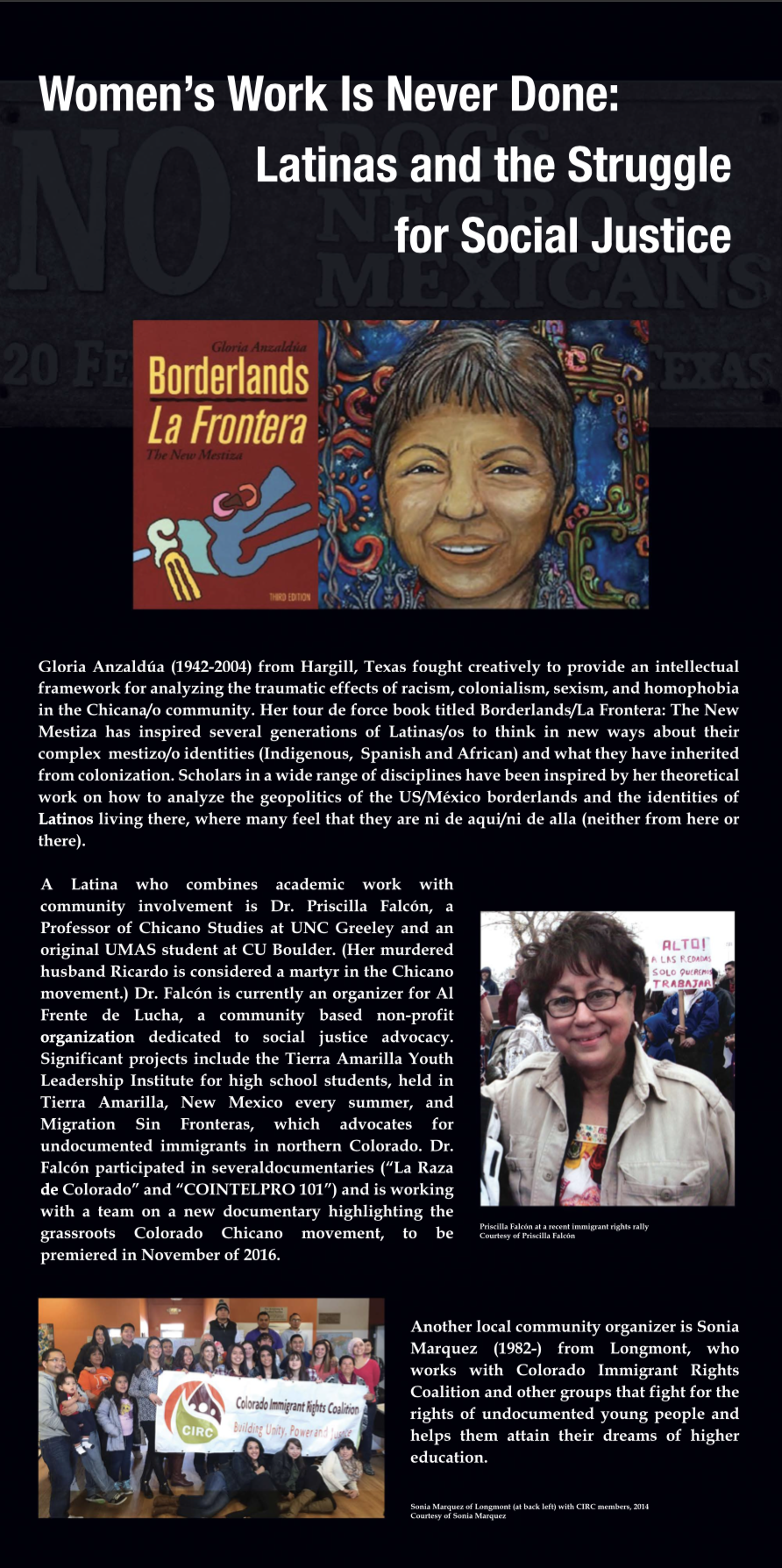

Churro sheep
LHP_Intern2019-12-13T21:10:25+00:00Two men standing with a Churro sheep, SLV but exact place and date unknown

Erinea Garcia at graduation, 1918
LHP_Intern2020-01-09T22:04:24+00:00Graduation portrait of Erinea García (later Erinea García de Gallegos), holding her diploma and a bouquet of roses in her lap. She graduated from Antonito High School in Antonito (Conejos County) in 1918.

Rural folk band
LHP_Intern2019-12-13T20:29:03+00:00Brothers José Filiberto Martinez, far left with violin and Gaspar Martinez, 2nd left with guitar, play with a rural folk band in San Luis Valley, Colorado, 1915-20.
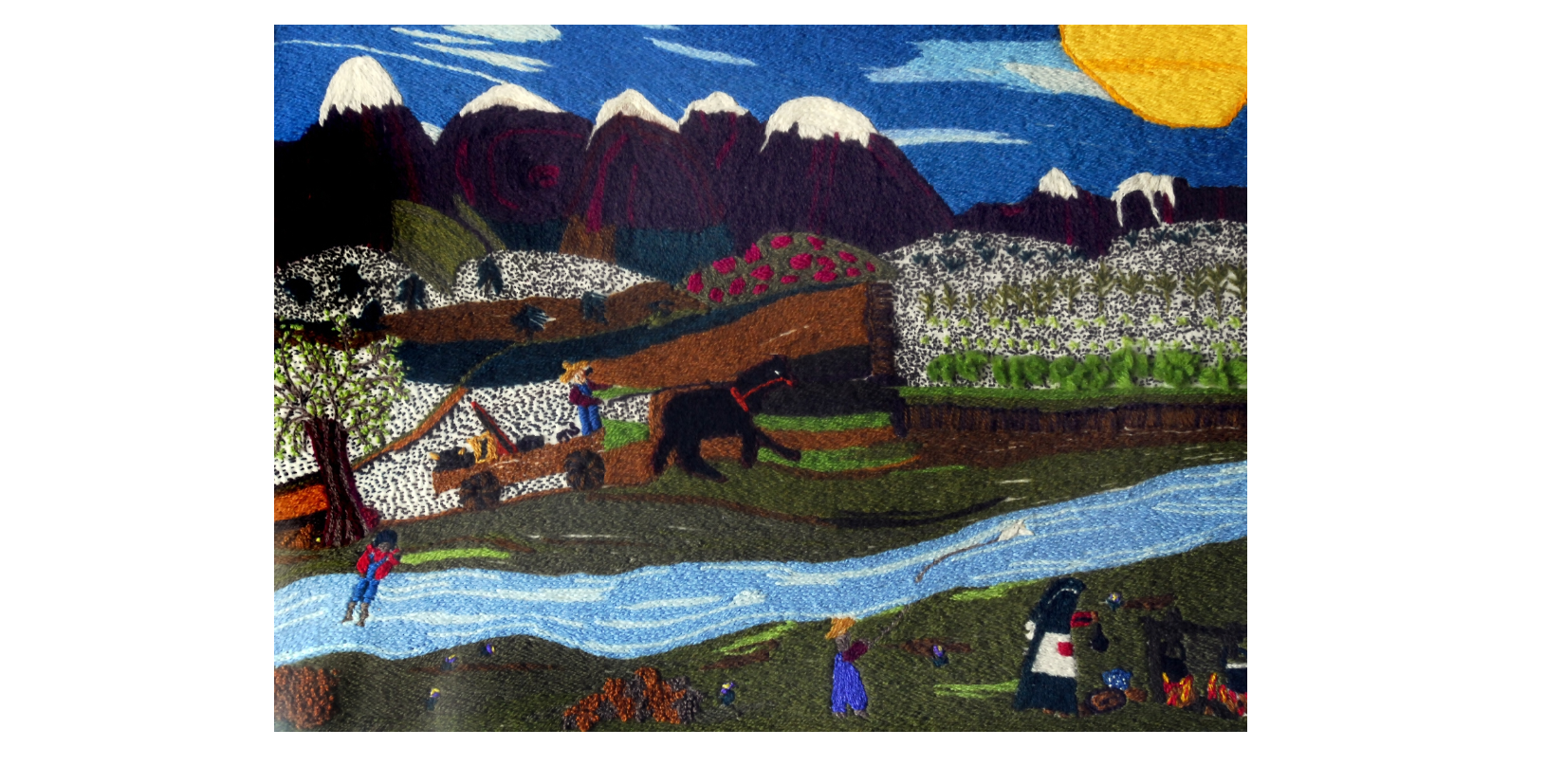
Colcha showing San Luis scene
LHP_Intern2019-12-13T20:29:53+00:00View of a colcha by Hispanic American Teresa Vigil of San Luis (Costilla County), Colorado. The embroidery of a rural scene in the San Luis Valley depicts men fishing in a stream, a woman cooking a fish and a man in a horse-drawn wagon.

Oral History interview, Theresa Vigil, 2011
LHP_Intern2019-12-13T20:30:24+00:00Interview with Theresa Vigil, including description of colcha embroidery (at 12:15)

Colcha, San Luis Valley
LHP_Intern2019-12-13T20:30:57+00:00Traditional colcha embroidery by Josie Lobato featuring the Capilla de Todos los Santos in San Luis

Our Lady of Guadalupe Rock Art
LHP_Intern2019-12-13T20:31:58+00:00A pictograph of Our Lady of Guadalupe created in the 1940s or 50s in Penitente Canyon near La Garita
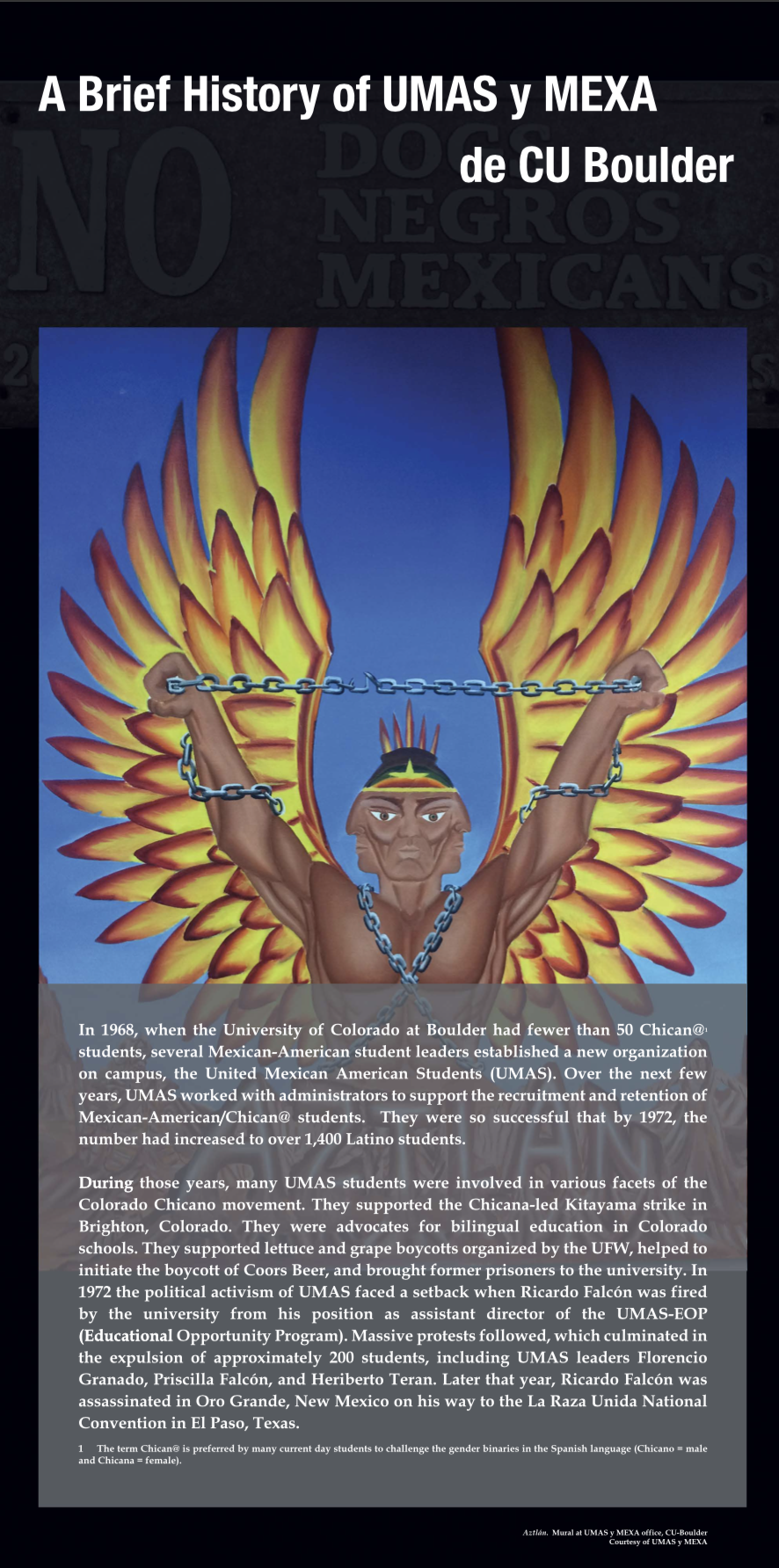
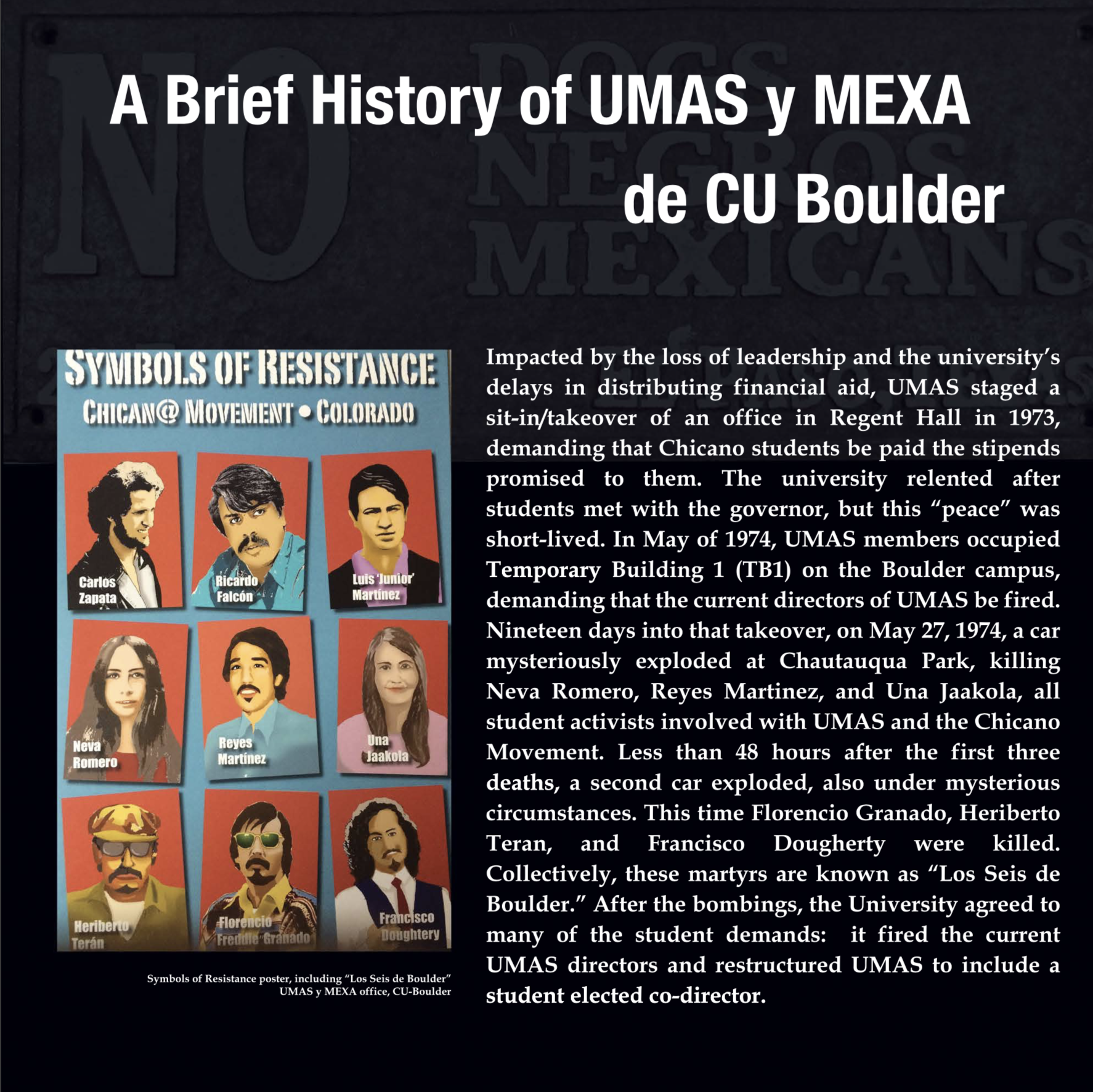
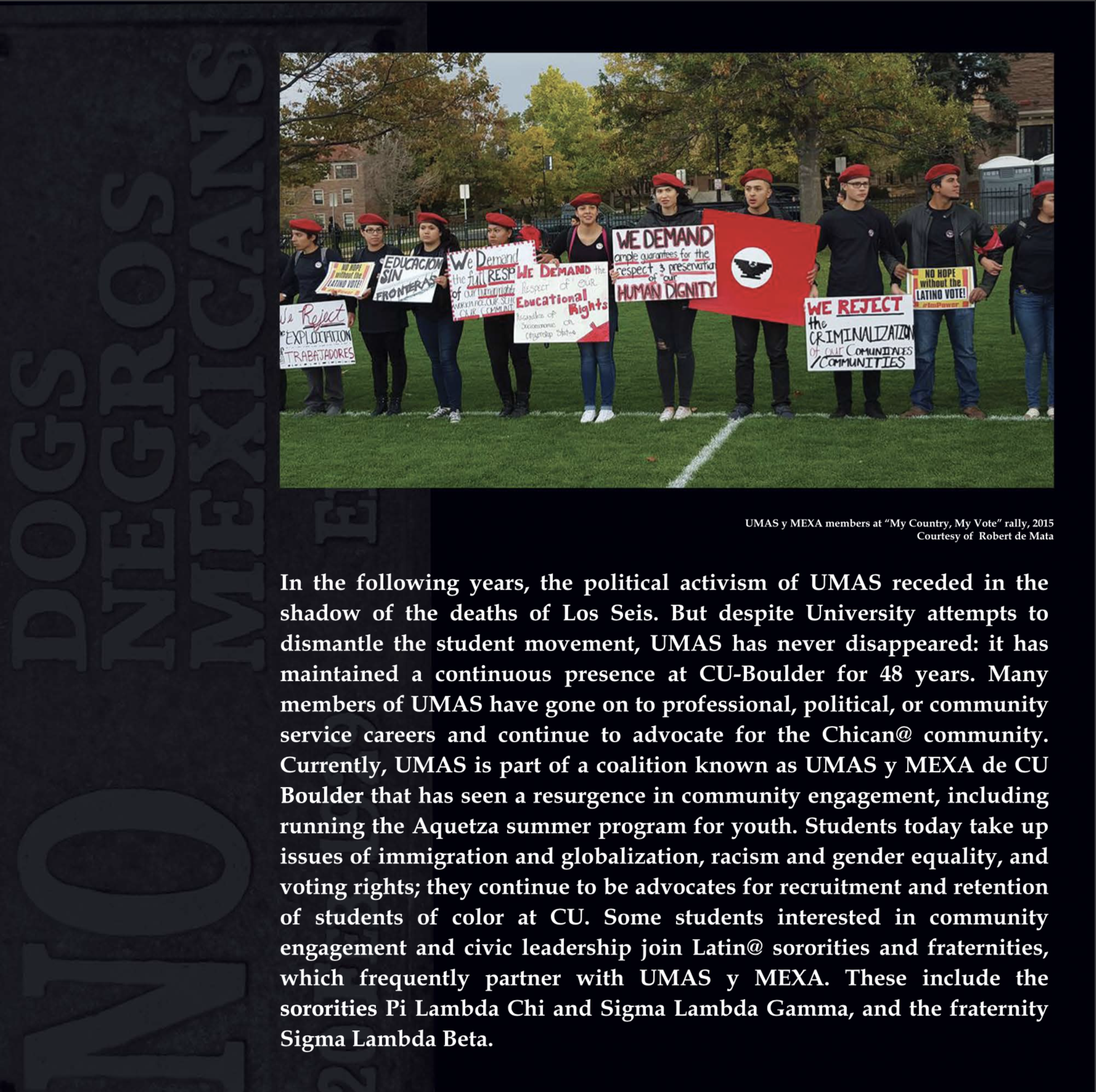

CF&I Steelworkers OK ‘realistic’ contract, 1989
LHP_Intern2019-09-14T22:21:11+00:00Union negotiators told workers on Saturday that the approved 3-yr. contract was the best they could get. The union was Pueblo Steelworkers Local 2102, representing 1,600 production and maintenance workers. They hoped that better business conditions for the CF&I would lead to a better contract in the future.
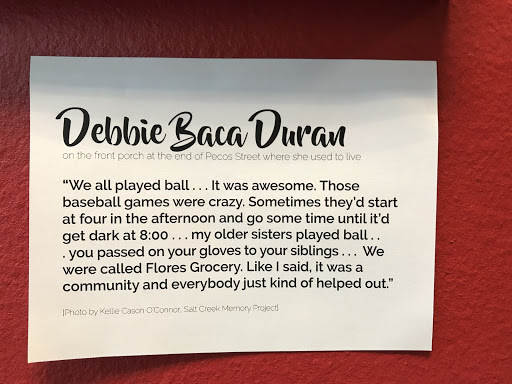
Debbie Baca Duran Quote
LHP_Intern2019-09-13T03:00:22+00:00“We all played ball… It was awesome. Those baseball games were crazy. Sometimes they’d start at four in the afternoon and go some time until it’d get dark at 8:00… your older sisters played ball… you passed on your gloves to your siblings… We were called Flores Grocer. Like I said, it was a community and everybody just kind of helped out”

Salt Creek residents push for bus service, 1992
LHP_Intern2020-01-18T04:49:47+00:00Sharon Villalon, executive director of HOPE Alive, said Salt Creek residents have complained to her agency that the lack of adequate public transportation remains among the neighborhood’s chief problems.
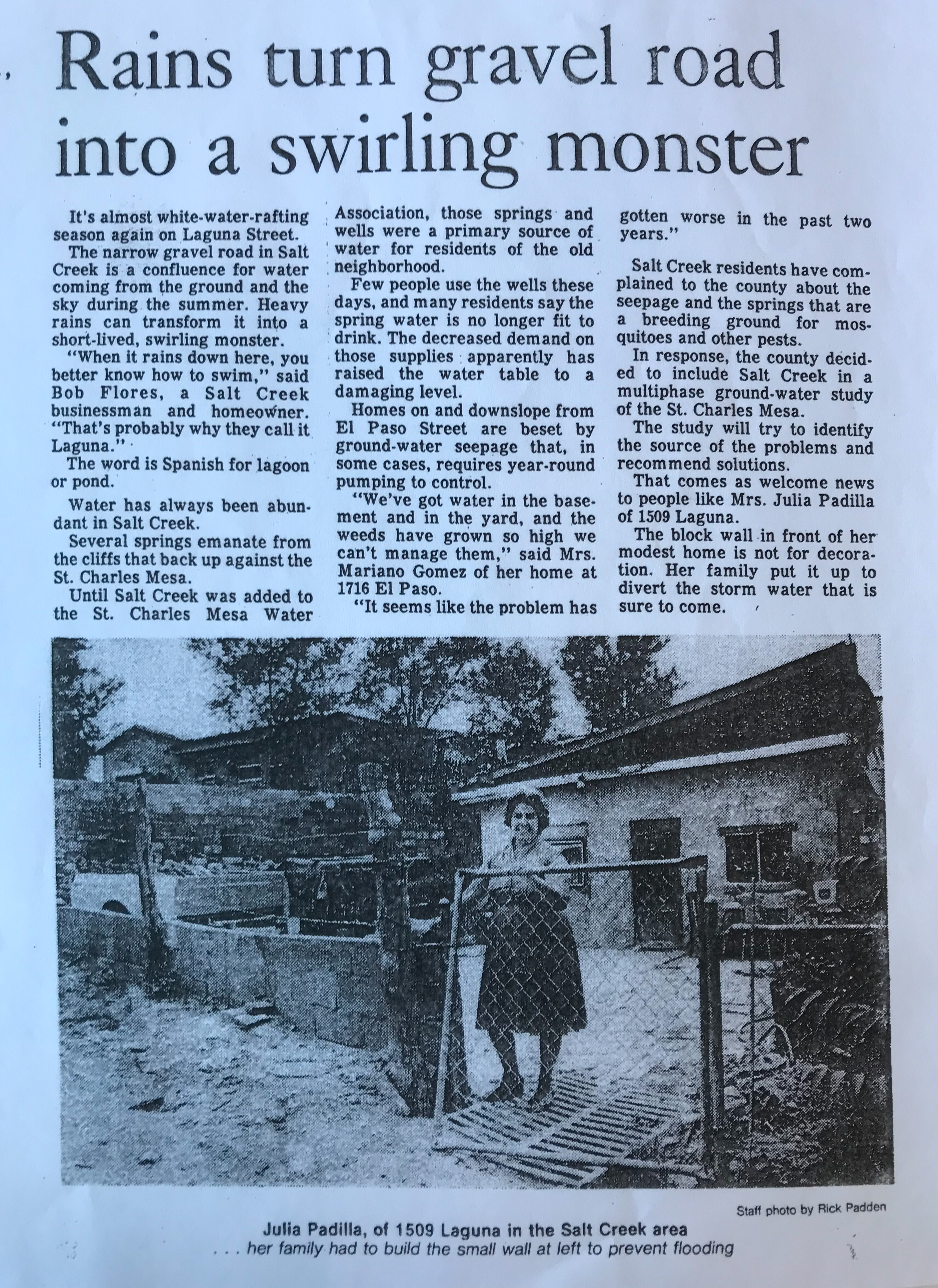
Rains turn gravel road into a swirling monster, 1985
LHP_Intern2020-01-18T04:49:33+00:00Laguna Street in Salt Creek floods after heavy rains. Water is abundant in Salt Creek, with several springs that emanate from the nearby cliffs. Few people use wells these days, but flooding is getting worse.

Salt Creek Residents make bid for bus service, 1982
LHP_Intern2020-01-18T04:49:20+00:00Local residents say it is frustrating and discouraging to feel they are stranded outside the City.

Clippings about Salt Creek: CO-OP, and Salt Creek Park, 1974-5
LHP_Intern2020-01-18T04:49:04+00:003 clippings from unidentified Pueblo papers: (1) Citizens claim Community Organization-Outreach of Pueblo, an anti-poverty project, was slighting Salt Creek, Aug. 1, 1974; (2) Cooperation by Salt Creek residents tied to CO-OP aid in area, Dec. 11, 1974; (3) Salt Creek park opened, June 9, 1975

Salt Creek residents fight for paved roads, 1972
LHP_Intern2020-01-18T04:47:59+00:00Residents of the Salt Creek community asked the county commissioners to improve and pave roads in the community—an issue that has been raised repeatedly for several years. Louis Garcia, chairman of the Barrio de Salado Improvement Association, accused Road Commissioner Martin Moore of failing to meet past promises to pave roads in Salt Creek and of being a racist.
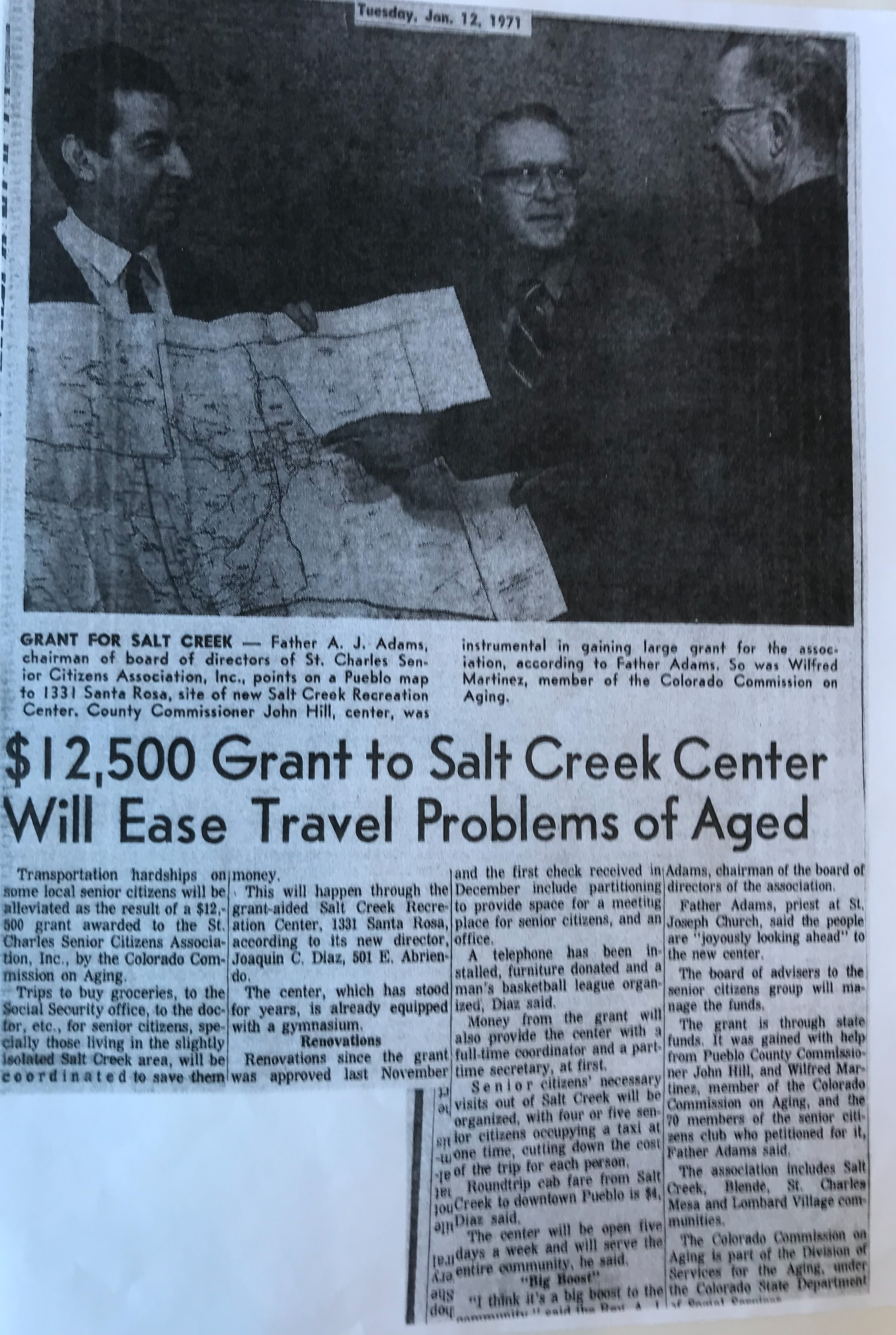
$12,500 Grant to Salt Creek Center Will Ease Travel Problems of Aged, 1971
LHP_Intern2020-01-18T04:47:44+00:00Grant given to the St. Charles Senior Citizens Association by the Colorado Commission on Aging, to be administered through the grant-aided Salt Creek Recreation Center.
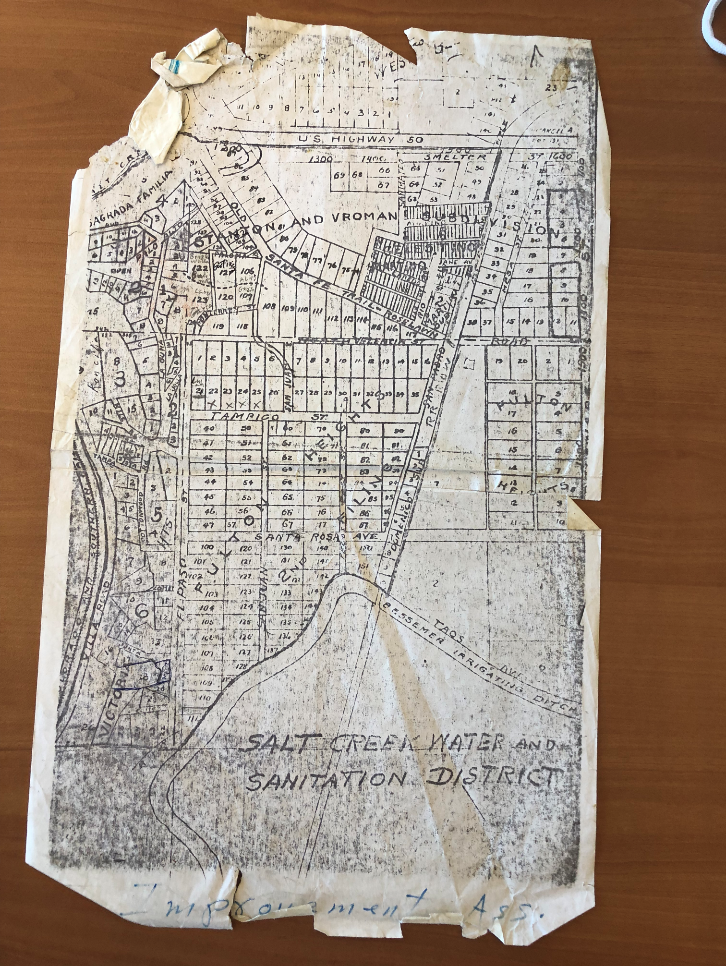
Salt Creek Water District
LHP_Intern2020-01-18T04:47:32+00:00Map of Salt Creek Water and Sanitation District, undated

Funds approved for Salt Creek project, 1980
LHP_Intern2020-01-18T04:47:19+00:00County commissioners awarded $63,000 to Salt Creek Water and Sanitation District as part of the local matching funds for installation of a sanitary sewer system in the Salt Creek area.

Officials deny dragging their feet regarding bad conditions in Salt Creek, 1972
LHP_Intern2020-01-18T04:44:26+00:00City and county officials denied Thursday that they are dragging their feet in processing complaints about dilapidated buildings, outdoor privies and an open cistern in the Salt Creek area.

Salt Creek Residents Condemn Water Supply, Nov., 1971
LHP_Intern2020-01-18T04:45:51+00:00Complaint to the chief of the engineering section of the State Health Department led by Louis Garcia, chair of the 10-member local committee named by residents. Chief engineer was to come with a chemist to make a laboratory test of the Salt Creek water supply.

Salt Creek Residents Taking Precautions with Well Water, Oct., 1971
LHP_Intern2020-01-18T04:45:39+00:00Residents say water from well and pump house near Palo Alto and Laguna is not fit to drink or use to bathe. The well, completed in 1968, is deep, but underground seepage from Salt Creek is causing problems. Salt Creek is visibly polluted with oils and chemicals from CF&I Steel Corp. A recent water analysis undertaken by a microbiologist revealed major hazards. The private tests on the water began after residents failed to get action from the Pueblo City-County Health Department, who repeatedly said the water was good.
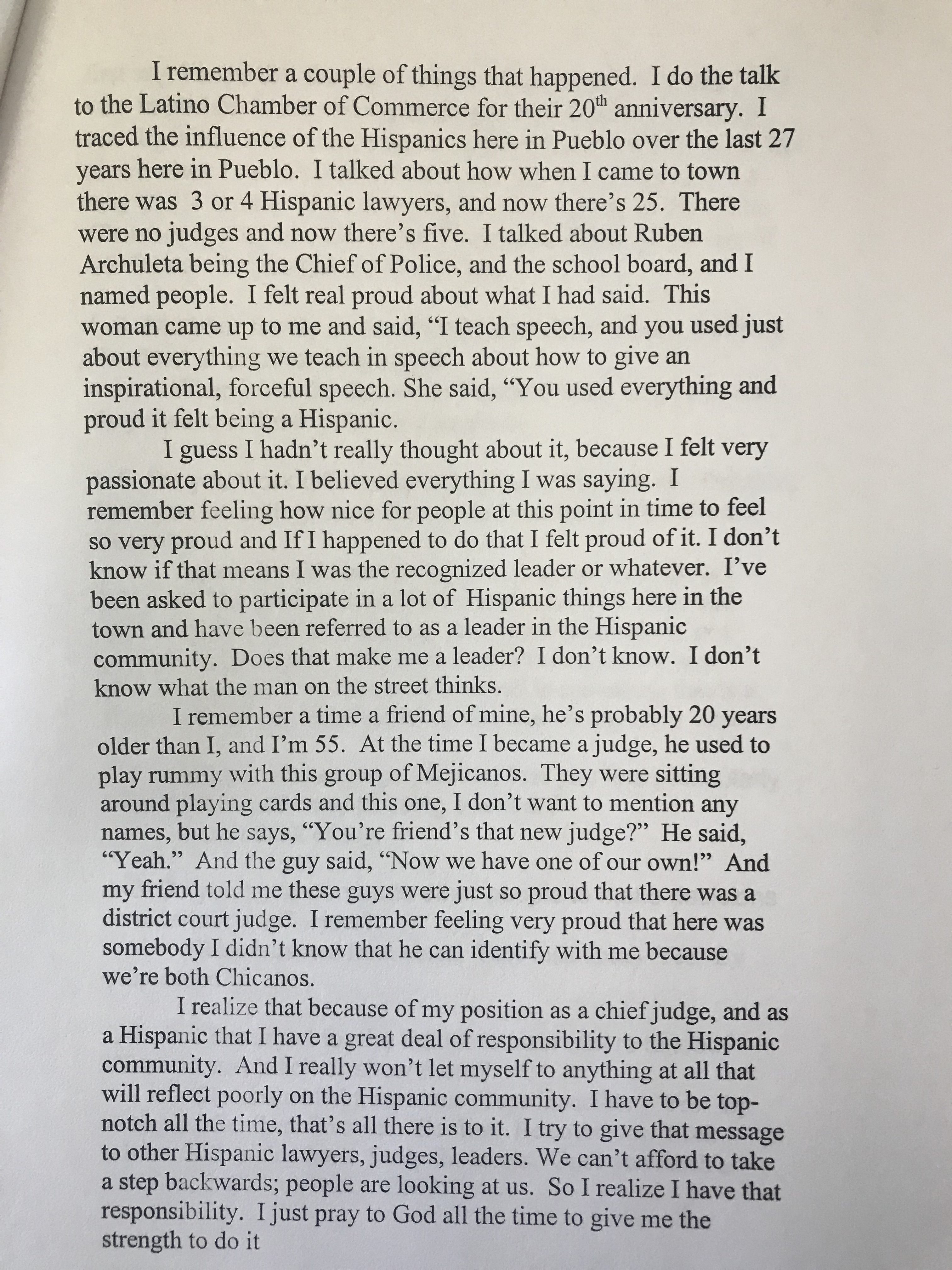
Judge Dennis Maes discusses being a Hispanic judge
LHP_Intern2019-09-08T22:29:01+00:00In an interview, Judge Dennis Maes talked in 2000 about his experiences growing up as a Hispanic in Colorado. He discusses some of the first experiences with discrimination and here he talks about the growth in representation he has seen among Hispanic lawyers in Pueblo.
A Product of the Chicano Movement – Virgilio Licona, MD
LHP_Intern2019-11-17T23:16:51+00:00A documentary by Rick Vigil about the life and contributions of Dr. Virgilio Licona (30:58).
A Product of the Chicano Movement – Transcript
LHP_Intern2019-11-17T23:18:08+00:00A transcript of the interview with Dr. Licona which was used in Rick Vigil’s documentary. (p1)
A Product of the Chicano Movement – Transcript
LHP_Intern2019-11-17T23:19:02+00:00A transcript of the interview with Dr. Licona which was used in Rick Vigil’s documentary. (p2)
A Product of the Chicano Movement – Transcript
LHP_Intern2019-11-17T23:19:58+00:00A transcript of the interview with Dr. Licona which was used in Rick Vigil’s documentary. (p3)
A Product of the Chicano Movement – Transcript
LHP_Intern2019-11-17T23:20:50+00:00A transcript of the interview with Dr. Licona which was used in Rick Vigil’s documentary. (p4)
A Product of the Chicano Movement – Transcript
LHP_Intern2019-11-17T23:21:35+00:00A transcript of the interview with Dr. Licona which was used in Rick Vigil’s documentary. (p5)
A Product of the Chicano Movement – Transcript
LHP_Intern2019-11-17T23:22:17+00:00A transcript of the interview with Dr. Licona which was used in Rick Vigil’s documentary. (p6)
A Product of the Chicano Movement – Transcript
LHP_Intern2019-11-17T23:23:23+00:00A transcript of the interview with Dr. Licona which was used in Rick Vigil’s documentary. (p7)
A Product of the Chicano Movement – Transcript
LHP_Intern2019-11-17T23:24:10+00:00A transcript of the interview with Dr. Licona which was used in Rick Vigil’s documentary. (p8)
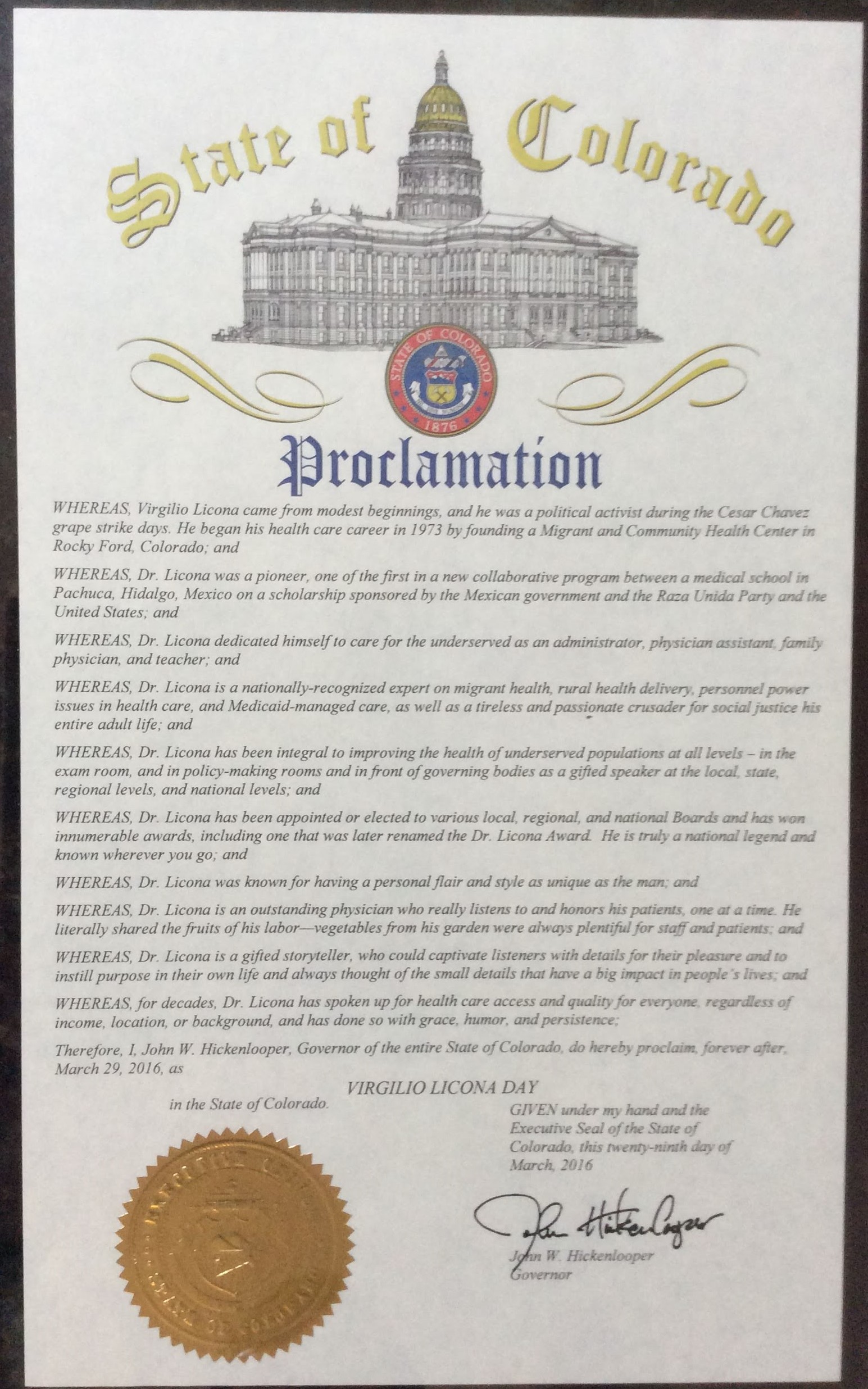
Virgilio Licona Day Official State Proclamation (2016)
LHP_Intern2019-11-17T23:24:55+00:00The official proclamation from Colorado Governor John W. Hickenlooper names March 29, 2016 as Virgilio Licona Day.
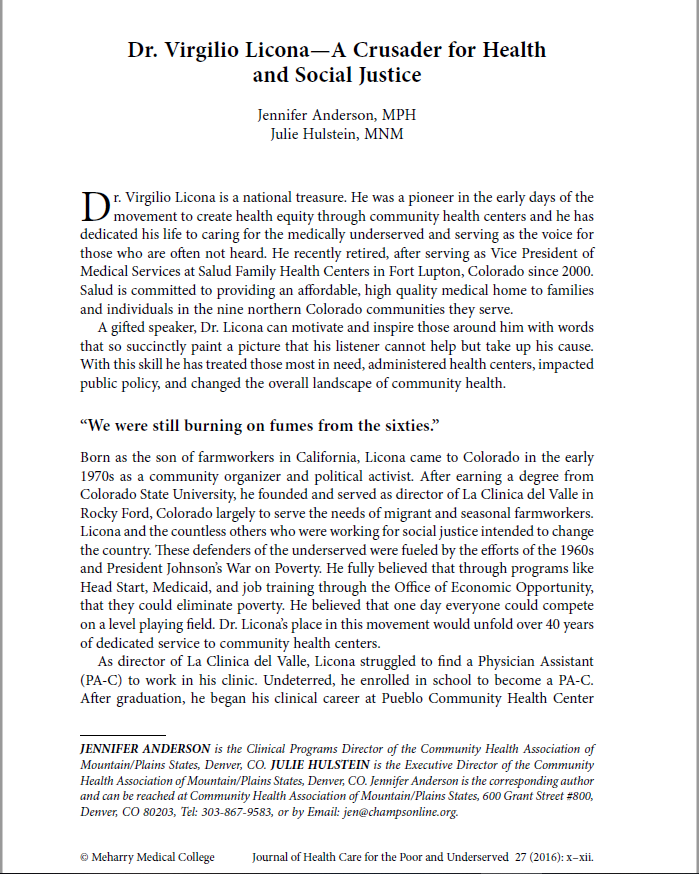
Dr. Virgilio Licona—A Crusader for Health and Social Justice (2016)
LHP_Intern2019-11-17T23:25:38+00:00Summarizes Dr. Licona’s life story and his contributions to health care.
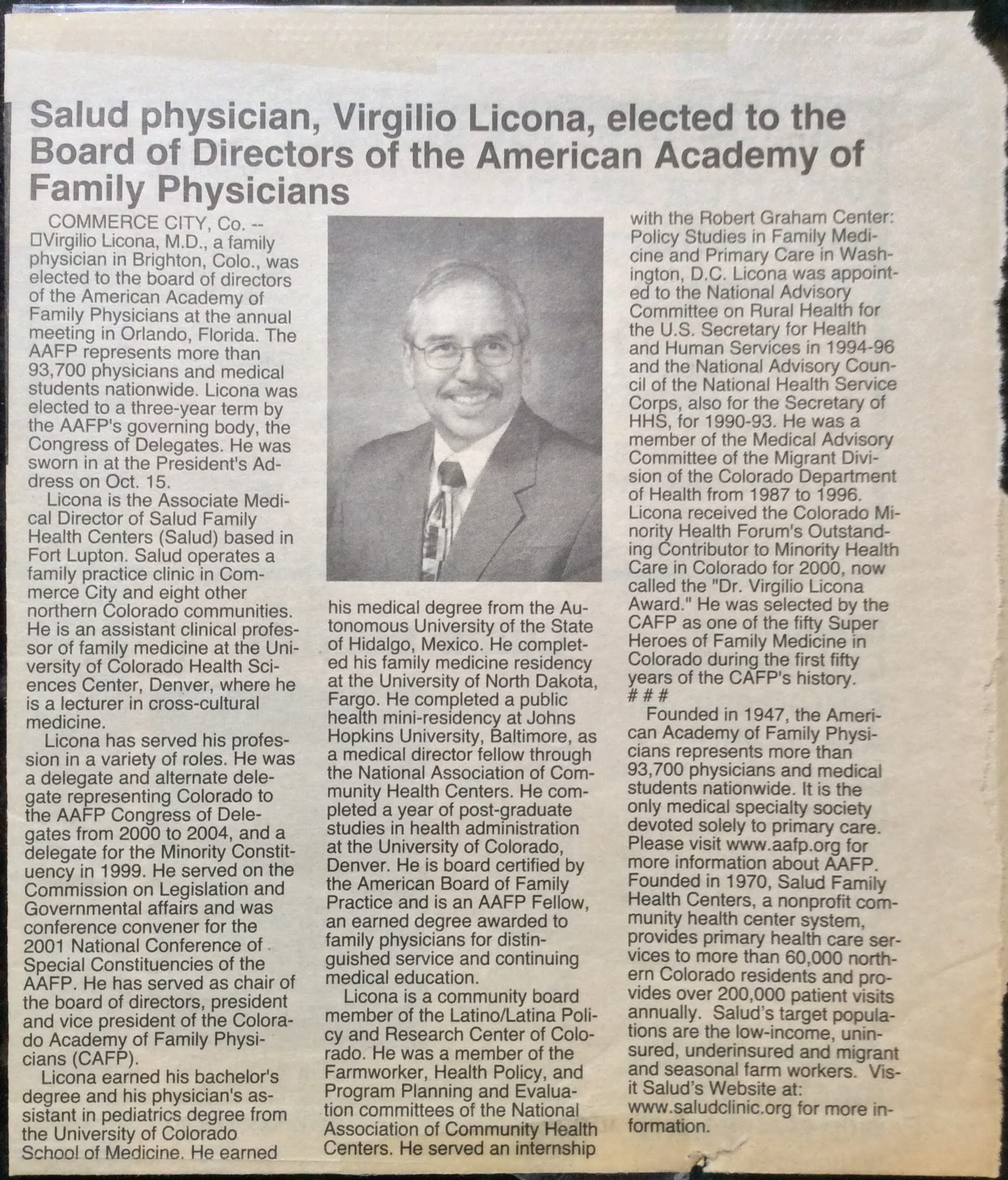
Salud Physician, Virgilio Licona, elected to the Board of Directors of the American Academy of Family Physicians (2004)
LHP_Intern2019-11-17T23:26:26+00:00Describes Dr. Licona’s career and announces his appointment to the AAFP Board of Directors.
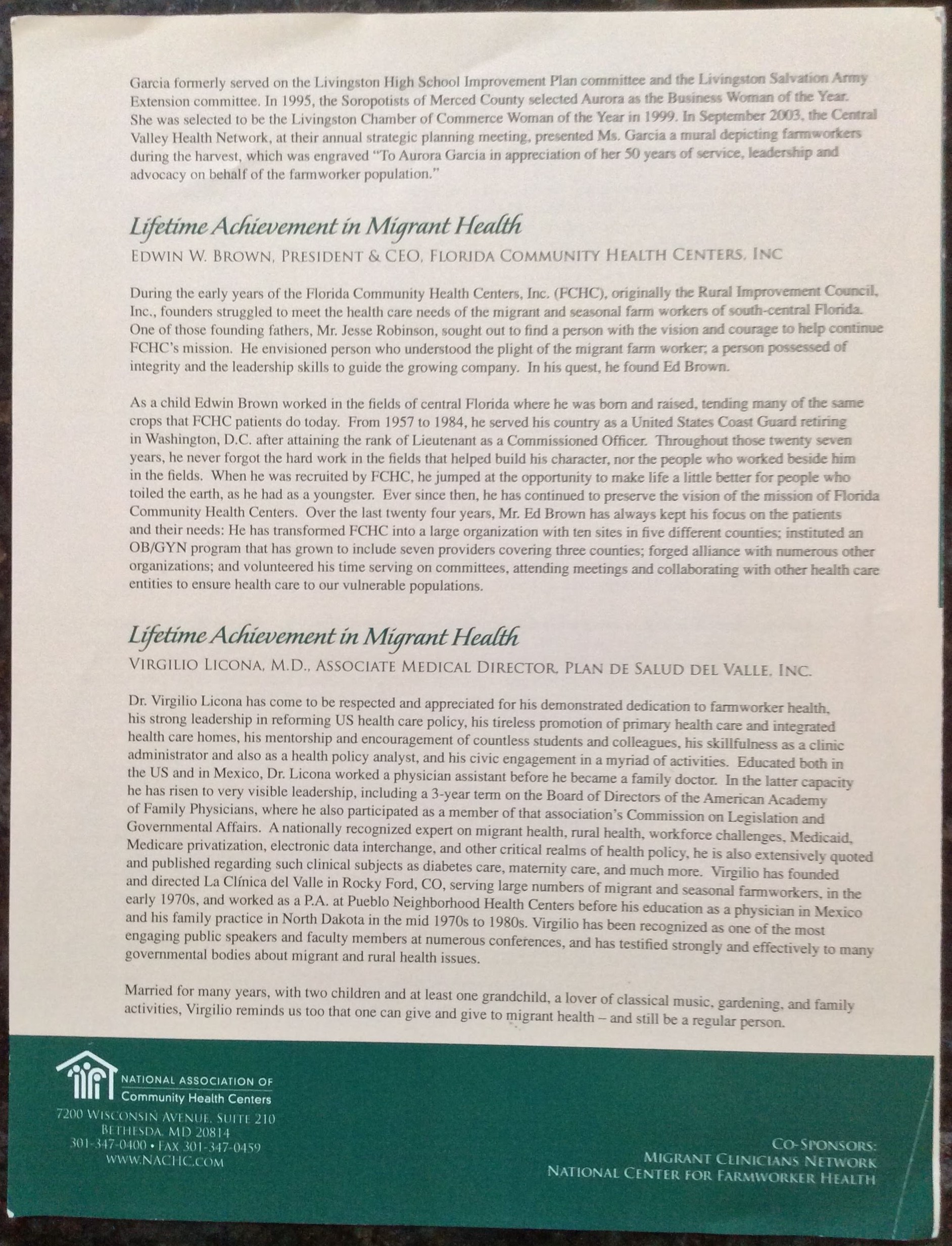
2008 National Farmworker Health Conference Opening Plenary Program
LHP_Intern2019-11-17T23:27:08+00:00Explains Dr. Licona’s background in medicine and his contributions which led to the award for Lifetime Achievement in Migrant Health.
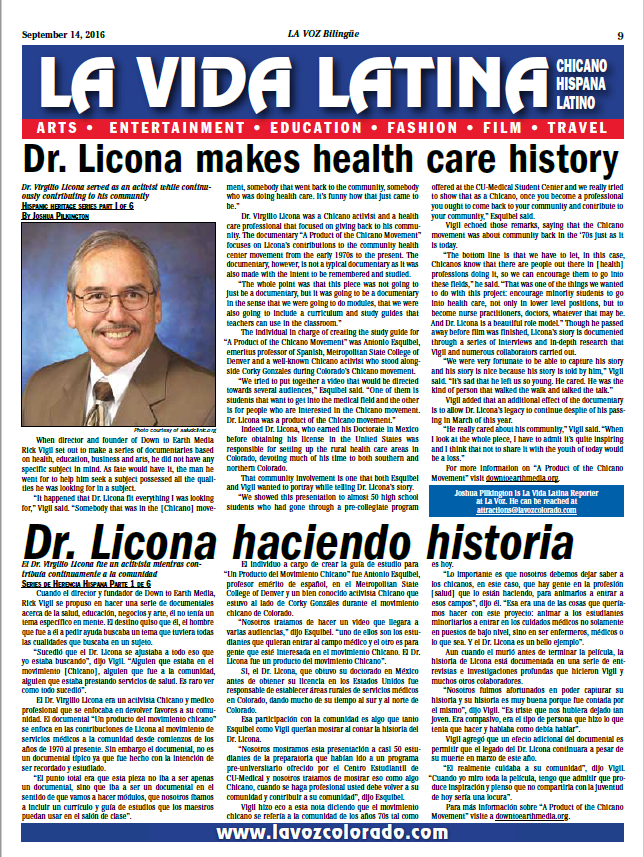
Dr. Licona makes health care history (2016)
LHP_Intern2019-11-17T23:28:00+00:00Describes Dr. Licona’s contributions and the documentary Rick Vigil created.
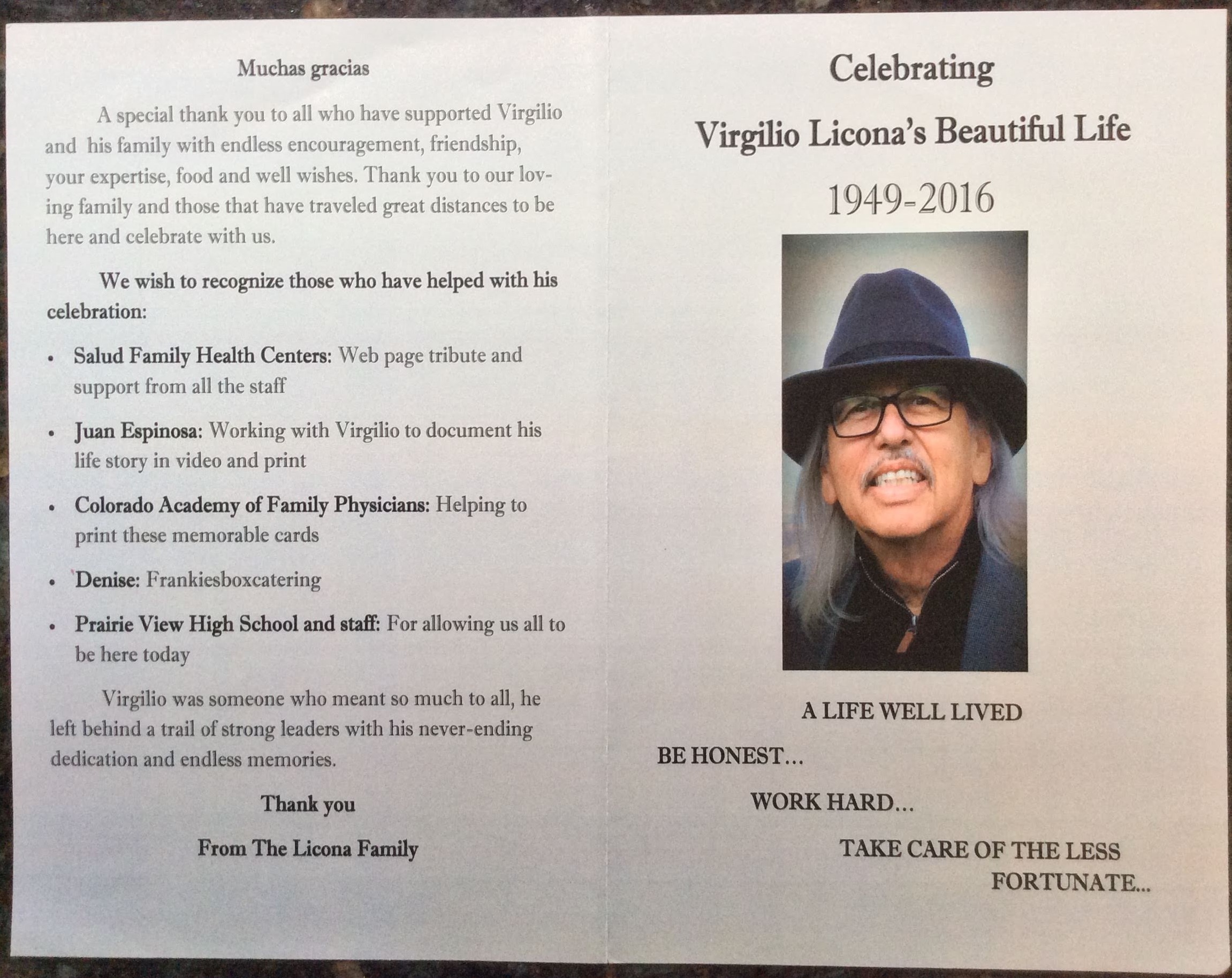
Celebrating Vigilio Licona’s Beautiful Life, 1949-2016
LHP_Intern2019-11-17T23:29:34+00:00The program for the memorial service for Dr. Licona. (p1)
Celebrating Vigilio Licona’s Beautiful Life, 1949-2016
LHP_Intern2019-11-17T23:31:01+00:00The program for the memorial service for Dr. Licona. (p2)
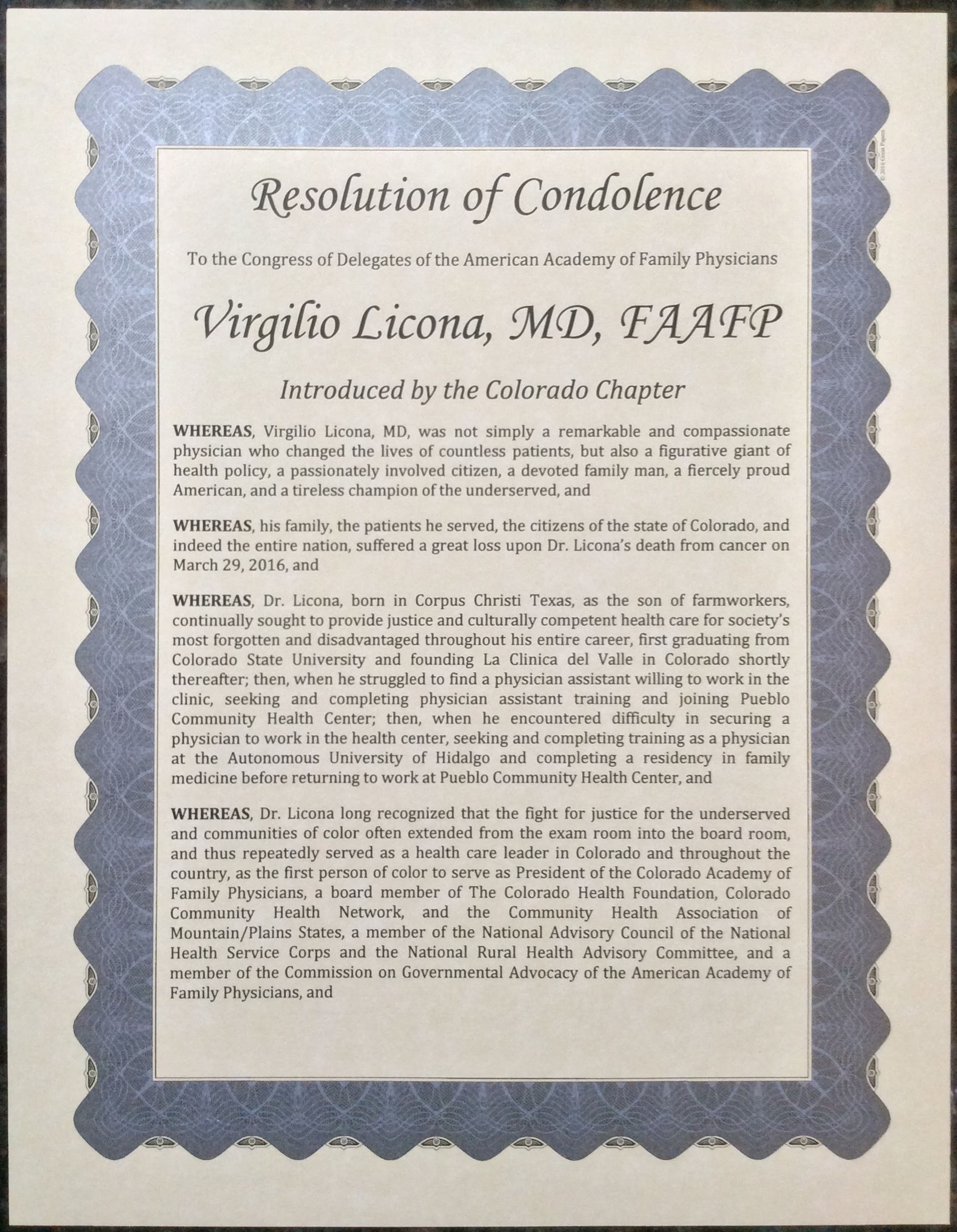
Resolution of Condolence (2016)
LHP_Intern2019-11-17T23:32:51+00:00The Colorado Chapter of the American Academy of Physicians offers condolences and a tribute to Dr. Licona’s life. (p1)
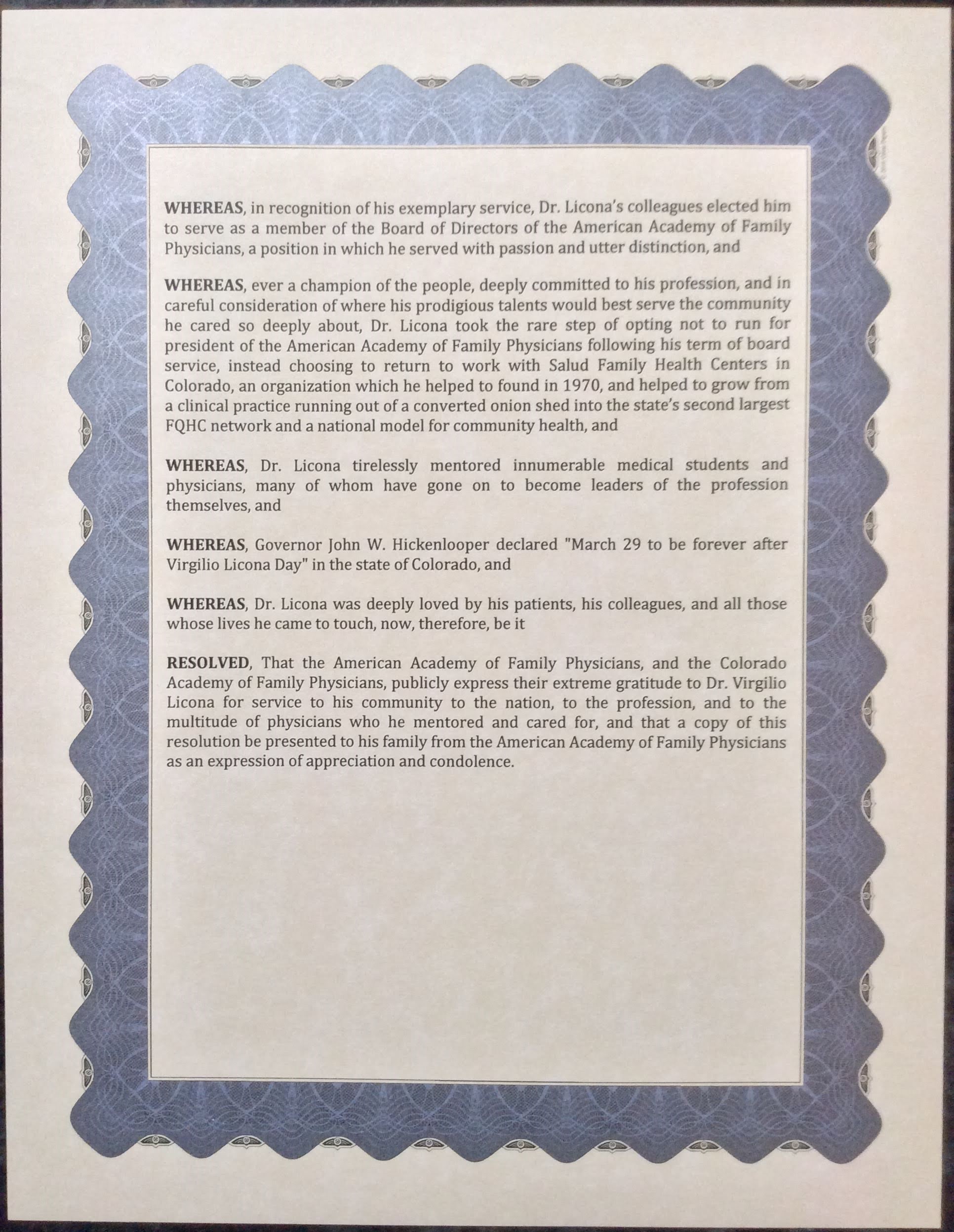
Resolution of Condolence (2016)
LHP_Intern2019-11-17T23:36:12+00:00The Colorado Chapter of the American Academy of Physicians offers condolences and a tribute to Dr. Licona’s life. (p2)
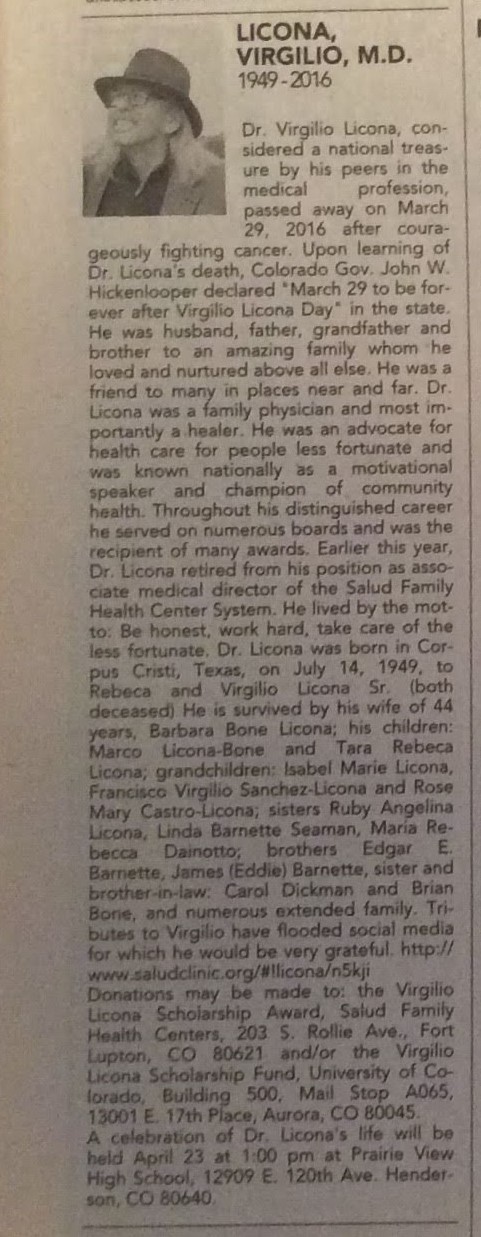
Licona, Virgilio, M.D. (2016)
LHP_Intern2019-11-17T23:39:30+00:00An obituary about Dr. Licona and his life.
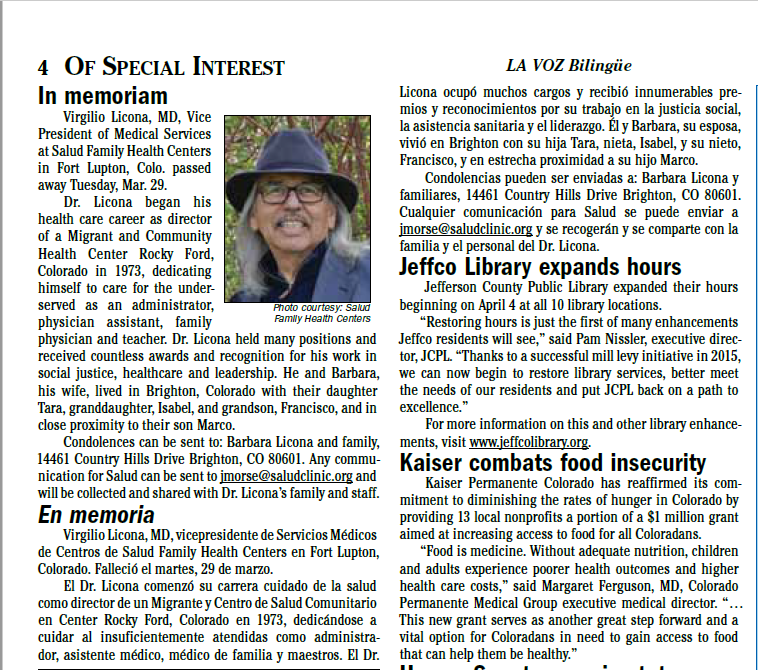
In memoriam/En memoria (2016)
LHP_Intern2019-11-17T23:41:19+00:00A tribute to Dr. Licona after his death.
Virgilio Licona Corrido
LHP_Intern2022-04-26T16:14:58+00:00A traditional Mexican ballad that tells a story about Dr. Licona and honors his life (5:24).
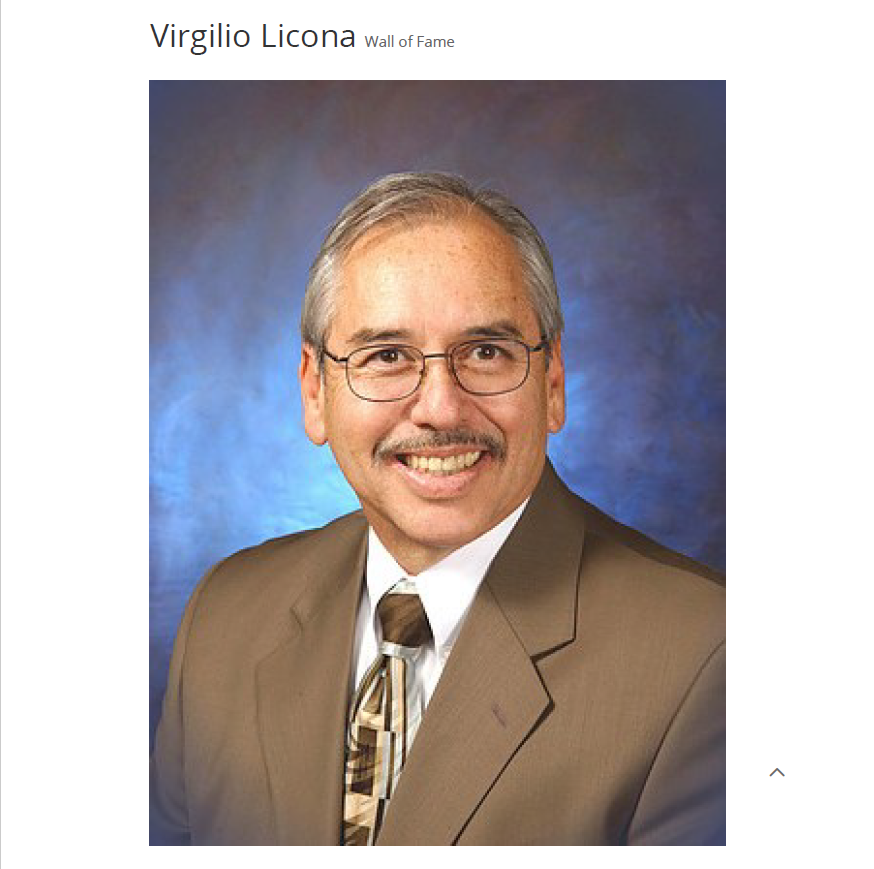
Virgilio Licona Wall of Fame
LHP_Intern2019-11-17T23:43:54+00:00The article discusses Dr. Licona’s contributions to the community health center movement.
“A Product of the Chicano Movement” Virgilio Licona, MD (Trailer)
LHP_Intern2019-11-17T23:44:40+00:00A trailer for the documentary on the life and contributions of Dr. Licona to the Community Health Center movement from the period of the early 1970s to the present in Colorado (4:11)
Trailer: A Product of the Chicano Movement
LHP_Intern2019-11-17T23:45:23+00:00An abridged documentary on the life and contributions of Dr. Licona to the Community Health Center movement from the period of the early 1970s to the present in Colorado (14:49)
Through the eye of a visionary “Dr. Virgilio Licona”
LHP_Intern2019-11-17T23:46:18+00:00An abridged documentary on the life and contributions of Dr. Licona to the Community Health Center movement from the period of the early 1970s to the present in Colorado (8:47).
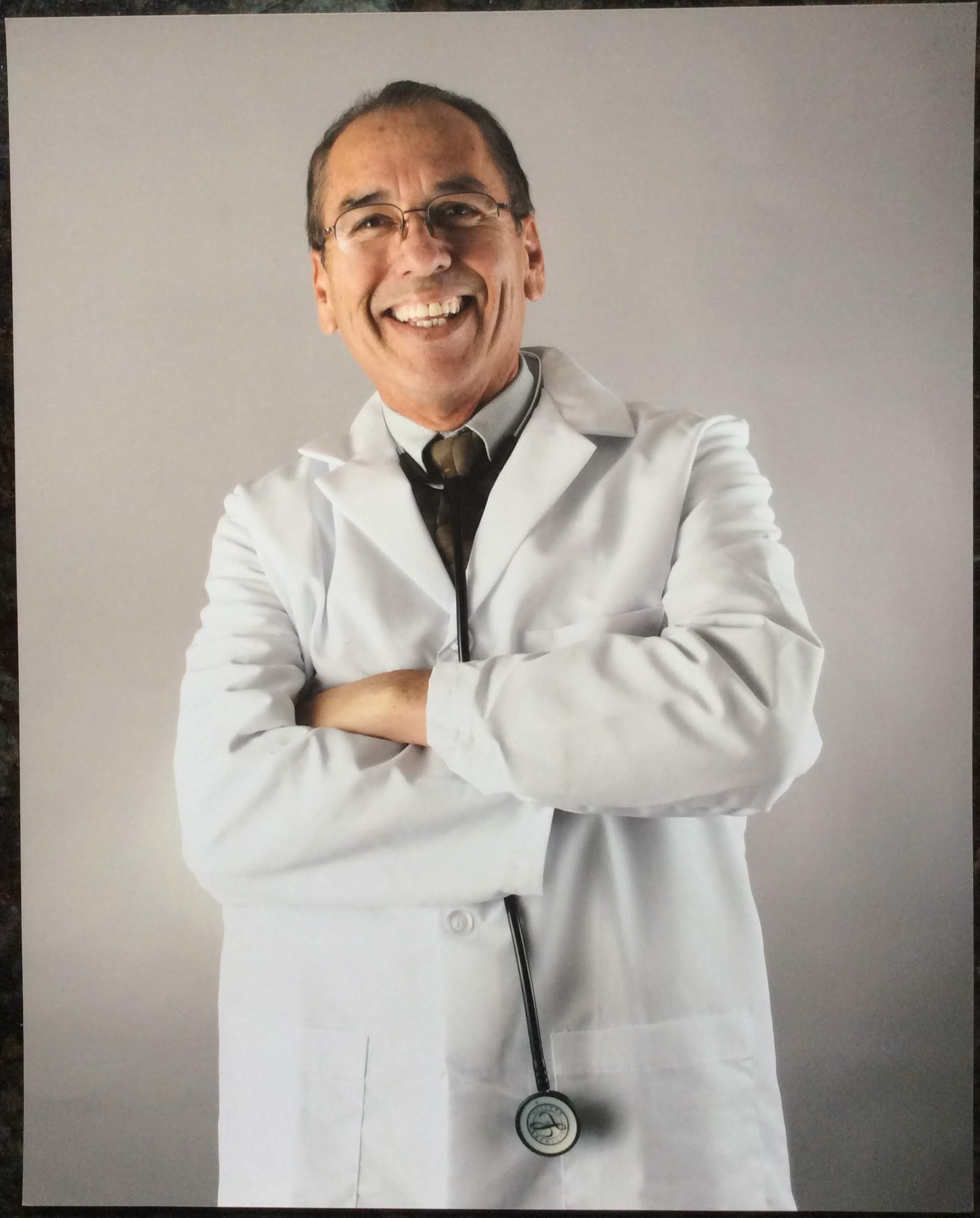
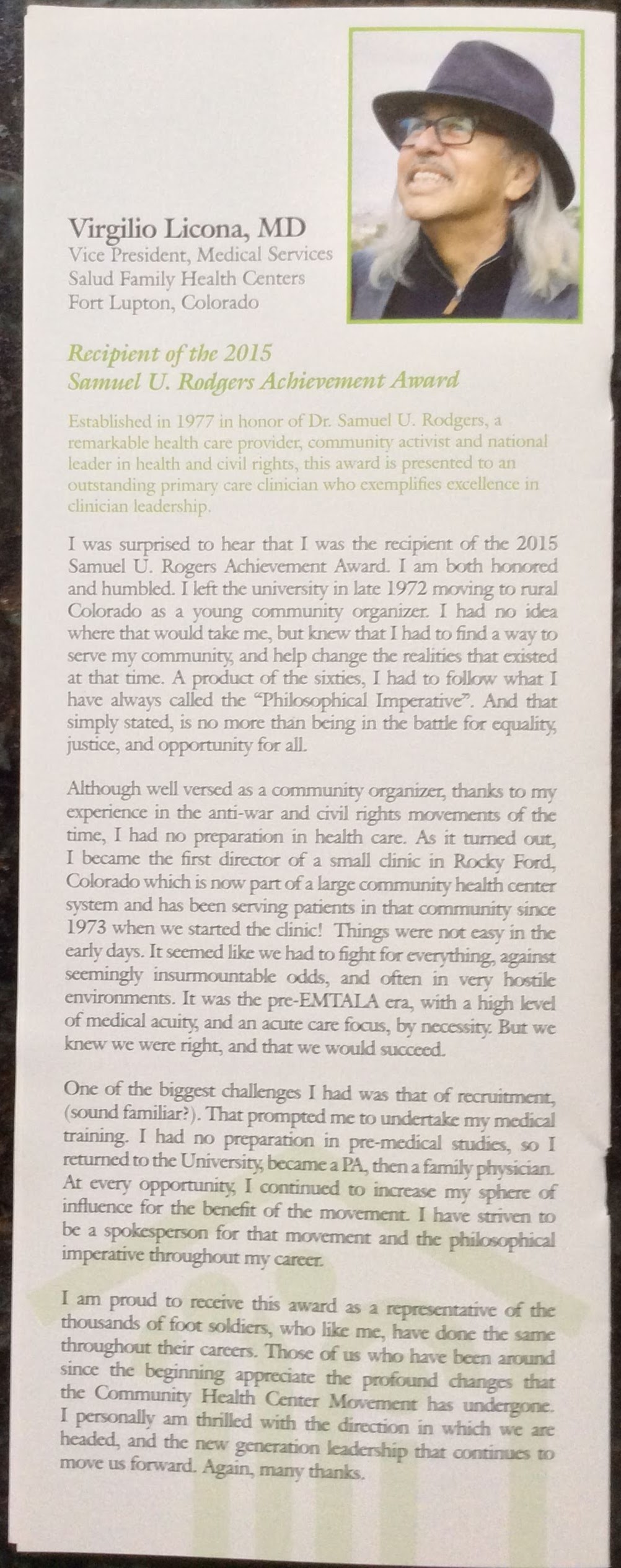
NACHC Community Health Care Awards of Excellence (2015)
LHP_Intern2019-11-17T23:47:51+00:00Announces Dr. Licona as the winner of the Samuel U. Rodgers Achievement Award for his excellence in clinician leadership.
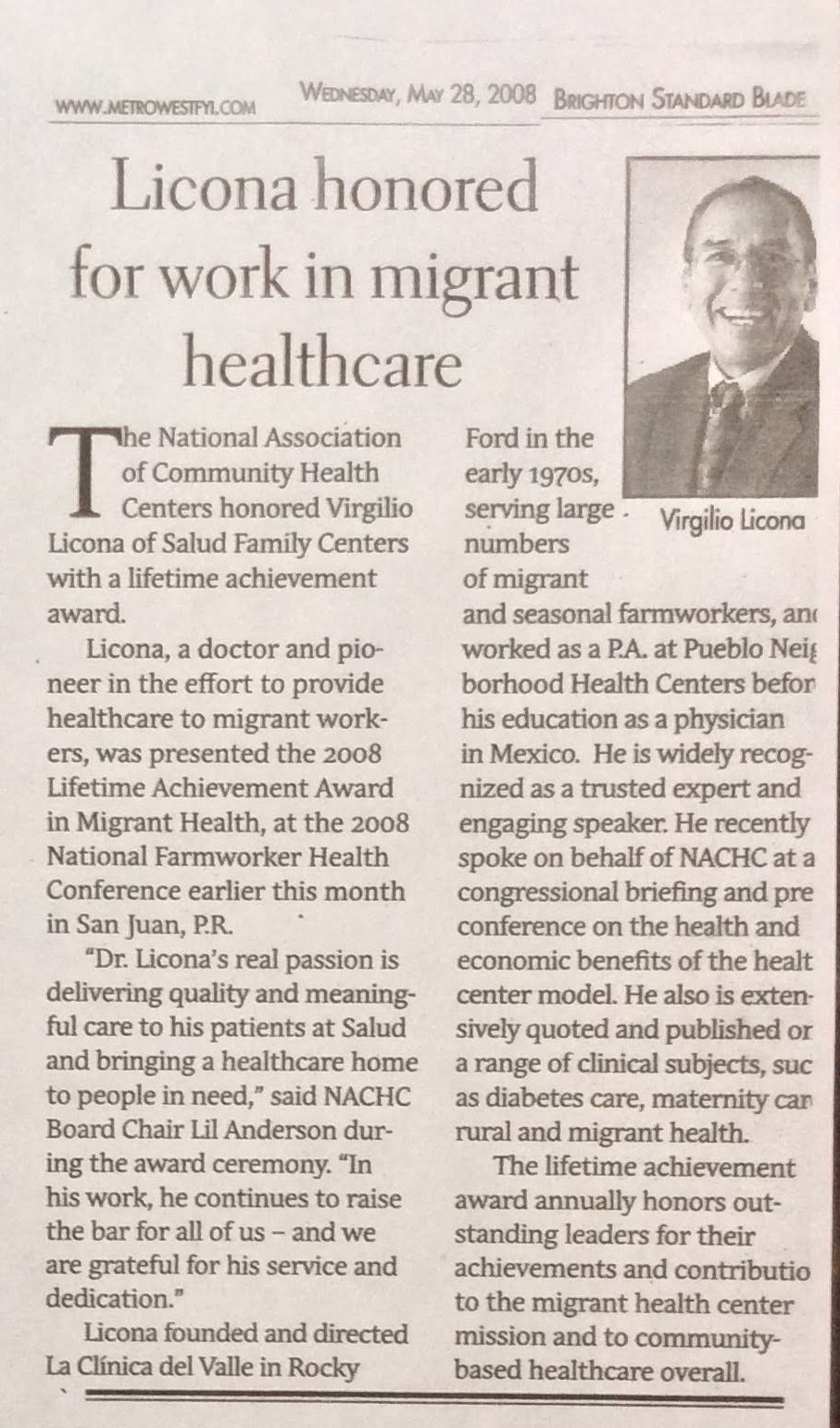
Licona honored for work in migrant healthcare (2008)
LHP_Intern2019-11-17T23:48:36+00:00Explains how Dr. Licona won the 2008 Lifetime Achievement Award in Migrant Health from the NACHC.
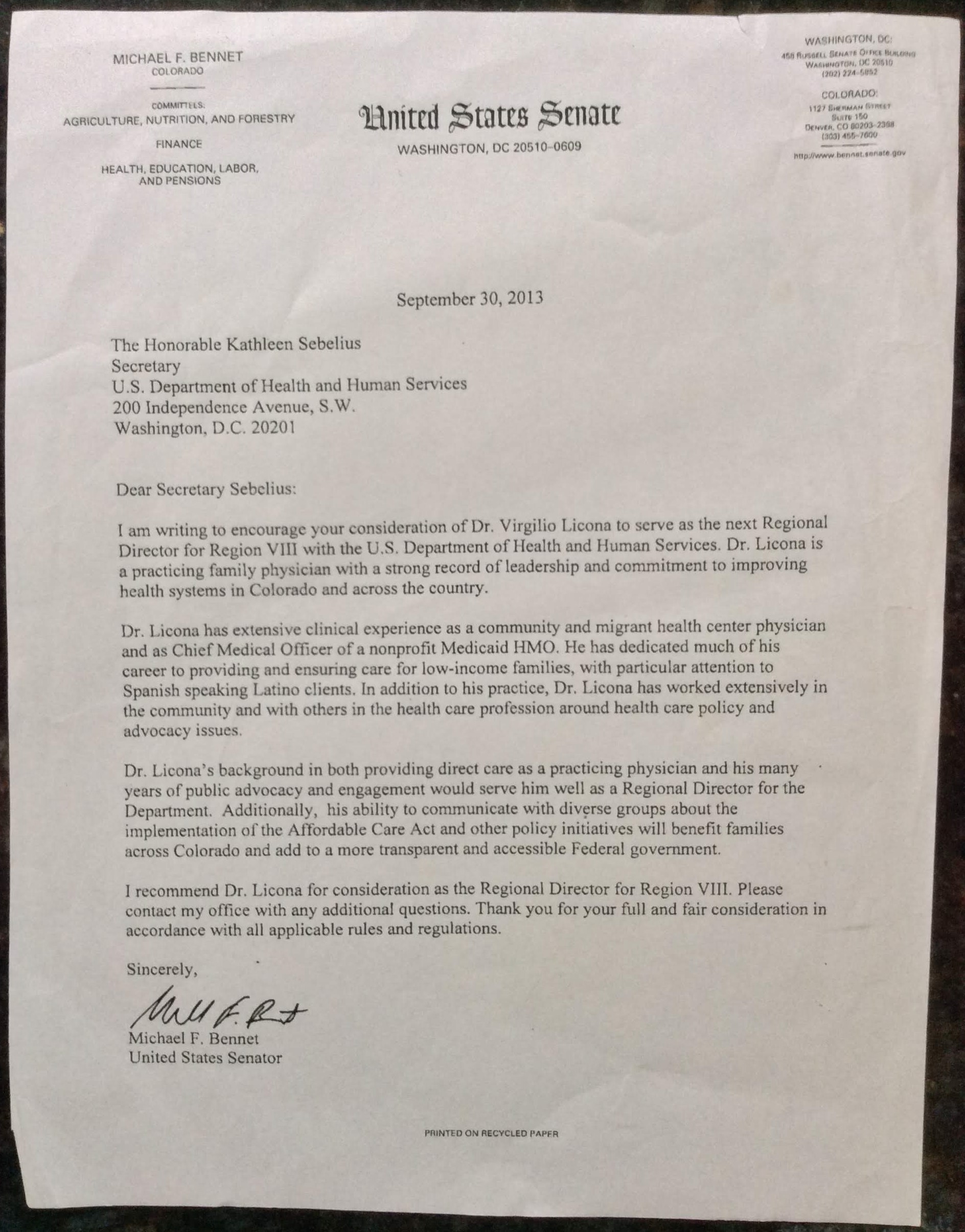
United States Senate Letter to U.S. Department of Health and Human Services (2013)
LHP_Intern2019-11-17T23:49:22+00:00Sen. Bennet encourages the Department of Health and Human Services to consider Dr. Licona as the next Regional Director for Region VIII.
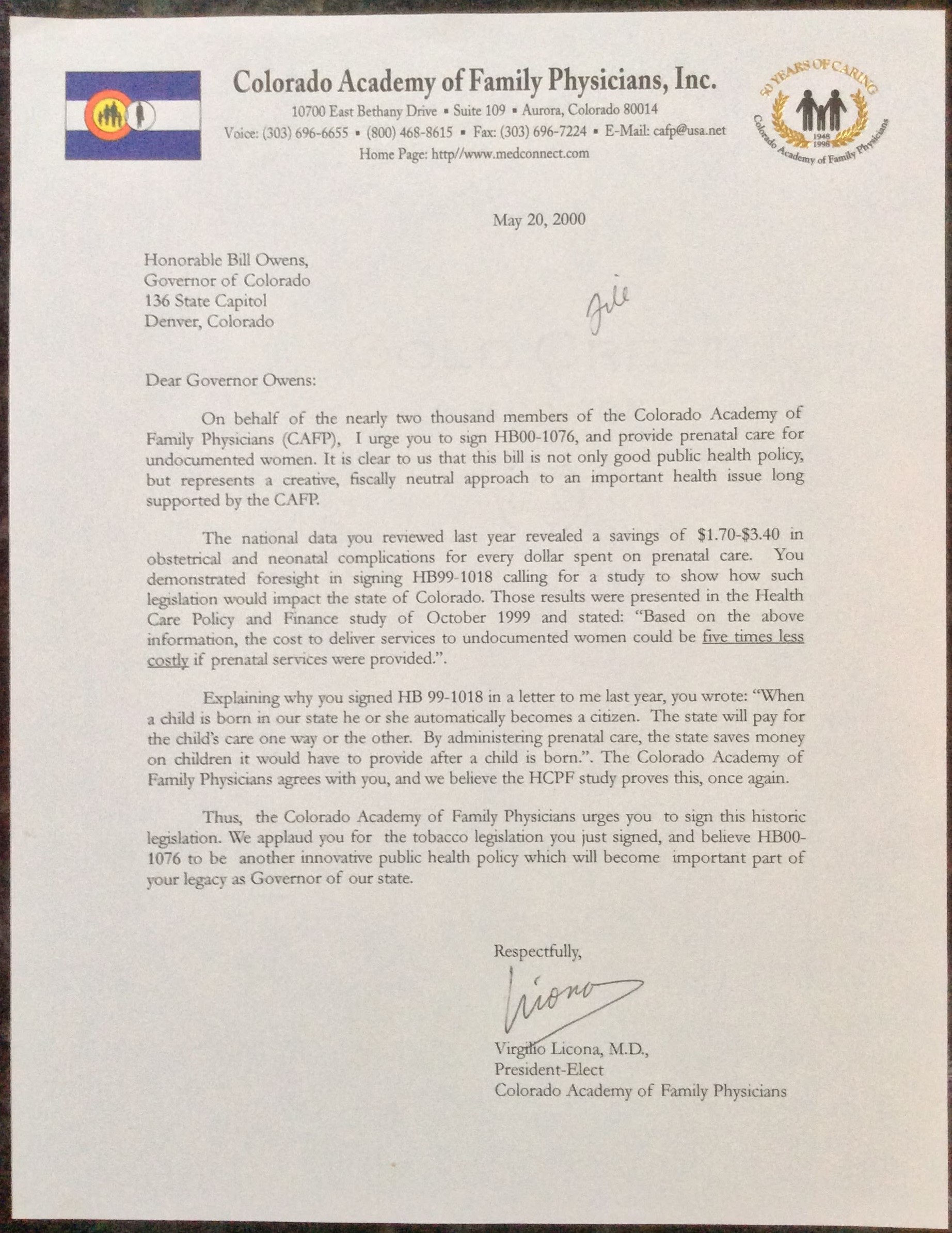
Colorado Academy of Family Physicians Letter to Governor Owens (2000)
LHP_Intern2019-11-17T23:50:08+00:00Dr. Licona urges Gov. Owens to sign HB00-1076 which would provide prenatal care for undocumented women.
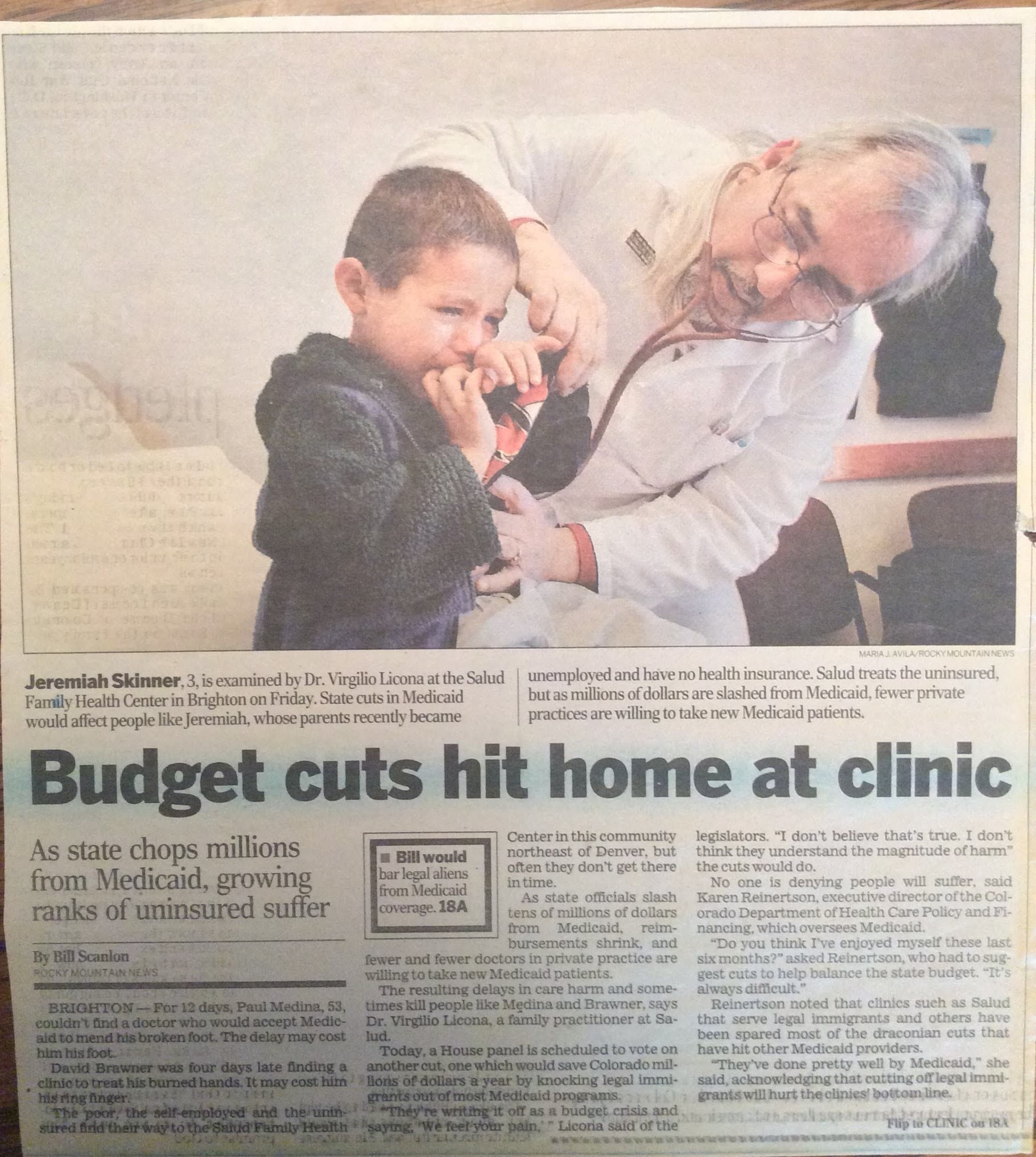
Budget cuts hit home at clinic (2003)
LHP_Intern2019-11-17T23:51:25+00:00Explains how Medicaid cuts have hurt the uninsured. (p1)
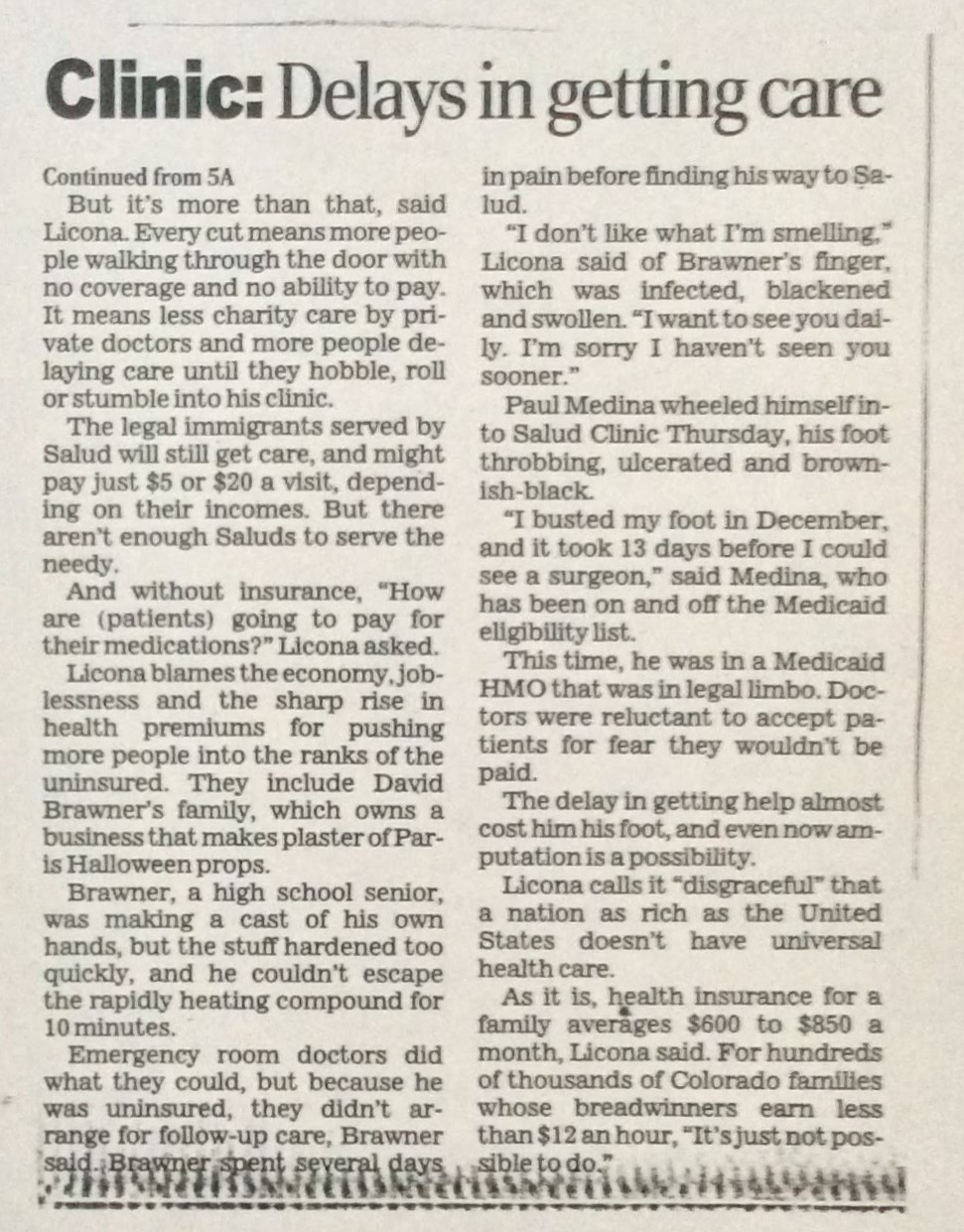
Budget cuts hit home at clinic (2003)
LHP_Intern2019-11-17T23:52:17+00:00Explains how Medicaid cuts have hurt the uninsured. (p2)
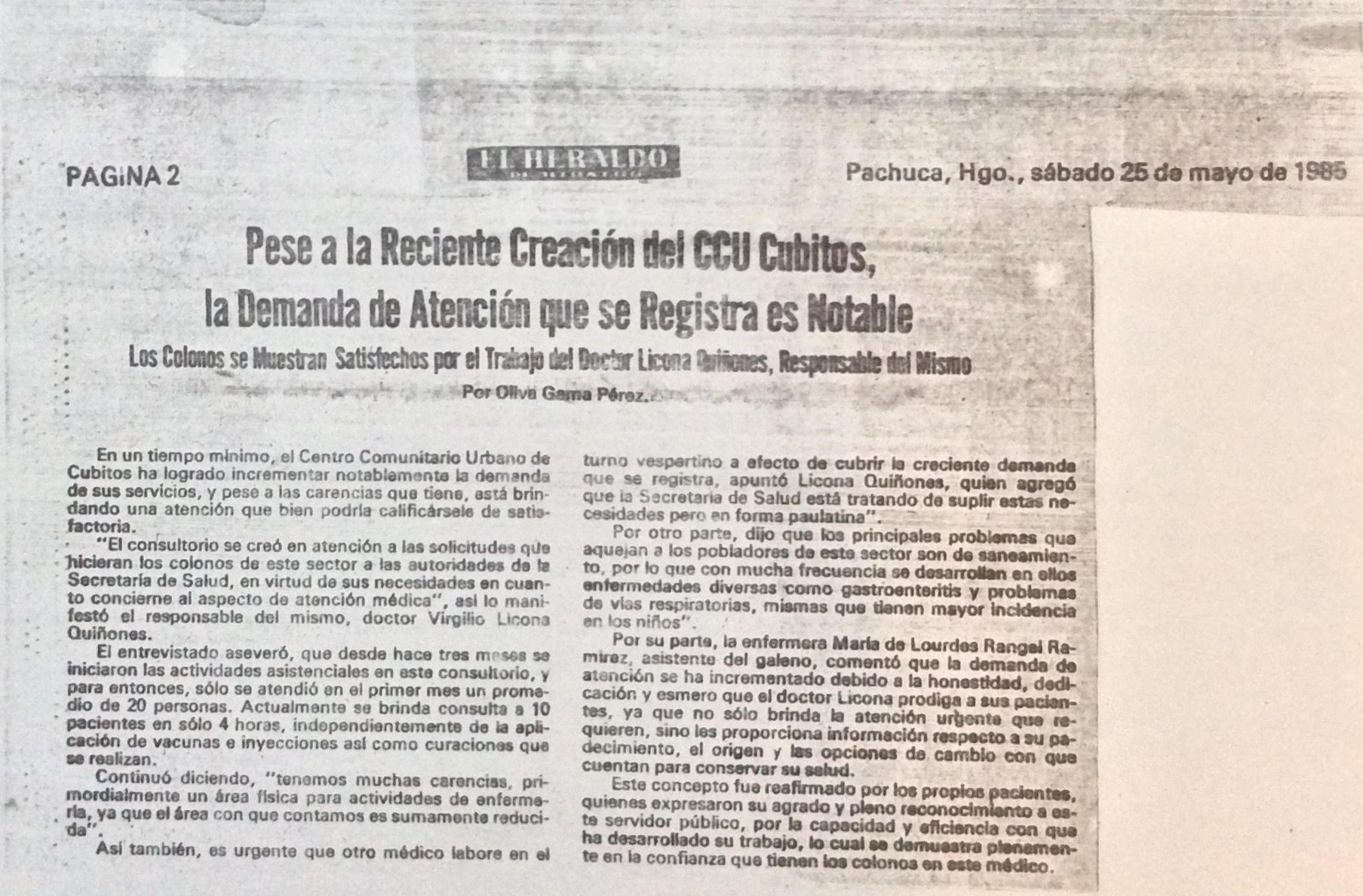
Pese a la Reciente Creacion del CCU Cubitos, la Demanda de Atencion que se Registra es Notable (1985)
LHP_Intern2019-11-17T23:53:02+00:00Discusses the impact of the Cubitos clinic where Dr. Licona worked.
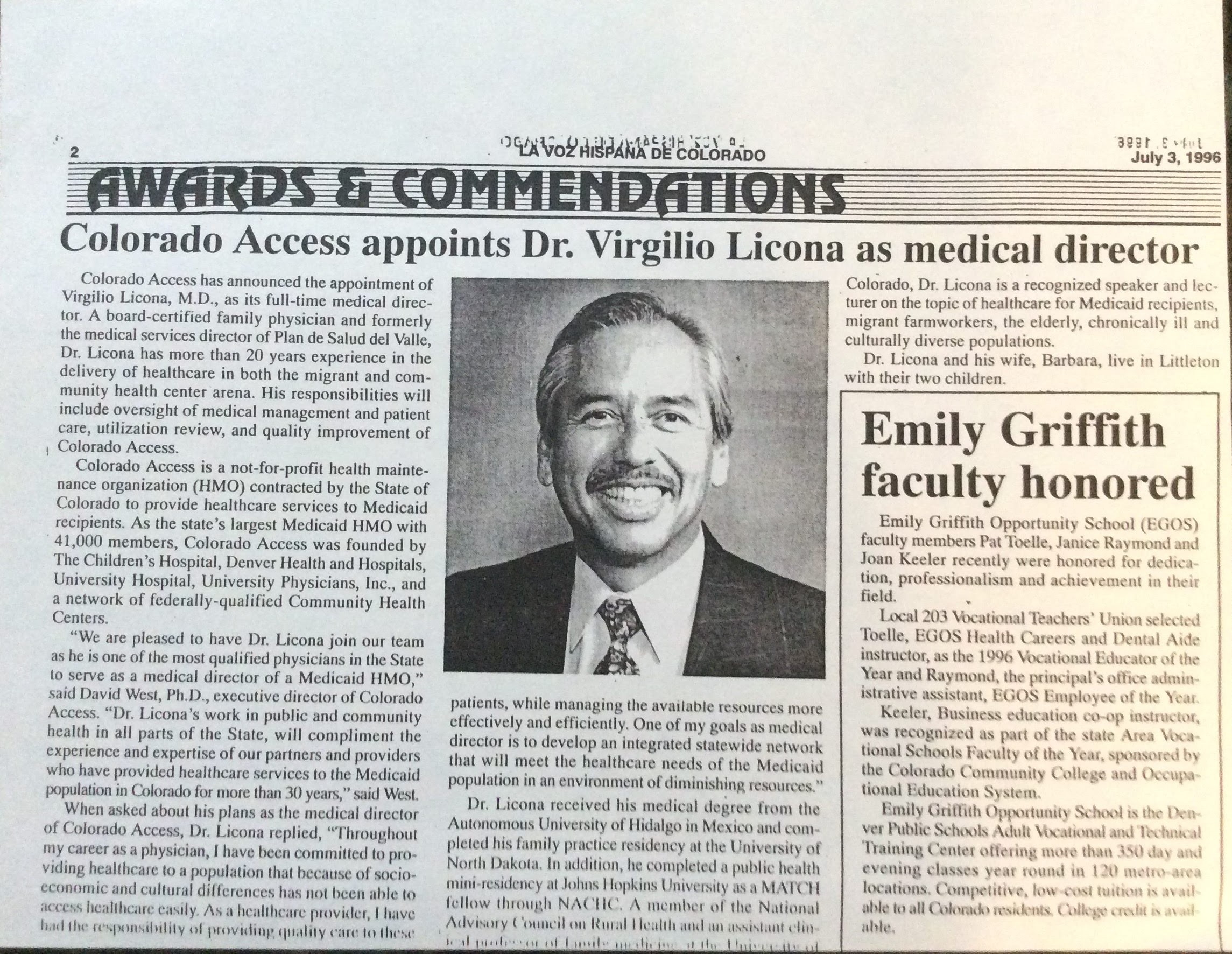
Colorado Access appoints Dr. Virgilio Licona as medical director (1996)
LHP_Intern2019-11-17T23:53:46+00:00Discusses the role of Colorado Access and gives information about Dr. Licona’s career.
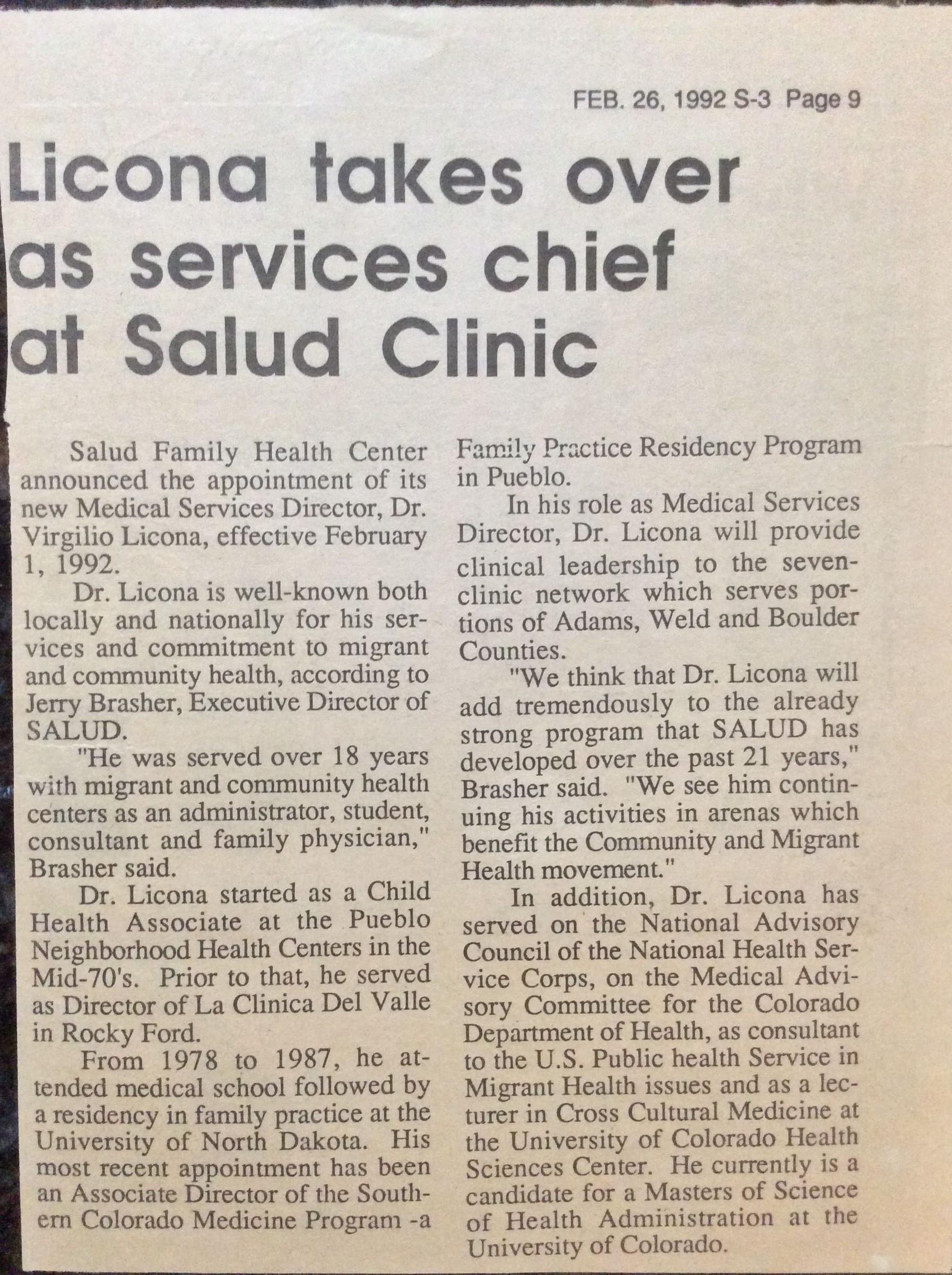
Licona takes over as service chief at Salud Clinic (1992)
LHP_Intern2019-11-17T23:54:37+00:00Discusses Dr. Licona’s credentials and his appointment as the Medical Services Director for Salud Clinic.
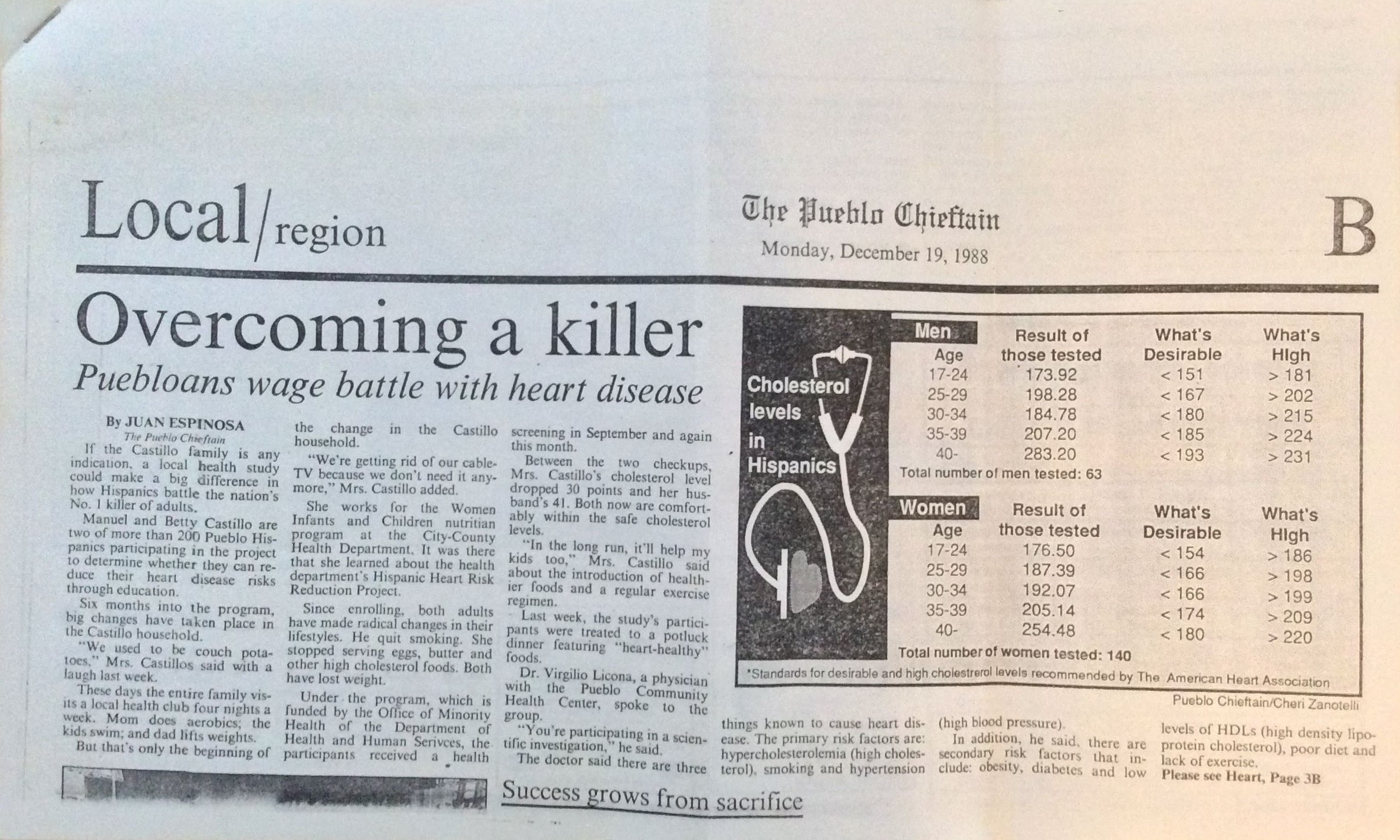
Overcoming a killer (1988)
LHP_Intern2019-11-17T23:55:40+00:00Describes how doctors like Dr. Licona fought against heart disease in Latino-Americans. (p1)
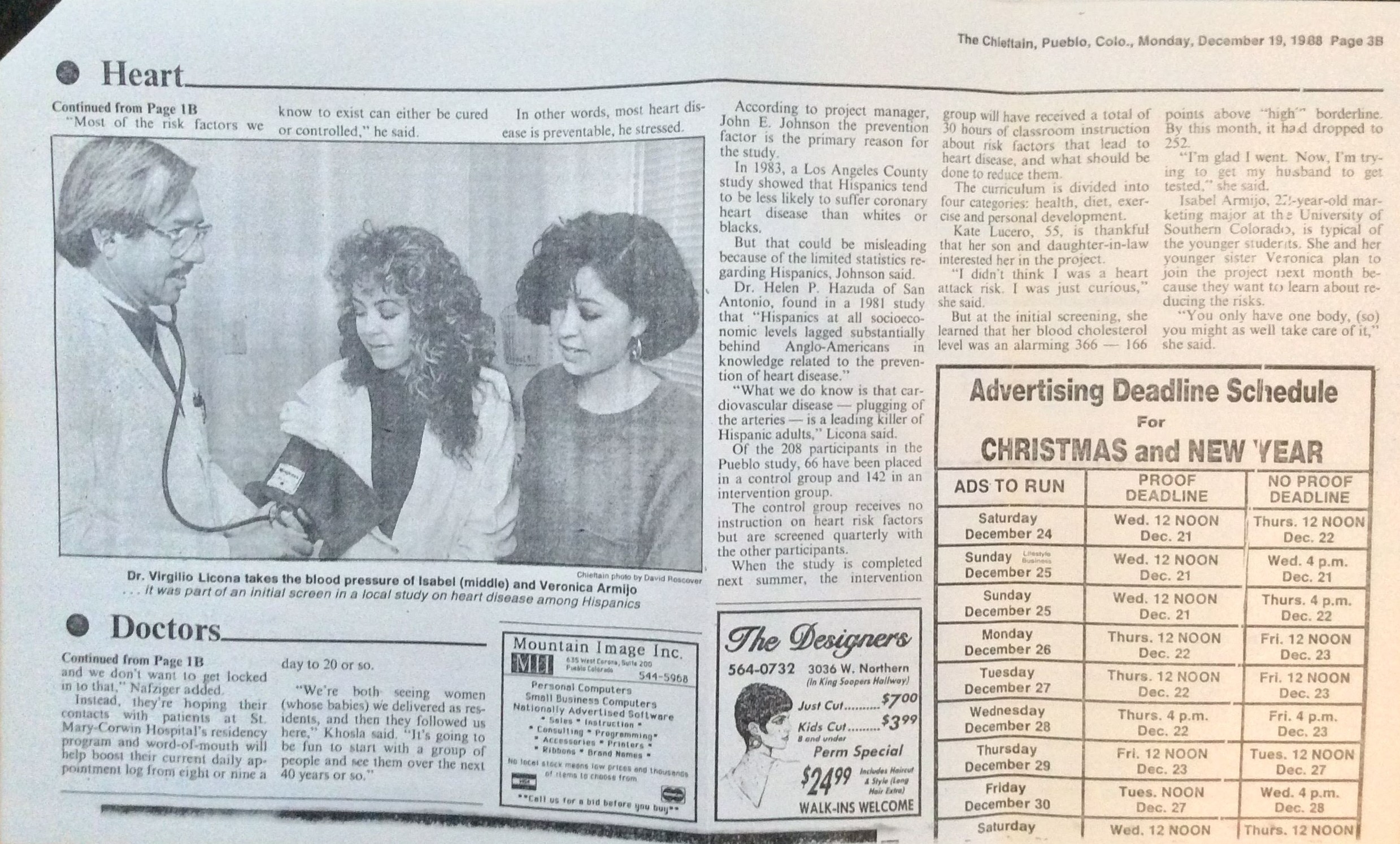
Overcoming a killer (1988)
LHP_Intern2019-11-17T23:56:33+00:00Describes how doctors like Dr. Licona fought against heart disease in Latino-Americans. (p2)
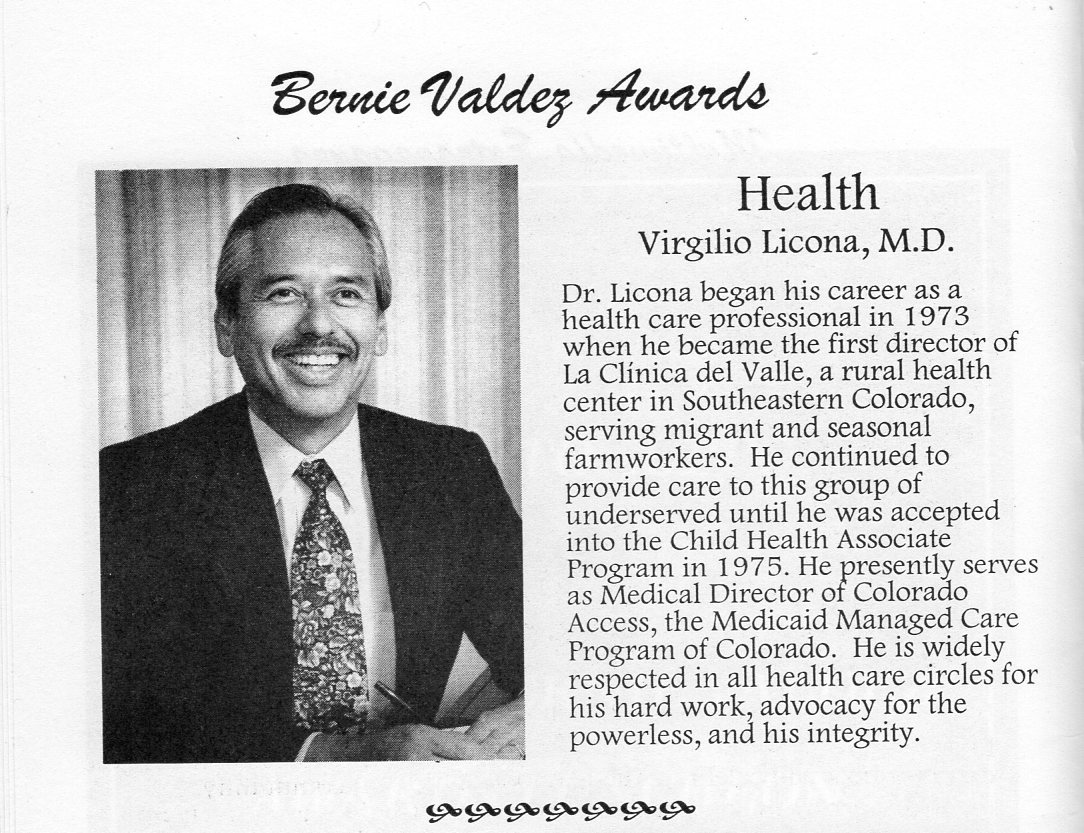
Virgilio Licona 1997 Bernie Valdez Award
LHP_Intern2019-11-17T23:57:30+00:00Contains a picture of Dr. Licona and his credentials which led him to win the 1997 Bernie Valdez Award.
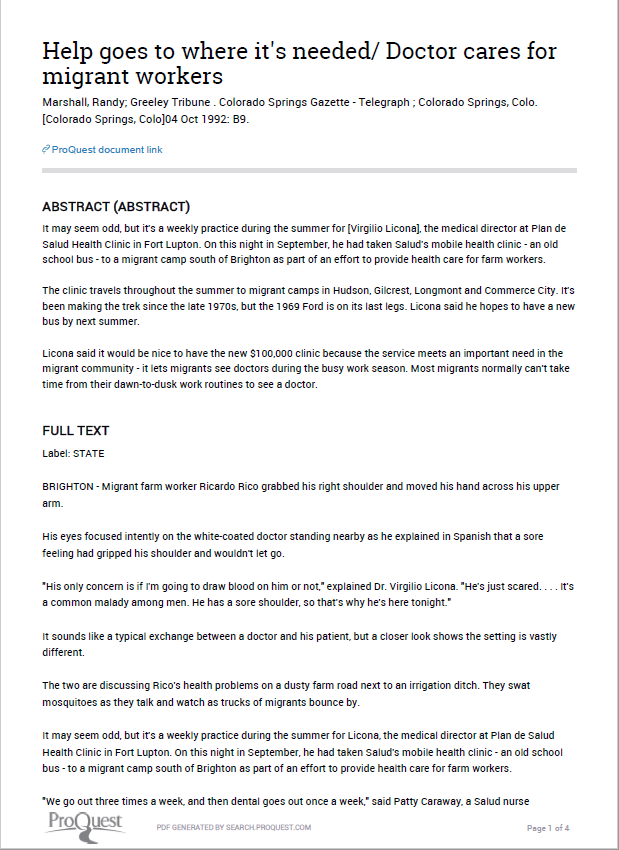
Help goes to where it’s needed/Doctor cares for migrant workers (1992)
LHP_Intern2019-11-17T23:58:56+00:00Explains more about Dr. Licona’s work on migrant health through community clinics.
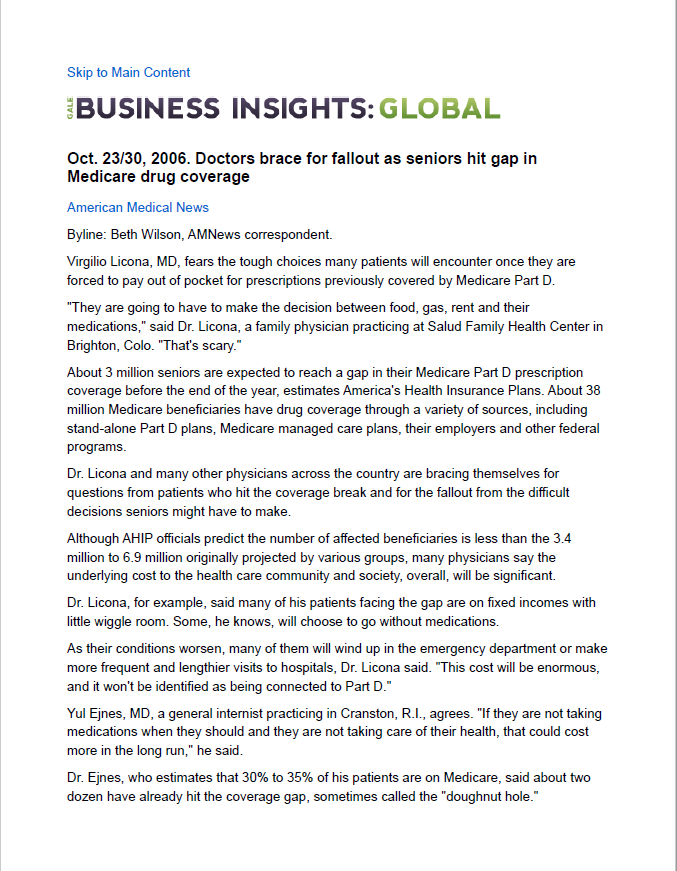
Doctors brace for fallout as seniors hit gap in Medicare drug coverage (2006)
LHP_Intern2019-11-17T23:59:46+00:00Dr. Licona explains how seniors will face a gap in Medicare coverage.
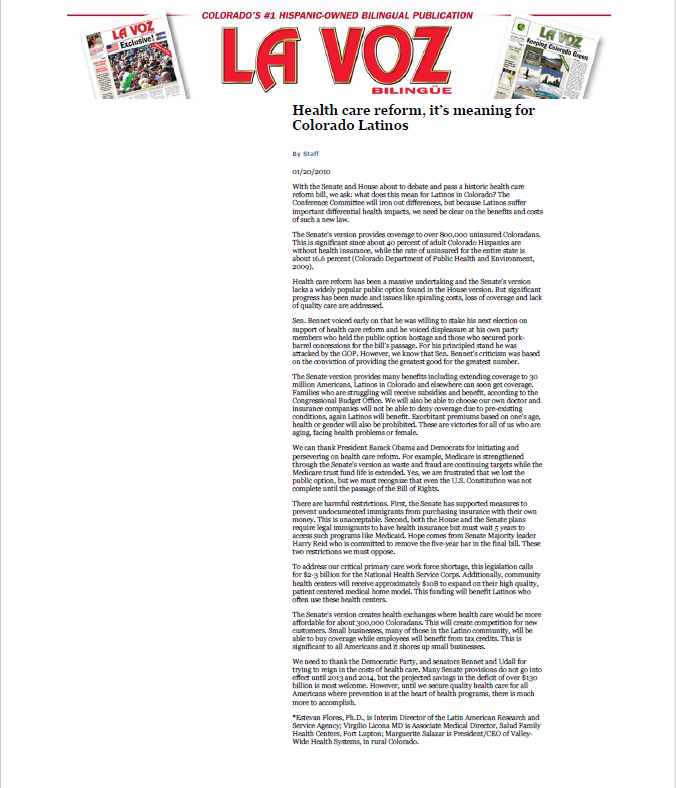
Health care reform; it’s meaning for Colorado Latinos (2010)
LHP_Intern2019-11-18T00:07:56+00:00Dr. Licona explains the advantages and disadvantages of the new health care reform bill (the Affordable Care Act) in Congress.
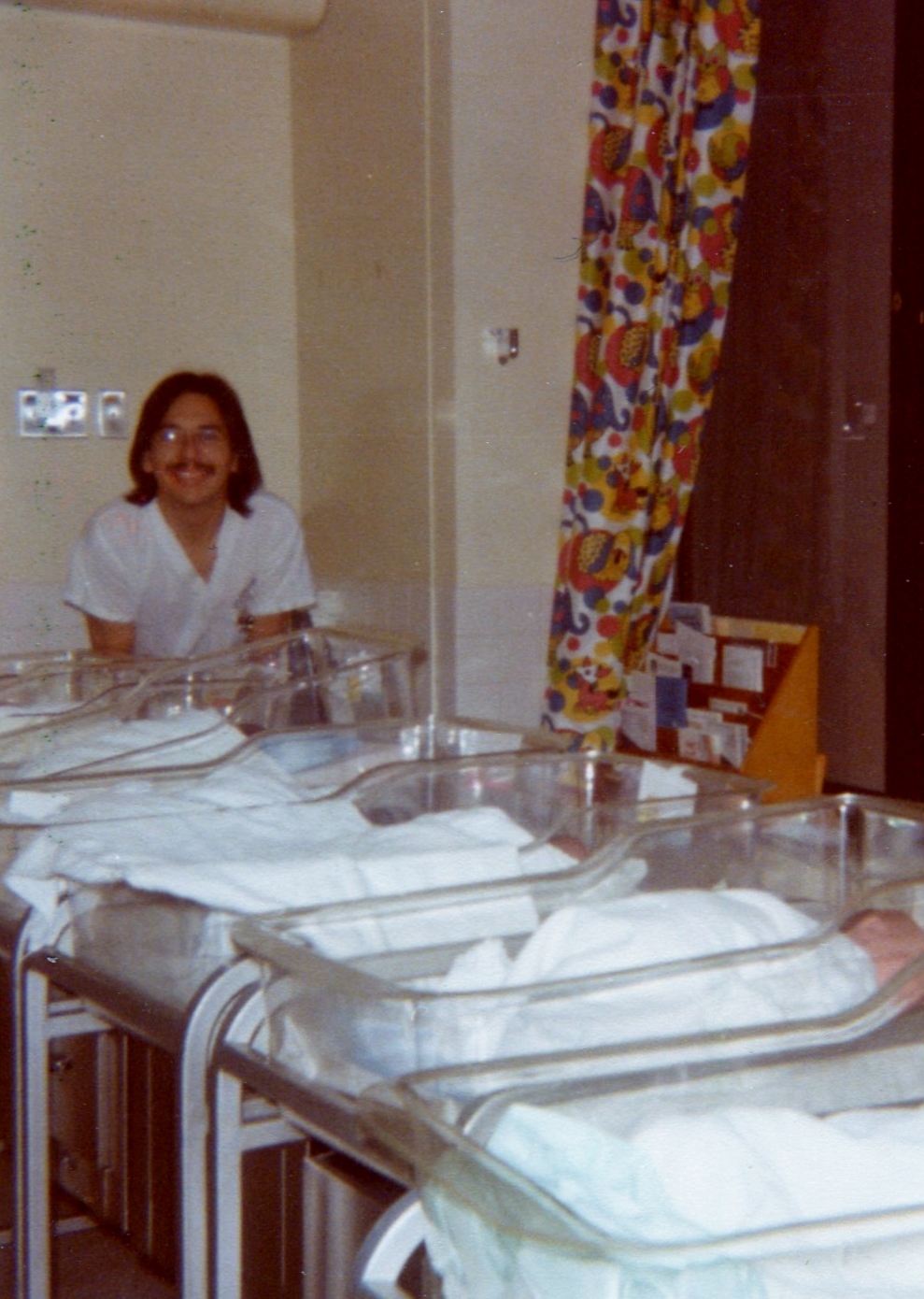
Virgilio Licona with Babies as CHAP Student (1978)
LHP_Intern2019-11-18T00:08:55+00:00Dr. Licona as a CHAP student in the newborn nursery.
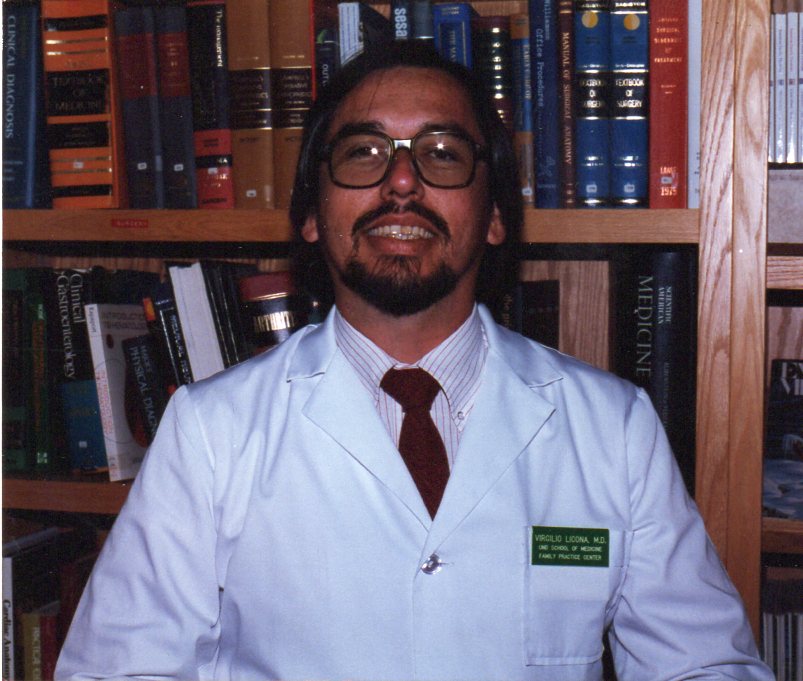
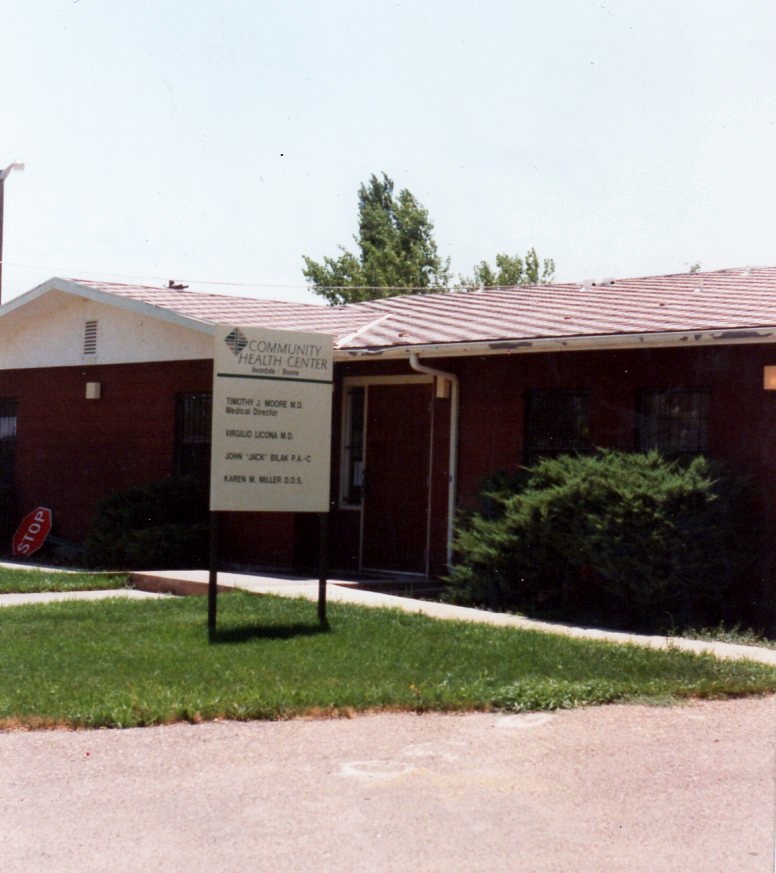
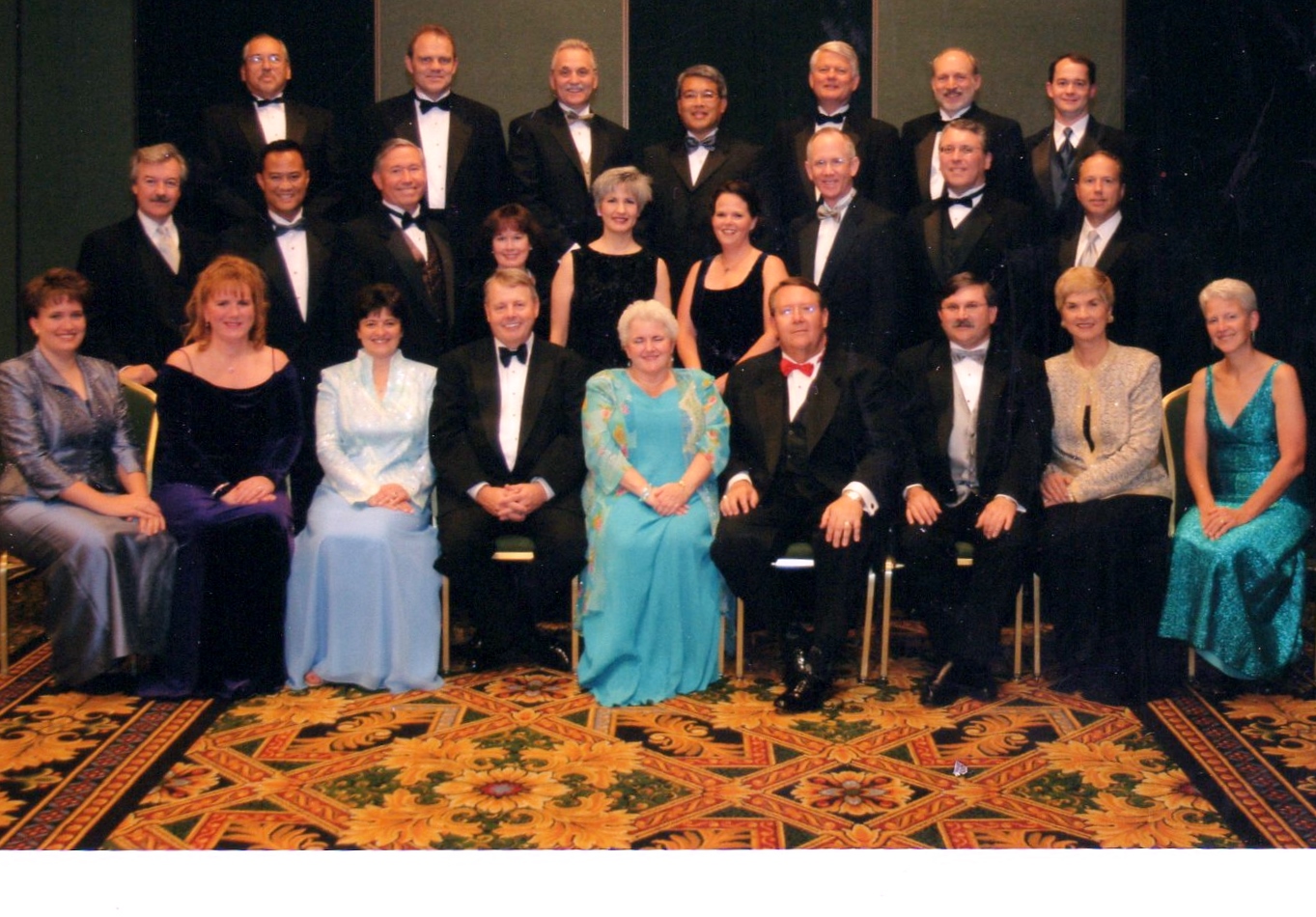
Virgilio Licona at the American Academy of Family Physicians (1996)
LHP_Intern2019-11-18T00:12:14+00:00Dr. Licona at the awards ceremony for the American Academy of Family Physicians
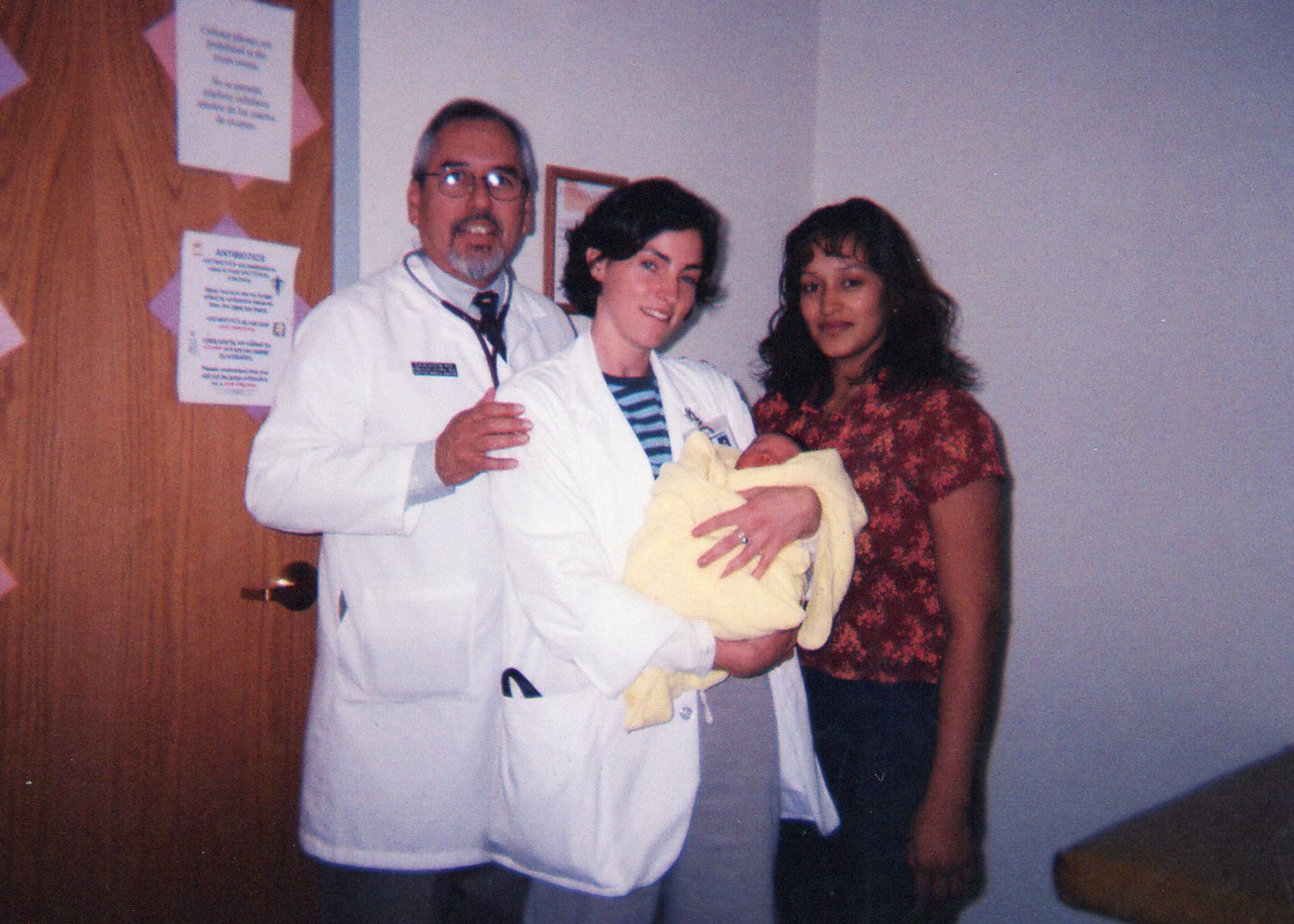
Virgilio Licona with Student (2011)
LHP_Intern2019-11-18T00:13:36+00:00Dr. Licona with a student and a patient.
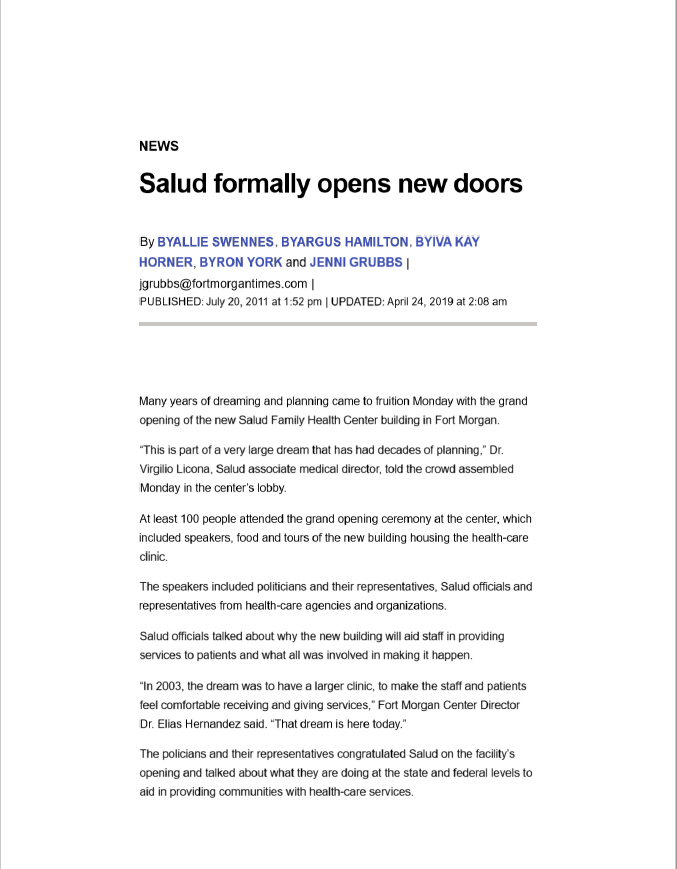
Salud formally opens new doors (2011)
LHP_Intern2019-11-18T00:14:37+00:00Dr. Licona talks about the significance of the new Salud health clinic.
SEQ 5 Returning to Colorado iPad Apple TV 1080p
LHP_Intern2019-11-18T00:16:15+00:00Contains the fifth segment of Rick Vigil’s documentary which highlights Dr. Licona’s initial work as a doctor.
SEQ 6 Manage Health Care iPad Apple TV 1080p
LHP_Intern2019-11-18T00:17:15+00:00Contains the sixth segment of Rick Vigil’s documentary which illustrates Dr. Licona’s work in Colorado health care.
SEQ 7 Salud Fam Health Ctr’s Success iPad Apple TV 1080p
LHP_Intern2019-11-18T00:18:02+00:00Contains the seventh segment of Rick Vigil’s documentary which reflects on Dr. Licona’s efforts for the Salud Family Health Center.
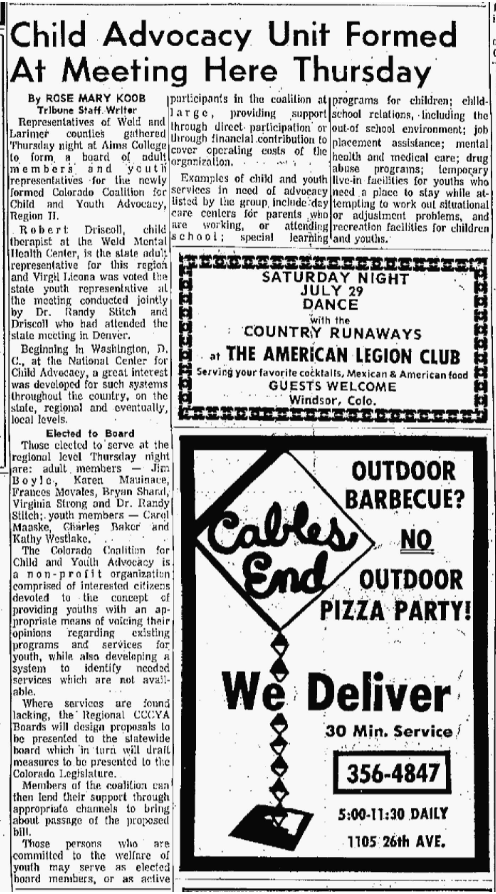
Child Advocacy Unit Formed At Meeting Here Thursday (1972)
LHP_Intern2019-11-18T00:18:53+00:00Lists Dr. Licona as the state youth representative for the Colorado Coalition for Child and Youth Advocacy, Region II.
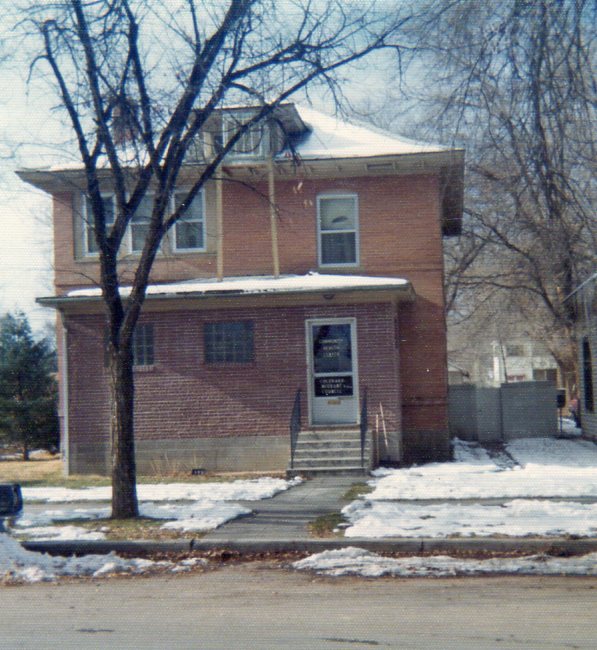
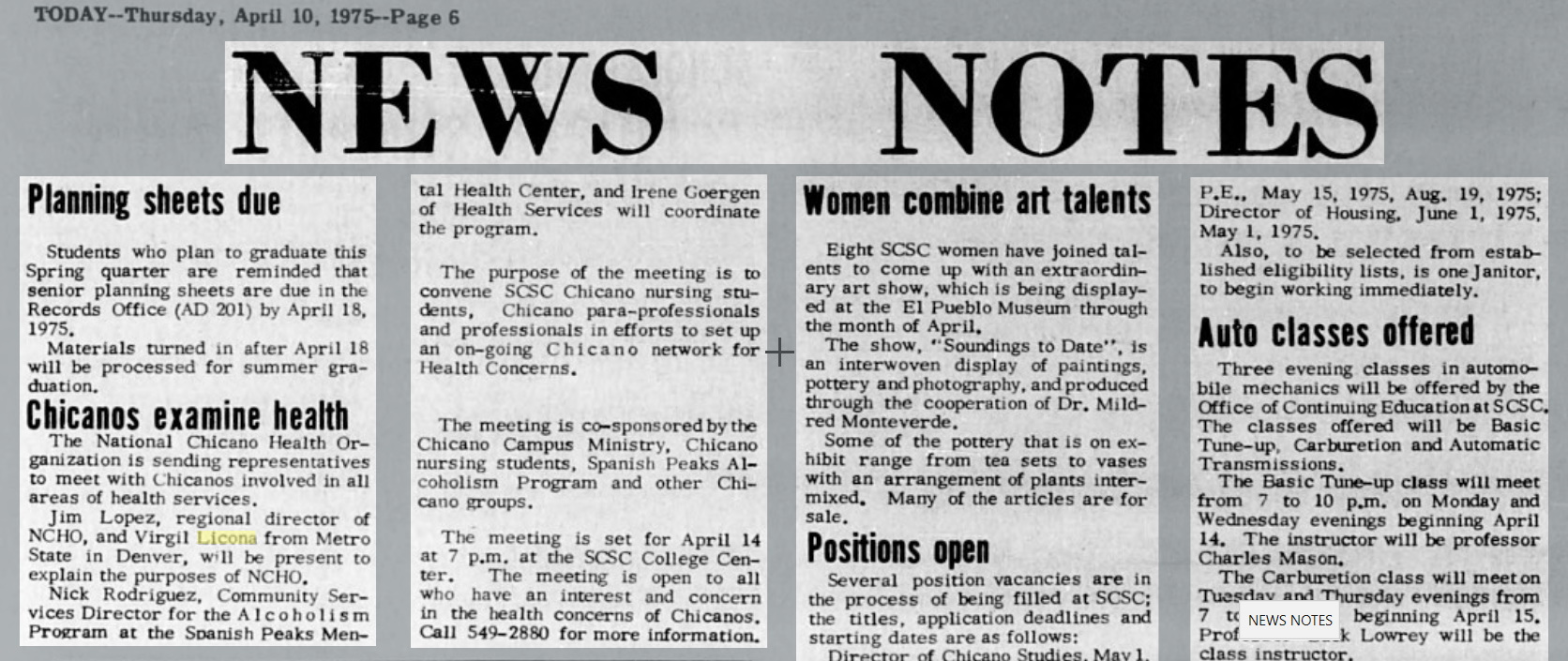
News Notes: Chicanos examine health (1975)
LHP_Intern2019-11-18T00:21:22+00:00States that the National Chicano Health Organization is sending Dr. Licona to meet with Chicanos involved in health services.
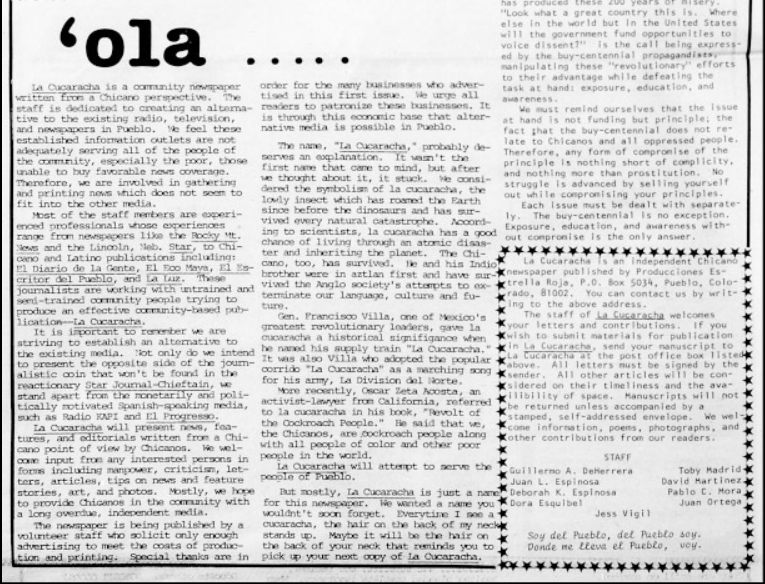
Ola… (1976)
LHP_Intern2019-11-18T00:22:34+00:00Explains the purposes of La Cucaracha newspaper and the reason for its name.
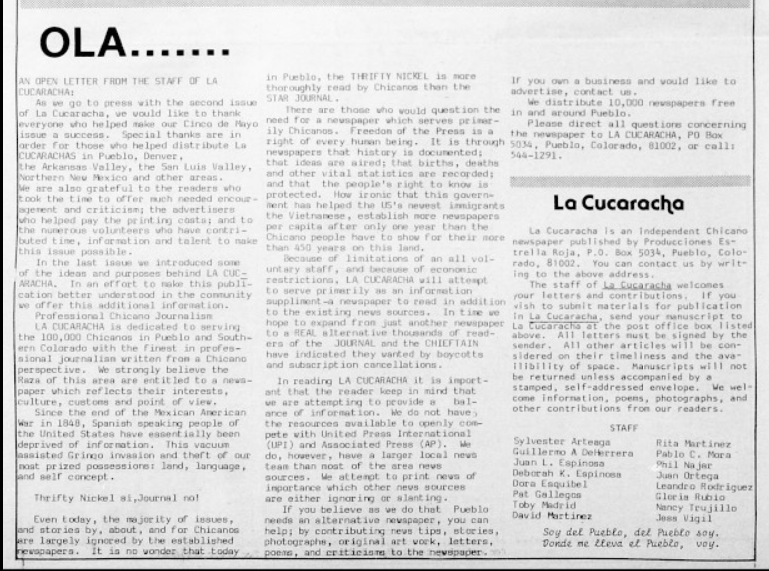
Ola… (1976)
LHP_Intern2019-09-12T20:48:23+00:00Explains more about the production and purposes of La Cucaracha.
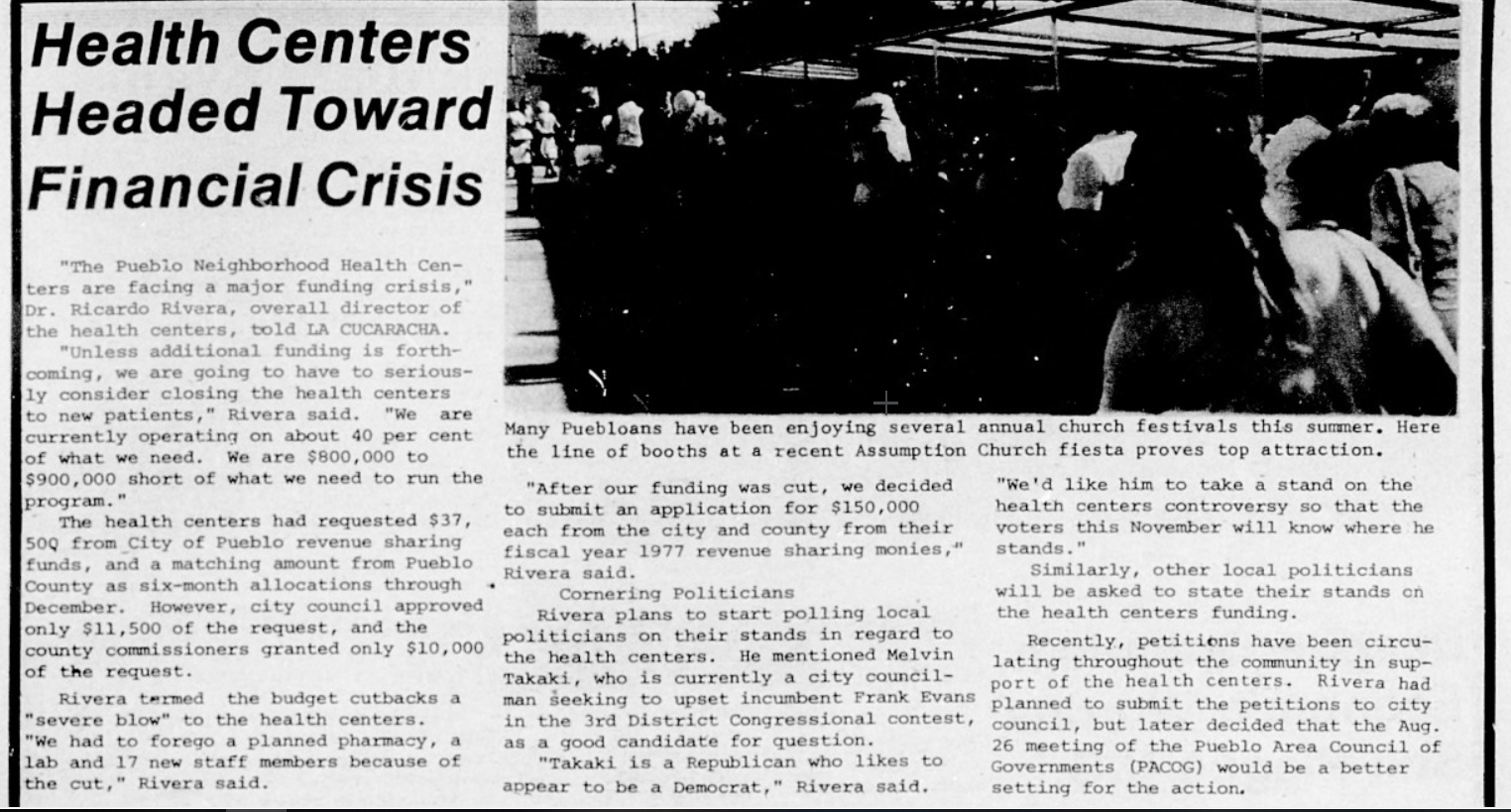
Health Centers Headed Toward Financial Crisis (1976)
LHP_Intern2019-11-18T00:25:23+00:00Explains that the Pueblo health centers need more money and describes the problems that led Dr. Licona to a medical career.
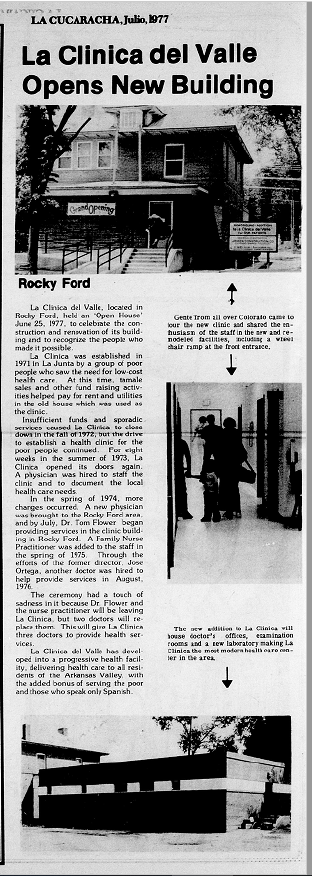
La Clinica del Valle Opens New Building (1977)
LHP_Intern2019-11-18T00:26:20+00:00La Clinica del Valle, located in Rocky Ford, Colorado, held an open house June 25, 1977 to celebrate the construction and renovation of its building.
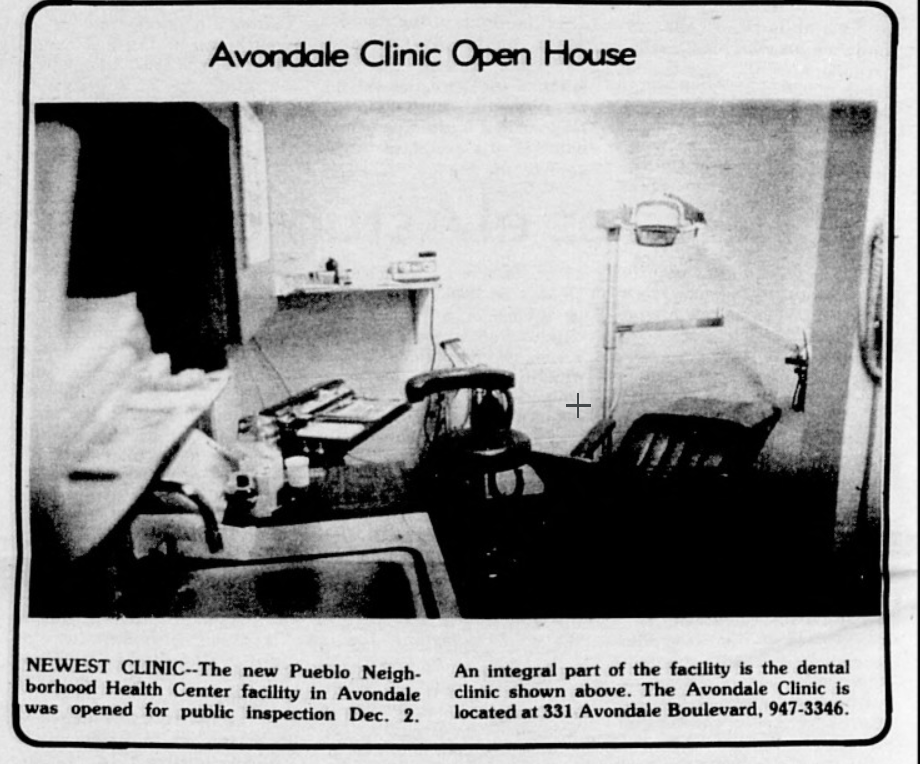
Avondale Clinic Open House (1978)
LHP_Intern2019-11-18T00:27:20+00:00A new Pueblo neighborhood health center opened in Avondale on December 2, 1978.
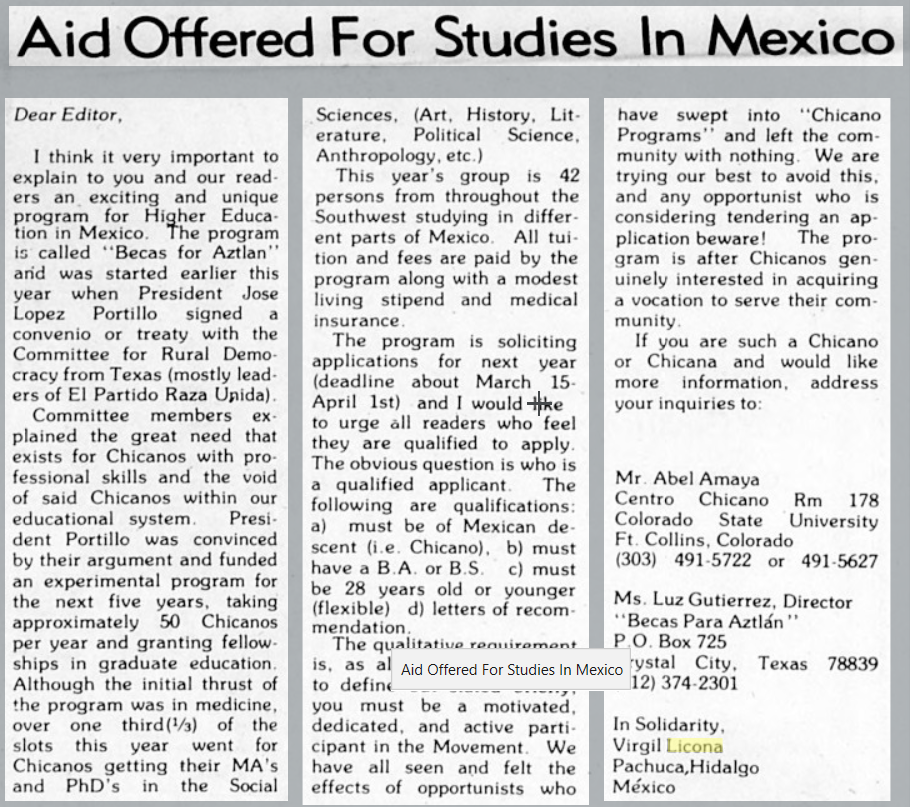
Aid Offered for Studies in Mexico (1979)
LHP_Intern2019-11-18T00:28:14+00:00Dr. Licona discusses a new program for Higher Education in Mexico called “Becas for Aztlan” (English).

Cincuenta becas ofrecidas pa’ Estudiar en México (1979)
LHP_Intern2019-11-18T00:29:13+00:00Dr. Licona discusses a new program for Higher Education in Mexico called “Becas for Aztlan” (Espanol).
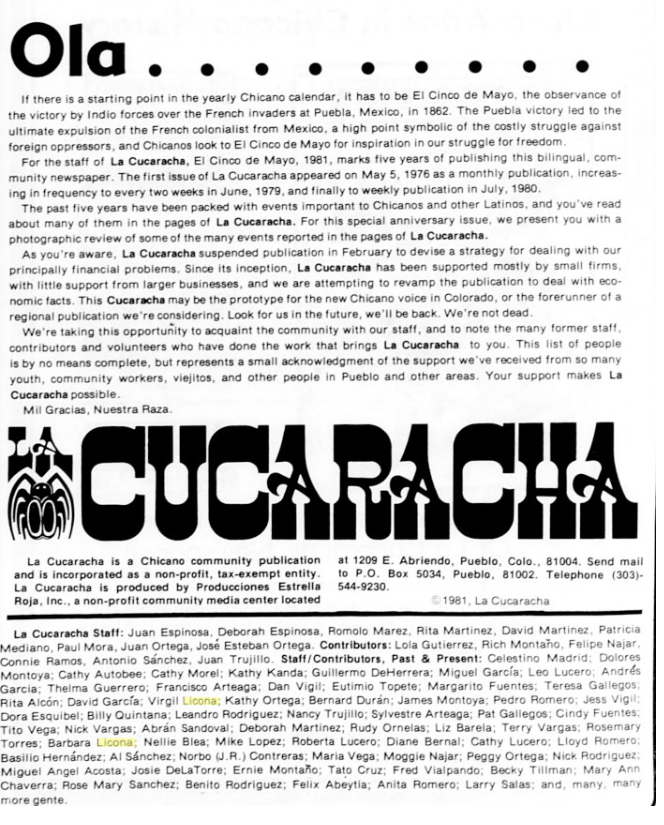
Ola… (1981)
LHP_Intern2019-11-18T00:40:55+00:00La Cucaracha celebrates five years of publications and notes the significance of Cinco de Mayo.
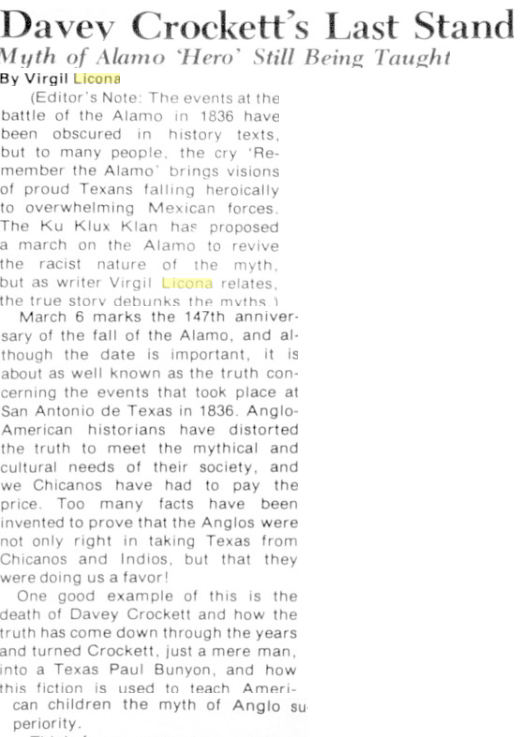
Davey Crockett’s Last Stand (1983)
LHP_Intern2019-11-18T00:41:52+00:00Dr. Licona debunks some myths about Davy Crockett and the Alamo. (p1)
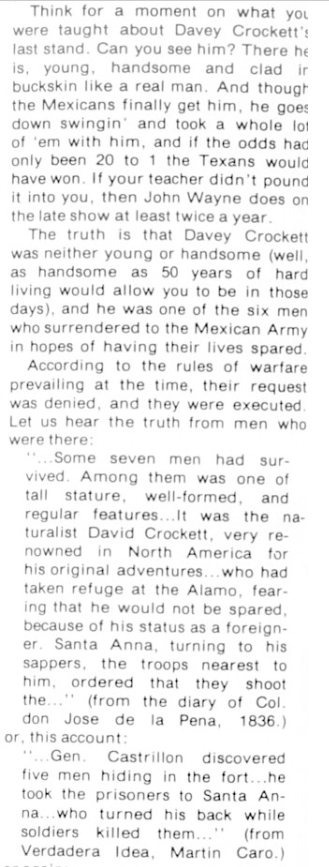
Davey Crockett’s Last Stand (1983)
LHP_Intern2019-11-18T00:42:53+00:00Dr. Licona debunks some myths about Davy Crockett and the Alamo. (p2)
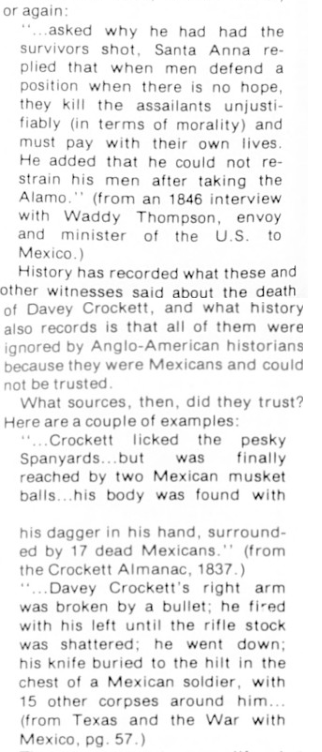
Davey Crockett’s Last Stand (1983)
LHP_Intern2019-11-18T00:43:41+00:00Dr. Licona debunks some myths about Davy Crockett and the Alamo. (p3)
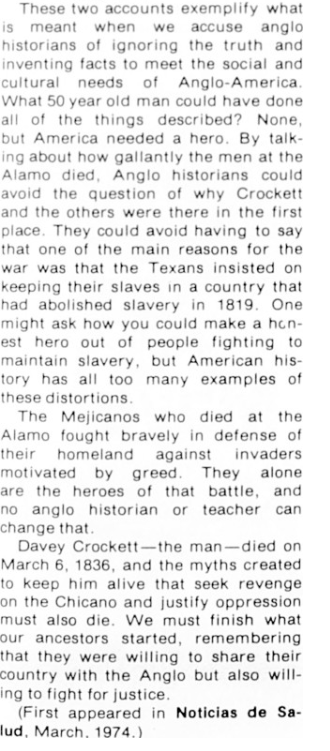
Davey Crockett’s Last Stand (1983)
LHP_Intern2019-11-18T00:45:13+00:00Dr. Licona debunks some myths about Davy Crockett and the Alamo. (p4)
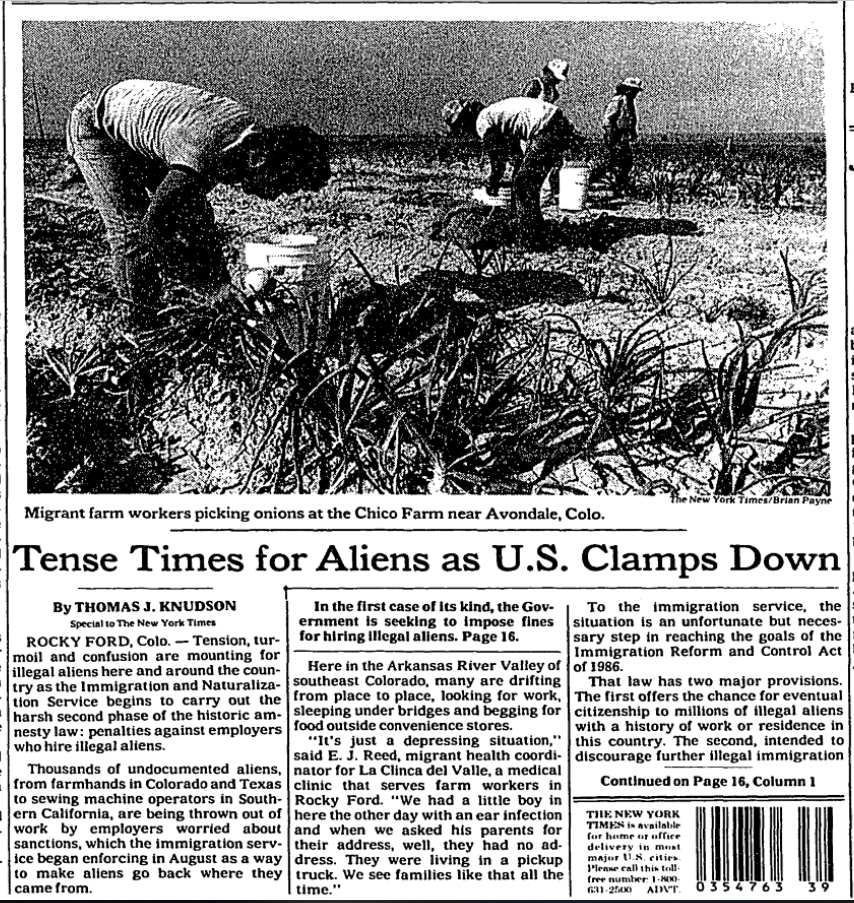
Tense Times for Aliens as U.S. Clamps Down (1987)
LHP_Intern2019-11-18T00:46:23+00:00Discusses the obstacles faced by migrants and staff at La Clinica del Valle. (p1)
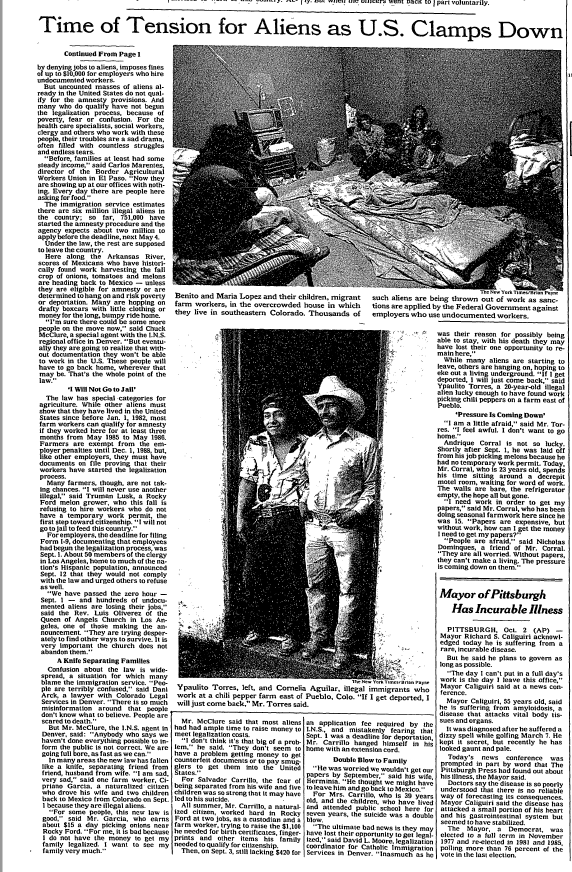
Time of Tension for Aliens as U.S. Cracks Down (1987)
LHP_Intern2019-11-18T00:47:54+00:00Discusses the obstacles faced by migrants and staff at La Clinica del Valle. (p2)
Faces of Hope (2008)
LHP_Intern2019-11-18T00:48:52+00:00An introduction to the Faces of Hope project and the history of community health centers. (p1)
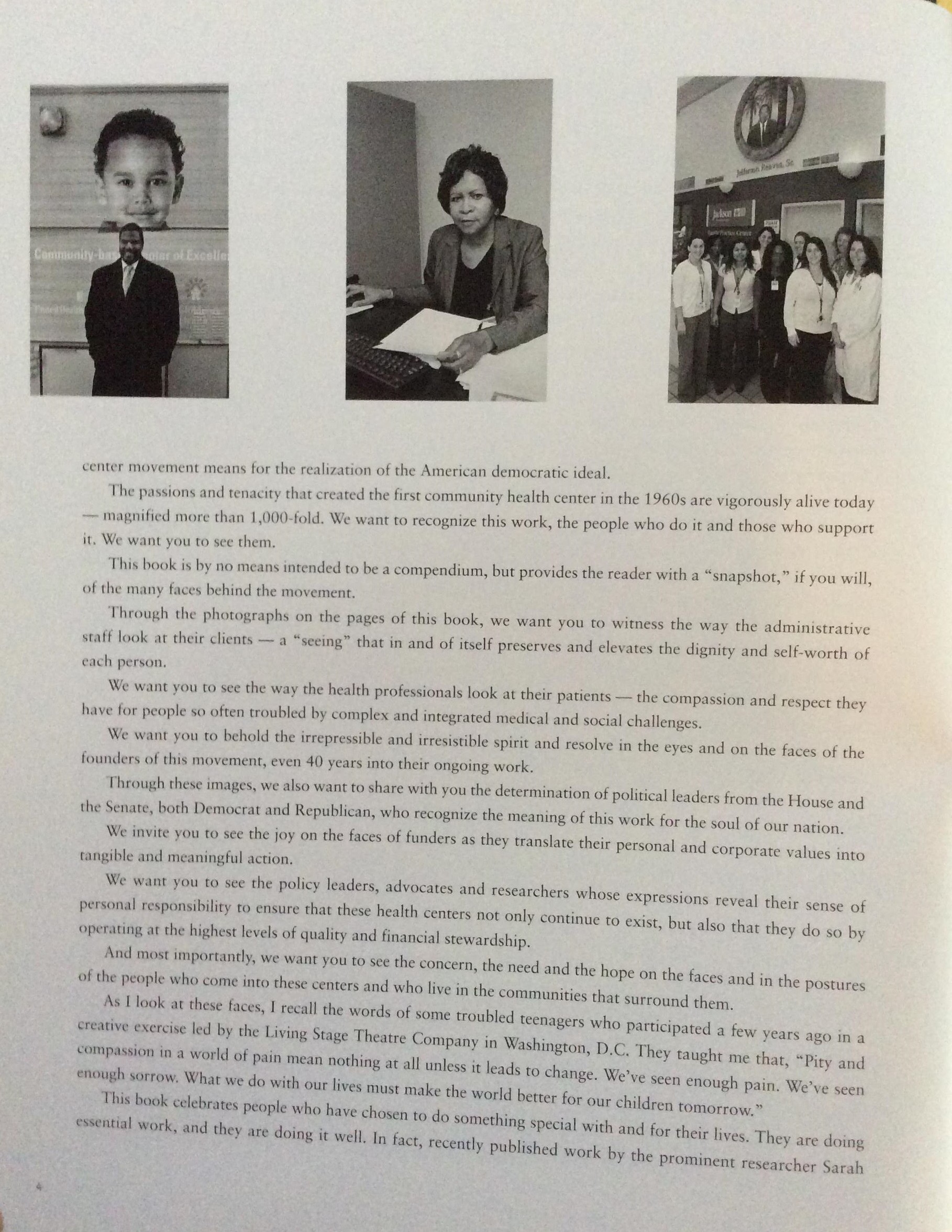
Faces of Hope (2008)
LHP_Intern2019-11-18T00:49:47+00:00An introduction to the Faces of Hope project and the history of community health centers. (p2)
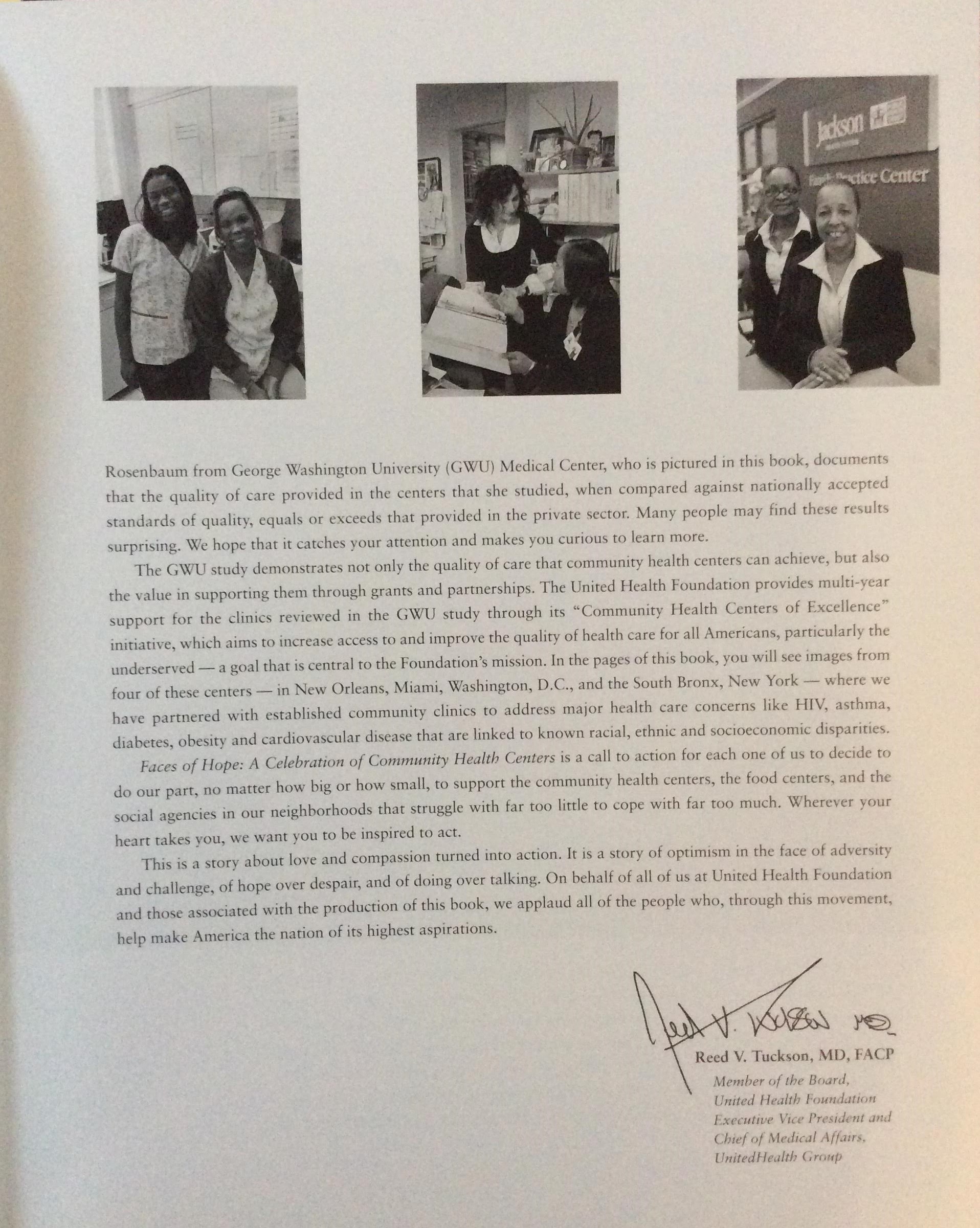
Faces of Hope (2008)
LHP_Intern2019-11-18T00:50:54+00:00An introduction to the Faces of Hope project and the history of community health centers. (p3)
Faces of Hope (2008)
LHP_Intern2019-09-12T21:23:44+00:00Dr. Jack Geiger provides a history of the community health center movement. (p4)

Faces of Hope (2008)
LHP_Intern2019-11-18T00:51:56+00:00Dr. Jack Geiger provides a history of the community health center movement. (p5)
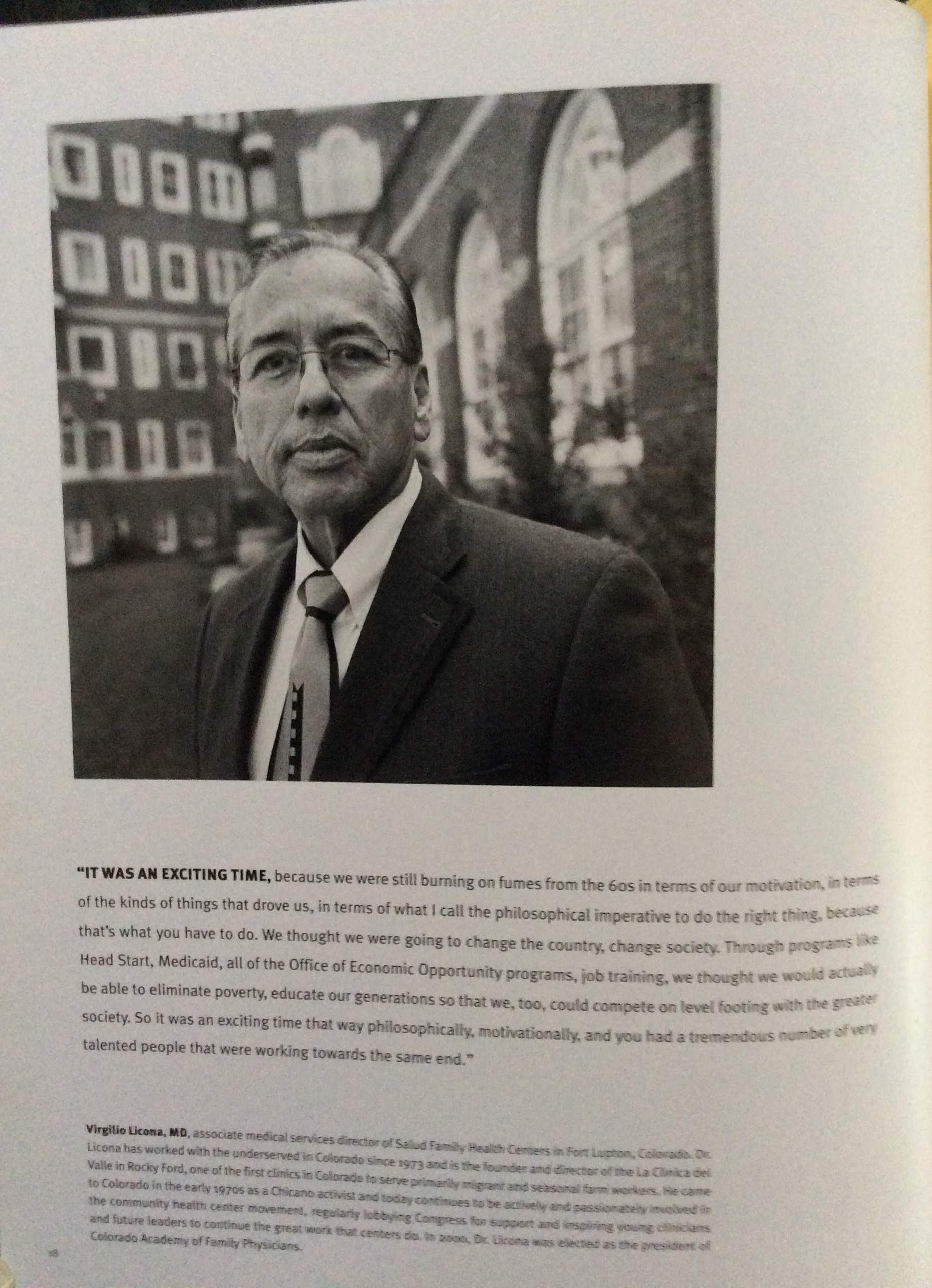
Faces of Hope (2008)
LHP_Intern2019-11-18T00:53:03+00:00Presents an overview of Dr. Licona’s work as a community organizer, activist, and doctor. (p6)
2016 JTOH Test Questions El Movimiento
LHP_Intern2019-11-18T00:54:03+00:00Contains test questions and answers about the origins of the Chicano movement in Colorado.
SEQ 3 Giving back to the Comm iPad Apple TV 1080p
LHP_Intern2019-11-18T00:56:53+00:00Contains the third segment of Rick Vigil’s documentary about Dr. Licona which describes his role as a community organizer.
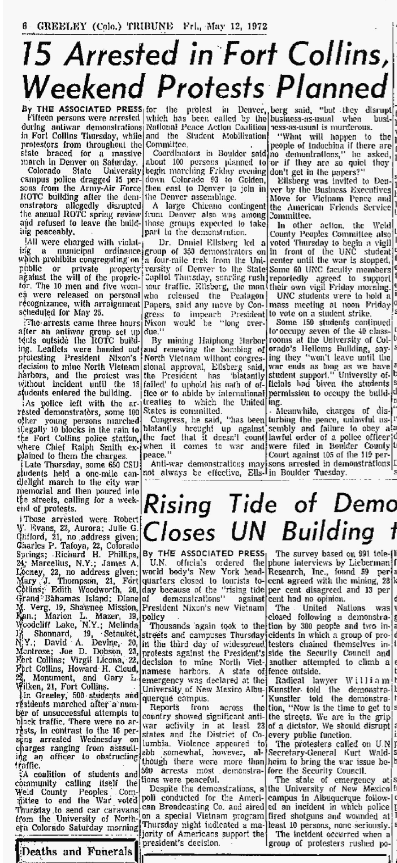
15 Arrested in Fort Collins, Weekend Protests Planned (1972)
LHP_Intern2019-11-18T00:58:47+00:00Describes how anti-war protestors took over the ROTC building at CSU and Dr. Licona was arrested.
SEQ 2 Chicano and Anti War Mov iPad Apple TV 1080p
LHP_Intern2019-11-18T01:00:48+00:00Contains the second segment of Rick Vigil’s documentary about Dr. Licona which describes his involvement with UMAS and the antiwar movement.
SEQ 1 Personal BG and Hist Setting iPad Apple TV 1080p
LHP_Intern2019-11-18T01:01:47+00:00Contains the first segment of Rick Vigil’s documentary about Dr. Licona which chronicles his time at CSU and the political climate of the 1960s and 1970s.
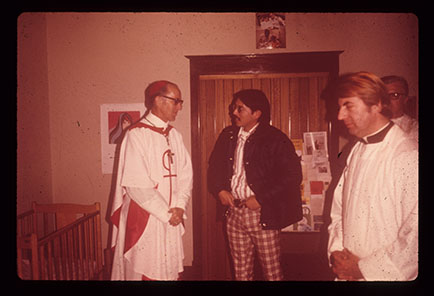
Virgilio Licona with Bishop Boswell
LHP_Intern2019-11-18T01:06:03+00:00Shows Dr. Licona talking with Bishop Boswell.
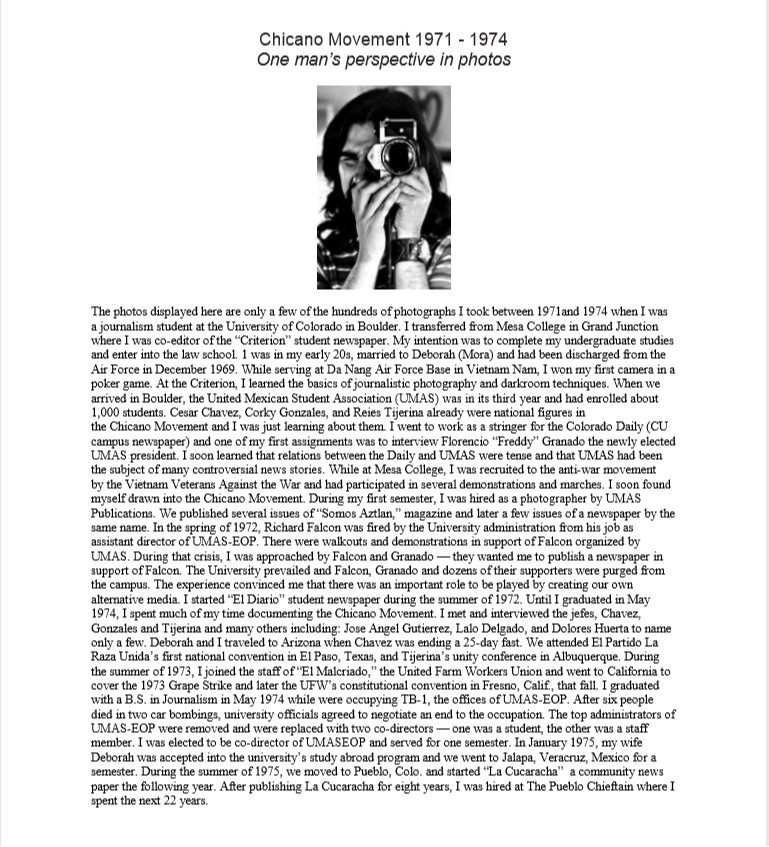
Chicano Movement 1971-1974: One Man’s Perspective in Photos
LHP_Intern2019-11-18T01:07:15+00:00Provides details about the Chicano Movement in Colorado through photographs taken by Juan Espinosa.
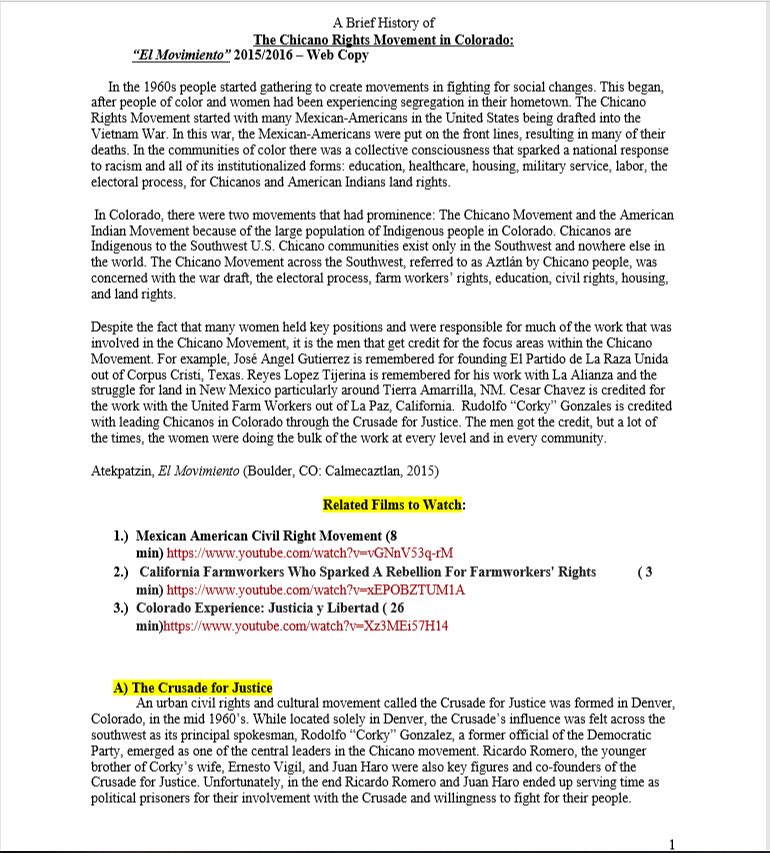
A Brief History of the Chicano Rights Movement in Colorado
LHP_Intern2019-11-18T01:08:18+00:00Discusses the history of the Chicano Movement in Colorado.
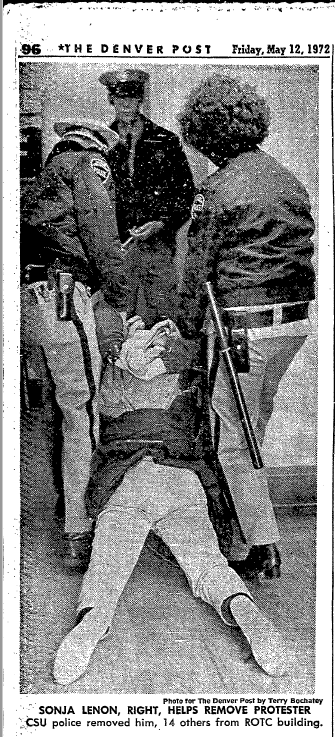
Sonja Lenon, Right, Helps Remove Protester (1972)
LHP_Intern2019-11-18T01:17:20+00:00Shows CSU police removing a an antiwar protester from the ROTC building.
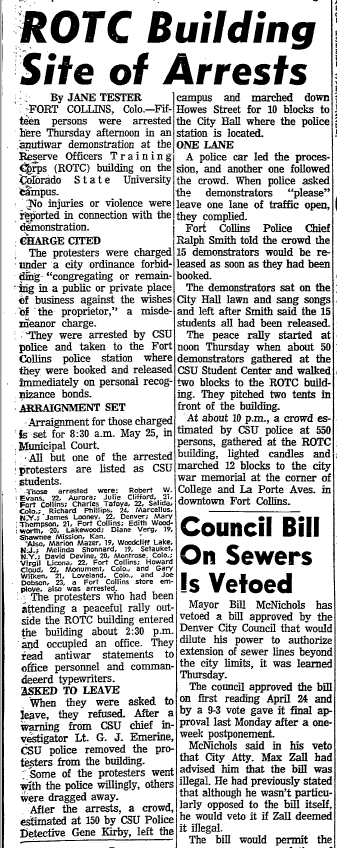
ROTC Building Site of Arrests (1972)
LHP_Intern2019-11-18T01:19:00+00:00Describes the antiwar protests that resulted in the occupation of the ROTC building at CSU.
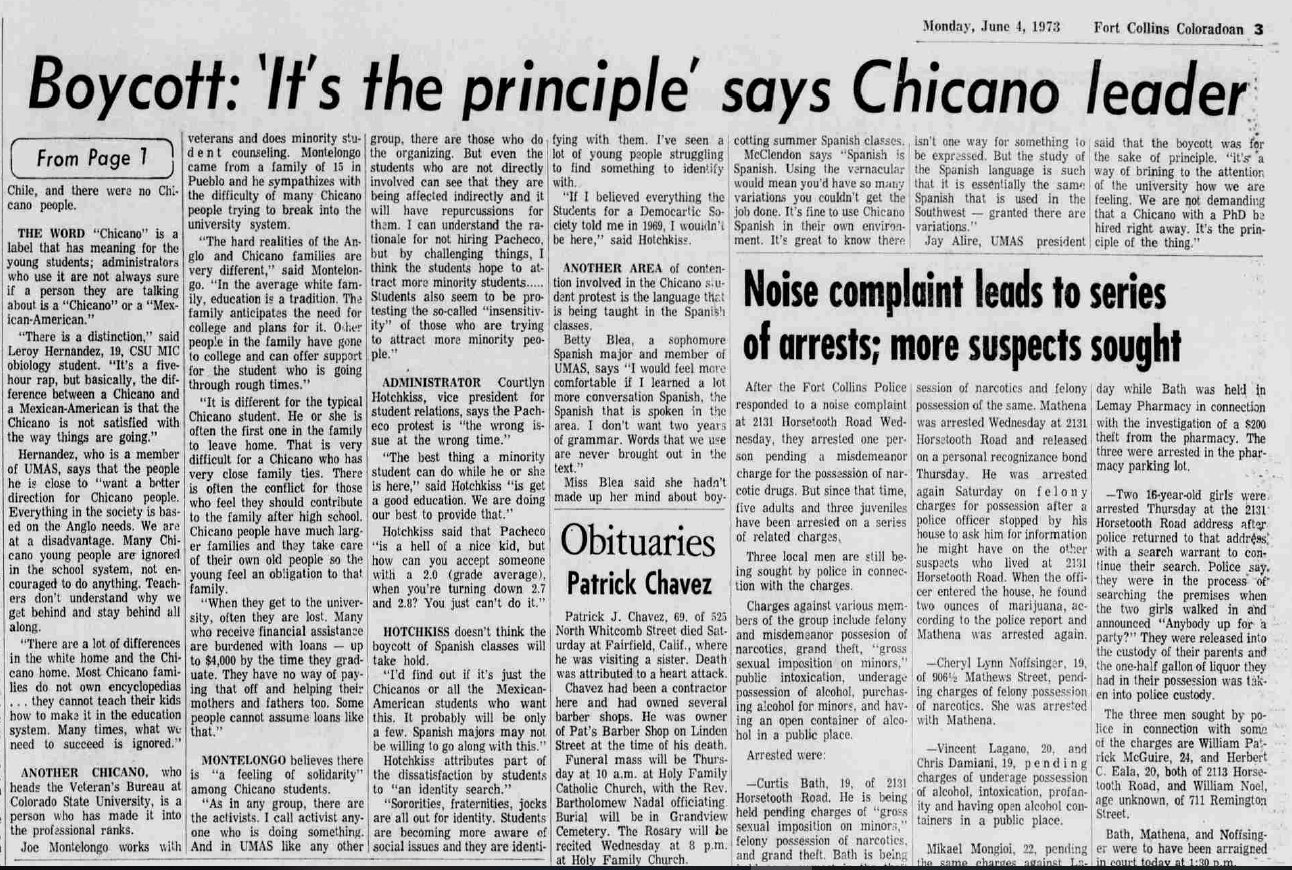
Boycott: “it’s the principle” says Chicano leader (p2) (1973)
LHP_Intern2019-11-18T01:20:59+00:00Describes an impasse between CSU administrators and Chicano activists/students.
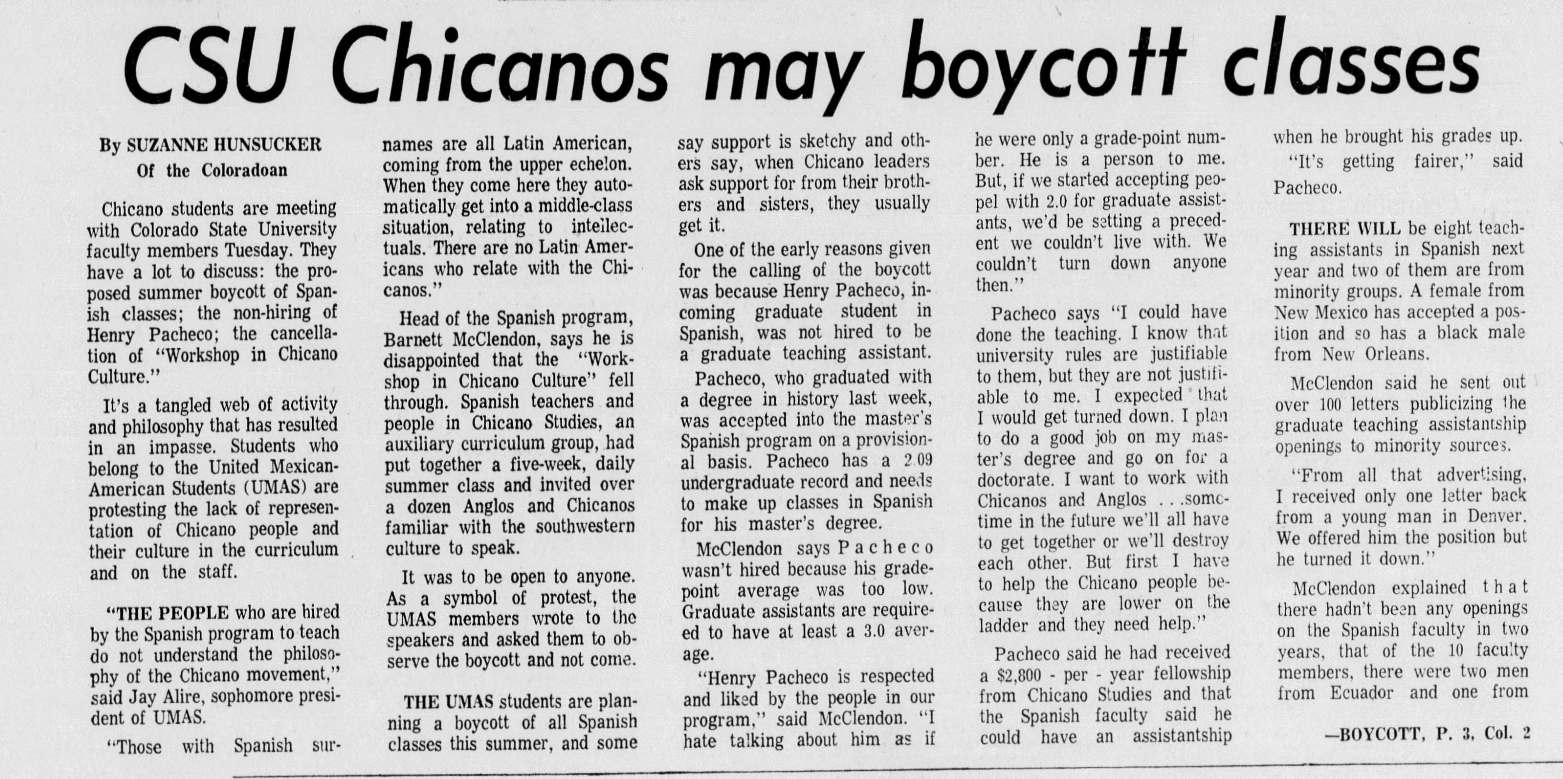
CSU Chicanos may boycott classes (p1) (1973)
LHP_Intern2019-11-18T01:22:28+00:00Describes an impasse between CSU administrators and Chicano activists/students.
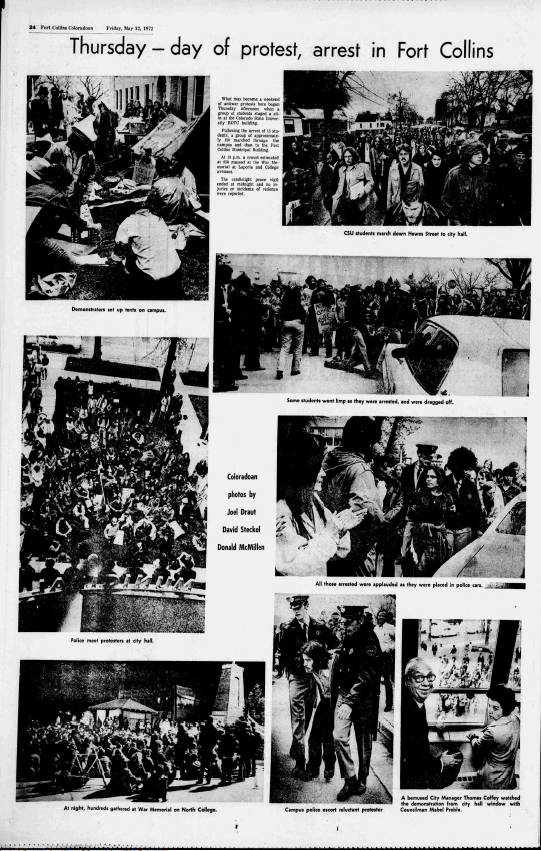
Thursday – day of protest, arrest in Fort Collins (1972)
LHP_Intern2019-11-18T01:23:50+00:00Shows pictures of the 1972 antiwar protests at CSU.
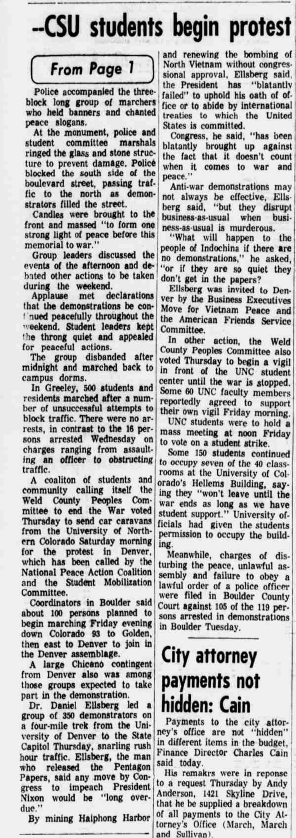
CSU students begin protest (p2) (1972)
LHP_Intern2019-11-18T01:24:55+00:00Describes the antiwar protests on CSU’s campus and the arrest of Dr. Licona.
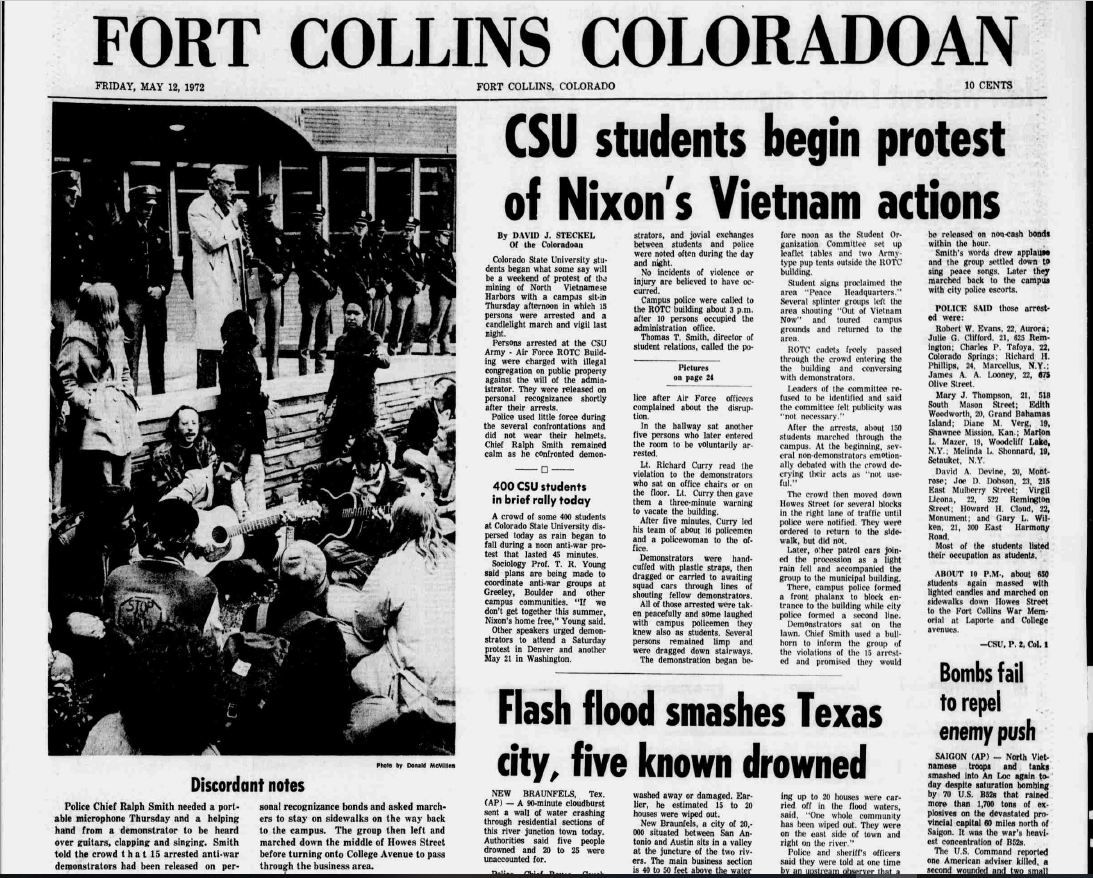
CSU students begin protest of Nixon’s Vietnam actions (p1) (1972)
LHP_Intern2019-11-18T01:26:25+00:00Describes the antiwar protests on CSU’s campus and the arrest of Dr. Licona.
CSU students launch protest (1972)
LHP_Intern2019-11-18T01:27:18+00:00Explains that Dr. Licona and about 100 other students camped outside of the ROTC building at CSU.
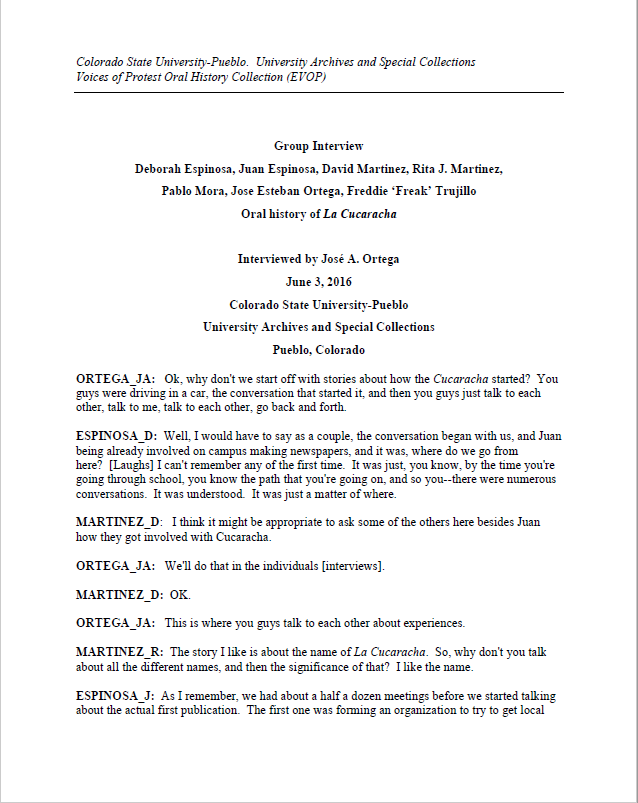
Group Interview: Oral History of La Cucaracha (2016)
LHP_Intern2023-06-01T14:53:15+00:00Jose Ortega interviewed Chicano activists Deborah Espinosa, Juan Espinosa, David Martinez, Rita J. Martinez, Pablo Mora, Jose Esteban Ortega, and Freddie “Freak” Trujillo, to collect an orall history about La Cucaracha, a Chicano newspaper supported by Dr. Licona.
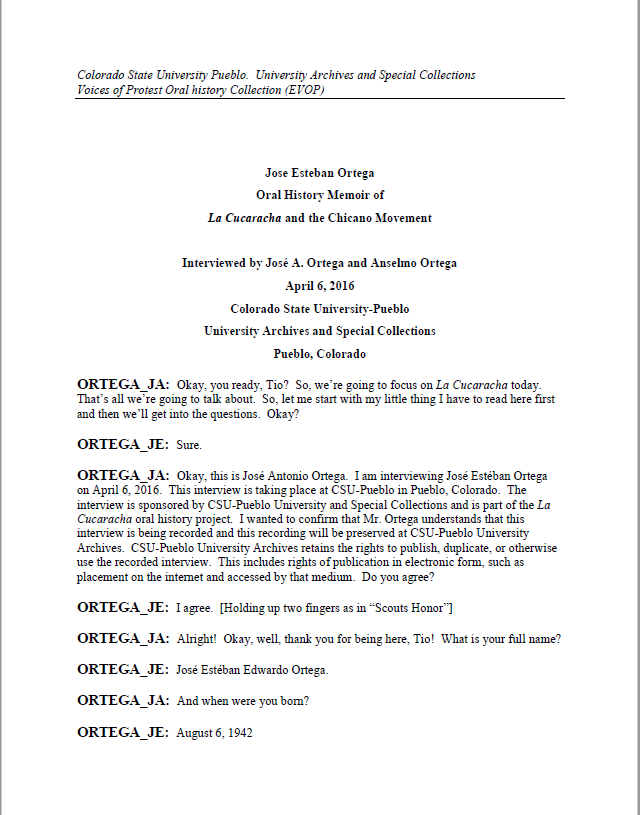
Jose Esteban Ortega Oral History Memoir of La Cucaracha and the Chicano Movement (2016)
LHP_Intern2019-11-18T01:29:18+00:00Jose Esteban Ortega gives an oral history of the Chicano Movement, including the role of Dr. Licona.
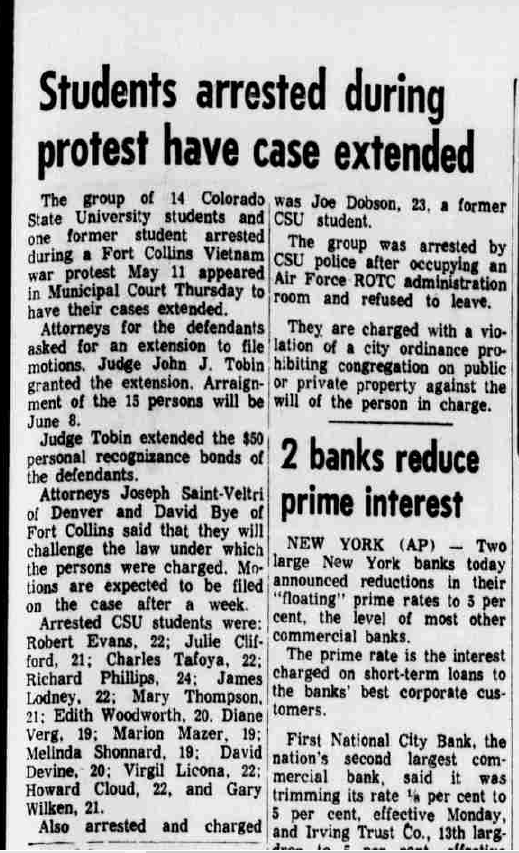
Students arrested during protest have case extended (1972)
LHP_Intern2019-11-18T01:30:19+00:00Dr. Licona and the other CSU students who were arrested for protesting the Vietnam War appeared in court to have their case extended.
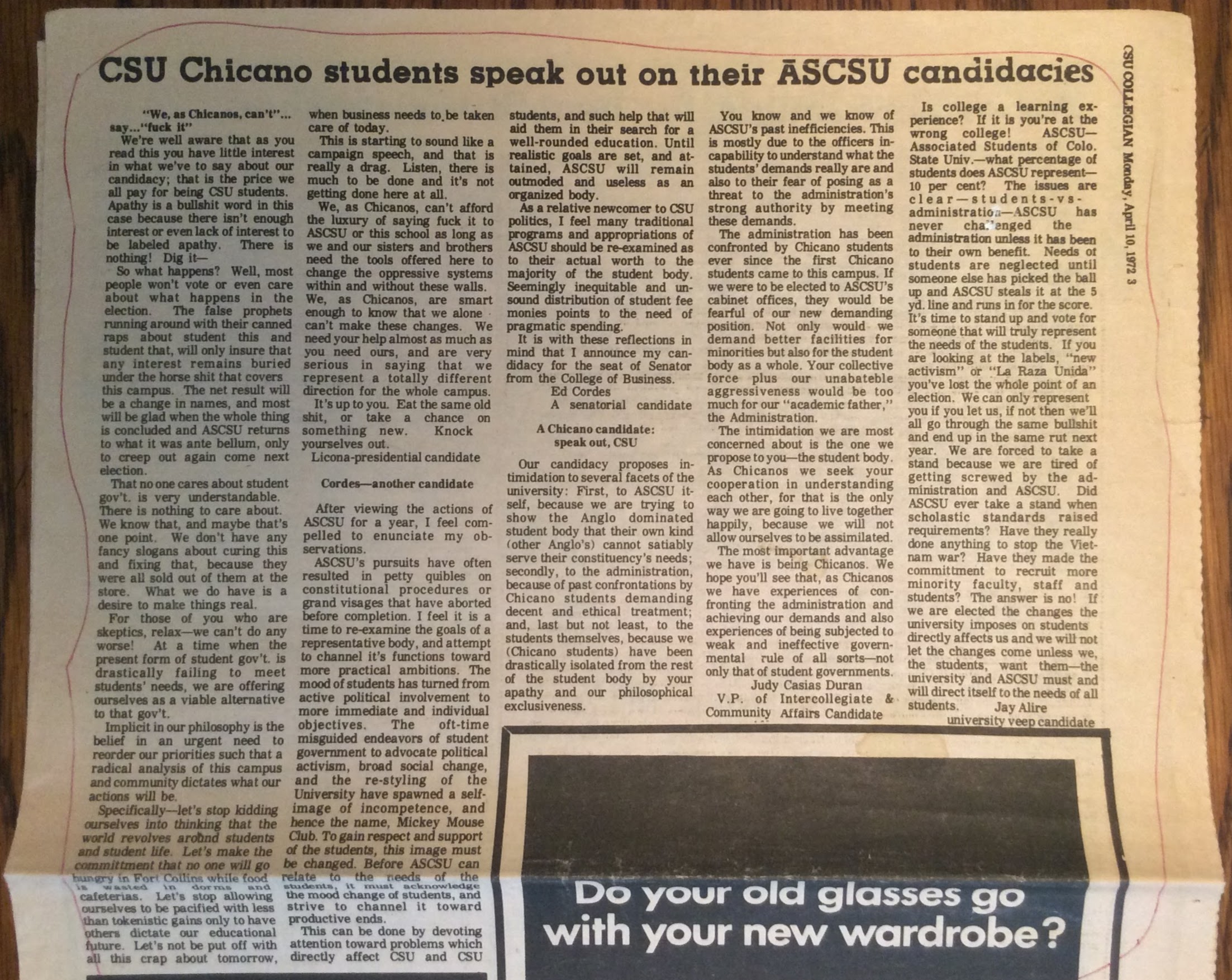
CSU Chicano students speak out on their ASCU candidacies (1972)
LHP_Intern2019-11-18T01:31:22+00:00Dr. Licona discusses the concerns of Chicano students at CSU and why he is running for student-body office.
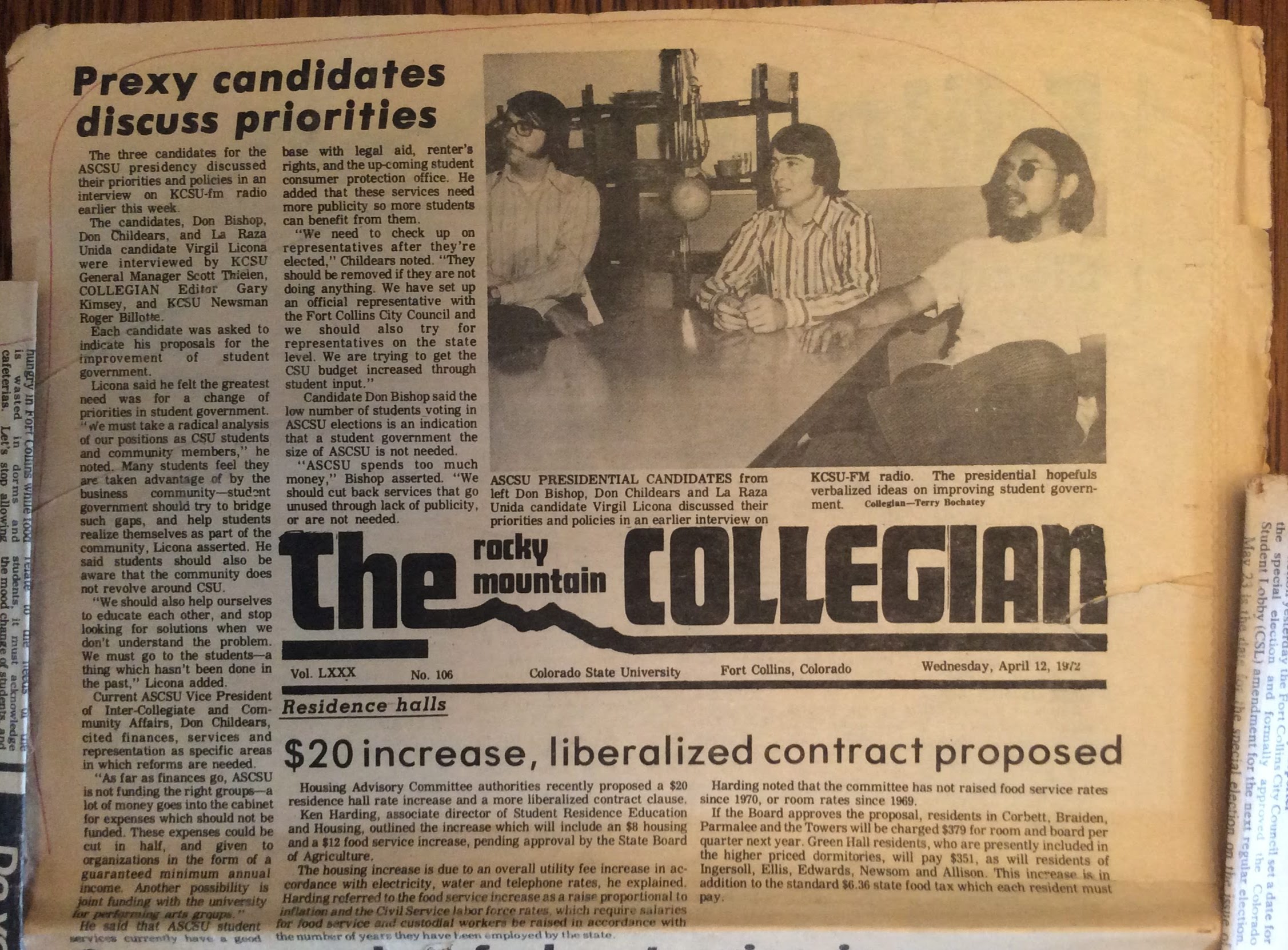
Prexy candidates discuss priorities (1972)
LHP_Intern2019-11-18T01:32:21+00:00Explains how Dr.Licona and other candidates for student body president at CSU discussed their policies and priorities in a radio interview.
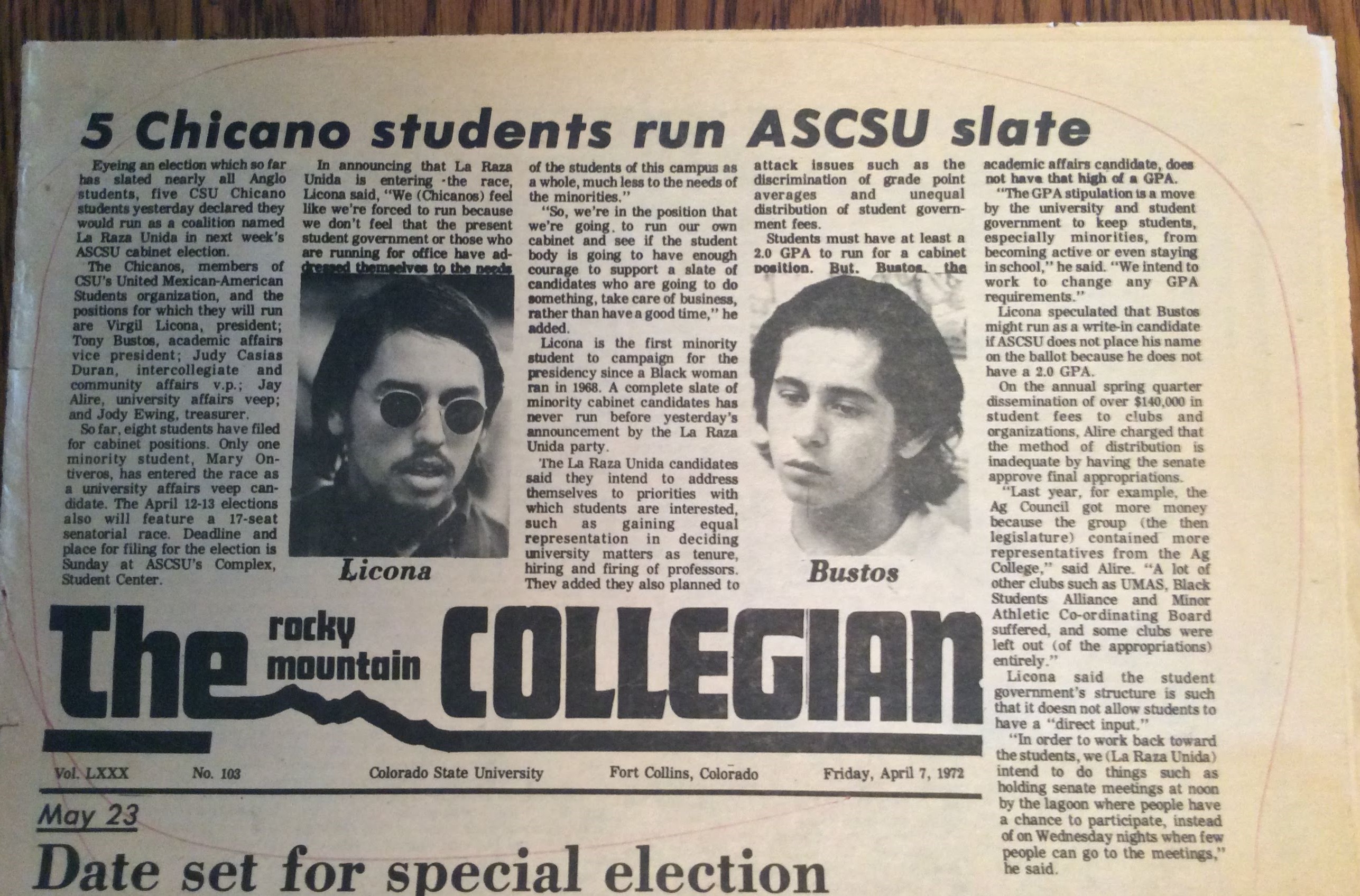
5 Chicano students run ASCU Slate (1972)
LHP_Intern2019-11-18T01:34:14+00:00Shows Dr. Licona and four other members of La Raza Unida who ran for student body cabinet offices at CSU.
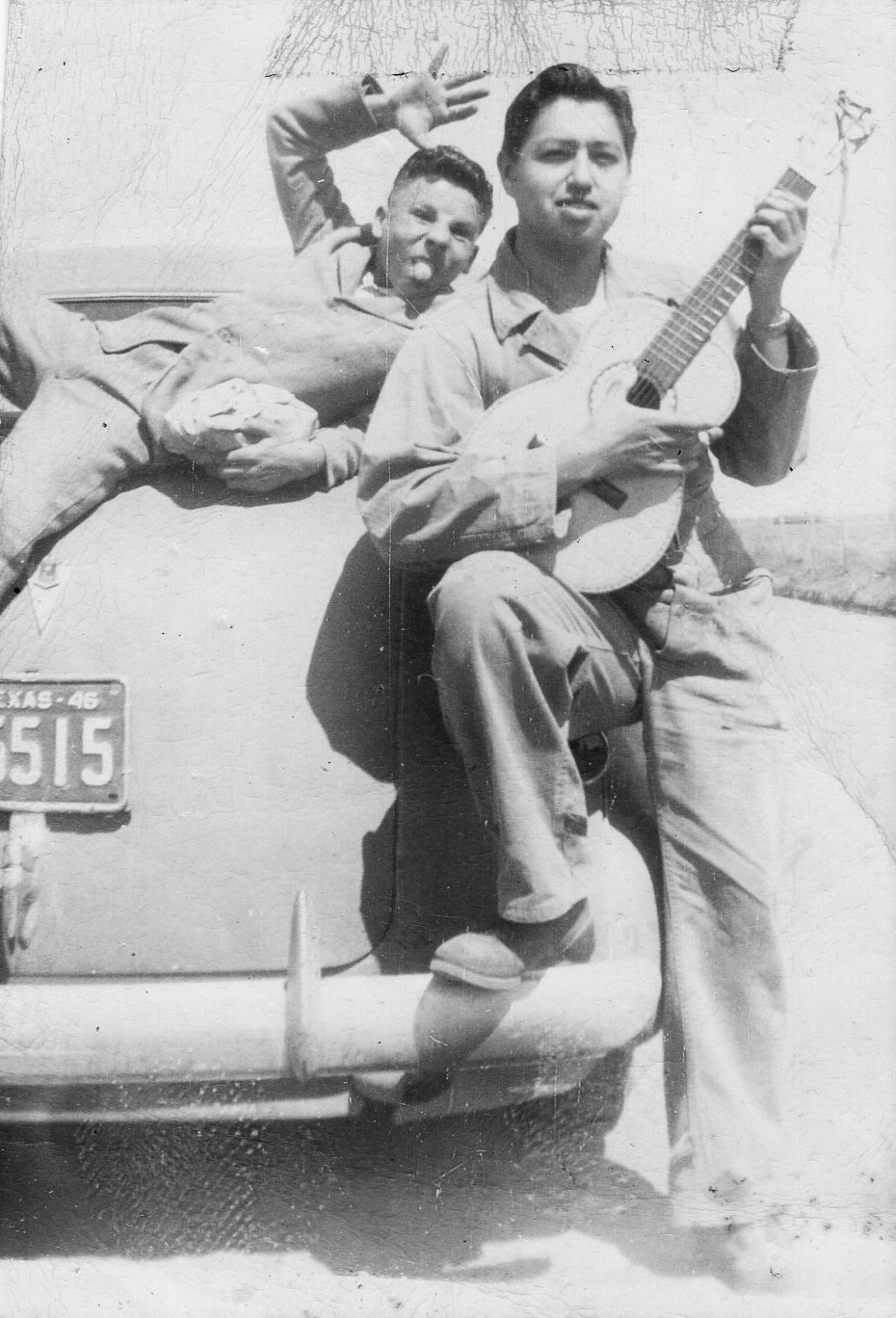
Virgilio Licona Sr. and Ray Quiñones
LHP_Intern2019-11-18T01:35:43+00:00Dr. Licona’s father and uncle (Virgilio Sr. and Ray Quiñones) playing the guitar.
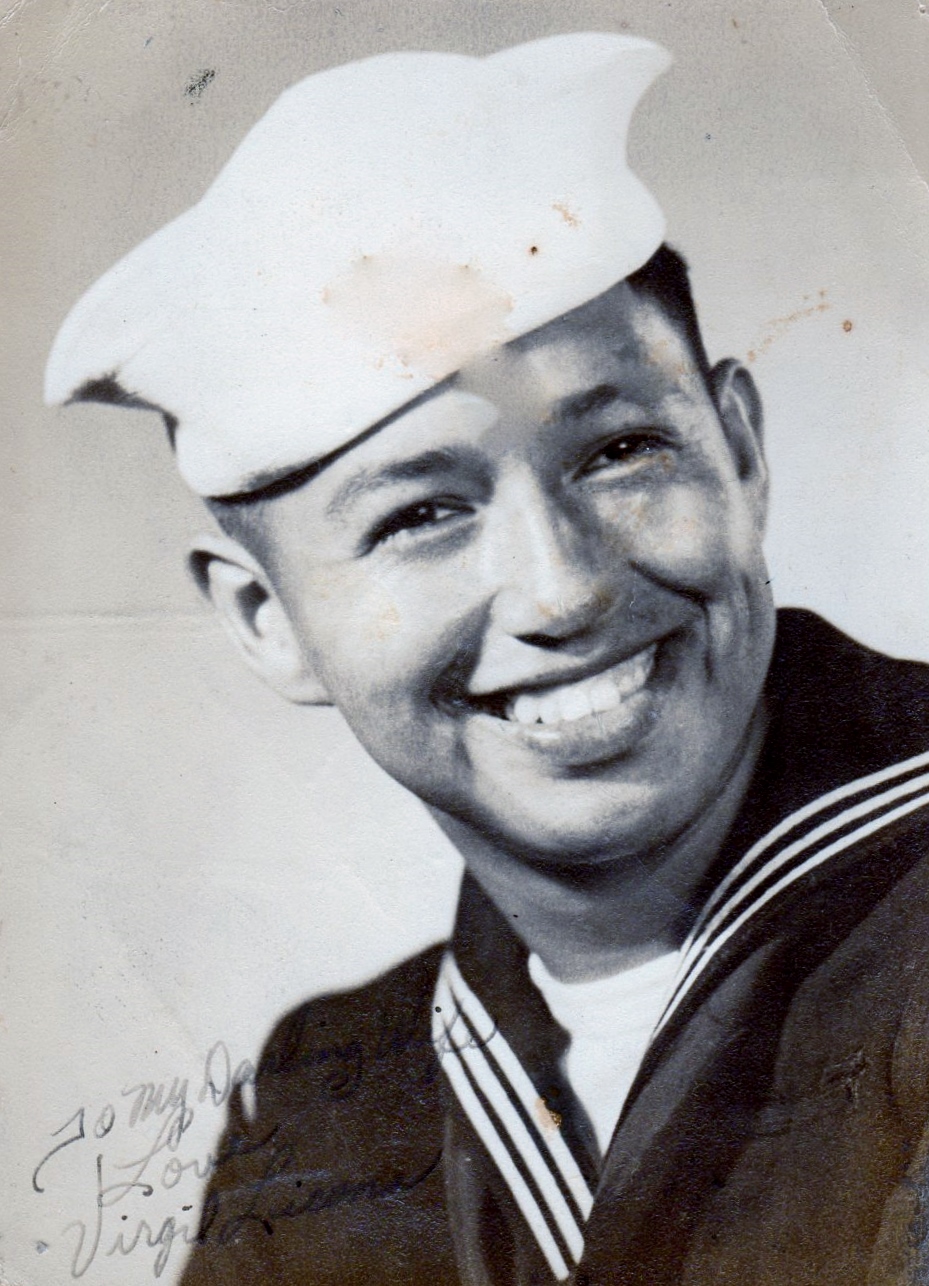
Virgilio Licona Sr. Navy Photograph
LHP_Intern2019-11-18T01:37:48+00:00Virgilio Licona Sr. as a naval serviceman. The photo is signed, “To my darling wife. Love, Virgil Licona.”
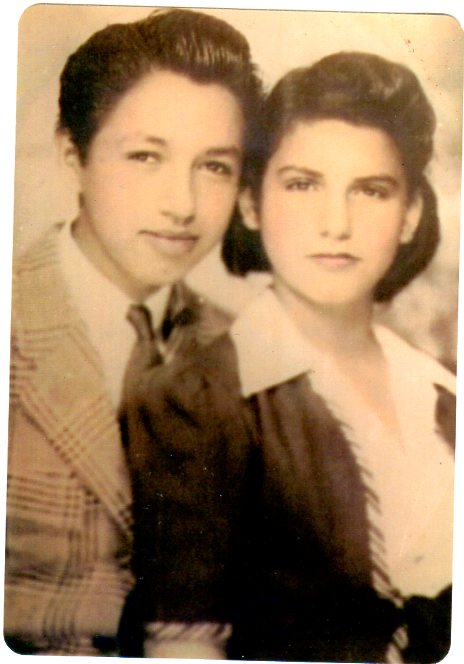
Virgilio Licona Sr. and Rebecca Quiñones Yellow Photograph
LHP_Intern2019-11-18T01:40:20+00:00Dr. Licona’s parents, Virgilio Licona Sr. and Rebecca Quiñones, as a young couple.
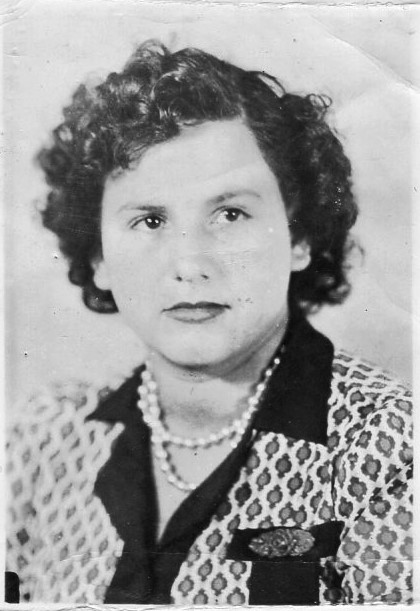
Rebecca Quiñones Photograph
LHP_Intern2019-11-18T01:44:30+00:00Dr. Licona’s mother, Rebecca Quiñones.
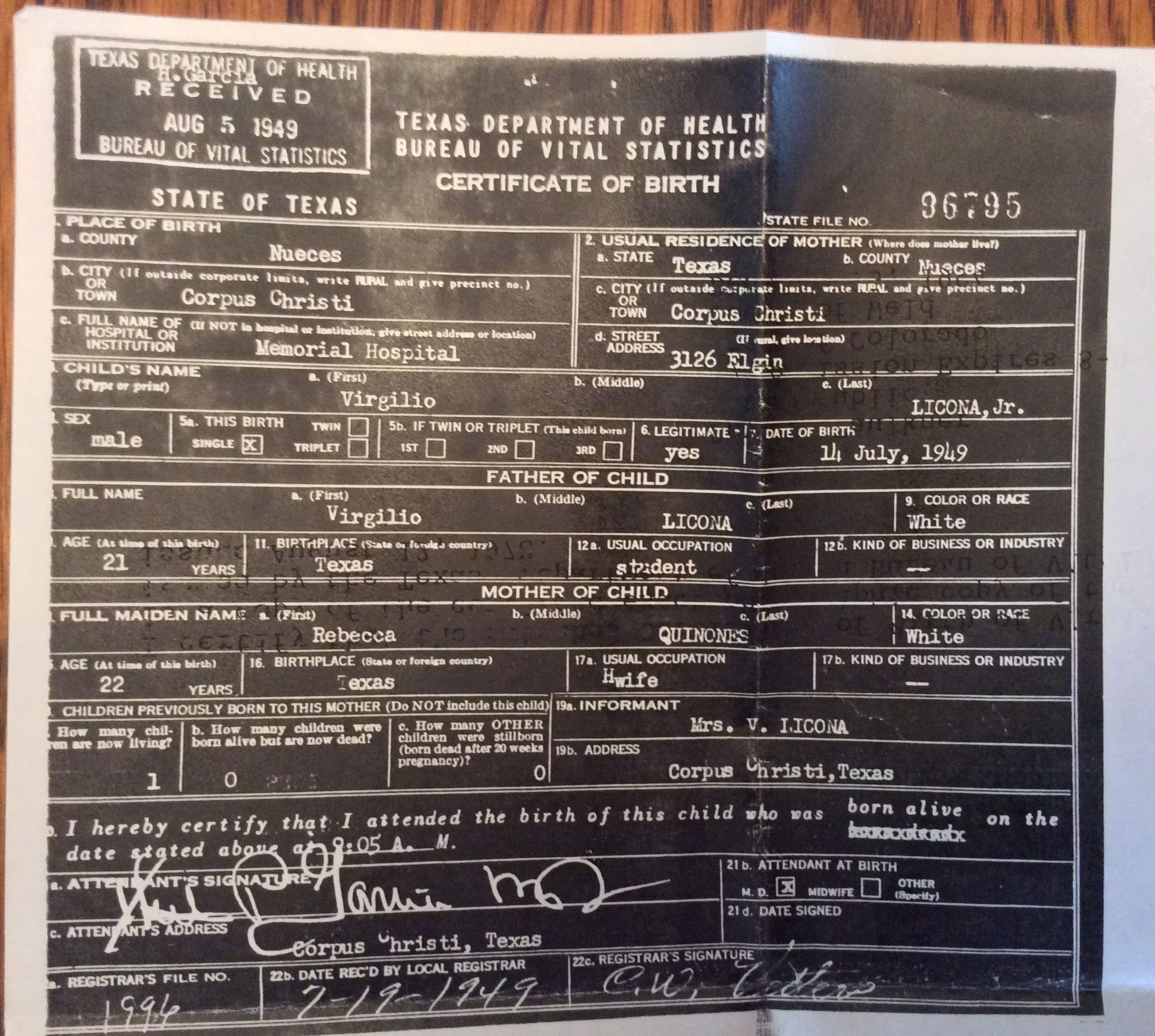
Virgilio Licona, Certificate of Birth (1949)
LHP_Intern2019-11-18T01:45:31+00:00Dr. Licona’s birth certificate. The certificate is signed by the doctor who delivered Virgilio, Dr. Hector P. Garcia, founder of the G.I. Forum and a family friend.
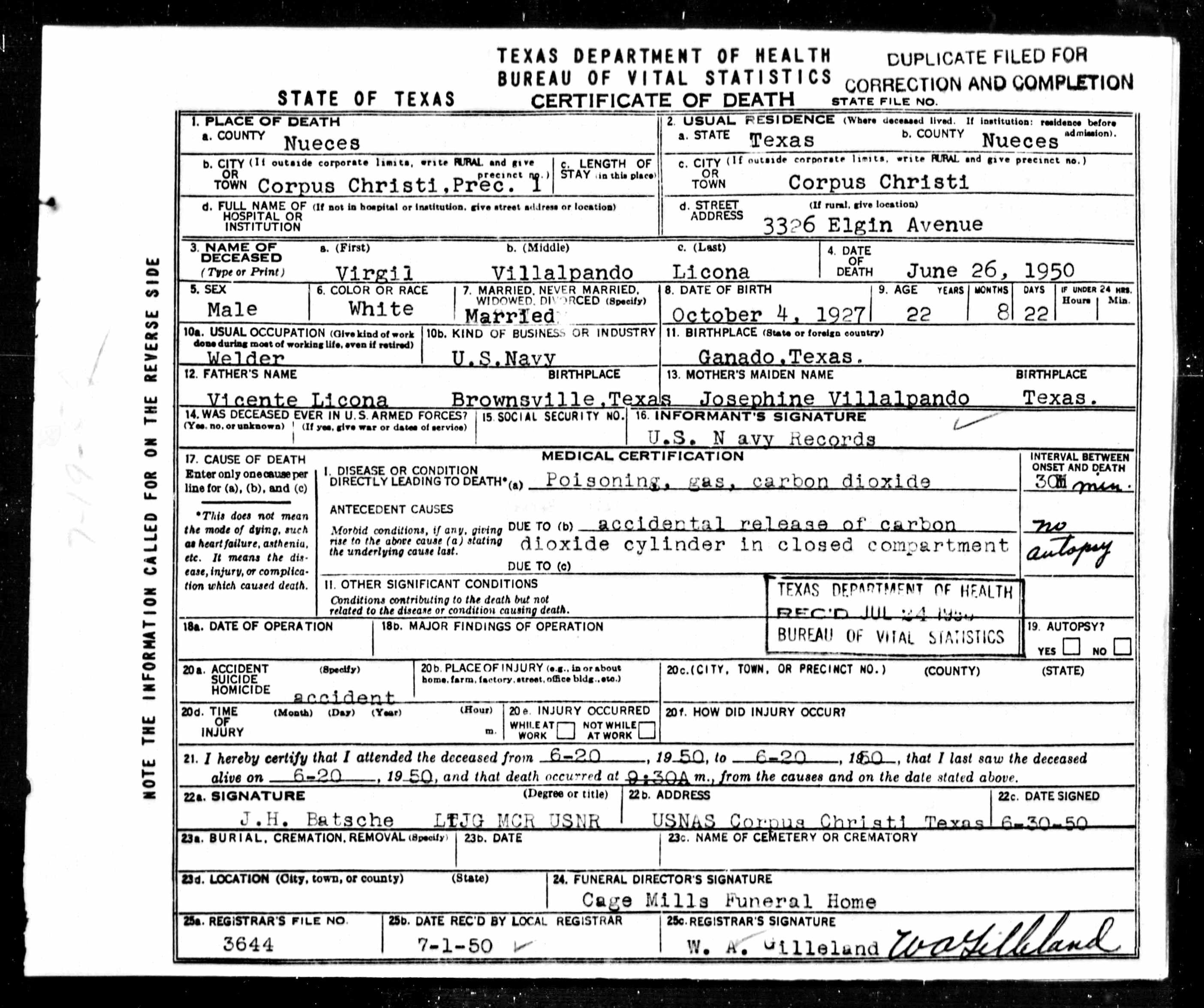
Virgilio Licona Sr. Death Certificate Corrected Duplicate (1950)
LHP_Intern2019-11-18T01:48:17+00:00The certificate is a corrected duplicate of the original death certificate of Virgilio Licona Sr.

Belle Davis 3rd Grade Class, Normandy Elementary School (1950s)
LHP_Intern2019-11-18T01:51:14+00:00Dr. Licona with his 3rd grade class at Normandy Elementary School in Jacksonville, Florida.
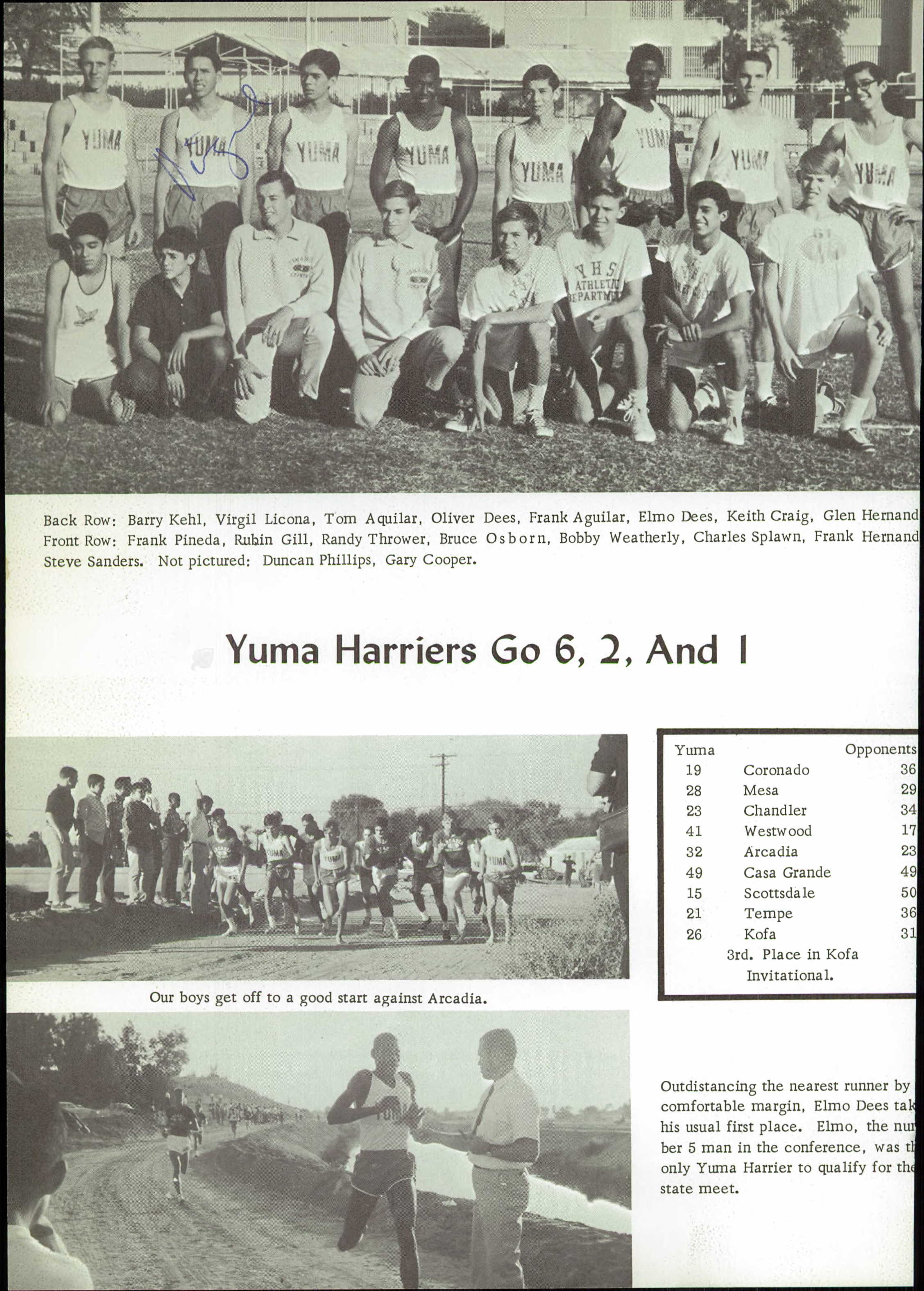
Yuma Union High School Yearbook, El Saguaro (1966-1967)
LHP_Intern2019-11-18T01:54:16+00:00Dr. Licona on the Yuma High School cross-country team in Yuma, Arizona.
Virgilio and Barbara Licona (1970s)
LHP_Intern2019-11-18T01:55:14+00:00Barbara and Virgilio Licona sometime in the 1970s.
Virgilio Licona with his nephew and grandfather, Fidel Quiñones (1970s)
LHP_Intern2019-11-18T01:56:30+00:00Dr. Licona with his nephew and grandfather, Fidel Quiñones.
Virgilio Licona and His Guitar (1973)
LHP_Intern2019-11-18T01:58:17+00:00Dr. Licona with his guitar in 1973.
Virgilio Licona and Baby Marco (1978)
LHP_Intern2019-11-18T02:00:38+00:00Dr. Licona with his infant son, Marco, in Pachuca, Hidalgo, Mexico.
Virgilio Licona and Butch Barnette (and Hank Williams)
LHP_Intern2019-11-18T02:01:51+00:00Dr. Licona with his brother, Butch Barnette, and a record by Hank Williams.

The Licona Family (1980s)
LHP_Intern2019-11-18T02:03:07+00:00Dr. Licona and his family during the 1980s.
Resident Training in Fargo with Kids (1984)
LHP_Intern2019-11-18T02:04:06+00:00Dr. Licona with his children in a pool during his medical residency in Fargo, North Dakota.
Licona Family Reunion (1988)
LHP_Intern2019-11-18T02:05:11+00:00Dr. Licona with his siblings and Aunt Rosie Hernandez.

Licona Family Reunion in North Carolina (1990s)
LHP_Intern2019-11-18T02:06:06+00:00Virgilio and Barbara Licona with their two children, Marco and Tara, at a family reunion in North Carolina.
Virgilio Licona Fishing for Oranges in San Diego with Grandkids (2010)
LHP_Intern2019-11-18T02:07:25+00:00Dr. Licona “fishing for oranges” in San Diego with his grandkids.
Virgilio Licona 2014 World Cup Lunch
LHP_Intern2019-11-18T02:09:34+00:00Dr. Licona eating lunch during the 2014 FIFA World Cup.
Video Clip from Interview with Samantha and Shantell Quintana, Latino Political Activity in Trinidad
LHP_Intern2019-06-25T18:14:31+00:00This 2018 interview, the Quintana sisters talk about the lack of political involvement from Latino people in Trinidad because of the Italian people who hold power over them in the city. Length: 2:19.
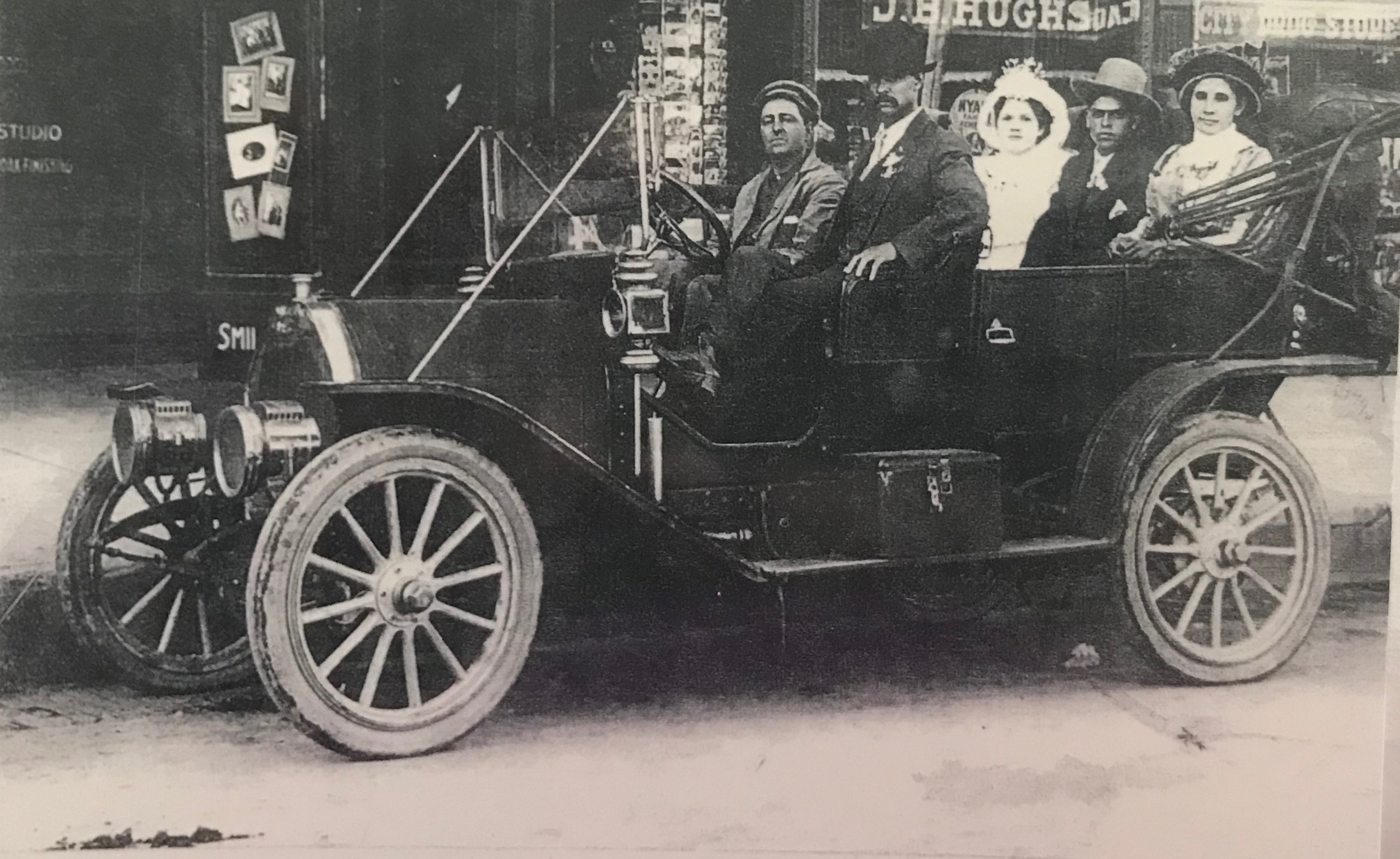
Juanita and Severiano in car on their wedding day
LHP_Intern2019-10-09T02:36:16+00:00| This shows the bride and groom in the back seat of a car in Trinidad. Beside them is Luisita Trujillo Bueno. The driver is Pablo Bueno, Luisita’s husband. |
Women’s March in support of striking miners, 1913
LHP_Intern2019-10-11T04:24:51+00:00Women’s March in support of striking miners, 1913
Video Clip from Interview with Mayor Garduno, Early Life in Trinidad
LHP_Intern2019-06-20T19:25:43+00:00In this 2018 interview, Mayor Garduno speaks about growing up in Trinidad with her family. Although she would like to remember more of the history of her parents, she recalls how all of her family came to live in Trinidad. Length: 2:37.
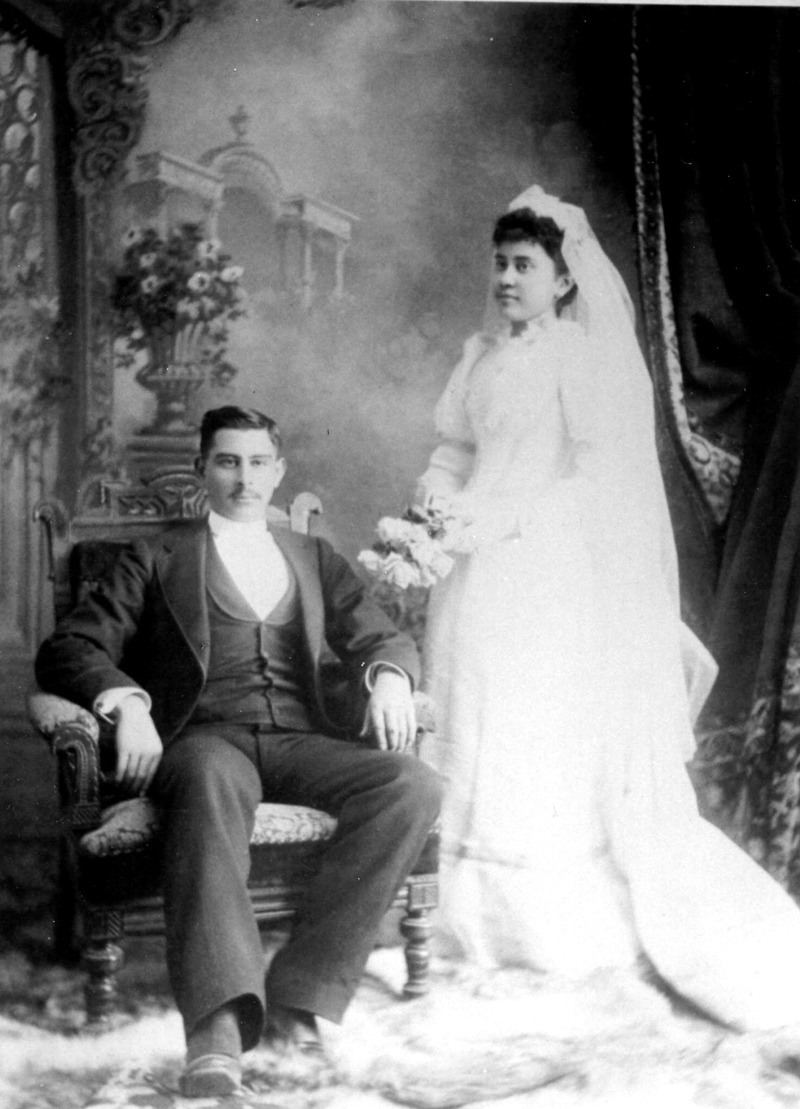
Portrait of Eusebio Chacón (son of Rafael Chacón) and Sophia Barela (dau. of Senator Barela), 1891
LHP_Intern2019-06-20T19:25:01+00:00They married in the Chapel of San Francisco in Barela, Colorado, and their wedding celebration was held at her father’s ranch, El Porvenir.
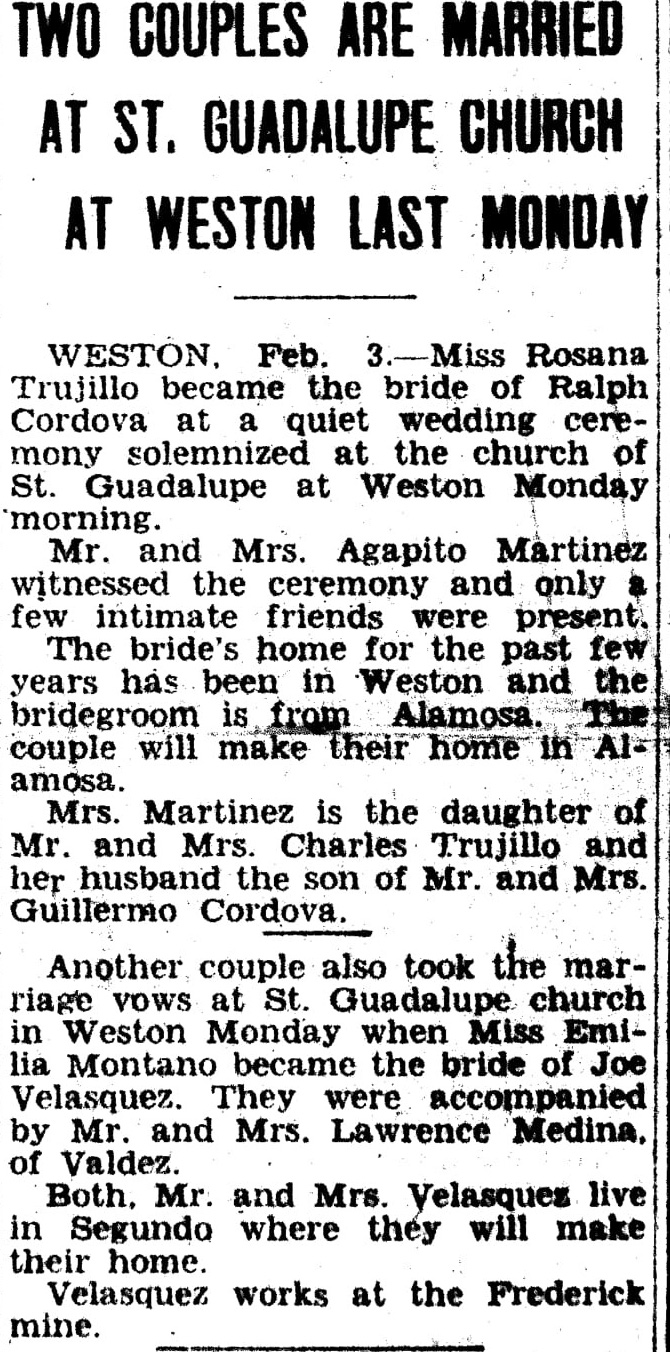
Wedding announcements for Latinos/as from Alamosa and Segundo, 1933
LHP_Intern2019-10-09T02:56:09+00:00The two Latino couples will live in Alamosa and Segundo
Video Clip from Interview with Samantha and Shantell Quintana, Religion
LHP_Intern2019-06-20T18:44:35+00:00This 2018 interview with Samantha and Shantell delves into how religious traditions have changed over time in Trinidad Latino families as well as their own personal involvement with the church. Length: 1:17.
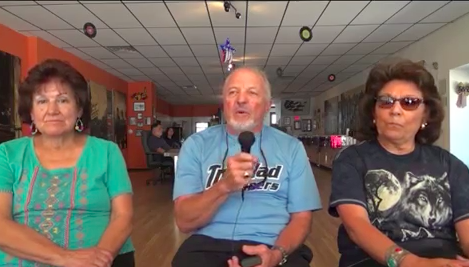
Video Clip from Interview with Yolanda Romero and Jack & Georganne Vallejos, Business Women in Trinidad
LHP_Intern2019-06-20T18:43:52+00:00Jack Vallejos talks about his early memories of the women who owned and operated business in the early days of Trinidad. 2018. Length: 1:21.
Video Clip from Interview with Shantell and Samantha, Women & Coal Mining in Trinidad
LHP_Intern2019-06-20T18:42:53+00:00The Quintana sisters talk about the coal mines and their memories of their mom working in the Trinidad coal mine in this 2018 interview. Length: 1:00.
Video Clip from Interview with Shantell and Samantha Quintana, Women as Leaders & Gender Discrimination
LHP_Intern2019-06-20T18:41:49+00:00Shantell and Samantha respond to the lack of Latina women as leaders in organizations in this 2018 interview. Length: 1:16.
Video Clip from Interview with Shantell and Samantha Quintana, Discrimination
LHP_Intern2019-06-20T18:40:56+00:00Shantell and Samantha speak to gender and racial discrimination in school and work contexts. 2018. Length: 3:50.
Video Clip from Interview with Shantell and Samantha Quintana, Women as Leaders in Church & Community
LHP_Intern2019-06-20T18:40:00+00:00The Quintana sisters talk about their own experience as leaders but those experiences of other Latina women in the Church and Community of Trinidad. 2018. Length: 1:04.
Video Clip from Interview with Shantell and Samantha Quintana, Electrical Work as a Woman
LHP_Intern2019-06-20T18:38:52+00:00Samantha Quintana speaks of the work she does as a woman electrical business owner in Trinidad. 2018. Length: 3:02.
Video Clip from Interview with Shantell and Samantha Quintana, Being a Woman in the Workplace
LHP_Intern2019-06-20T18:37:52+00:002018 interview where Shantell talks about being a resturant owner as a Latina woman and the obstacles she has faced in the workplace. Length: 2:48.
Video Clip from Interview with Mayor Garduno, Achievements in Work
LHP_Intern2019-06-20T18:35:04+00:00In this 2018 interview, Mayor Garduno talks about all of her career achievements as a Latina Mayor. Length: 1:33.
Video Clip from Interview with Mayor Garduno, Gender & Work
LHP_Intern2019-06-20T18:34:11+00:00Mayor Garduno talks about her experience with racial discrimination as a Mayor and before her career in this 2018 interview. Length: 2:13.
Video Clip from Interview with Mayor Garduno, Racial Discrimination
LHP_Intern2019-06-20T18:29:03+00:00Mayor Garduno speaks to the struggles she had in her early career as a nurse because of her race. 2018. Length: 4:52.
Video Clip from Interview with Yolanda Romero and Jack & Georganne Vallejos, Latinos in College
LHP_Intern2020-01-18T05:08:30+00:00Yolanda Romero attests to the lack of Latino students in Trinidad State College. She notes that economic privileged students were more likely to attend while Georganne agrees and adds that access to scholarships were a determining factor to go in. Length: 4:06.
Video Clip from Interview with Yolanda Romero and Jack & Georganne Vallejos, Trinidad State Junior College and Education
LHP_Intern2020-01-18T05:08:46+00:00In this 2018 interview, Yolanda Romero delves into her own experiences in Trinidad State Junior College and how Latinos were underrepresented. Jack Vallejos also speaks to the convenience of having the college so close to him as well as the added advantage that the GI Bill gave him in 1968. Length: 4:35.
Video Clip from Interview with Shantell and Samantha Quintana, Educational Discrimination
LHP_Intern2020-01-18T05:09:02+00:00This 2018 interview with Shantell and Samantha goes into how schools in Trinidad discriminate Latino students. Specifically, they both give their testimony to how their own daughter and niece has been disproportionately denied help from schools in relation to her white peers. Length: 2:31.
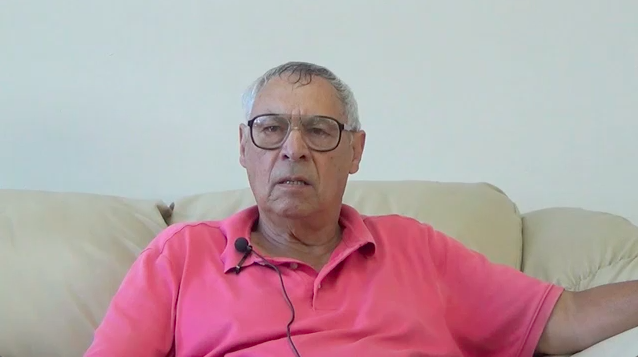
Video Clip from Interview with Judge Manzanares, Spanish only in Trinidad Schools
LHP_Intern2020-01-18T05:09:14+00:00Judge Manzanares recalls how when he grew up there was an imbalance of language. In his home, Spanish and English were spoken as compared to English only in his schools. 2018. Length: 00:48.
Video Clip from Interview with Judge Manzanares, Latino Representation in Law School
LHP_Intern2020-01-18T05:09:28+00:00In this 2018 interview, Judge Manzanares responds to the amount of Latino students during his time in law school. He was chosen as one of the few Latino students from the Ford Foundation to attend law school. He later went on to become dean of this very program where he noticed the size of Latino students decreased. Length: 3:11.
Video Clip from Interview with Judge Manzanares, Education in Trinidad State College
LHP_Intern2020-01-18T05:09:40+00:00Judge Manzanares shares his educational experiences in Trinidad State College all the way to his other educational experiences to get into law school. 2018. Length: 1:38.
Video Clip from Interview with Mayor Garduno, Discrimination in Schools
LHP_Intern2020-01-18T05:09:52+00:00Mayor Garduno talks about the struggles she experienced growing up and being discouraged from going to school and how that parallels to the way Latino youth today are discouraged from higher education. 2018. Length: 1:45.
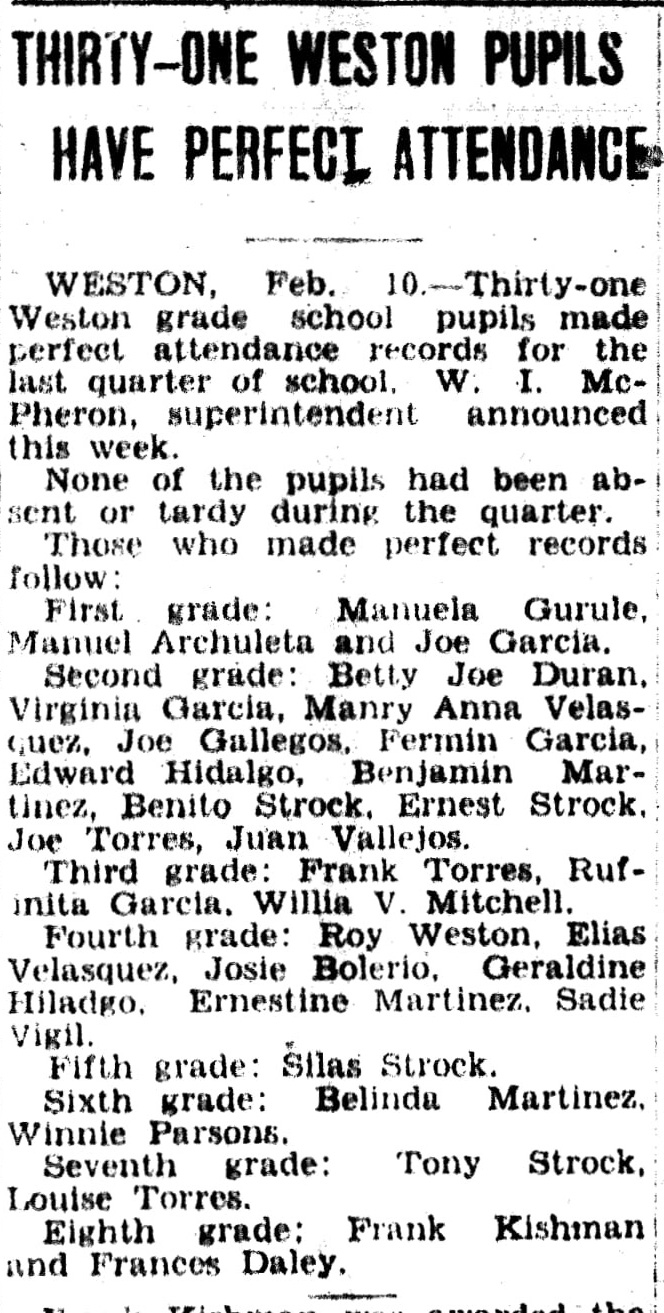
Weston grade school students with perfect attendence, 1933
LHP_Intern2019-12-13T20:10:29+00:00List of Weston elementary school students with perfect attendence records contains mostly Latino names.
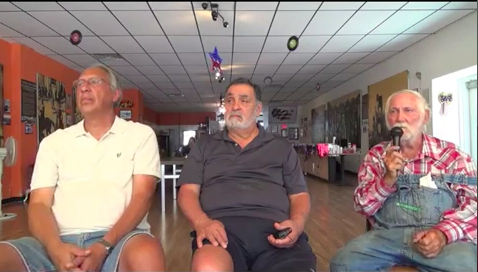
Video Clip from Interview with Jerald Renner, Mike Romero, and Thomas Hay, Mining Community Impact
LHP_Intern2020-01-18T05:02:17+00:00Thomas Hay discusses the community impact the mines in Trinidad had. Length: 3:44.
Video Clip from Interview with Yolanda Romero and Jack & Georganne Vallejos, Coal Miners Museum
LHP_Intern2020-01-18T05:02:04+00:00Yolanda Romero talks about how the Coal Miners Museum in Trinidad came to be by community support. 2018. Length: 4:40.
Video Clip from Interview with Shantell and Samantha, Women & Coal Mining in Trinidad
LHP_Intern2020-01-18T05:01:52+00:00The Quintana sisters talk about the coal mines and their memories of their mom working in the Trinidad coal mine in this 2018 interview. Length: 1:00.
Video Clip from Interview with Jerald Renner, Mike Romero, and Thomas Hay, Mining Jobs
LHP_Intern2020-01-18T05:00:53+00:002018 interview with Jerald Renner where he provides information about the daily work life in the mining sites in Trinidad. Length: 2:55.
Video Clip from Interview with Jerald Renner, Mike Romero, and Thomas Hay, Unions
LHP_Intern2020-01-18T05:00:40+00:00Interview in 2018 with Thomas Hay where he expands on the importance of the mining union in relation to health. Length: 0:59.
Video Clip from Interview with Jerald Renner, Mike Romero, and Thomas Hay, Mining & Unions
LHP_Intern2020-01-18T05:00:27+00:00Renner, Romero, and Hay speak in this 2018 interview about how United Mine Workers of America worked and how they protected them as workers. Length: 5:20.
Video Clip from Interview with Jerald Renner, Mike Romero, and Thomas Hay, Mining
LHP_Intern2020-01-18T05:00:30+00:00Renner, Romero, and Hay talk about working in the Trinidad Coal Mines, the kind of jobs one did, and all the responsibilities they had. 2018. Length: 1:52.
Video Clip from Interview with Mayor Garduno, Mining
LHP_Intern2020-01-18T04:59:48+00:00Mayor Garduno talks about how mining was in Trinidad and how it began to decline in this 2018 interview. Length: 00:39.
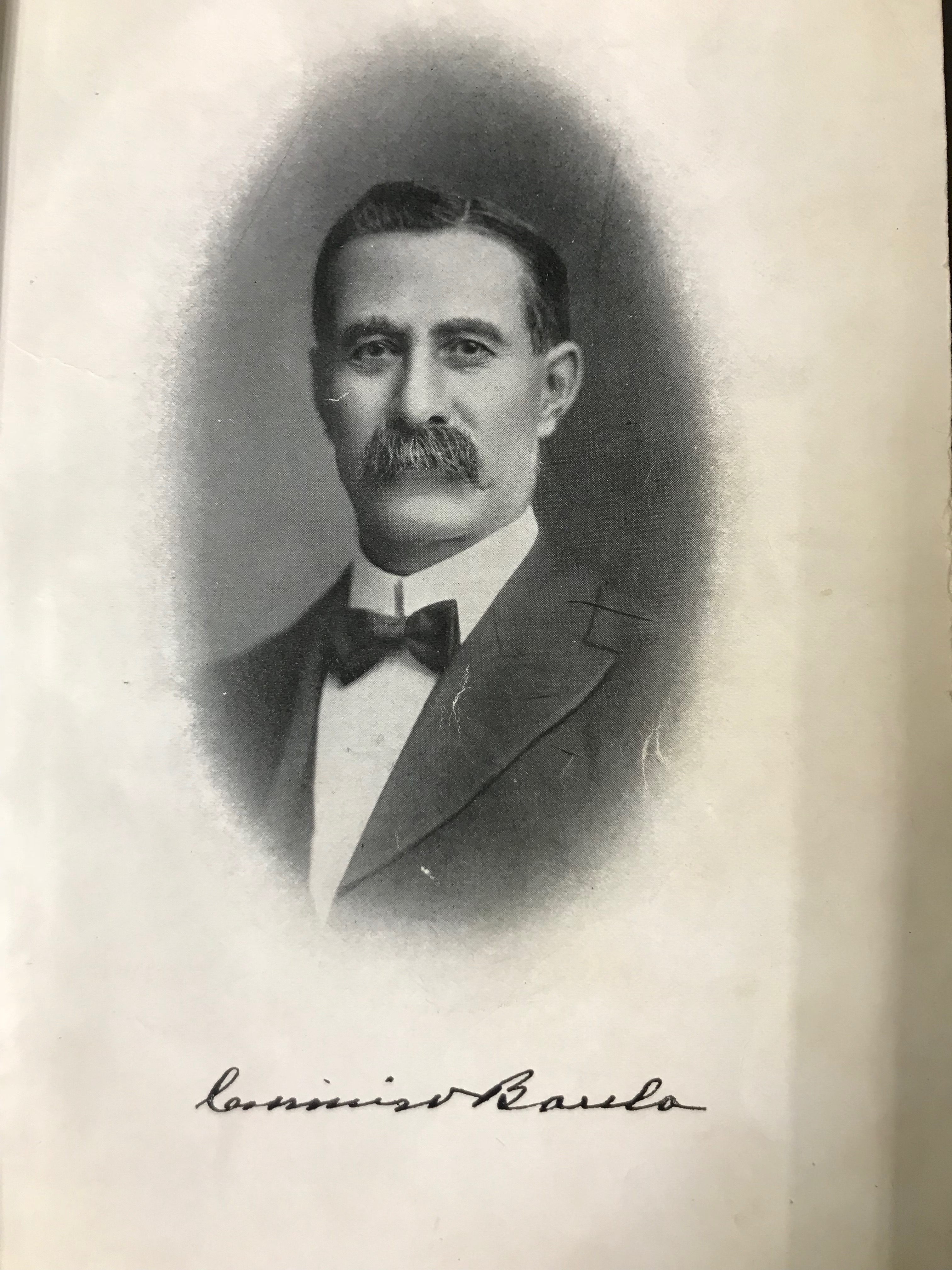
Casimiro Barela and signature, undated
LHP_Intern2019-10-11T04:16:10+00:00Casimiro Barela and signature, undated
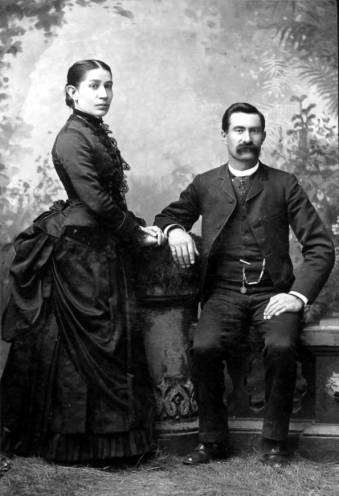
Casimiro Barela and his wife, around 1885
LHP_Intern2019-06-17T19:57:35+00:00Damiana Rivera de Barela and State Representative Casimiro Barela
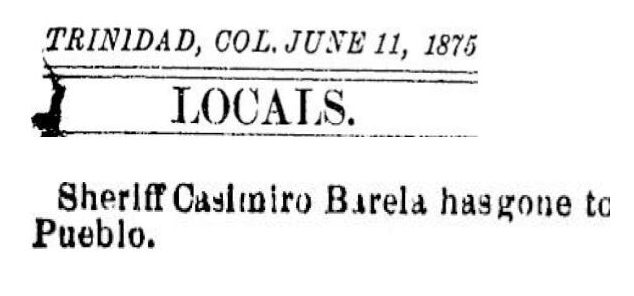
Casimiro Barela as Sheriff of Los Animas County, 1875
LHP_Intern2019-10-09T02:24:28+00:00He later became the longest-serving member of the Colorado legislature (1875-1916)

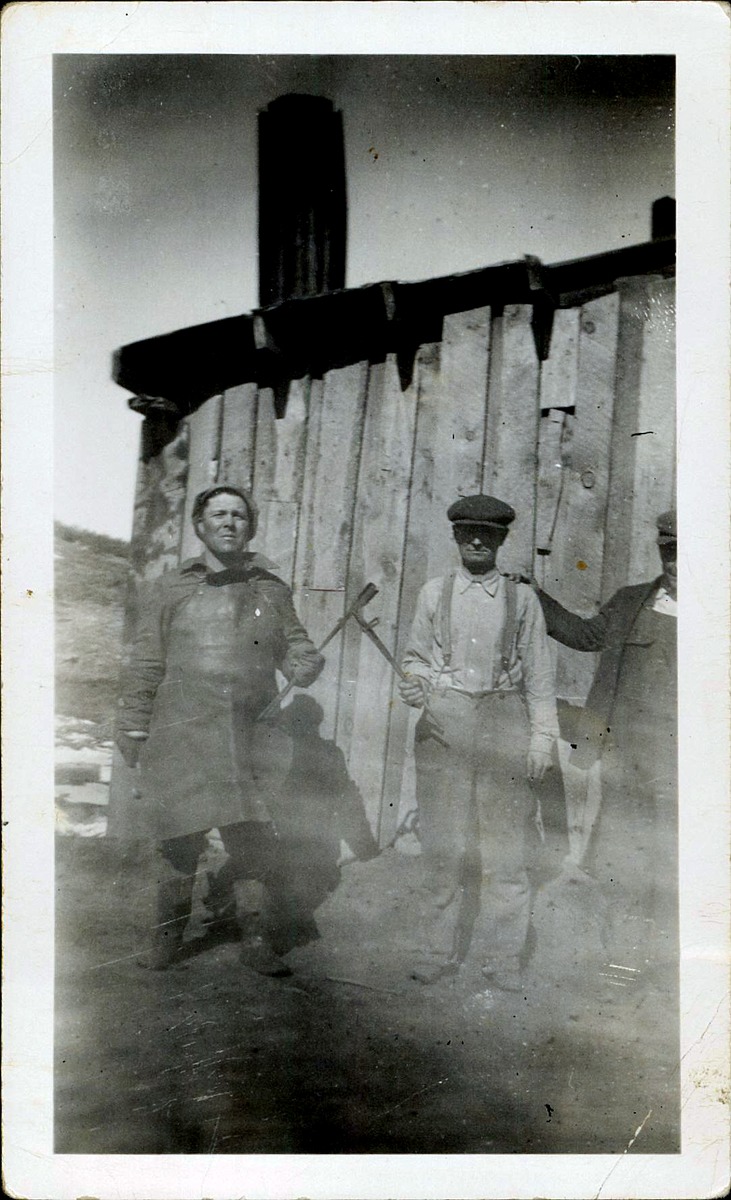
Blacksmith Hilario Herminio Paiz of Gurule, 1915
LHP_Intern2019-06-17T19:44:50+00:00Blacksmith Hilario Herminio Paiz (on left) poses outside of a wood building on his ranch in Gulnare, Las Animas County. He was born in 1898 in Gulnare and died in 1983 in Trinidad, Colorado. Herman worked on a ranch in Gulnare homesteaded by his grandfather José de la Cruz Paiz. Herman never married, and stayed at the ranch to take care of his mother, Anastacia Gonzales Paiz.

“Marching through Denver,” a song of the Colorado miners, 1914
LHP_Intern2019-10-09T03:16:46+00:00To be sung to the tune of “Marching through Georgia,” Trinidad Library History Room
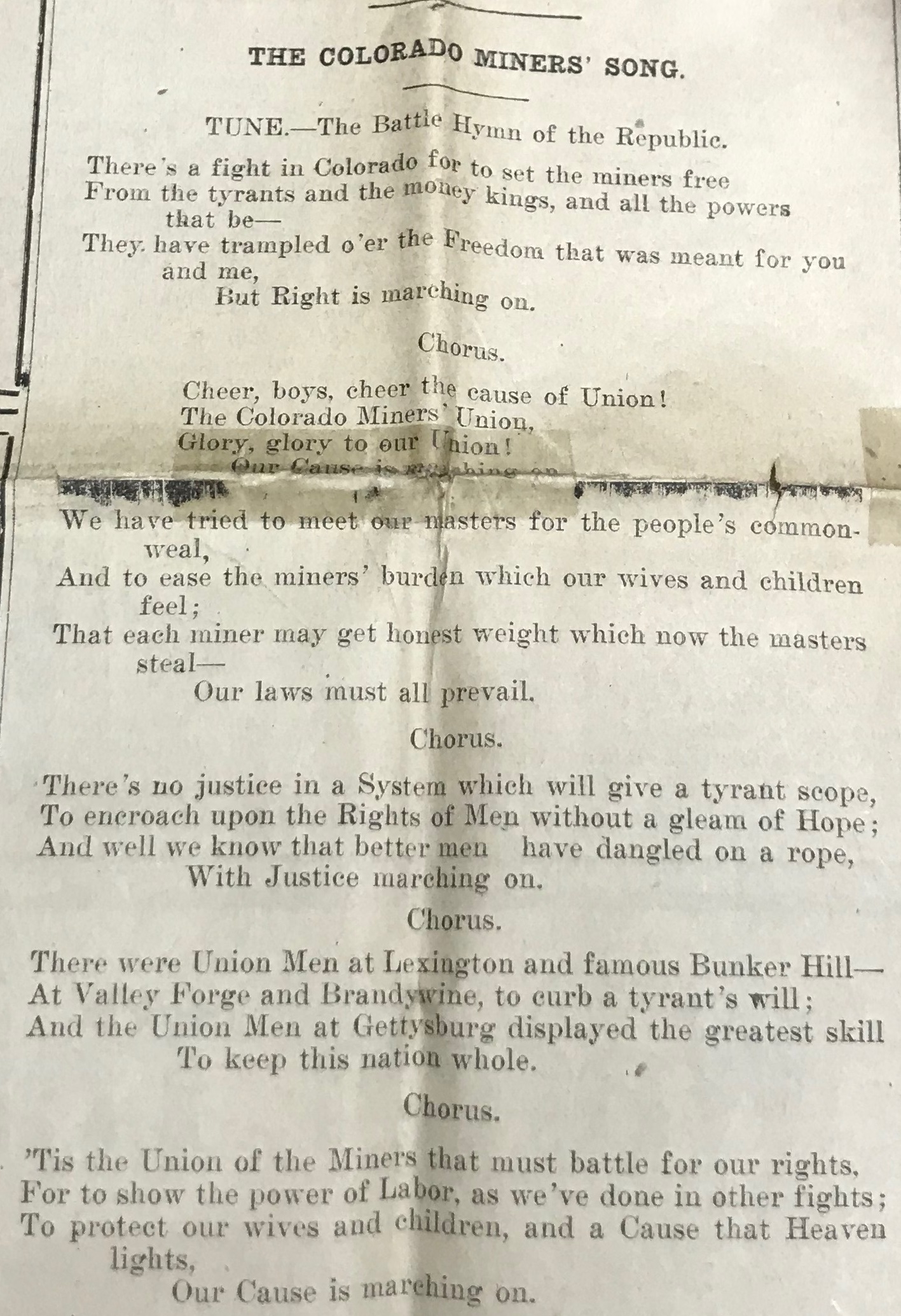
“Colorado Miners’ Song,” 1914
LHP_Intern2019-10-09T03:17:02+00:00To be sung to the tune of “The Battle Hymn of the Republic,” Trinidad Library History Room
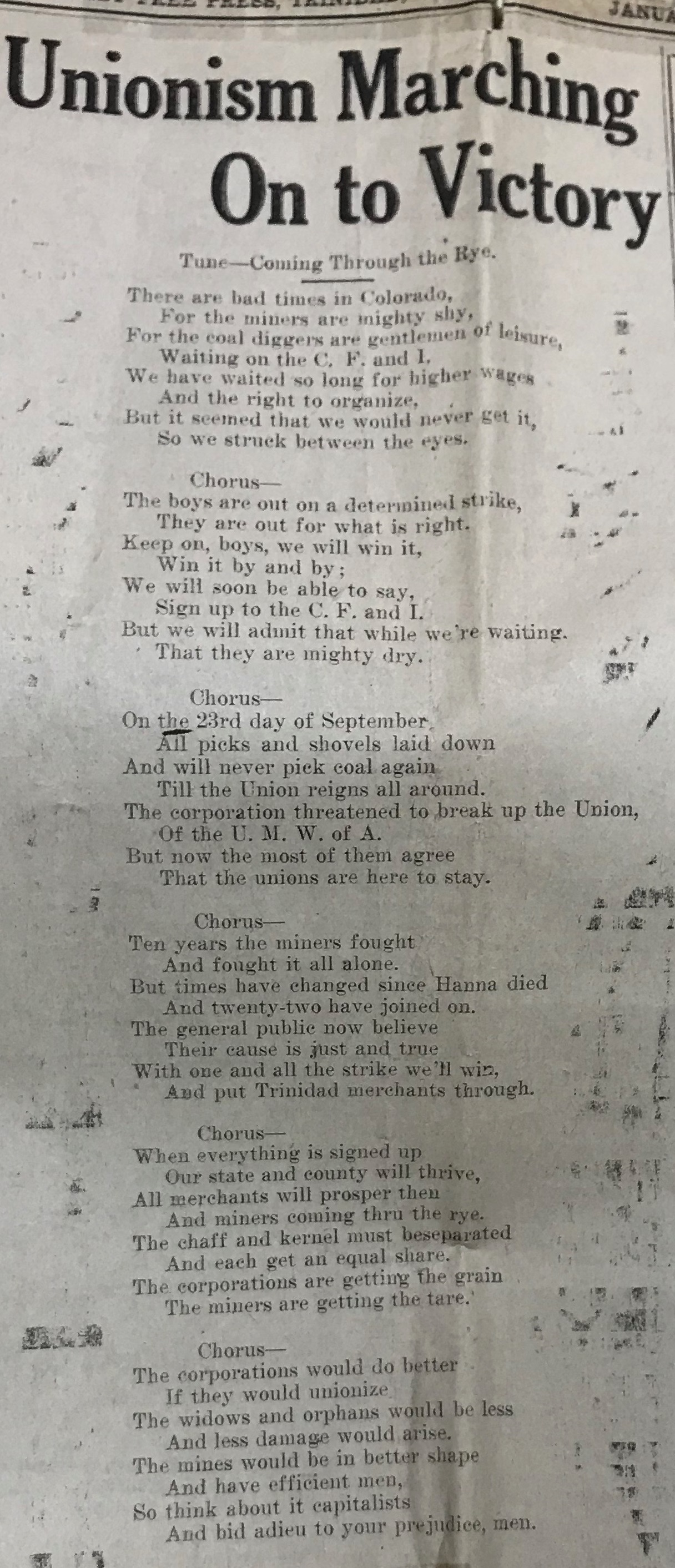
Union song “Unionism Marching On To Victory,” 1914
LHP_Intern2019-10-09T03:16:01+00:00To be sung to the tune of “Coming through the Rye,” Trinidad Library History Room
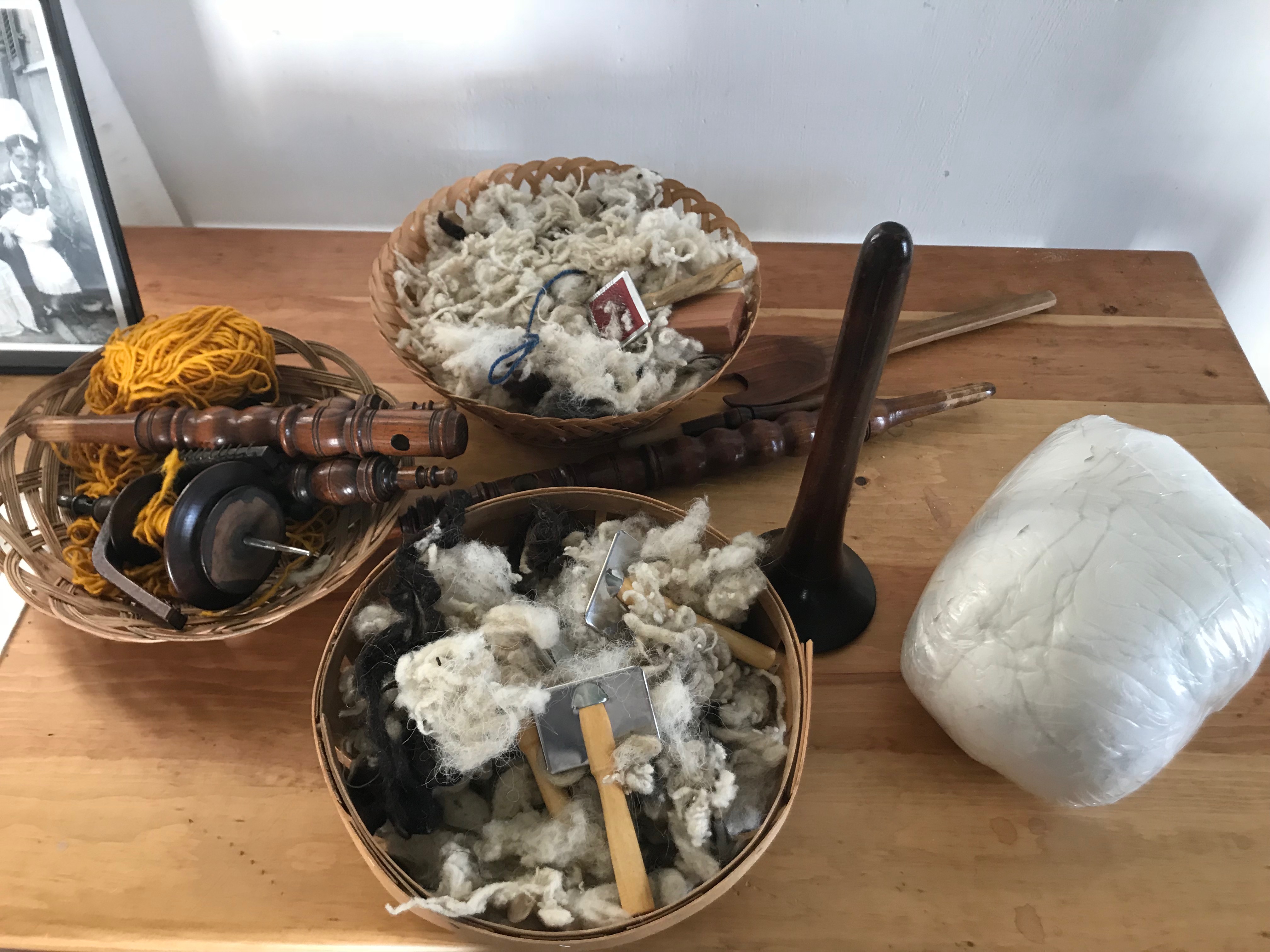
Tools for carding and spinning wool
LHP_Intern2019-10-11T04:15:20+00:00Tools for carding and spinning wool
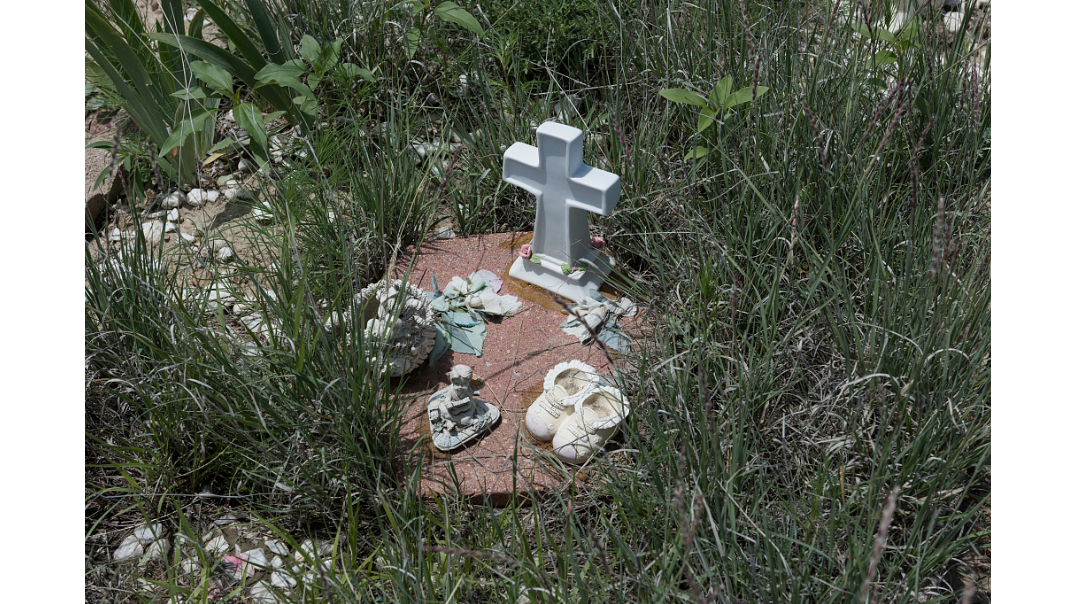
Grave site at Chico Cemetery, 2010s
LHP_Intern2019-12-27T15:54:42+00:00Gravesite at Chico Cemetery, a windswept country graveyard near Avondale in Pueblo County; photo taken by Carol Highsmith

Farm workers and supporters on march from Pueblo to Denver with image of the Virgin Mary, 1970
LHP_Intern2019-12-27T15:54:57+00:00Photo of people marching to Denver holding a poster of Mother Mary

Penitentes and Holy week customs
LHP_Intern2019-12-27T15:55:13+00:00Charley Autobees talks in 1981 about the Penitentes and celebrations around Holy week that would involve food and community gatherings. Autobees mentioned earlier in the interview that as a child he would sneak to watch the events and would witness the penitentes which involved people hitting each other as a part of representation of religious sacrifice.

Rita J. Martinez and her parents’ involvement in church related activities, Chicano Movement
LHP_Intern2019-12-27T15:55:33+00:00Rita J. Martinez talks in 2000 about her experience growing up in Pueblo, Colorado. Here she is discussing her parents and their involvement in the steelworkers union as well as church. She largely talks about her mom’s involvement with church activities among other leadership which encouraged her to become involved in leadership activities.


Cross
LHP_Intern2019-12-27T15:56:49+00:00Wooden cross made from tree branches; barbed wire ‘crown of thorns’ through cross section; face, torso, and arm of Jesus carved at the base; dark red paint to simulate blood on Jesus’ hand where barbed wire is inserted into wood.

Immaculate Conception Figurine
LHP_Intern2019-12-27T15:57:04+00:00Figurine representing the Immaculate Conception. Figure is dressed in black and white, wearing a crown.

Immaculate Conception Figurine
LHP_Intern2019-12-27T15:57:23+00:00Figurine representing the Immaculate Conception. Figure is dressed in red and gold, wearing a crown.


Blessed Graves
LHP_Intern2019-12-27T15:58:06+00:00Mount of the Holy cross constructed on top of graves of two people who died of the Flu in 1918. Espinosa Graves Cemetery, La Garita, CO.

Father Murray, priest important to Salt Creek, 1989
LHP_Intern2019-12-27T15:58:38+00:00“Father Murray stopped Salt Creek land grab.” A Jesuit priest in Mt. Carmel Parish from 1942 onwards, he set up a credit union that enabled Pueblo families, many in Salt Creek, to buy their homes back from land owned by CF&I on which they had squatted for decades. 700 families bought their own homes this way.
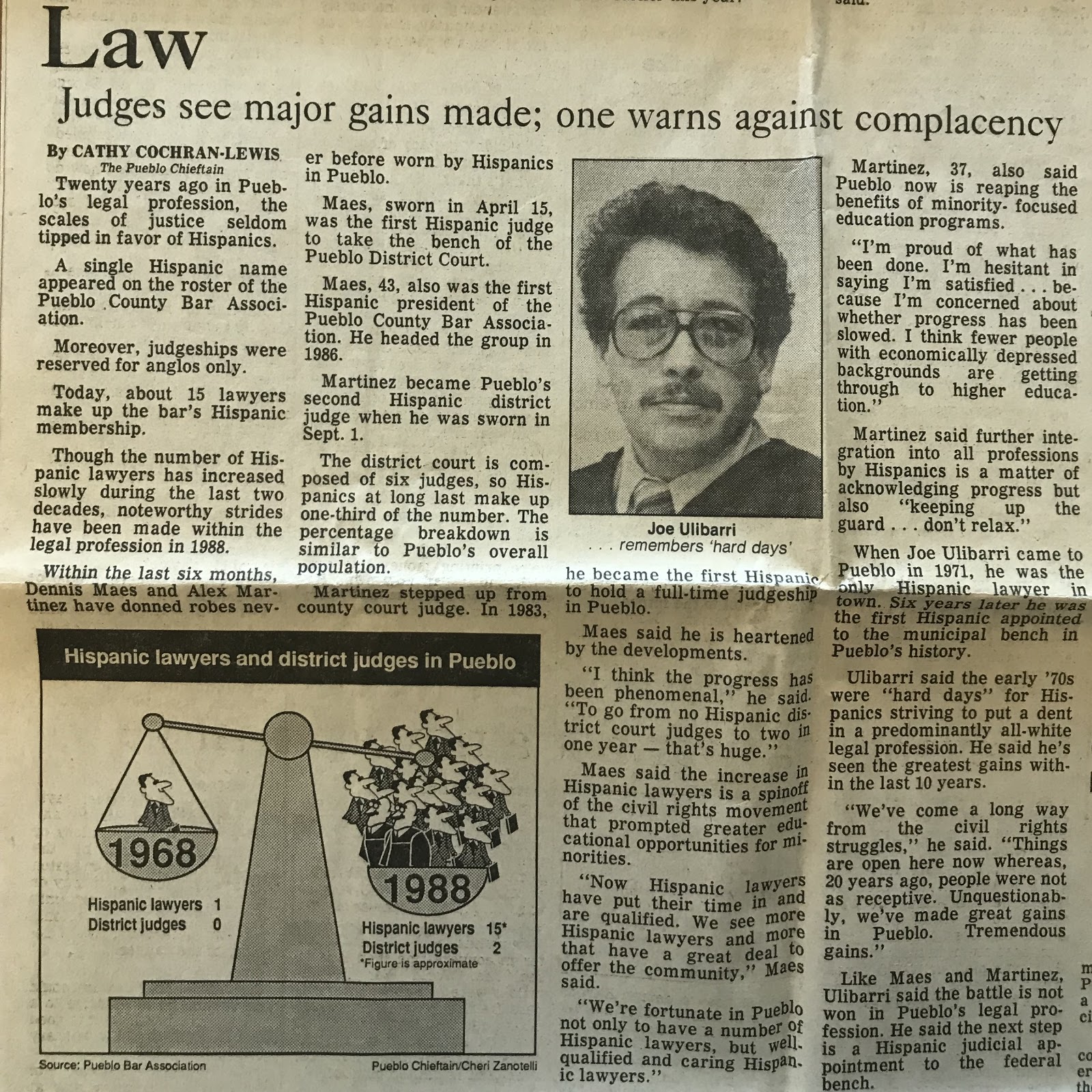
Hispanic Pioneers in Law: Dennis Maes and Alex Martinez
LHP_Intern2019-09-08T22:13:21+00:00Article from September 15, 1988 highlighting the accomplishments of Dennis Maes and Alex Martinez: Martinez, first Hispanic judge to take the bench of the Pueblo District Court; and Martinez second Hispanic district judge.
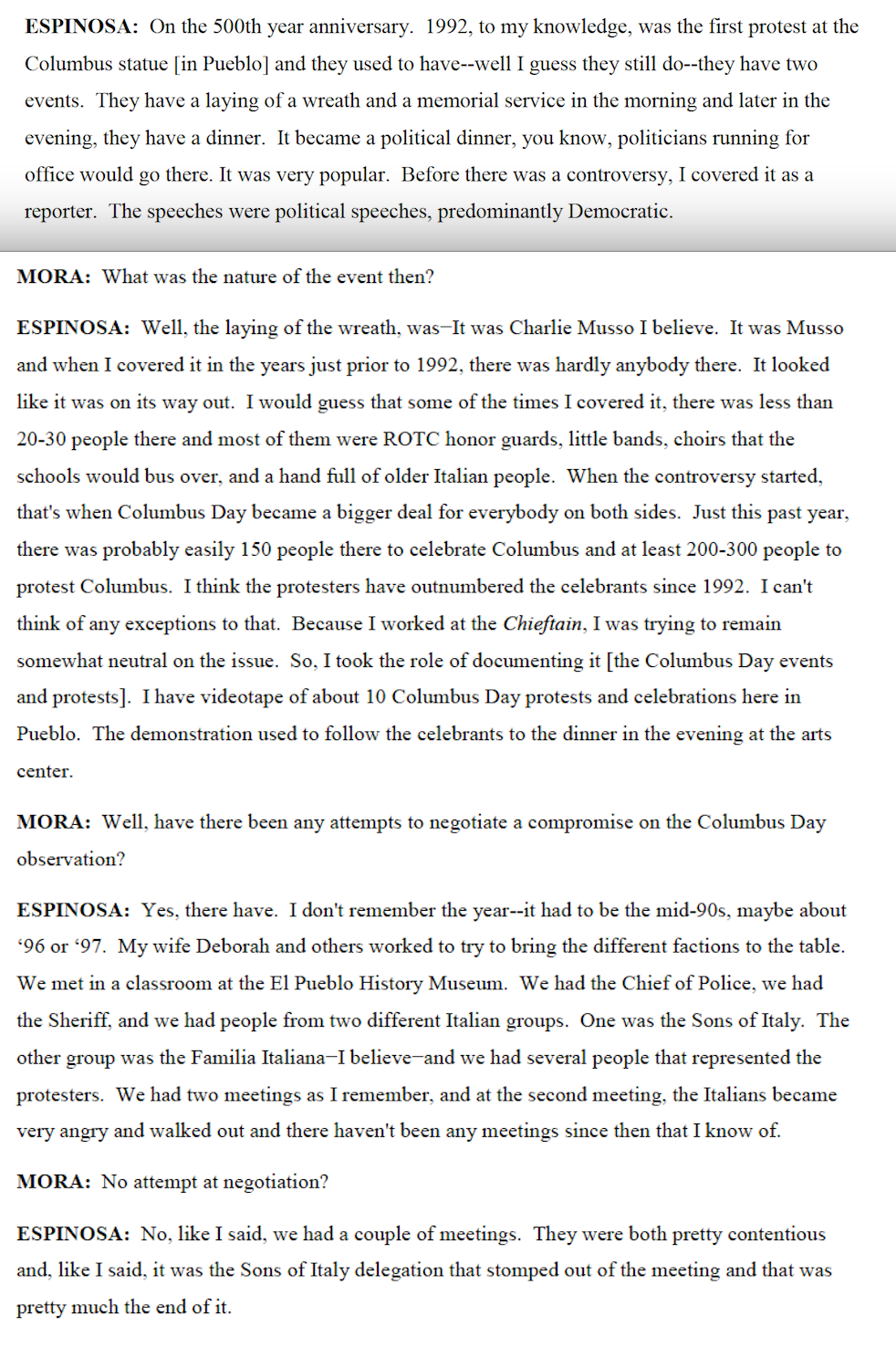
Juan Espinosa recalls 1992 Columbus Day Protest
LHP_Intern2019-09-08T22:34:20+00:00Juan Espinosa talks in 2014 about the first Columbus Day Protest he recalls and the attempted community compromises.
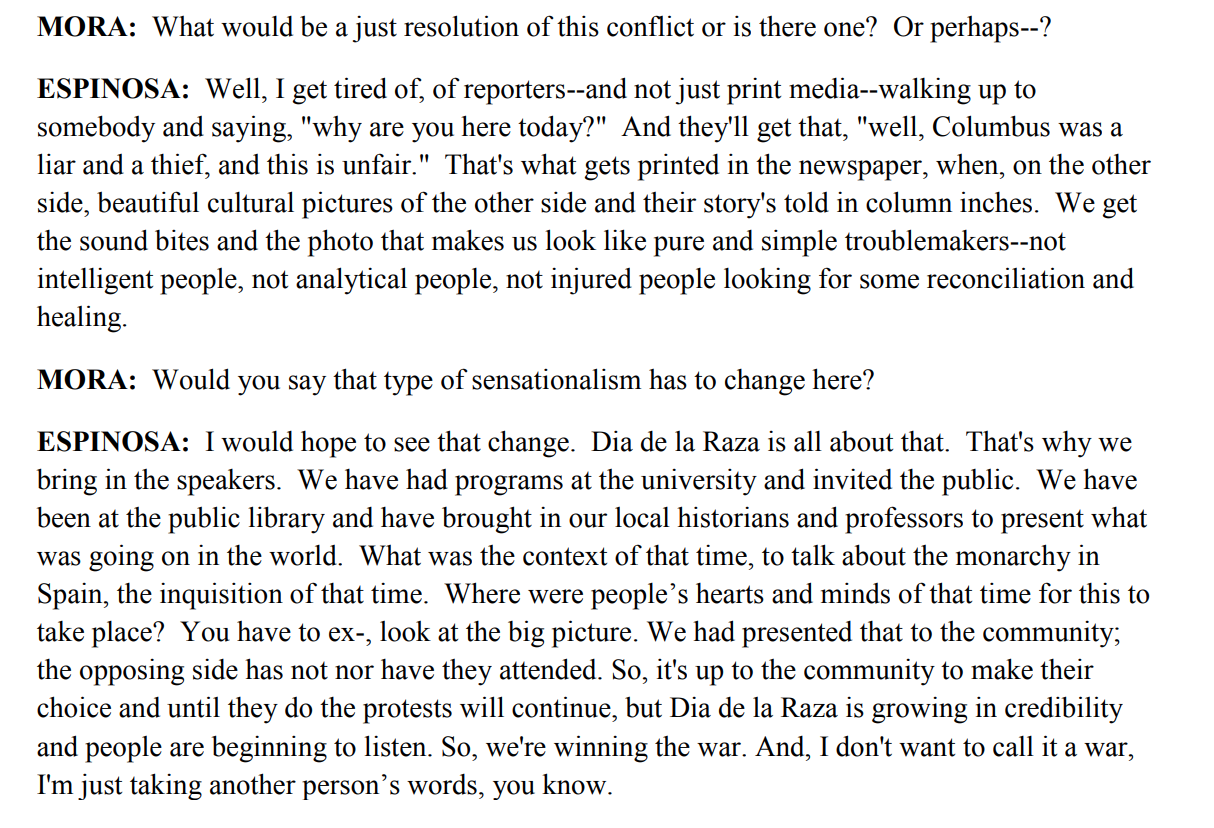
Deborah Espinosa and Columbus Day Protest
LHP_Intern2019-09-11T03:06:41+00:00An excerpt from an interview with Deborah Espinosa in 2014 in which she talked about some of the issues surrounding Columbus Day in Pueblo, some of the resistance and push back against the holiday, and some tensions with Italian Americans in Pueblo. Here she talks about Dia de la Raza and some of the hope around replacing Columbus Day with this.

Eloy and Ray Calderon Quote
LHP_Intern2020-01-18T04:32:39+00:00“My dad had a tavern . . . on the corner of San Pedro and Roselawn . . . that used to be my Dad’s dance hall and bar. It used to be called the Oasis Café. When I started school, I was living there in 1935. They used to pick me up right there in front of the railroad. There was a railroad that went from Blende through Salt Creek and behind CF&I. Used to go to the zinc smelter over in Blende.”

Photograph of Eloy and Ray Calderon
LHP_Intern2020-01-18T04:32:28+00:00Eloy and Ray Calderon
on San Juan in front of their old family home, where their mother once used the front porch as a neighborhood liquor store
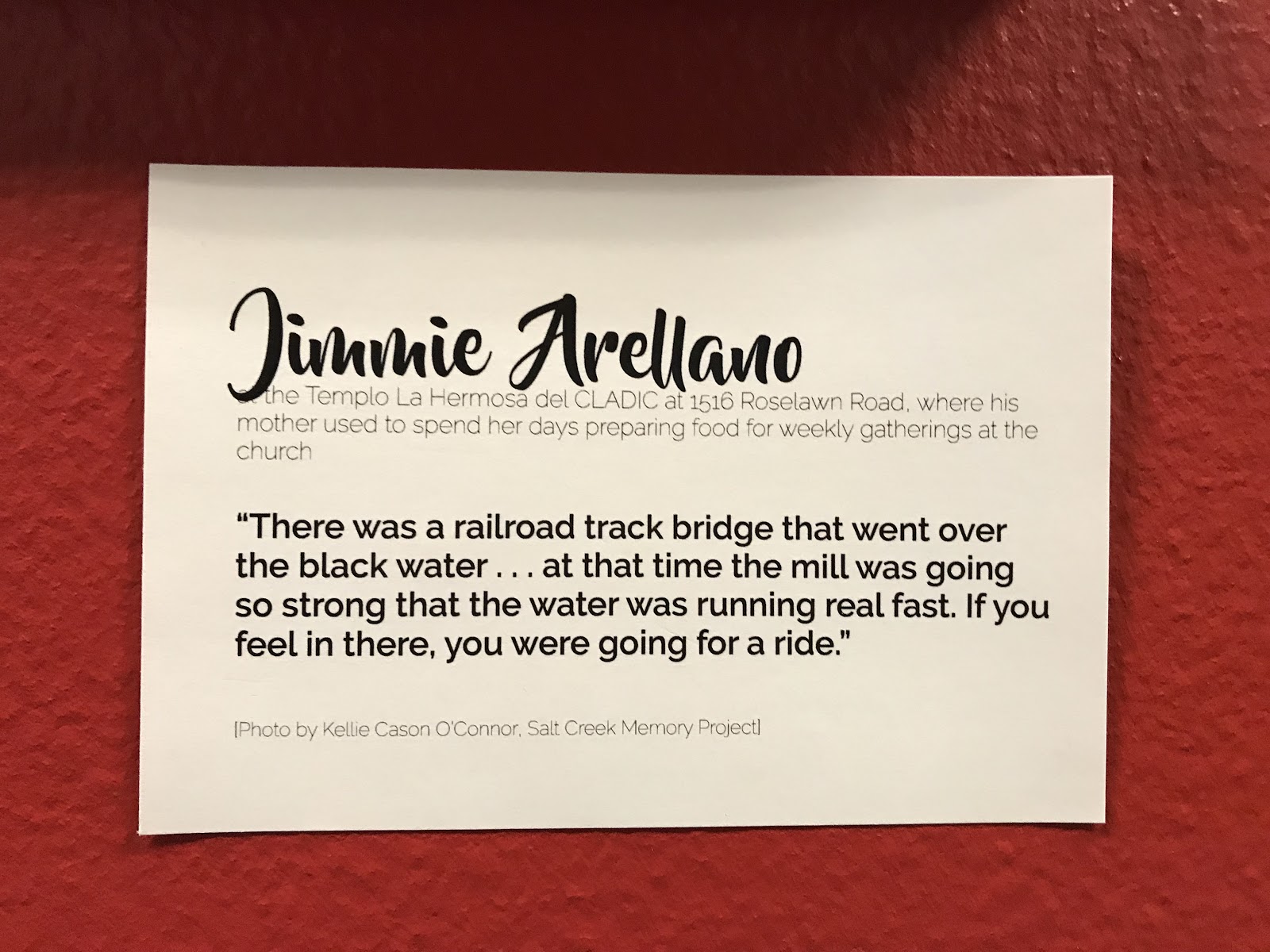
Jimmie Arellano Quote
LHP_Intern2020-01-18T04:32:14+00:00“There was a railroad track bridge that went over the black water… at that time the mill was going so strong that the water was running real fast. If you fell in there, you were going for a ride.”

Photograph of Jimmie Arellano
LHP_Intern2020-01-18T04:31:56+00:00Jimmie Arellano at the Templo La Hermosa del CLADIC at 1516 Roselawn Road, where his mother used to spend her days preparing food for weekly gatherings at the church.

Arthur Luna quote
LHP_Intern2020-01-18T04:34:13+00:00Art Luna talks about his experience playing football in high school.

Columbus Day Protests
LHP_Intern2019-09-08T22:44:01+00:00Columbus Day 1998 protests in Pueblo. Leaders at two protests that took place in Pueblo condemn Columbus as a murderer and encourage people to not celebrate the Holiday as Italians and Politicians honor the man. Protest organizer Rita Martinez says it is their responsibility to abolish the holiday considering it started in Pueblo.

Photograph of Arthur Luna
LHP_Intern2020-01-18T04:34:01+00:00Art Luna at Olguins, which at one time was a grocery and bar/dance hall

Lad and Gerald Flores Quote
LHP_Intern2020-01-18T04:33:48+00:00“There was always a radio in the house. When we worked in the farm fields, we had a little radio with us. Grandma had a little radio and it was always in Spanish.”

Letter from an “Unhappy White”
LHP_Intern2019-09-08T22:44:58+00:00Discriminatory letter addressed to a Mr. and Mrs. Garcia, dated April 14, 1972.

Photograph of Lad and Gerald Flores
LHP_Intern2020-01-18T04:33:36+00:00Lad and Gerald Flores at Flores Grocery store, which is currently owned by Lad who lives next door in the same home where his parents once lived.

Eloy Arellano Quote
LHP_Intern2020-01-18T04:35:54+00:00“We were too old for Boy Scouts so, at that time, we gave it up. At that time was the lettuce strike, you know, the grape strikes started. So it got real active here in Pueblo, so we joined that… And, we, marched to Denver… we used to picket farms.”
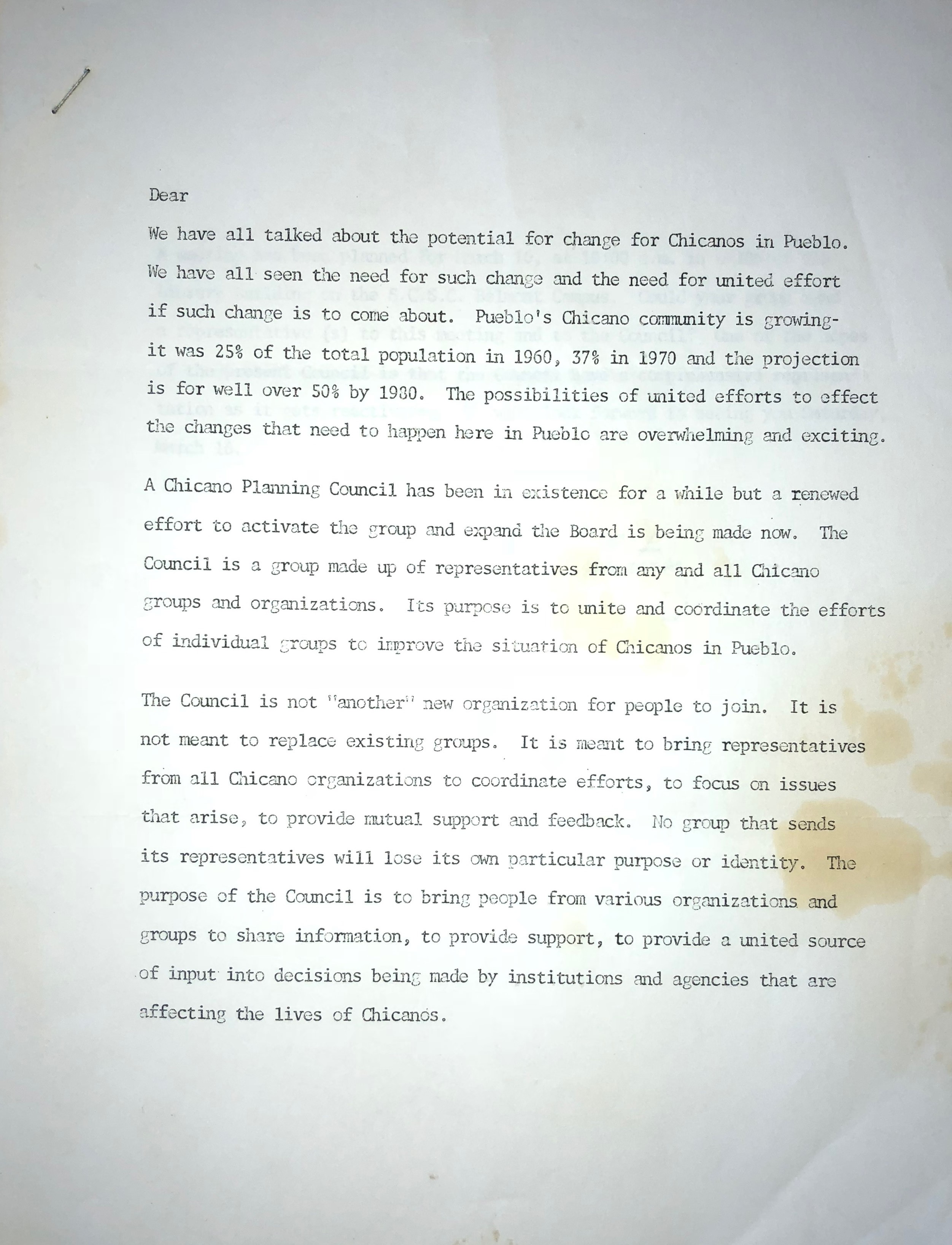
Chicano Planning Council
LHP_Intern2019-09-08T22:57:31+00:00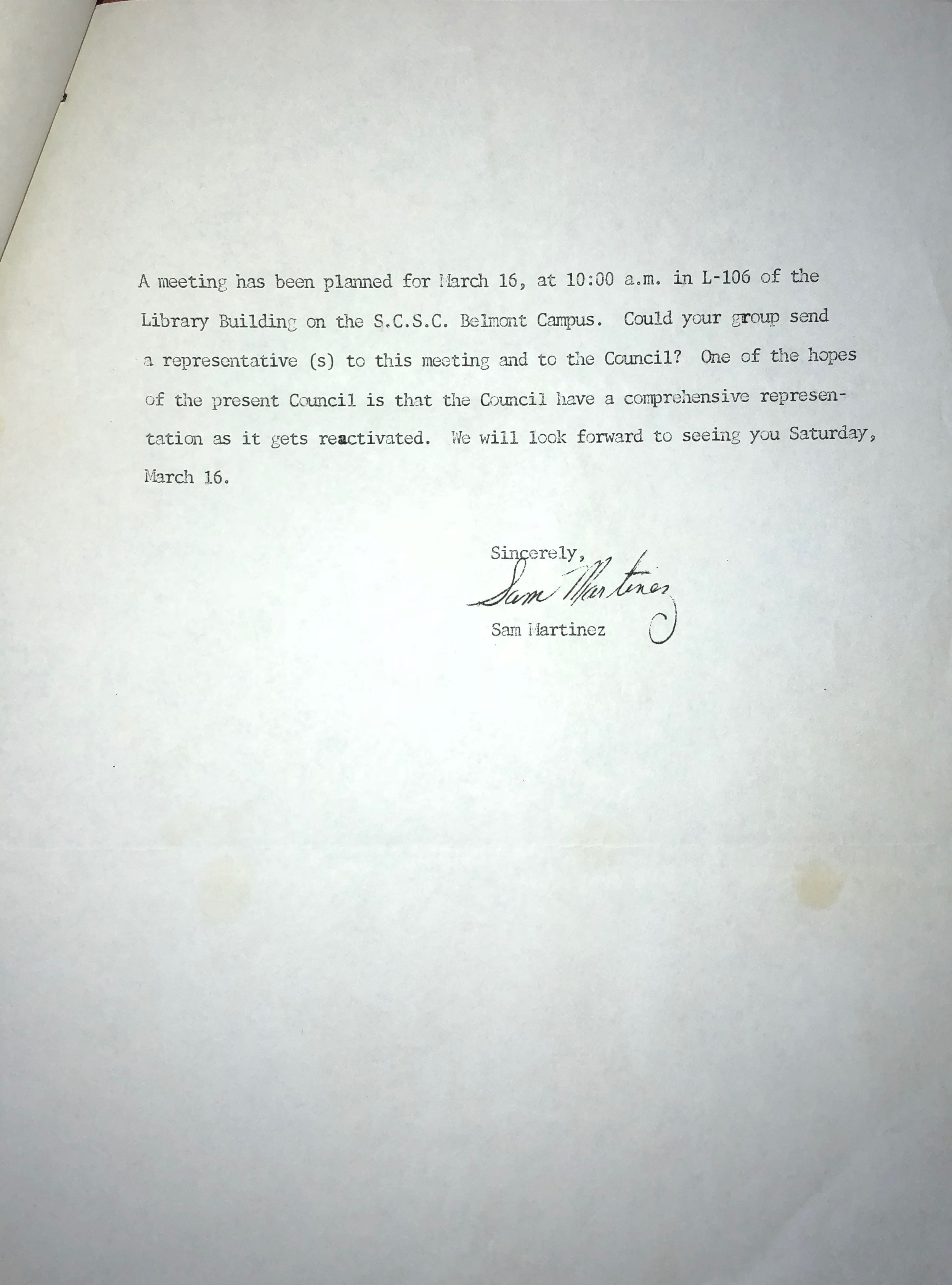 Letter written regarding the need for change for Chicanos in Pueblo, ca. 1975
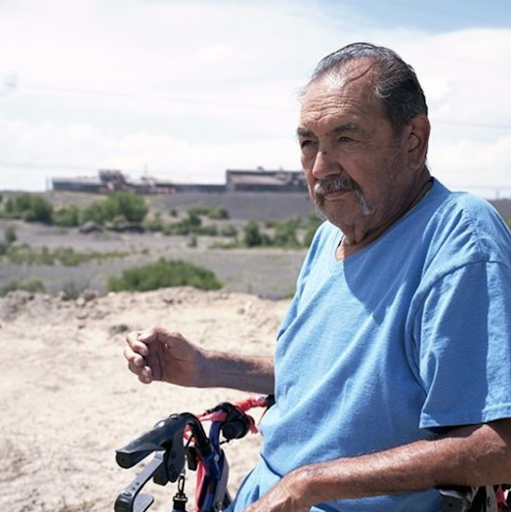
Photograph of Eloy Arellano
LHP_Intern2020-01-18T04:35:42+00:00“Eloy Arellano at an overlook off of La Junta Road with the mill (where he worked for over 30 years) in the background”

Frank Orona Quote
LHP_Intern2020-01-18T04:35:29+00:00“I was lucky at 16, they (at CF&I) were hiring kids and women. The war was on – World War II… in 44. I went to Central for a couple years. the minute I got to be 16 – zoom – I come to work in the mill. My birthday is November 8th. On November 13th, I started working in the mill.”
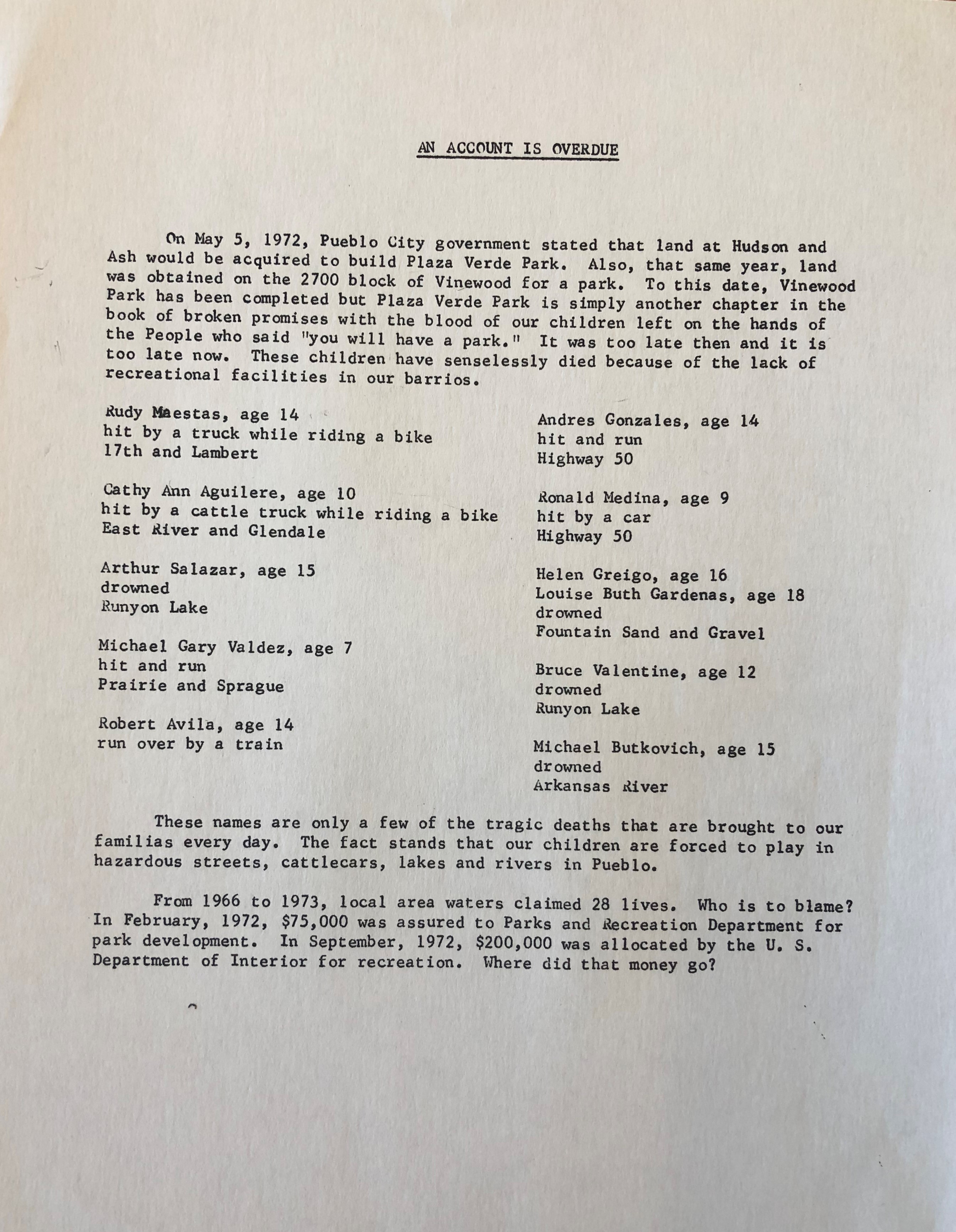
Statement, “An Account is Overdue”
LHP_Intern2019-09-08T23:02:22+00:00Statement issued on May 5, 1972 demanding action regarding recent deaths of Hispanic children.

Frank Orona
LHP_Intern2020-01-18T04:35:18+00:00“Frank Orona at his home on San Juan Street, just off of Santa Rosa”

Fact Sheet about DA’s office, 1978
LHP_Intern2019-09-08T23:03:44+00:00Fact sheet issued by the Pueblo Health Coalition regarding misconceptions about misconduct by the Pueblo District Attorney’s Office, 1978.
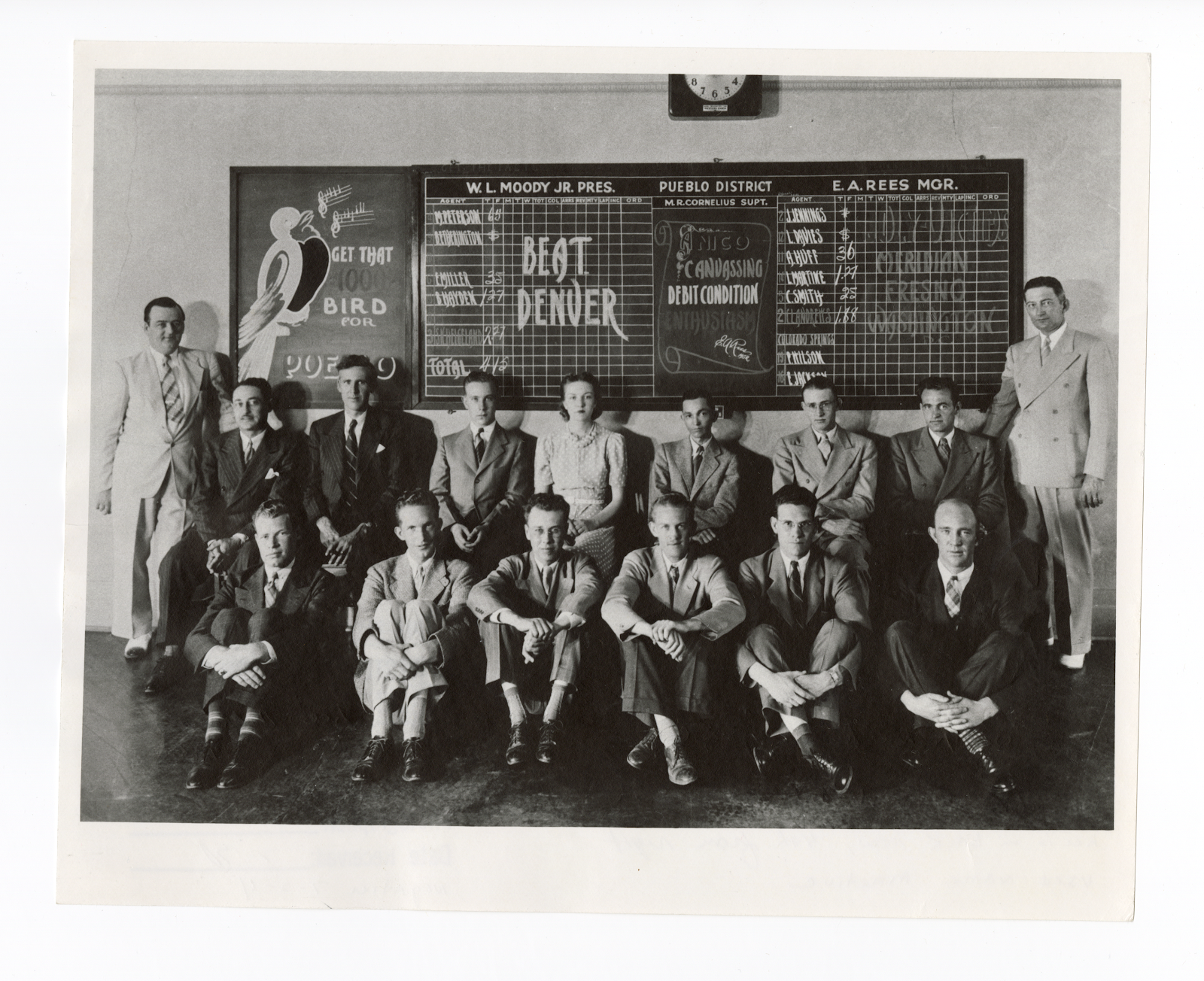
Insurance Company’s discriminatory hiring, 1940
LHP_Intern2019-09-08T23:04:38+00:00American National Life Insurance company would not hire hispanic people. Lee Martinez, under the alias Martine, is shown 4th from the right in the back.

Health Centers headed Toward Financial Crisis, 1976
LHP_Intern2019-09-08T23:05:58+00:00Article on the declining state of the health centers in connection to the policies politicians chose to vote for. Dr. Rivera, director of these centers seeks to call out these politicians for their lack of support on healthcare

Police Brutality against Chicanos, 1976
LHP_Intern2019-09-08T23:06:42+00:00Fred S. Rael was beaten by police on March 11, 1976 and there is community backlash against police. Despite backlash, the DA has no ‘justifiable’ reason to convict the police officer

Miners Eloy Cruz and Leandro Vigil near Frederick Mine, 1920?
LHP_Intern2019-07-11T23:25:34+00:00Coal miners Eloy Cruz (left) and his brother-in-law Leandro Vigil pose near the entrance to the Frederick Mine in Valdez (Las Animas County)

Poem from Luis de Lujan to his son Antonio Lujan on his saint’s day, 12 June, 1899
LHP_Intern2019-10-11T04:18:44+00:00Poem from Luis de Lujan to his son Antonio Lujan on his saint’s day, 12 June, 1899

Trinidad, 1870, from corner of First and Beech Streets
LHP_Intern2019-10-11T04:20:13+00:00Trinidad, 1870, from corner of First and Beech Streets

Sample pages from Trinidad City Directory, 1899, showing many Hispanic names as well as others
LHP_Intern2019-10-11T04:20:18+00:00Sample pages from Trinidad City Directory, 1899, showing many Hispanic names as well as others
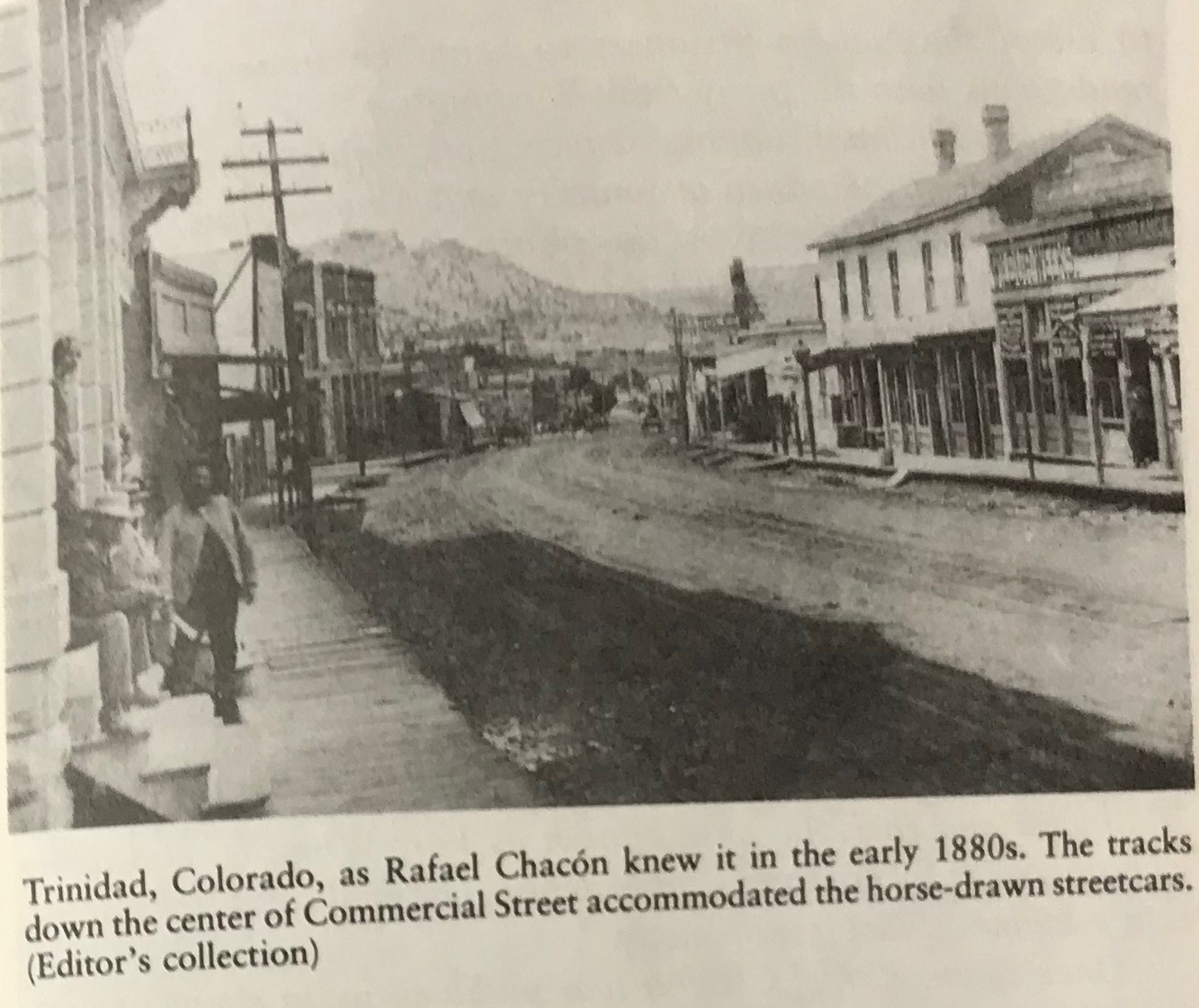
Commercial Street, Trinidad in the early 1880s, with tracks down the middle for horse-drawn streetcars
LHP_Intern2019-10-11T04:21:04+00:00Commercial Street, Trinidad in the early 1880s, with tracks down the middle for horse-drawn streetcars
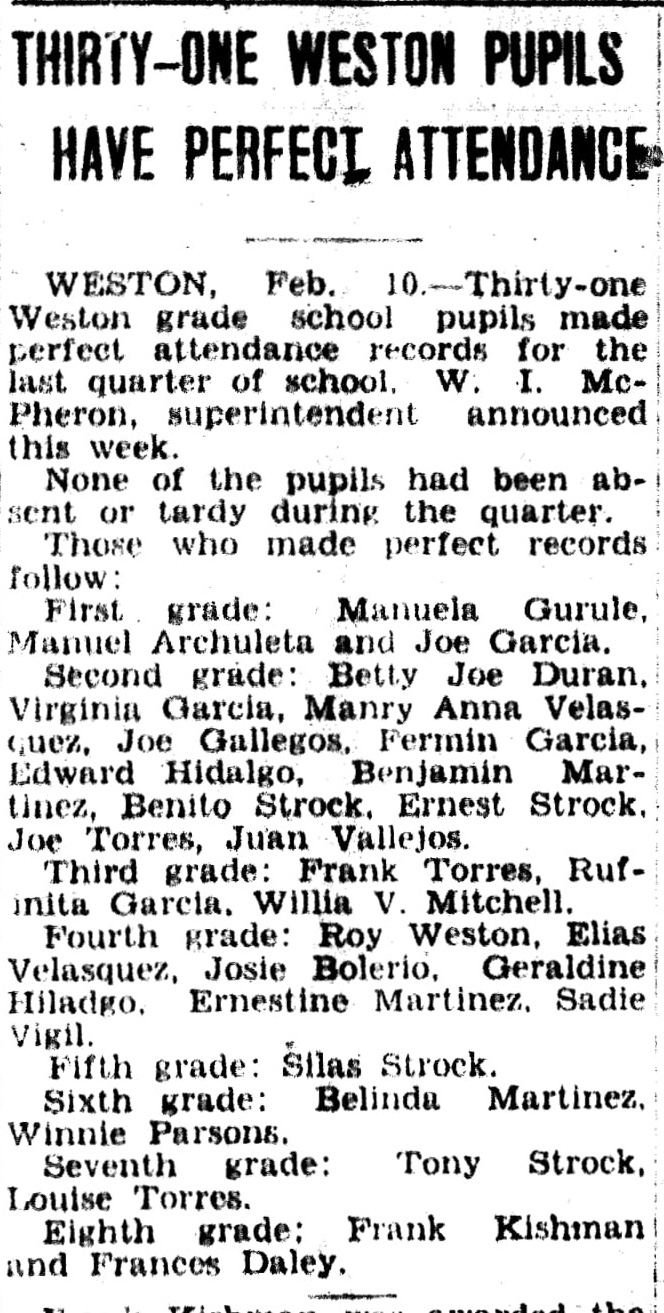
Weston grade school students with perfect attendence, 1933
LHP_Intern2019-10-18T20:22:25+00:00List of Weston elementary school students with perfect attendence records contains mostly Latino names.

Vera Estrada quote
LHP_Intern2019-09-13T03:02:19+00:00Vera Estrada quote
“The mill used to dispose of the slang into, what we called, the black waters… and the slag would actually light up all of Salt Creek. There were no indoor bathrooms. They had outhouses. and in the evening, everyone would wait for the slag to be thrown and you could see the neighbors scurrying, running to the outhouse before the light of the slag went out.”

Trinidad High School Yearbook (The Yellow and White), 1917, p. 7
LHP_Intern2019-12-13T20:10:58+00:00Includes Joseph P. Bacca as class “Veledictorian” and class President

Vera Estrada
LHP_Intern2019-09-13T03:02:31+00:00“Vera Estrada at the end of Pecos Street next to the Bessemer Ditch where she used to wade with her brother, when they were children”

Trinidad High School Yearbook (The Yellow and White), 1917, p. 6
LHP_Intern2019-12-13T20:11:28+00:00Includes J. Eliseo Martinez as class Vice- President

An Early Teacher, Juan J. Valdéz and his wife Reyes Maes de Valdéz, 1896
LHP_Intern2019-12-13T20:11:58+00:00He was a farmer and a teacher who taught school for 30 years in the towns of Jaroso, Trujillo Creek, and Martinez; he and his wife raised their family in Trujillo Creek.
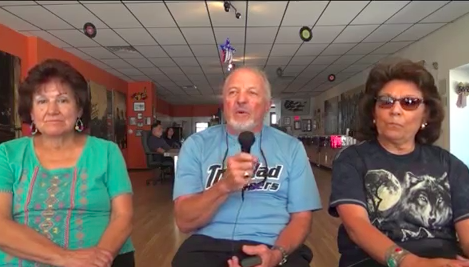
Video Clip from Interview with Yolanda Romero and Jack & Georganne Vallejos, Traditions and Family.
LHP_Intern2019-06-20T19:28:41+00:00In this 2018 interview, Yolanda Romero and Georganne Vallejos speak to the way traditions in families have changed from the ways their elders raised them in Trinidad. Georganne notices the importance of grandparents in helping raise the children. Length: 2:26.
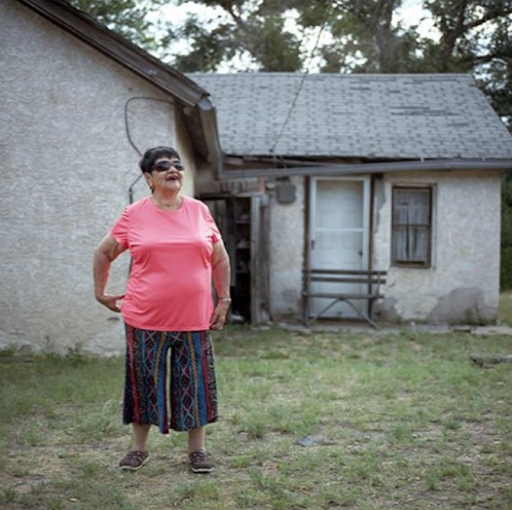
Photograph of Vera Hernandez Esquibel
LHP_Intern2019-09-13T03:03:38+00:00“Vera Esquibel in El Paso in front of the old home of her parents where her own mother passed away 20 minutes after giving birth to Vera”
Video Clip from Interview with Yolanda Romero and Jack & Georganne Vallejos, Early Trinidad Settlements.
LHP_Intern2019-06-20T19:27:44+00:00Georganne Vallejos speaks about her family settling in Trinidad in “El Barrio.” 2018. Length: 1:13.

Photograph of Debbie Baca Duran
LHP_Intern2019-09-13T02:58:24+00:00“Debbie Baca Duran on the front porch at the end of Pecos Street where she used to live”

Video Clip from Interview with Judge Manzanares, Early Life in Trinidad.
LHP_Intern2019-06-20T19:26:53+00:00Judge Manzanares recalls his memories of growing up in Trinidad and how the city was back then. He highlights his mom as his hero, as she raised him and all his five siblings, modeling for them what it was to value education. Aditionally, he recalls how his own family supported him through his career. 2018. Length: 3:57.
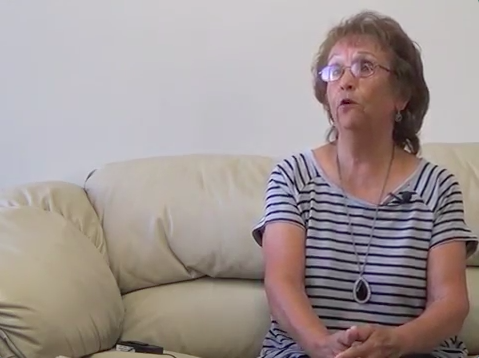
Video Clip from Interview with Mayor Garduno, Early Life in Trinidad.
LHP_Intern2019-05-12T02:19:09+00:00In this 2018 interview, Mayor Garduno speaks about growing up in Trinidad with her family. Although she would like to remember more of the history of her parents, she recalls how all of her family came to live in Trinidad. Length: 2:37.

Emily “Chata” Lopez Quote
LHP_Intern2019-09-13T03:01:17+00:00“I was born in Salt Creek in a chicken coop…next to Roselawn Road. My mom had me in a chicken coop… where chickens laid eggs, where the chickens live. She had her midwife there.”
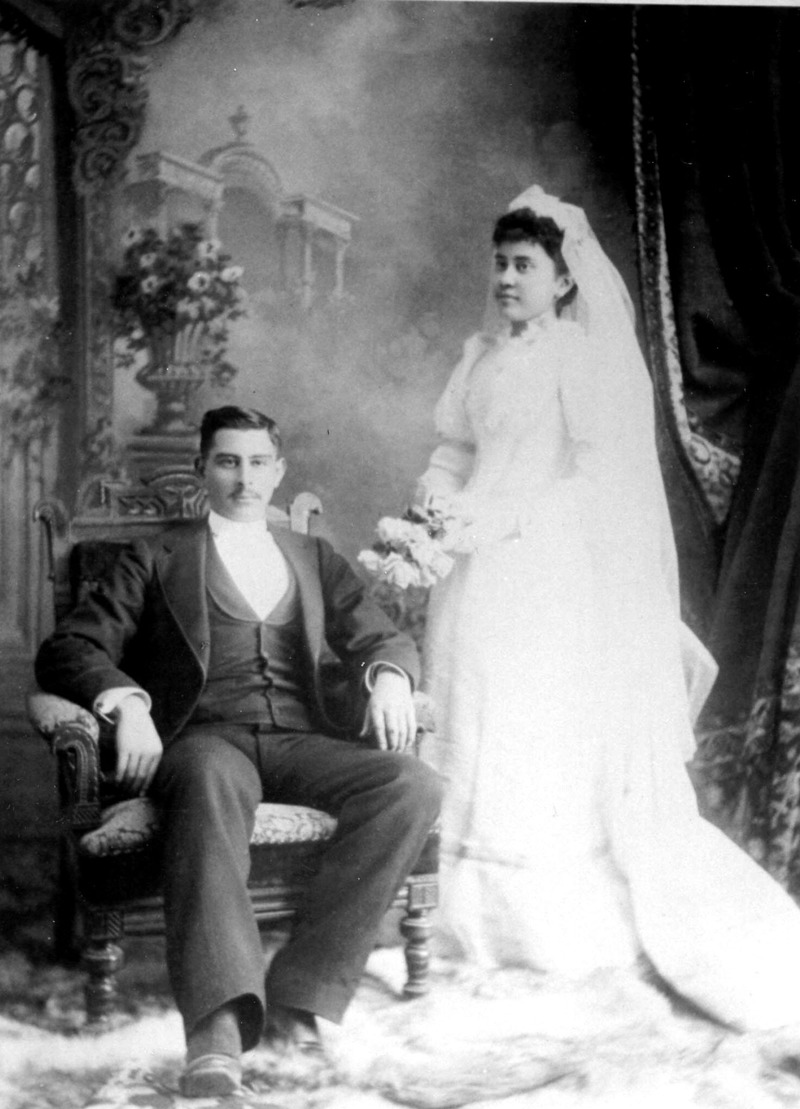
Portrait of Eusebio Chacón (son of Rafael Chacón) and Sophia Barela (dau. of Senator Barela), 1891
LHP_Intern2019-05-12T02:18:09+00:00They married in the Chapel of San Francisco in Barela, Colorado, and their wedding celebration was held at her father’s ranch, El Porvenir.
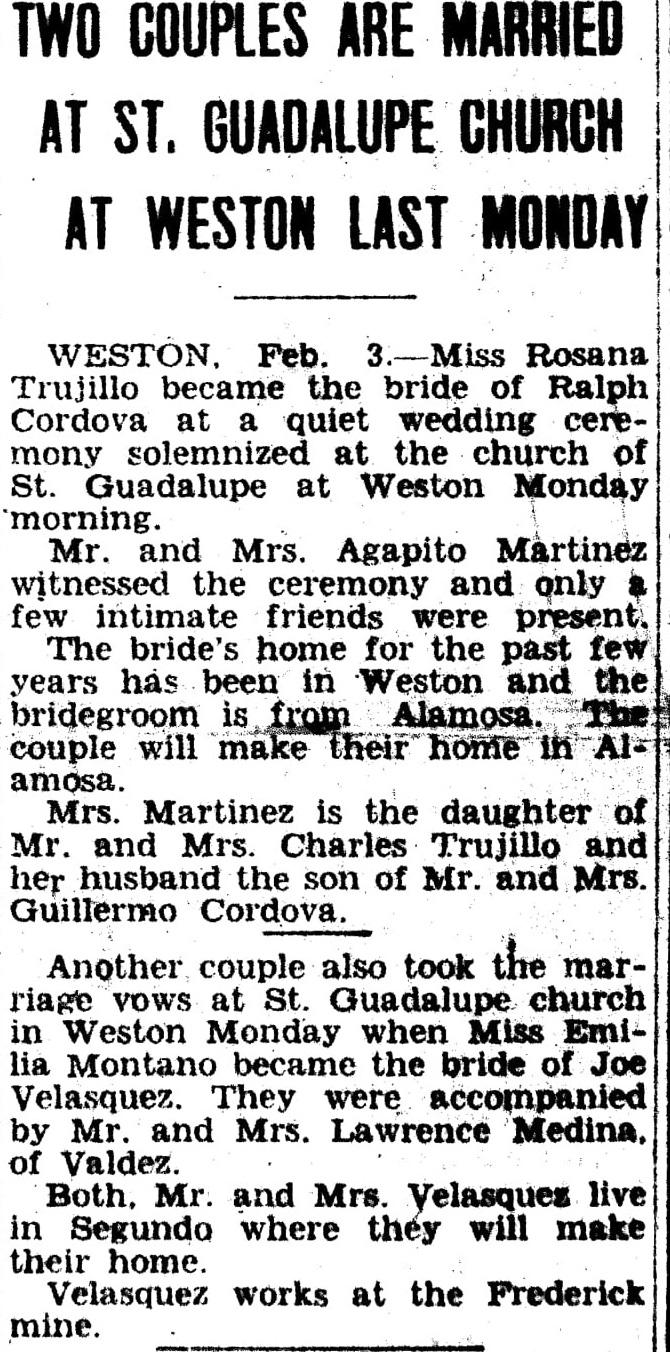
Wedding announcements for Latinos/as from Alamosa and Segundo, 1933
LHP_Intern2019-10-18T20:24:02+00:00The two Latino couples will live in Alamosa and Segundo

Photograph of Emily “Chata” Lopez
LHP_Intern2019-09-13T03:01:34+00:00“Emily “Chata” Lopez at Adeline Baca Lopez’s (her mother) current home on the Eastside, Pueblo”

Wedding Party in Trinidad, 1890-1910
LHP_Intern2019-10-11T04:22:44+00:00Wedding Party in Trinidad, 1890-1910
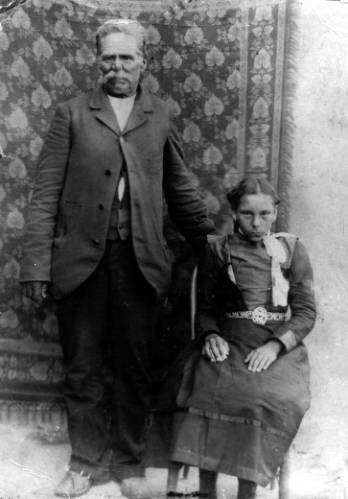

Margaret Gomez Santos
LHP_Intern2019-09-13T02:51:46+00:00“I heard comments as I was growing up that there were stupid people in Salt Creek. There were very smart people in Salt Creek. They were very politically oriented. They were well vested.


Cordova Sisters of Hoene, late 1850s
LHP_Intern2019-06-20T19:19:42+00:00Antonia, Benigna (front), Maria Salome, and Magdalena (back), daughters of Juan Bautista Cordova
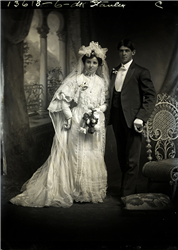
F. C. Baca and Wife, Wedding Portrait, 1905
LHP_Intern2019-10-11T04:23:06+00:00F. C. Baca and Wife, Wedding Portrait, 1905

Photograph of Margaret Gomez Santos
LHP_Intern2019-09-13T02:52:00+00:00Margaret Gomez Santos on Pecos in front of her old family home next to the Bessemer ditch.


Felipe and Maria Dolores Baca with their children, around 1875
LHP_Intern2019-10-11T04:23:12+00:00Felipe and Maria Dolores Baca with their children, around 1875

Adeline Baca Lopez Quote
LHP_Intern2019-09-13T02:52:58+00:00“We used to dance and play… We lived on 111 Roselawn.”

Julian Estevan, 1890
LHP_Intern2019-06-20T19:16:22+00:00Baby Julian Estevan Lobato from Hoehne (Las Animas County) in his baptismal gown, 1890

Della Marie Lovato, 1911
LHP_Intern2019-06-20T19:15:43+00:00Baby Della Marie Lovato of Trinidad, 1911

Photograph of Adeline Baca Lopez
LHP_Intern2019-09-13T02:53:11+00:00Adeline Baca Lopez at her current home on the Eastside, Pueblo

Trujillo Brothers, 1910s
LHP_Intern2019-06-20T19:14:50+00:00The Trujillo brothers from Mora County, New Mexico, and Las Animas. Leopoldo (middle front) was a miner at the Frederick Mine in Valdez (Las Animas County). Photo taken in 1910s

Rivera Family, 1887
LHP_Intern2019-06-20T19:14:07+00:00Francisco Rivera, his wife Benigna Córdova de Rivera and their children, probably in San Francisco Plaza, 1887

Gómez Family, 1912
LHP_Intern2019-06-20T19:09:02+00:00Family portrait taken at the time of the baptism of Mercedes Gómez in Vigil (Las Animas County), 1912

Photograph of Socorro L. Arellano
LHP_Intern2019-09-13T02:50:42+00:00Socorro Arellano
at her old home on El Paso Avenue, just off of Placita

An early settler of Manzanares, 1900
LHP_Intern2020-01-09T22:32:27+00:00Rumaldo Manzanares, 1900, one of the first settlers of La Plaza de los Manzanares (a.k.a Manzanares, Garcia, in Costilla County). He moved to Colorado from Tierra Amarilla in northern New Mexico.

Homesteading claim filed, 1912
LHP_Intern2020-01-09T22:32:42+00:00Notice that Pedro Gonzalez has submitted final homesteading claim for non-coal land in Walsenburg district, with 4 Hispanic witnesses

Socorro Arellano Quote
LHP_Intern2019-09-13T02:50:31+00:00“They changed our names . . . in those days they couldn’t pronounce our names, so they told me my name would be Cora . . . I thought that was my name until I went and got my driver’s license and they wanted my birth certificate. Is that my name?”

Policarpio Cordova Family, undated
LHP_Intern2020-01-09T22:32:55+00:00Policarpio ran a cattle and sheep ranch operation near Trinidad with his brother Juan Antonio and his father
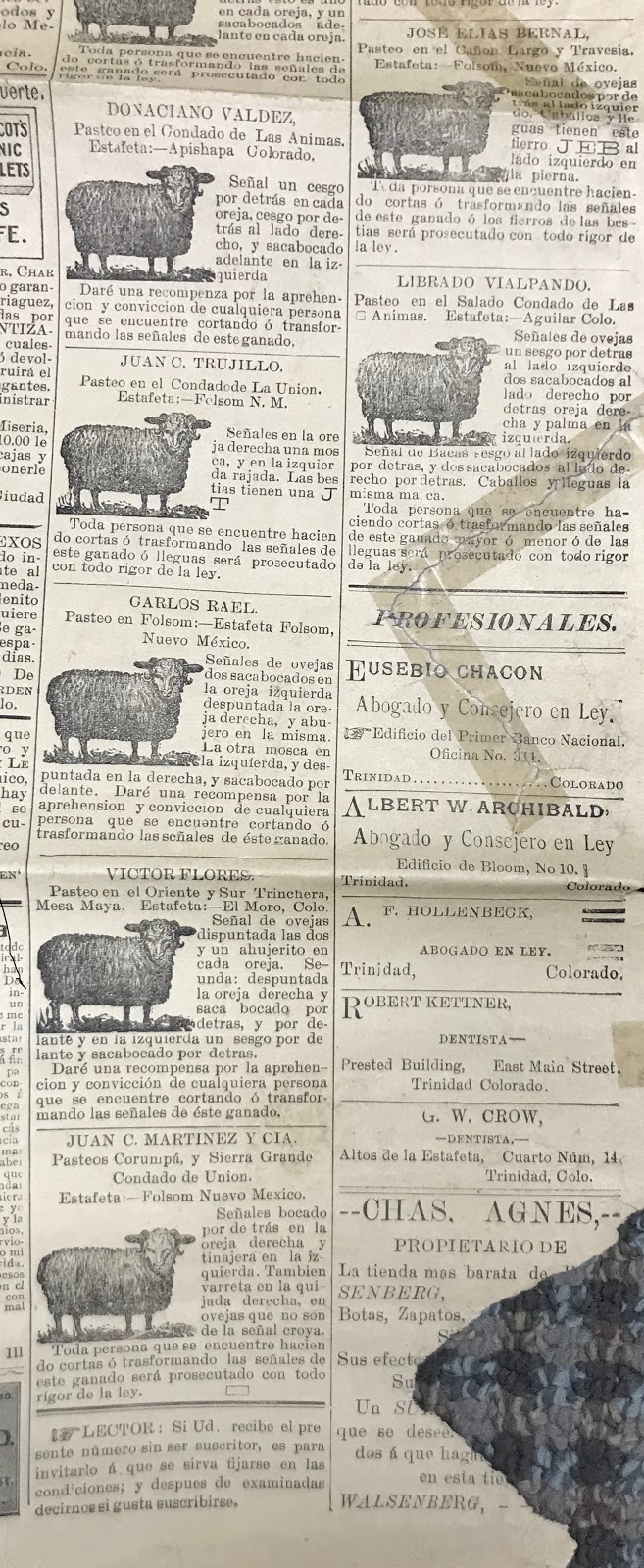
Notice in paper by shepherds registering the brand marks for their sheep, 1899
LHP_Intern2020-01-09T22:33:39+00:00Notice in paper by shepherds registering the brand marks for their sheep, 1899

Photograph of Catherine Ruedas, Denise Vargas, and Edna Vargas
LHP_Intern2019-09-13T02:49:34+00:00Salt Creek residents Catherine Ruedas, Denise Vargas, and Edna Vargas

Threshing Technique, 1889
LHP_Intern2020-01-09T22:33:54+00:00Description of how Hispanic farmers along Purgatoire River in Las Animas County threshed grain

Goat Herders, 1905
LHP_Intern2020-01-18T16:54:55+00:00Hispanics owned flocks of goats that they grazed outside Trinidad

Ruedas, Vargas, and Vargas Quote
LHP_Intern2019-09-13T02:49:00+00:00“We had our wedding at St. Joseph Hall. It was a big wedding . . . you know, in Salt Creek everyone goes to weddings even if they’re not invited. It’s familia.”

Horse-Drawn Plow, 1915
LHP_Intern2020-01-09T22:34:38+00:00Hilario Herminio Paiz (Herman) sits on a horse-drawn plow on his ranch in Gulnare (Las Animas County), 1915

Antonio Cipriano Gutierrez’s Saddle, probably early 20th century
LHP_Intern2020-01-09T22:35:00+00:00Mexican charro-style saddle with a wide seat, big slick horn, and bull-nose style tapaderos. Used by Antonio Cipriano Gutierrez (1842-1929) of Colfax County, New Mexico, and Las Animas County, Colorado.

Eusebio Chacon (son of Rafael), undated
LHP_Intern2020-01-09T23:01:56+00:00He was an important lawyer, writer, editor of El Progreso paper, and deputy District Attorney for Las Animas County in the 1890s

Four ”bright young men” from Trinidad work for Colorado Senate, 1899
LHP_Intern2020-01-09T23:02:35+00:00Includes Ed Garcia and N. Chavez
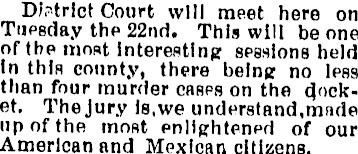
Hispanics on juries, 1875
LHP_Intern2020-01-09T23:02:52+00:00The jury for 4 murder trials in 1875 included both “Mexicans and and Americans,”all said to be among “the most enlightened of our citizens”

Chicano Barrio Education Committee, 1973
LHP_Intern2019-09-14T13:43:20+00:00Recommendations made to this school to improve Chicano student success/experience

P. L. Sanchez, 1912
LHP_Intern2020-01-09T23:03:19+00:00P. L. Sanchez was Assessor of Huerfano County in 1912

José Vivián Abeyta, 1883-5
LHP_Intern2020-01-09T23:03:54+00:00José Vivián Abeyta, a barber who represented Las Animas County in the Colorado General Assembly House of Representatives

Rafael Chacón , 1858
LHP_Intern2020-01-09T23:04:22+00:00Major Rafael Chacón and his wife Juanita Páiz de Chacón. He served in the U.S. Army in New Mexico during the Civil War; after his retirement from the military, he moved to Trinidad, where he served as Las Animas County Treasurer and Sheriff

Chicano Barrio Education Committee, 1973
LHP_Intern2019-09-14T13:43:51+00:00List of demands presented to East High School for Chicano teachers, counselors, etc.

José Ramón Aguilar, 1881-2
LHP_Intern2020-01-09T23:04:41+00:00José Ramón Aguilar, who served in the Colorado General Assembly House of Representatives and later as Las Animas County Commissioner; he was also Mayor of Aguilar, which was named in his honor

Funeral Procession after Ludlow Massacre, April, 1914
LHP_Intern2019-10-11T04:24:56+00:00Funeral Procession after Ludlow Massacre, April, 1914

Trinidad News Boys, 1914
LHP_Intern2019-06-24T19:43:14+00:00A group of boys holding issues of the Trinidad Free Press that have headlines relating to the Ludlow strike

Ludlow Memorial, erected 1918-25
LHP_Intern2019-06-24T19:42:35+00:00View of the Ludlow Memorial, erected in memory of the Ludlow Massacre, near Trinidad (Las Animas County). The inscription reads: “In Memory of the Men, Women and Children Who Lost Their Lives in Freedom’s Cause at Ludlow, Colorado, April 20, 1914. Erected By The United Mine Workers of America.”
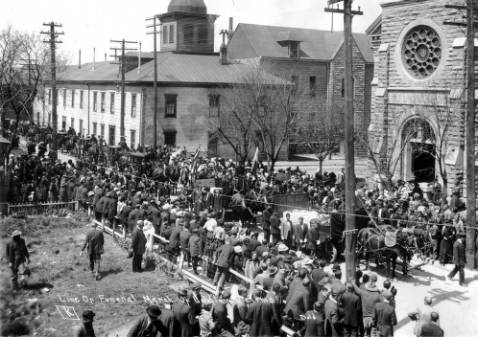
Funeral Procession in front of Church, Victims of the Ludlow Massacre, 1914
LHP_Intern2019-10-11T04:25:18+00:00Funeral Procession in front of Church, Victims of the Ludlow Massacre, 1914

Letter to Superintendent
LHP_Intern2019-09-14T13:48:23+00:00Letter to Superintendent of School District 60 listing the problems with the district’s Chicano education
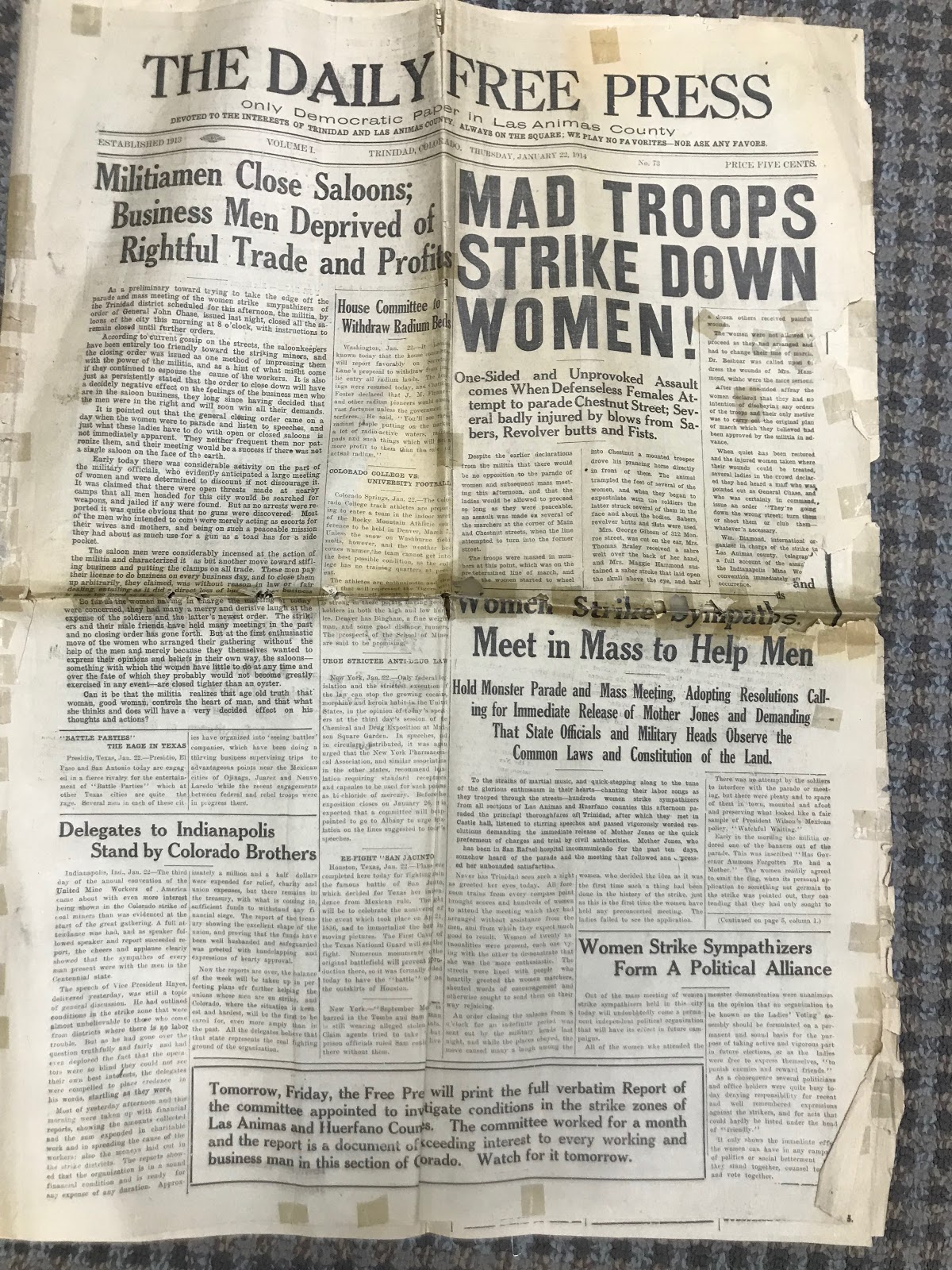
Women strike supporters attacked, 1914
LHP_Intern2019-10-11T04:25:24+00:00Women strike supporters attacked, 1914


Article opposing unions as a “labor trust,” 1914
LHP_Intern2019-10-09T03:00:56+00:00Article reprinted from “The Literary Digest” charging unions with “conspiring to restrain trade and commerce” and mentioning indictments of two local leaders of the coal strike under the anti-trust law

Summary of Recommendations for School District, Chicano Barrio Education Committee, 1973
LHP_Intern2019-09-14T13:51:05+00:00Summary of recommendations for Pueblo school district 60 in terms of Chicano Education

Chronology of the coal strike in Trinidad District, 1913
LHP_Intern2019-10-09T03:01:20+00:00Beginning of a multi-part listing of events. This page includes visits /speeches by Mother Jones on Sept. 2-3 and Sept. 14
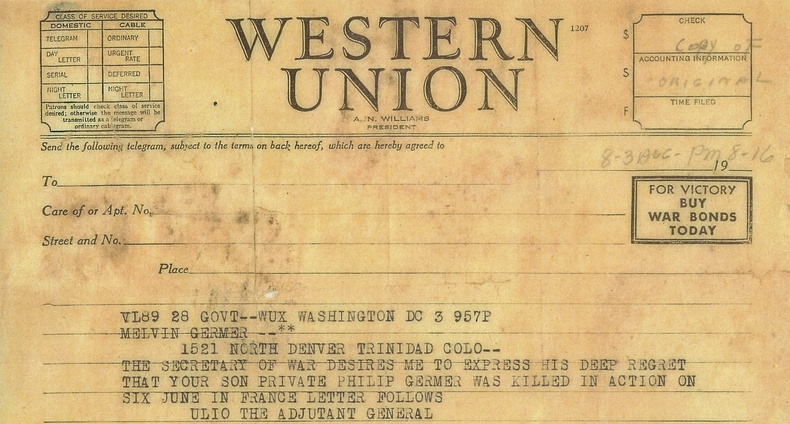
Western Union telegram sent to Philip Germer’s father, 1944
LHP_Intern2019-10-09T03:02:05+00:00It announced that he was killed in action in France on June 6 during the D-Day Invasion

Chicano Studies at CSU Pueblo (audio clip & transcript)
LHP_Intern2019-09-14T13:59:57+00:002016 interview of George Autobee talking about being involved with student activism and pushing for Chicano Studies courses at CSU Pueblo as a veteran. This would have been during the Chicano Movement in the 1970s. Autobee included information regarding his involvement with MEChA and student protests at CSU-Pueblo.

Philip Germer in uniform, 1942
LHP_Intern2019-10-09T03:02:24+00:00In 1943 he was attached to the 101st Airborne Division

Philip Germer at Camp Toccoa, Georgia, 1942
LHP_Intern2019-10-09T03:02:39+00:00Born in Trinidad, he was the son of Melvin Germer and Dora Lucero. He enlisted in the U.S. Army in 1942 and trained as a paratrooper.

Rafael Chacon in U.S. Army uniform, 1900-1910
LHP_Intern2019-10-11T04:26:02+00:00Rafael Chacon in U.S. Army uniform, 1900-1910
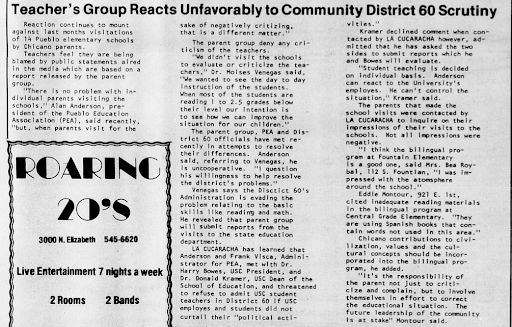
Parent Concerns leave District 60 Teachers feeling Blamed, 1976
LHP_Intern2019-09-14T14:05:44+00:00After Chicano parents visit multiple elementary schools and make public statements to the media about how they are failing students, teachers are left feeling attacked. The parents claim they did not visit with intention to criticize but were just concerned with their students falling behind in reading levels. Parents seem to be trying to remedy these relationships but district 60 keeps evading the problems.

List of men drafted in 1917 for World War I, including many Hispanic names
LHP_Intern2019-10-11T04:26:10+00:00List of men drafted in 1917 for World War I, including many Hispanic names

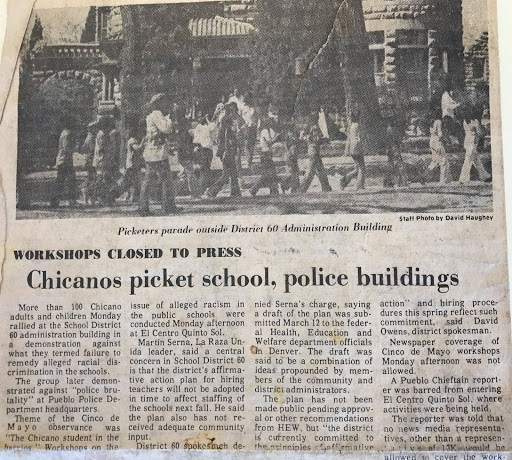
Chicanos picket school, police buildings, 1975
LHP_Intern2019-09-14T14:06:32+00:00Chicano children and adults rallied at the School District 60 administration building in a demonstration against what they termed failure to remedy alleged discrimination in the schools and lack of Chicano teachers. The group later demonstrated against “police brutality” at Pueblo Police Department headquarters.” Rudolfo “Corky” Gonzales, state chairman of La Raza Unida party, was to be the keynote speaker.
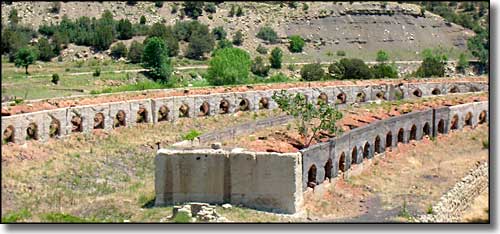
Ruins of coke processing ovens in Cokedale: #2
LHP_Intern2020-01-18T05:22:48+00:00The ovens were constructed by Colorado Fuel & Iron in 1907 and later sold to American Smelting and Refining. The last ones were shut down in 1947.

Ruins of coke processing ovens in Cokedale: #1
LHP_Intern2020-01-18T05:22:35+00:00These ovens, or sealed furnaces, converted coal into coke, which burned at a higher temperature and was used in industry, especially smelting ore. At their peak, some 500 ovens operated in Cokedale.

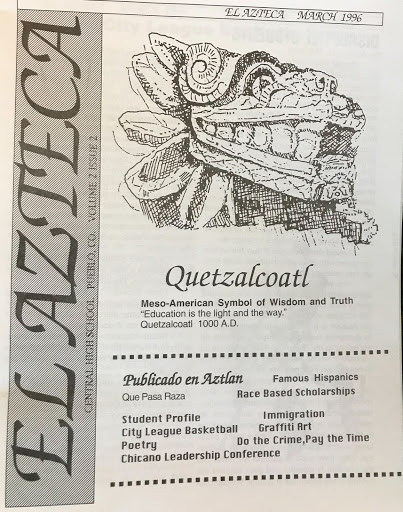
Front page of El Azteca, Central High student paper, 1996
LHP_Intern2019-09-14T14:07:36+00:00El Azteca paper, published by students at Central High School in Pueblo, Vol. 2, Issue 2, March, 1996. Front page shows Quetzalcoatl, with subjects of some of the contents.


Ruins of the Commissary at Madrid Plaza, undated
LHP_Intern2020-01-18T05:23:11+00:00A Commissary was a company store that sold food and other necessities

Front page of Aztlan F.U.C.K., Horace Mann Jr. High student paper, 1973
LHP_Intern2019-09-14T14:08:09+00:00Mimeographed student paper from Horace Mann Jr. High, Pueblo, May, 1973. Initials stand for “For Us Chicano Kids.” Issue is dedicated to our Indian Brothers in Wounded Knee.


Adobe buildings and oven, Segundo, 1902
LHP_Intern2020-01-18T05:17:53+00:00Mexican adobe buildings and “bake oven,” Segundo, 1902

View of Weston, 1903
LHP_Intern2020-01-18T05:25:46+00:00Weston, Colorado, “built by Mexicans and by early White settlers and not by the Company” = CF&I, 1903

Adobe building at Starkville, 1903
LHP_Intern2020-01-18T05:21:05+00:00A typical adobe building in the Mexican Plaza, Starkville, Colorado, 1903

Children, oven, and grinder at Starkville, 1902
LHP_Intern2020-01-18T05:18:21+00:00Children, baking oven, and chili grinder at Mexican Plaza, Starkville, 1902

Adobe settlement in Starkville, 1896-1915
LHP_Intern2020-01-18T05:18:10+00:00View of adobe and frame buildings in the coal mining camp of Starkville (Las Animas County)

Biography of Eloisa Martinez and Joseph M. Arroyo, p. 2
LHP_Intern2019-10-09T02:36:52+00:00More of Eloise Arroyo’s account

Biography of Eloisa Martinez and Joseph (Joe) M. Arroyo, p. 1
LHP_Intern2019-10-09T02:37:15+00:00Written by Eloise (as she spells it) Martinez Arroyo, this describes their life of traveling between mining camps and going north to work the fields

Organizing women at CSU Pueblo
LHP_Intern2019-09-14T22:48:37+00:00In this excerpt from a 2008 interview, Deborah Espinosa is discussing the role she played in creating a place for women on campus and within the greater Chicano Movement as a form of working against machismo.

Eloisa Martinez Arroyo and Jose (Joseph) Arroyo with their deceased baby son, John Arroyo
LHP_Intern2019-10-09T02:38:17+00:00The photo was taken in Aguilar, CO, Dec., 1931, perhaps at the cemetery

Five daughters of Juanita and Severiano Martinez, with their mother on the right
LHP_Intern2019-10-09T02:37:58+00:00Shown here, left to right, are: Dulcenea Martinez, Mary Victoria Martinez, Lucy Martinez Gomez, Eloisa Martinez Arroyo, and Pauline Martinez Gomez. Their mother Juanita is on the right. Not pictured are her two sons, Samuel and Leonardo Martinez

Pueblo Hispanic Education Foundation, Bank, and leadership
LHP_Intern2019-09-14T19:23:33+00:00Ray Aguilera talks in 2000 about his involvement with the Pueblo Hispanic Education Foundation in Pueblo.

Dulcenea, Eloisa, and Pauline Martinez, 1929
LHP_Intern2019-10-09T02:37:38+00:00This photo was taken on a Sunday morning in Lafayette, CO, while Severiano Martinez and his family were there working in the sugar beet fields

Lucy, Leonardo, and Eloisa Martinez as young children
LHP_Intern2019-10-09T02:38:49+00:00These are children of Juanita and Severiano Martinez

Severiano Martinez’s memorial ribbon, back
LHP_Intern2019-10-09T02:39:08+00:00The back of the ribbon says he was a member of Local 2395 of Suffield, CO

Severiano Martinez’s memorial ribbon, front
LHP_Intern2019-10-09T02:39:24+00:00This “in memoriam” ribbon was given to Severiano’s family by the United Mine Workers of America, to place on his coffin

Severiano Martinez on the Sopris baseball team
LHP_Intern2019-10-09T02:39:42+00:00Severiano playing on the baseball team for Sopris

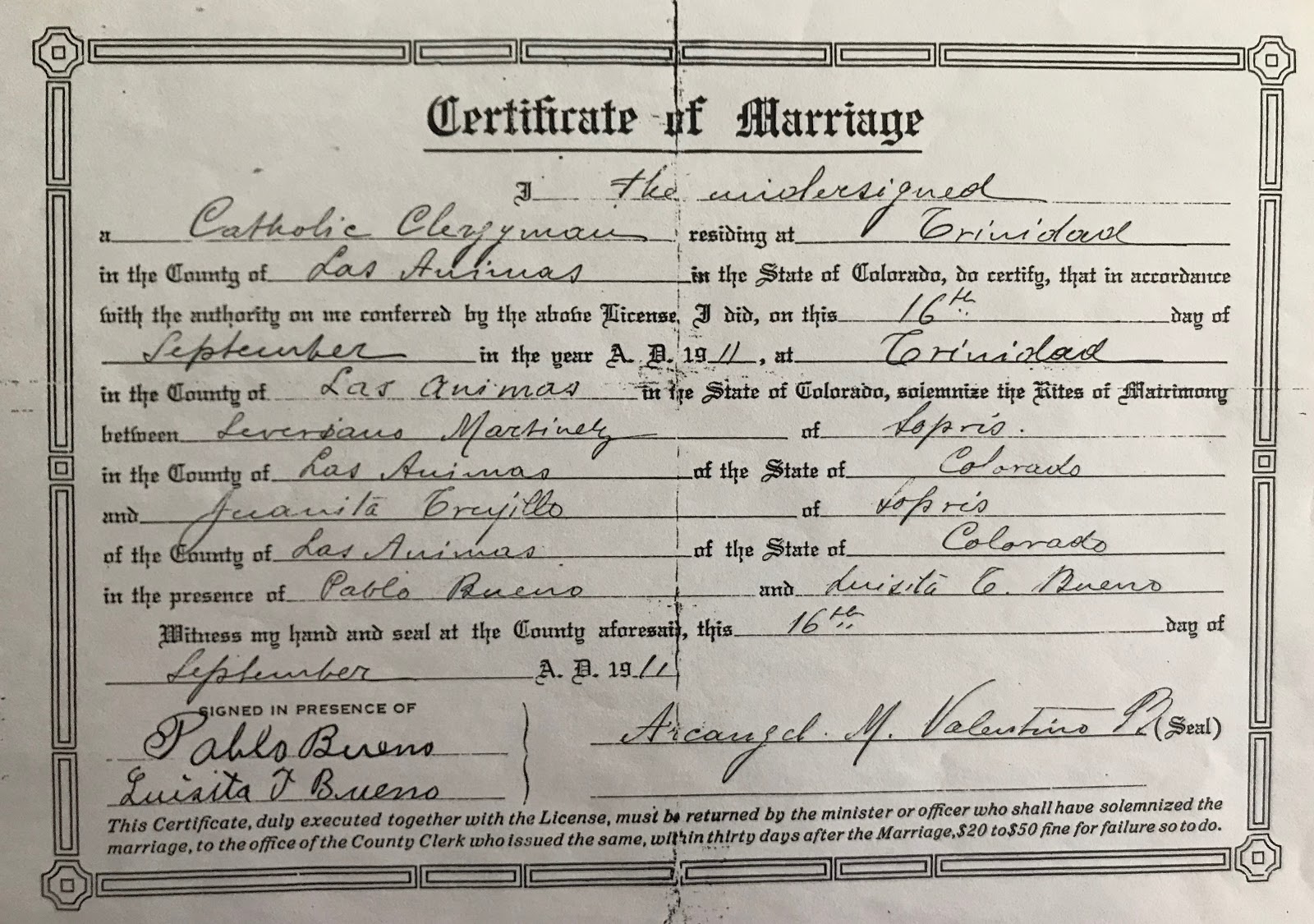
Marriage Certificate, Juanita and Severiano Martinez
LHP_Intern2019-10-09T02:40:20+00:00The certificate says they were both living in Sopris at the time. Luisita and Pablo Bueno were the two witnesses

Josephine Minjares/Lucille Rivera Aragon talk about their experience in Teacher Corp
LHP_Intern2019-09-14T19:20:55+00:00In a 2016 interview, Josephine Minjares and Lucille Rivera Aragon talk about the challenges they faced working within Pueblo schools while being a part of Teacher Corps. Here they talk about what it means to them to have been change agents in the schools.
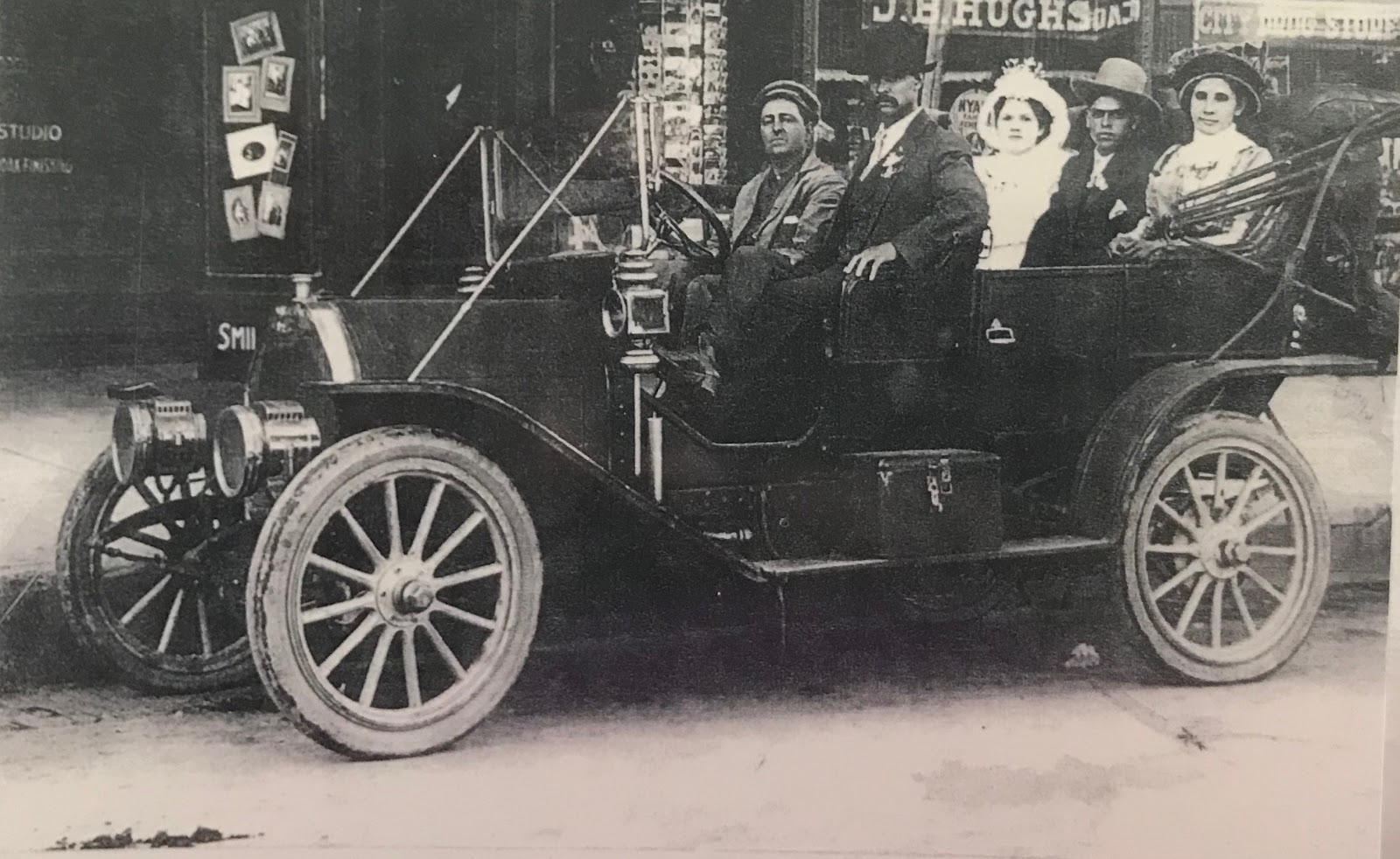
Juaninta and Severiano Martinez in Car Wedding Day
LHP_Intern2019-10-18T21:48:25+00:00This shows the bride and groom in the back seat of a car in Trinidad. Beside them is Luisita Trujillo Bueno. The driver is Pablo Bueno, Luisita’s husband.
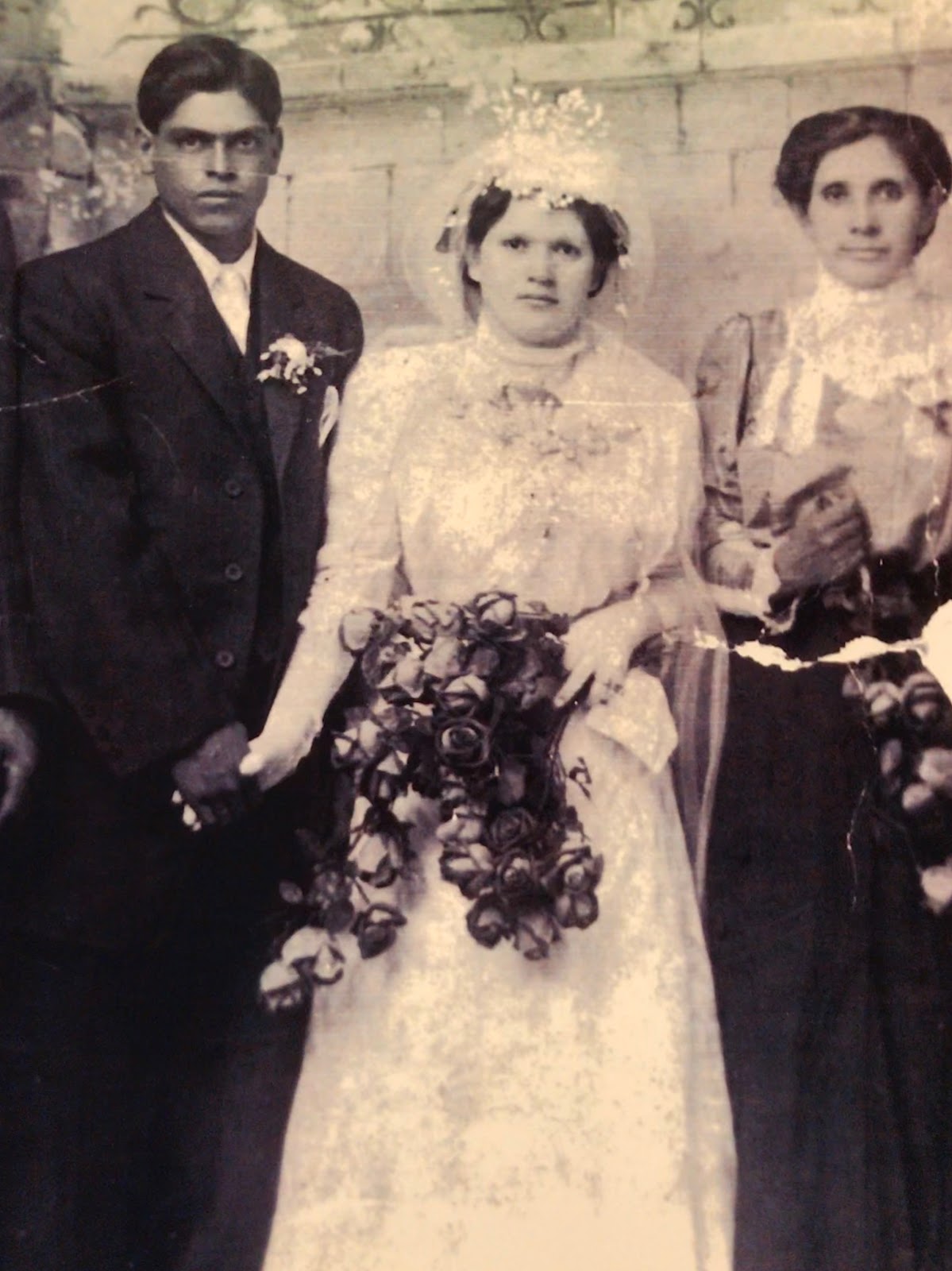
Wedding photo, Juanita Trujillo and Severiano Martinez, Sept. 16, 1911
LHP_Intern2019-10-09T02:40:58+00:00Here is the couple on their wedding day. They are on the left, and Juanita’s sister, Luisita Trujillo Bueno, is on the right.

Original Central High School
LHP_Intern2019-09-14T19:18:00+00:00Built circa 1881 as a high school, after several years it became a grade school. Known as the “Stone Schoolhouse,” it is constructed of pink rhyolite.

Account of the Lives of Juanita Trujillo Martinez and Severiano Martinez
LHP_Intern2019-10-09T02:41:19+00:00This description was written by Linda. Severiano was her great-grandfather.

Juana Trujillo and Andres Hurtado, around 1880
LHP_Intern2019-10-09T02:41:45+00:00Juana was born in 1837 and Andres in 1833. They were the maternal grandparents of Juanita Trujillo Martinez, and Linda Arroyo’s great-great- grandparents.

Judy Baca, about high school walkouts and involvement in Chicano classes and clubs at Colorado State College
LHP_Intern2019-09-14T19:28:46+00:00Judy Baca talks in 2016 about her experience in high school during the 70’s when there were a lot of walkouts. Then she talks about her involvement at Colorado State College through Chicanos Unidos for Action and chicano studies courses. She talks about how when she was younger, being from Salt Creek, she was made to feel like she didn’t like school and even considered dropping out.

Interview with Samantha Quintana and Shantell Quintana, 2018
LHP_Intern2019-06-25T18:04:32+00:00Both Samantha and Shantell Quintana are business owners in Trinidad

Hispanic Pioneers in Schools Teacher Corps and CSU-P Chicano Studies
LHP_Intern2019-09-14T20:01:23+00:00Teacher Corps and CSU-P Chicano Studies (Video Clip)
2016 interview with George Autobee talking about how the teacher corps was involved with Chicano Studies classes at CSU Pueblo while working in the public schools in Pueblo.
Interview with Jesse Manzanares, 2018
LHP_Intern2019-06-25T18:03:38+00:00Jesse Manzanares is an attorney and former Colorado District Court judge

Interview with Jennie Garduno, 2018
LHP_Intern2019-06-25T18:01:01+00:00Jennie Garduno is a retired nurse and former Mayor of Trinidad

Questions asked at the Oral History Interviews in Trinidad, 2018
LHP_Intern2019-10-22T22:25:38+00:00These questions were asked at most of the interviews. The one with the retired coal miners followed a somewhat different course.

Interview with Tom Hays, Jerry Renner, and Mike Romero, 2018
LHP_Intern2019-06-25T18:06:14+00:00All three men are retired coal miners; Jerry Renner (at left) and Mike Romero (center) are former union officers in the United Mine Workers of America

Hispanic Pioneers in Schools
LHP_Intern2019-09-14T19:56:45+00:00The Pueblo Chieftain article explaining the representation of Hispanic people in administration positions in School District 60 including Edmund Vallejo, the superintendent.

Interview with Yolanda Romero and Jack and Georganne Vallejos, 2018
LHP_Intern2019-06-25T18:05:28+00:00Yolanda Romero (at left) is a community activist and Director of the Southern Colorado Coal Miner’s Museum; Jack and Georganne Vallejos (middle and right) are community organizers

Edmund Vallejo named to the Board of Trustees of State Colleges, 1975
LHP_Intern2019-09-14T19:57:57+00:00Dr. Edmund Vallejo, Asst. Superintendent of District 60, has been appointed to the Board of Trustees of State Colleges. He has a BA from Adams State, a master’s from UNC Greeley, and a Ph.D. from Kansas State University. He is active in several civic organizations, including Congress of Hispano Educators and Pueblo Diversified Industries.

Video Clip from Interview with Judge Manzanares, Political Activity in El Movimiento.
LHP_Intern2019-06-25T18:19:12+00:00Video Clip from Interview with Judge Manzanares, Political Activity in El Movimiento.
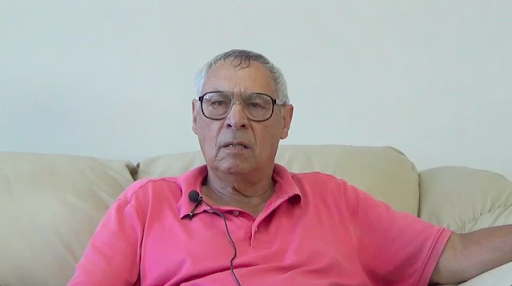
Video Clip from Interview with Judge Manzanares, Political Activity.
LHP_Intern2019-06-25T18:18:28+00:00In this 2018 interview, Judge Manzanares talks about the organizations he has been involved with such as The Hispanic Chamber of Commerce. Length: 3:02.

Francisco Coca’s political statement, in Spanish, probably April, 1991
LHP_Intern2019-10-09T02:46:15+00:001 page of Francisco Coca’s political statement (“Declararion Politica)” justifying his refusal to accept the authority of U.S. courts, undated but around April, 1991
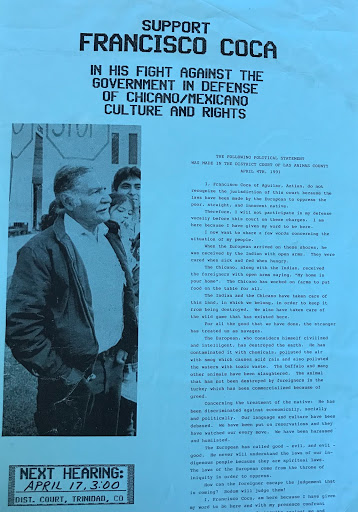
Poster calling for people to support Francisco Coca of Aguilar at his trial, April 17, 1991
LHP_Intern2019-10-09T02:46:30+00:00Coca, who says he is from “Aguilar, Atzlan” was on trial for an unspecified crime but refused to accept the authority of the court because it was based on European laws that had oppressed “the poor and innocent native,” including Indians and Chicanos. Poster asks people to come to his Hearing in District Court, Trinidad
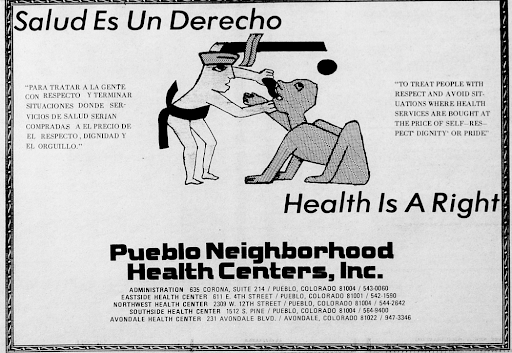
Advertisement for Equitable Health Services in Pueblo from La Cucaracha: “Salud Es Un Derecho”
LHP_Intern2019-09-14T20:18:18+00:00Bilingual advertisement in 1976 raising awareness to the equity, respect, and dignity provided by Pueblo Neighborhood Health Centers

1970 Census figures, showing a decline of 23.5% in Las Animas County’s population since 1960
LHP_Intern2019-10-09T02:46:45+00:001970 Census figures, showing a decline of 23.5% in Las Animas County’s population since 1960

Carlos Solano as a soldier and poem to him, 1943
LHP_Intern2019-09-14T22:34:37+00:00Photo and start of a long, sentimental poem in Spanish about Carlos, of Pueblo, who had just finished a week’s leave from the Navy and will now be going into Signal School

Video Clip from Interview with Yolanda Romero and Jack & Georganne, Political Activity.
LHP_Intern2019-06-25T18:15:21+00:00Yolanda Romero speaks about groups she was and is a part of to create change in her community such as schools’ PTOs and the Southern Colorado Coal Miners Memorial. Length: 4:00.

Spanish section of The CF&I Blast, 1933
LHP_Intern2019-09-14T20:23:54+00:00Spanish-language page of the newspaper put out by Colorado Fuel & Iron for its employees. Ten years before there were few mentions of anyone with a Spanish name, much less a Spanish section.
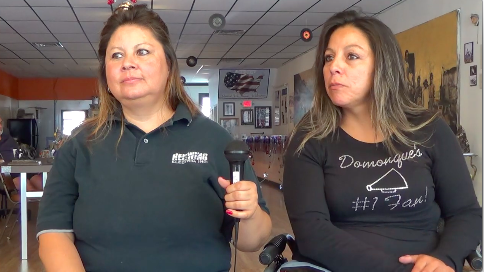
Video Clip from Interview with Samantha and Shantell Quintana, Latino Political Activity in Trinidad.
LHP_Intern2019-05-11T23:07:30+00:00This 2018 interview, the Quintana sisters talk about the lack of political involvement from Latino people in Trinidad because of the Italian people who hold power over them in the city. Length: 2:19.
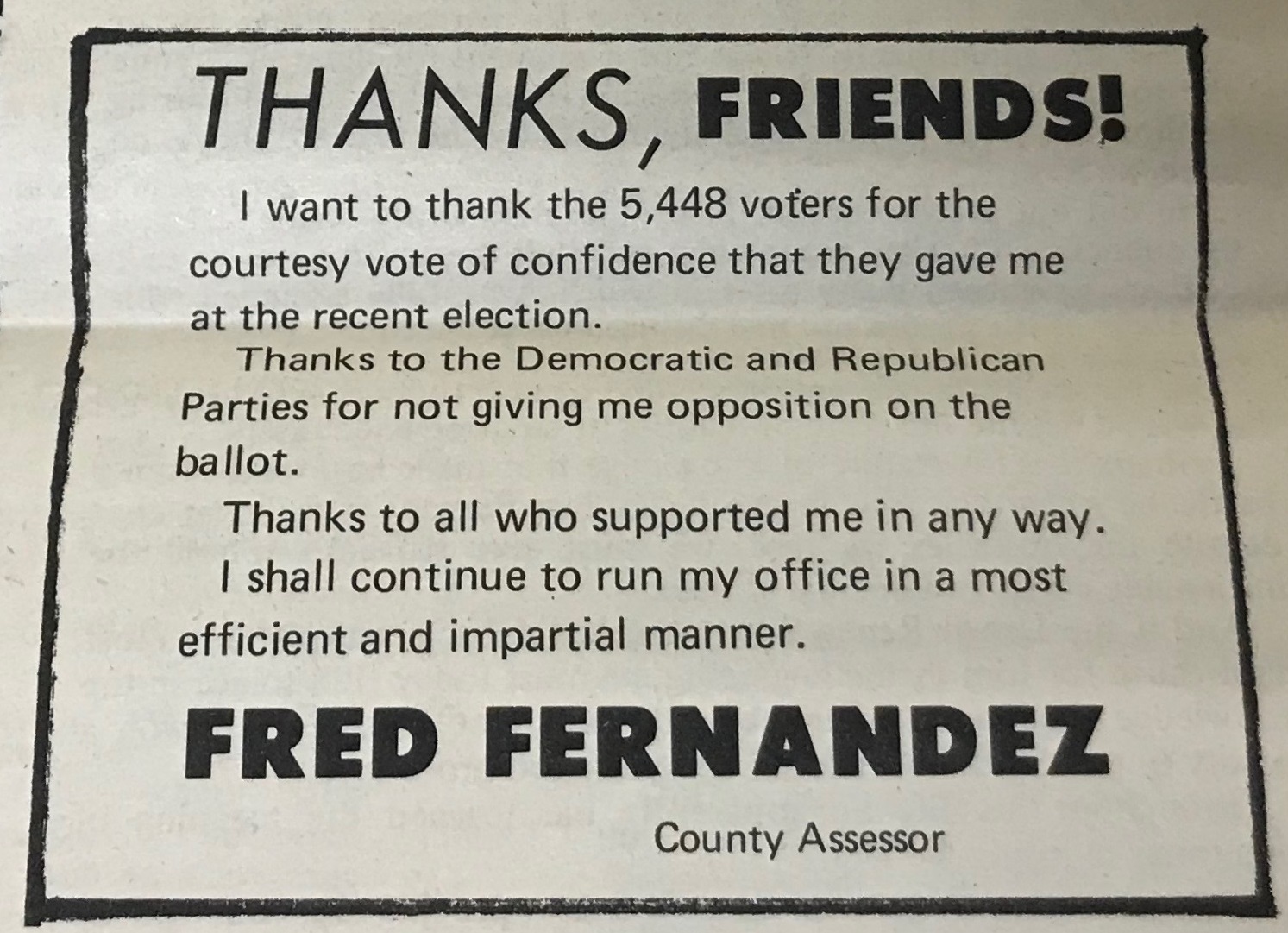
Thanks from newly-elected County Assessor to those who voted for him, 1970
LHP_Intern2019-10-11T04:27:42+00:00Thanks from newly-elected County Assessor to those who voted for him, 1970

Call (in Spanish) on people to vote their consciences, 1970
LHP_Intern2019-10-11T04:27:47+00:00Call (in Spanish) on people to vote their consciences, 1970

Candidates for Trinidad City Council, 1970, including 2 men and 1 woman with Hispanic names
LHP_Intern2019-10-11T04:27:50+00:00Candidates for Trinidad City Council, 1970, including 2 men and 1 woman with Hispanic names
1921 Flood After effects, Interview, 1980
LHP_Intern2019-09-14T20:13:43+00:001921 Flood After effects, Interview, 1980 (Audio Clip)
Theodora Valles talks about the after effects of the 1921 flood which according to her caused people to be taken to different places in order to be sheltered. The red cross was involved. Many people seemed to have gotten sick from vaccines “shots”, they received. Additionally there was no electricity and homes were very damaged.

Video Clip from Interview with Samantha and Shantell Quintana, Religion.
LHP_Intern2020-01-18T05:37:45+00:00This 2018 interview with Samantha and Shantell delves into how religious traditions have changed over time in Trinidad Latino families as well as their own personal involvement with the church. Length: 1:17.

Penitente Cross near Trinidad, 1903
LHP_Intern2020-01-18T05:38:20+00:00Penitente Cross not far from Trinidad
1921 Flood Description, Interview, 1980
LHP_Intern2019-09-14T20:14:32+00:001921 Flood Description, Interview, 1980 (Audio Clip)
Theodora Valles talks about how she and others could hear people, horses and cows scream and be taken by the 1921 flood. It was caused by heavy rain which caused the river (or current) to create mass destruction. At the beginning, the flooding was very close to people’s homes and in fact had already reached many homes. It carried with it dead cows. Police were working to get people out of the flood and out of danger but many people tried to stay in their homes and protect their belongings. Many people were not successful.

Cross with straw appliqué decoration, Spanish colonial style, from Baca House
LHP_Intern2020-01-18T05:38:07+00:00Cross with straw appliqué decoration, Spanish colonial style, from Baca House
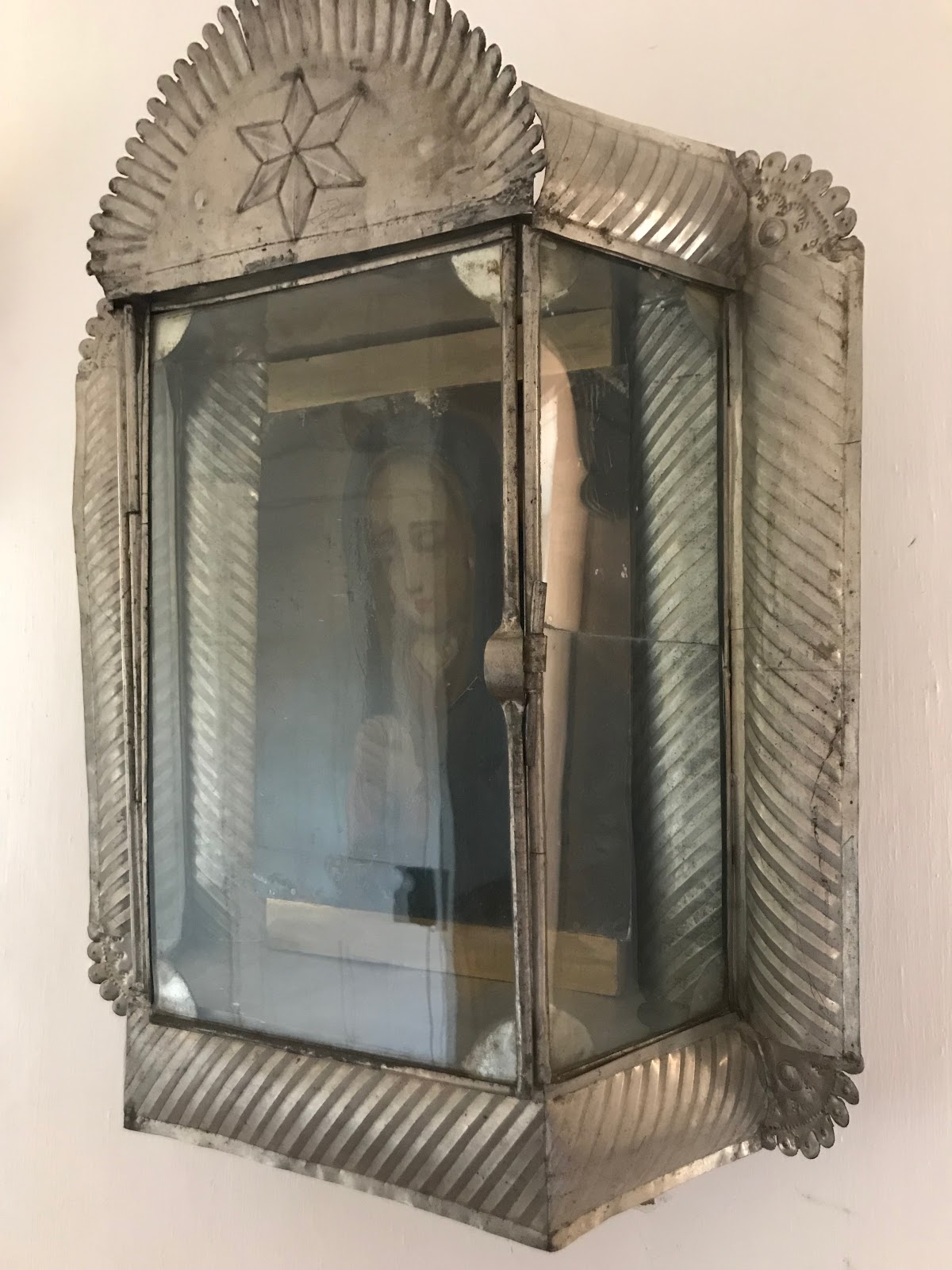
Tin and glass mini-altar, with painting of the Virgin, Baca House, Trinidad
LHP_Intern2020-01-18T05:37:54+00:00Tin and glass mini-altar, with painting of the Virgin, Baca House, Trinidad

Painting of the Virgin Mary, on Tin, from Baca House, Trinidad
LHP_Intern2020-01-18T05:36:45+00:00Painting of the Virgin Mary, on Tin, from Baca House, Trinidad

Bulto from Baca House, Trinidad, undated
LHP_Intern2020-01-18T05:36:56+00:00Bulto from Baca House, Trinidad, undated
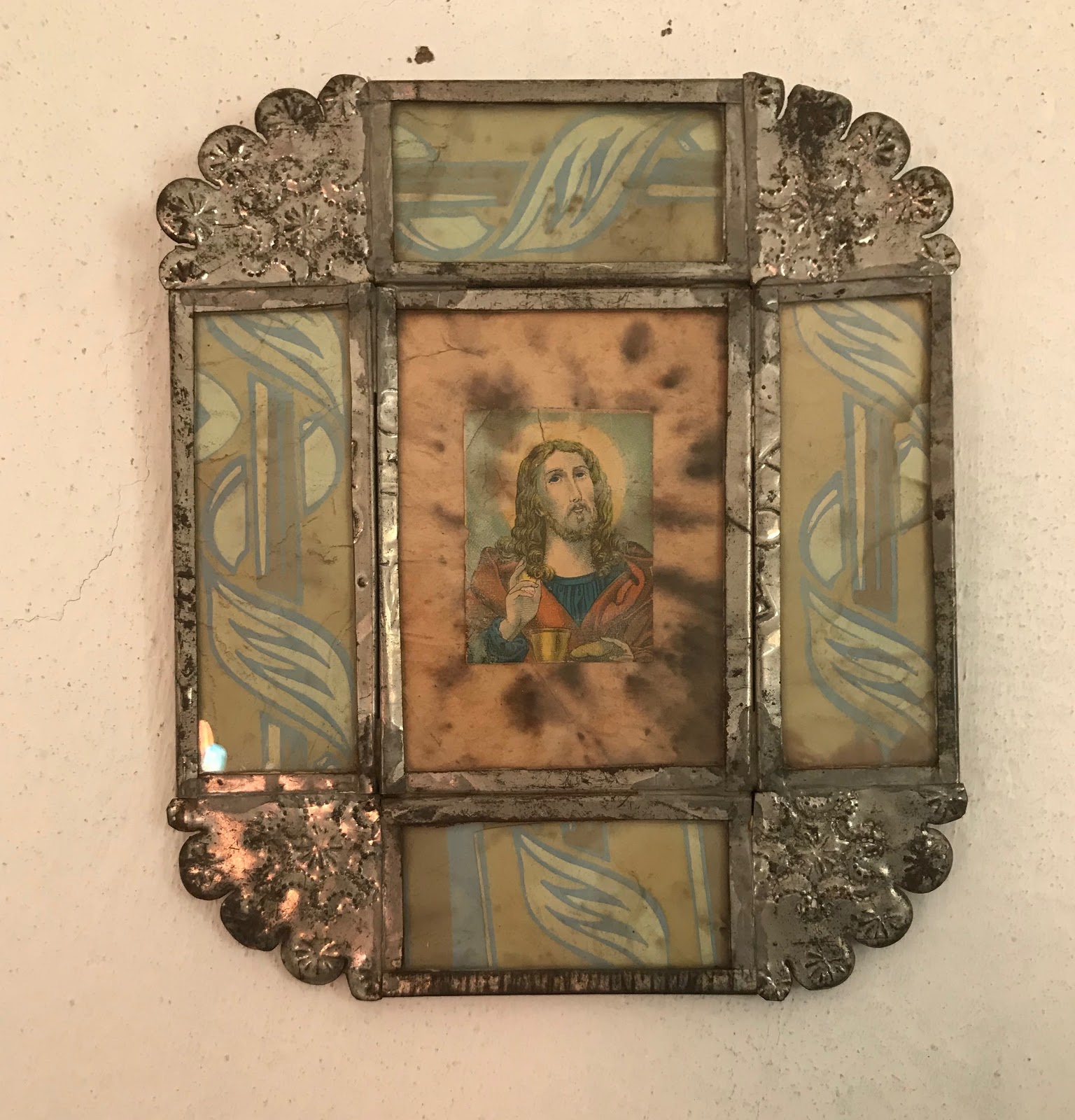
Religious object from Baca House, Trinidad
LHP_Intern2020-01-18T05:36:31+00:00Religious object from Baca House, Trinidad

Los Cordovas Church, 1895
LHP_Intern2020-01-18T05:35:58+00:00Los Cordovas Catholic Church in Los Cordovas, a settlement located along the Purgatory River, approximately two miles east of El Moro (Las Animas County). Standing in front are members of the Hispanic American congregation and the elderly José Benito Córdova and his wife Marina Rivera de Córdova, 1895

Child with rosary, 1915
LHP_Intern2020-01-18T05:35:23+00:00Studio portrait of José B. García of Gulnare (Las Animas County), holding a rosary, around 1915

Boys at Sopris dressed as miners for school pageant, 1915
LHP_Intern2019-10-11T04:30:22+00:00Boys at Sopris dressed as miners for school pageant, 1915
Boy Scouts with U.S. Flag in front of Sopris School, 1915
LHP_Intern2019-10-11T04:30:27+00:00Boy Scouts with U.S. Flag in front of Sopris School, 1915
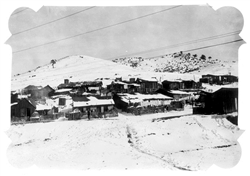
Sopris Neighborhood known as “Little Italy,” late 19th or early 20th century
LHP_Intern2019-10-11T04:30:30+00:00Sopris Neighborhood known as “Little Italy,” late 19th or early 20th century
Pueblo in 1919 and Italian Neighbors, Interview, 1980
LHP_Intern2019-09-14T20:17:22+00:00Pueblo in 1919 and Italian Neighbors, Interview, 1980 (Audio Clip)
In an interview, Theodora Valles and Tom Valles talk about their experience during the Great Depression and living in Pueblo. Here they talk about how Theodora, Toms mother, arrived to Pueblo and about her relationship with her Italian neighbors.

Award to Sopris Town, 2007, listing the camps/plazas it included
LHP_Intern2019-10-11T04:30:34+00:00Award to Sopris Town, 2007, listing the camps/plazas it included

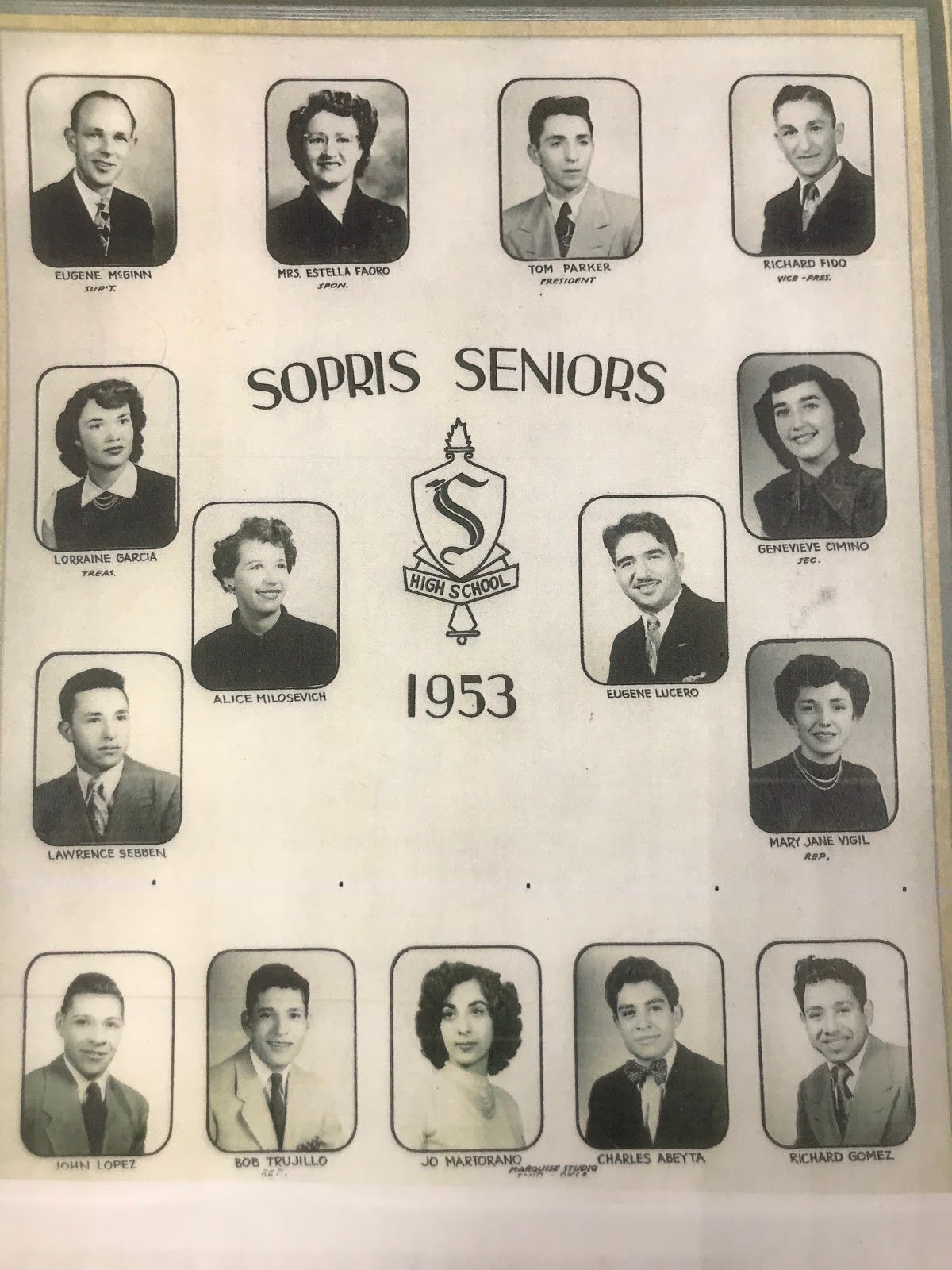
Seniors at Sopris School, Yearbook, 1953
LHP_Intern2019-10-11T04:30:41+00:00Seniors at Sopris School, Yearbook, 1953


St. Thomas the Apostle Catholic Church, Sopris
LHP_Intern2019-10-11T04:30:50+00:00St. Thomas the Apostle Catholic Church, Sopris


Students in front of Sopris School, undated
LHP_Intern2019-10-11T04:30:57+00:00Students in front of Sopris School, undated


Girls Learning to Swim, 1948
LHP_Intern2019-09-14T20:26:58+00:00A female swimming instructor with a whistle in her mouth instructs a group of girls in the Steel Company’s YMCA pool.

Women at a field day, Trinidad, 1919
LHP_Intern2019-07-05T19:13:44+00:00Three women at the women’s nail driving contest at the annual field day in Trinidad. The picnic was held on August 23, 1919 for all CF&I miners and their families from Las Animas and Huerfano Counties. Two of the women are African-Americans. Woman at left (holding hammer) is Annie Rollins from Toller.

Morley baseball team, 1926
LHP_Intern2019-06-26T17:14:17+00:00The Morley baseball team poses for picture at a Trinidad field day

CF&I Swimming Pool, 1920
LHP_Intern2019-09-14T20:29:15+00:00The large swimming pool provided for C.F. & I. Steel Workers, 1920

Parade float with coke oven, 1915
LHP_Intern2019-06-26T17:13:40+00:00A parade float in Trinidad that is a replica of a coke oven in Segundo. A young boy in overalls stands on the float, which is pulled by a horse. August 14, 1915

Feliberto Gonzáles at a bar, 1915
LHP_Intern2019-06-26T17:12:34+00:00Feliberto Gonzales stands behind a bar with a marble top, probably in a saloon in Gulnare (Las Animas County), Colorado. He holds a bottle of beer

Boys Swimming Team, 1940s
LHP_Intern2019-09-14T20:30:01+00:00Boys’ swimming team at the Steelworks YMCA, 1940s

Cock Fighting, Trinidad, 1900-1930?
LHP_Intern2019-10-11T04:31:59+00:00Cock Fighting, Trinidad, 1900-1930?

Ad for circus and parade in Trinidad, July 10, 1893
LHP_Intern2019-10-11T04:32:05+00:00Ad for circus and parade in Trinidad, July 10, 1893

Berwind Baseball Team (near Ludlow), undated
LHP_Intern2019-10-11T04:32:10+00:00Berwind Baseball Team (near Ludlow), undated

East Mills Baseball Team, 1916
LHP_Intern2019-09-14T20:31:46+00:00Winner of CF&I championship, 1916 season. Includes player named Sandoval

Trinidad High School, boys baseball team, 1914-1917
LHP_Intern2019-10-11T04:32:13+00:00Trinidad High School, boys baseball team, 1914-1917

Trinidad High School, boys basketball team, 1914-1917
LHP_Intern2019-10-11T04:32:17+00:00Trinidad High School, boys basketball team, 1914-1917
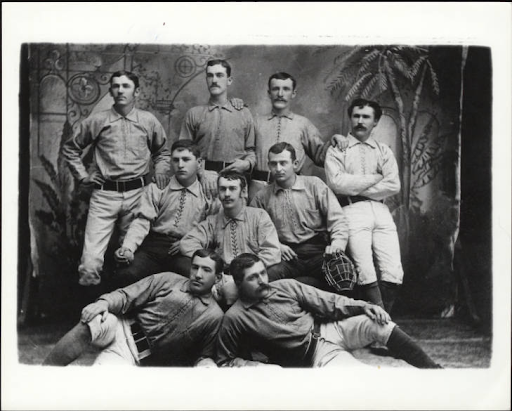
1880 Baseball Team
LHP_Intern2019-09-14T20:33:02+00:00Photo of a baseball team in a studio. All were firemen in Pueblo, Colorado, as noted on the back of the image

Girl’s Letterman Sweater, Trinidad High School, 1931
LHP_Intern2019-10-11T04:32:21+00:00Girl’s Letterman Sweater, Trinidad High School, 1931

Tradition of naming a queen at TSJC basketball tournament, 1985
LHP_Intern2019-10-09T03:10:02+00:00Lists girls and their schools, 1950-1984

Babe Ruth Visits Pueblo
LHP_Intern2019-09-14T20:33:42+00:00Black and white photo of Babe Ruth with baseball players in Pueblo, date unknown

High school girls competing for positiion of queen of TSJC’s basketball tournament, 1988
LHP_Intern2019-10-09T03:10:20+00:00The girls and their schools are listed

Trinidad State’s baseball team, 1987
LHP_Intern2019-10-09T03:10:38+00:00This team lost in the National Junior College World Series held in Gunnison

HIgh School basketball game and dance announcement, 1916
LHP_Intern2019-06-26T16:57:37+00:00Announcement about the upcoming basketball game and dance, Trinidad High School vs. HCHS

High School basketball article, 1916: both boys and girls teams
LHP_Intern2019-06-26T16:56:04+00:00Article about upcoming game between Trinidad High School and HCHS (= Huerfano County High School?), Jan. 20, 1916. The boys team had some Hispanic-named players; the girls team a few

Participants in farm workers march, 1970
LHP_Intern2019-09-14T22:07:26+00:00Photo of Pilar Media, Ernest Media, and Liz Garcia at the farm workers strike

Trinidad in sports, 1913
LHP_Intern2019-10-09T03:10:52+00:00Article lists successful boxers, city and high school baseball teams, and girls and boys high school basket ball teams

Cokedale baseball team, 1901-1920
LHP_Intern2019-10-11T04:32:25+00:00Cokedale baseball team, 1901-1920

Marchers with Huelga and Viva la Raza signs, 1970
LHP_Intern2019-09-14T22:09:24+00:00Photo of farm work strikers marching to Denver with signs

Men standing in front of locomotive at the Trinidad train depot, ca. 1915
LHP_Intern2019-10-11T04:33:05+00:00Men standing in front of locomotive at the Trinidad train depot, ca. 1915

Three trains, Trinidad-Starkville, one marked “Base Ball Today,” undated
LHP_Intern2019-10-11T04:33:09+00:00Three trains, Trinidad-Starkville, one marked “Base Ball Today,” undated

Ad for Indian “Motocycles,” for miners to use getting to the mines, 1917
LHP_Intern2019-10-11T04:33:14+00:00Ad for Indian “Motocycles,” for miners to use getting to the mines, 1917

Marchers with image of the Virgin Mary, 1970
LHP_Intern2019-09-14T22:09:44+00:00Photo of people marching to Denver holding a poster of Mother Mary
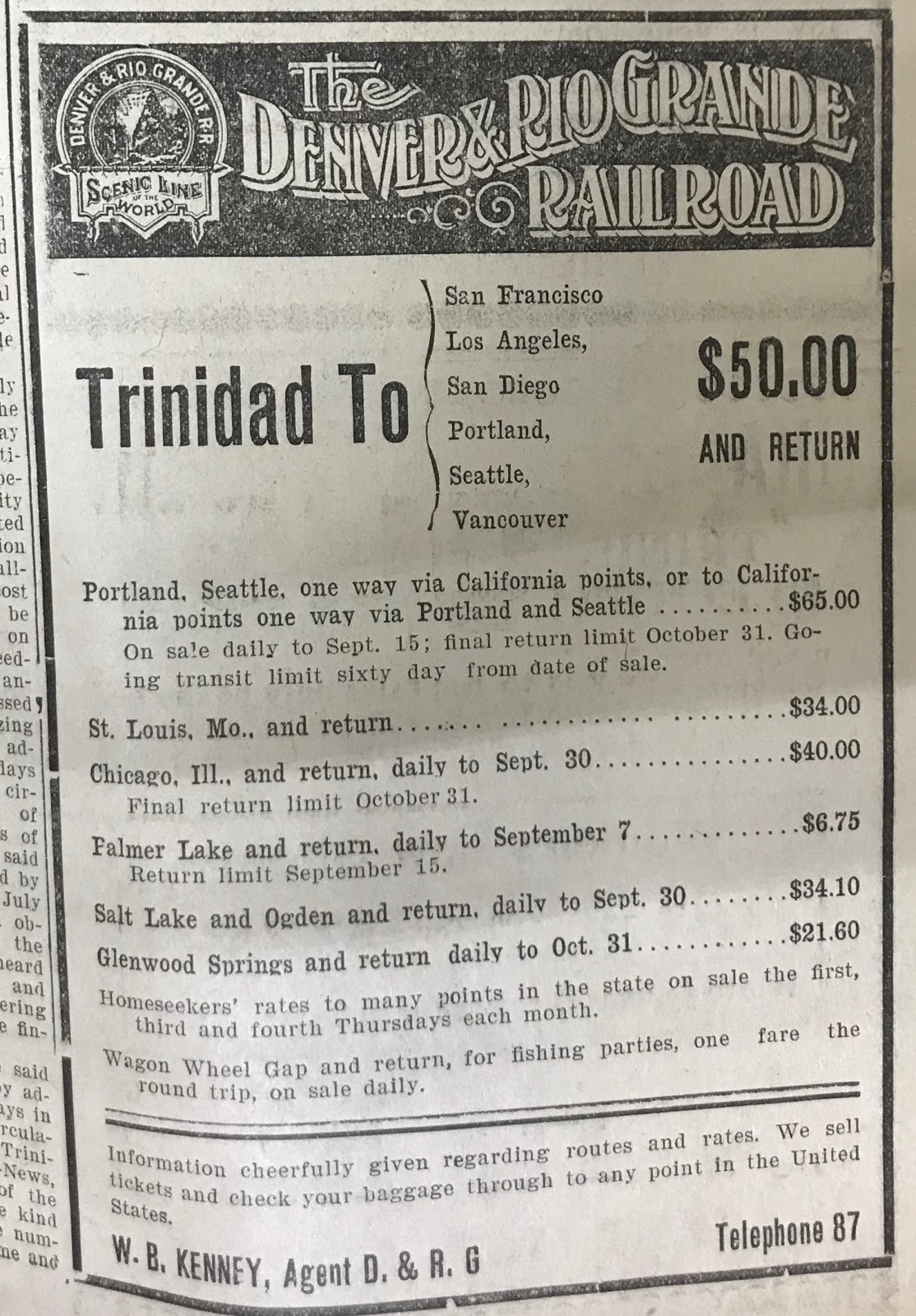
Ad for train travel from Trinidad to many major cities, on Denver & Rio Grande Railroad, 1903
LHP_Intern2019-10-11T04:33:18+00:00Ad for train travel from Trinidad to many major cities, on Denver & Rio Grande Railroad, 1903

United Farm Workers’ March, 1970
LHP_Intern2019-09-14T22:10:47+00:00Photo of striking farm workers and supporters marching from Pueblo to Denver
Video Clip from Interview with Jerald Renner, Mike Romero, and Thomas Hay, Mining & Unions.
LHP_Intern2019-05-11T22:01:53+00:002018 interview with Jerald Renner where he provides information about the daily work life in the mining sites in Trinidad. Length: 2:55.

Dr. Beshoar’s “Day Book” of treatments for UMWA members, 1913
LHP_Intern2019-10-09T03:12:53+00:00In Sept. and Oct., 2013, during a strike by United Mine Workers of America, Dr. Ben Beshoar kept a record of his treatments of union members and their families. He apparently traveled around to the various mining camps near Trinidad. This image shows the inside front cover and first page, with names of places and people and abbreviations for the medicines he administered.

Drawing of John L. Lewis, undated
LHP_Intern2019-10-11T04:33:53+00:00Drawing of John L. Lewis, undated

Start of farm workers march to Denver, 1970
LHP_Intern2019-09-14T22:11:30+00:00Photo of men in black berets gathered for the march to Denver, which started at the Dogpatch Huelga Office.

A tribute to John L. Lewis, undated
LHP_Intern2019-10-11T04:33:58+00:00A tribute to John L. Lewis, undated

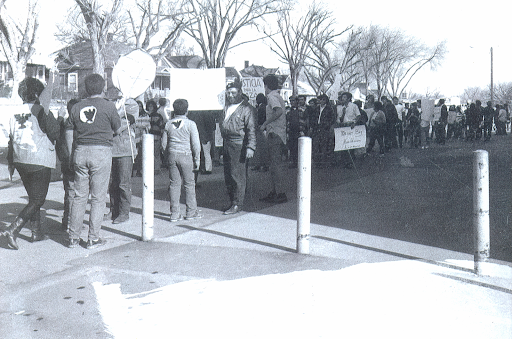
March on behalf of grape pickers
LHP_Intern2019-09-14T22:12:11+00:00Photo of march to protest sale of grapes picked by non-union workers at the Safeway on 8th Street in Pueblo, 1970?

Circular display, UMWA, undated, with Fishers Peak at top
LHP_Intern2019-10-11T04:34:06+00:00Circular display, UMWA, undated, with Fishers Peak at top

Video Clip from Interview with Shantell and Samantha, Women & Coal Mining in Trinidad.
LHP_Intern2019-07-05T19:16:29+00:00The Quintana sisters talk about the coal mines and their memories of their mom working in the Trinidad coal mine in this 2018 interview. Length: 1:00.

Picket line, farm workers’ strike, 1970
LHP_Intern2019-09-14T22:13:16+00:00Photo of a picket in front of employment office for the farm workers, protesting so people would not take work on farms. Louie Lugs is one of the protesters.

Girls cooking in Home Economics class at Sopris School, 1915
LHP_Intern2019-10-11T04:35:12+00:00Girls cooking in Home Economics class at Sopris School, 1915

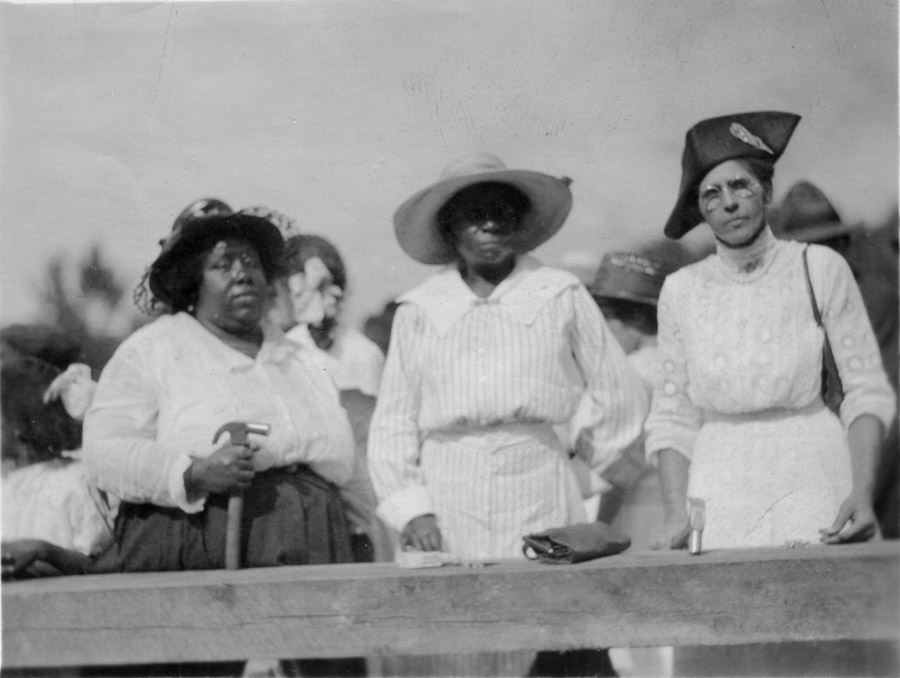
Women at a field day, Trinidad, 1919
LHP_Intern2019-05-11T21:52:49+00:00Three women at the women’s nail driving contest at the annual field day in Trinidad. The picnic was held on August 23, 1919 for all CF&I miners and their families from Las Animas and Huerfano Counties. Two of the women are African-Americans. Woman at left (holding hammer) is Annie Rollins from Toller.

Manuel Diaz, involvement with starting the CF&I union, 1978
LHP_Intern2019-09-14T22:15:42+00:00Manuel Diaz being interviewed in 1978 about his involvement in starting a representative union for CF&I workers. Among some of the experiences he talks about is some violence experienced by workers at the hands of the CF&I company.

Wooden cabinet with tin work, for keeping food
LHP_Intern2019-10-09T03:14:39+00:00Wooden cabinet with tin work, for keeping food
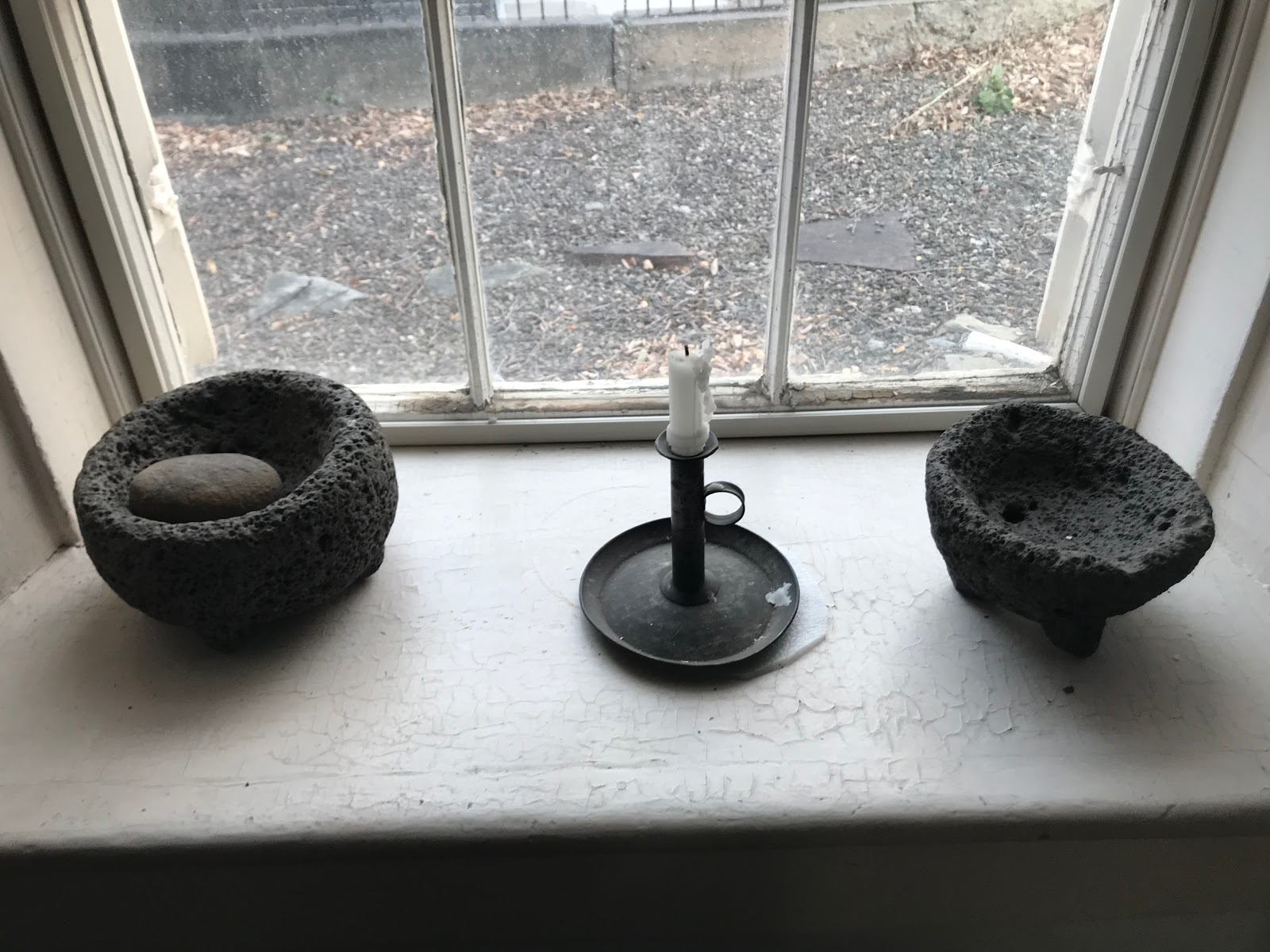
Stone mortars (molcajetes) used for grinding food
LHP_Intern2019-10-09T03:14:56+00:00Stone mortars (molcajetes) used for grinding food

Pueblo Public Metals Co. Workers on Strike for Fourth Week, 1976
LHP_Intern2019-09-14T22:17:27+00:00Mexican American workers of Pueblo Public Metals Co. have been on strike for four weeks backed up by unions. The strike which began on September 8, 1976 has held out this long because the company refuses to sit to work out better wages which is what workers like Wilfred Espinosa, who has worked there 17 years, is asking for.

Maria Onofre Paiz at Gasoline Pump on Ranch, 1920s
LHP_Intern2019-07-05T19:11:04+00:00María Onofre Paiz, a young woman, uses a handle to pump gasoline into an elevated tank outside a tin building on the Paiz Ranch in Gulnare (Las Animas County)

Juana Maria Paiz, wife of Rafael Chacon, 1880s
LHP_Intern2019-07-05T19:10:09+00:00Born March 10, 1844 in Peñasco, New Mexico, the daughter of Rafael Paiz and María Dolores Olguín. She married Rafael Chacon on April 15, 1858 in Peñasco, New Mexico. Her father and three of her brothers came to Colorado in the 1860’s. Juana and her husband came in 1872. She died in 1927 in Trinidad

Steelworkers file NRLB complaint, 1988
LHP_Intern2019-09-14T22:23:59+00:00Local 2102 of the United Steelworkers of America contends that CF&I Steel Corp. violated sections of the National Labor Relations Act. Specifically, the company is accused of failing to provide the union with information needed to settle a contract dispute after an arbitrator ruled against CF&I. The complaint stems from a three-month fight between the union and CF&I over incentive rates for arc-furnace workers.

Maria Dolores Gonzales
LHP_Intern2019-10-09T03:15:14+00:00Born in 1831 in New Mexico, she married Felipe Baca in 1846 and they later moved to Trinidad. In 1873 they moved into what is now called Baca House. She had 10 children, including Felix Baca. She handled some of the family’s accounts and investments.

Damiana Barela, 1890
LHP_Intern2019-07-05T19:08:33+00:00Damiana Rivera de Barela, wife of Colorado State Senator Casimiro Barela, poses for a portrait in an embroidered cape trimmed in fur and a hat decorated with feathers, a bow and a veil

Maria Odlia Lobato
LHP_Intern2019-07-05T19:07:26+00:00María Odila Lobato, probably in the 1920s. Her hair was styled (“marcelled”) by her cousin, Aurelia Cordova, a hairdresser in Trinidad, using a heated curling iron

Salt Creek Water System Dedicated, thanks to Union members, 1968
LHP_Intern2020-01-18T04:45:24+00:00The perseverance of 5 members of United Steelworkers of America LU 2012, finally paid off with the dedication of a community water system in Salt Creek, funded by a federal grant. Tests of 37 wells conducted by the City and County Health Dept. had shown only 4 wells with water safe to drink. The men, all employed by CF&I, are: Endy Garcia, Basic Oxygen Shop; Ray Barela, Wire Mill Drawing Room; Ted T. Lopez, Wire Mill Weigher; Stanley Gutierrez, Wire Mill Galvanizing; and Adrian Martinez, Operator, Hearth Department.

Lucia Maria Gomez Smith
LHP_Intern2019-07-05T19:06:23+00:00Lucia Maria Gomez Smith, born in Stonewall (west of Weston); photo taken around 1905

Article about new Hispanic political and benevolent organization, 1933
LHP_Intern2019-09-14T22:26:07+00:00Description of first anniversary of the distinguished Asociacion Política y Protectiva Hispano Americano, evidently based in Pueblo, a precursor to later unions

Richard Romero, killed in action in Vietnam in 1968
LHP_Intern2019-09-14T22:28:50+00:00Richard Romero, Specialist Four, HHC, 4TH TRANS CMD, ARMY SPT CMD SAIGON, 1ST LOG CMD, USARV, Army of the United States, January 12, 1947 to March 02, 1968

Veteran Juan Espinosa and his family
LHP_Intern2019-09-14T22:31:59+00:00Juan Espinosa, Vietnam War veteran, talks in 2008 about his experience coming back from war. He shares anti-war sentiments and what he did when he came back to Colorado.


Soldiers at Pueblo Army Depot
LHP_Intern2019-09-14T22:33:46+00:00African American Soldiers gathered around for a haircut. ca. 1941

Soldiers at Pueblo Army Depot
LHP_Intern2019-09-14T22:33:23+00:00African American Soldiers working on artillery shells. ca. 1941

Dona Bernarda: Image from El Pueblo Museum
LHP_Intern2019-09-14T22:41:16+00:00“Dona Bernarda Mejia Velazquez delivered over 3,000 babies in her lifetime. She came to Pueblo, Salt Creek, in 1912 from her homeland in Mexico”

Expectations of women and family life
LHP_Intern2019-09-14T22:44:18+00:00Marie (Maria) Pauline Subia tells of her family and some of the expectations they had/have of women including herself.

Marie (Maria) Pauline Subia’s experience at Colorado State College
LHP_Intern2019-09-14T22:47:59+00:00Careers that were open for women. She talks about her experience going to school at Southern Colorado State College where she started taking classes but eventually stopped due to starting her family.

People with Latino surnames, 1886-1905/6
LHP_Intern2019-09-12T14:40:31+00:00Listing of people with Latino surnames starting with G or M, 1886-1906. Occupation and place of residence given for most. Spreadsheet for use in math and/or social studies lessons (link below)
People with Latino Surnames, City Directories, G and M, 1886-1905-6

Five candidates as “Sweetheart of the Mayas,” 1943
LHP_Intern2019-09-14T22:51:23+00:00Photos of 5 of the 6 candidates for this position, chosen from the various clubs within the YWCA in Pueblo, all Latinas. They were presumably employed by CF&I.

A view of “Mexico,” 1903
LHP_Intern2019-09-12T14:42:10+00:00View of “Mexico” or “Mexican town,” described as “a picturesque settlement of foreigners in Pueblo near the smelter,” 1903

Experience with racial discrimination and dating women
LHP_Intern2019-09-14T22:47:44+00:00Ray Aguilera describing some of the challenges that he and other Mexican boys/men faced when trying to date. Women (most likely non-Mexican) were not allowed to date Mexican boys/men.

YWCA Building
LHP_Intern2019-09-14T22:49:25+00:00Young Women’s Christian Association, built in 1935. Its 14-inch thick brick walls are stuccoed, and the gabled portions of the roof are covered with red tile. Architect Walter DeMordaunt designed the building.

Children of “Mexico,” 1903
LHP_Intern2019-09-12T14:42:46+00:00Photo of some of the children of “Mexico,” a neighborhood in Pueblo, 1903
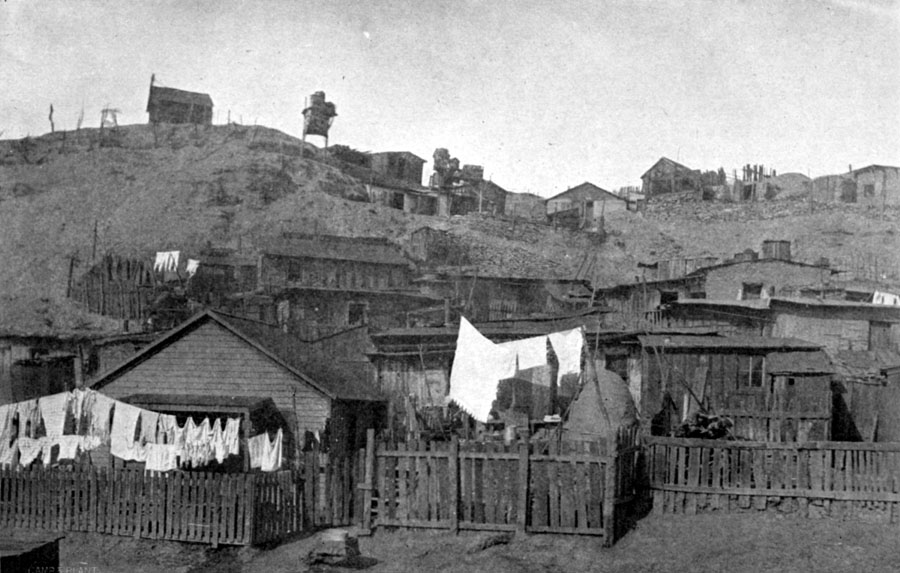
“Mexico” neighborhood, 1903
LHP_Intern2019-09-12T14:43:38+00:00A general view of “Mexico” in Pueblo, 1903

Salt Creek, 1902
LHP_Intern2019-09-12T14:44:14+00:00Photo of Salt Creek, described as a “Mexican Settlement,” 1902

Maria Trujillo-Sandoval, painting
LHP_Intern2019-09-12T14:45:20+00:00Sketched by Alexander Barclay, 1853

Portrait of Maria de la Luz Trujillo-Sandoval, 1890s
LHP_Intern2019-09-12T14:46:08+00:00Born in 1830, she married Charles Archibald Metcalf, a trader, and pioneer in Pueblo, in 1845. Charles had been trapping/ trading with Indian tribes from the small fort located in what is now Pueblo; after marriage, they lived in the fort and she helped run the trading post. Maria was one of the earliest women to live in the Pueblo area. She died in 1910

Community Demonstrations against English only, 1988
LHP_Intern2019-09-12T14:14:32+00:00Article excerpt from Ya Basta! explaining the press conference held in Pueblo demanding an investigation of Secretary of State Steve Meyer and State Representative Philip over the English only initiative.
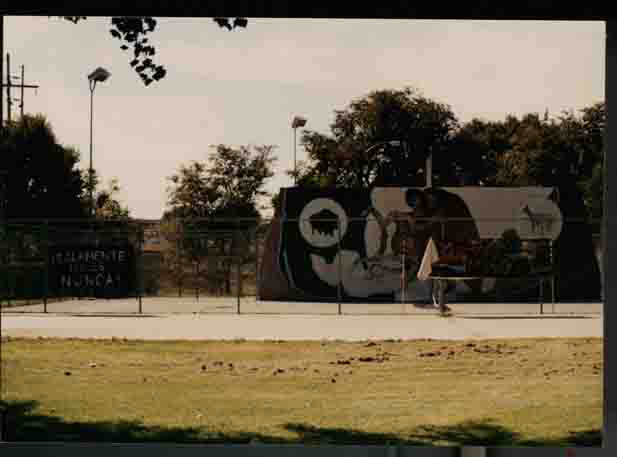
English Only Protests
LHP_Intern2019-09-12T14:16:29+00:00Photo of a sign on a fence that reads, “!Solamente Ingles Nunca!” , murals and poster in the background, ca. 1980s.
Photo of a sign on the other side of the fence that reads, “English only never!” ca. 1980s.

Protest Against English Only
LHP_Intern2019-09-12T14:17:14+00:00Drawing of a headstone that reads, “English only is cultural death,” with a hand emerging from behind writing “Deny our language, deny our roots, deny our culture.”
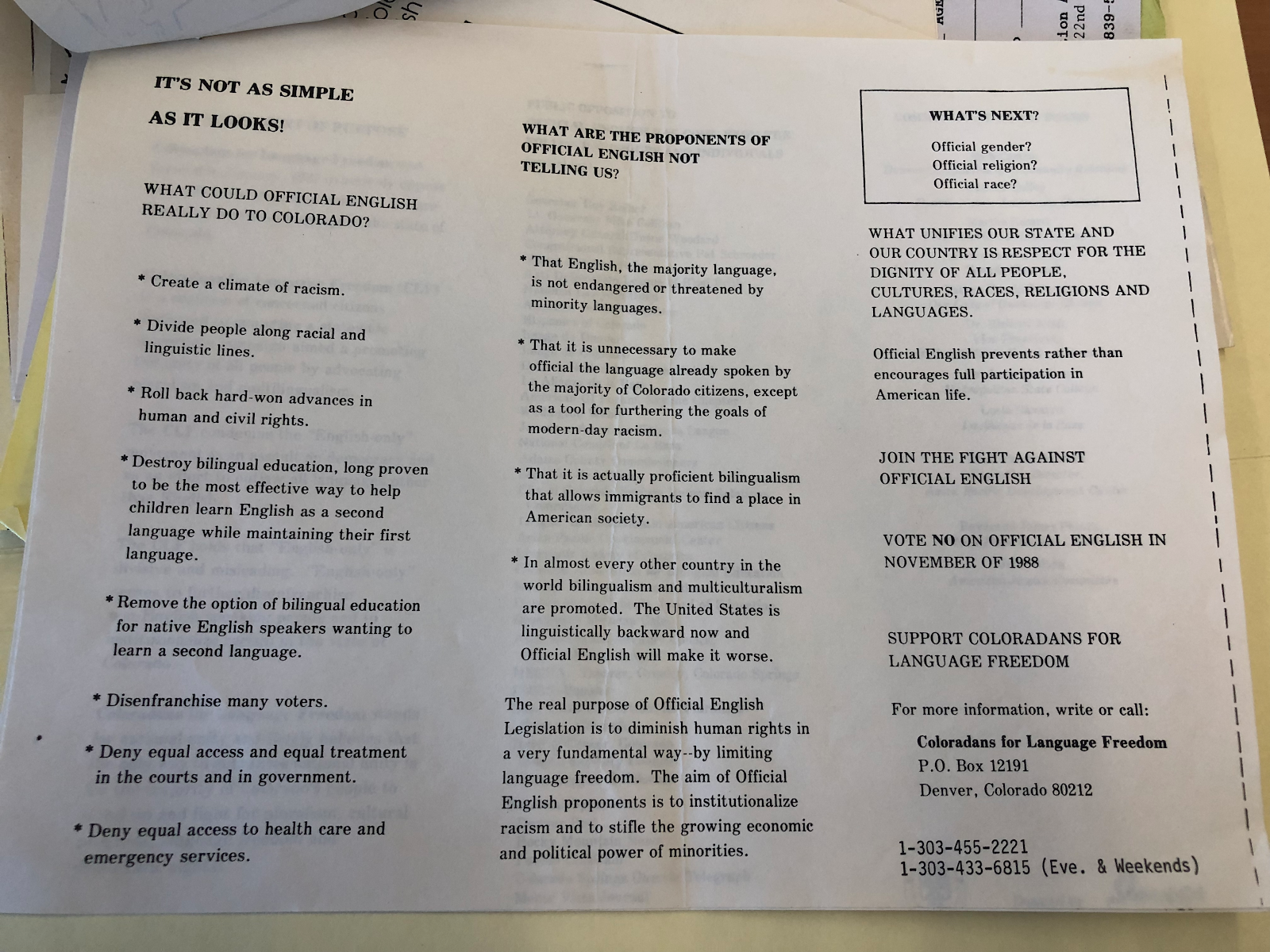
What Will English Only Really Do?
LHP_Intern2019-09-12T14:18:57+00:00Printed list of consequences of the English-Only movement and what people can do to help.

Political Cartoon
LHP_Intern2019-09-12T14:20:44+00:00Cartoon depicting a Klan member attempting to vote, speaking in very poor English. Shows that whites are equally as illiterate in English as Chicanos.

What People Are Saying About English Only
LHP_Intern2019-09-12T14:21:22+00:00Handout titled “What the People Are Saying About the English-Only Movement,” and a list of quotations from various people throughout Colorado.

Strong feelings over victory of “English only” campaign, 1988
LHP_Intern2019-09-12T14:22:17+00:00After the victory of the official English victory, opponents say they fear rash of discrimination.

Pueblo paper recommends “No” vote on official English, 1988
LHP_Intern2019-09-12T14:23:05+00:00Main editorial, Oct. 14, 1988: “Now it’s on the ballot: Vote no on official English.” It calls the measure “ugly racism.”

Catholic Crosswinds on English Only
LHP_Intern2019-09-12T14:23:49+00:00Article published in the Catholic Crosswinds decrying the English only movement, 1987

X-Mas Events Advertisement for December 1976
LHP_Intern2019-09-12T14:01:42+00:00Advertisement in section of La Cucaracha for X-Mas events. Some of the events include Christmas tree decorating contests and a Christmas party in El Centro del Quinto Sol.

Diesiseis de Septiembre
LHP_Intern2019-09-12T14:06:11+00:00Photo of the Diesiseis de Septiembre celebration on September 16th, 1989 in Pueblo, Colorado.

Diesiseis de Septiembre
LHP_Intern2019-09-12T14:04:19+00:00Photo of the Coca Family playing musical instruments on September 16th, 1989 at the Diesiseis de Septiembre celebration in Plaza Verde Park


Pueblo Mexican-Americans
LHP_Intern2019-09-12T14:07:13+00:00Photo of women dancing at the Colorado State Fair Fiesta Day, Spring 1977.
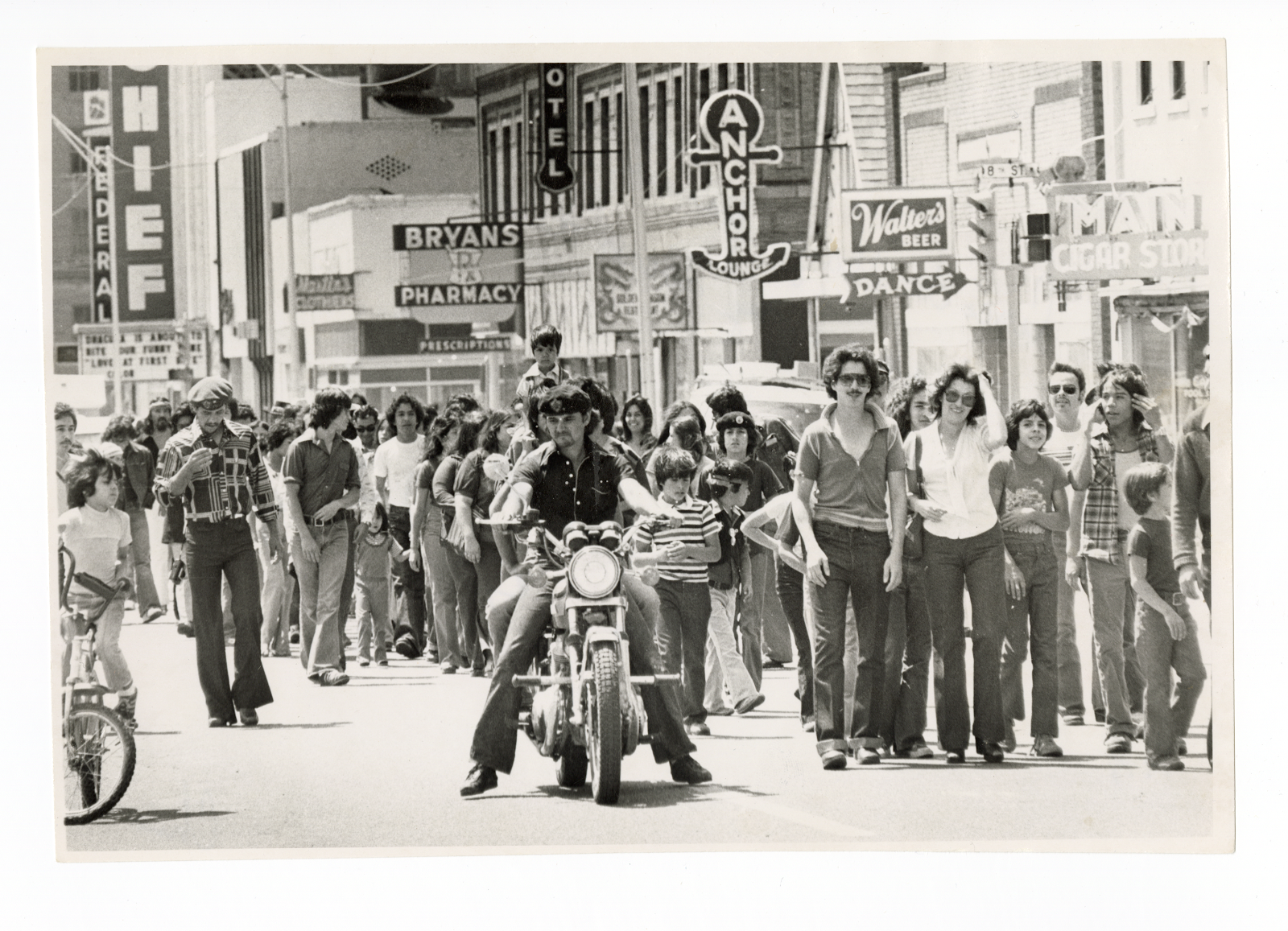
Cinco De Mayo
LHP_Intern2019-09-12T14:08:57+00:00Cinco de Mayo Parade makes its way down Main Street in 1979

Cinco De Mayo Celebrations
LHP_Intern2019-09-12T14:09:22+00:00Multiple festivities are under preparation for 5 de Mayo 1976 including events by La Raza Unida and the Chicano Coalition. Pueblo Natives like Eppy Santova also recall how the events used to take place in the 30s and 40s.

Molten steel and slag on the casting floor, 1966
LHP_Intern2019-12-13T20:42:06+00:00Molten steel and slag in ditches on the casting floor. Three workers are seen wearing safety gear. January, 1966.
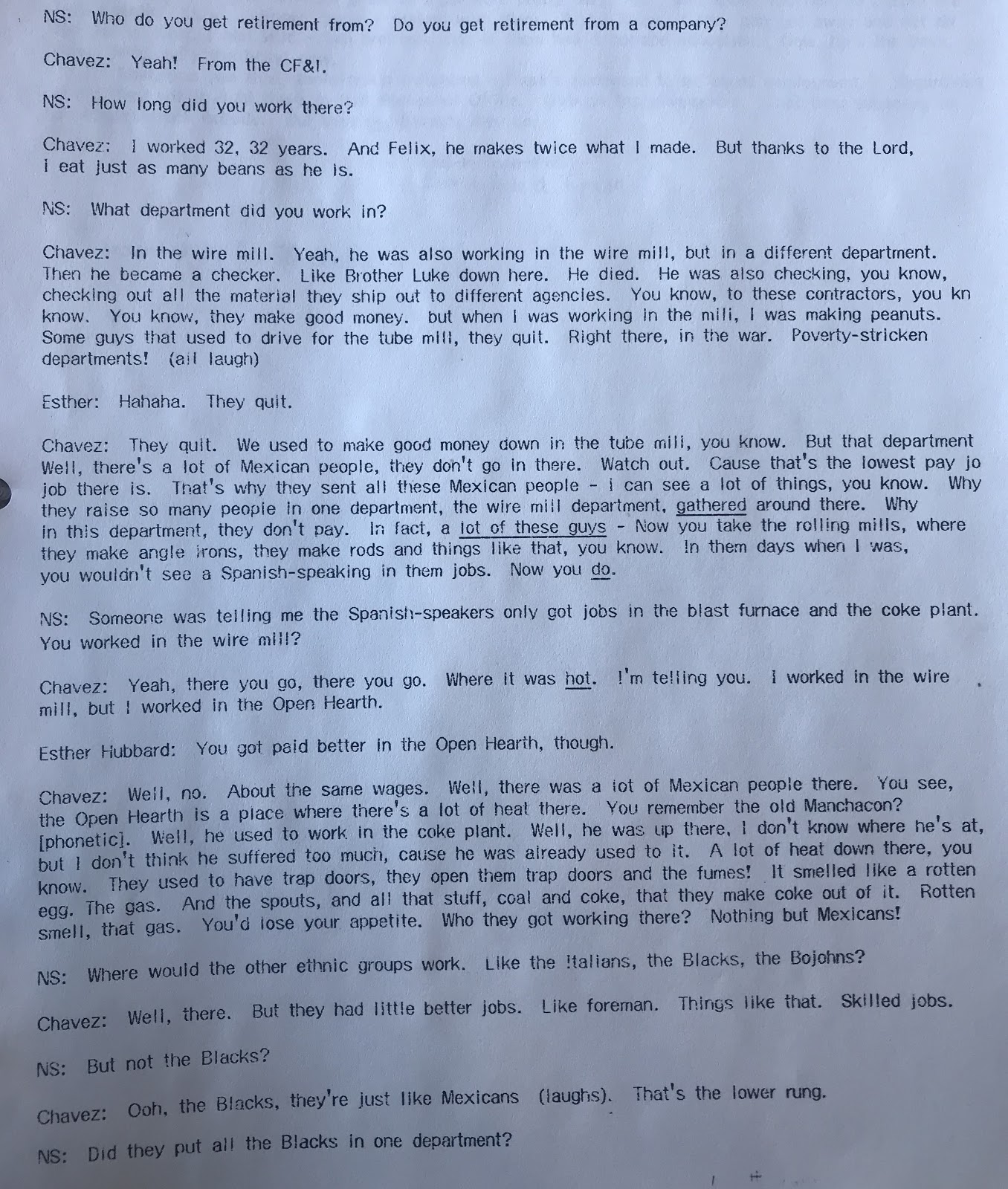
Joe Chavez, Retiring from CF&I, discrimination witnessed at CF&I
LHP_Intern2019-12-13T20:43:24+00:00In 1978 Joe Chavez recalls the one of the departments he worked in and the conditions that he had to work under. In his description, he also talks about how Mexicans were put in the lowest paying and often most tiring departments.

Joe Chavez, Working at the Pueblo smelter, interactions between Mexicans and Spanish Americans
LHP_Intern2019-12-13T20:47:14+00:00In 1978 Joe Chavez shares a story of when he used to work at the Pueblo smelter. In this story he got into a fight with other workers. Joe Chavez’s story highlights some of the tensions between Mexicans, and as Chavez puts it, Spanish Americans.

Colorado Fuel and Iron Company Charged with Race and Sex Discrimination, 1976
LHP_Intern2019-12-13T20:47:53+00:00Front page news article of October 1976 from La Cucaracha explaining the investigations into the Pueblo plant, which has racially and sexually discriminated against employees with “Spanish surnames.”

Workers outside north entrance of the Wire Mill, 1965
LHP_Intern2019-12-13T20:51:10+00:00Four workers outside of north entrance of the Wire Mill holding belt buckets and jackets awarded to them for breaking safety records. From left: Fred Pohill, Don Anderson, “Hoss” Trujillo, and John Kambich, 1965

Workers near sulfurization unit, undated
LHP_Intern2019-12-13T20:53:54+00:00Two workers standing near the sulfurization unit, undated photo

Gilbert Trujillo, journeyman electrician, 1962
LHP_Intern2019-12-13T20:54:34+00:00Worker Gilbert Trujillo, journeyman electrician, at a machine. Picture taken for CF&I Blast’s “Hand Tools” story, February 16.

Julian Gallegos lifting nails, 1964
LHP_Intern2019-12-13T20:55:09+00:00Worker Julian Gallegos lifting boxes of nails, February 11, 1964

Workers in the Steel Production department, 1979
LHP_Intern2019-12-13T20:56:06+00:00Workers in the Steel Production department. Worker standing with his back to the photographer is Larry Trujillo, continuous caster helper. Workers on lower level are mould helpers Eloy Arellano, Ray Guerro, and Joe Alvarado. February 09, 1979

Aerial photograph of Pueblo Plant looking W, 1962
LHP_Intern2019-12-13T20:56:21+00:00Aerial photograph of Pueblo Plant looking west. In view are east slag piles, entire mill, Bessemer neighborhood, and Salt Creek neighborhood. April 13, 1962.
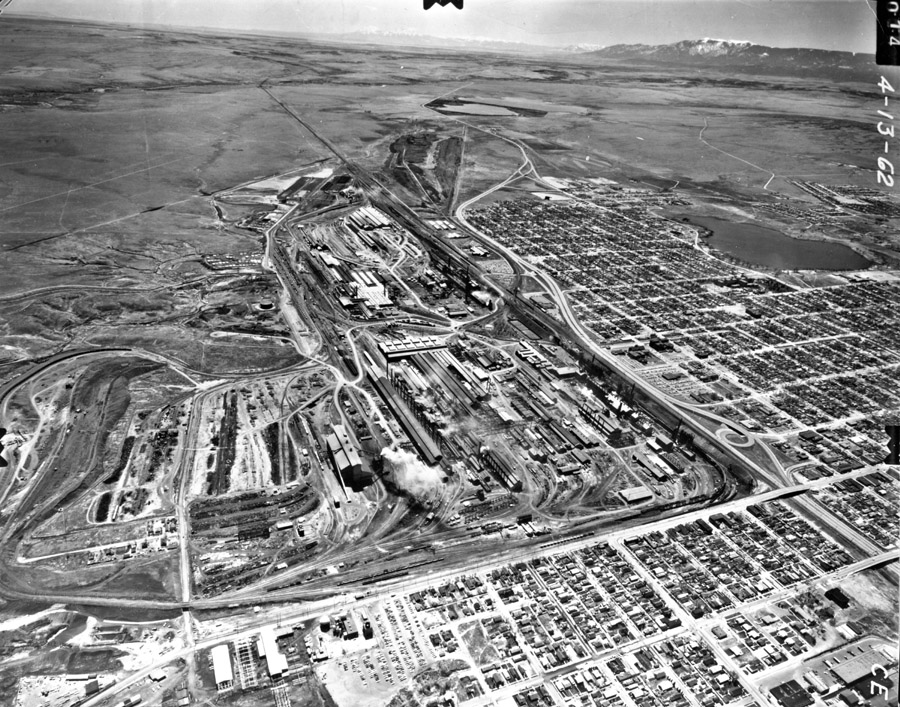
Aerial view of CF&I Pueblo Mills looking SW, 1962
LHP_Intern2019-12-13T20:56:35+00:00Aerial view of CF&I Pueblo Mills, looking southwest toward the Spanish Peaks, April 13, 1962

CF&I Plant, c. 1908
LHP_Intern2019-12-13T20:56:53+00:00Photo of Colorado Fuel & Iron Plant in Pueblo around 1908

Wedding Photo, 1920s
LHP_Intern2019-09-11T03:45:03+00:00Mr. Pasqual Chacon (bridegroom), Lee Martinez’s Parents, Bride (Gomecinda) of Pasqual, ca. 1920’s; Salt Creek.

Salt Creek Wedding Photo, 1927
LHP_Intern2019-09-11T03:45:48+00:00Left to right: Carmen Perez Moreno, Macario Chavez, unknown young girl, Blanco, Bride and Groom–Epifania Hernandez and Mariano Nunez, 1927.

Salt Creek Wedding Photo, 1920s
LHP_Intern2019-09-11T03:47:21+00:00In back: Jim Chavez and Maclovia Chavez, Alcadio Rodriguez, (related to Lee’s Mother), 1920’s.

Hiding Mexican food while in school
LHP_Intern2019-09-11T03:56:59+00:00Joe Chavez recalls in a 1978 interview being embarrassed about taking Mexican food like burritos to school, so he would hide it under a bridge and go get it after school.

Vera Hernandez Esquibel Quote
LHP_Intern2019-09-13T03:03:27+00:00“In Salt Creek, we had no grass. At Roselawn, the cemetery had the grass so us kids would play on the grass while they would have the service of the dead person. That was our playground. But, we were only allowed to go when there was a funeral.”

Children with Adobe Oven
LHP_Intern2019-09-11T04:00:01+00:00Italian and Mexican families built outdoor ovens of adobe bricks, plastered with mud. Fires were burned inside the ovens for an hour or two. With the walls hot, the ashes were raked out and pans of bread and pastries were shoved inside with a long-handled paddle. The opening was covered. The hot walls did the baking. Boys wore knee pants, held up by suspenders, or bib overalls. Like their mothers girls wore sun bonnets. This house was made of cottonwood logs, standing upright, then plastered with adobe mud.

Rita Martinez recalls Columbus Day Protest
LHP_Intern2019-09-11T03:07:55+00:00Excerpt from 2014 interview of Rita Martinez talking about Columbus Day Protests in Pueblo, Colorado. She talks about counter-events to Columbus day.

Chicano Studies at CSU Pueblo (video)
LHP_Intern2019-09-14T13:58:25+00:00George Autobee Chicano Studies at CSU Pueblo (Video Clip)
2016 interview of George Autobee talking about being involved with student activism and pushing for Chicano Studies courses at CSU Pueblo.

Juan Espinosa recalls Dia de la Raza
LHP_Intern2019-09-11T03:18:48+00:00In a 2014 interview, Juan Espinosa talks about Dia de la Raza as a counter event to Columbus Day celebrations in Pueblo, Colorado.

Coors Boycott Rally., 1970s
LHP_Intern2019-09-11T03:20:36+00:00Photo from the Coors boycott rally, “Coors does not practice fair employment,” ca. 1970-79.

Dora Esquibel Weapons Case, 1970s
LHP_Intern2019-09-11T03:22:07+00:00Photo of people of all ages gathered in response to the Dora Esquibel case, ca. 1970s.

“In memory of the late UMAS program,” University of CO-Boulder, 1974
LHP_Intern2019-09-11T03:27:05+00:00Symbolic memorial created for the UMAS program, 1974.

March, 1977
LHP_Intern2019-09-11T03:29:36+00:00Photo of people marching through the street, holding a banner equating Colorado to Nazi Germany, summer 1977.

No Justice, 1979
LHP_Intern2019-09-11T03:35:22+00:00Francisco Coca, Aguilar, addresses crowd in front of County Courthouse following parade Saturday. The head of statue in front of the court house was covered by one in the crowd to signify that justice ‘does not exist’ for Chicano people. Cinco de Mayo, 1979.

Commemoration of “Louie Lugs” Garcia, a Salt Creek activist, 2008
LHP_Intern2019-09-11T03:39:29+00:00“¡Que viva Louie Lugs! Louis Lugs fought hard for Salt Creek barrio”. His real name was Louis Garcia.
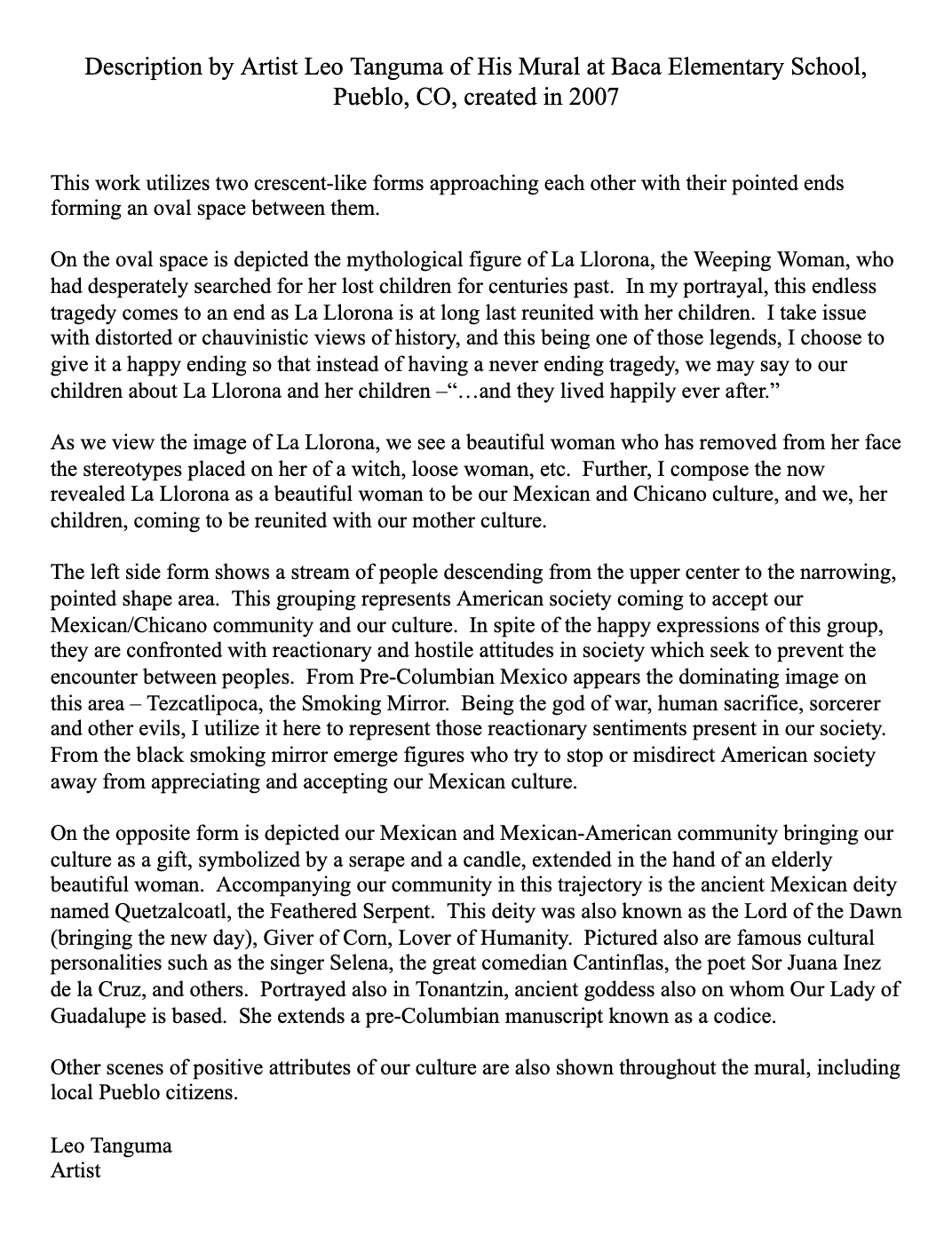
Explanation by Leo Tanguma of his mural at Baca Elementary School
LHP_Intern2019-09-11T02:42:26+00:00The artist’s description of the figures and symbolism in the mural, done in 2007

Mural at Baca Elementary School
LHP_Intern2019-09-11T02:43:39+00:00Mural created by artist Leo Tanguma in 2007. The school is located at 2800 E. 17th Street in Pueblo.

Mexican-American Women Dancing, 1976
LHP_Intern2019-09-11T02:44:47+00:00Mexican-American women in traditional dresses dancing with guns, ca. 1976

Girls Dancing, 1977
LHP_Intern2019-09-11T02:46:51+00:00Young Mexican-American girls in traditional dress dancing, 1st Cinco de Mayo, Musical Palace, 1977

Obituary for Abel Juan “Santos” Martinez, guitar player, 1997
LHP_Intern2019-09-11T02:48:12+00:00“Celebrations will miss Martinez, his guitar.” About Abel Juan “Santos” Martinez, who walked around Pueblo playing his guitar, dressed in a mariachi outfit. He played at Cinco de Mayo and Sept. 16th (Mexican Independence) celebrations.

Musician performing for group going on farmworkers’ strike, 1970
LHP_Intern2019-09-11T02:49:15+00:00Photo of people gathered for the march from Pueblo to Denver on behalf of striking farm workers watching a musician.

Top Mexican Entertainers Give Concert in Pueblo, 1976
LHP_Intern2019-09-11T02:51:23+00:00La Cucaracha article detailing the performers that gathered in Pueblo for concert on October 16. 1976. Some of the performers included Juan Gabriel and Lola Beltran.
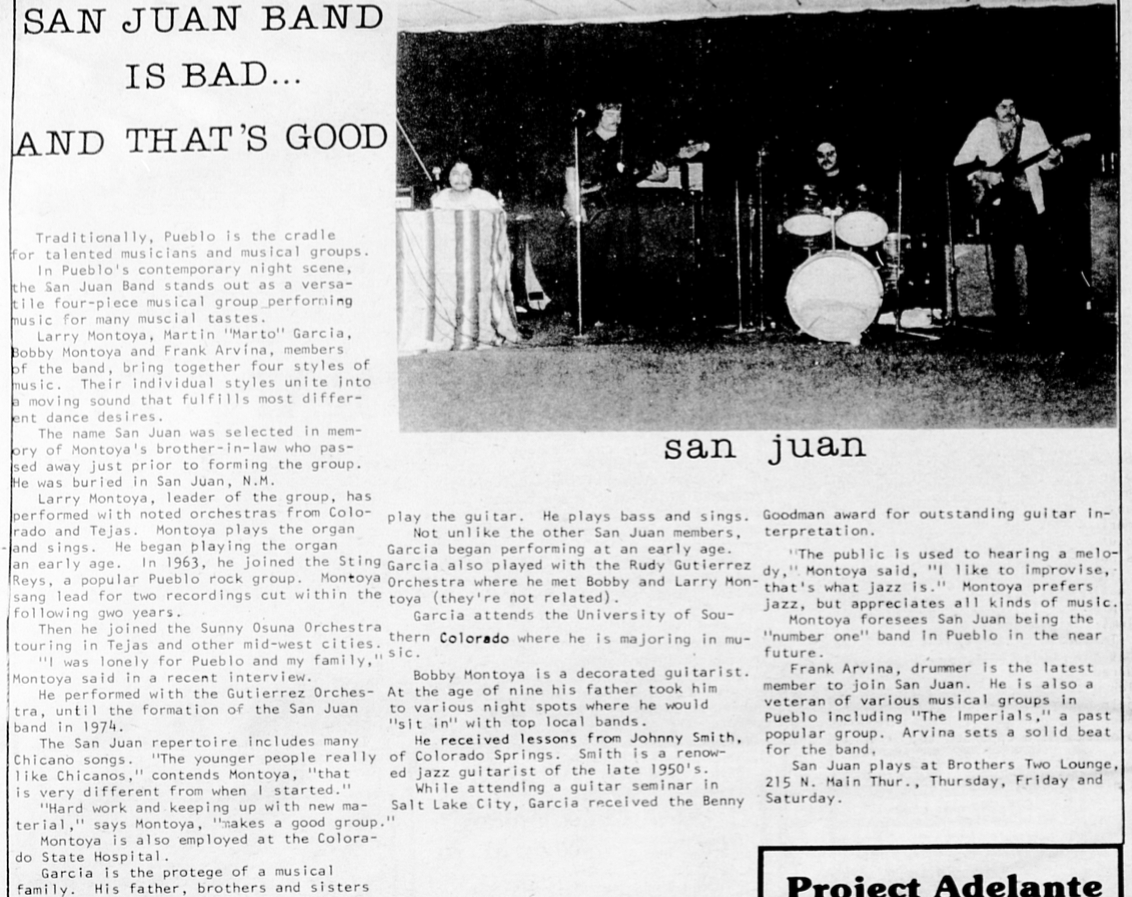
San Juan Band, 1976
LHP_Intern2019-05-10T19:53:52+00:00Members of the San Juan Band in Pueblo are introduced in this article. Larry Montoya and his family make up the band which play many old Chicano songs with their own twist.

Coca Family playing at Diesiseis de Septiembre event, 1989
LHP_Intern2019-09-11T02:52:48+00:00Photo of the Coca Family playing musical instruments on September 16th, 1989 at the Diesiseis de Septiembre celebration in Plaza Verde Park

Article about Francisco Coca, musician and activist, and his family, 1988
LHP_Intern2020-01-18T17:14:49+00:00Francisco Coca “brings decades of tradition,” playing guitar and singing at Cinco de Mayo festivities in Pueblo’s Bessemer Park. From Aguilar, he performs with his wife and children, as La Familia Coca, doing a mixture of “old timers,” including songs from the Mexican Revolution of 1910, and contemporary songs like “Campesino” (farm workers) and “Learn to Read,” from the Nicaraguan revolution.

Mo Valdez with color supplies, 2016
LHP_Intern2019-09-11T02:58:11+00:00Valdez is an artist who produces posters for such organizations as Walt Disney, Fox Broadcasting, and individual movies.

Screen-printer Mo Valdez
LHP_Intern2019-09-11T03:00:42+00:00Mathias (“Mo”) Valdez at work in Pueblo, 2016

Robert Hoag Rawlings Public Library “Corazon del Pueblo” mural, 2012
LHP_Intern2019-09-11T03:02:01+00:00David Ocelotl Garcia’s mural ‘Corazón del Pueblo’. This mural is a visual representation of the prominent Pueblo community members as well as important cultural symbols that make up Pueblo.

At a meeting to make Alamosa more beautiful, most presentations were in English but one in Spanish
LHP_Intern2019-09-24T06:11:32+00:00At a meeting to make Alamosa more beautiful, most presentations were in English but one in Spanish

The newspaper office for El Heraldo del Valle
LHP_Intern2019-10-11T03:50:09+00:00The newspaper office for El Heraldo del Valle, a Spanish Language, Republican newspaper in San Luis, with men standing in front; photo taken 1900-1910. The two story house next door belonged to José Ramos Valdéz (8th from left), a school teacher, translator, poet and editor/publisher of El Heraldo. José Candelario de la Luz Valdéz (5th from the left) was the owner of a general mercantile store, the Costilla County Treasurer, Justice of the Peace, and County Sheriff

San Luis Valley paper announces a new Spanish page for the large % of the Valley’s population who speak Spanish
LHP_Intern2019-09-24T06:22:35+00:00San Luis Valley paper announces a new Spanish page for the large % of the Valley’s population who speak Spanish
 Teacher re-hired for the Mexican school south of the tracks, so it must have continued despite previous order allowing children to attend the school nearest them Gallery
Teacher re-hired for the Mexican school south of the tracks, so it must have continued despite previous order allowing children to attend the school nearest them
Teacher re-hired for the Mexican school south of the tracks, so it must have continued despite previous order allowing children to attend the school nearest them
LHP_Intern2019-09-24T05:52:35+00:00Teacher re-hired for the Mexican school south of the tracks, so it must have continued despite previous order allowing children to attend the school nearest them
 Court decides school case in favor of plaintiff, Francisco Maestas, on behalf of his son Miguel, against local school board; Spanish speaking people believe that segregation is based on race, which must be eradicated Gallery
Court decides school case in favor of plaintiff, Francisco Maestas, on behalf of his son Miguel, against local school board; Spanish speaking people believe that segregation is based on race, which must be eradicated
Court decides school case in favor of plaintiff, Francisco Maestas, on behalf of his son Miguel, against local school board; Spanish speaking people believe that segregation is based on race, which must be eradicated
LHP_Intern2019-09-24T05:53:51+00:00Court decides school case in favor of plaintiff, Francisco Maestas, on behalf of his son Miguel, against local school board; Spanish speaking people believe that segregation is based on race, which must be eradicated
 Pleadings in case of Frank Maestas vs. School Board; “most of our citizens”think the current arrangement is fine, but the several hundred Spanish Americans think their children are not being treated justly Gallery
Pleadings in case of Frank Maestas vs. School Board; “most of our citizens”think the current arrangement is fine, but the several hundred Spanish Americans think their children are not being treated justly
Pleadings in case of Frank Maestas vs. School Board; “most of our citizens”think the current arrangement is fine, but the several hundred Spanish Americans think their children are not being treated justly
LHP_Intern2019-09-24T05:55:32+00:00Pleadings in case of Frank Maestas vs. School Board; “most of our citizens”think the current arrangement is fine, but the several hundred Spanish Americans think their children are not being treated justly

State Board of Education says it cannot stop segregation of Mexican children in Alamosa in a special school
LHP_Intern2019-09-24T06:00:23+00:00State Board of Education says it cannot stop segregation of Mexican children in Alamosa in a special school
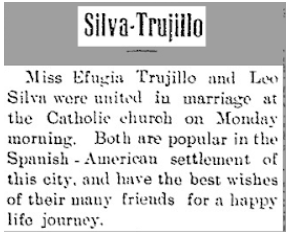
Marriage of a couple said to be popular with the Spanish-American settlement in Alamosa
LHP_Intern2019-05-09T03:35:15+00:00Marriage of a couple said to be popular with the Spanish-American settlement in Alamosa

An old shoe-repair shop in Antonito in Conejos County, near the New Mexico border
LHP_Intern2019-09-22T00:53:05+00:00An old shoe-repair shop in Antonito in Conejos County, near the New Mexico border

Desiderio “Dario” Gallegos owned a mercantile store in San Luis (Costilla County). Photo taken probl. in 1870s.
LHP_Intern2019-09-22T00:54:35+00:00Desiderio “Dario” Gallegos owned a mercantile store in San Luis (Costilla County). Photo taken probl. in 1870s.

Merchants also appealing to Spanish-speaking men, in a largely Anglo paper
LHP_Intern2019-09-22T00:56:21+00:00Merchants also appealing to Spanish-speaking men, in a largely Anglo paper

Anglo merchants were trying to attract Spanish-speaking customers, including women
LHP_Intern2019-09-22T00:58:04+00:00Anglo merchants were trying to attract Spanish-speaking customers, including women
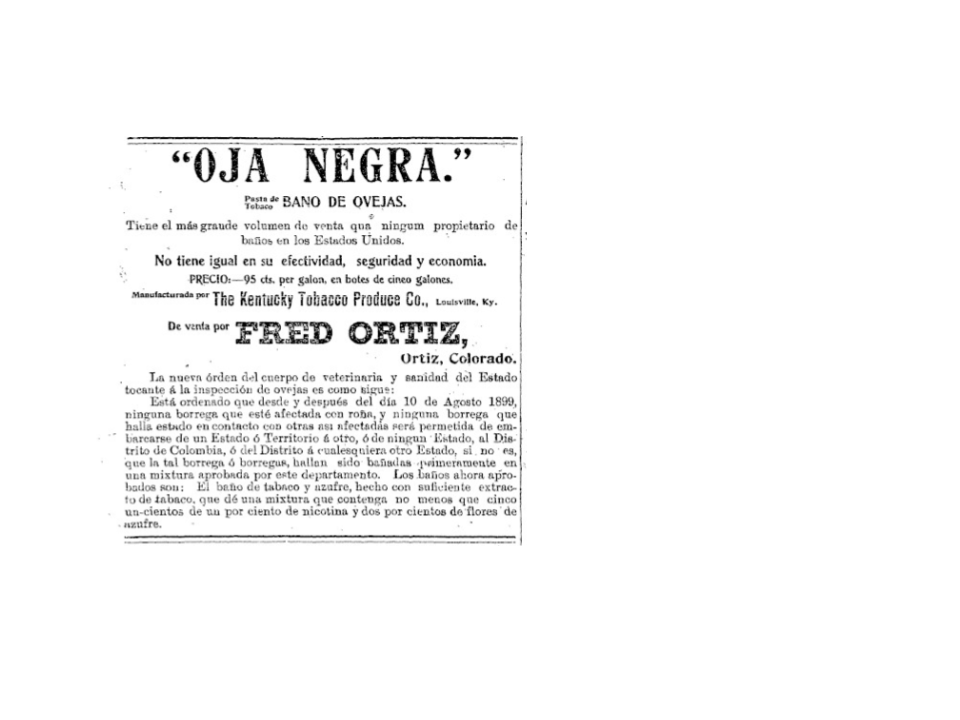
Advert by a Hispanic selling veterinary supplies
LHP_Intern2019-09-22T00:59:34+00:00Advert by a Hispanic selling veterinary supplies

A Hispanic professor, “one of the best Spanish scholars in the valley,” is offering lessons
LHP_Intern2019-09-22T01:01:40+00:00A Hispanic professor, “one of the best Spanish scholars in the valley,” is offering lessons

Adverts for family of Hispanic jewelers, silversmiths, and watchmakers, in San Luis, one perhaps a woman
LHP_Intern2019-09-22T01:08:25+00:00Adverts for family of Hispanic jewelers, silversmiths, and watchmakers, in San Luis, one perhaps a woman

Trujillo house before preservation.
LHP_Intern2020-01-18T04:09:28+00:00It is interesting that a Hispanic-American settler chose to build a two-story log house rather than an adobe building.

El movimiento artwork
LHP_Intern2019-12-13T20:32:25+00:00Paintings from the El Movimiento period of Chicano activism, 1960s-70s, as displayed in an exhibit.
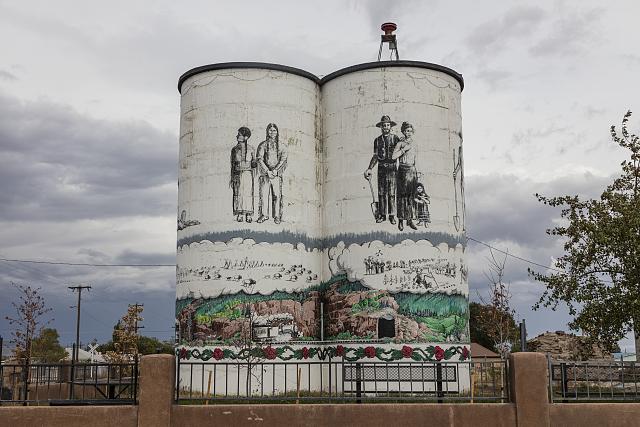
Storage towers, Antonito
LHP_Intern2019-12-13T20:32:51+00:00Carefully decorated storage towers in the town of Antonito

Water serpent mural, Antonito
LHP_Intern2019-12-13T20:33:21+00:00The “Great Water Serpent of the Rio Grande” mural on a Save the Children building in the town of Antonito

Antonito band to play
LHP_Intern2019-12-13T20:33:51+00:00Band from Antonito to play at a celebration in Los Pinos, with dancing, 1900 (article in Spanish)

Weaving tools
LHP_Intern2019-12-13T20:34:17+00:00A spindle and bowl made by Alberto Lobato and two hand carders used by weaver María Salomé Córdova, his mother, 1940s

Hand woven blanket
LHP_Intern2019-12-13T20:34:54+00:00A hand-woven Rio Grande style blanket made at a WPA sponsored weaving project in San Luis (Costilla County), 1940s

San Luis Institute chorus, 1953
LHP_Intern2019-12-13T20:35:23+00:00Members of the San Luis Institute chorus pose around an upright piano at the San Luis Institute of the Arts and Crafts in San Luis

La Jara, CO, restaurant/boarding house and land office, undated early photo
LHP_Intern2019-10-11T03:52:02+00:00La Jara, CO, restaurant/boarding house and land office, undated early photo

Alamosa business district, Main Street, with Rialto Theatre, undated early photo
LHP_Intern2019-10-11T03:52:15+00:00Alamosa business district, Main Street, with Rialto Theatre, undated early photo

Alamosa train station and yard around 1900
LHP_Intern2019-10-11T03:52:27+00:00Alamosa train station and yard around 1900

Men pose in front of the first permanent Costilla County Courthouse built in 1884, San Luis (Costilla County, in 1910).
LHP_Intern2019-09-21T17:47:47+00:00The courthouse on the National Register of Historic Places. The men are identified left to right: Eleuterio Gallegos, Eduvigen Gold, Alcadio Salazar, Felipe Pacheco, unknown, José Ramos Valdéz, Heraldo Groendke, Charles Meyer, Eduvigen Barela, Francisco Gallegos, Harry Brink, L.B. Webster, Atanacio Padilla, and Juan Aragón.

The aftermath of a fire in Antonito (Conejos County), 1905.
LHP_Intern2019-09-21T17:48:59+00:00Shows smoking adobe buildings destroyed by the fire. Hispanic American men, probably firefighters, stand near a wagon loaded with three large barrels filled with water to fight the fire. A ladder is up against an adobe building with a wooden false front, a sign reads: “Drug Store.”
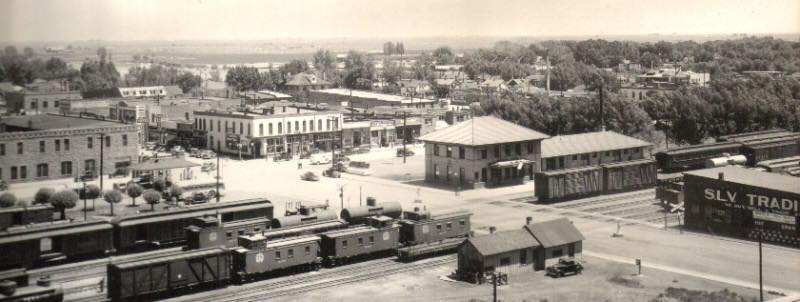
Alamosa train station and tracks, undated early photo
LHP_Intern2019-10-11T03:52:23+00:00Alamosa train station and tracks, undated early photo

Blanca, CO, with Mt. Blanca above it, undated early photo
LHP_Intern2019-10-11T03:51:20+00:00Blanca, CO, with Mt. Blanca above it, undated early photo

View of San Luis (Costilla County). Founded in 1851 as San Luis de Culebra, it is the oldest town in Colorado. Photo probl. 1865-70.
LHP_Intern2019-10-11T03:51:14+00:00View of San Luis (Costilla County). Founded in 1851 as San Luis de Culebra, it is the oldest town in Colorado. Photo probl. 1865-70.
 A man stands in the middle of Main Street in San Luis (Costilla County), 1880? Shows one and two story adobe buildings around a large, open, dirt plaza. Gallery
A man stands in the middle of Main Street in San Luis (Costilla County), 1880? Shows one and two story adobe buildings around a large, open, dirt plaza.
A man stands in the middle of Main Street in San Luis (Costilla County), 1880? Shows one and two story adobe buildings around a large, open, dirt plaza.
LHP_Intern2019-10-11T03:51:10+00:00A man stands in the middle of Main Street in San Luis (Costilla County), 1880? Shows one and two story adobe buildings around a large, open, dirt plaza.

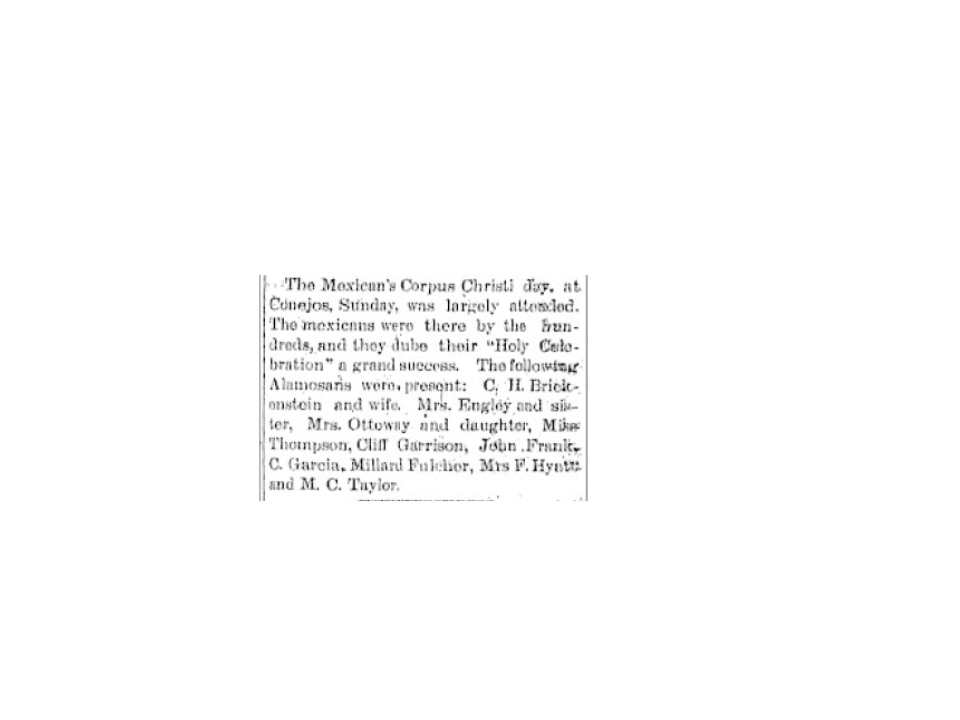
Mexicans’ Corpus Christi Day in Conejos attended by hundreds of Mexicans and named Anglos
LHP_Intern2019-10-11T04:01:47+00:00Mexicans’ Corpus Christi Day in Conejos attended by hundreds of Mexicans and named Anglos

Band from Antonito to play at a celebration in Los Pinos, with dancing, 1900
LHP_Intern2019-10-11T04:02:08+00:00Band from Antonito to play at a celebration in Los Pinos, with dancing, 1900

A Mexican dance was held at the opera house in Alamosa, together with a political meeting
LHP_Intern2019-10-11T04:02:04+00:00A Mexican dance was held at the opera house in Alamosa, together with a political meeting

A Mexican ball to be held at the Colorado opera house in Alamosa at Thanksgiving
LHP_Intern2019-10-11T04:01:57+00:00A Mexican ball to be held at the Colorado opera house in Alamosa at Thanksgiving

Labor Day picnic at Oraig’s Grove park included baseball game between shop boys and the Mexican ball team
LHP_Intern2019-10-11T04:01:53+00:00Labor Day picnic at Oraig’s Grove park included baseball game between shop boys and the Mexican ball team

Delfino Salazar
LHP_Intern2020-01-09T22:05:54+00:00Delfino Salazar, a resident of the San Luis Valley, shown as student at Jarvis Hall, a liberal arts, grammar, and military college in Denver, 1880s

Girls school in Conejos, 1900
LHP_Intern2020-01-09T22:06:28+00:00The Sisters of Loretto ran a school for girls in Conejos, perhaps for Spanish-speaking children

Older children of resettlement families in school yard outside community building
LHP_Intern2020-01-18T03:57:53+00:00San Luis Valley Farms, Colorado


Student staff of a yearbook in San Luis, 1953
LHP_Intern2020-01-09T22:08:11+00:00Members of the staff of El Conquistador, a yearbook, sit at a table at the San Luis Institute of the Arts and Crafts in San Luis.
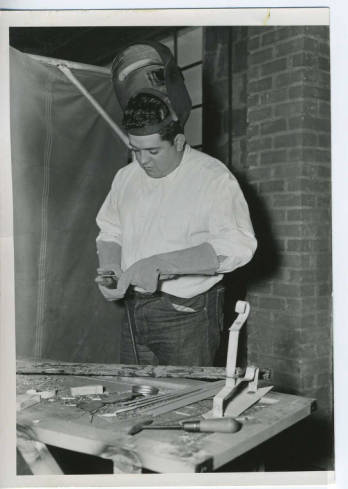
A student learning welding
LHP_Intern2020-01-09T22:08:31+00:00Rueben Pacheco, a student in the General Vocational Program at the San Luis Institute of the Arts and Crafts in San Luis, 1953

An important early vocational/arts center
LHP_Intern2020-01-09T22:09:44+00:00The San Luis Institute of the Arts and Crafts, San Luis, 1953

Vocational students
LHP_Intern2020-01-09T22:09:58+00:00Students in the General Vocational Program, inside the San Luis Institute of the Arts and Crafts in San Luis, 1953

President’s House, Adams State
LHP_Intern2020-01-09T22:04:44+00:00The President’s House at Adams State University, founded in 1921 as a “normal school” ( teachers’ college) in Alamosa

Freshman class officers, 1953
LHP_Intern2020-01-09T22:05:01+00:00Freshman class officers at the San Luis Institute of the Arts and Crafts in San Luis (Costilla County). They are identified (left to right) as: Secretary-Treasurer Irene Trujillo, Vice President Gene Medina, and President Abie Duarte.

Women’s physical education class, 1953
LHP_Intern2020-01-09T22:10:21+00:00Women in a physical education class at the San Luis Institute of the Arts and Crafts in San Luis (Conejos County). The women are identified (left to right) as: Margie Cordova, Josephine Prezzia, Lucille Ortega, Sally Trujillo, Henrietta Lobato, Loyola Romero, Viola Garcia, Irene Arguello, Ninfa Romero, Delfinia Rael.

Jose Ramos Valdez, postmaster of San Luis, 1900-1945
LHP_Intern2019-09-22T01:20:32+00:00Owner of the Heraldo newspaper; photo taken around 1950
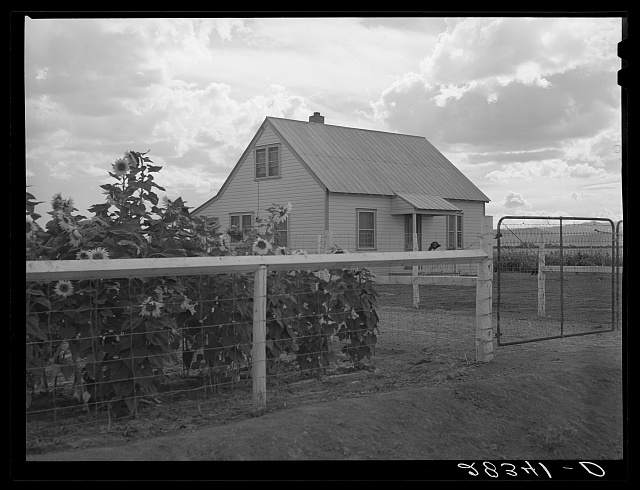
A home in the resettlement project
LHP_Intern2020-01-18T03:54:54+00:00San Luis Valley Farms, Colorado

Harvesting grain
LHP_Intern2020-01-18T03:55:08+00:00Harvesting grain on farm of FSA (Farm Security Administration) client near San Luis, Colorado
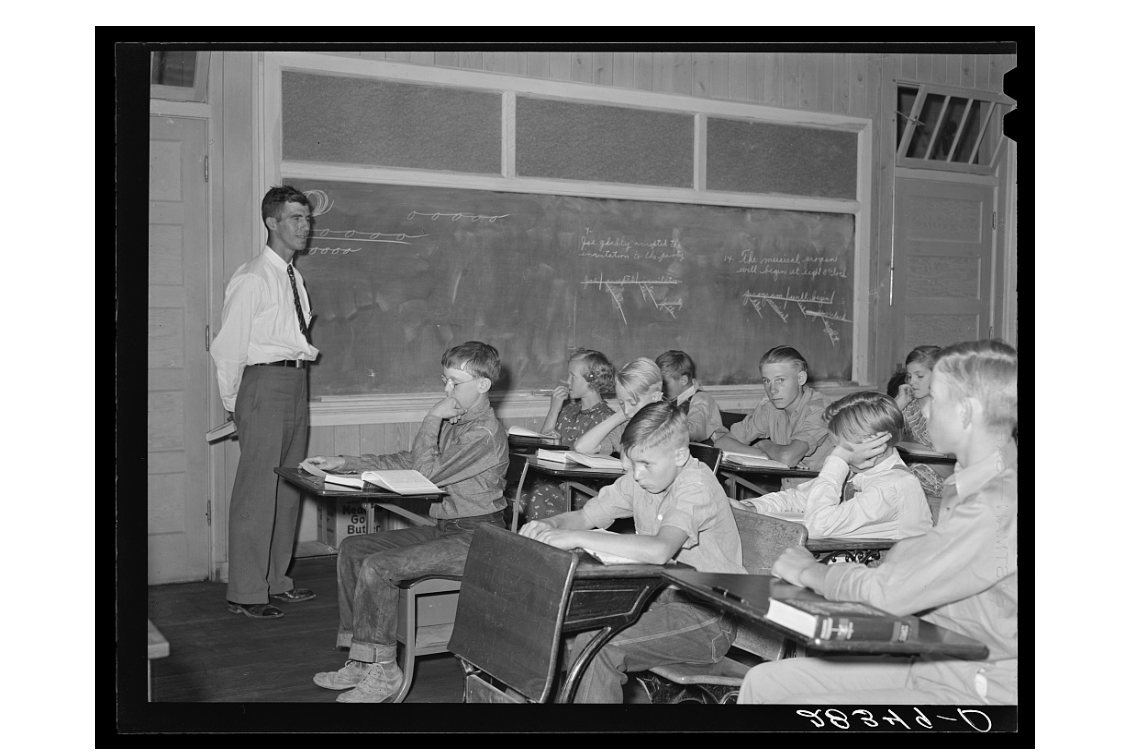
Scene in school room of resettlement project
LHP_Intern2020-01-18T03:58:06+00:00Students and a teacher in a school room in San Luis Valley Farms

Young children in schoolyard of resettlement community
LHP_Intern2020-01-18T03:58:28+00:00Children of resettlement families playing in the schoolyard, San Luis Valley Farms


Brothers Francisco and Raymundo Gallegos, ranchers near San Luis, 1895
LHP_Intern2020-01-18T04:04:11+00:00Brothers Francisco and Raymundo Gallegos, ranchers near San Luis, 1895

Mr. and Mrs. Howard Crowder and daughter in their garden in San Luis Valley Farms, a resettlement community
LHP_Intern2020-01-18T03:50:10+00:00Resettlement farms were issued by the Farm Security Administration to destitute victims of the Dust Bowl

Spanish-American farmers
LHP_Intern2020-01-18T03:52:42+00:00Spanish-American rehabilitation clients working in the field of their farm near San Luis, Colorado, 1939

Wife of Farm Security Administration resettlement resident
LHP_Intern2020-01-18T03:53:48+00:00She is preserving vegetables in her home, San Luis Valley Farms, Colorado

Wife and daughter of resettlement resident
LHP_Intern2020-01-18T03:53:13+00:00Preparing beans for canning, San Luis Valley Farms


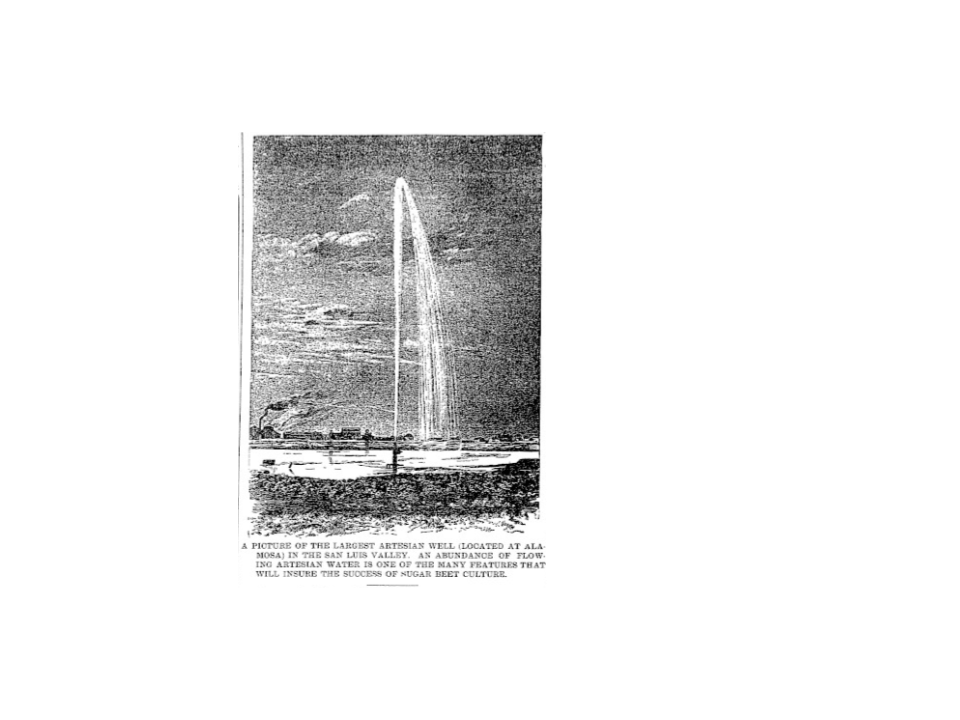
Picture of largest artesian well in the Valley, in Alamosa
LHP_Intern2020-01-18T04:04:23+00:00Picture of largest artesian well in the Valley, in Alamosa


An artesian well being drilled in Antonito
LHP_Intern2020-01-18T04:04:47+00:00An artesian well being drilled in Antonito

Most of the farmers in Antonito, a town which is less than 8 years old, are Hispanics; their fine farms are under good cultivation
LHP_Intern2020-01-18T04:06:54+00:00Most of the farmers in Antonito, a town which is less than 8 years old, are Hispanics; their fine farms are under good cultivation

Technique used by “some of our Mexicans owning large ranches” to get rid of Loco Weed
LHP_Intern2020-01-18T04:07:07+00:00Technique used by “some of our Mexicans owning large ranches” to get rid of Loco Weed
 In description of death of his son, Jose Garcia of Conejos was said to be a large holder of sheep who shipped them to Chama, NM by train for lambing Gallery
In description of death of his son, Jose Garcia of Conejos was said to be a large holder of sheep who shipped them to Chama, NM by train for lambing
In description of death of his son, Jose Garcia of Conejos was said to be a large holder of sheep who shipped them to Chama, NM by train for lambing
LHP_Intern2020-01-18T04:06:18+00:00In description of death of his son, Jose Garcia of Conejos was said to be a large holder of sheep who shipped them to Chama, NM by train for lambing
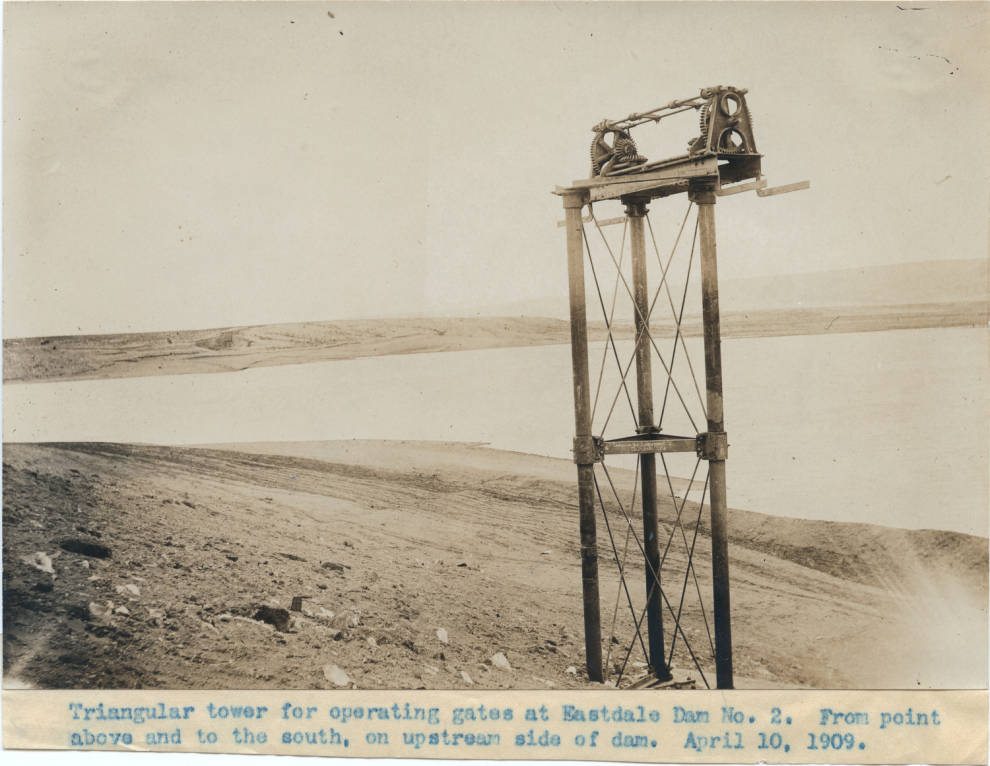
Triangular towers guarding Eastvale Dam no. 2, April 10, 1909
LHP_Intern2020-01-18T04:06:31+00:00Triangular towers guarding Eastvale Dam no. 2, April 10, 1909

Sugar beet farming can be profitable in Valley, especially around Alamosa, due to water and abundance of “Mexican” labor
LHP_Intern2020-01-18T04:06:42+00:00Sugar beet farming can be profitable in Valley, especially around Alamosa, due to water and abundance of “Mexican” labor
 Soil Map of San Luis Valley, showing soil composition, township grid, agricultural canals, and railroads during the early twentieth century. Made by Holmes J. Garnett, 1903 Gallery
Soil Map of San Luis Valley, showing soil composition, township grid, agricultural canals, and railroads during the early twentieth century. Made by Holmes J. Garnett, 1903
Soil Map of San Luis Valley, showing soil composition, township grid, agricultural canals, and railroads during the early twentieth century. Made by Holmes J. Garnett, 1903
LHP_Intern2020-01-18T04:08:42+00:00Soil Map of San Luis Valley, showing soil composition, township grid, agricultural canals, and railroads during the early twentieth century. Made by Holmes J. Garnett, 1903

300 skilled sugar beet raisers coming to Monte Vista, La Jara, and Romeo from Globeville, CO (NE of Denver)
LHP_Intern2020-01-18T04:08:52+00:00300 skilled sugar beet raisers coming to Monte Vista, La Jara, and Romeo from Globeville, CO (NE of Denver)

The Lucero family pose by an adobe wall on the White Mountain Ranch in Costilla County, San Luis Valley. Undated photo
LHP_Intern2020-01-18T04:09:07+00:00The Lucero family pose by an adobe wall on the White Mountain Ranch in Costilla County, San Luis Valley. Undated photo
 Trujillo homestead, near Mosca, builtby Pedro Trujillo, a first generation Hispanic-American, in 1879. He was a small-scale pioneer cattle rancher Gallery
Trujillo homestead, near Mosca, builtby Pedro Trujillo, a first generation Hispanic-American, in 1879. He was a small-scale pioneer cattle rancher
Trujillo homestead, near Mosca, builtby Pedro Trujillo, a first generation Hispanic-American, in 1879. He was a small-scale pioneer cattle rancher
LHP_Intern2020-01-18T04:09:18+00:00Trujillo homestead, near Mosca, builtby Pedro Trujillo, a first generation Hispanic-American, in 1879. He was a small-scale pioneer cattle rancher

“Spud Bowl”
LHP_Intern2019-12-13T21:10:37+00:00Farm workers stand near a pickup truck in a field in the San Luis Valley. A man stands in the back of the pickup truck filled with burlap bags of potatoes, 1950-55

Dairy herd feeding on alfalfa
LHP_Intern2019-12-13T21:13:07+00:00Cows used for dairy are feeding on alfalfa in a pasture in the San Luis Valley, October, 1939

Grain harvest
LHP_Intern2019-12-13T21:12:39+00:00A farm worker harvests grain in the San Luis Valley, 1939
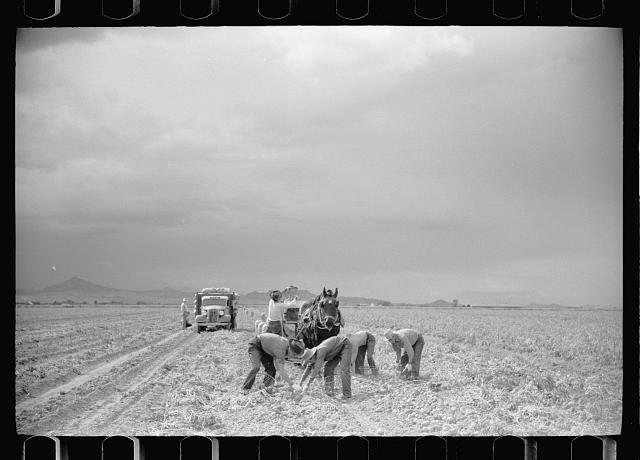

Men picking potatoes
LHP_Intern2019-12-13T21:11:45+00:00Men picking potatoes in San Luis Valley, Rio Grande County, 1939

Photo of irrigation ditch taken 1965
LHP_Intern2019-12-13T21:11:33+00:00Concrete lined Vallejos Ditch, Costilla County, Colorado

Grain threshing outfit in operation, late 1930s
LHP_Intern2019-12-13T21:11:15+00:00San Luis Valley Farms, CO

Untitled Photo, late 1930s
LHP_Intern2019-12-13T21:10:55+00:00Farmer looking at his field, San Luis Valley Farms
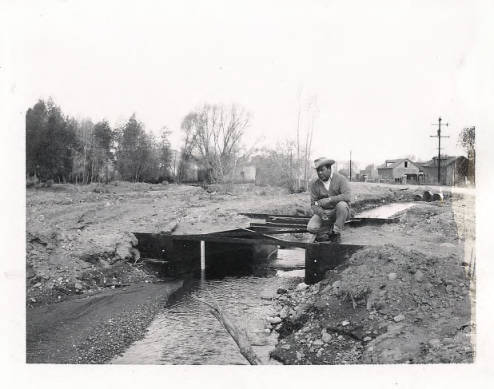
Vallejos Ditch before improvements
LHP_Intern2020-01-18T04:18:05+00:00George G. Romero kneels beside the Vallejos Ditch near an old headgate, prior to the USDA Ditch no. 5 Special Improvement Project, San Pablo (Costilla County), 1965?

Acequia, Costilla County, 1990s
LHP_Intern2019-12-13T21:13:35+00:00View of an acequia (irrigation ditch), possibly part of the Vallejos Ditch system in the San Luis Valley

Irrigating a field
LHP_Intern2019-12-13T21:13:19+00:00Bill Moreno irrigates his field in San Luis (Costilla County), 1970

Boy with lamb
LHP_Intern2019-12-13T21:12:50+00:00A young Hispanic American boy poses with his arm around a lamb probably near Chama (Costilla County), 1950

Farmer with vegetables
LHP_Intern2019-12-13T21:13:51+00:00Howard Crowder displays some of the vegetables produced in his garden on San Luis Valley Farms, Alamosa, Colorado

Footrace in Del Norte
LHP_Intern2020-01-18T17:12:39+00:00Race between an Anglo and a Hispanic runner in Del Norte: heavy betting and a large audience, including a special train with 150 people from Conejos area, 1904

Footrace in La Jara
LHP_Intern2020-01-18T17:12:45+00:00Race in La Jara between a New Mexican and a local runner, 1905

Santa Ana Fiesta, San Luis
LHP_Intern2020-01-18T17:12:49+00:00Cenaida Roybal Manzanares (right) and Francisca Manzanares Quintana, her sister in-law, near rides at the Fiesta, 1950

A carnival in San Luis
LHP_Intern2020-01-18T17:12:11+00:00Carlos Lopez looks up at ferris wheel at a carnival in San Luis, probaby the Santa Ana Fiesta, 1950
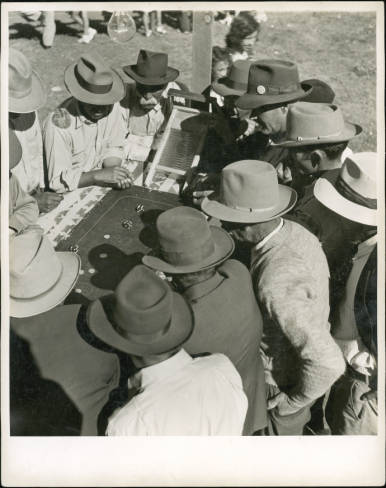
Dice game at a carnival
LHP_Intern2020-01-18T17:12:18+00:00Carlos Lopez (back row center) watches a dice game at a carnival in San Luis, 1950

A pancake race
LHP_Intern2020-01-18T17:12:23+00:00Women participants in the annual Alamosa Colorado pancake race, 1958. One woman, dressed as Aunt Jemima, is either African American or in blackface.

Ramon del Castillo, 2001
LHP_Intern2020-01-18T17:12:31+00:00Ramon Del Castillo, a professor of Chicano studies at Metropolitan State College of Denver and a well known Chicano poet, plays hand drums with an unidentified musician group at the Santa Anna Fiesta in San Luis (Costilla County)

Article about founding of San Luis, 1851
LHP_Intern2019-10-11T03:58:07+00:00Article about founding of San Luis, 1851

Early photo of town of San Luis (undated) against its mountain backdrop
LHP_Intern2019-10-11T03:58:29+00:00Early photo of town of San Luis (undated) against its mountain backdrop

Photo of San Luis town, c. 1865-70?
LHP_Intern2019-10-11T03:58:23+00:00Photo of San Luis town, c. 1865-70?

Map of the Sangre de Cristo Land Grant
LHP_Intern2019-10-11T03:58:14+00:00Map of the Sangre de Cristo Land Grant
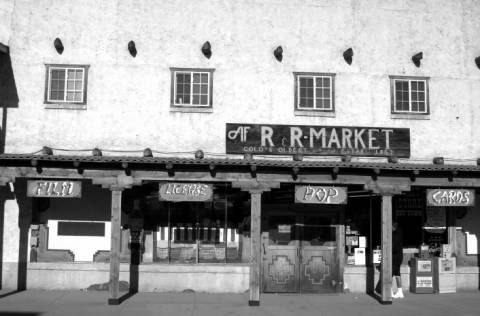
The R & R Market
LHP_Intern2019-10-11T04:00:12+00:00(Romero’s Market) located in San Luis (Costilla County), 2005; said to be the oldest business in Colorado, founded in 1857
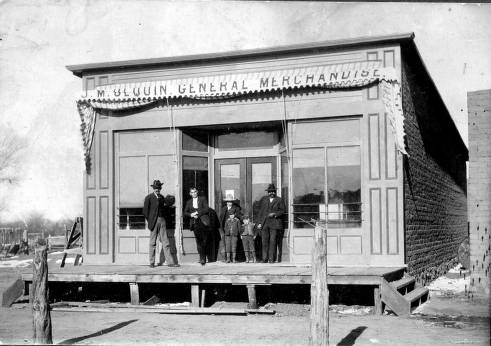
The J.M. Olguín Mercantile owned by Jesús María Olguín in San Luis, 1910
LHP_Intern2019-10-11T04:00:20+00:00The J.M. Olguín Mercantile owned by Jesús María Olguín in San Luis, 1910
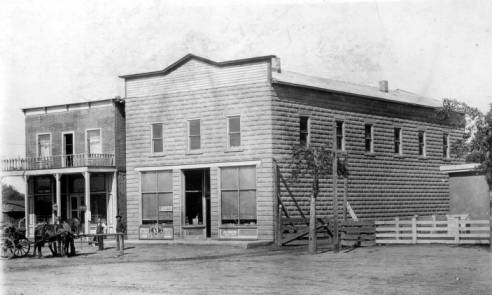
Gallegos Mercantile and Hotel on the plaza in San Luis, 1900-1905.
LHP_Intern2019-10-11T04:00:40+00:00The two story stone building, owned by José Presentación “J.P.” Gallegos, was also the telegraph and post office

Advert for a Hispanic blacksmith and cartmaker in Antonito
LHP_Intern2019-10-11T04:00:26+00:00Advert for a Hispanic blacksmith and cartmaker in Antonito

Wedding portrait of José Amarante García and Teodora Espinosa from Conejos, 1889
LHP_Intern2019-09-22T03:25:07+00:00Wedding portrait of José Amarante García and Teodora Espinosa from Conejos, 1889

Marriage of a couple said to be popular with the Spanish-American settlement in Alamosa
LHP_Intern2019-09-22T03:23:22+00:00Marriage of a couple said to be popular with the Spanish-American settlement in Alamosa

Obituary for woman who was one of the first Spanish-speaking residents of Alamosa, coming about 1879
LHP_Intern2019-09-22T03:21:55+00:00Obituary for woman who was one of the first Spanish-speaking residents of Alamosa, coming about 1879

Marriage of two young Hispanics from a well-liked and influential Spanish American families
LHP_Intern2019-09-22T03:20:12+00:00Marriage of two young Hispanics from a well-liked and influential Spanish American families

Death notice of married Hispanic woman from East Alamosa, leaving very young child
LHP_Intern2019-09-22T03:18:28+00:00Death notice of married Hispanic woman from East Alamosa, leaving very young child

Marriage of a local Swede and a newer arrival of Spanish origin, with Swedes, Mexicans, and Germans at party
LHP_Intern2019-09-22T03:16:27+00:00Marriage of a local Swede and a newer arrival of Spanish origin, with Swedes, Mexicans, and Germans at party

Wedding of former teacher in the local Mexican schools and a “fair daughter of Mexican descent” in Alamosa
LHP_Intern2019-09-22T03:13:33+00:00Wedding of former teacher in the local Mexican schools and a “fair daughter of Mexican descent” in Alamosa

Discussion and vote against making Spanish a subject in the schools; Mexicans should be compelled to learn English
LHP_Intern2019-09-24T06:25:13+00:00Discussion and vote against making Spanish a subject in the schools; Mexicans should be compelled to learn English
The main Alamosa newspaper distinguished between “American” and “Mexican” residents of the San Luis Valley in 1885
LHP_Intern2019-09-24T06:23:54+00:00The main Alamosa newspaper distinguished between “American” and “Mexican” residents of the San Luis Valley in 1885
San Luis Valley paper announces a new Spanish page for the large % of the Valley’s population who speak Spanish
LHP_Intern2019-03-18T08:25:27+00:00San Luis Valley paper announces a new Spanish page for the large % of the Valley’s population who speak Spanish

La Jara paper has started Spanish section, which the Courier says is an obligation owed to Spanish people
LHP_Intern2019-09-24T06:20:03+00:00La Jara paper has started Spanish section, which the Courier says is an obligation owed to Spanish people

Nearly all papers in the Valley now have Spanish sections, as is due to “our Mexican friends”
LHP_Intern2019-09-24T06:18:35+00:00Nearly all papers in the Valley now have Spanish sections, as is due to “our Mexican friends”
English-speakers taking interest in learning Spanish, have organized a class
LHP_Intern2019-09-24T06:16:51+00:00English-speakers taking interest in learning Spanish, have organized a class

Spanish-language section of paper is reaching “many of the best Mexican families,” who read only Spanish
LHP_Intern2019-09-24T06:15:21+00:00Spanish-language section of paper is reaching “many of the best Mexican families,” who read only Spanish

Listing of Anglo students’ names in regular school and 36 students in the “town hall school” (= the Mexican school)
LHP_Intern2019-09-24T06:06:43+00:00Listing of Anglo students’ names in regular school and 36 students in the “town hall school” (= the Mexican school)

Spanish Americans in Alamosa petition school board to allow their children to attend the school nearest to their homes
LHP_Intern2019-09-24T06:03:54+00:00Spanish Americans in Alamosa petition school board to allow their children to attend the school nearest to their homes

School directors defend separate schools for Spanish American children as the best system ever inaugurated
LHP_Intern2019-09-24T06:02:13+00:00School directors defend separate schools for Spanish American children as the best system ever inaugurated

State Board of Education says it cannot stop segregation of Mexican children in Alamosa in a special school
LHP_Intern2019-09-24T05:57:08+00:00State Board of Education says it cannot stop segregation of Mexican children in Alamosa in a special school

Perfecto Chavez, a Hispanic sheepherder, murdered in Saguache County; Anglo man accused is described as a cow-boy
LHP_Intern2019-09-22T03:57:52+00:00Perfecto Chavez, a Hispanic sheepherder, murdered in Saguache County; Anglo man accused is described as a cow-boy
Man accused of killing Chavez refused bail; admits he shot him but will claim self defense
LHP_Intern2019-09-22T03:56:10+00:00Man accused of killing Chavez refused bail; admits he shot him but will claim self defense

Man accused of killing Chavez acquitted
LHP_Intern2019-10-11T04:04:08+00:00Paper says that “men who own great herds of cattle” were responsible for jury’s verdict, as in similar cases where perpetrator has gone unpunished

Anglo man and son charged with assaulting Hispanic sheep herder and killing/stealing his sheep
LHP_Intern2019-09-22T03:51:44+00:00Anglo man and son charged with assaulting Hispanic sheep herder and killing/stealing his sheep

Sheepherders pose near sacks of wool
LHP_Intern2019-10-11T04:04:59+00:00And with freight wagons loaded with sacks of wool near the Denver and Rio Grande railroad station in Fort Garland (Costilla County), 1910

Reginaldo García, a sheep rancher in Conejos County.
LHP_Intern2019-10-11T04:03:25+00:00He was also a banker and a legislator in the House of Representatives in the Colorado General Assembly. Photo from 1920s.
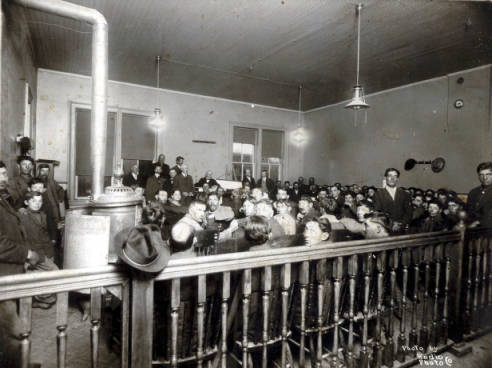
View of a trial in the Costilla County Court House in San Luis, 1917. The Mexican American jury is at the center back
LHP_Intern2019-12-13T21:34:41+00:00View of a trial in the Costilla County Court House in San Luis, 1917. The Mexican American jury is at the center back
 Hispanic American men pose in front of the first permanent Costilla County Courthouse built in 1884, San Luis in 1910. The courthouse on the National Register of Historic Places Gallery
Hispanic American men pose in front of the first permanent Costilla County Courthouse built in 1884, San Luis in 1910. The courthouse on the National Register of Historic Places
Hispanic American men pose in front of the first permanent Costilla County Courthouse built in 1884, San Luis in 1910. The courthouse on the National Register of Historic Places
LHP_Intern2019-12-13T21:34:27+00:00Hispanic American men pose in front of the first permanent Costilla County Courthouse built in 1884, San Luis in 1910. The courthouse on the National Register of Historic Places

Juan Antonio Baca of San Luis (Costilla County), 1880-85. Mr. Baca was elected to the Colorado General Assembly as Senator for Costilla County.
LHP_Intern2019-12-13T21:34:13+00:00Juan Antonio Baca of San Luis (Costilla County), 1880-85. Mr. Baca was elected to the Colorado General Assembly as Senator for Costilla County.
Mexican political meeting and dance held at opera house in Alamosa
LHP_Intern2019-12-13T21:33:47+00:00Mexican political meeting and dance held at opera house in Alamosa

Current County Commissioners less capable than their Mexican predecessors
LHP_Intern2019-12-13T21:35:44+00:00Current County Commissioners less capable than their Mexican predecessors

Democratic and Republican candidates are button-holing all voters, including Mexicans
LHP_Intern2019-12-13T21:34:58+00:00Democratic and Republican candidates are button-holing all voters, including Mexicans

Colorado Sheriffs in 1904, location unknown. Some of those from the SLV and Las Animas/Huerfano Counties may have been Hispanic
LHP_Intern2019-12-13T21:37:01+00:00Colorado Sheriffs in 1904, location unknown. Some of those from the SLV and Las Animas/Huerfano Counties may have been Hispanic

Republicans claim to have all Mexican votes in their vest pocket, but Mexicans do not vote like sheep
LHP_Intern2019-12-13T21:36:46+00:00Republicans claim to have all Mexican votes in their vest pocket, but Mexicans do not vote like sheep
 José Victor García, a rancher in Conejos County, 1890s, who served in the Colorado Territorial Legislature and held many political appointments. Gallery
José Victor García, a rancher in Conejos County, 1890s, who served in the Colorado Territorial Legislature and held many political appointments.
José Victor García, a rancher in Conejos County, 1890s, who served in the Colorado Territorial Legislature and held many political appointments.
LHP_Intern2020-01-18T04:04:00+00:00José Victor García, a rancher in Conejos County, 1890s, who served in the Colorado Territorial Legislature and held many political appointments.
 José Julián “J.J.” Lobato poses beside his Ford Model T touring car near San Luis (Costilla County), later 1920. Jose Lobato served as Costilla County Treasurer and as a Costilla County Judge. Gallery
José Julián “J.J.” Lobato poses beside his Ford Model T touring car near San Luis (Costilla County), later 1920. Jose Lobato served as Costilla County Treasurer and as a Costilla County Judge.
José Julián “J.J.” Lobato poses beside his Ford Model T touring car near San Luis (Costilla County), later 1920. Jose Lobato served as Costilla County Treasurer and as a Costilla County Judge.
LHP_Intern2019-12-13T21:35:59+00:00José Julián “J.J.” Lobato poses beside his Ford Model T touring car near San Luis (Costilla County), later 1920. Jose Lobato served as Costilla County Treasurer and as a Costilla County Judge.

María Eulogia Valdéz
LHP_Intern2019-09-24T06:58:03+00:00María Eulogia Valdéz, wife of Desiderio “Dario” Gallegos, a mercantile store owner in San Luis (Costilla County). Photo probl. from 1860s.

Elderly woman in headscarf
LHP_Intern2019-09-24T06:56:48+00:00An unidentified elderly Hispanic woman, probably of Native American descent from either San Luis or Chama in Costilla County, 1950.

Erinea Trujillo Vigil and grandchildren, 1918
LHP_Intern2019-09-24T06:55:31+00:00Group portrait of Erinea Trujillo Vigil and her grandchildren in San Luis (Costilla County. They are identified as Front row L to R: Jususita Romero, Tonita Romero, Adelia Vigil; Back row L to R: Luis Romero, Magdalena Vigil, Erinea Trujillo Vigil, Isabela Romero, Francisco Vigil, and Antonio Romero.
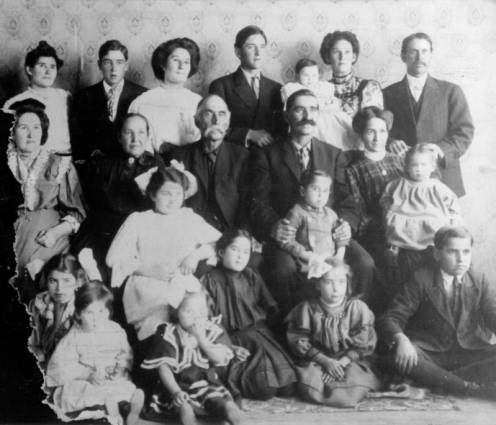
Lobato family, 1908?
LHP_Intern2019-09-24T06:53:30+00:00The Lobato Family from San Luis (Costilla County). Front row, left to right: Adela and Eufelia Espinoza, Manuelita Jaramillo, María Odila, Miquela, and Alberto Lobato. Second row: Quirina Espinoza. Third row left to right: Rosavel Lobato, María Epemenia Córdova Lobato, Antonio Teodoro Lobato, Jose Julian “J.J.” Lobato holding son Pedro Lobato and María Salomé Córdova Lobato holding baby daughter Salomé Lobato. Back row, left to right: Refugio, Teodoro, Félez and Julián Lobato, Concepción Lobato Romero holding her son Manuel Romero, and Pedro Romero.
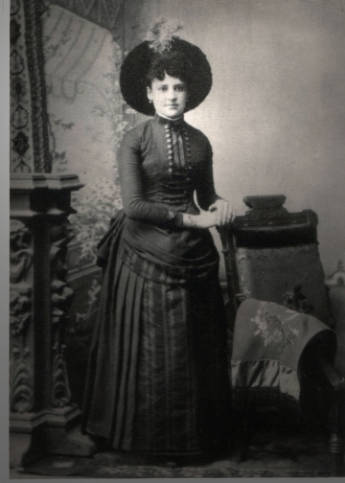
María Salomé Córdova
LHP_Intern2020-01-18T17:18:36+00:00María Salomé Córdova, born April 27, 1867 in Piedras Coloradas near Trinidad, married Jose Julian Labato on September 4, 1889. Jose, a rancher, moved the family to San Luis where they had eight children. María died on September 1, 1960 in Blanca, Colorado. Her husband José died on May 17, 1947 in Alamosa, Colorado. In her later years, María was a weaver.


Old adobe house
LHP_Intern2019-09-24T06:47:05+00:00Remains of a family home in Costilla County, photo taken in 2005-6

A healer
LHP_Intern2019-09-24T06:46:00+00:00Teresa Vigil, an expert in medicinal herbs (curandera) in her kitchen in San Luis, 2005

Shaving
LHP_Intern2019-09-24T06:44:59+00:00An elderly Hispanic American man, identified as Mr. Atencio, sits at a table in his kitchen and shaves in Chama (Costilla County), 1950

A large family home
LHP_Intern2019-09-24T06:43:47+00:00\José Benito Córdova and his wife Marina Rivera de Córdova pose with their families at their two story, Territorial style, adobe house in Las Córdovas, near El Moro (Las Animas County), 1895

Young cousins
LHP_Intern2019-09-24T06:42:24+00:00Quirina de la Luz Espinoza and her cousin, Teodoro Lobato, 1904. Teodoro later held offices as Assessor and Treasurer of Conejos, Colorado and in 1940 he opened a liquor store.
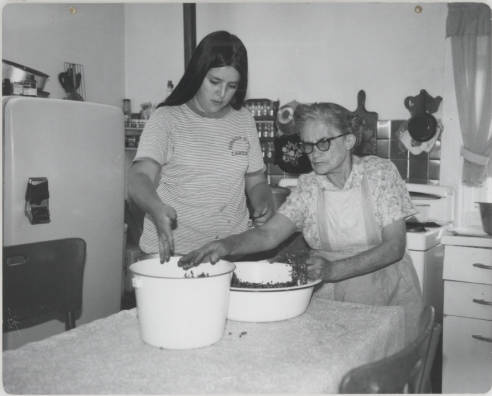
Making elderberry jam
LHP_Intern2019-09-24T06:41:10+00:00Eloisa Esquibel Gallegos and her teenage granddaughter Rafaelita Gallegos prepare elderberries for jam probably in San Luis, 1970?

A woman mail carrier
LHP_Intern2019-09-24T06:39:24+00:00Josephine Cardenas Lucero delivers mail in San Luis, 1950

Bath time
LHP_Intern2019-09-24T06:38:24+00:00A young Hispanic girl sits in a metal wash tub and is bathed by her mother in Costilla County, 1950

Eating lunch
LHP_Intern2019-09-24T06:37:26+00:00An elderly man, probably Mr. Atencio, having lunch in his home in Chama (Costilla County), 1950

Haircut
LHP_Intern2019-09-24T06:36:26+00:00Grace Rodriguez Serna, wife of Xavier Serna, watches as her son Rodney gets a haircut from local barber Adonaise De Herrera, San Luis, 1970?
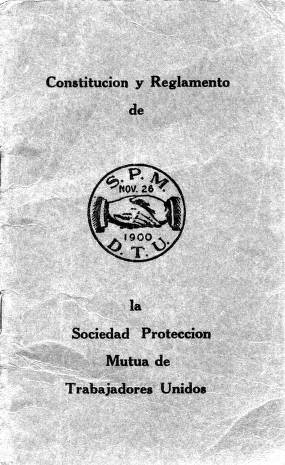
Sociedad Protección Mutua de Trabajadores Unidos, Pamphlet Cover
LHP_Intern2019-09-24T04:48:36+00:00View of the cover of a pamphlet for SPMDTU. The society was organized in 1900 in Antonito, CO by Hispanic Americans as a means to fight back against racial and discriminatory practices in the San Luis Valley

Sociedad Protección Mutua de Trabajadores Unidos, original building
LHP_Intern2019-09-24T04:46:54+00:00This building (still in use), was built in Antonito, Costilla County, in 1900 at the founding of the organization. It now houses the central Concilio for the SPMDTU

SPMDTU building in Chama
LHP_Intern2019-09-24T04:44:48+00:00Juan Olivas near the La Sociedad Protección Mutua de Trabajadores Unidos, Concilio #2 hall in Chama (Costilla County), probably built in first half of 20th century

Sociedad Protección Mutua de Trabajadores Unidos
LHP_Intern2019-09-24T04:43:47+00:00Hispanic American men pose at a meeting of the SPMDTU in their building in Antonito, CO. 1935(?)
Current Website of the SPMDTU: http://www.spmdtu.org/who-we-are/la-historia/

Road crew, Costilla County
LHP_Intern2019-09-24T04:41:59+00:00Hispanic American men employed on a WPA road project pose near a tractor and a road grader on a dirt road probably in Costilla County, 1935

Lettuce Strike, Center, CO
LHP_Intern2019-09-24T04:40:34+00:00A member of the United Farm Workers of America stands beside his wife and holds his baby during a lettuce workers’ strike in Center, CO, 1970

Striking Lettuce Workers
LHP_Intern2019-09-24T04:39:06+00:00Striking workers pray near a Mobil gas station during the Finerman lettuce strike in Center (Saguache County), 1970

Leroy “Korn” Maes
LHP_Intern2019-09-24T04:37:20+00:00Leader of the United Farm Workers of America during strike against the Finerman Lettuce company in Center, 1970

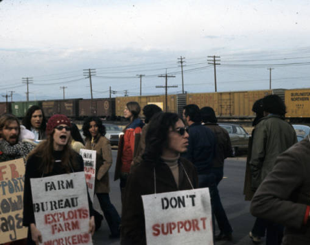
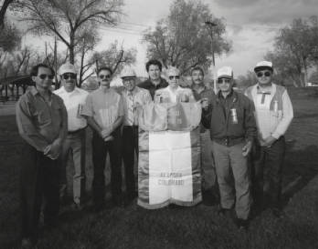
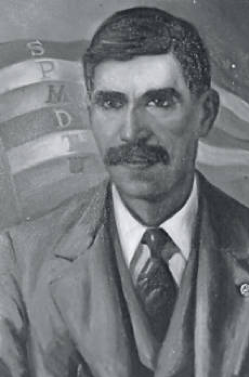

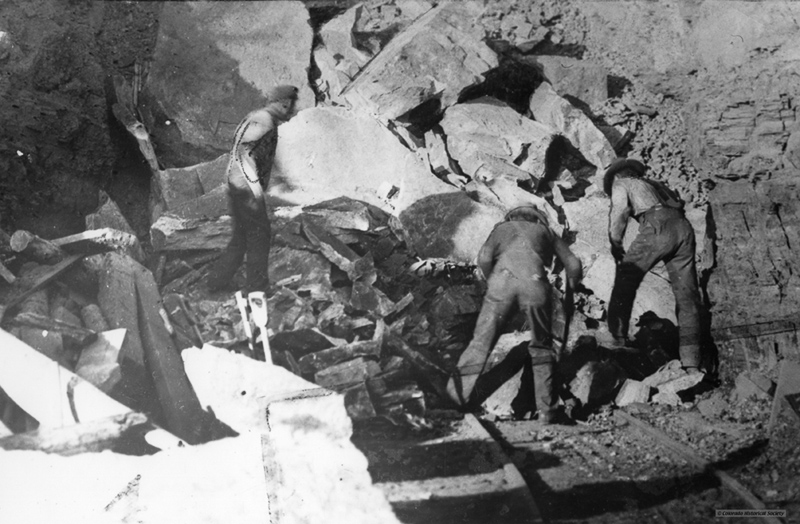

Tram line for ore carts above the Glory Hole at the mine
LHP_Intern2019-10-11T04:08:00+00:00Tram line for ore carts above the Glory Hole at the mine


Remains of historic trestles at the mine
LHP_Intern2019-10-11T04:07:47+00:00Remains of historic trestles at the mine

Men in front of a building in the old town of Orient
LHP_Intern2019-10-11T04:07:38+00:00Men in front of a building in the old town of Orient


San Acacio Catholic Church in San Acacio (Costilla County), built in 1860s
LHP_Intern2019-12-27T16:00:45+00:00San Acacio Catholic Church in San Acacio (Costilla County), built in 1860s
 Our Lady of Guadalupe Parish Church in Conejos, just north of Antonito. It is the oldest church in Colorado, built in 1863 by a French missionary. Gallery
Our Lady of Guadalupe Parish Church in Conejos, just north of Antonito. It is the oldest church in Colorado, built in 1863 by a French missionary.
Our Lady of Guadalupe Parish Church in Conejos, just north of Antonito. It is the oldest church in Colorado, built in 1863 by a French missionary.
LHP_Intern2019-12-27T16:01:58+00:00Our Lady of Guadeloupe Parish Church in Conejos, just north of Antonito. It is the oldest church in Colorado, built in 1863 by a French missionary.

Sisters of Mercy Convent in San Luis, built in 1905
LHP_Intern2019-12-27T16:01:28+00:00Sisters of Mercy Convent in San Luis, built in 1905

Mass for Spanish speaking people offered in Alamosa
LHP_Intern2019-12-27T16:01:14+00:00Mass for Spanish speaking people offered in Alamosa

Spanish Americans in Alamosa have their own cemetery, which they are buying over time
LHP_Intern2019-12-27T16:01:01+00:00Spanish Americans in Alamosa have their own cemetery, which they are buying over time
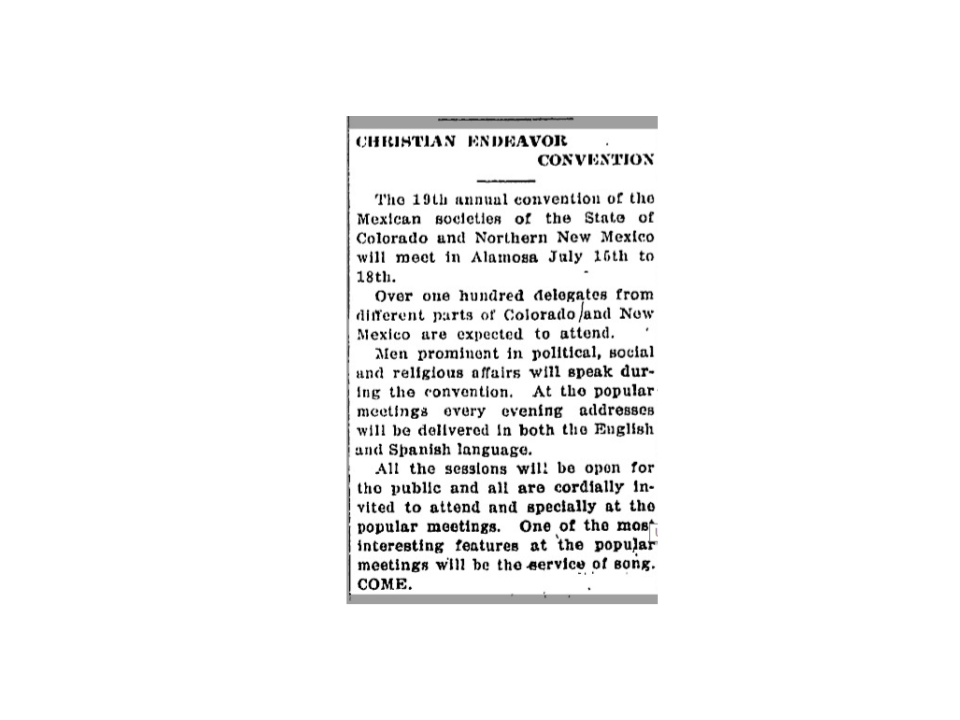 Alamosa to host annual convention of the Mexican societies of Christian Endeavor, Colorado and Northern New Mexico, with all speeches given in both English and Spanish Gallery
Alamosa to host annual convention of the Mexican societies of Christian Endeavor, Colorado and Northern New Mexico, with all speeches given in both English and Spanish
Alamosa to host annual convention of the Mexican societies of Christian Endeavor, Colorado and Northern New Mexico, with all speeches given in both English and Spanish
LHP_Intern2019-12-27T16:02:13+00:00Alamosa to host annual convention of the Mexican societies of Christian Endeavor, Colorado and Northern New Mexico, with all speeches given in both English and Spanish

Spanish Presbyterian church in Alamosa dedicated
LHP_Intern2019-12-27T16:04:03+00:00Spanish Presbyterian church in Alamosa dedicated

Reference in a real estate advert to land near Mexican church in Alamosa
LHP_Intern2019-12-27T16:03:53+00:00Reference in a real estate advert to land near Mexican church in Alamosa
 A morada built by Los Hermanos Penitentes in San Francisco (Costilla County), with a large wood cross on a hill in the distance, probably constructed in first half of 20th century Gallery
A morada built by Los Hermanos Penitentes in San Francisco (Costilla County), with a large wood cross on a hill in the distance, probably constructed in first half of 20th century
A morada built by Los Hermanos Penitentes in San Francisco (Costilla County), with a large wood cross on a hill in the distance, probably constructed in first half of 20th century
LHP_Intern2019-12-27T16:02:42+00:00A morada built by Los Hermanos Penitentes in San Francisco (Costilla County), with a large wood cross on a hill in the distance, probably constructed in first half of 20th century

Hispanic American parishioners attend Mass at Immaculate Conception Church in Chama (Costilla County), 1950
LHP_Intern2019-12-27T16:02:28+00:00Hispanic American parishioners attend Mass at Immaculate Conception Church in Chama (Costilla County), 1950

Moises Vialpondo and an elderly man stand at the grave of Maria Ursulita Vialpondo in the cemetery in Chama, 1950
LHP_Intern2019-12-27T16:04:37+00:00Moises Vialpondo and an elderly man stand at the grave of Maria Ursulita Vialpondo in the cemetery in Chama, 1950
 The Catholic Capilla de Todos Los Santos, a part of the Shrine of the Stations of the Cross (La Mesa de la Piedad y de la Misericordia, Hill of Piety and Mercy) in San Luis, built in 1986 Gallery
The Catholic Capilla de Todos Los Santos, a part of the Shrine of the Stations of the Cross (La Mesa de la Piedad y de la Misericordia, Hill of Piety and Mercy) in San Luis, built in 1986
The Catholic Capilla de Todos Los Santos, a part of the Shrine of the Stations of the Cross (La Mesa de la Piedad y de la Misericordia, Hill of Piety and Mercy) in San Luis, built in 1986
LHP_Intern2019-12-27T16:04:20+00:00The Catholic Capilla de Todos Los Santos, a part of the Shrine of the Stations of the Cross (La Mesa de la Piedad y de la Misericordia, Hill of Piety and Mercy) in San Luis, built in 1986
 Photos mounted on decorative metal tray show Most Precious Blood Catholic Church and Father José Samuel García, San Luis (Costilla County), 1890s Gallery
Photos mounted on decorative metal tray show Most Precious Blood Catholic Church and Father José Samuel García, San Luis (Costilla County), 1890s
Photos mounted on decorative metal tray show Most Precious Blood Catholic Church and Father José Samuel García, San Luis (Costilla County), 1890s
LHP_Intern2019-12-27T16:05:59+00:00Photos mounted on decorative metal tray show Most Precious Blood Catholic Church and Father José Samuel García, San Luis (Costilla County), 1890s

Religious procession in Los Sauces, CO, with men carrying statue of a saint and other carved images, undated photo
LHP_Intern2019-12-27T16:05:44+00:00Religious procession in Los Sauces, CO, with men carrying statue of a saint and other carved images, undated photo

Father Benito Hernandez preaches from a lectern in the Catholic Sangre de Cristo Church in San Luis, 2005
LHP_Intern2019-12-27T16:05:33+00:00Father Benito Hernandez preaches from a lectern in the Catholic Sangre de Cristo Church in San Luis, 2005

Members of the Hermanos Penitentes walk along a dirt trail during the Stations of the Cross observance on Good Friday in Costilla County, 2005
LHP_Intern2019-12-27T16:05:18+00:00Members of the Hermanos Penitentes walk along a dirt trail during the Stations of the Cross observance on Good Friday in Costilla County, 2005

Members of the Hermanos Penitentes near a wood stove in their adobe morada in Costilla County, 2005
LHP_Intern2019-12-27T16:05:08+00:00Members of the Hermanos Penitentes near a wood stove in their adobe morada in Costilla County, 2005
 Members of Sangre de Cristo Parish in San Luis (Costilla County) walk in a Good Friday pilgrimage from San Francisco to San Luis with Father Pat Valdez “Father Pat” (second from left), 2005. A woman crucifer carries a processional cross at the head of the procession. Gallery
Members of Sangre de Cristo Parish in San Luis (Costilla County) walk in a Good Friday pilgrimage from San Francisco to San Luis with Father Pat Valdez “Father Pat” (second from left), 2005. A woman crucifer carries a processional cross at the head of the procession.
Members of Sangre de Cristo Parish in San Luis (Costilla County) walk in a Good Friday pilgrimage from San Francisco to San Luis with Father Pat Valdez “Father Pat” (second from left), 2005. A woman crucifer carries a processional cross at the head of the procession.
LHP_Intern2019-12-27T16:04:51+00:00Members of Sangre de Cristo Parish in San Luis (Costilla County) walk in a Good Friday pilgrimage from San Francisco to San Luis with Father Pat Valdez “Father Pat” (second from left), 2005. A woman crucifer carries a processional cross at the head of the procession.
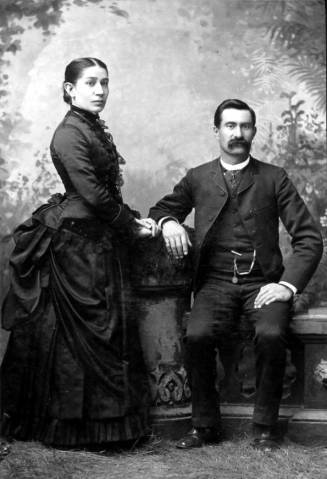
Casimiro Barela and his wife, around 1885
LHP_Intern2019-03-18T08:23:43+00:00Damiana Rivera de Barela and State Representative Casimiro Barela

Casimiro Barela with his wife and daughter, around 1900-1910?
LHP_Intern2019-06-17T19:58:41+00:00Casimiro Barela, his wife Damiana Rivera Barela, and daughter Juanita

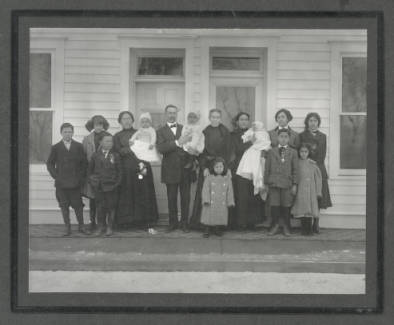
Barela’s extended family, 1912
LHP_Intern2019-06-17T20:00:37+00:00Colorado State Senator Casimiro Barela, his wife Damiana Rivera de Barela, their daughters and grandchildren on the porch of their house (Rancho de Rivera) in Rivera (Las Animas County)

Damiana, Barela’s wife, 1890
LHP_Intern2019-06-17T20:01:39+00:00Damiana Rivera de Barela, wife of Colorado State Senator Casimiro Barela, poses for a portrait in an embroidered cape trimmed in fur and a hat decorated with feathers, a bow and a veil

Barela’s house, 1890s
LHP_Intern2019-06-17T20:02:35+00:00People pose on the porch of Senator Casimiro Barela’s house, probably in Barela (Las Animas County)

Barela’s country house, 1902
LHP_Intern2019-06-17T20:04:06+00:00Colorado Senator Casimiro Barela’s country home in El Moro (Las Animas County)

Maria de Jesus Abeyta de Barela, Casimiro’s mother
LHP_Intern2019-10-11T04:16:16+00:00Maria de Jesus Abeyta de Barela, Casimiro’s mother


Important Colorado laws and policies backed by Casimiro Barela, 1872-1897
LHP_Intern2019-10-11T04:16:30+00:00Important Colorado laws and policies backed by Casimiro Barela, 1872-1897

Map of Coal Mines in Las Animas County
LHP_Intern2019-10-11T04:17:12+00:00Map of Coal Mines in Las Animas County

List of all coal mines in Las Animas County
LHP_Intern2019-10-11T04:17:18+00:00List of all coal mines in Las Animas County

Workers at Segundo Mine, 1927
LHP_Intern2019-10-09T02:28:33+00:00Workers standing outside in front of the coke ovens at the Segundo Mine
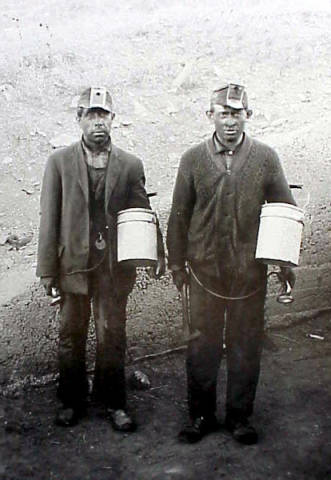
Miners Eloy Cruz and Leandro Vigil near Frederick Mine, 1920?
LHP_Intern2019-03-18T08:23:21+00:00Coal miners Eloy Cruz (left) and his brother-in-law Leandro Vigil pose near the entrance to the Frederick Mine in Valdez (Las Animas County)
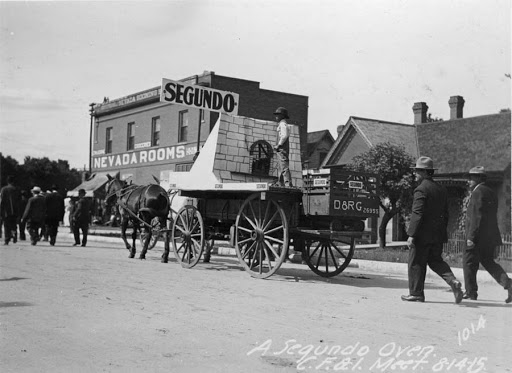
Parade float with coke oven, 1915
LHP_Intern2019-03-18T08:23:21+00:00A parade float in Trinidad that is a replica of a coke oven in Segundo. A young boy in overalls stands on the float, which is pulled by a horse. August 14, 1915

Map of Forbes Mine, Las Animas County, 1895
LHP_Intern2019-10-09T02:28:53+00:00Forbes Mine map, also showing surface structures, August 01, 1895

Mine Rescue Team, around 1900
LHP_Intern2019-06-18T03:39:00+00:00Some of the men hold face masks connected by a tube to a respirator machine strapped to their chests

Cokedale Mine Marshals Crecencio Vigil and Melitón Vigil, 1913?
LHP_Intern2019-06-18T03:40:05+00:00Crecencio Vigil and Melitón Barela, marshals at the Colorado Fuel and Iron Cokedale Mines in Cokedale (Las Animas County).

Workers at the Allen Mine, undated
LHP_Intern2019-10-11T04:17:23+00:00Workers at the Allen Mine, undated

Primero First Aid Team, 1920
LHP_Intern2019-06-18T03:41:41+00:00The Primero First Aid Team participating in a 1920 Field Day First Aid contest in Trinidad


Mine explosion, 1991
LHP_Intern2019-10-09T02:29:48+00:00Explosion in coal mine in near Weston, injuring 11 named miners
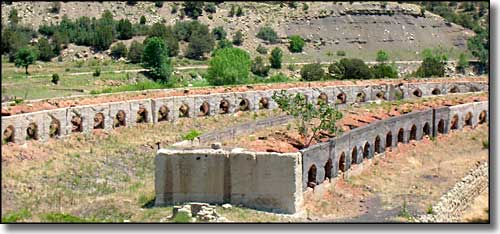
Ruins of coke processing ovens in Cokedale: #2
LHP_Intern2019-10-18T22:34:26+00:00The ovens were constructed by Colorado Fuel & Iron in 1907 and later sold to American Smelting and Refining. The last ones were shut down in 1947.
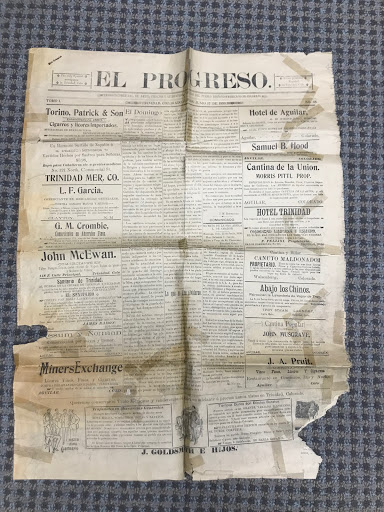
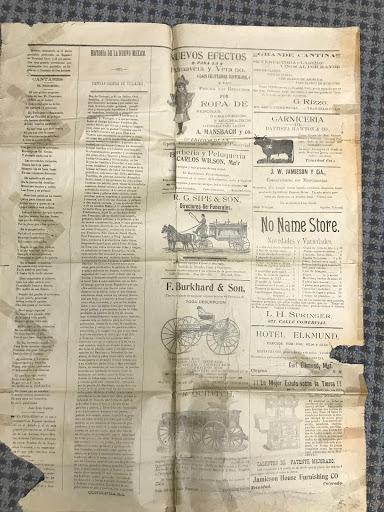

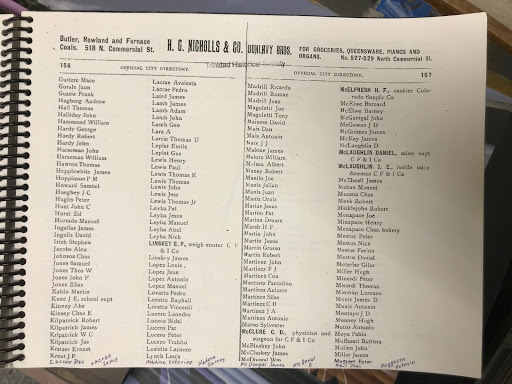
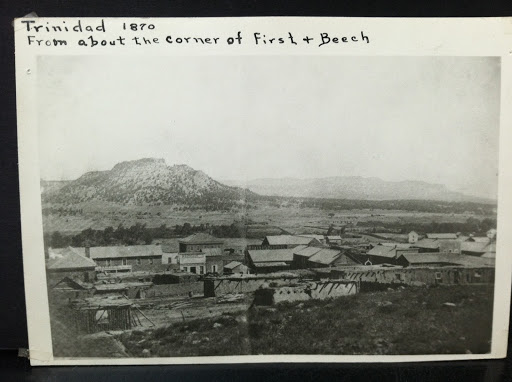

Man and burros near 139 East Main Street, 1881?
LHP_Intern2019-10-11T04:21:32+00:00Man and burros near 139 East Main Street, 1881?


Postcard showing Main Street, Trinidad, undated
LHP_Intern2019-10-11T04:21:20+00:00Postcard showing Main Street, Trinidad, undated


Exterior of Trinidad Store, Colorado Supply Company, 1902
LHP_Intern2019-10-11T04:21:32+00:00Exterior of Trinidad Store, Colorado Supply Company, 1902
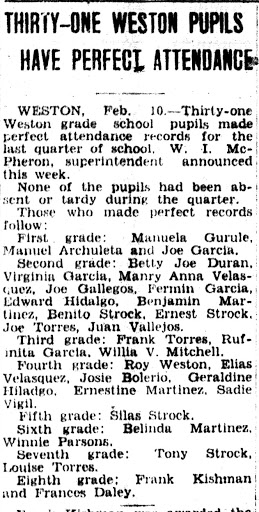
Weston grade school students with perfect attendance, 1933
LHP_Intern2019-12-10T01:07:03+00:00List of Weston elementary school students with perfect attendance records contains mostly Latino names.

Newspaper article, 1970, about poor children
LHP_Intern2019-12-13T20:14:05+00:00Poor children are hiding in rest room to avoid embarrassment when they cannot afford to buy lunch

Primero Grade School and High School, undated
LHP_Intern2019-12-13T20:13:40+00:00Primero Grade School and High School, undated

St. Joseph’s Academy and Holy Trinity Church, Trinidad, undated
LHP_Intern2019-12-13T20:13:09+00:00St. Joseph’s Academy and Holy Trinity Church, Trinidad, undated

Rice High School, Trinidad, undated
LHP_Intern2019-12-13T20:12:23+00:00Rice High School, Trinidad, undated

Students at Rice School, Trinidad, 7th grade, 1892
LHP_Intern2019-12-13T20:19:03+00:00Students at Rice School, Trinidad, 7th grade, 1892

Graduates of Trinidad State Junior College, 1987
LHP_Intern2019-12-13T20:17:39+00:00First page of commencement booklet, giving names of graduates and their majors

Students at Brown Street School, Trinidad, grade 6, 1888
LHP_Intern2019-12-13T20:17:05+00:00Students at Brown Street School, Trinidad, grade 6, 1888

Students at Rice School, Trinidad, upper grades, 1885-6
LHP_Intern2019-12-13T20:16:39+00:00Students at Rice School, Trinidad, upper grades, 1885-6

Students at Starkville School, early primary grades, undated
LHP_Intern2019-12-13T20:16:14+00:00Students at Starkville School, early primary grades, undated


María Odila Lobato and Diego Antonio Gallegos
LHP_Intern2019-09-24T07:00:05+00:00Diego Antonio Gallegos and his wife María Odila Lobato de Gallegos pose for their wedding portrait in the early 1920s. The couple were from San Luis (Costilla County), Colorado.

Electrical workers at the Primero Mine, undated
LHP_Intern2019-10-11T04:17:31+00:00Electrical workers at the Primero Mine, undated
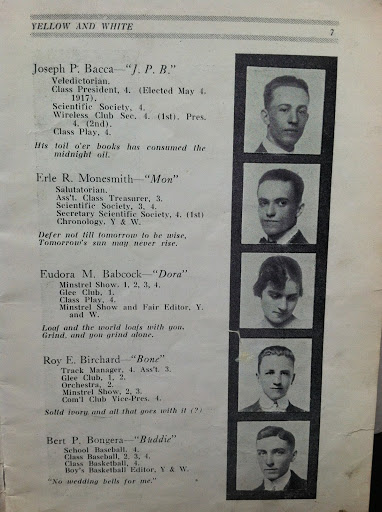
Trinidad High School Yearbook (The Yellow and White), 1917, p. 7
LHP_Intern2019-12-10T01:10:49+00:00Includes Joseph P. Bacca as class “Veledictorian” and class President
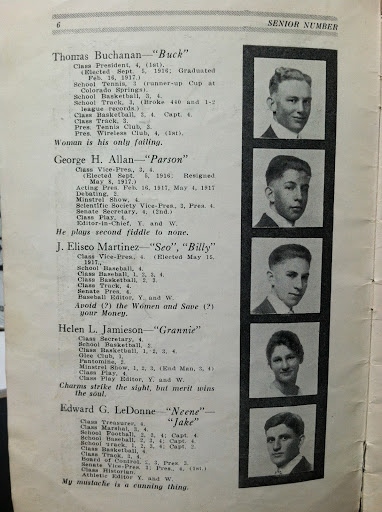
Trinidad High School Yearbook (The Yellow and White), 1917, p. 6
LHP_Intern2019-12-10T01:11:01+00:00Includes J. Eliseo Martinez as class Vice- President
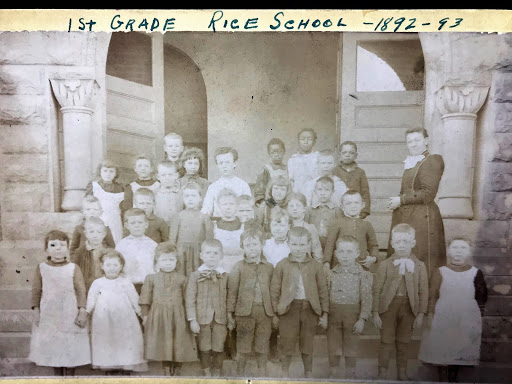
Students at Rice School, Trinidad, 1st grade, 1892-3
LHP_Intern2019-12-13T20:21:12+00:00School photo of students and teacher. Three African-American students are shown at the back right
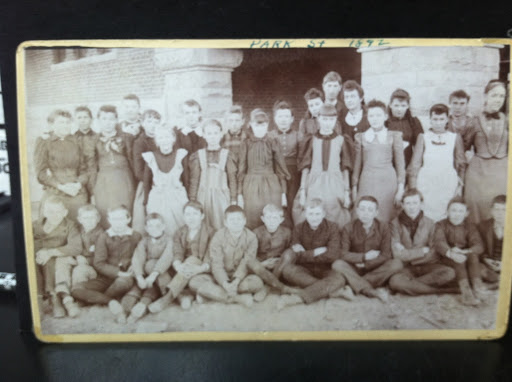
Students at Park St. School, Trinidad, middle grades, 1892
LHP_Intern2019-12-13T20:21:00+00:00Students at Park St. School, Trinidad, middle grades, 1892
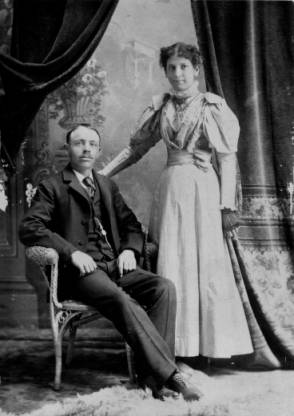
An Early Teacher, Juan J. Valdéz and his wife Reyes Maes de Valdéz, 1896
LHP_Intern2019-12-10T01:08:55+00:00He was a farmer and a teacher who taught school for 30 years in the towns of Jaroso, Trujillo Creek, and Martinez; he and his wife raised their family in Trujillo Creek.

Students from Martinez School, 1910
LHP_Intern2019-12-13T20:20:32+00:00Students from the Martínez School pose in Martínez Plaza near the village of Plaza de los Martínez (Las Animas County). Nearly all have Hispanic names.

Students at Rivera School, 1890s
LHP_Intern2019-12-13T20:20:06+00:00Hispanic American students and their male teacher pose in front of their school in Rivera (San Francisco Plaza, Glenham), Las Animas County. A plaque over the door reads: “Public School 1890.”

Holy Trinity High School Graduating Class, 1931
LHP_Intern2019-12-13T20:19:30+00:00Two rows of graduates stand between two period cars, wearing their caps and gowns. At least eight of the students had Hispanic names.
Coat Made by Gilbert Fernandez in Chimayo Weave, 1976-7
LHP_Intern2020-01-18T17:08:59+00:00Coat hand-woven by Gilbert “Gil” Fernandez in his Weston, Colorado shop. It is made with a Chimayo style weave of his interpretation.
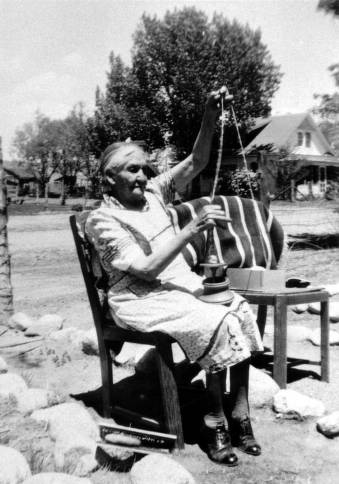
María Salomé Córdova spinning wool, 1930s
LHP_Intern2019-05-12T02:50:08+00:00María Salomé Córdova sits in a chair and spins wool into yarn in her yard in Hoehne (Las Animas County)
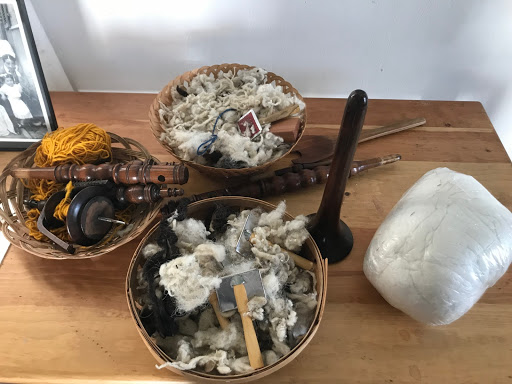
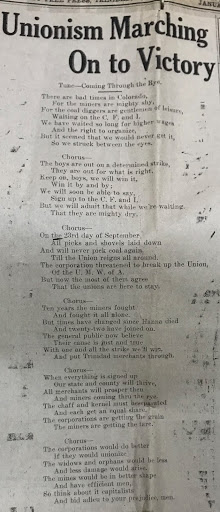
Union song “Unionism Marching On To Victory,” 1914
LHP_Intern2019-10-18T22:43:12+00:00To be sung to the tune of “Coming through the Rye,” Trinidad Library History Room
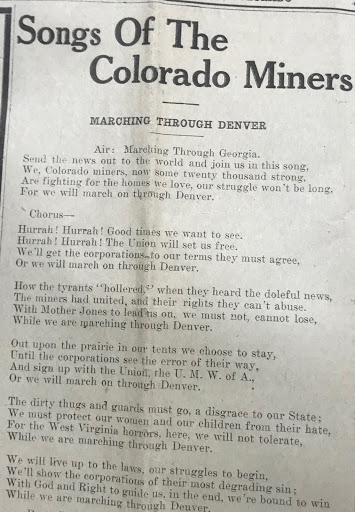
“Marching through Denver,” a song of the Colorado miners, 1914
LHP_Intern2019-10-18T22:43:45+00:00To be sung to the tune of “Marching through Georgia,” Trinidad Library History Room
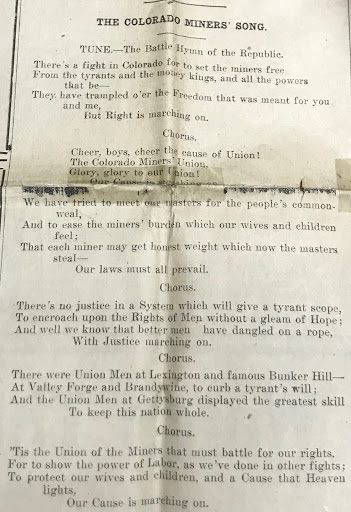
“Colorado Miners’ Song,” 1914
LHP_Intern2019-10-18T22:44:16+00:00To be sung to the tune of “The Battle Hymn of the Republic,” Trinidad Library History Room
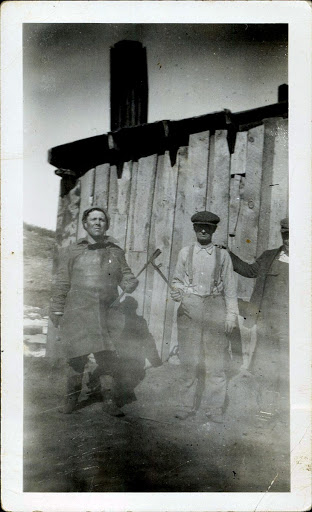
Blacksmith Hilario Herminio Paiz of Gurule, 1915
LHP_Intern2019-05-12T02:48:54+00:00Blacksmith Hilario Herminio Paiz (on left) poses outside of a wood building on his ranch in Gulnare, Las Animas County. He was born in 1898 in Gulnare and died in 1983 in Trinidad, Colorado. Herman worked on a ranch in Gulnare homesteaded by his grandfather José de la Cruz Paiz. Herman never married, and stayed at the ranch to take care of his mother, Anastacia Gonzales Paiz.
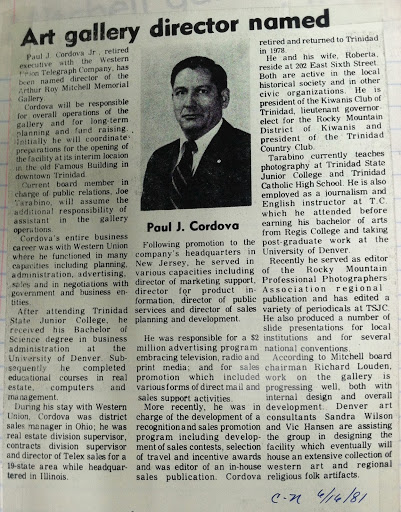
Casimiro Barela as Sheriff of Los Animas County, 1875
LHP_Intern2019-05-12T02:46:08+00:00He later became the longest-serving member of the Colorado legislature (1875-1916)

Trinidad, 1st Street looking west at Commercial Street, undated
LHP_Intern2019-10-11T04:21:40+00:00Trinidad, 1st Street looking west at Commercial Street, undated


Spanish section of Trinidad Enterprise, an English-language paper, 1878
LHP_Intern2019-10-11T04:19:05+00:00Spanish section of Trinidad Enterprise, an English-language paper, 1878

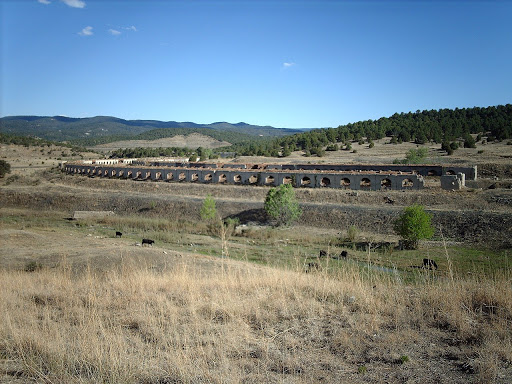
Ruins of coke processing ovens in Cokedale: #1
LHP_Intern2019-10-18T22:48:31+00:00These ovens, or sealed furnaces, converted coal into coke, which burned at a higher temperature and was used in industry, especially smelting ore. At their peak, some 500 ovens operated in Cokedale.

María Salomé Córdova spinning wool
ann2019-03-09T07:33:46+00:00María Salomé Córdova sits in a chair and spins wool into yarn in her yard in Hoehne (Las Animas County), 1930s